BUILDING RESILIENT FOOD SECURITY SYSTEMS TO
BENEFIT THE SOUTHERN EGYPT REGION
Othman Elshaikh
Ministry of Agriculture & Land Reclamation
The Executive Agency for the Comprehensive
Development Projects (EACDP)
BACKGROUND
SOUTHERN
EGYPT
Highest Food insecurity+ Poverty
rates
rates-dependence on agriculture
Highest Climate vulnerability rates
 Highest temperature rise and current extreme
weather events
 Highest evapo-transpiration
 Highest losses in crop productivity
 Highest rates of disease and pest infestations
 Highest livestock productivity affected
Southern Egypt stands to lose a
minimum of 30 % of its food
production by 2050 -
compounding the already
economically stressed and food –
insecure state of the region.
BACKGROUND…CONT’
In response, GOE proposed a project to build resilience of Southern Egypt rural
communities.
Project is funded by the AF. WFP is the implementing entity and MALR is the
executing entity.
Project Objectives:
1) improve the adaptive capacity of the Southern region’ smallholders
in the face of anticipated climate-induced reduction in food production
through a set of integrated interventions and
2) build institutional capacity at national, regional and local levels to
enable sustainability and replication of the project interventions
6 years 135,757 direct + 1.7 indirect beneficiaries
Agro-Climatology parameters
analyzed
Each of the 5 governorates is a
distinct climatic area
Implement in All five
governorates
Climate data available at governorate
level
Socio-economic vulnerability used for
selection of districts (food
security) then villages (poverty)
Consultations with stakeholders
(security, social tensions,
acceptance, Presence of local
NGOs )
SELECTION OF VILLAGES (50)
SELECTION OF LOCATIONS
ASWAN, LUXOR , QENA, SOHAG & ASSUIT
PROJECT INTERVENTIONS
Component 1:
Community level mobilization and climate adaptation planning including baseline
assessment- done in preparation of project document
techniques: awareness sessions, contests, theatre
Establishment Climate information centers in NGOs
Early Warning System 5 days & recommendations. Dissemination of information
through local means + Smart phone application + SMS
PROJECT INTERVENTIONS…………CONTINUED
Building resilience in agricultural
production
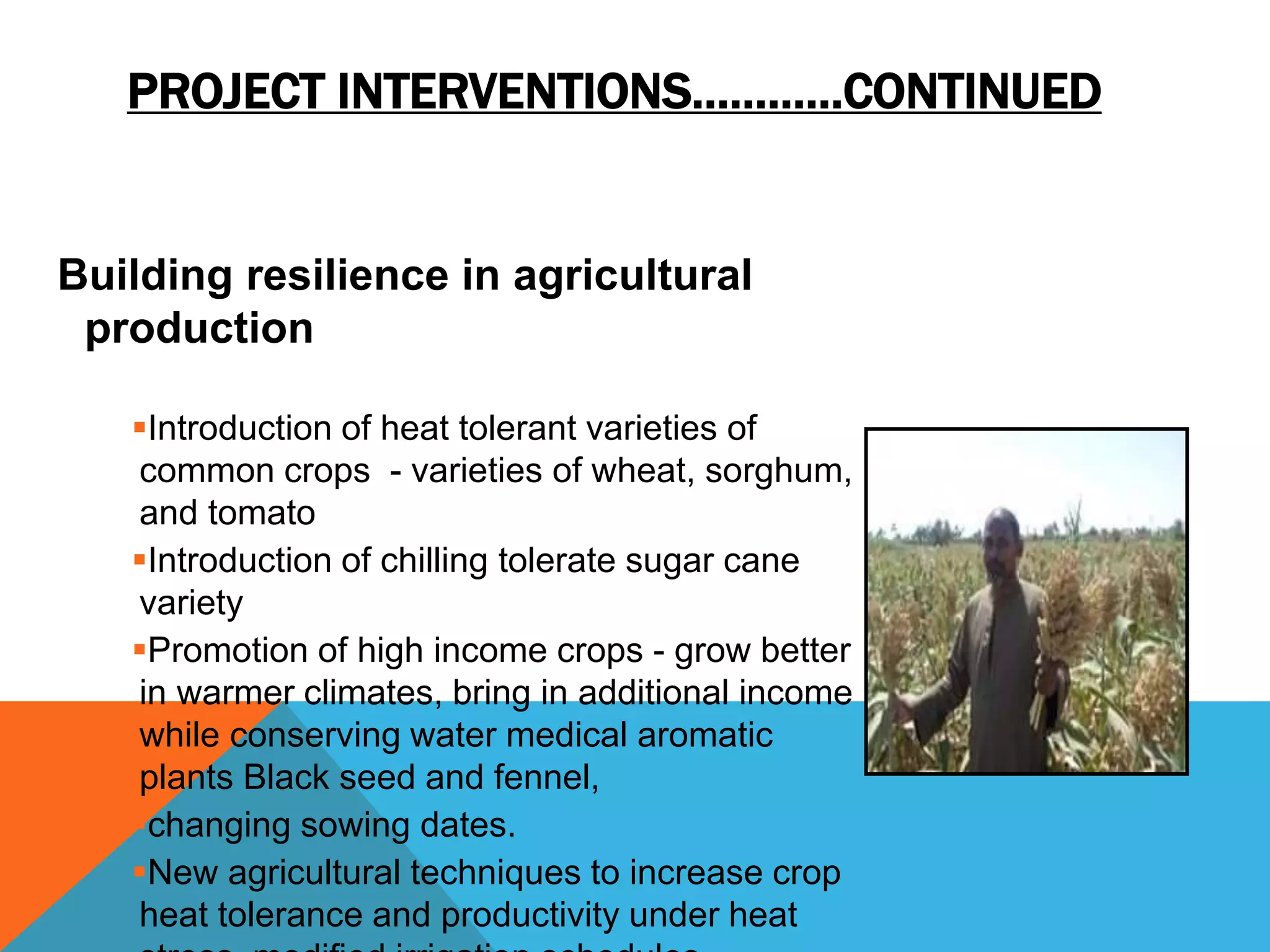
Introduction of heat tolerant varieties of
common crops - varieties of wheat, sorghum,
and tomato
Introduction of chilling tolerate sugar cane
variety
Promotion of high income crops - grow better
in warmer climates, bring in additional income
while conserving water medical aromatic
plants Black seed and fennel,
changing sowing dates.
New agricultural techniques to increase crop
heat tolerance and productivity under heat
PROJECT INTERVENTIONS…………CONTINUED
Building resilience in agricultural production
Intercropping to diversify and increase income ( sorghum &
cowpea fava beans & cane; maize and tomato; garlic and wheat)
as a means of increasing resilience. 60% increase in income &
resources efficiency
Value addition to diversify and augment income sources, such as
improved post harvest practices and small scale food processing
(sun dried tomato + pomegranate deseeding)
PROJECT
INTERVENTIONS…………CONTINUED
Building resilience through
livestock and poultry
production.
 Establishment of community-level revolving loans schemes in local
NGOs. (goats; honey bees; ducks; and rabbits
 Vet services enhanced
 Training and ongoing technical assistance on animal nutrition will
be given by trained governmental and community organizations.
 Target women for gender balance
INTRODUCTION AND USE OF WATER SAVING
IRRIGATION AND OTHER ADAPTATION
TECHNIQUES
H O W I T S D O N E
realizing irrigation efficiency
through laser leveling of soil;
canal lining;
Demonstration fields set up
Establishment/strengthening
water users associations
C A N A L L I N I N G B E N E F I T S
Local Ownership
 Water users associations
under local NGO
 Increased efficiency- 25-
30%
 Owners participate
 Much lower costs
COMPONENT 2: CAPACITY BUILDING FOR CLIMATE
KNOWLEDGE AND REPLICATION OF INTERVENTIONS
UNDER COMPONENT 1
lessons learned retained and disseminated to all actors to replicate them in
the government’s first phase of support to 151 villages covering some 1.7
million people
Building capacity of government technical staff:
 extension officers- soft skills + technical capacity building
 replication of early warning systems and other project interventions in
directorates
 Presentations to senior governmental offices at central level
Documentation & sharing of Lessons learned and Best Practices
 Flyers, Brochures, documentary, (sample +pictures) 1-hour orientation
package for ministers and 2-days training package for technical ministerial
staff, organized visits. TV, radio and newspapers outreach &Harvest Days
(explain) for replication
Integration of solutions into University & Secondary Schools curriculum
 Training of students: field days, case studies, summer training, on campus
demonstration fields
 Use of lessons learned in enriching teaching modules
INDICATORS OF SUCCESS
N A T I O N A L L E V E L
Adoption by farmers
within village
+neighboring
villages
Government adoption
(National
Adaptation Plan+
Climate information
centers)
Request for phase 2 in
Middle Egypt
I N T E R N A T I O N A L L E V E L
External mid-term
evaluation= highly
successful
AF documented project
for guidance on AF
projects
+presentation in 10th
anniversary
WFP documented best
practice in ownership
build and stakeholder
engagement
LESSONS LEARNED
Farmers make use of technology more than expected (facebook, smart
phone application was very success full)
Word of mouth +use of local resources (mosque +church) was very
effective in spreading messages from the project (eg. early warning
messages)
Use of innovative methods (theater, traditional singers, to raise awareness
on adaptation was highly successful)
Income generated from animal projects allowed women to establish their
own businesses, building household financial resilience
Builds overall resilience +livelihood support

Building resilient food security project

  • 1.
    BUILDING RESILIENT FOODSECURITY SYSTEMS TO BENEFIT THE SOUTHERN EGYPT REGION Othman Elshaikh Ministry of Agriculture & Land Reclamation The Executive Agency for the Comprehensive Development Projects (EACDP)
  • 2.
    BACKGROUND SOUTHERN EGYPT Highest Food insecurity+Poverty rates rates-dependence on agriculture Highest Climate vulnerability rates  Highest temperature rise and current extreme weather events  Highest evapo-transpiration  Highest losses in crop productivity  Highest rates of disease and pest infestations  Highest livestock productivity affected Southern Egypt stands to lose a minimum of 30 % of its food production by 2050 - compounding the already economically stressed and food – insecure state of the region.
  • 3.
    BACKGROUND…CONT’ In response, GOEproposed a project to build resilience of Southern Egypt rural communities. Project is funded by the AF. WFP is the implementing entity and MALR is the executing entity. Project Objectives: 1) improve the adaptive capacity of the Southern region’ smallholders in the face of anticipated climate-induced reduction in food production through a set of integrated interventions and 2) build institutional capacity at national, regional and local levels to enable sustainability and replication of the project interventions 6 years 135,757 direct + 1.7 indirect beneficiaries
  • 4.
    Agro-Climatology parameters analyzed Each ofthe 5 governorates is a distinct climatic area Implement in All five governorates Climate data available at governorate level Socio-economic vulnerability used for selection of districts (food security) then villages (poverty) Consultations with stakeholders (security, social tensions, acceptance, Presence of local NGOs ) SELECTION OF VILLAGES (50) SELECTION OF LOCATIONS ASWAN, LUXOR , QENA, SOHAG & ASSUIT
  • 5.
    PROJECT INTERVENTIONS Component 1: Communitylevel mobilization and climate adaptation planning including baseline assessment- done in preparation of project document techniques: awareness sessions, contests, theatre Establishment Climate information centers in NGOs Early Warning System 5 days & recommendations. Dissemination of information through local means + Smart phone application + SMS
  • 6.
    PROJECT INTERVENTIONS…………CONTINUED Building resiliencein agricultural production Introduction of heat tolerant varieties of common crops - varieties of wheat, sorghum, and tomato Introduction of chilling tolerate sugar cane variety Promotion of high income crops - grow better in warmer climates, bring in additional income while conserving water medical aromatic plants Black seed and fennel, changing sowing dates. New agricultural techniques to increase crop heat tolerance and productivity under heat
  • 7.
    PROJECT INTERVENTIONS…………CONTINUED Building resiliencein agricultural production Intercropping to diversify and increase income ( sorghum & cowpea fava beans & cane; maize and tomato; garlic and wheat) as a means of increasing resilience. 60% increase in income & resources efficiency Value addition to diversify and augment income sources, such as improved post harvest practices and small scale food processing (sun dried tomato + pomegranate deseeding)
  • 8.
    PROJECT INTERVENTIONS…………CONTINUED Building resilience through livestockand poultry production.  Establishment of community-level revolving loans schemes in local NGOs. (goats; honey bees; ducks; and rabbits  Vet services enhanced  Training and ongoing technical assistance on animal nutrition will be given by trained governmental and community organizations.  Target women for gender balance
  • 9.
    INTRODUCTION AND USEOF WATER SAVING IRRIGATION AND OTHER ADAPTATION TECHNIQUES H O W I T S D O N E realizing irrigation efficiency through laser leveling of soil; canal lining; Demonstration fields set up Establishment/strengthening water users associations
  • 10.
    C A NA L L I N I N G B E N E F I T S Local Ownership  Water users associations under local NGO  Increased efficiency- 25- 30%  Owners participate  Much lower costs
  • 11.
    COMPONENT 2: CAPACITYBUILDING FOR CLIMATE KNOWLEDGE AND REPLICATION OF INTERVENTIONS UNDER COMPONENT 1 lessons learned retained and disseminated to all actors to replicate them in the government’s first phase of support to 151 villages covering some 1.7 million people Building capacity of government technical staff:  extension officers- soft skills + technical capacity building  replication of early warning systems and other project interventions in directorates  Presentations to senior governmental offices at central level Documentation & sharing of Lessons learned and Best Practices  Flyers, Brochures, documentary, (sample +pictures) 1-hour orientation package for ministers and 2-days training package for technical ministerial staff, organized visits. TV, radio and newspapers outreach &Harvest Days (explain) for replication Integration of solutions into University & Secondary Schools curriculum  Training of students: field days, case studies, summer training, on campus demonstration fields  Use of lessons learned in enriching teaching modules
  • 12.
    INDICATORS OF SUCCESS NA T I O N A L L E V E L Adoption by farmers within village +neighboring villages Government adoption (National Adaptation Plan+ Climate information centers) Request for phase 2 in Middle Egypt I N T E R N A T I O N A L L E V E L External mid-term evaluation= highly successful AF documented project for guidance on AF projects +presentation in 10th anniversary WFP documented best practice in ownership build and stakeholder engagement
  • 13.
    LESSONS LEARNED Farmers makeuse of technology more than expected (facebook, smart phone application was very success full) Word of mouth +use of local resources (mosque +church) was very effective in spreading messages from the project (eg. early warning messages) Use of innovative methods (theater, traditional singers, to raise awareness on adaptation was highly successful) Income generated from animal projects allowed women to establish their own businesses, building household financial resilience Builds overall resilience +livelihood support