Asian Journal
of Research in
Social Sciences
and
Humanities
Asian Journal of Research in Social Sciences and Humanities
Vol. 4, No. 11, November 2014, pp. 1-15.
ISSN 2249-7315
1
www.aijsh.org
Asian Research Consortium
Building Resilience to Climate Change and Health:
Can Adolescents in Urban Slums be the Answer?
Anuj Ghanekar*; Dr. Vikas Desai**; Dr. Hemant Desai***;
Dr. Suresh Kumar Rathi****; Dr. Akash Acharya*****;
Dr. Kalpesh Khatri******
*Consultant Social Anthropologist,
Urban Health and Climate Resilience Centre (UHCRC),
Surat, India.
**Technical Director,
Urban Health and Climate Resilience Centre (UHCRC),
Surat, India.
***Deputy Commissioner,
Health and Hospital, Surat Municipal Corporation (SMC),
Surat, India.
****Senior Public Health Consultant,
Urban Health and Climate Resilience Centre (UHCRC),
Surat, India.
*****Associate Professor,
Centre for Social Studies (CSS),
Surat, India.
******Medical Officer Health,
Surat Municipal Corporation (SMC),
Surat, India. DOI NUMBER-10.5958/2249-7315.2014.01027.2
Abstract
Climate change and health hazards can be tackled by developing potential of adolescents from
urban slums. The paper describes profile of adolescents in slums of flood vulnerable Surat city
along with their climate change inclusive health perspective. Mixed methods were used: survey,
Ghanekar et al. (2014). Asian Journal of Research in Social Sciences and Humanities,
Vol. 4, No.11, pp. 1-15.
2
focused groups and flood memory picturing. Adolescent shared 1/5th
slum population. Assessment
on schooling and health scales favours considering them as entitled resilience providers.
Adolescents’ health perspective ranged from concrete information, say 90 percent named vector
borne diseases (climate change associated health problems); to abstract health concept. Slum
experience enabled them to link health with climate change induced migration, livelihood, water
scarcity, poverty, weather events and conflicts as stress sources. They recognized personal and
environmental behaviour as health determinants. Peers, television and teachers were preferred
health information sources. Perceived risk enabled adolescents to think possible mitigation and
adaptation actions. Handholding can prove adolescents as resilience agents.
Keywords: Adolescents, Climate change, urban poor, health resilience.
________________________________________________________________________________
Introduction
Knowledge and skills among adolescents shape their preparedness for future societal challenges. As
estimated by World Health Organization, 1 in every 5 people in world is an adolescent [between
10-19 years of age]*
. With an estimated 1.2 billion adolescents alive today, the world has the largest
adolescent population ever in history (United Nations Children’s Fund [UNICEF], 2011). A society
which is capable of turning the potential of its adolescents into positive action, eventually benefits
with a positive future (E.g., Fergus, Zimmermann, 2005, Ministry of Health and Family Welfare,
Government of India, 2013).
Climate change and its impact on public health have been an essential concern for the society in
recent past (Keim, 2008; Costello et al, 2009). Vulnerable segment of the society faces higher risk
to Climate change and health hazards, say, slums and slum population (E.g., Cutter, 2003, Desai,
2003, The world bank, 2006). Crowding settlements, poverty, lack of access to services and
opportunities for participation brings urban slums to the vulnerable state. Rising urban population
and slum dwellers has become a major concern for Asia which is already home to more than half of
the global slum population [581 million] (UN-Habitat, 2006) .
Surat, with population 4.4 million as per Census 2011, is India’s 8th
most populated city (Thakkar
and Sheth, 2014) where slum population counts 4.8 lakhs, 10.78 per cent of total. Rapid
industrialization with heavy migration and extension of city limits has resulted in almost doubling
of the overall population of city in last inter-census period. A huge section of migrant population
resides in low-income, informal slum settlements. Surat has also been historically known for facing
a number of climate-sensitive health concerns (Institute for Social and Environmental Transition,
2011). Surat has witnessed 7 river floods in past two decades [1994, 1998, 2002, 2003, 2006, 2012
and 2013]. There is a rising concern about economic loss and serious health hazards related to
floods in the city. The flood of 1994 was followed by plague while one in 2006 by Leptospirosis
(Surat Municipal corporation: Disaster Management plan, 2014).
*
The age definition of adolescent varies from agency to agency. We have used here current age
criteria defined by World Health Organization (WHO). (Source: WHO website
http://www.who.int/topics/adolescent_health/en/)
Ghanekar et al. (2014). Asian Journal of Research in Social Sciences and Humanities,
Vol. 4, No.11, pp. 1-15.
3
Recently the international approach of climate and health resilience has been shifted from post-
impact activities to systematic preparedness actions. Community is viewed as the answer for
environment and climate change related actions (Keim, 2008; Turnbull, 2013).
Community preparedness is a step towards overall city resilience. Ensuring community
participation in urban area and that too in slums is a challenge because of its socio-demographic
characteristics. In case of Surat, slum represents a habitat of majority migrants, heterogeneous
group with poor social cohesion, male predominant, poorly literate, busy in non skilled job, with a
main goal of earning and survival and living under uncertainty. Migrant slum dwellers often
consider destination city as a workplace and hardly imagine contributing to the climate change and
health resilience. However, their younger generation, adolescents, rapidly adopt the place as their
home. These budding neo citizens can be great resource and strength for community driven
adaptation action.
Adolescents as a future of society and nation need to make informed decisions and participate being
community links as students, workers, consumers, care-givers. They have the capacity to be
energetic and influential proponents of disaster risk reduction and climate change adaptation in
their families, peers, schools and communities (Turnbull, 2013).
Best of knowledge of research team, there was scant literature on climate change associated health
perspectives of adolescents globally. Although global literature includes environment as one of the
determinants of adolescent health and development (E.g., World Health Organization, 2014), the
present study has been first in Surat city and perhaps in India capturing climate associated health
perspective of adolescents in slums. The study does not claim to produce comprehensive or an
exhaustive account of their knowledge. It is, instead, an overview which aims at providing
background status of sizable adolescent population in slums, about their access to health
information, experience based understanding, level of information they possess. The study gives a
direction regarding how adolescents can be enabled as climate change and health resilience
proponents.
2 Materials and Methods
Experts strongly recommend the use of mixed method approaches in adolescent health research
(Millstein, Susan, (Ed); Petersen, Anne C. (Ed); Nightingale, Elena O. (Ed), 1993). In line with this
recommendation, present article draws from a variety of sources accumulated over 1 year research
work.
The approach involved use of quantitative methods - Multi-Indicator Cluster Survey-MICS and
Structured interviews and qualitative methods - Focused Group Discussions [FGDs] and
participatory flood memory picturing activity.
Ghanekar et al. (2014). Asian Journal of Research in Social Sciences and Humanities,
Vol. 4, No.11, pp. 1-15.
4
MICS was conducted in 30 slums of 402 in city with sampling technique of probability
proportionate to population†
. This household survey covered socio-demographic profile, disease
burden, health service coverage and utilization among the residents in slums of Surat city. Survey
covered 1042 families with total 5775 family members including 1257 adolescents.
Convenient sampling procedure was followed and 514 adolescents were interviewed for further
study. Adolescents available at home during survey were sampled. Informed oral consent was
obtained from respondent before beginning the interview with structured pretested performa.
Source of health information, modes of common disease transmission and beneficial-harmful
behaviour and habits to health were captured during interviews. Data collected was entered in Epi
Info version 3.3.2. Data were analyzed with bivariate and descriptive statistics.
In qualitative methods, 32 adolescent boys and 13 girls participated in flood memory drawing
activity. Four FGDs were conducted, 2 with adolescent boys and another 2 with girls. Slum area
variation was ensured. Discussions were audio recorded and then transcribed. Each transcript was
coded independently by two analysts who then met to agree on the final coding. This method was
used to ensure coding reliability across analysts. Analysts then transformed the codes into
categorical themes and sub-themes.
3 Results and Discussion
Logical steps to build this study was an assessment of adolescents’ demography, health profile,
knowledge of disease and healthy life style, source of health information, recent memory of
disaster, perception of climate change and its impact on their life as well as their preparedness to
participate in a process of building resilience.
3.1 Socio-demographic Profile of Adolescents in Urban Slums
Socio-demographic profile of adolescents in slums intends to describe what the size of adolescent
population slums possess, what their social background is which can influence their preparedness
and participation; and why this particular group needs to be targeted for preparedness.
In study population, adolescents contributed 21.8 percent to total population [1257 out of 5775].
This percentage is also consistent with national proportion of adolescents to total population [20
percent] (Census of India, 2011). The Adolescents thus, represent a force for their own health as
well as for the health of their families and communities as previous literature too attributes (E.g.,
UNICEF, 2011, Fergus, Zimmermann, 2005, World Health Organization, 2014). Developing
country like India can look forward for the holistic contribution of youngsters in development and
progress.
†
For conducting this study prior informed and written permission was taken from higher officials
from Surat Municipal Corporation. List of urban slums of Surat city was obtained from office of
Surat Municipal Corporation, Urban Development Cell. There were 402 slums in the list with total
slum population 4,66,724.
Ghanekar et al. (2014). Asian Journal of Research in Social Sciences and Humanities,
Vol. 4, No.11, pp. 1-15.
5
As shown in table 1, gender disparity prevails in studied population as boys exceed than girls by 9
percent. Sex ratio of this study group was 824 girls per 1000 boys. The results match with child sex
ratio of Surat city, 813 girls per 1000 boys, as per census 2011 (Census, 2011). As census of India
describes, difference in migration is one of the causal factors for sex differentials (Census, 2011).
This factor can also be attributed in Surat city’s case which has high influx of migrant population
(UNICEF, 2013).
Table 1: Age and Sex Distribution of Adolescent Population in Slums
Respondent
category
10-14 years
Pre-adolescence
n=622 (%)
15-19 years
Late adolescence
n=635 (%)
Total n=1257
(%)
Boys 343 (55.1) 346 (54.5) 689 (54.8)
Girls 279 (44.9) 289 (45.5) 568 (45.2)
Detailed interviews were conducted among randomly selected 514 adolescents (41 percent)
including 296 boys and 218 girls.
As indicated in table 2, more than half, about 56 percent adolescents were attending school/college
at the time of present study. The proportion of girls attending school/ college was little higher [58.7
percent] than boys [54.4 percent]. On the other side among 16 percent of adolescents in job there
were more boys [22 percent] than girls [9 percent].
Table 2: Socio-demographic and Health Profile of Adolescents interviewed
under Study
Profile indicator Boys
Frequency=296
(%)
Girls
Frequency=218
(%)
Total
Frequency=514
(%)
Attending School / college 161 (54.4) 128 (58.7) 289 (56.2)
Employed in Job 64 (21.6) 19 (8.7) 83 (16.1)
Married 7 (2.4) 6 (2.5) 13 (2.5)
Major health problem present 1 (0.3) 6 (2.8) 7 (0.7)
Disability present 3 (1) 3 (1.4) 6 (1.2)
This schooling data of adolescents in slums strongly supports the idea of considering them as an
answer for community inclusive health resilience in slums. Schooling can provide knowledge to
this receptive group. Empowering adolescents at school is also less resource intensive and more
result oriented compared to community approach. Adolescents in educational institutions can be
effective change agents for the society as they can influence out of school adolescents, their peers
as well as their family and neighbourhood.
Early marriage of adolescents results into several health and socioeconomic problems contributing
in their vulnerability. This study reports only 2.5 percent of adolescent marriages which is much
lower than national average [43 percent] (Ram, 2008).
Ghanekar et al. (2014). Asian Journal of Research in Social Sciences and Humanities,
Vol. 4, No.11, pp. 1-15.
6
“I am the only girl taking education till 9th
standard in this area. All my friends are spending their
married lives in villages. Girls are married at early age in Bihar, my native state.”
- 15 year old girl in Udhna slum
In preceding year of survey, not a single death of adolescent was reported. Long term or chronic
illness report was 0.7 percent, higher among girls [2.8 percent] than boys [0.3 percent]. Overall
disability burden in this age group was 1.2 percent [6 adolescents] and the disability prevalence rate
was 1 percent in boys and 1.4 percent in girls, the commonest disability reported was
blindness/high degree myopia in 4 adolescents.
The above profile thus highlights the capacity of this group to large extent. Assessed health care
needs for chronic illness and disability problems reflect need for strengthening of adolescent health
services in urban slums but the rate does not reflect any serious limitation or vulnerability of this
resource for contributing to climate change initiatives.
3.2 Adolescents Do Have Their “Own” Perspective for Concept of “Health”
Respondents, especially from early adolescence [10-14 years], viewed health in relatively simplistic
illness terms and described vague symptoms like fever, bodyache, headache, and breathing
difficulties. They talked about direct impacts in terms of health related morbidities. They had
difficulty defining the concept of health except illness. In early adolescence, relatively concrete
thinking about illness still predominates. They often focus on absence of illness and their concept
of health lacks abstraction (Millstein, Susan, (Ed); Petersen, Anne C. (Ed); Nightingale, Elena O.
(Ed), 1993).
However, the information beyond vague symptoms is also evident. For example, knowledge of
adolescents was assessed about vector borne disease transmission as Surat city climate is conducive
to vector borne diseases which are sensitive to climate change and community participation is
important for Vector Borne Disease Control. (Service, ) Almost 90 percent of adolescents could
name Malaria as mosquito borne disease followed by Dengue and Filariasis. [Table no. 3]
Table 3: Awareness regarding Mosquito-borne Diseases
Type of diseases spread by mosquito Frequency =514 (%)
Correct answer
Malaria 462 (89.9)
Dengue 342 (66.5)
Filariasis 30 (5.8)
Wrong answer
Diarrhoea 9 (1.8)
Measles 10 (1.9)
Tuberculosis 2 (0.4)
* Multiple responses are considered
Ghanekar et al. (2014). Asian Journal of Research in Social Sciences and Humanities,
Vol. 4, No.11, pp. 1-15.
7
Adolescents recognized personal behaviours as factor in health concept. They identified potential
behavioural health threats like substance abuse, unhealthy eating habits; and environmental health
threats like lack of cleanliness in surroundings.
Table 4: Knowledge about Health Promoting Behaviour
Harmful to health Boys
Frequency=296
(%)
Girls
Frequency=218
(%)
Total
Frequency=514
(%)
Behavioural threats
Alcohol 264 (89.2) 198 (90.8) 462 (89.9)
Smoking 280 (94.6) 202 (92.7) 482 (93.8)
Eating on Street Stall 229 (77.4) 168 (77.1) 397 (77.2)
Early Marriage 119 (40.2) 89 (40.8) 208 (40.5)
Fast Food 80 (27.1) 80 (36.7) 160 (31.1)
Not consulting doctor for illness 38 (12.8) 17 (7.8) 55 (10.7)
Daily Bath 16 (5.4) 4 (1.8) 20 (3.9)
Cycling 7 (2.4) 7 (3.2) 14 (2.7)
Wearing clean clothes 6 (2.1) 5 (2.3) 11 (2.1)
Walking 3 (1.1) 0 3 (0.6)
Vaccination 1 (0.3) 1 (0.4) 2 (0.3)
Environmental threats
Dirty Surrounding near house 254 (85.8) 183 (83.9) 437 (84.0)
Unclean water 223 (75.3) 165 (75.7) 388 (75.5)
Indiscriminate Spitting 238 (80.4) 168 (77.1) 406 (79.0)
* Multiple responses are considered
Table 4 highlights adolescent indices on various scores about health threats. Habits like alcohol
consumption [90 percent], smoking [94 percent] were identified harmful by large majority of
Adolescents. Girls’ reaction was found stronger than boys for the same. Environmental factors
scored unhealthy included dirty Surrounding near house [84 percent], indiscriminate spitting [79
percent] and dirty water [75 percent]. Adolescents also scored dietary habit like outside eating [77
percent] and fast food [31 percent] as health risk, where girls score high for fast food. Scoring of
personal hygiene practices like daily bath (4 percent) and clean cloths [2 percent] was very low as
health promoting practices. Personal health practices like early marriage [40 percent], not
contacting doctor during sickness and non-acceptance of vaccination [0.3 percent] were scored as
harmful health practices. Cycling [2.7 percent] and walking [0.6 percent] were scored as low
priority healthy practices by the them.
In Indian society marriage is almost universal and arranged, is more a family matter than
individual. Age at marriage has several socio economic influencers and in this study though only
2.5 percent of adolescents were married, overall adolescents hesitated in giving bold opinion about
early marriage, and only 40 percent of adolescents opined early marriage as a health issue.
This elicits that adolescents did not underestimate the potentially negative consequences of their
personal behaviour and simultaneously they were conscious about their environment. Behaviours
often identified as health enhancing were recognized like personal hygiene, proper nutrition,
Ghanekar et al. (2014). Asian Journal of Research in Social Sciences and Humanities,
Vol. 4, No.11, pp. 1-15.
8
exercise, getting enough sleep and seeing the doctor. Healthy lifestyle and environmental practices
are keys to health resilience to climate change and adolescents carry awareness of it to certain
extent.
3.3 Adolescents thought Climate Change Inevitable in Concept of Health
Respondents in late adolescence [15-19 years] put forth more abstract and more inclusive concept
of health. They recognized environmental and social components relevant to health like climate
change, poverty and social vulnerability. Elaboration of vicious cycle of climate change, poverty
and health by adolescents reflected this abstraction.
Climate Change and Health Association Model
depicted by Adolescents under present study
WHO Climate Change and Health Framework Source:
http://www.who.int/globalchange/environment/en/chapter3.p
df [24]
* Encircled aspects are covered by adolescents under present
study in their perspective
Figure 1: Climate and Health Associations as per Adolescent Thinking
Overall adolescent perspective came up with climate and health association model as depicted in
figure 1. It shows how adolescents’ model covered the aspects of already existing World Health
Organization suggested framework of climate change impacts of health.
Adolescents are also deeply concerned about climate change, their own future and future of coming
generations (UNICEF, 2011). Present study reported how adolescent think climate change as a
huge concern of stress in relation to health.
Impacts of Climate
Change on Health
Direct
Illness symptoms
like fever,
breathing
difficulties,
bodyache,
headache
Indirect
Decrease in
agricultural
productivity --
> shortage of
food--> price-
hike -->
compromised
healthcare
Ghanekar et al. (2014). Asian Journal of Research in Social Sciences and Humanities,
Vol. 4, No.11, pp. 1-15.
9
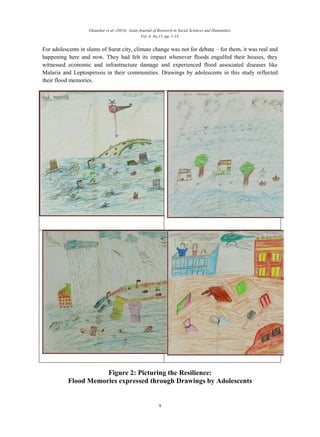
For adolescents in slums of Surat city, climate change was not for debate – for them, it was real and
happening here and now. They had felt its impact whenever floods engulfed their houses, they
witnessed economic and infrastructure damage and experienced flood associated diseases like
Malaria and Leptospirosis in their communities. Drawings by adolescents in this study reflected
their flood memories.
Figure 2: Picturing the Resilience:
Flood Memories expressed through Drawings by Adolescents
Ghanekar et al. (2014). Asian Journal of Research in Social Sciences and Humanities,
Vol. 4, No.11, pp. 1-15.
10
The drawings emphasized on
 damage of residential buildings and huts, public buildings and transport
 rescue and evacuation activities like use of helicopters and boats
 shifting families from low lying area,
 role of swimmers
 distribution of food packets and medicines
Understanding about rising temperature, changing rain pattern, environmental pollution and climate
change synergy, role of safer environment in reduction of health vulnerability to climate change
was also revealed through qualitative discussions.
3.4 They Linked Climate Change and Health in Relation with Poverty
The sources of stress vary as a function of context in which adolescents live. Present study was
carried out with adolescents in slums and reflection of slum context was expected. Poverty and
lower socio-economic status are presumed risk factors for children and adolescent health. The pro-
poor health approaches worldwide support how poor suffer worse health and die younger (Spencer,
2000). Climate change also threatens human health through its effect on under-nutrition and food
insecurity (UNICEF, 2013). In present study, adolescents thought climate change as one of the
causal factors for poverty. According to them, climate change depletes agricultural crop production,
causes price-hike and compromised meals lead to ill-health.
“Vegetables are expensive nowadays, all because of changing climate. It is not possible to cook
Subji-Roti twice in a day. Generally rice is an evening meal in my family.”
- A 13 year old boy from Limbayat slum
They also linked their rural native experience of impact of climate change on agriculture which
reflects on higher price and difficult access for urban poor.
3.5 They Distinguish Their Own Vulnerability
Adolescents included themselves [their age group] in the list of vulnerable age group to climate
change but they put small children on first rank of vulnerability as children are dependent on others
for care, support and their immune system is also weak.
Employed participants also responded that ill-health and adverse climate affects their working
capacity. This showed how health itself is an economic asset, especially for working boys.
Many studies have reported gender differences in number and types of health concerns reported by
adolescents (Millstein, Susan, (Ed); Petersen, Anne C. (Ed); Nightingale, Elena O. (Ed), 1993).
However, present study revealed that health, climate change and poverty were of equal concerns for
both, boys and girls.
Ghanekar et al. (2014). Asian Journal of Research in Social Sciences and Humanities,
Vol. 4, No.11, pp. 1-15.
11
3.6 They Viewed Health Holistically
Adolescents reflected upon how climate and health concerns rank relative to other concerns in their
lives. Livelihood, sanitation of area, living conditions, water scarcity, crimes and security were the
concerns reported linked to and other than health. Adolescents linked almost every concern with the
health concern. This showed that adolescent definition of health was not merely absence of illness
but was much beyond that.
“Earning money is crucial for me. But many times I invest my morning working time in bringing
water from tanker. Household water is not pure; it stinks and gives many diseases. It becomes
difficult to manage on all fronts.”
-19 year old boy in Vadod
Some adolescents simply refused to rank any priority amongst all their concerns. According to
them, it was impossible to prioritize because of existing linkages between concerns and “climate
change inclusive health” stands equally with other concerns. Adolescents, thus, viewed health more
holistically.
3.7 They Preferred Few Health Promotion Contexts and Few Not
A variety of contexts provide opportunity for promoting health and healthy environment. The
preferred source of health information is very useful in conveying the right message towards health
promotion (Millstein, Susan, (Ed); Petersen, Anne C. (Ed); Nightingale, Elena O. (Ed), 1993).
Table No. 5. Preferences for Information source on Health and Environment
Promotion
Source of information Boys
Frequency=296 (%)
Girls
Frequency=218 (%)
Total
Frequency=514 (%)
Friends 189 (63.9) 138 (63.3) 327 (63.6)
Television 210 (70.9) 106 (48.6) 316 (61.5)
School teachers 135 (45.6) 133 (61.0) 268 (52.1)
Books/ magazines 131 (44.3) 107 (49.1) 238 (46.3)
Doctors 80 (27.0) 83 (38.1) 163 (31.7)
Newspaper 77 (26.0) 51 (23.4) 128 (24.9)
Movies 60 (20.3) 33 (15.1) 93 (18.1)
Radio 38 (12.8) 17 (7.8) 55 (10.7)
Others 18 (6.1) 13 (5.9) 31 (6.0)
As table 5 shows, the major reported source of information in this study was friends or peers [63
percent]. Peers serve as proximal, interpersonal context for health and healthy environment
promotion.
Institutional contexts include schools or healthcare settings. School is a critical avenue for health
promotion efforts as it is a place of learning and a place where adolescents congregate. Present data
revealed that more than half population is school going and 52 percent reported school teachers as
Ghanekar et al. (2014). Asian Journal of Research in Social Sciences and Humanities,
Vol. 4, No.11, pp. 1-15.
12
preferred source of information, adolescents can be empowered for health, healthy environment and
health resilience to climate change.
Healthcare providers are adult source of health information for adolescents but they are not seen in
this case as credible source [32 percent]. Score of school teacher and doctor was higher among girls
than boys.
In mass media, television is most preferred source by adolescents than radio and magazines. Even
Television also has worked as a source of flood early warning for overall slum population. Socio-
economic studies in Surat also highlighted the television possession in majority slum households
(E.g., Acharya, 2010). This media can be best used for promotion of positive practices.
Though study of source of information is predominantly for health and environment this
exploration stands true for health resilience to climate change too.
3.8 Adolescents Are Agents of Climate Change inclusive Health Resilience
Adolescents’ participation is being sought to tackle with climate change worldwide. Incorporating
adolescents’ perspectives and encouraging their participation in disaster risk reduction and climate
change adaptation strategies has been considered essential (Turnbull, 2013). In 2009, United
Nations Framework Convention on Climate Change [UNFCCC] officially recognized youth as a
civil society actor in global climate change issues (UNICEF, 2013). UNICEF is engaging youth
through several community driven adaptation programmes like Climate Ambassador Programme,
the Children’s Climate Forum and other initiatives.
Adolescents under present study also enlisted community based actions around climate change
mitigation and adaptation.
Mitigation Actions
 To use the vehicles with low pollution effect
 To protect trees and grow trees
 To reduce the use of plastics and plan for safe disposal of plastics
 To ensure proper waste disposal
Adaptation Actions
 To keep the house and area clean and do the advocacy for the same
 To ensure proper drainage of open drain systems
 To remove water logging surrounding the house
The actions suggested by adolescents can be attributed to mitigation and adaptation strategies
recommended by international agencies. (IPCC, 2007)
Ghanekar et al. (2014). Asian Journal of Research in Social Sciences and Humanities,
Vol. 4, No.11, pp. 1-15.
13
“We can communicate Oriya migrants in our slum area not to dispose waste outside so that
cleanliness of our area will be maintained.”
-A 16 year old girl from Udhana slum
Although world of adolescents in slums is their house and neighborhood, the community action
information was found percolated amongst them and also their willingness for participation was
evident. More amount of knowledge, handholding for specific resilience action and providing
opportunity for participation to these change agents can be a step forward to community
involvement in health resilience to climate change in urban poor area- slums.
This study revealed information about adolescents, a one fifth active population in slums with
access to education, information, better health than other members of their area, with a significant
influence of peers in health and environment knowledge, understanding of vicious cycle of climate
change, poverty and health and willingness to participate is a great potential, a valuable human
resource for activities in health resilience to climate change in Surat city. There is less potential of
bias in this data as climate change, floods, poverty are not difficult issues for them to disclose in
comparison with other adolescent specific concerns like, reproductive health and substance abuse.
Adolescents don’t find it difficult to raise concerns about climate change and health and discuss
them with others.
Present findings support the argument that adolescents should be targeted for building climate
change and health resilience preparedness in cities effectively and it is time to include climate
change and health resilience agenda as a part of adolescent health as well as climate change
programs.
4 Conclusion
In Surat city, vulnerable for floods and public health hazards, slum population belongs to the
presumed risk category. Adolescents in slums represent available human resource for climate
change and health resilience. Their population size is considerable. Their capability is evident in
terms of basic educational and health profile. Adolescents carry their own unique climate change
inclusive health perspective based on self-experience like that of poverty, migration and flood.
Moreover, this population can be easily accessed in institutional contexts, say, schools or
interpersonal contexts like peer network. The community inclusive climate change and health
resilience can be achieved through the potential medium of adolescents by imparting enough
scientific knowledge and handholding.
References
Acharya A. (2008). Access and utilization of healthcare services in urban low income settlements
in Surat. VNGSU Journal of Humanities and Social Sciences, 1 (2), 64-87
Census of India, (2011) Census of India: Gender Composition.
Retrieved from website: http://censusindia.gov.in/Census_And_You/gender_composition.aspx
Ghanekar et al. (2014). Asian Journal of Research in Social Sciences and Humanities,
Vol. 4, No.11, pp. 1-15.
14
Census of India, (2011). Census of India: Population Enumeration Data (Final Population).
Retrieved from website:
www.censusindia.gov.in/2011census/Age_level_Data/India/Five_Year_Age_data.xls
Costello A. et al. (2009) Managing the Health Effects of Climate Change. Lancet, 373, 1693–1733.
Retrieved from website: http://www.ucl.ac.uk/global-health/project-pages/lancet1/ucl-
lancet-climate-change.pdf
Cutter, S.L.; B.J. Boruff; W.L. Shirley. (2003). Social Vulnerability Environmental Hazards. Social
Science Quarterly 84(2):242–261.
Desai, V.K. et al. (2003). Study of measles incidence and vaccination coverage in slums of Surat
city. Indian Journal of Community Medicine 28 (1), 10-14
Dilley, M. (2005). Natural disaster hotspots: a global risk analysis (Vol. 5). World Bank
Publications
Fergus S, Zimmermann M. (2005). Adolescent Resilience: A Framework for Understanding
Healthy Development In the Face of Risk. Annu. Rev. Public Health, 26,399-419.
Retrieved from website:
http://is.muni.cz/el/1421/jaro2011/PSA_033/um/adolescent_resilience.pdf
Institute for Social and Environmental Transition. 2011. Surat Health Sector Study, India.
Retrieved from website:
http://www.acccrn.org/sites/default/files/documents/5%20Surat%20Health%20Sector%20
Study.pdf
International Panel of Climate Change (IPCC), Fourth Assessment Report: Climate Change, 2007.
Retrieved from IPCC website:
http://www.ipcc.ch/publications_and_data/ar4/syr/en/spms4.html
Keim M. (2008). Building human resilience: The role of public health preparedness and response as
an adaptation to climate change. Am J Prev Med, 35(5), 508-516. Retrieved from website:
http://www.theresourceinnovationgroup.org/storage/Keim.pdf
Millstein, Susan G. (Ed), Petersen, Anne C. (Ed), Nightingale, Elena O. (Ed). (1993). Promoting
the health of adolescents: New directions for the twenty-first century. New York, NY, US:
Oxford University Press.
Ministry of Health and Family Welfare, Government of India. (2013). A strategic approach to
reproductive, maternal, newborn, child and adolescent health (RMNCH+A) in India, 2013.
Retrieved from website: http://www.unicef.org/india/1._RMNCHAStrategy.pdf
Ram R. (2008). Reproductive Tract Infection Among Female Adolescents. Studies on adolescent
girls-Analytical review, National Institute of Public Co-operation & Child development.
Spencer N. (2000). Poverty and child health. Radcliffe Medical Press
Ghanekar et al. (2014). Asian Journal of Research in Social Sciences and Humanities,
Vol. 4, No.11, pp. 1-15.
15
Surat Municipal Corporation (SMC), (2014). Disaster Management Plan. Retrieved from SMC
website: https://www.suratmunicipal.gov.in/Contents/Default.aspx
Thakkar V., & Sheth N. (2014). Communication patterns between adolescents and their parents.
International journal of multidisciplinary and current research. Vol. 2, 965-972.
The World Bank. 2006. Disaster risk management Series number 6: Natural disaster hotspots case
studies. Retrieved from website:
http://siteresources.worldbank.org/INTDISMGMT/Resources/0821363328.pdf?resourceur
lname=0821363328.p$
Turnbull M., Sterrett C. & Hilleboe A. (2013). Towards resilience: A guide to Disaster Risk
Reduction and Climate Change Adaptation. Practical action publishing ltd. Warwickshire
Retrieved from website: http://reliefweb.int/sites/reliefweb.int/files/resources/ECB-
toward-resilience-Disaster-risk-reduction-Climate-Change-Adaptation-guide-english.pdf
United Nations Children’s Fund (UNICEF). (2011). The state of the World’s children 2011,
Adolescence: An Age of Opportunity. Retrieved from website:
http://www.unicef.org/sowc2011/pdfs/SOWC-2011-Main-Report_EN_02092011.pdf
United Nations Children’s Fund. (2013). Social Inclusion of Internal Migrants in India.
Retrieved from website: http://unesdoc.unesco.org/images/0022/002237/223702e.pdf
UN-Habitat. (2006). The State of the World's Cities Report 2006/7: 30 years of shaping the habitat
agenda. Retrieved from website:
http://sustainabledevelopment.un.org/content/documents/11292101_alt.pdf
World Health Organization. (2014). Summary report- Health for world’s adolescents: A second
chance in second decade, Retrieved from website: www.who.int/adolescent/second-
decade

Building Resilience

  • 1.
    Asian Journal of Researchin Social Sciences and Humanities Asian Journal of Research in Social Sciences and Humanities Vol. 4, No. 11, November 2014, pp. 1-15. ISSN 2249-7315 1 www.aijsh.org Asian Research Consortium Building Resilience to Climate Change and Health: Can Adolescents in Urban Slums be the Answer? Anuj Ghanekar*; Dr. Vikas Desai**; Dr. Hemant Desai***; Dr. Suresh Kumar Rathi****; Dr. Akash Acharya*****; Dr. Kalpesh Khatri****** *Consultant Social Anthropologist, Urban Health and Climate Resilience Centre (UHCRC), Surat, India. **Technical Director, Urban Health and Climate Resilience Centre (UHCRC), Surat, India. ***Deputy Commissioner, Health and Hospital, Surat Municipal Corporation (SMC), Surat, India. ****Senior Public Health Consultant, Urban Health and Climate Resilience Centre (UHCRC), Surat, India. *****Associate Professor, Centre for Social Studies (CSS), Surat, India. ******Medical Officer Health, Surat Municipal Corporation (SMC), Surat, India. DOI NUMBER-10.5958/2249-7315.2014.01027.2 Abstract Climate change and health hazards can be tackled by developing potential of adolescents from urban slums. The paper describes profile of adolescents in slums of flood vulnerable Surat city along with their climate change inclusive health perspective. Mixed methods were used: survey,
  • 2.
    Ghanekar et al.(2014). Asian Journal of Research in Social Sciences and Humanities, Vol. 4, No.11, pp. 1-15. 2 focused groups and flood memory picturing. Adolescent shared 1/5th slum population. Assessment on schooling and health scales favours considering them as entitled resilience providers. Adolescents’ health perspective ranged from concrete information, say 90 percent named vector borne diseases (climate change associated health problems); to abstract health concept. Slum experience enabled them to link health with climate change induced migration, livelihood, water scarcity, poverty, weather events and conflicts as stress sources. They recognized personal and environmental behaviour as health determinants. Peers, television and teachers were preferred health information sources. Perceived risk enabled adolescents to think possible mitigation and adaptation actions. Handholding can prove adolescents as resilience agents. Keywords: Adolescents, Climate change, urban poor, health resilience. ________________________________________________________________________________ Introduction Knowledge and skills among adolescents shape their preparedness for future societal challenges. As estimated by World Health Organization, 1 in every 5 people in world is an adolescent [between 10-19 years of age]* . With an estimated 1.2 billion adolescents alive today, the world has the largest adolescent population ever in history (United Nations Children’s Fund [UNICEF], 2011). A society which is capable of turning the potential of its adolescents into positive action, eventually benefits with a positive future (E.g., Fergus, Zimmermann, 2005, Ministry of Health and Family Welfare, Government of India, 2013). Climate change and its impact on public health have been an essential concern for the society in recent past (Keim, 2008; Costello et al, 2009). Vulnerable segment of the society faces higher risk to Climate change and health hazards, say, slums and slum population (E.g., Cutter, 2003, Desai, 2003, The world bank, 2006). Crowding settlements, poverty, lack of access to services and opportunities for participation brings urban slums to the vulnerable state. Rising urban population and slum dwellers has become a major concern for Asia which is already home to more than half of the global slum population [581 million] (UN-Habitat, 2006) . Surat, with population 4.4 million as per Census 2011, is India’s 8th most populated city (Thakkar and Sheth, 2014) where slum population counts 4.8 lakhs, 10.78 per cent of total. Rapid industrialization with heavy migration and extension of city limits has resulted in almost doubling of the overall population of city in last inter-census period. A huge section of migrant population resides in low-income, informal slum settlements. Surat has also been historically known for facing a number of climate-sensitive health concerns (Institute for Social and Environmental Transition, 2011). Surat has witnessed 7 river floods in past two decades [1994, 1998, 2002, 2003, 2006, 2012 and 2013]. There is a rising concern about economic loss and serious health hazards related to floods in the city. The flood of 1994 was followed by plague while one in 2006 by Leptospirosis (Surat Municipal corporation: Disaster Management plan, 2014). * The age definition of adolescent varies from agency to agency. We have used here current age criteria defined by World Health Organization (WHO). (Source: WHO website http://www.who.int/topics/adolescent_health/en/)
  • 3.
    Ghanekar et al.(2014). Asian Journal of Research in Social Sciences and Humanities, Vol. 4, No.11, pp. 1-15. 3 Recently the international approach of climate and health resilience has been shifted from post- impact activities to systematic preparedness actions. Community is viewed as the answer for environment and climate change related actions (Keim, 2008; Turnbull, 2013). Community preparedness is a step towards overall city resilience. Ensuring community participation in urban area and that too in slums is a challenge because of its socio-demographic characteristics. In case of Surat, slum represents a habitat of majority migrants, heterogeneous group with poor social cohesion, male predominant, poorly literate, busy in non skilled job, with a main goal of earning and survival and living under uncertainty. Migrant slum dwellers often consider destination city as a workplace and hardly imagine contributing to the climate change and health resilience. However, their younger generation, adolescents, rapidly adopt the place as their home. These budding neo citizens can be great resource and strength for community driven adaptation action. Adolescents as a future of society and nation need to make informed decisions and participate being community links as students, workers, consumers, care-givers. They have the capacity to be energetic and influential proponents of disaster risk reduction and climate change adaptation in their families, peers, schools and communities (Turnbull, 2013). Best of knowledge of research team, there was scant literature on climate change associated health perspectives of adolescents globally. Although global literature includes environment as one of the determinants of adolescent health and development (E.g., World Health Organization, 2014), the present study has been first in Surat city and perhaps in India capturing climate associated health perspective of adolescents in slums. The study does not claim to produce comprehensive or an exhaustive account of their knowledge. It is, instead, an overview which aims at providing background status of sizable adolescent population in slums, about their access to health information, experience based understanding, level of information they possess. The study gives a direction regarding how adolescents can be enabled as climate change and health resilience proponents. 2 Materials and Methods Experts strongly recommend the use of mixed method approaches in adolescent health research (Millstein, Susan, (Ed); Petersen, Anne C. (Ed); Nightingale, Elena O. (Ed), 1993). In line with this recommendation, present article draws from a variety of sources accumulated over 1 year research work. The approach involved use of quantitative methods - Multi-Indicator Cluster Survey-MICS and Structured interviews and qualitative methods - Focused Group Discussions [FGDs] and participatory flood memory picturing activity.
  • 4.
    Ghanekar et al.(2014). Asian Journal of Research in Social Sciences and Humanities, Vol. 4, No.11, pp. 1-15. 4 MICS was conducted in 30 slums of 402 in city with sampling technique of probability proportionate to population† . This household survey covered socio-demographic profile, disease burden, health service coverage and utilization among the residents in slums of Surat city. Survey covered 1042 families with total 5775 family members including 1257 adolescents. Convenient sampling procedure was followed and 514 adolescents were interviewed for further study. Adolescents available at home during survey were sampled. Informed oral consent was obtained from respondent before beginning the interview with structured pretested performa. Source of health information, modes of common disease transmission and beneficial-harmful behaviour and habits to health were captured during interviews. Data collected was entered in Epi Info version 3.3.2. Data were analyzed with bivariate and descriptive statistics. In qualitative methods, 32 adolescent boys and 13 girls participated in flood memory drawing activity. Four FGDs were conducted, 2 with adolescent boys and another 2 with girls. Slum area variation was ensured. Discussions were audio recorded and then transcribed. Each transcript was coded independently by two analysts who then met to agree on the final coding. This method was used to ensure coding reliability across analysts. Analysts then transformed the codes into categorical themes and sub-themes. 3 Results and Discussion Logical steps to build this study was an assessment of adolescents’ demography, health profile, knowledge of disease and healthy life style, source of health information, recent memory of disaster, perception of climate change and its impact on their life as well as their preparedness to participate in a process of building resilience. 3.1 Socio-demographic Profile of Adolescents in Urban Slums Socio-demographic profile of adolescents in slums intends to describe what the size of adolescent population slums possess, what their social background is which can influence their preparedness and participation; and why this particular group needs to be targeted for preparedness. In study population, adolescents contributed 21.8 percent to total population [1257 out of 5775]. This percentage is also consistent with national proportion of adolescents to total population [20 percent] (Census of India, 2011). The Adolescents thus, represent a force for their own health as well as for the health of their families and communities as previous literature too attributes (E.g., UNICEF, 2011, Fergus, Zimmermann, 2005, World Health Organization, 2014). Developing country like India can look forward for the holistic contribution of youngsters in development and progress. † For conducting this study prior informed and written permission was taken from higher officials from Surat Municipal Corporation. List of urban slums of Surat city was obtained from office of Surat Municipal Corporation, Urban Development Cell. There were 402 slums in the list with total slum population 4,66,724.
  • 5.
    Ghanekar et al.(2014). Asian Journal of Research in Social Sciences and Humanities, Vol. 4, No.11, pp. 1-15. 5 As shown in table 1, gender disparity prevails in studied population as boys exceed than girls by 9 percent. Sex ratio of this study group was 824 girls per 1000 boys. The results match with child sex ratio of Surat city, 813 girls per 1000 boys, as per census 2011 (Census, 2011). As census of India describes, difference in migration is one of the causal factors for sex differentials (Census, 2011). This factor can also be attributed in Surat city’s case which has high influx of migrant population (UNICEF, 2013). Table 1: Age and Sex Distribution of Adolescent Population in Slums Respondent category 10-14 years Pre-adolescence n=622 (%) 15-19 years Late adolescence n=635 (%) Total n=1257 (%) Boys 343 (55.1) 346 (54.5) 689 (54.8) Girls 279 (44.9) 289 (45.5) 568 (45.2) Detailed interviews were conducted among randomly selected 514 adolescents (41 percent) including 296 boys and 218 girls. As indicated in table 2, more than half, about 56 percent adolescents were attending school/college at the time of present study. The proportion of girls attending school/ college was little higher [58.7 percent] than boys [54.4 percent]. On the other side among 16 percent of adolescents in job there were more boys [22 percent] than girls [9 percent]. Table 2: Socio-demographic and Health Profile of Adolescents interviewed under Study Profile indicator Boys Frequency=296 (%) Girls Frequency=218 (%) Total Frequency=514 (%) Attending School / college 161 (54.4) 128 (58.7) 289 (56.2) Employed in Job 64 (21.6) 19 (8.7) 83 (16.1) Married 7 (2.4) 6 (2.5) 13 (2.5) Major health problem present 1 (0.3) 6 (2.8) 7 (0.7) Disability present 3 (1) 3 (1.4) 6 (1.2) This schooling data of adolescents in slums strongly supports the idea of considering them as an answer for community inclusive health resilience in slums. Schooling can provide knowledge to this receptive group. Empowering adolescents at school is also less resource intensive and more result oriented compared to community approach. Adolescents in educational institutions can be effective change agents for the society as they can influence out of school adolescents, their peers as well as their family and neighbourhood. Early marriage of adolescents results into several health and socioeconomic problems contributing in their vulnerability. This study reports only 2.5 percent of adolescent marriages which is much lower than national average [43 percent] (Ram, 2008).
  • 6.
    Ghanekar et al.(2014). Asian Journal of Research in Social Sciences and Humanities, Vol. 4, No.11, pp. 1-15. 6 “I am the only girl taking education till 9th standard in this area. All my friends are spending their married lives in villages. Girls are married at early age in Bihar, my native state.” - 15 year old girl in Udhna slum In preceding year of survey, not a single death of adolescent was reported. Long term or chronic illness report was 0.7 percent, higher among girls [2.8 percent] than boys [0.3 percent]. Overall disability burden in this age group was 1.2 percent [6 adolescents] and the disability prevalence rate was 1 percent in boys and 1.4 percent in girls, the commonest disability reported was blindness/high degree myopia in 4 adolescents. The above profile thus highlights the capacity of this group to large extent. Assessed health care needs for chronic illness and disability problems reflect need for strengthening of adolescent health services in urban slums but the rate does not reflect any serious limitation or vulnerability of this resource for contributing to climate change initiatives. 3.2 Adolescents Do Have Their “Own” Perspective for Concept of “Health” Respondents, especially from early adolescence [10-14 years], viewed health in relatively simplistic illness terms and described vague symptoms like fever, bodyache, headache, and breathing difficulties. They talked about direct impacts in terms of health related morbidities. They had difficulty defining the concept of health except illness. In early adolescence, relatively concrete thinking about illness still predominates. They often focus on absence of illness and their concept of health lacks abstraction (Millstein, Susan, (Ed); Petersen, Anne C. (Ed); Nightingale, Elena O. (Ed), 1993). However, the information beyond vague symptoms is also evident. For example, knowledge of adolescents was assessed about vector borne disease transmission as Surat city climate is conducive to vector borne diseases which are sensitive to climate change and community participation is important for Vector Borne Disease Control. (Service, ) Almost 90 percent of adolescents could name Malaria as mosquito borne disease followed by Dengue and Filariasis. [Table no. 3] Table 3: Awareness regarding Mosquito-borne Diseases Type of diseases spread by mosquito Frequency =514 (%) Correct answer Malaria 462 (89.9) Dengue 342 (66.5) Filariasis 30 (5.8) Wrong answer Diarrhoea 9 (1.8) Measles 10 (1.9) Tuberculosis 2 (0.4) * Multiple responses are considered
  • 7.
    Ghanekar et al.(2014). Asian Journal of Research in Social Sciences and Humanities, Vol. 4, No.11, pp. 1-15. 7 Adolescents recognized personal behaviours as factor in health concept. They identified potential behavioural health threats like substance abuse, unhealthy eating habits; and environmental health threats like lack of cleanliness in surroundings. Table 4: Knowledge about Health Promoting Behaviour Harmful to health Boys Frequency=296 (%) Girls Frequency=218 (%) Total Frequency=514 (%) Behavioural threats Alcohol 264 (89.2) 198 (90.8) 462 (89.9) Smoking 280 (94.6) 202 (92.7) 482 (93.8) Eating on Street Stall 229 (77.4) 168 (77.1) 397 (77.2) Early Marriage 119 (40.2) 89 (40.8) 208 (40.5) Fast Food 80 (27.1) 80 (36.7) 160 (31.1) Not consulting doctor for illness 38 (12.8) 17 (7.8) 55 (10.7) Daily Bath 16 (5.4) 4 (1.8) 20 (3.9) Cycling 7 (2.4) 7 (3.2) 14 (2.7) Wearing clean clothes 6 (2.1) 5 (2.3) 11 (2.1) Walking 3 (1.1) 0 3 (0.6) Vaccination 1 (0.3) 1 (0.4) 2 (0.3) Environmental threats Dirty Surrounding near house 254 (85.8) 183 (83.9) 437 (84.0) Unclean water 223 (75.3) 165 (75.7) 388 (75.5) Indiscriminate Spitting 238 (80.4) 168 (77.1) 406 (79.0) * Multiple responses are considered Table 4 highlights adolescent indices on various scores about health threats. Habits like alcohol consumption [90 percent], smoking [94 percent] were identified harmful by large majority of Adolescents. Girls’ reaction was found stronger than boys for the same. Environmental factors scored unhealthy included dirty Surrounding near house [84 percent], indiscriminate spitting [79 percent] and dirty water [75 percent]. Adolescents also scored dietary habit like outside eating [77 percent] and fast food [31 percent] as health risk, where girls score high for fast food. Scoring of personal hygiene practices like daily bath (4 percent) and clean cloths [2 percent] was very low as health promoting practices. Personal health practices like early marriage [40 percent], not contacting doctor during sickness and non-acceptance of vaccination [0.3 percent] were scored as harmful health practices. Cycling [2.7 percent] and walking [0.6 percent] were scored as low priority healthy practices by the them. In Indian society marriage is almost universal and arranged, is more a family matter than individual. Age at marriage has several socio economic influencers and in this study though only 2.5 percent of adolescents were married, overall adolescents hesitated in giving bold opinion about early marriage, and only 40 percent of adolescents opined early marriage as a health issue. This elicits that adolescents did not underestimate the potentially negative consequences of their personal behaviour and simultaneously they were conscious about their environment. Behaviours often identified as health enhancing were recognized like personal hygiene, proper nutrition,
  • 8.
    Ghanekar et al.(2014). Asian Journal of Research in Social Sciences and Humanities, Vol. 4, No.11, pp. 1-15. 8 exercise, getting enough sleep and seeing the doctor. Healthy lifestyle and environmental practices are keys to health resilience to climate change and adolescents carry awareness of it to certain extent. 3.3 Adolescents thought Climate Change Inevitable in Concept of Health Respondents in late adolescence [15-19 years] put forth more abstract and more inclusive concept of health. They recognized environmental and social components relevant to health like climate change, poverty and social vulnerability. Elaboration of vicious cycle of climate change, poverty and health by adolescents reflected this abstraction. Climate Change and Health Association Model depicted by Adolescents under present study WHO Climate Change and Health Framework Source: http://www.who.int/globalchange/environment/en/chapter3.p df [24] * Encircled aspects are covered by adolescents under present study in their perspective Figure 1: Climate and Health Associations as per Adolescent Thinking Overall adolescent perspective came up with climate and health association model as depicted in figure 1. It shows how adolescents’ model covered the aspects of already existing World Health Organization suggested framework of climate change impacts of health. Adolescents are also deeply concerned about climate change, their own future and future of coming generations (UNICEF, 2011). Present study reported how adolescent think climate change as a huge concern of stress in relation to health. Impacts of Climate Change on Health Direct Illness symptoms like fever, breathing difficulties, bodyache, headache Indirect Decrease in agricultural productivity -- > shortage of food--> price- hike --> compromised healthcare
  • 9.
    Ghanekar et al.(2014). Asian Journal of Research in Social Sciences and Humanities, Vol. 4, No.11, pp. 1-15. 9 For adolescents in slums of Surat city, climate change was not for debate – for them, it was real and happening here and now. They had felt its impact whenever floods engulfed their houses, they witnessed economic and infrastructure damage and experienced flood associated diseases like Malaria and Leptospirosis in their communities. Drawings by adolescents in this study reflected their flood memories. Figure 2: Picturing the Resilience: Flood Memories expressed through Drawings by Adolescents
  • 10.
    Ghanekar et al.(2014). Asian Journal of Research in Social Sciences and Humanities, Vol. 4, No.11, pp. 1-15. 10 The drawings emphasized on  damage of residential buildings and huts, public buildings and transport  rescue and evacuation activities like use of helicopters and boats  shifting families from low lying area,  role of swimmers  distribution of food packets and medicines Understanding about rising temperature, changing rain pattern, environmental pollution and climate change synergy, role of safer environment in reduction of health vulnerability to climate change was also revealed through qualitative discussions. 3.4 They Linked Climate Change and Health in Relation with Poverty The sources of stress vary as a function of context in which adolescents live. Present study was carried out with adolescents in slums and reflection of slum context was expected. Poverty and lower socio-economic status are presumed risk factors for children and adolescent health. The pro- poor health approaches worldwide support how poor suffer worse health and die younger (Spencer, 2000). Climate change also threatens human health through its effect on under-nutrition and food insecurity (UNICEF, 2013). In present study, adolescents thought climate change as one of the causal factors for poverty. According to them, climate change depletes agricultural crop production, causes price-hike and compromised meals lead to ill-health. “Vegetables are expensive nowadays, all because of changing climate. It is not possible to cook Subji-Roti twice in a day. Generally rice is an evening meal in my family.” - A 13 year old boy from Limbayat slum They also linked their rural native experience of impact of climate change on agriculture which reflects on higher price and difficult access for urban poor. 3.5 They Distinguish Their Own Vulnerability Adolescents included themselves [their age group] in the list of vulnerable age group to climate change but they put small children on first rank of vulnerability as children are dependent on others for care, support and their immune system is also weak. Employed participants also responded that ill-health and adverse climate affects their working capacity. This showed how health itself is an economic asset, especially for working boys. Many studies have reported gender differences in number and types of health concerns reported by adolescents (Millstein, Susan, (Ed); Petersen, Anne C. (Ed); Nightingale, Elena O. (Ed), 1993). However, present study revealed that health, climate change and poverty were of equal concerns for both, boys and girls.
  • 11.
    Ghanekar et al.(2014). Asian Journal of Research in Social Sciences and Humanities, Vol. 4, No.11, pp. 1-15. 11 3.6 They Viewed Health Holistically Adolescents reflected upon how climate and health concerns rank relative to other concerns in their lives. Livelihood, sanitation of area, living conditions, water scarcity, crimes and security were the concerns reported linked to and other than health. Adolescents linked almost every concern with the health concern. This showed that adolescent definition of health was not merely absence of illness but was much beyond that. “Earning money is crucial for me. But many times I invest my morning working time in bringing water from tanker. Household water is not pure; it stinks and gives many diseases. It becomes difficult to manage on all fronts.” -19 year old boy in Vadod Some adolescents simply refused to rank any priority amongst all their concerns. According to them, it was impossible to prioritize because of existing linkages between concerns and “climate change inclusive health” stands equally with other concerns. Adolescents, thus, viewed health more holistically. 3.7 They Preferred Few Health Promotion Contexts and Few Not A variety of contexts provide opportunity for promoting health and healthy environment. The preferred source of health information is very useful in conveying the right message towards health promotion (Millstein, Susan, (Ed); Petersen, Anne C. (Ed); Nightingale, Elena O. (Ed), 1993). Table No. 5. Preferences for Information source on Health and Environment Promotion Source of information Boys Frequency=296 (%) Girls Frequency=218 (%) Total Frequency=514 (%) Friends 189 (63.9) 138 (63.3) 327 (63.6) Television 210 (70.9) 106 (48.6) 316 (61.5) School teachers 135 (45.6) 133 (61.0) 268 (52.1) Books/ magazines 131 (44.3) 107 (49.1) 238 (46.3) Doctors 80 (27.0) 83 (38.1) 163 (31.7) Newspaper 77 (26.0) 51 (23.4) 128 (24.9) Movies 60 (20.3) 33 (15.1) 93 (18.1) Radio 38 (12.8) 17 (7.8) 55 (10.7) Others 18 (6.1) 13 (5.9) 31 (6.0) As table 5 shows, the major reported source of information in this study was friends or peers [63 percent]. Peers serve as proximal, interpersonal context for health and healthy environment promotion. Institutional contexts include schools or healthcare settings. School is a critical avenue for health promotion efforts as it is a place of learning and a place where adolescents congregate. Present data revealed that more than half population is school going and 52 percent reported school teachers as
  • 12.
    Ghanekar et al.(2014). Asian Journal of Research in Social Sciences and Humanities, Vol. 4, No.11, pp. 1-15. 12 preferred source of information, adolescents can be empowered for health, healthy environment and health resilience to climate change. Healthcare providers are adult source of health information for adolescents but they are not seen in this case as credible source [32 percent]. Score of school teacher and doctor was higher among girls than boys. In mass media, television is most preferred source by adolescents than radio and magazines. Even Television also has worked as a source of flood early warning for overall slum population. Socio- economic studies in Surat also highlighted the television possession in majority slum households (E.g., Acharya, 2010). This media can be best used for promotion of positive practices. Though study of source of information is predominantly for health and environment this exploration stands true for health resilience to climate change too. 3.8 Adolescents Are Agents of Climate Change inclusive Health Resilience Adolescents’ participation is being sought to tackle with climate change worldwide. Incorporating adolescents’ perspectives and encouraging their participation in disaster risk reduction and climate change adaptation strategies has been considered essential (Turnbull, 2013). In 2009, United Nations Framework Convention on Climate Change [UNFCCC] officially recognized youth as a civil society actor in global climate change issues (UNICEF, 2013). UNICEF is engaging youth through several community driven adaptation programmes like Climate Ambassador Programme, the Children’s Climate Forum and other initiatives. Adolescents under present study also enlisted community based actions around climate change mitigation and adaptation. Mitigation Actions  To use the vehicles with low pollution effect  To protect trees and grow trees  To reduce the use of plastics and plan for safe disposal of plastics  To ensure proper waste disposal Adaptation Actions  To keep the house and area clean and do the advocacy for the same  To ensure proper drainage of open drain systems  To remove water logging surrounding the house The actions suggested by adolescents can be attributed to mitigation and adaptation strategies recommended by international agencies. (IPCC, 2007)
  • 13.
    Ghanekar et al.(2014). Asian Journal of Research in Social Sciences and Humanities, Vol. 4, No.11, pp. 1-15. 13 “We can communicate Oriya migrants in our slum area not to dispose waste outside so that cleanliness of our area will be maintained.” -A 16 year old girl from Udhana slum Although world of adolescents in slums is their house and neighborhood, the community action information was found percolated amongst them and also their willingness for participation was evident. More amount of knowledge, handholding for specific resilience action and providing opportunity for participation to these change agents can be a step forward to community involvement in health resilience to climate change in urban poor area- slums. This study revealed information about adolescents, a one fifth active population in slums with access to education, information, better health than other members of their area, with a significant influence of peers in health and environment knowledge, understanding of vicious cycle of climate change, poverty and health and willingness to participate is a great potential, a valuable human resource for activities in health resilience to climate change in Surat city. There is less potential of bias in this data as climate change, floods, poverty are not difficult issues for them to disclose in comparison with other adolescent specific concerns like, reproductive health and substance abuse. Adolescents don’t find it difficult to raise concerns about climate change and health and discuss them with others. Present findings support the argument that adolescents should be targeted for building climate change and health resilience preparedness in cities effectively and it is time to include climate change and health resilience agenda as a part of adolescent health as well as climate change programs. 4 Conclusion In Surat city, vulnerable for floods and public health hazards, slum population belongs to the presumed risk category. Adolescents in slums represent available human resource for climate change and health resilience. Their population size is considerable. Their capability is evident in terms of basic educational and health profile. Adolescents carry their own unique climate change inclusive health perspective based on self-experience like that of poverty, migration and flood. Moreover, this population can be easily accessed in institutional contexts, say, schools or interpersonal contexts like peer network. The community inclusive climate change and health resilience can be achieved through the potential medium of adolescents by imparting enough scientific knowledge and handholding. References Acharya A. (2008). Access and utilization of healthcare services in urban low income settlements in Surat. VNGSU Journal of Humanities and Social Sciences, 1 (2), 64-87 Census of India, (2011) Census of India: Gender Composition. Retrieved from website: http://censusindia.gov.in/Census_And_You/gender_composition.aspx
  • 14.
    Ghanekar et al.(2014). Asian Journal of Research in Social Sciences and Humanities, Vol. 4, No.11, pp. 1-15. 14 Census of India, (2011). Census of India: Population Enumeration Data (Final Population). Retrieved from website: www.censusindia.gov.in/2011census/Age_level_Data/India/Five_Year_Age_data.xls Costello A. et al. (2009) Managing the Health Effects of Climate Change. Lancet, 373, 1693–1733. Retrieved from website: http://www.ucl.ac.uk/global-health/project-pages/lancet1/ucl- lancet-climate-change.pdf Cutter, S.L.; B.J. Boruff; W.L. Shirley. (2003). Social Vulnerability Environmental Hazards. Social Science Quarterly 84(2):242–261. Desai, V.K. et al. (2003). Study of measles incidence and vaccination coverage in slums of Surat city. Indian Journal of Community Medicine 28 (1), 10-14 Dilley, M. (2005). Natural disaster hotspots: a global risk analysis (Vol. 5). World Bank Publications Fergus S, Zimmermann M. (2005). Adolescent Resilience: A Framework for Understanding Healthy Development In the Face of Risk. Annu. Rev. Public Health, 26,399-419. Retrieved from website: http://is.muni.cz/el/1421/jaro2011/PSA_033/um/adolescent_resilience.pdf Institute for Social and Environmental Transition. 2011. Surat Health Sector Study, India. Retrieved from website: http://www.acccrn.org/sites/default/files/documents/5%20Surat%20Health%20Sector%20 Study.pdf International Panel of Climate Change (IPCC), Fourth Assessment Report: Climate Change, 2007. Retrieved from IPCC website: http://www.ipcc.ch/publications_and_data/ar4/syr/en/spms4.html Keim M. (2008). Building human resilience: The role of public health preparedness and response as an adaptation to climate change. Am J Prev Med, 35(5), 508-516. Retrieved from website: http://www.theresourceinnovationgroup.org/storage/Keim.pdf Millstein, Susan G. (Ed), Petersen, Anne C. (Ed), Nightingale, Elena O. (Ed). (1993). Promoting the health of adolescents: New directions for the twenty-first century. New York, NY, US: Oxford University Press. Ministry of Health and Family Welfare, Government of India. (2013). A strategic approach to reproductive, maternal, newborn, child and adolescent health (RMNCH+A) in India, 2013. Retrieved from website: http://www.unicef.org/india/1._RMNCHAStrategy.pdf Ram R. (2008). Reproductive Tract Infection Among Female Adolescents. Studies on adolescent girls-Analytical review, National Institute of Public Co-operation & Child development. Spencer N. (2000). Poverty and child health. Radcliffe Medical Press
  • 15.
    Ghanekar et al.(2014). Asian Journal of Research in Social Sciences and Humanities, Vol. 4, No.11, pp. 1-15. 15 Surat Municipal Corporation (SMC), (2014). Disaster Management Plan. Retrieved from SMC website: https://www.suratmunicipal.gov.in/Contents/Default.aspx Thakkar V., & Sheth N. (2014). Communication patterns between adolescents and their parents. International journal of multidisciplinary and current research. Vol. 2, 965-972. The World Bank. 2006. Disaster risk management Series number 6: Natural disaster hotspots case studies. Retrieved from website: http://siteresources.worldbank.org/INTDISMGMT/Resources/0821363328.pdf?resourceur lname=0821363328.p$ Turnbull M., Sterrett C. & Hilleboe A. (2013). Towards resilience: A guide to Disaster Risk Reduction and Climate Change Adaptation. Practical action publishing ltd. Warwickshire Retrieved from website: http://reliefweb.int/sites/reliefweb.int/files/resources/ECB- toward-resilience-Disaster-risk-reduction-Climate-Change-Adaptation-guide-english.pdf United Nations Children’s Fund (UNICEF). (2011). The state of the World’s children 2011, Adolescence: An Age of Opportunity. Retrieved from website: http://www.unicef.org/sowc2011/pdfs/SOWC-2011-Main-Report_EN_02092011.pdf United Nations Children’s Fund. (2013). Social Inclusion of Internal Migrants in India. Retrieved from website: http://unesdoc.unesco.org/images/0022/002237/223702e.pdf UN-Habitat. (2006). The State of the World's Cities Report 2006/7: 30 years of shaping the habitat agenda. Retrieved from website: http://sustainabledevelopment.un.org/content/documents/11292101_alt.pdf World Health Organization. (2014). Summary report- Health for world’s adolescents: A second chance in second decade, Retrieved from website: www.who.int/adolescent/second- decade