Building Interactive
Dashboards in Tableau
Feeling overwhelmed by vast amounts of raw data? Interactive
dashboards in Tableau can transform complex datasets into clear,
actionable insights.
Let's explore how to build powerful visualizations that help you make
better business decisions.
Why Use Tableau Dashboards?
Data Consolidation
Brings reports from various sources into a single view.
Real-Time Monitoring
Provides instant access to business metrics.
Better Decision Making
Presents data in interactive form for deeper analysis.
Customizable Analysis
Offers flexibility to explore data in multiple ways.
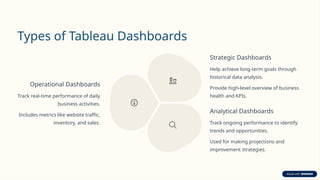
Types of Tableau Dashboards
Operational Dashboards
Track real-time performance of daily
business activities.
Includes metrics like website traffic,
inventory, and sales.
Strategic Dashboards
Help achieve long-term goals through
historical data analysis.
Provide high-level overview of business
health and KPIs.
Analytical Dashboards
Track ongoing performance to identify
trends and opportunities.
Used for making projections and
improvement strategies.
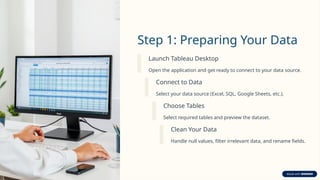
Step 1: Preparing Your Data
Launch Tableau Desktop
Open the application and get ready to connect to your data source.
Connect to Data
Select your data source (Excel, SQL, Google Sheets, etc.).
Choose Tables
Select required tables and preview the dataset.
Clean Your Data
Handle null values, filter irrelevant data, and rename fields.
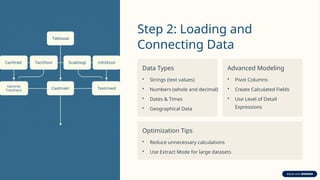
Step 2: Loading and
Connecting Data
Data Types
• Strings (text values)
• Numbers (whole and decimal)
• Dates & Times
• Geographical Data
Advanced Modeling
• Pivot Columns
• Create Calculated Fields
• Use Level of Detail
Expressions
Optimization Tips
• Reduce unnecessary calculations
• Use Extract Mode for large datasets
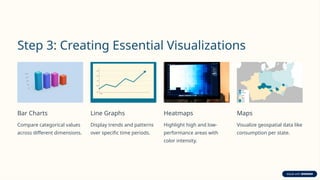
Step 3: Creating Essential Visualizations
Bar Charts
Compare categorical values
across different dimensions.
Line Graphs
Display trends and patterns
over specific time periods.
Heatmaps
Highlight high and low-
performance areas with
color intensity.
Maps
Visualize geospatial data like
consumption per state.
Step 4: Adding Interactivity
Add Filters
• Click drop-down menu on any field
• Select "Show Filter"
• Choose filter type (Dropdown, Range, Multi-select)
• Apply to multiple sheets if needed
Create Parameters
Allow users to input values that change visualizations dynamically.
Add Objects
Include buttons, images, and web pages to enhance functionality.
Benefits of Interactive
Dashboards
100%
Data Visibility
Complete view of all business metrics in
one place.
24/7
Availability
Constant access to real-time business
intelligence.
60%
Faster Decisions
Reduction in time needed to analyze
and act on data.
Transform your business decision-making with powerful Tableau dashboards that
bring your data to life.

contact us
info@augmentedtechlabs.co
m
+91 79491 86335
https://www.augmentedtechlabs.com/

Building-Interactive-Dashboards-in-Tableau

  • 1.
    Building Interactive Dashboards inTableau Feeling overwhelmed by vast amounts of raw data? Interactive dashboards in Tableau can transform complex datasets into clear, actionable insights. Let's explore how to build powerful visualizations that help you make better business decisions.
  • 2.
    Why Use TableauDashboards? Data Consolidation Brings reports from various sources into a single view. Real-Time Monitoring Provides instant access to business metrics. Better Decision Making Presents data in interactive form for deeper analysis. Customizable Analysis Offers flexibility to explore data in multiple ways.
  • 3.
    Types of TableauDashboards Operational Dashboards Track real-time performance of daily business activities. Includes metrics like website traffic, inventory, and sales. Strategic Dashboards Help achieve long-term goals through historical data analysis. Provide high-level overview of business health and KPIs. Analytical Dashboards Track ongoing performance to identify trends and opportunities. Used for making projections and improvement strategies.
  • 4.
    Step 1: PreparingYour Data Launch Tableau Desktop Open the application and get ready to connect to your data source. Connect to Data Select your data source (Excel, SQL, Google Sheets, etc.). Choose Tables Select required tables and preview the dataset. Clean Your Data Handle null values, filter irrelevant data, and rename fields.
  • 5.
    Step 2: Loadingand Connecting Data Data Types • Strings (text values) • Numbers (whole and decimal) • Dates & Times • Geographical Data Advanced Modeling • Pivot Columns • Create Calculated Fields • Use Level of Detail Expressions Optimization Tips • Reduce unnecessary calculations • Use Extract Mode for large datasets
  • 6.
    Step 3: CreatingEssential Visualizations Bar Charts Compare categorical values across different dimensions. Line Graphs Display trends and patterns over specific time periods. Heatmaps Highlight high and low- performance areas with color intensity. Maps Visualize geospatial data like consumption per state.
  • 7.
    Step 4: AddingInteractivity Add Filters • Click drop-down menu on any field • Select "Show Filter" • Choose filter type (Dropdown, Range, Multi-select) • Apply to multiple sheets if needed Create Parameters Allow users to input values that change visualizations dynamically. Add Objects Include buttons, images, and web pages to enhance functionality.
  • 8.
    Benefits of Interactive Dashboards 100% DataVisibility Complete view of all business metrics in one place. 24/7 Availability Constant access to real-time business intelligence. 60% Faster Decisions Reduction in time needed to analyze and act on data. Transform your business decision-making with powerful Tableau dashboards that bring your data to life.

  • 9.
    contact us info@augmentedtechlabs.co m +91 7949186335 https://www.augmentedtechlabs.com/