Download to read offline
![Different disciplines, common features [1]:
● Generation of coherence between old and new knowledge
● Same elements (theory, anterior, posterior, circumstances)
● Same processes (psychological , linguistic)
[1] Tiddi et al. (2015), An Ontology Design Pattern to Define Explanations, K-CAP2015.
Determinists Hempel&
Oppenheim
Weber&
Durkheim
Charles
Peirce
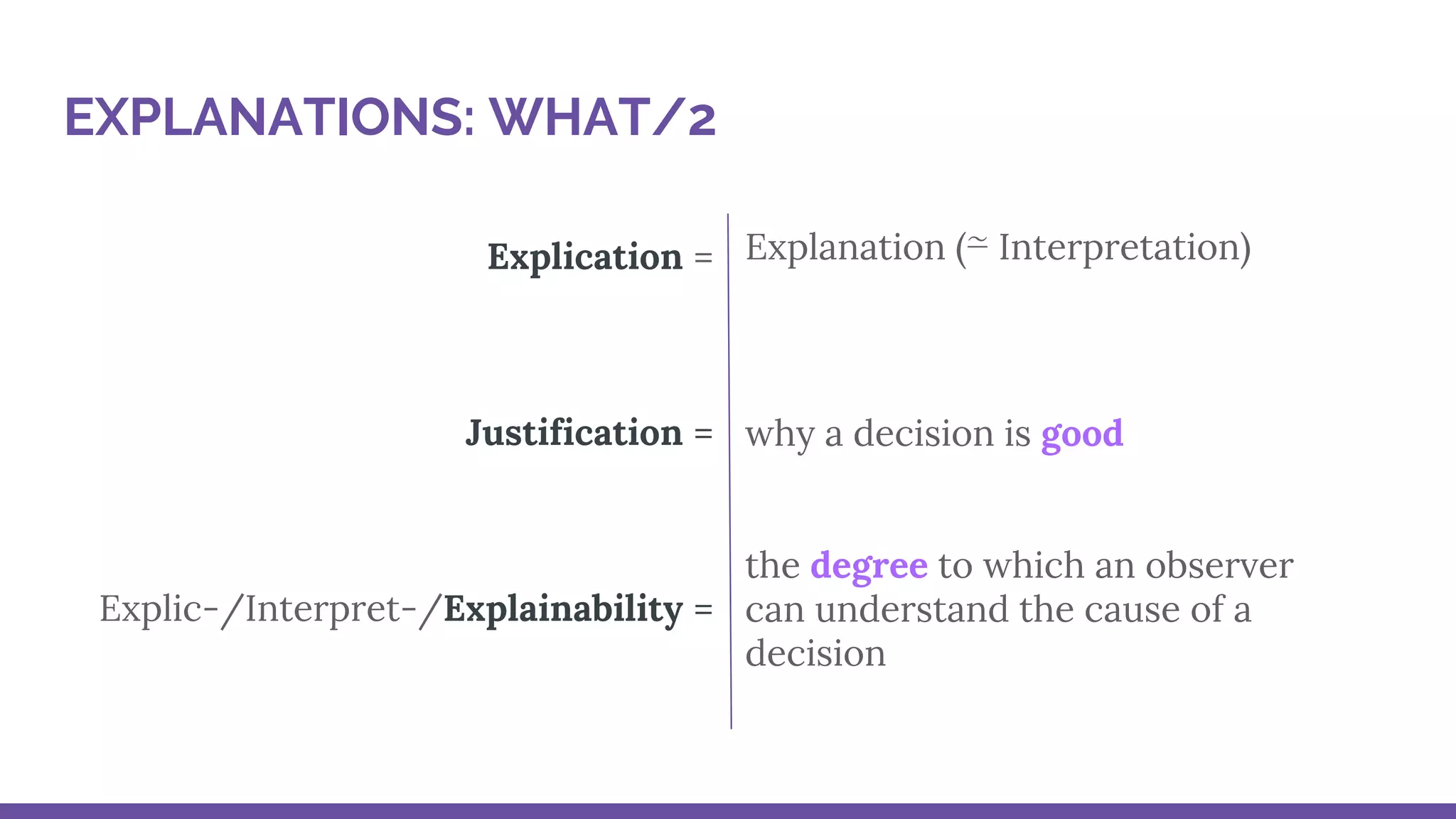
EXPLANATIONS: WHAT/1
V-IV BC
Plato&Aristotle
XVII AC 1948 19641903 2015
?](https://image.slidesharecdn.com/2019hwu-190306110726/75/Building-intelligent-systems-that-can-explain-5-2048.jpg)
![[2] Tiddi. (2016), Explaining Data Patterns using Knowledge from the Web of Data, Ph.D. thesis.
Demo: http://dedalo.kmi.open.ac.uk/
Explaining web searches
using the Linked Data Cloud
Why do people search for “A Song of Ice and
Fire” only in certain periods?
EXPLAINING DATA PATTERNS](https://image.slidesharecdn.com/2019hwu-190306110726/75/Building-intelligent-systems-that-can-explain-11-2048.jpg)
![Explaining user online activities
with Wikidata, recommending
Open University courses
[3] http://afel-project.eu
EXPLAINING BEHAVIOURS](https://image.slidesharecdn.com/2019hwu-190306110726/75/Building-intelligent-systems-that-can-explain-12-2048.jpg)
![Using identity links to find:
● The NYT dataset is about places in
the US (trivial)
● The Reading Experience Dataset is
about poets/novelists which
committed suicide (less trivial)
[4] Tiddi. (2014), Quantifying the bias in data links (EKAW201 4)
owl:sameAs
skos:exactMatch
...
A
B
Projection of B in A
EXPLAINING BIAS IN DATASETS](https://image.slidesharecdn.com/2019hwu-190306110726/75/Building-intelligent-systems-that-can-explain-13-2048.jpg)
![Using open data (DBpedia,
MK:DataHub) to enhance
smart-city applications
[5] Tiddi et al. (2018), Allowing exploratory search from podcasts: the case of Secklow Sounds Radio (ISWC2018)
EXPLAINING RADIO CONTENTS](https://image.slidesharecdn.com/2019hwu-190306110726/75/Building-intelligent-systems-that-can-explain-14-2048.jpg)
![Semantic mapping with
ShapeNet and ConceptNet
DBpedia ConceptNet ShapeNet
EXPLAINING SCENES IN MOTION
[6] Chiatti et al., Task-agnostic, ShapeNet-based Object Recognition for Mobile Robots, DARLI-AP 2019 (EDBT/ICDT 2019)](https://image.slidesharecdn.com/2019hwu-190306110726/75/Building-intelligent-systems-that-can-explain-15-2048.jpg)
![Explaining and rebalancing
LSTM networks using linguistic
corpora (e.g. FrameNet)
[7] Mensio et al., Towards Explainable Language Understanding for Human Robot Interaction
EXPLAINING NEURAL ATTENTIONS](https://image.slidesharecdn.com/2019hwu-190306110726/75/Building-intelligent-systems-that-can-explain-16-2048.jpg)
![Cooperation Databank : 50
years of scientific studies on
human cooperation
Scholarly KGs (e.g. Scigraph) to
support systematic
reviews/meta-analyses
[8] https://amsterdamcooperationlab.com/databank/
EXPLAINING SCIENTIFIC RESEARCH](https://image.slidesharecdn.com/2019hwu-190306110726/75/Building-intelligent-systems-that-can-explain-17-2048.jpg)
![Bringing together social and
computer scientists
Reflect on the threats and
misuse of our technologies
[9] https://kmitd.github.io/recoding-black-mirror/
EXPLAINING ETHICS TO MACHINES?](https://image.slidesharecdn.com/2019hwu-190306110726/75/Building-intelligent-systems-that-can-explain-18-2048.jpg)
![Sharing and reusing is the key to explainable systems
● Lots of data
● Lots of theories (e.g. insights from the social/cognitive sciences [10])
(My) desiderata:
+ cross-disciplinary discussions
+ formalised common-sense knowledge (Web of entities, Web of actions)
+ links between data, allow serendipitous knowledge discovery
SOME TAKEAWAYS
[10] Tim Miller (2018), Explanations in artificial intelligence: Insights from the social sciences, Artificial Intelligence.](https://image.slidesharecdn.com/2019hwu-190306110726/75/Building-intelligent-systems-that-can-explain-19-2048.jpg)

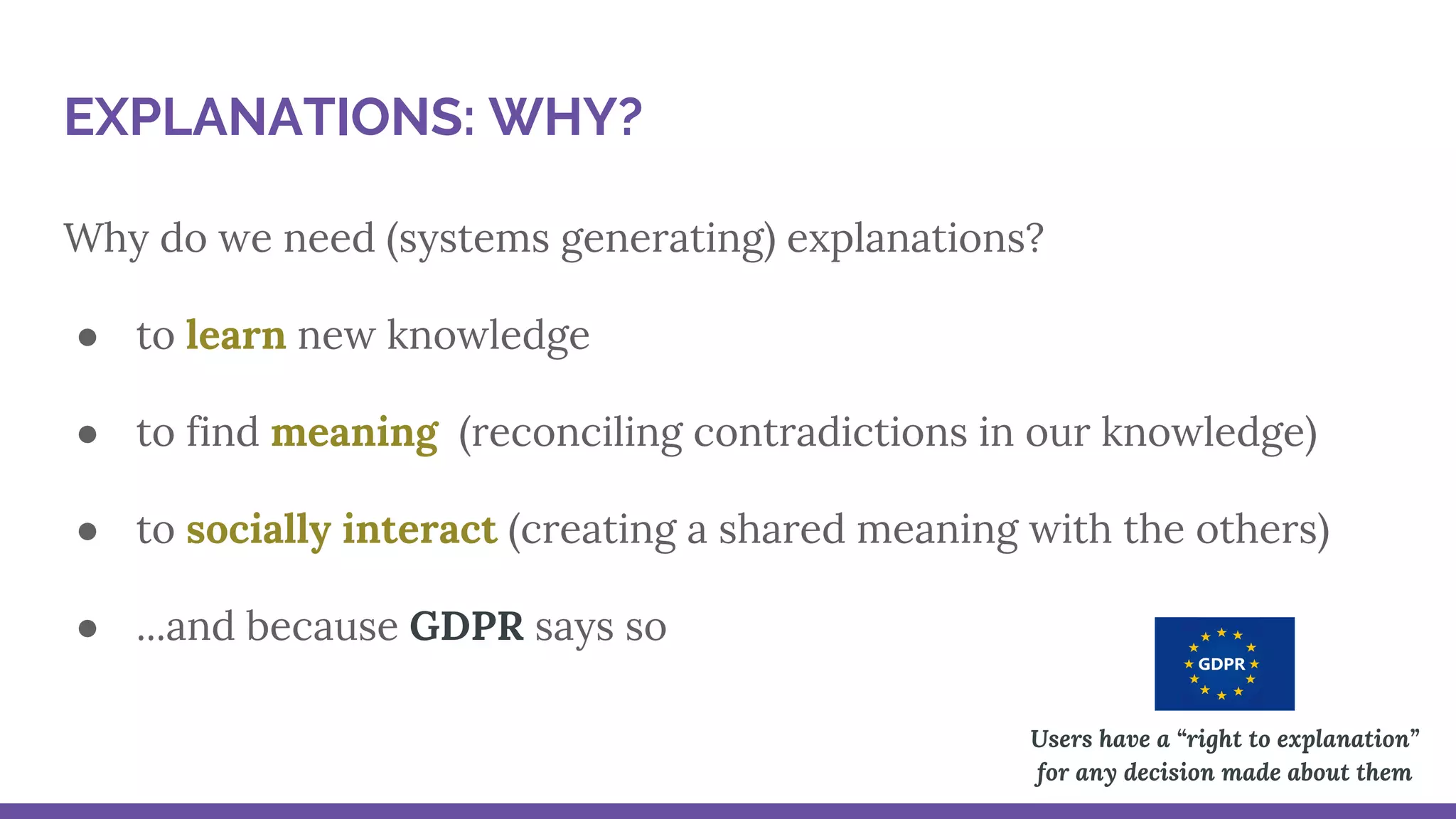
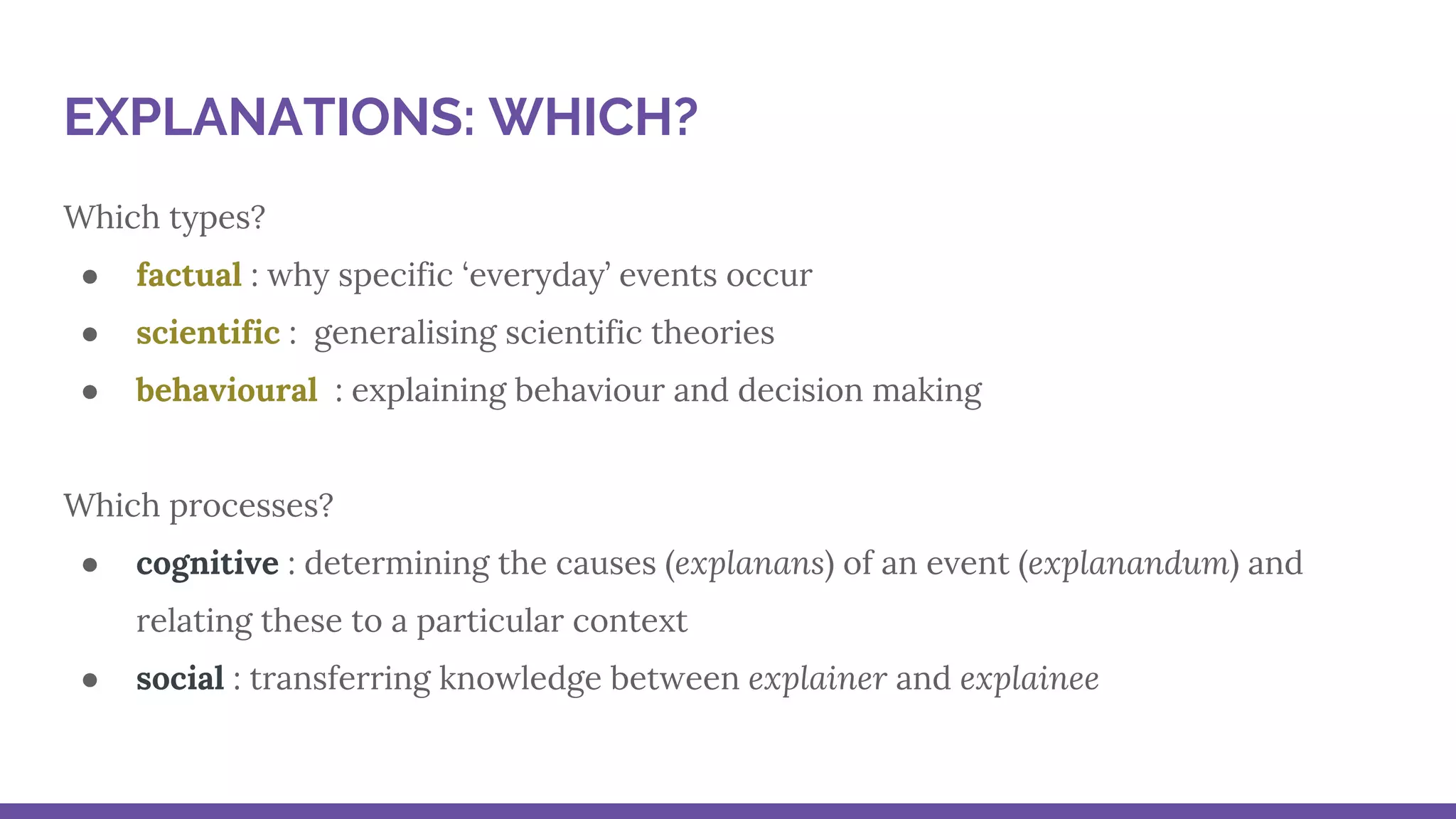
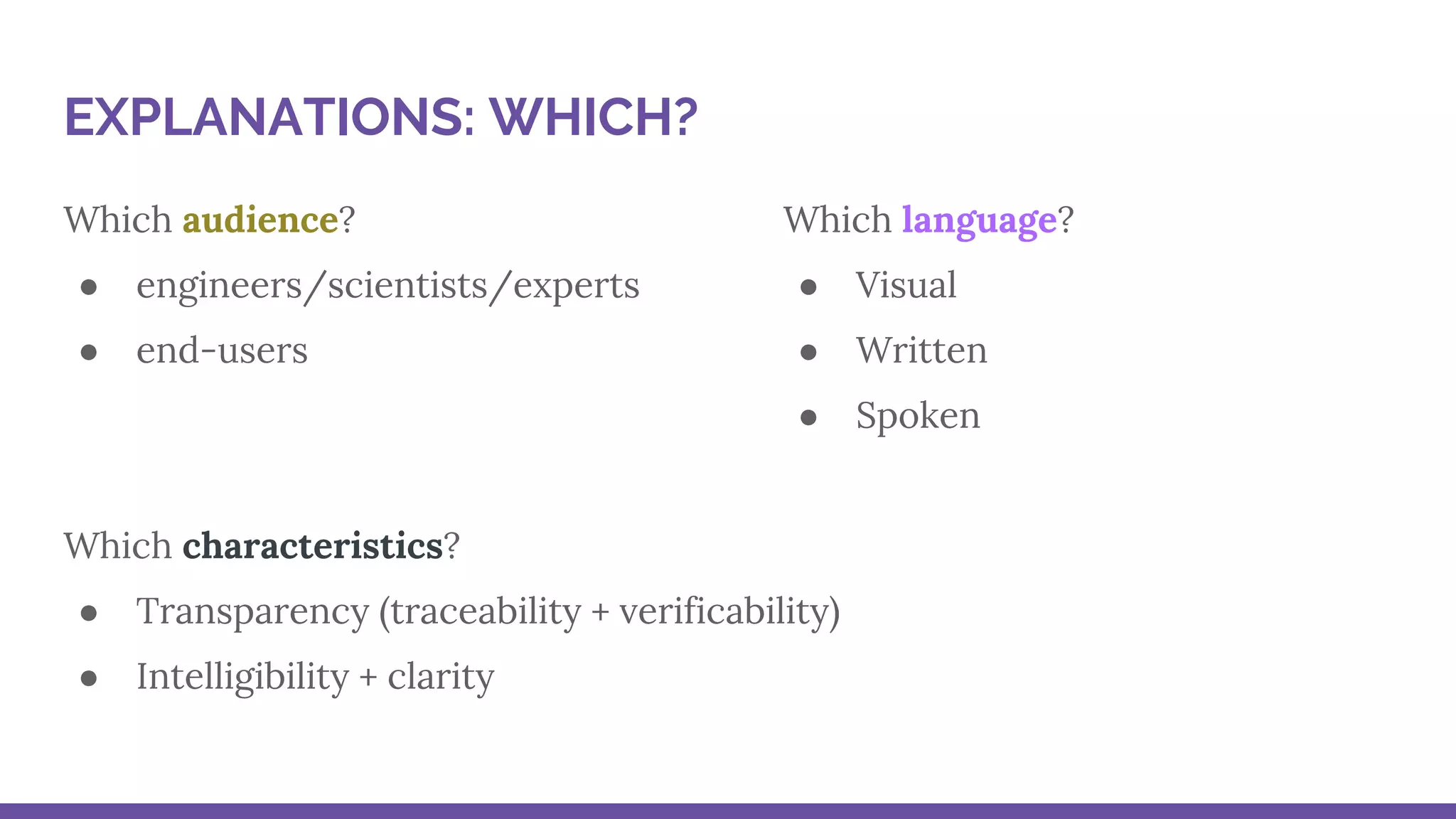
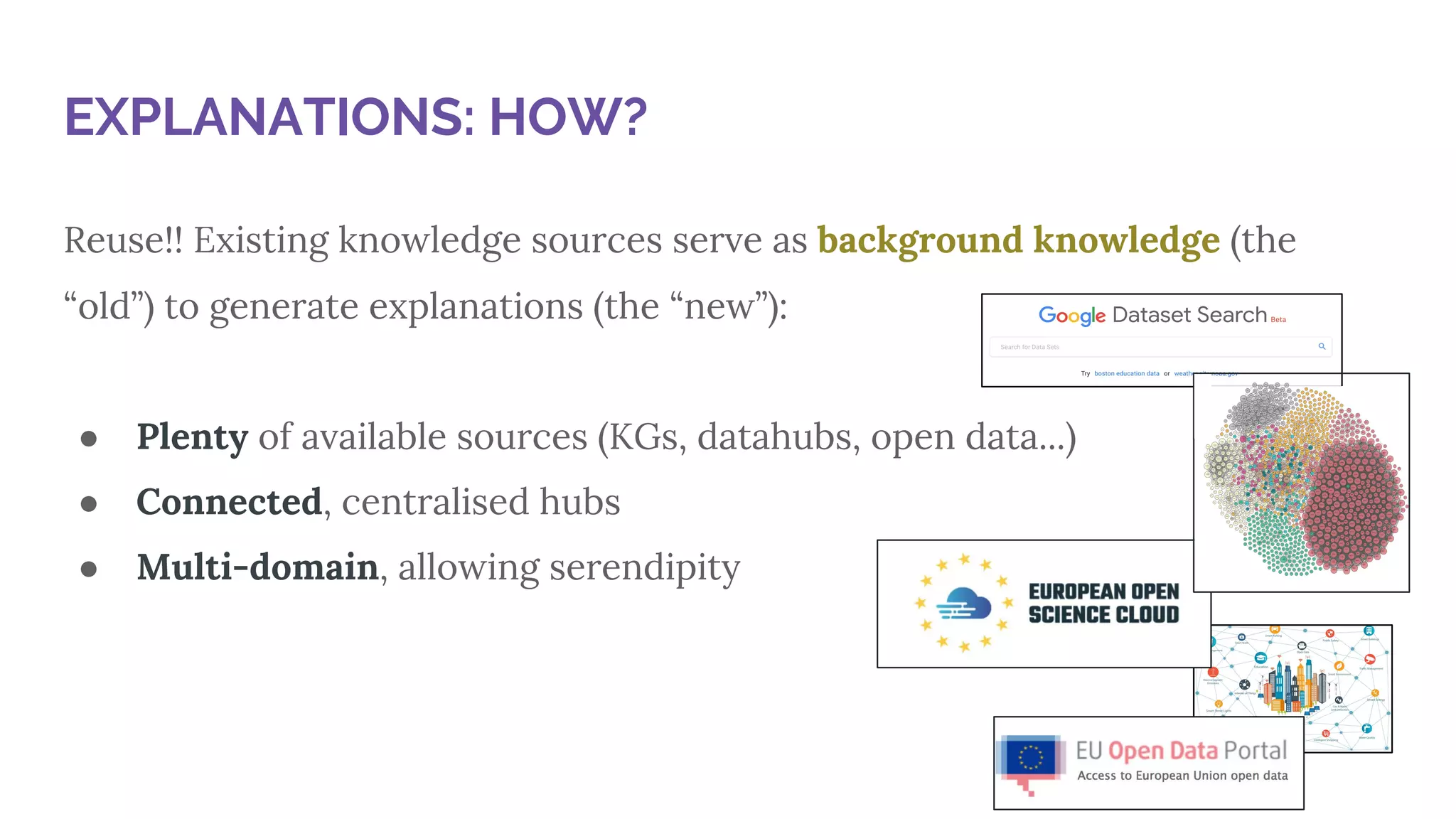
The document discusses the importance of generating explanations in intelligent systems, emphasizing their role in knowledge acquisition, meaning-making, and compliance with GDPR regulations. It outlines different types of explanations and their characteristics, including audiences and formats, while providing examples of how existing knowledge sources can be leveraged to create new explanations. The author advocates for cross-disciplinary collaboration and the reuse of data to enhance the effectiveness of explainable systems.


![[ADBIS 2021] - Optimizing Execution Plans in a Multistore](https://cdn.slidesharecdn.com/ss_thumbnails/slideadbis2021-210830100718-thumbnail.jpg?width=640&height=640&fit=bounds)


![[DOLAP2019] Augmented Business Intelligence](https://cdn.slidesharecdn.com/ss_thumbnails/mfrancia-abi-190327143945-thumbnail.jpg?width=640&height=640&fit=bounds)


