INTRODUCTION TO
INSTITUTIONAL
REPOSITORY AND DSPACE
BY BHARAT CHAUDHARI
Webinitio Network
What we will cover
 Repository Structure
 Intro to metadata
 Item submissions
 Workflows
 Copyright issues and embargos
 RSS, Statistics
 Information Management
What is an Institutional Repository
(IR)?
 An IR is a digital collection capturing,
preserving and disseminating the intellectual
output of a single university community
Institutional repository
 A university-based institutional repository is a set
of services that a university offers to the members
of its community for the management and
dissemination of digital materials created by the
institution and its community members. It is most
essentially an organisational commitment to the
stewardship of these digital materials, including
long-term preservation where appropriate, as well
as organisation and access or distribution.”
 Clifford A. Lynch. Institutional Repositories: Essential Infrastructure for
Scholarship in the Digital Age ARL, no. 226 (February 2003): 1-7.
What content?
 Research output from faculty
 Research output from students
Contents are…..
 Academic research papers
 Journal articles
 Research data sets
 Conference papers
 Exam Papers etc. Theses and dissertations
Why Repository?
 Easy to find resources
 Make University’s intellectual (research) output
visible
 Facilitate global access
 University rankings
 Best IM practices
Important elements of IRs
 Institutionally defined
 Scholarly and research purposes
 Cumulative and perpetual
 Open and interoperable
Many levels of repositories
 Institutional repository
- Vidyanidhi etc
 National repository
- National Digital Library-IIT
International repository
Implementation
 Develop policies
 Metadata for storage/presentation
 Author permissions and license agreements
 Submission guidelines (staff and students)
 Submission software training
 Marketing concept to depositors – advocacy
efforts
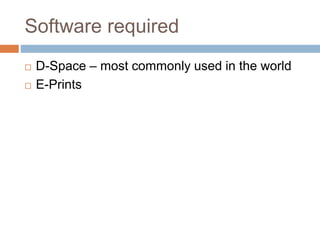
Software required
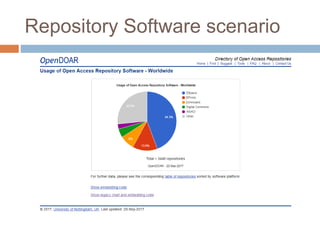
 D-Space – most commonly used in the world
 E-Prints
Repository Software scenario
Roles, skills required?
 Repository Manager
Policy development, advocacy, liaison with
stakeholders, team leadership
 Technical services
Customization, software upgrades
 General support
Data entry and general tasks
Metadata
Metadata is "data [information] that provides
information about other data".[1] Three distinct
types of metadata exist: descriptive
metadata, structural metadata,
and administrative metadata.[2]
Dublin Core Metadata
 Title, Creator, Subject, Publisher, Description,
Contributor, Language, Rights, Source, Date
Relation, Format ,Coverage, Identifier, Type
Openness
Open source
software where the source code is available for
modification
Open standards
Specifications De facto standards
Open access
access to resources made available without fees
of cost
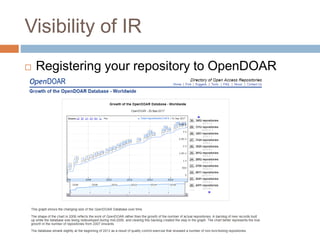
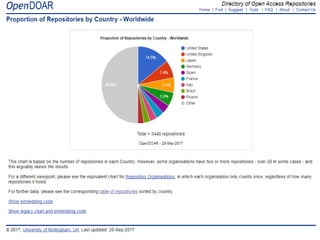
Visibility of IR
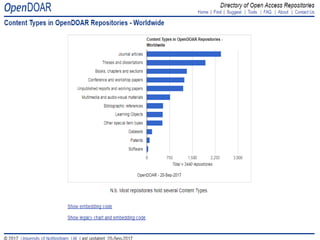
 Registering your repository to OpenDOAR

Building an institutional repository using dspace

  • 1.
    INTRODUCTION TO INSTITUTIONAL REPOSITORY ANDDSPACE BY BHARAT CHAUDHARI Webinitio Network
  • 2.
    What we willcover  Repository Structure  Intro to metadata  Item submissions  Workflows  Copyright issues and embargos  RSS, Statistics  Information Management
  • 3.
    What is anInstitutional Repository (IR)?  An IR is a digital collection capturing, preserving and disseminating the intellectual output of a single university community
  • 4.
    Institutional repository  Auniversity-based institutional repository is a set of services that a university offers to the members of its community for the management and dissemination of digital materials created by the institution and its community members. It is most essentially an organisational commitment to the stewardship of these digital materials, including long-term preservation where appropriate, as well as organisation and access or distribution.”  Clifford A. Lynch. Institutional Repositories: Essential Infrastructure for Scholarship in the Digital Age ARL, no. 226 (February 2003): 1-7.
  • 5.
    What content?  Researchoutput from faculty  Research output from students Contents are…..  Academic research papers  Journal articles  Research data sets  Conference papers  Exam Papers etc. Theses and dissertations
  • 6.
    Why Repository?  Easyto find resources  Make University’s intellectual (research) output visible  Facilitate global access  University rankings  Best IM practices
  • 7.
    Important elements ofIRs  Institutionally defined  Scholarly and research purposes  Cumulative and perpetual  Open and interoperable
  • 8.
    Many levels ofrepositories  Institutional repository - Vidyanidhi etc  National repository - National Digital Library-IIT International repository
  • 9.
    Implementation  Develop policies Metadata for storage/presentation  Author permissions and license agreements  Submission guidelines (staff and students)  Submission software training  Marketing concept to depositors – advocacy efforts
  • 10.
    Software required  D-Space– most commonly used in the world  E-Prints
  • 11.
  • 14.
    Roles, skills required? Repository Manager Policy development, advocacy, liaison with stakeholders, team leadership  Technical services Customization, software upgrades  General support Data entry and general tasks
  • 15.
    Metadata Metadata is "data[information] that provides information about other data".[1] Three distinct types of metadata exist: descriptive metadata, structural metadata, and administrative metadata.[2]
  • 16.
    Dublin Core Metadata Title, Creator, Subject, Publisher, Description, Contributor, Language, Rights, Source, Date Relation, Format ,Coverage, Identifier, Type
  • 17.
    Openness Open source software wherethe source code is available for modification Open standards Specifications De facto standards Open access access to resources made available without fees of cost
  • 18.
    Visibility of IR Registering your repository to OpenDOAR