Institutional Repositories:
An Introduction
Presenter:
Muhammed Rahoof NC
Dept. Of . Library and information science
University of Calicut
1
🠶Overview
🠶Types of Institutional Repositories
🠶Components of a repository system
🠶Institutional Repository Softwares
🠶Benefits of Institutional Repositories
🠶Characteristics of Institutional
Repositories
🠶Constraints
🠶Insurance of repositories
🠶Conclusion
🠶References
Outline
2
🠶 Access to information is a very vital factor for success in any human
endeavor.
🠶 Repositories have existed ever since humans began collecting and
storing important information and artifacts for safekeeping and long term
use.
🠶 “All institutions which maintain long-term collections of paper, recorded
sound and recorded images have to make the shift to managing long-
term electronic storage.”
🠶 Two contemporary developments in particular have helped shape the
nature of today’s institutional repositories:
1. The emerging knowledge management movement.
2. Advancing technology in the digital information management.
Introduction
3
🠶 Although institutional repository, in the current
usage, originated in an institution (i.e. university)
with a large corps of researcher and scholars, the
practice has spread to other non-university
establishments, especially research institutes,
hospitals, security agencies, financial institutions
and multi-national corporations (Chukwueke,
Nnadozie & Okafor, 2020).
Introduction (conti…)
4
🠶 Institutional repository as the digital collection used for capturing
and preserving the intellectual output of a single or multi-university
community (Crow, 2002).
Definition of Institutional Repository
5
Types of
Repositories
1. Subject based repositories e.g
🠶 arXiv (Pronounced archive) (scientific papers)
🠶 Research Papers in Economics (RePEc).
2. Research Repositories eg. KARI Institutional Repository
3.National Repository systems (National Repository For The Kenya Agricultural Information Network
(KAINet)
4. Institutional Repositories containing the various outputs of the Institution. Eg.
A University Institutional Repository (Armbruster & Romary, 2010).
NB. For this matter, this presentation will be biased towards Institutional
Repositories.
5
Characteristics of Institutional Repositories
🠶 The Repository is institutionally defined — unlike a
subject repository; it captures only the intellectual output
of host institution.
🠶 Content may be purely scholarly, or may comprise
administrative, teaching and research materials,
both published and unpublished.
🠶 Content is cumulative (Once items are submitted they
should not be withdrawn).
🠶 Open Access: An institutional repository is published online and
is basically open to the public.
6
Building a Repository Service: Components
🠶 The process of developing an institutional repository requires:
🠶 Expatriate(s)-For customizing or programming a software. The
software can also be procured.
🠶 Basic Hardware
🠶 Servers
🠶 Storage
🠶 Back-up Systems
🠶 Networking / Connectivity
🠶 Power
🠶 Security
8
Building a Repository Service: Components
Softwares
🠶 Commercial
🠶 Open Source
🠶 Home-grown
There are many world renowned softwares used to create repositories eg.
(Developed in New Zealand)
(a) GreenStone Digital library software
(b) Dspace
(c)Eprint (developed as a part of digital library project at University
of Southampton, UK.
9
Building a Repository Service: Components
Registering the
Repository:
1.
2.
Join Directory of Open Access Repositories
(DOAR) Registry of Open Access Repositories
(ROAR)
10
Communities of Institutional Repositories
This may include-
🠶 Research reports submitted for publishing ; the text of journals
articles
accepted for publication.
🠶 Revised text of published work with comments from academic
readers.
🠶 Conference papers.
🠶 Teaching material.
🠶 Student’s projects.
🠶 Doctoral thesis and dissertations.
🠶 Database resulting from research projects.
🠶 Committee papers, administrative papers.
🠶 Computer software .
🠶 Photographs and video recordings.
12
Benefits of Institutional Repositories
🠶 Long-term preservation of research papers and others
🠶 Provide wider access and visibility to the research output
🠶 Build Intellectual Leadership and Credibility- Preserves an
Institution’s heritage
🠶 Increase the citation to the publications
🠶 Avoid duplicate work/project
🠶 Save the Library space
🠶 Improved impact/ranking of Institutions
🠶 Reaching a worldwide audience through exposure to search engines
(such as Google)
🠶 Archiving and distributing material
11
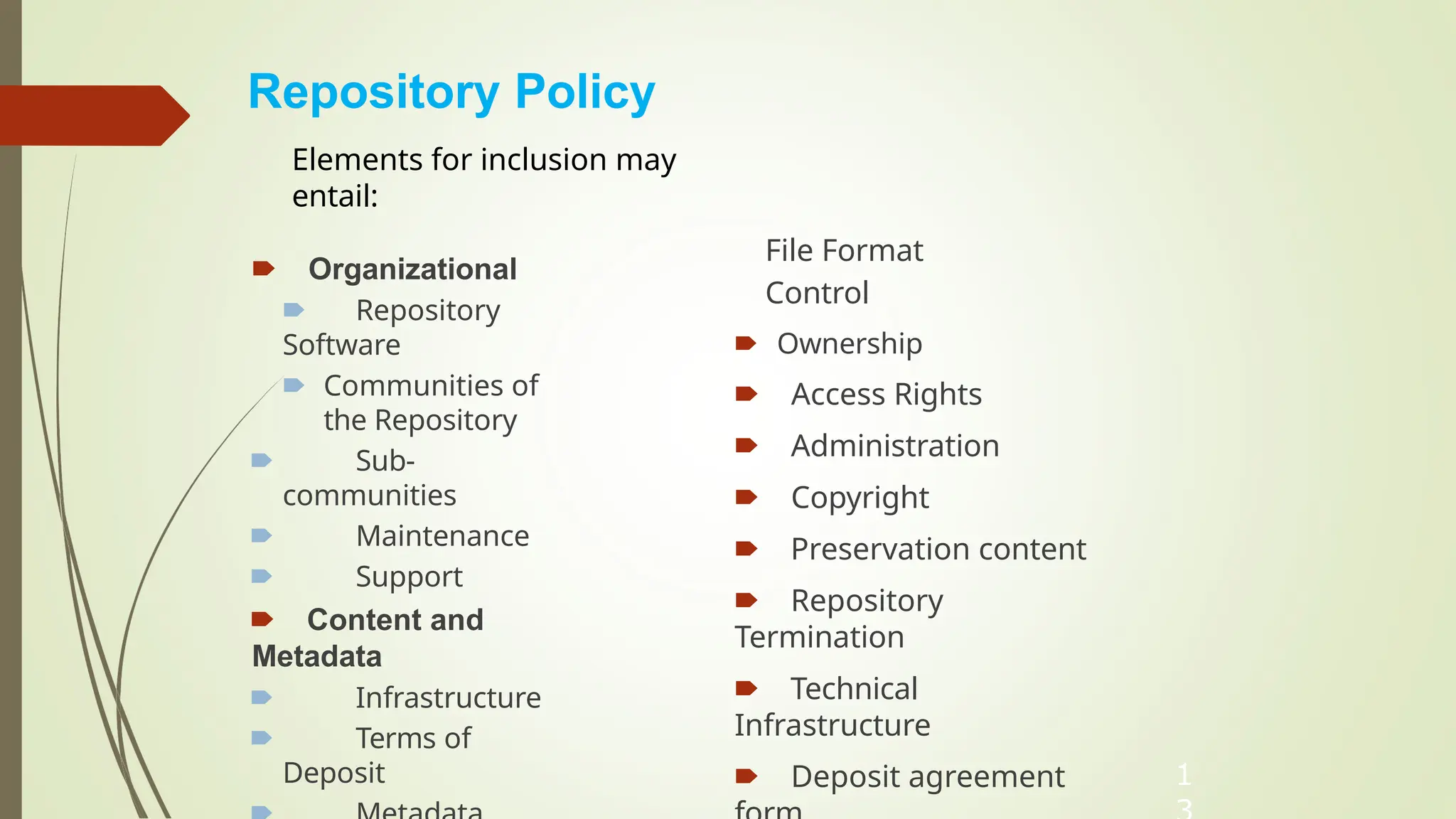
Repository Policy
🠶 Organizational
🠶 Repository
Software
🠶 Communities of
the Repository
🠶 Sub-
communities
🠶 Maintenance
🠶 Support
🠶 Content and
Metadata
🠶 Infrastructure
🠶 Terms of
Deposit
File Format
Control
🠶 Ownership
🠶 Access Rights
🠶 Administration
🠶 Copyright
🠶 Preservation content
🠶 Repository
Termination
🠶 Technical
Infrastructure
🠶 Deposit agreement 1
Elements for inclusion may
entail:
There is need for controls in the management of a
repository eg. by Systems Administrators,
managers…
🠶 Enforce policies
🠶 Access controls
🠶 Back-ups
🠶 Versions
Controls
14
Constraints of Institutional Repositories
Some constraints to academic institutional
repositories
include:
🠶 Absence of a well defined Digital/Institutional
Policy
🠶 Lack of Institutional Repository expertise
🠶 Diversity of content and the
language used in the full texts
🠶 Initial costs may be high as contributors perceive
high
risks and duplicate effort to reduce them. 15
🠶 Hardware Failure
🠶 Communication/Network
Failure
🠶 Software Failure
🠶 Power Failure
Constraints (Cont…)
16
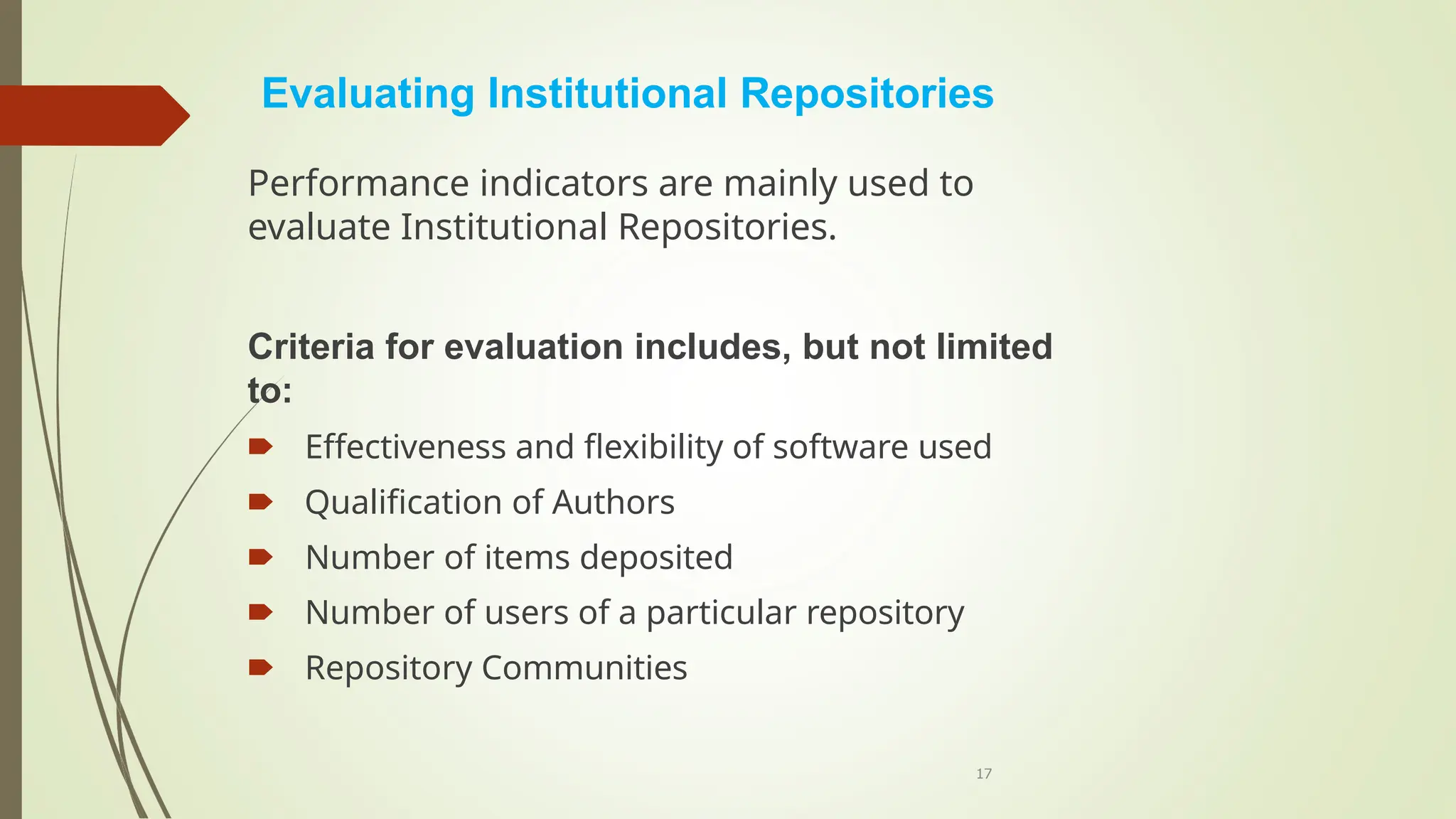
Evaluating Institutional Repositories
Performance indicators are mainly used to
evaluate Institutional Repositories.
Criteria for evaluation includes, but not limited
to:
🠶 Effectiveness and flexibility of software used
🠶 Qualification of Authors
🠶 Number of items deposited
🠶 Number of users of a particular repository
🠶 Repository Communities
17
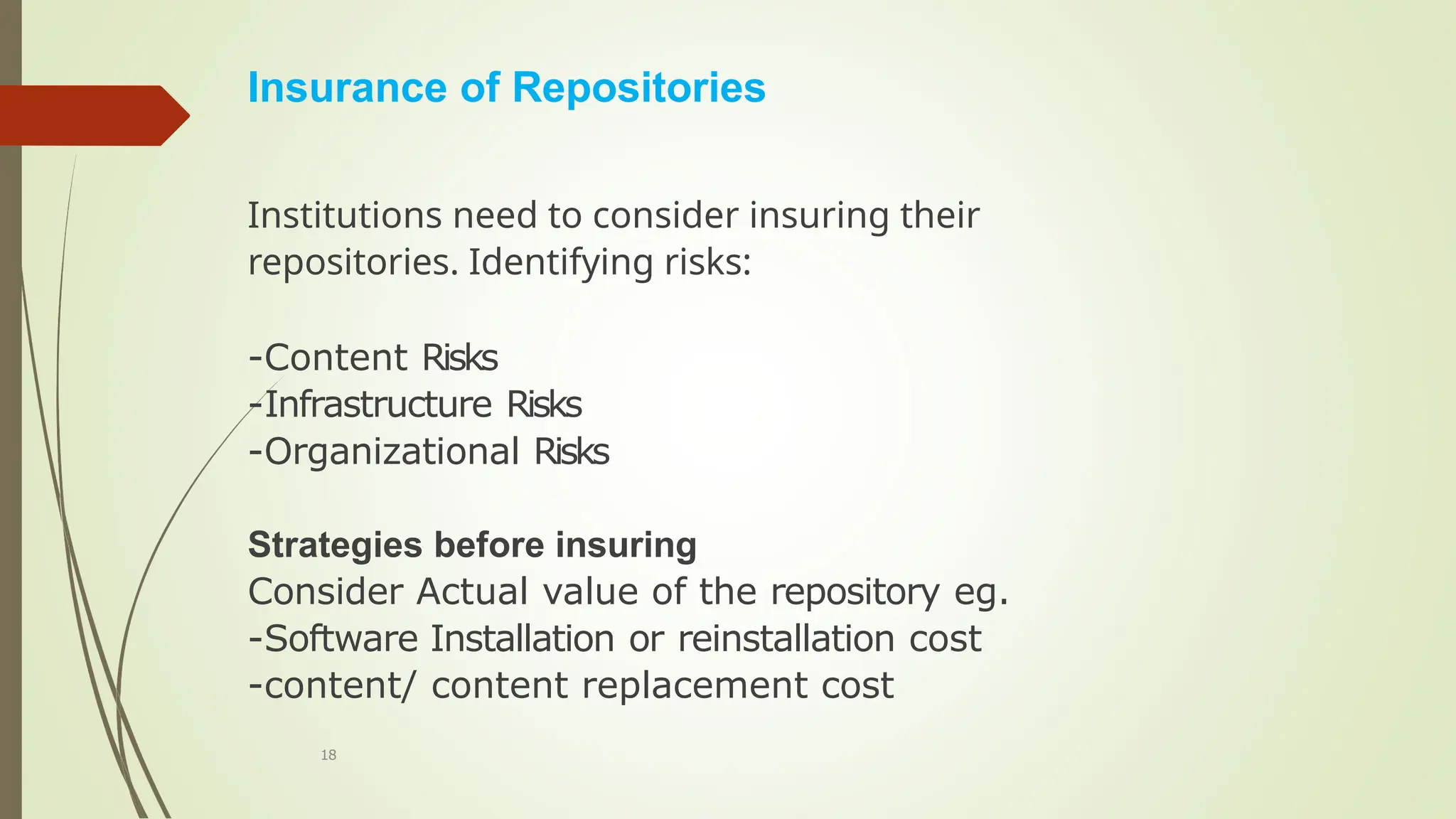
Institutions need to consider insuring their
repositories. Identifying risks:
-Content Risks
-Infrastructure Risks
-Organizational Risks
Strategies before insuring
Consider Actual value of the repository eg.
-Software Installation or reinstallation cost
-content/ content replacement cost
Insurance of Repositories
18
The way
forward
InstitutionalRepositories offer a convenient way to capture,
manipulate, store, manage, share and curate a variety of digital
material. Therefore,
there is need for disaster planning, monitoring and recovery
back-up systems, systems maintenance and repair. There is also need
for institutions to have effective and efficient Institutional Repository
promotion initiatives.
Managers need to have cordial relationships with a diverse
community, including content creators, depositors, systems
administrators as well as end users in starting, developing and using
Institutional Repositories.
Institutions need to have Institutional Repository Policies for effective
and efficient operation of their Institutional Repositories.
1
9
References
Armbruster, C., & Romary, L. (2010). Comparing repository types: challenges and barriers for subject-
based repositories, research repositories, national repository systems and institutional repositories in
serving scholarly communication. International Journal of Digital Library Systems (IJDLS), 1(4), 61-73.
Aspesi, C., Allen, N., Crow, R., Daugherty, S., Joseph, H., McArthur, J., & Shockey, N.
(2019). SPARC* Landscape
Analysis: The Changing Academic Publishing Industry–Implications for Academic
Institutions.
Chukwueke, C., Nnadozie, C. D., & Okafor, V. N. (2020). Enhancing academic
visibility of faculty members in Nigerian university community: The role of
institutional repositories. Journal of Research and Scientific Innovation. IJRSI, 7(9).
Crow, R. (2002). The case for institutional repositories: a SPARC position paper.
Demetres, M. R., Delgado, D., & Wright, D. N. (2020). The impact of institutional
repositories: a systematic
review. Journal of the Medical Library Association: JMLA, 108(2), 177.

Institutional repositories...for library science.pptx

  • 1.
    Institutional Repositories: An Introduction Presenter: MuhammedRahoof NC Dept. Of . Library and information science University of Calicut 1
  • 2.
    🠶Overview 🠶Types of InstitutionalRepositories 🠶Components of a repository system 🠶Institutional Repository Softwares 🠶Benefits of Institutional Repositories 🠶Characteristics of Institutional Repositories 🠶Constraints 🠶Insurance of repositories 🠶Conclusion 🠶References Outline 2
  • 3.
    🠶 Access toinformation is a very vital factor for success in any human endeavor. 🠶 Repositories have existed ever since humans began collecting and storing important information and artifacts for safekeeping and long term use. 🠶 “All institutions which maintain long-term collections of paper, recorded sound and recorded images have to make the shift to managing long- term electronic storage.” 🠶 Two contemporary developments in particular have helped shape the nature of today’s institutional repositories: 1. The emerging knowledge management movement. 2. Advancing technology in the digital information management. Introduction 3
  • 4.
    🠶 Although institutionalrepository, in the current usage, originated in an institution (i.e. university) with a large corps of researcher and scholars, the practice has spread to other non-university establishments, especially research institutes, hospitals, security agencies, financial institutions and multi-national corporations (Chukwueke, Nnadozie & Okafor, 2020). Introduction (conti…) 4
  • 5.
    🠶 Institutional repositoryas the digital collection used for capturing and preserving the intellectual output of a single or multi-university community (Crow, 2002). Definition of Institutional Repository 5
  • 6.
    Types of Repositories 1. Subjectbased repositories e.g 🠶 arXiv (Pronounced archive) (scientific papers) 🠶 Research Papers in Economics (RePEc). 2. Research Repositories eg. KARI Institutional Repository 3.National Repository systems (National Repository For The Kenya Agricultural Information Network (KAINet) 4. Institutional Repositories containing the various outputs of the Institution. Eg. A University Institutional Repository (Armbruster & Romary, 2010). NB. For this matter, this presentation will be biased towards Institutional Repositories. 5
  • 7.
    Characteristics of InstitutionalRepositories 🠶 The Repository is institutionally defined — unlike a subject repository; it captures only the intellectual output of host institution. 🠶 Content may be purely scholarly, or may comprise administrative, teaching and research materials, both published and unpublished. 🠶 Content is cumulative (Once items are submitted they should not be withdrawn). 🠶 Open Access: An institutional repository is published online and is basically open to the public. 6
  • 8.
    Building a RepositoryService: Components 🠶 The process of developing an institutional repository requires: 🠶 Expatriate(s)-For customizing or programming a software. The software can also be procured. 🠶 Basic Hardware 🠶 Servers 🠶 Storage 🠶 Back-up Systems 🠶 Networking / Connectivity 🠶 Power 🠶 Security 8
  • 9.
    Building a RepositoryService: Components Softwares 🠶 Commercial 🠶 Open Source 🠶 Home-grown There are many world renowned softwares used to create repositories eg. (Developed in New Zealand) (a) GreenStone Digital library software (b) Dspace (c)Eprint (developed as a part of digital library project at University of Southampton, UK. 9
  • 10.
    Building a RepositoryService: Components Registering the Repository: 1. 2. Join Directory of Open Access Repositories (DOAR) Registry of Open Access Repositories (ROAR) 10
  • 11.
    Communities of InstitutionalRepositories This may include- 🠶 Research reports submitted for publishing ; the text of journals articles accepted for publication. 🠶 Revised text of published work with comments from academic readers. 🠶 Conference papers. 🠶 Teaching material. 🠶 Student’s projects. 🠶 Doctoral thesis and dissertations. 🠶 Database resulting from research projects. 🠶 Committee papers, administrative papers. 🠶 Computer software . 🠶 Photographs and video recordings. 12
  • 12.
    Benefits of InstitutionalRepositories 🠶 Long-term preservation of research papers and others 🠶 Provide wider access and visibility to the research output 🠶 Build Intellectual Leadership and Credibility- Preserves an Institution’s heritage 🠶 Increase the citation to the publications 🠶 Avoid duplicate work/project 🠶 Save the Library space 🠶 Improved impact/ranking of Institutions 🠶 Reaching a worldwide audience through exposure to search engines (such as Google) 🠶 Archiving and distributing material 11
  • 13.
    Repository Policy 🠶 Organizational 🠶Repository Software 🠶 Communities of the Repository 🠶 Sub- communities 🠶 Maintenance 🠶 Support 🠶 Content and Metadata 🠶 Infrastructure 🠶 Terms of Deposit File Format Control 🠶 Ownership 🠶 Access Rights 🠶 Administration 🠶 Copyright 🠶 Preservation content 🠶 Repository Termination 🠶 Technical Infrastructure 🠶 Deposit agreement 1 Elements for inclusion may entail:
  • 14.
    There is needfor controls in the management of a repository eg. by Systems Administrators, managers… 🠶 Enforce policies 🠶 Access controls 🠶 Back-ups 🠶 Versions Controls 14
  • 15.
    Constraints of InstitutionalRepositories Some constraints to academic institutional repositories include: 🠶 Absence of a well defined Digital/Institutional Policy 🠶 Lack of Institutional Repository expertise 🠶 Diversity of content and the language used in the full texts 🠶 Initial costs may be high as contributors perceive high risks and duplicate effort to reduce them. 15
  • 16.
    🠶 Hardware Failure 🠶Communication/Network Failure 🠶 Software Failure 🠶 Power Failure Constraints (Cont…) 16
  • 17.
    Evaluating Institutional Repositories Performanceindicators are mainly used to evaluate Institutional Repositories. Criteria for evaluation includes, but not limited to: 🠶 Effectiveness and flexibility of software used 🠶 Qualification of Authors 🠶 Number of items deposited 🠶 Number of users of a particular repository 🠶 Repository Communities 17
  • 18.
    Institutions need toconsider insuring their repositories. Identifying risks: -Content Risks -Infrastructure Risks -Organizational Risks Strategies before insuring Consider Actual value of the repository eg. -Software Installation or reinstallation cost -content/ content replacement cost Insurance of Repositories 18
  • 19.
    The way forward InstitutionalRepositories offera convenient way to capture, manipulate, store, manage, share and curate a variety of digital material. Therefore, there is need for disaster planning, monitoring and recovery back-up systems, systems maintenance and repair. There is also need for institutions to have effective and efficient Institutional Repository promotion initiatives. Managers need to have cordial relationships with a diverse community, including content creators, depositors, systems administrators as well as end users in starting, developing and using Institutional Repositories. Institutions need to have Institutional Repository Policies for effective and efficient operation of their Institutional Repositories. 1 9
  • 20.
    References Armbruster, C., &Romary, L. (2010). Comparing repository types: challenges and barriers for subject- based repositories, research repositories, national repository systems and institutional repositories in serving scholarly communication. International Journal of Digital Library Systems (IJDLS), 1(4), 61-73. Aspesi, C., Allen, N., Crow, R., Daugherty, S., Joseph, H., McArthur, J., & Shockey, N. (2019). SPARC* Landscape Analysis: The Changing Academic Publishing Industry–Implications for Academic Institutions. Chukwueke, C., Nnadozie, C. D., & Okafor, V. N. (2020). Enhancing academic visibility of faculty members in Nigerian university community: The role of institutional repositories. Journal of Research and Scientific Innovation. IJRSI, 7(9). Crow, R. (2002). The case for institutional repositories: a SPARC position paper. Demetres, M. R., Delgado, D., & Wright, D. N. (2020). The impact of institutional repositories: a systematic review. Journal of the Medical Library Association: JMLA, 108(2), 177.