Building Livable Communities in Secondlife A Project of the Westchester Alliance for Livable Communities
Building Livable Communities in Secondlife We will answer the following questions : What are Livable Communities? What is the Westchester Alliance? What is Second Life? What was our contest about? What’s next?
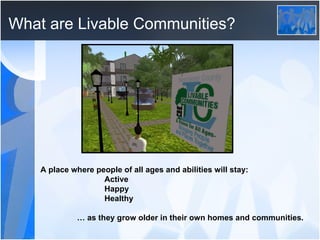
What are Livable Communities? A place where people of all ages and abilities will stay: Active Happy Healthy …  as they grow older in their own homes and communities.
Features of a Livable Community  Livable Communities have within them: A wide-range of recreational, social and cultural activities Good Healthcare Accessible Public Transportation and walkable streets Affordable, accessible housing options and more Formal and Informal Services Safety & Security Roads designed for safe driving
Advantages of Livable Communities They provide the opportunity for people: To stay in own home and community To stay connected to friends and family To stay healthy To stay active and engaged in the community and socially
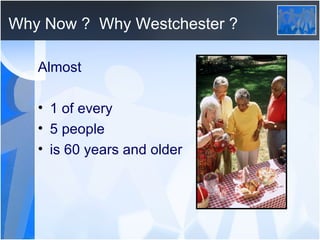
Why Now ?  Why Westchester ? Almost 1 of every  5 people  is 60 years and older
Why Now?  Why Westchester? Did you know Almost 80% of people 65 + living alone are women. A little over one–third of people 65+ report a disability ¾ physical disability Number and severity increase with age
What is the Westchester Alliance? A consortium of colleges, universities, community-based not-for-profits and businesses working together to address the aging phenomenon by facilitating curricula that address aging issues and promoting interest in careers in aging.
How does the Westchester Alliance Work? Westchester Department of Senior Programs and Services Staff and Westchester College/University Liaisons design and coordinate intergenerational projects.  This is accomplished in internships, community and service learning and field placements.
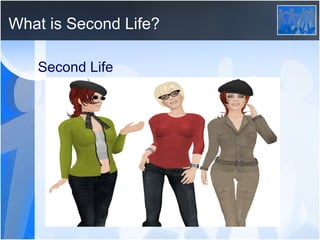
What is Second Life? Second Life
Second Life is a Virtual World A Virtual world is an online environment where the residents are avatars that represent the individuals that are participating online. Users of virtual worlds design their environments and often their avatars as well, from gender to clothing and hairstyle, and control how those avatars communicate, move, create things, and interact.
The Virtual World The functioning of a virtual world can mirror that of the real world, or it can allow residents to do such things as fly, wander around underwater, or teleport themselves to other locations.  Today’s virtual worlds are immersive, animated, 3D environments that operate over the Internet, giving access to anyone in the world.
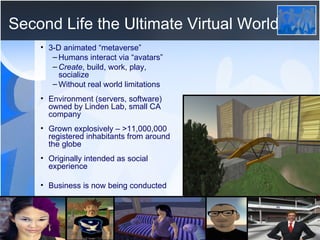
Second Life the Ultimate Virtual World 3-D animated “metaverse”  Humans interact via “avatars” Create , build, work, play, socialize Without real world limitations Environment (servers, software) owned by Linden Lab, small CA company Grown explosively – >11,000,000  registered inhabitants from around the globe  Originally intended as social experience Business is now being conducted
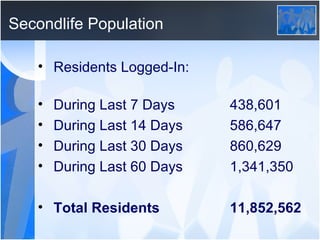
Secondlife Population Residents Logged-In: During Last 7 Days  438,601  During Last 14 Days 586,647  During Last 30 Days 860,629 During Last 60 Days  1,341,350  Total Residents   11,852,562
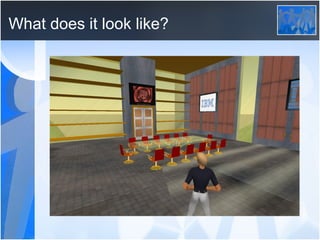
What does it look like?
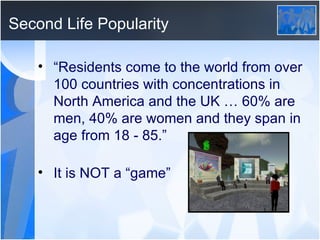
Second Life Popularity “ Residents come to the world from over 100 countries with concentrations in North America and the UK … 60% are men, 40% are women and they span in age from 18 - 85.” It is NOT a “game”
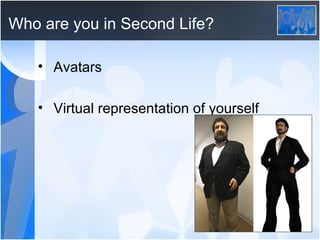
Who are you in Second Life? Avatars Virtual representation of yourself
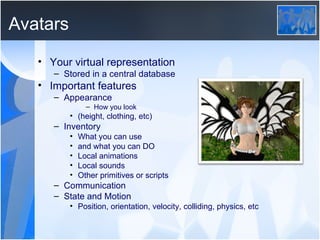
Avatars Your virtual representation Stored in a central database Important features Appearance How you look  (height, clothing, etc) Inventory What you can use  and what you can DO Local animations Local sounds Other primitives or scripts Communication State and Motion  Position, orientation, velocity, colliding, physics, etc
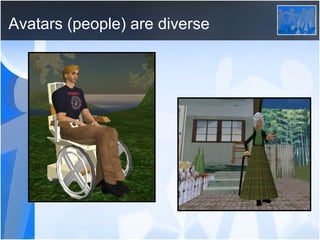
Avatars (people) are diverse
Building Livable Communities in Second Life The Competition Contest Description: The object of this competition was to create a 3D Intergenerational livable community space and design  in a way which people can grow up and grow old comfortably
Competition Requirements Register with the Westchester Alliance and Technical coordinator for Livable Community Project Team should communicate with Livable Community Advisory Committee Team must adhere to requirements stipulated by technical coordinator – these requirements include – communication  through a  system established by technical coordinator Follow instruction posted on  website Project presentation must be completed by end date  in order to be considered for cash award or honorable mention
Eligibility Requirements Students were eligible to enter this contest if they: Are a student attending a Westchester,NY based academic institution  Registered with Westchester Alliance Program and Technical Coordinator for  Livable Community Project Will designate a Livable Community Team  of no more than 4 students  Must be willing to present project at a location determined by advisory committee
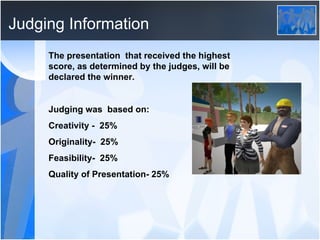
Judging Information The presentation  that received the highest score, as determined by the judges, will be declared the winner. Judging was  based on: Creativity -  25% Originality-  25% Feasibility-  25% Quality of Presentation- 25%
Judging Criteria Creative  – Team generates new ideas or associations that relates to the assigned task to develop livable community areas.   Original –  Using creative themes the Team develops the livable community area new and different and unlike others.   Feasible –  project is practical and can be put into effect Quality of presentation –  Team presentation is well-thought out – easily understood
Faculty Advisors formed Teams Team Formation: Faculty Perspective Extra Credit or Required Intergenerational Communication via Twitter, TextMsg, Email, Phone, etc. Non-Majors / Any Discipline Interdisciplinary teams Community college and university collaborations
Awards $750 Award to the winning team $500 2nd place $250 3 rd  place Certificate of Participation will be awarded to each team member   Article published in “ Generations”
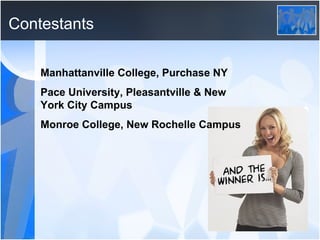
Contestants Manhattanville College, Purchase NY Pace University, Pleasantville & New York City Campus Monroe College, New Rochelle Campus
Building Livable Communities in Second Life Support Team Dr. Matt Ganis, IBM Second Life Island Manager – Project Advisor Dozene Guishard, MPA – Executive Director, Livable Communities Colette Phipps – Deputy Executive Director, Livable Communities Director, Westchester Alliance
Building Livable Communities in Second LIfe Faculty Advisors & Team Members Manhattanville College Pace University   Monroe College Faculty Advisor Faculty Advisor   Faculty Advisor Dr. Norman Bashias Dr. Jean Coppola   Prof J. Shaw Team Members Team Members   Team Members Justin Capalbo Lloyd Duberry   Sadiq Burke Lawrence Laski Luisa Morales   DeAndre Elvy Eric Pierce   Jermaine Hamilton  Jaime Rosalez-Duque Audre King   Ed Hazel   Jennelle Mason


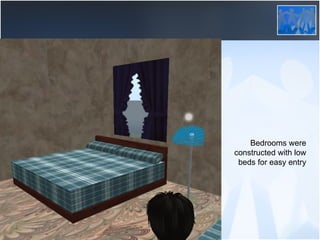
Bedrooms were constructed with low beds for easy entry
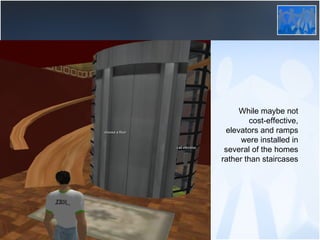
While maybe not cost-effective, elevators and ramps were installed in several of the homes rather than staircases
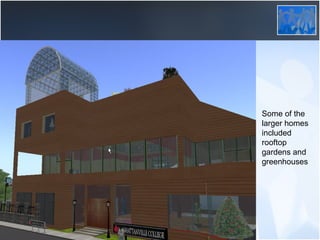
Some of the larger homes included rooftop gardens and greenhouses
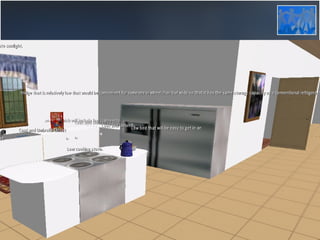
Everyone was a winner! The students went above and beyond what we expected 1 st  Place  Pace University Team 2 nd  Place Monroe College 3 rd  Place Manhattanville Many aspects of the house were considered Validated the requirements
Video
IMPORTANT ! This project was NOT about Technology It’s about changing the perspective of our young people.  By providing a contest where they need to understand and think of the issues as they relate to the elderly, we hope that the lessons they’ve  learned here (in the virtual world)  will go back with them into the real world  - causing them to pause and think when they plan new cities, build homes or engineer new solutions for our daily lives.
What’s Next
The Future The next contest will be larger and more advanced Student teams will be assigned a particular facet of a community and be responsible for its construction Streets Homes Parks Shopping Schools
Project Sponsors Westchester County Department of Senior Programs and Services Westchester Public/Private Partnership for Aging Services Westchester Alliance of Academic Institutions for Aging Related Studies and Workforce Development United Way of Westchester and Putnam Helen Andrus Benedict Foundation

Building a livable commuity in Second Life

  • 1.
    Building Livable Communitiesin Secondlife A Project of the Westchester Alliance for Livable Communities
  • 2.
    Building Livable Communitiesin Secondlife We will answer the following questions : What are Livable Communities? What is the Westchester Alliance? What is Second Life? What was our contest about? What’s next?
  • 3.
    What are LivableCommunities? A place where people of all ages and abilities will stay: Active Happy Healthy … as they grow older in their own homes and communities.
  • 4.
    Features of aLivable Community Livable Communities have within them: A wide-range of recreational, social and cultural activities Good Healthcare Accessible Public Transportation and walkable streets Affordable, accessible housing options and more Formal and Informal Services Safety & Security Roads designed for safe driving
  • 5.
    Advantages of LivableCommunities They provide the opportunity for people: To stay in own home and community To stay connected to friends and family To stay healthy To stay active and engaged in the community and socially
  • 6.
    Why Now ? Why Westchester ? Almost 1 of every 5 people is 60 years and older
  • 7.
    Why Now? Why Westchester? Did you know Almost 80% of people 65 + living alone are women. A little over one–third of people 65+ report a disability ¾ physical disability Number and severity increase with age
  • 8.
    What is theWestchester Alliance? A consortium of colleges, universities, community-based not-for-profits and businesses working together to address the aging phenomenon by facilitating curricula that address aging issues and promoting interest in careers in aging.
  • 9.
    How does theWestchester Alliance Work? Westchester Department of Senior Programs and Services Staff and Westchester College/University Liaisons design and coordinate intergenerational projects. This is accomplished in internships, community and service learning and field placements.
  • 10.
    What is SecondLife? Second Life
  • 11.
    Second Life isa Virtual World A Virtual world is an online environment where the residents are avatars that represent the individuals that are participating online. Users of virtual worlds design their environments and often their avatars as well, from gender to clothing and hairstyle, and control how those avatars communicate, move, create things, and interact.
  • 12.
    The Virtual WorldThe functioning of a virtual world can mirror that of the real world, or it can allow residents to do such things as fly, wander around underwater, or teleport themselves to other locations. Today’s virtual worlds are immersive, animated, 3D environments that operate over the Internet, giving access to anyone in the world.
  • 13.
    Second Life theUltimate Virtual World 3-D animated “metaverse” Humans interact via “avatars” Create , build, work, play, socialize Without real world limitations Environment (servers, software) owned by Linden Lab, small CA company Grown explosively – >11,000,000 registered inhabitants from around the globe Originally intended as social experience Business is now being conducted
  • 14.
    Secondlife Population ResidentsLogged-In: During Last 7 Days 438,601 During Last 14 Days 586,647 During Last 30 Days 860,629 During Last 60 Days 1,341,350 Total Residents 11,852,562
  • 15.
    What does itlook like?
  • 16.
    Second Life Popularity“ Residents come to the world from over 100 countries with concentrations in North America and the UK … 60% are men, 40% are women and they span in age from 18 - 85.” It is NOT a “game”
  • 17.
    Who are youin Second Life? Avatars Virtual representation of yourself
  • 18.
    Avatars Your virtualrepresentation Stored in a central database Important features Appearance How you look (height, clothing, etc) Inventory What you can use and what you can DO Local animations Local sounds Other primitives or scripts Communication State and Motion Position, orientation, velocity, colliding, physics, etc
  • 19.
  • 20.
    Building Livable Communitiesin Second Life The Competition Contest Description: The object of this competition was to create a 3D Intergenerational livable community space and design in a way which people can grow up and grow old comfortably
  • 21.
    Competition Requirements Registerwith the Westchester Alliance and Technical coordinator for Livable Community Project Team should communicate with Livable Community Advisory Committee Team must adhere to requirements stipulated by technical coordinator – these requirements include – communication through a system established by technical coordinator Follow instruction posted on website Project presentation must be completed by end date in order to be considered for cash award or honorable mention
  • 22.
    Eligibility Requirements Studentswere eligible to enter this contest if they: Are a student attending a Westchester,NY based academic institution Registered with Westchester Alliance Program and Technical Coordinator for Livable Community Project Will designate a Livable Community Team of no more than 4 students Must be willing to present project at a location determined by advisory committee
  • 23.
    Judging Information Thepresentation that received the highest score, as determined by the judges, will be declared the winner. Judging was based on: Creativity - 25% Originality- 25% Feasibility- 25% Quality of Presentation- 25%
  • 24.
    Judging Criteria Creative – Team generates new ideas or associations that relates to the assigned task to develop livable community areas. Original – Using creative themes the Team develops the livable community area new and different and unlike others. Feasible – project is practical and can be put into effect Quality of presentation – Team presentation is well-thought out – easily understood
  • 25.
    Faculty Advisors formedTeams Team Formation: Faculty Perspective Extra Credit or Required Intergenerational Communication via Twitter, TextMsg, Email, Phone, etc. Non-Majors / Any Discipline Interdisciplinary teams Community college and university collaborations
  • 26.
    Awards $750 Awardto the winning team $500 2nd place $250 3 rd place Certificate of Participation will be awarded to each team member Article published in “ Generations”
  • 27.
    Contestants Manhattanville College,Purchase NY Pace University, Pleasantville & New York City Campus Monroe College, New Rochelle Campus
  • 28.
    Building Livable Communitiesin Second Life Support Team Dr. Matt Ganis, IBM Second Life Island Manager – Project Advisor Dozene Guishard, MPA – Executive Director, Livable Communities Colette Phipps – Deputy Executive Director, Livable Communities Director, Westchester Alliance
  • 29.
    Building Livable Communitiesin Second LIfe Faculty Advisors & Team Members Manhattanville College Pace University Monroe College Faculty Advisor Faculty Advisor Faculty Advisor Dr. Norman Bashias Dr. Jean Coppola Prof J. Shaw Team Members Team Members Team Members Justin Capalbo Lloyd Duberry Sadiq Burke Lawrence Laski Luisa Morales DeAndre Elvy Eric Pierce Jermaine Hamilton Jaime Rosalez-Duque Audre King   Ed Hazel Jennelle Mason
  • 30.
  • 31.
  • 32.
  • 33.
    Bedrooms were constructedwith low beds for easy entry
  • 34.
    While maybe notcost-effective, elevators and ramps were installed in several of the homes rather than staircases
  • 35.
    Some of thelarger homes included rooftop gardens and greenhouses
  • 36.
    Everyone was awinner! The students went above and beyond what we expected 1 st Place Pace University Team 2 nd Place Monroe College 3 rd Place Manhattanville Many aspects of the house were considered Validated the requirements
  • 37.
  • 38.
    IMPORTANT ! Thisproject was NOT about Technology It’s about changing the perspective of our young people. By providing a contest where they need to understand and think of the issues as they relate to the elderly, we hope that the lessons they’ve learned here (in the virtual world) will go back with them into the real world - causing them to pause and think when they plan new cities, build homes or engineer new solutions for our daily lives.
  • 39.
  • 40.
    The Future Thenext contest will be larger and more advanced Student teams will be assigned a particular facet of a community and be responsible for its construction Streets Homes Parks Shopping Schools
  • 41.
    Project Sponsors WestchesterCounty Department of Senior Programs and Services Westchester Public/Private Partnership for Aging Services Westchester Alliance of Academic Institutions for Aging Related Studies and Workforce Development United Way of Westchester and Putnam Helen Andrus Benedict Foundation