Campus District
Project Progress:
Research & Design
Opportunities
Contents:
    Client Information
    Project Goals
    Research Strategies
    Communication Strategies
    Team Discovery
    Design Opportunities
Mission Statement:
    Campus District Inc. (CDI) connects
    Cleveland’s downtown campuses by
    leading, providing, and promoting
    community development services.
The Campus District:
    Where is the Campus District?
    The District covers a 500 acre area north
    and south from Woodland Ave. to Lake
    Erie and east and west from E. 22nd to
    E. 30th.
The Campus District:
    Who are Members of the CDI*
    Tri-C, CSU and St. Vincent’s Hospital

    Brothers Printing
    The Chilcote Company
    Cleveland Postal Employees Credit Union
    Cuyahoga County
    Cuyahoga Metropolitan Housing Authority (CMHA)
    PNC
    The Ohio Educational Credit
    The Salvation Army
    Sisters of Charity Health System
    Trinity Cathedral
    Visiting Nurse Association of Ohio
    YMCA of Greater Cleveland
    *from the campus district website www.campusdistrict.org accessed on 06.24.10
Client History:
    In the 1980s representatives of St. Vincent’s, Tri-C and CSU signed
    the St. Vincent Quadrangle Consortium Agreement. The agreement
    was to address issues of mutual concern in the community.

    The board voted to change the name to Campus District, Inc. The
    new plan is to change the structure of the organization and connect
    the areas assets both physically and socially.
Project Objectives:
    Why are we doing this?
    •	 Investigate	and	address	common	
       needs of the stakeholders
    •	 Develop	communication	strategy	that	
       builds a shared identities and trusting
       relationships.
    •	 Establish	systems	that	encourage	
       stakeholder interaction.
    •	 Propose	to	the	Campus	District	organization	
       both short and long term design solutions.
Stakeholder:
    Who Are Our Stakeholders?
    •	   Campus	District,	Inc.
    •	   Institutions/Businesses
    •	   Residents
    •	   Collaboration	Participants
Project Mission:
    Empowering the stakeholders of the
    Campus District to collaboratively
    design and sustain quality of life
    experiences.
Project Theme:
   Empowering the stakeholders of the
   Campus District to collaboratively
   design and sustain quality of life
   experiences with a focus on
   food/retail or fitness/recreation.
Research Strategies
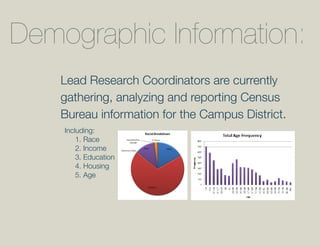
Demographic Information:
    Lead Research Coordinators are currently
    gathering, analyzing and reporting Census
    Bureau information for the Campus District.
    Including:
        1. Race
        2. Income
        3. Education
        4. Housing
        5. Age
Social Aspects:
    Through the use of interviews we are able to
    discover social aspects of the District.
    The students have over 50 completed
    interviews with results in progress.
    Questions on the interview included:

    A.) What activities are available? Which ones do you participate in?
    B.) How do you get around? Why?
    C.) Are there places you avoid in your neighborhood? Why?
    D.) Do you live here by choice or because you have to?
Business Lists:
    We are creating surveys for employees of
    the institutions, and interviews for small
    business owners.
    The surveys and interviews will help us to understand more
    about the employees and small business owners.

    : what they can do or are doing to be part of the CDI community
    : where they eat, where they exercise
    : where they would like to eat or exercise in the CDI
    : what they expect from the CDI
    : how do they come into the district, what form of transportation?
Case Studies:
    In the Process of Evaluation:
    : Dudly Street Neighborhood Initiative in Boston
    : City of Neighborhoods Cooper Hewitt National Design Museum
    : Fairfax Renaissance Development Cooperation
    : Sweat Equity Enterprises
    : Design Ignites Change
Communication
Strategies
Communications
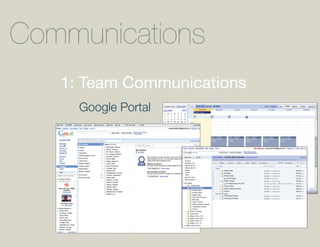
   1: Team Communications
     Google Portal
Communications
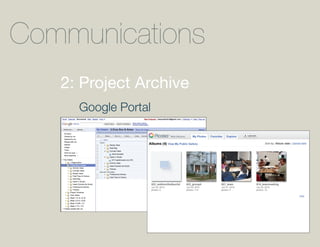
   2: Project Archive
     Google Portal
Communications
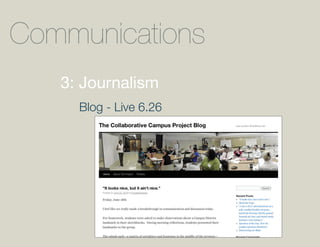
   3: Journalism
     Blog - Live 6.26
Communications
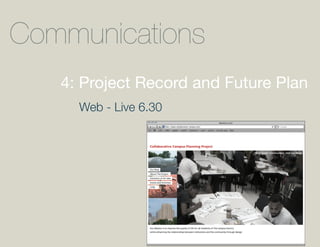
   4: Project Record and Future Plan
     Web - Live 6.30
Communications:
   5: Grass Roots
   Considering Communications for Stakeholders that
   don’t have internet acess.

   Direct Mail
   Flyers
   Posters
   Newsletters
Team Discovery
Team Discovery:
   Group Activities that facilitate the
   ideation process: Identifying challenges
   and opportunities.
   What are we learning about
   each other?
   What are we discovering
   about the Campus District?
Project Discussion:
    Daily questions identify problems & opportunities:
    “Once you go north of Euclid,
    people look at you funny.”

    “I don’t go to Orange (Street)
    because there is nothing
    there.”
Project Discussion:
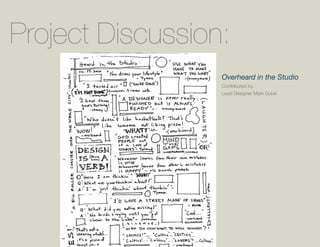
                  Overheard in the Studio
                  Contributed by
                  Lead Designer Mark Duluk
Brainstorming:


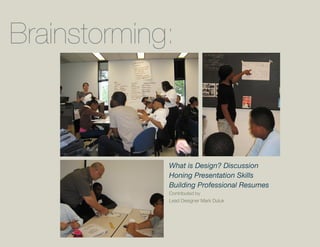
             What is Design? Discussion
             Honing Presentation Skills
             Building Professional Resumes
             Contributed by
             Lead Designer Mark Duluk
District Discovery:


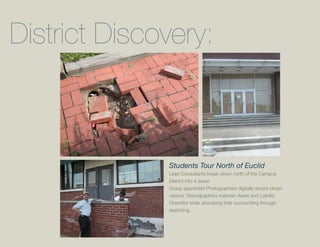
              Students Tour North of Euclid
              Lead Consultants break down north of the Campus
              District into 4 areas:
              Group appointed Photographers digitally record obser-
              vations. Stenographers maintain Asset and Liability
              Checklist while absorbing their surrounding through
              sketching.
Attributes Maps:
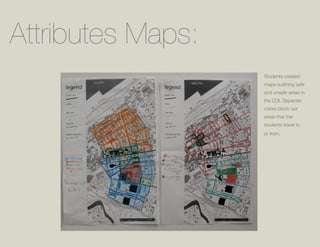
                   Students created
                   maps outlining safe
                   and unsafe areas in
                   the CDI. Separate
                   colors block out
                   areas that the
                   students travel to
                   or from.
Design Opportunities
Design Opportunities:
 Challenge   There is a lack of access to
             facilities that satisfy common daily
             needs:	food,	retail,	fitness	&	safety.
Design Opportunities:
 Challenge    There is a lack of access to
              facilities that satisfy common daily
              needs:	food,	retail,	fitness	&	safety.

Opportunity
              We propose design solutions that
              address human needs including
              marketplace,	recreation,	fitness	&	
              public safety.
Design Opportunities:
 Challenge   There is little interaction between
             varying stakeholder groups: people
             and institutions.
Design Opportunities:
 Challenge    There is little interaction between
              varying stakeholder groups: people
              and institutions.

Opportunity
              We propose the creation of spaces,
              experiences, programs or products
              that promote deliberate, regular
              exchanges.
Design Opportunities:
 Challenge   There is a diverse range of skills and
             assets represented in the District, yet
             not utilized beyond the boundaries of
             segregated neighborhoods.
Design Opportunities:
 Challenge    There is a diverse range of skills and
              assets represented in the District, yet
              not utilized beyond the boundaries of
              segregated neighborhoods.
Opportunity
              We propose a workforce development
              program that empowers one
              stakeholder group to train another and
              employ one another’s services.
Design Opportunities:
 Challenge   Despite a strong academic presence
             in the Campus District, only a small
             percentage of the population have
             advanced degrees.
Design Opportunities:
 Challenge    Despite a strong academic presence
              in the Campus District, only a small
              percentage of the population have
              advanced degrees.
Opportunity
              We can design opportunities that
              utilize institutions as a clearinghouse
              for community engagement and
              employability.
Design Opportunities:
 Challenge   There are few permanent residents in
             the district.
Design Opportunities:
 Challenge    There are few permanent residents in
              the district.


Opportunity
              We can design a strong district
              identity that promotes community
              pride and empowerment.
Design Opportunities:
 Challenge   There are dramatic socioeconomic
             divides within the community and
             different perceptions of safety.
Design Opportunities:
 Challenge    There are dramatic socioeconomic
              divides within the community and
              different perceptions of safety.

Opportunity
              We can design programs and
              structures that enable safe
              environments.

Campus District Market Research Presentation

  • 1.
  • 2.
    Contents: Client Information Project Goals Research Strategies Communication Strategies Team Discovery Design Opportunities
  • 3.
    Mission Statement: Campus District Inc. (CDI) connects Cleveland’s downtown campuses by leading, providing, and promoting community development services.
  • 4.
    The Campus District: Where is the Campus District? The District covers a 500 acre area north and south from Woodland Ave. to Lake Erie and east and west from E. 22nd to E. 30th.
  • 5.
    The Campus District: Who are Members of the CDI* Tri-C, CSU and St. Vincent’s Hospital Brothers Printing The Chilcote Company Cleveland Postal Employees Credit Union Cuyahoga County Cuyahoga Metropolitan Housing Authority (CMHA) PNC The Ohio Educational Credit The Salvation Army Sisters of Charity Health System Trinity Cathedral Visiting Nurse Association of Ohio YMCA of Greater Cleveland *from the campus district website www.campusdistrict.org accessed on 06.24.10
  • 6.
    Client History: In the 1980s representatives of St. Vincent’s, Tri-C and CSU signed the St. Vincent Quadrangle Consortium Agreement. The agreement was to address issues of mutual concern in the community. The board voted to change the name to Campus District, Inc. The new plan is to change the structure of the organization and connect the areas assets both physically and socially.
  • 7.
    Project Objectives: Why are we doing this? • Investigate and address common needs of the stakeholders • Develop communication strategy that builds a shared identities and trusting relationships. • Establish systems that encourage stakeholder interaction. • Propose to the Campus District organization both short and long term design solutions.
  • 8.
    Stakeholder: Who Are Our Stakeholders? • Campus District, Inc. • Institutions/Businesses • Residents • Collaboration Participants
  • 9.
    Project Mission: Empowering the stakeholders of the Campus District to collaboratively design and sustain quality of life experiences.
  • 10.
    Project Theme: Empowering the stakeholders of the Campus District to collaboratively design and sustain quality of life experiences with a focus on food/retail or fitness/recreation.
  • 11.
  • 12.
    Demographic Information: Lead Research Coordinators are currently gathering, analyzing and reporting Census Bureau information for the Campus District. Including: 1. Race 2. Income 3. Education 4. Housing 5. Age
  • 13.
    Social Aspects: Through the use of interviews we are able to discover social aspects of the District. The students have over 50 completed interviews with results in progress. Questions on the interview included: A.) What activities are available? Which ones do you participate in? B.) How do you get around? Why? C.) Are there places you avoid in your neighborhood? Why? D.) Do you live here by choice or because you have to?
  • 14.
    Business Lists: We are creating surveys for employees of the institutions, and interviews for small business owners. The surveys and interviews will help us to understand more about the employees and small business owners. : what they can do or are doing to be part of the CDI community : where they eat, where they exercise : where they would like to eat or exercise in the CDI : what they expect from the CDI : how do they come into the district, what form of transportation?
  • 15.
    Case Studies: In the Process of Evaluation: : Dudly Street Neighborhood Initiative in Boston : City of Neighborhoods Cooper Hewitt National Design Museum : Fairfax Renaissance Development Cooperation : Sweat Equity Enterprises : Design Ignites Change
  • 16.
  • 17.
    Communications 1: Team Communications Google Portal
  • 18.
    Communications 2: Project Archive Google Portal
  • 19.
    Communications 3: Journalism Blog - Live 6.26
  • 20.
    Communications 4: Project Record and Future Plan Web - Live 6.30
  • 21.
    Communications: 5: Grass Roots Considering Communications for Stakeholders that don’t have internet acess. Direct Mail Flyers Posters Newsletters
  • 22.
  • 23.
    Team Discovery: Group Activities that facilitate the ideation process: Identifying challenges and opportunities. What are we learning about each other? What are we discovering about the Campus District?
  • 24.
    Project Discussion: Daily questions identify problems & opportunities: “Once you go north of Euclid, people look at you funny.” “I don’t go to Orange (Street) because there is nothing there.”
  • 25.
    Project Discussion: Overheard in the Studio Contributed by Lead Designer Mark Duluk
  • 26.
    Brainstorming: What is Design? Discussion Honing Presentation Skills Building Professional Resumes Contributed by Lead Designer Mark Duluk
  • 27.
    District Discovery: Students Tour North of Euclid Lead Consultants break down north of the Campus District into 4 areas: Group appointed Photographers digitally record obser- vations. Stenographers maintain Asset and Liability Checklist while absorbing their surrounding through sketching.
  • 28.
    Attributes Maps: Students created maps outlining safe and unsafe areas in the CDI. Separate colors block out areas that the students travel to or from.
  • 29.
  • 30.
    Design Opportunities: Challenge There is a lack of access to facilities that satisfy common daily needs: food, retail, fitness & safety.
  • 31.
    Design Opportunities: Challenge There is a lack of access to facilities that satisfy common daily needs: food, retail, fitness & safety. Opportunity We propose design solutions that address human needs including marketplace, recreation, fitness & public safety.
  • 32.
    Design Opportunities: Challenge There is little interaction between varying stakeholder groups: people and institutions.
  • 33.
    Design Opportunities: Challenge There is little interaction between varying stakeholder groups: people and institutions. Opportunity We propose the creation of spaces, experiences, programs or products that promote deliberate, regular exchanges.
  • 34.
    Design Opportunities: Challenge There is a diverse range of skills and assets represented in the District, yet not utilized beyond the boundaries of segregated neighborhoods.
  • 35.
    Design Opportunities: Challenge There is a diverse range of skills and assets represented in the District, yet not utilized beyond the boundaries of segregated neighborhoods. Opportunity We propose a workforce development program that empowers one stakeholder group to train another and employ one another’s services.
  • 36.
    Design Opportunities: Challenge Despite a strong academic presence in the Campus District, only a small percentage of the population have advanced degrees.
  • 37.
    Design Opportunities: Challenge Despite a strong academic presence in the Campus District, only a small percentage of the population have advanced degrees. Opportunity We can design opportunities that utilize institutions as a clearinghouse for community engagement and employability.
  • 38.
    Design Opportunities: Challenge There are few permanent residents in the district.
  • 39.
    Design Opportunities: Challenge There are few permanent residents in the district. Opportunity We can design a strong district identity that promotes community pride and empowerment.
  • 40.
    Design Opportunities: Challenge There are dramatic socioeconomic divides within the community and different perceptions of safety.
  • 41.
    Design Opportunities: Challenge There are dramatic socioeconomic divides within the community and different perceptions of safety. Opportunity We can design programs and structures that enable safe environments.