A H i g h Pe r f o r m a n c e D a t a P l a t f o r m U s i n g F l a s h
M A R C H 2 0 1 8
S u p e r C o m p u t i n g A s i a
• Edit Master text styles
• Second level
• Third level
• Fourth level
• Fifth level
$48M in Funding20+ Deployments
Industrial IoT
Financial Services
Telecommunications
Cyber Security
2
100+ Employees
NA
APAC
EMEA
iguazio
• Disk and Network were still slow
• Network was in general slower than disk
When Hadoop started
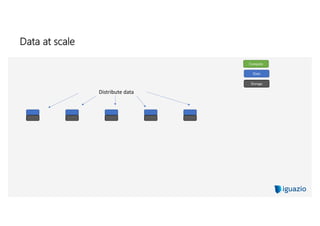
Data at scale
Compute
Data
Storage
Distribute data
• Disk is faster than Network
Compute is where data is
Compute
Data
StorageDistribute compute
• Scalable but inherently batch and slow
• Disk and Network I/O (Map, reduce, shuffle … )
• Runs on JVM
• Not suitable for all type of workloads (real-time, interactive, iterative M/L)
• Cannot scale compute independent of storage and vice versa
Big Data Workloads –
Performance Characteristics
Big Data Workloads –
Performance Characteristics
Big Data Workload Disk I/O Network I/O Compute
Iterative Machine Learning
Jobs
Interactive Analytics at
scale
Lambda & Kappa
Architecture at scale
Typically Disk or Network maxes out during a massively parallel job, before Compute
High
Medium
Low
Big Data Workloads –
Performance Characteristics
Big Data Workload Disk I/O Network I/O Compute
Iterative Machine Learning
Jobs
Interactive Analytics at
scale
Lambda & Kappa
Architecture at scale
Traditional Database
Workload
Compare this to traditional RDBBS – CPU or Disk I/O maxes out
Typically Disk or Network maxes out during a massively parallel job, before Compute
High
Medium
Low
Big Data Workloads –
Performance Characteristics
Big Data Workload Disk I/O Network I/O Compute
Iterative Machine Learning
Jobs
Interactive Analytics at
scale
Lambda & Kappa
Architecture at scale
Traditional Database
Workload
in-memory and high-speed networking ?
High
Medium
Low
• L1 cache reference 0.5 ns
• Branch mispredict 5 ns
• L2 cache reference 7 ns
• Mutex lock/unlock 100 ns
• Main memory reference 100 ns
• Send 2K bytes over 1 Gbps network 20,000 ns
• SSD seek 80,000 ns
• Read 1 MB sequentially from memory 250,000 ns
• Round trip within same datacenter 500,000 ns
• Disk seek 10,000,000 ns
• Read 1 MB sequentially from network 10,000,000 ns
• Read 1 MB sequentially from disk 30,000,000 ns
• Send packet CA->Netherlands->CA 150,000,000 ns
Designs, Lessons and Advice from Building Large Distributed Systems by Dr Jeff Dean of Google Source http://www.slideshare.net/ikewu83/dean-
keynoteladis2009-4885081
Optimizing Big Data
Performance
RAM is 10-20x more expensive than Flash in $Cost / GB
RAM is expensive
SSDs prices are falling
• L1 cache reference 0.5 ns
• Branch mispredict 5 ns
• L2 cache reference 7 ns
• Mutex lock/unlock 100 ns
• Main memory reference 100 ns
• Send 2K bytes over 1 Gbps network 20,000 ns
• SSD seek 80,000 ns
• Read 1 MB sequentially from memory 250,000 ns
• Round trip within same datacenter 500,000 ns
• Disk seek 10,000,000 ns
• Read 1 MB sequentially from network 10,000,000 ns
• Read 1 MB sequentially from disk 30,000,000 ns
• Send packet CA->Netherlands->CA 150,000,000 ns
Designs, Lessons and Advice from Building Large Distributed Systems by Dr Jeff Dean of Google Source http://www.slideshare.net/ikewu83/dean-
keynoteladis2009-4885081
Optimizing Big Data
Performance
0
1
2
3
4
5
6
7
8
9
DRAM NVMe SSD SATA SSD SAS HDD
8.5
1.2
0.85
0.04
Cost in $ per GB (Raw)
Price of Memory
Technology 2016/17
• NVMe is a software based standard that was specifically optimized for SSDs connected through the
PCIe interface.
What is NVMe?
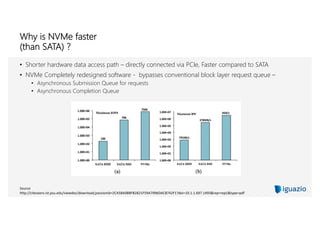
• Shorter hardware data access path – directly connected via PCIe, Faster compared to SATA
• NVMe Completely redesigned software - bypasses conventional block layer request queue –
• Asynchronous Submission Queue for requests
• Asynchronous Completion Queue
Why is NVMe faster
(than SATA) ?
Source
http://citeseerx.ist.psu.edu/viewdoc/download;jsessionid=2CA58A08BFB2821F59A7996DAC8742F1?doi=10.1.1.697.1493&rep=rep1&type=pdf
17
Micro-Services &
Serverless Functions
Unified DB for
Real-Time & Analytics
EXTERNAL
EVENTS AND
SOURCES
IMMEDIATE
INSIGHTS &
ACTIONS
EXTERNAL
DATA
Enrich
Reinforce
Learning
iguazio
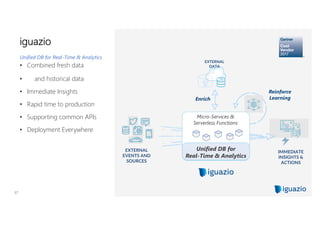
• Combined fresh data
• and historical data
• Immediate Insights
• Rapid time to production
• Supporting common APIs
• Deployment Everywhere
Unified DB for Real-Time & Analytics
FUNCTIONS &
MICRO-SERVICES
SQL & TS
QUERY APIS
ANALYTICS &
AI TOOLS AWS APIS
iguazio Data platform
for real time and analytics
Single platform
All in One
S3
Kinesis
DynamoDB
Secure Intelligent Multi-model
UNIFIED & REAL-TIME DATABASE ENGINE
EXTERNAL DATA LAKES & CLOUDS
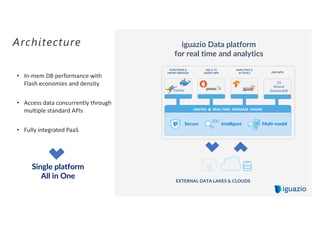
Architecture
• In-mem DB performance with
Flash economies and density
• Access data concurrently through
multiple standard APIs
• Fully integrated PaaS
19
LOCAL NVMe
AND OS BYPASS
Tr a d i t i o n a l L a y e r e d A p p r o a c h i g u a z i o
How to take full
advantage of NVMe?
And Advanced
Networking
iguazio © 2016
21
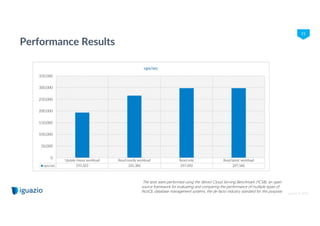
The tests were performed using the Yahoo! Cloud Serving Benchmark (YCSB), an open
source framework for evaluating and comparing the performance of multiple types of
NoSQL database management systems, the de facto industry standard for this purpose.
Performance Results
Independently scaling
compute and storage
iguazio Scale Outx2
Storage
Data nodes
(Processing)
CPU/Drive ratio
Performance
Capacity
Smart Rebuild
Scale Out System
CPU/Drive ratio
Performance
Capacity
Smart Rebuild
Processing + Storage
Scale Up System
Processing
CPU/Drive ratio
Performance
Capacity
Smart Rebuild
Storage
iguazio © 2016
24
Why iguazio?
Very high ingestion rate
Low latency for faster dashboards – in memory speed at the cost of SSD
Real time analytics on both fresh and historical data
Scale out architecture – enabling real time analytics on large data sets
Platform as a service providing cloud experience
iguazio © 2016
25
Business benefits - what’s in it for me?
Increase operational efficiency
Reduce TCO
Faster time to market for new services
Reduce cost of traditional data center operations while constraining growth of expensive cloud services such as
Amazon DynamoDB, Kinesis , S3 , redshift and EMR
Bring new services on-line in less time with greater reliability & security
Optimize business processes
Increase data engineering efficiency
Simplify the overall data pipe-line helping engineering to focus on building applications
Thank You
@Santanu_Dey

Building a High Performance Analytics Platform

  • 1.
    A H ig h Pe r f o r m a n c e D a t a P l a t f o r m U s i n g F l a s h M A R C H 2 0 1 8 S u p e r C o m p u t i n g A s i a
  • 2.
    • Edit Mastertext styles • Second level • Third level • Fourth level • Fifth level $48M in Funding20+ Deployments Industrial IoT Financial Services Telecommunications Cyber Security 2 100+ Employees NA APAC EMEA iguazio
  • 3.
    • Disk andNetwork were still slow • Network was in general slower than disk When Hadoop started
  • 4.
  • 5.
    • Disk isfaster than Network Compute is where data is Compute Data StorageDistribute compute
  • 6.
    • Scalable butinherently batch and slow • Disk and Network I/O (Map, reduce, shuffle … ) • Runs on JVM • Not suitable for all type of workloads (real-time, interactive, iterative M/L) • Cannot scale compute independent of storage and vice versa Big Data Workloads – Performance Characteristics
  • 7.
    Big Data Workloads– Performance Characteristics Big Data Workload Disk I/O Network I/O Compute Iterative Machine Learning Jobs Interactive Analytics at scale Lambda & Kappa Architecture at scale Typically Disk or Network maxes out during a massively parallel job, before Compute High Medium Low
  • 8.
    Big Data Workloads– Performance Characteristics Big Data Workload Disk I/O Network I/O Compute Iterative Machine Learning Jobs Interactive Analytics at scale Lambda & Kappa Architecture at scale Traditional Database Workload Compare this to traditional RDBBS – CPU or Disk I/O maxes out Typically Disk or Network maxes out during a massively parallel job, before Compute High Medium Low
  • 9.
    Big Data Workloads– Performance Characteristics Big Data Workload Disk I/O Network I/O Compute Iterative Machine Learning Jobs Interactive Analytics at scale Lambda & Kappa Architecture at scale Traditional Database Workload in-memory and high-speed networking ? High Medium Low
  • 10.
    • L1 cachereference 0.5 ns • Branch mispredict 5 ns • L2 cache reference 7 ns • Mutex lock/unlock 100 ns • Main memory reference 100 ns • Send 2K bytes over 1 Gbps network 20,000 ns • SSD seek 80,000 ns • Read 1 MB sequentially from memory 250,000 ns • Round trip within same datacenter 500,000 ns • Disk seek 10,000,000 ns • Read 1 MB sequentially from network 10,000,000 ns • Read 1 MB sequentially from disk 30,000,000 ns • Send packet CA->Netherlands->CA 150,000,000 ns Designs, Lessons and Advice from Building Large Distributed Systems by Dr Jeff Dean of Google Source http://www.slideshare.net/ikewu83/dean- keynoteladis2009-4885081 Optimizing Big Data Performance
  • 11.
    RAM is 10-20xmore expensive than Flash in $Cost / GB RAM is expensive
  • 12.
  • 13.
    • L1 cachereference 0.5 ns • Branch mispredict 5 ns • L2 cache reference 7 ns • Mutex lock/unlock 100 ns • Main memory reference 100 ns • Send 2K bytes over 1 Gbps network 20,000 ns • SSD seek 80,000 ns • Read 1 MB sequentially from memory 250,000 ns • Round trip within same datacenter 500,000 ns • Disk seek 10,000,000 ns • Read 1 MB sequentially from network 10,000,000 ns • Read 1 MB sequentially from disk 30,000,000 ns • Send packet CA->Netherlands->CA 150,000,000 ns Designs, Lessons and Advice from Building Large Distributed Systems by Dr Jeff Dean of Google Source http://www.slideshare.net/ikewu83/dean- keynoteladis2009-4885081 Optimizing Big Data Performance
  • 14.
    0 1 2 3 4 5 6 7 8 9 DRAM NVMe SSDSATA SSD SAS HDD 8.5 1.2 0.85 0.04 Cost in $ per GB (Raw) Cost in $ per GB (Raw) Price of Memory Technology 2016/17
  • 15.
    • NVMe isa software based standard that was specifically optimized for SSDs connected through the PCIe interface. What is NVMe?
  • 16.
    • Shorter hardwaredata access path – directly connected via PCIe, Faster compared to SATA • NVMe Completely redesigned software - bypasses conventional block layer request queue – • Asynchronous Submission Queue for requests • Asynchronous Completion Queue Why is NVMe faster (than SATA) ? Source http://citeseerx.ist.psu.edu/viewdoc/download;jsessionid=2CA58A08BFB2821F59A7996DAC8742F1?doi=10.1.1.697.1493&rep=rep1&type=pdf
  • 17.
    17 Micro-Services & Serverless Functions UnifiedDB for Real-Time & Analytics EXTERNAL EVENTS AND SOURCES IMMEDIATE INSIGHTS & ACTIONS EXTERNAL DATA Enrich Reinforce Learning iguazio • Combined fresh data • and historical data • Immediate Insights • Rapid time to production • Supporting common APIs • Deployment Everywhere Unified DB for Real-Time & Analytics
  • 18.
    FUNCTIONS & MICRO-SERVICES SQL &TS QUERY APIS ANALYTICS & AI TOOLS AWS APIS iguazio Data platform for real time and analytics Single platform All in One S3 Kinesis DynamoDB Secure Intelligent Multi-model UNIFIED & REAL-TIME DATABASE ENGINE EXTERNAL DATA LAKES & CLOUDS Architecture • In-mem DB performance with Flash economies and density • Access data concurrently through multiple standard APIs • Fully integrated PaaS
  • 19.
    19 LOCAL NVMe AND OSBYPASS Tr a d i t i o n a l L a y e r e d A p p r o a c h i g u a z i o How to take full advantage of NVMe?
  • 20.
  • 21.
    iguazio © 2016 21 Thetests were performed using the Yahoo! Cloud Serving Benchmark (YCSB), an open source framework for evaluating and comparing the performance of multiple types of NoSQL database management systems, the de facto industry standard for this purpose. Performance Results
  • 22.
    Independently scaling compute andstorage iguazio Scale Outx2 Storage Data nodes (Processing) CPU/Drive ratio Performance Capacity Smart Rebuild Scale Out System CPU/Drive ratio Performance Capacity Smart Rebuild Processing + Storage Scale Up System Processing CPU/Drive ratio Performance Capacity Smart Rebuild Storage
  • 23.
    iguazio © 2016 24 Whyiguazio? Very high ingestion rate Low latency for faster dashboards – in memory speed at the cost of SSD Real time analytics on both fresh and historical data Scale out architecture – enabling real time analytics on large data sets Platform as a service providing cloud experience
  • 24.
    iguazio © 2016 25 Businessbenefits - what’s in it for me? Increase operational efficiency Reduce TCO Faster time to market for new services Reduce cost of traditional data center operations while constraining growth of expensive cloud services such as Amazon DynamoDB, Kinesis , S3 , redshift and EMR Bring new services on-line in less time with greater reliability & security Optimize business processes Increase data engineering efficiency Simplify the overall data pipe-line helping engineering to focus on building applications
  • 25.