By Ramziya Begam
Budgeting
What is a budgeting?
The first drawn is long term plan to achieve the goals,
as a second step we draw a short term plan which helps
to achieve long term plans. the long term or short term
plan is expressed in financial terms, it is more formal
and deliberate in a process known as budgeting.
A budget is detail plan of action for a future period,
expressed in numbers.
An organization can include budget for both:
 Long-term plans
 Short-term plans
Purpose of Budgeting
 Planning
Forward planning forces managers to consider in
alternative future cause of action, to evaluate them
properly to decide on the best alternative. It also
encourage managers to anticipate problems before they
arises, thus giving them self time to consider alternative
ways of overcoming them when they do happen.
 Co-ordination
Left to their own devices, department managers may
make decisions about the future which are incompatible
or even in conflict with other department. E.g. Marketing
and finance dept., sales and production dept.
Purpose of Budgeting
 Control & performance evaluation
Control over actual performance is provided by the
comparisons of actual results against the budget
plan. Deviations from budget can then be
investigated and the reasons for the departures can
be divided into controllable and uncontrollable.
 Participation
By actively involving managers at all stages of
hierarchy, the process budgeting brings the
different levels closer together.
Main types of budgets
 overall budget is made up of a functional budget for
each section of its activities. A formal sequence of
drawing up these budgets would be as follows.
Functional Budgets
01. The sales budget.
02. The production budget.
03. The material usage budgets.
04. The material purchase budgets.
05. The labour cost budget .
06. The Overhead cost budget
The master budget
01. the cash budget.
Functional Budget
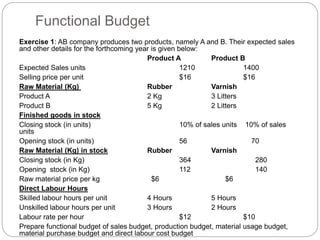
Exercise 1: AB company produces two products, namely A and B. Their expected sales
and other details for the forthcoming year is given below:
Product A Product B
Expected Sales units 1210 1400
Selling price per unit $16 $16
Raw Material (Kg) Rubber Varnish
Product A 2 Kg 3 Litters
Product B 5 Kg 2 Litters
Finished goods in stock
Closing stock (in units) 10% of sales units 10% of sales
units
Opening stock (in units) 56 70
Raw Material (Kg) in stock Rubber Varnish
Closing stock (in Kg) 364 280
Opening stock (in Kg) 112 140
Raw material price per kg $6 $6
Direct Labour Hours
Skilled labour hours per unit 4 Hours 5 Hours
Unskilled labour hours per unit 3 Hours 2 Hours
Labour rate per hour $12 $10
Prepare functional budget of sales budget, production budget, material usage budget,
material purchase budget and direct labour cost budget
Production Budget
Products Product
A
Product B
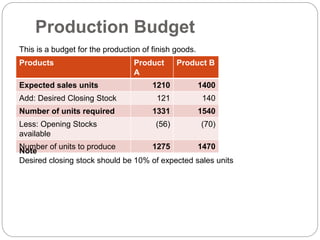
Expected sales units 1210 1400
Add: Desired Closing Stock 121 140
Number of units required 1331 1540
Less: Opening Stocks
available
(56) (70)
Number of units to produce 1275 1470
Note
Desired closing stock should be 10% of expected sales units
This is a budget for the production of finish goods.
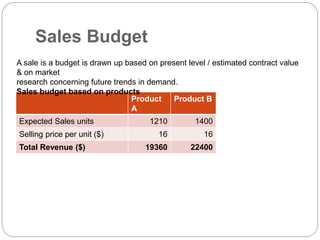
Sales Budget
Product
A
Product B
Expected Sales units 1210 1400
Selling price per unit ($) 16 16
Total Revenue ($) 19360 22400
A sale is a budget is drawn up based on present level / estimated contract value
& on market
research concerning future trends in demand.
Sales budget based on products
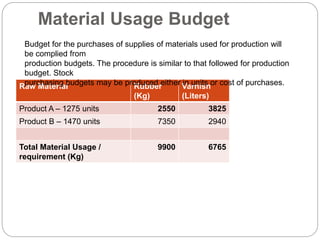
Material Usage Budget
Raw Material Rubber
(Kg)
Varnish
(Liters)
Product A – 1275 units 2550 3825
Product B – 1470 units 7350 2940
Total Material Usage /
requirement (Kg)
9900 6765
Budget for the purchases of supplies of materials used for production will
be complied from
production budgets. The procedure is similar to that followed for production
budget. Stock
purchasing budgets may be produced either in units or cost of purchases.
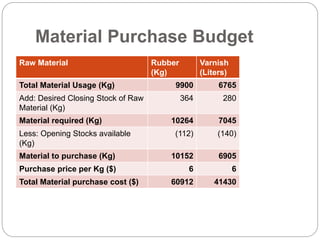
Material Purchase Budget
Raw Material Rubber
(Kg)
Varnish
(Liters)
Total Material Usage (Kg) 9900 6765
Add: Desired Closing Stock of Raw
Material (Kg)
364 280
Material required (Kg) 10264 7045
Less: Opening Stocks available
(Kg)
(112) (140)
Material to purchase (Kg) 10152 6905
Purchase price per Kg ($) 6 6
Total Material purchase cost ($) 60912 41430
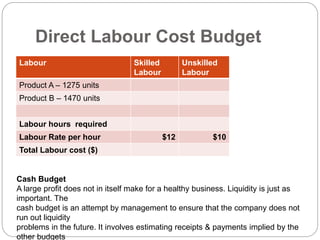
Direct Labour Cost Budget
Labour Skilled
Labour
Unskilled
Labour
Product A – 1275 units
Product B – 1470 units
Labour hours required
Labour Rate per hour $12 $10
Total Labour cost ($)
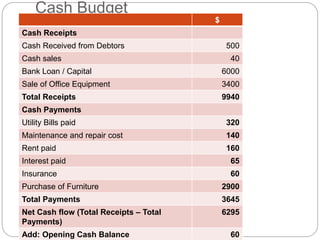
Cash Budget
A large profit does not in itself make for a healthy business. Liquidity is just as
important. The
cash budget is an attempt by management to ensure that the company does not
run out liquidity
problems in the future. It involves estimating receipts & payments implied by the
other budgets
Cash Budget
$
Cash Receipts
Cash Received from Debtors 500
Cash sales 40
Bank Loan / Capital 6000
Sale of Office Equipment 3400
Total Receipts 9940
Cash Payments
Utility Bills paid 320
Maintenance and repair cost 140
Rent paid 160
Interest paid 65
Insurance 60
Purchase of Furniture 2900
Total Payments 3645
Net Cash flow (Total Receipts – Total
Payments)
6295
Add: Opening Cash Balance 60

Budgeting, a worked example

  • 1.
  • 2.
    What is abudgeting? The first drawn is long term plan to achieve the goals, as a second step we draw a short term plan which helps to achieve long term plans. the long term or short term plan is expressed in financial terms, it is more formal and deliberate in a process known as budgeting. A budget is detail plan of action for a future period, expressed in numbers. An organization can include budget for both:  Long-term plans  Short-term plans
  • 3.
    Purpose of Budgeting Planning Forward planning forces managers to consider in alternative future cause of action, to evaluate them properly to decide on the best alternative. It also encourage managers to anticipate problems before they arises, thus giving them self time to consider alternative ways of overcoming them when they do happen.  Co-ordination Left to their own devices, department managers may make decisions about the future which are incompatible or even in conflict with other department. E.g. Marketing and finance dept., sales and production dept.
  • 4.
    Purpose of Budgeting Control & performance evaluation Control over actual performance is provided by the comparisons of actual results against the budget plan. Deviations from budget can then be investigated and the reasons for the departures can be divided into controllable and uncontrollable.  Participation By actively involving managers at all stages of hierarchy, the process budgeting brings the different levels closer together.
  • 5.
    Main types ofbudgets  overall budget is made up of a functional budget for each section of its activities. A formal sequence of drawing up these budgets would be as follows. Functional Budgets 01. The sales budget. 02. The production budget. 03. The material usage budgets. 04. The material purchase budgets. 05. The labour cost budget . 06. The Overhead cost budget The master budget 01. the cash budget.
  • 6.
    Functional Budget Exercise 1:AB company produces two products, namely A and B. Their expected sales and other details for the forthcoming year is given below: Product A Product B Expected Sales units 1210 1400 Selling price per unit $16 $16 Raw Material (Kg) Rubber Varnish Product A 2 Kg 3 Litters Product B 5 Kg 2 Litters Finished goods in stock Closing stock (in units) 10% of sales units 10% of sales units Opening stock (in units) 56 70 Raw Material (Kg) in stock Rubber Varnish Closing stock (in Kg) 364 280 Opening stock (in Kg) 112 140 Raw material price per kg $6 $6 Direct Labour Hours Skilled labour hours per unit 4 Hours 5 Hours Unskilled labour hours per unit 3 Hours 2 Hours Labour rate per hour $12 $10 Prepare functional budget of sales budget, production budget, material usage budget, material purchase budget and direct labour cost budget
  • 7.
    Production Budget Products Product A ProductB Expected sales units 1210 1400 Add: Desired Closing Stock 121 140 Number of units required 1331 1540 Less: Opening Stocks available (56) (70) Number of units to produce 1275 1470 Note Desired closing stock should be 10% of expected sales units This is a budget for the production of finish goods.
  • 8.
    Sales Budget Product A Product B ExpectedSales units 1210 1400 Selling price per unit ($) 16 16 Total Revenue ($) 19360 22400 A sale is a budget is drawn up based on present level / estimated contract value & on market research concerning future trends in demand. Sales budget based on products
  • 9.
    Material Usage Budget RawMaterial Rubber (Kg) Varnish (Liters) Product A – 1275 units 2550 3825 Product B – 1470 units 7350 2940 Total Material Usage / requirement (Kg) 9900 6765 Budget for the purchases of supplies of materials used for production will be complied from production budgets. The procedure is similar to that followed for production budget. Stock purchasing budgets may be produced either in units or cost of purchases.
  • 10.
    Material Purchase Budget RawMaterial Rubber (Kg) Varnish (Liters) Total Material Usage (Kg) 9900 6765 Add: Desired Closing Stock of Raw Material (Kg) 364 280 Material required (Kg) 10264 7045 Less: Opening Stocks available (Kg) (112) (140) Material to purchase (Kg) 10152 6905 Purchase price per Kg ($) 6 6 Total Material purchase cost ($) 60912 41430
  • 11.
    Direct Labour CostBudget Labour Skilled Labour Unskilled Labour Product A – 1275 units Product B – 1470 units Labour hours required Labour Rate per hour $12 $10 Total Labour cost ($) Cash Budget A large profit does not in itself make for a healthy business. Liquidity is just as important. The cash budget is an attempt by management to ensure that the company does not run out liquidity problems in the future. It involves estimating receipts & payments implied by the other budgets
  • 12.
    Cash Budget $ Cash Receipts CashReceived from Debtors 500 Cash sales 40 Bank Loan / Capital 6000 Sale of Office Equipment 3400 Total Receipts 9940 Cash Payments Utility Bills paid 320 Maintenance and repair cost 140 Rent paid 160 Interest paid 65 Insurance 60 Purchase of Furniture 2900 Total Payments 3645 Net Cash flow (Total Receipts – Total Payments) 6295 Add: Opening Cash Balance 60