Btrfs
Design, Implementation and the Current Status

Red Hat
Luk´ˇ Czerner
   as
February 18, 2012
Copyright ©    2012 Luk´ˇ Czerner, Red Hat.
                         as
Permission is granted to copy, distribute and/or modify this
document under the terms of the GNU Free Documentation
License, Version 1.3 or any later version published by the Free
Software Foundation; with no Invariant Sections, no Front-Cover
Texts, and no Back-Cover Texts. A copy of the license is included
in the COPYING file.
Agenda


 1   Btrfs and its place in the Linux file system world
 2   Design and implementation of Btrfs
 3   Btrfs Features
 4   Current status
 5   Who writes Btrfs
Part I
Btrfs and its place in the Linux file system
world
Linux file systems


Linux kernel file systems


   There are approximately 55 kernel file systems in Linux kernel
   tree
   A lot of them has limited or specific use
   ExtN file system family considered the only ”general purpose
   file system” for a long time
   Most active local file systems = xfs, btrfs, ext4
Linux file systems


Linux kernel file systems challenges

   Scalability - ability to grow and remain efficient
        ext4 just breached 16TB limit
        xfs scale up to 200TB and more
   Reliability - ability to recover from incidents
        Silent data corruption
        Metadata corruption tolerance
        File system repair on huge file systems
   Advanced Features - more than just storing data
        Snapshotting
        Encryption
   Ease of use - reduce administration overhead
        Growing storage stack - administration overhead
Place for Btrfs


What Btrfs has to offer ?
   Scalability
       Does not have fixed positions for metadata (mostly)
       16 EiB file/file system size limit
   Reliability
       Very fast file system creation
       Possibly very fast file system check
       Data + metadata checksumming
       Incremental backup + snapshotting
       Online scrub to find and fix problems
   Advanced features
       Integrated volume management (RAID)
       Integrated snapshotting support
       Reflink
   Ease of use
       Integrated easy-to-use volume management
Brief history of Btrfs


The idea


   IBM researcher Ohad Rodeh at Linux Storage and File system
   workshop 2007
   COW friendly btree
       Leaves can not be linked to their neighbors
       Reference counting for easy tree cloning
       Proactive merge/split
Brief history of Btrfs


The file system


   Chris Mason liked the idea of COW friendly Btrees
   Lot of previous experience from Reiserfs
   Using COW btree for every object in the file system
       COW advantages for free
Part II
Design and implementation of Btrfs
Design


Generic btree implementation for all objects


   The tree does not care about object types
   Each tree block carries header and key
       Header stores the location on disk + pointers to other blocks
       The key defines order in the tree block layout
   Regardless on the operation btrfs uses the same code path
       Reads
       Writes
       Data / Metadata allocation
File system layout


Superblock


   Stored on all devices
   Mirror copies of superblock kept up-to-date (not in SSD case)
   Main trees positions
       root tree
       chunk tree
       log tree
File system layout


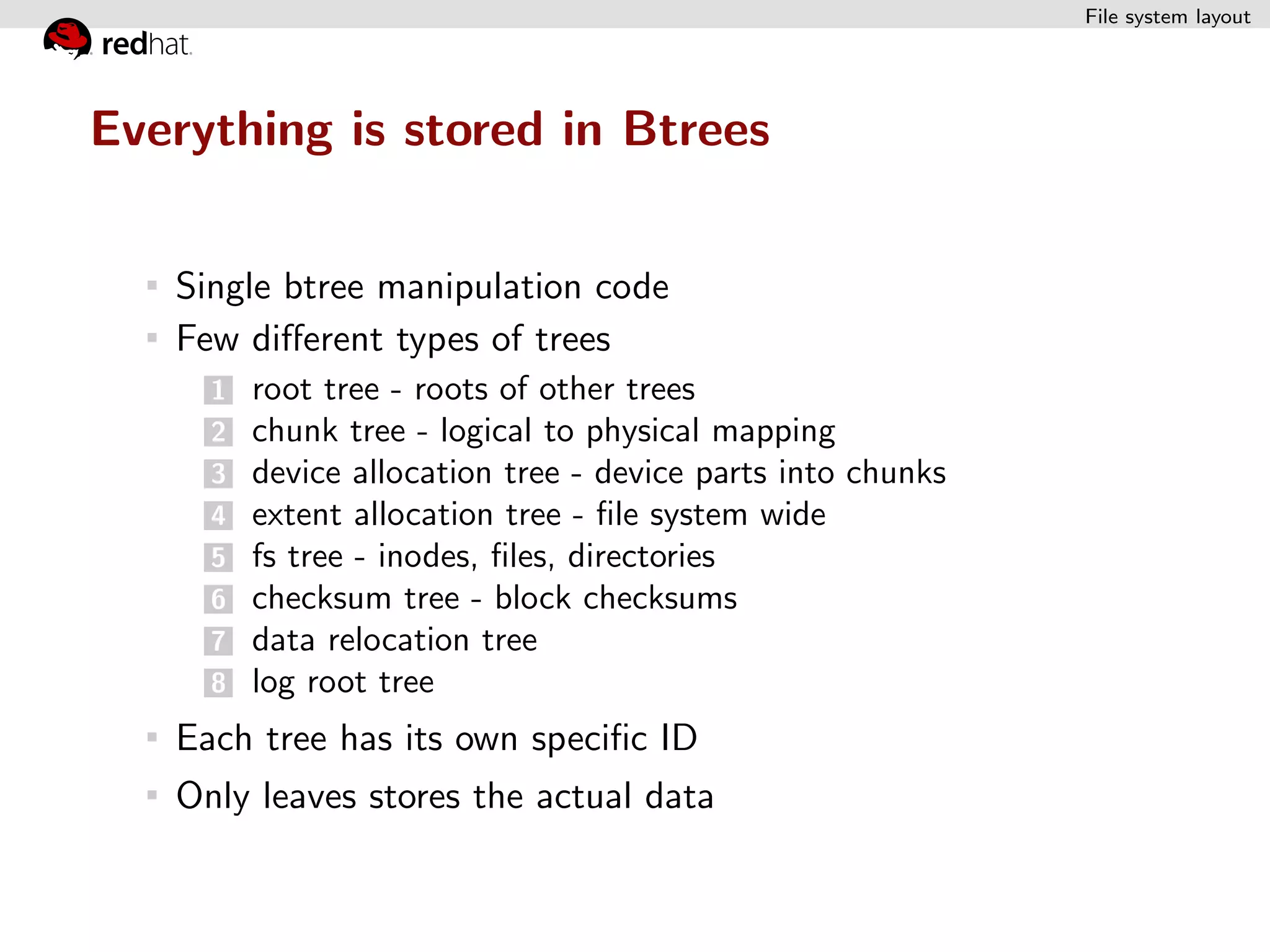
Everything is stored in Btrees


   Single btree manipulation code
   Few different types of trees
     1 root tree - roots of other trees
     2 chunk tree - logical to physical mapping
     3 device allocation tree - device parts into chunks
     4 extent allocation tree - file system wide
     5 fs tree - inodes, files, directories
     6 checksum tree - block checksums
     7 data relocation tree
     8 log root tree

   Each tree has its own specific ID
   Only leaves stores the actual data
File system layout


Leaves and nodes
    Every tree block is either leaf or node
    Every leaf and node begins with the header
    Nodes [header, key ptr0....key ptrN]
struct btrfs_node {                struct btrfs_key_ptr {
    struct btrfs_header header;        struct btrfs_disk_key;
    struct btrfs_key_ptr ptrs[];       __le64 blockptr;
}                                      __le64 generation;
                                   }


    Leaves [item0....itemN] [free space] [dataN...data0]
struct btrfs_leaf {                struct btrfs_item {
    struct btrfs_header header;        struct btrfs_disk_key key;
    struct btrfs_item items[];         __le32 offset;
}                                      __le32 size;
                                   }
Part III
Btrfs Features
Transactions


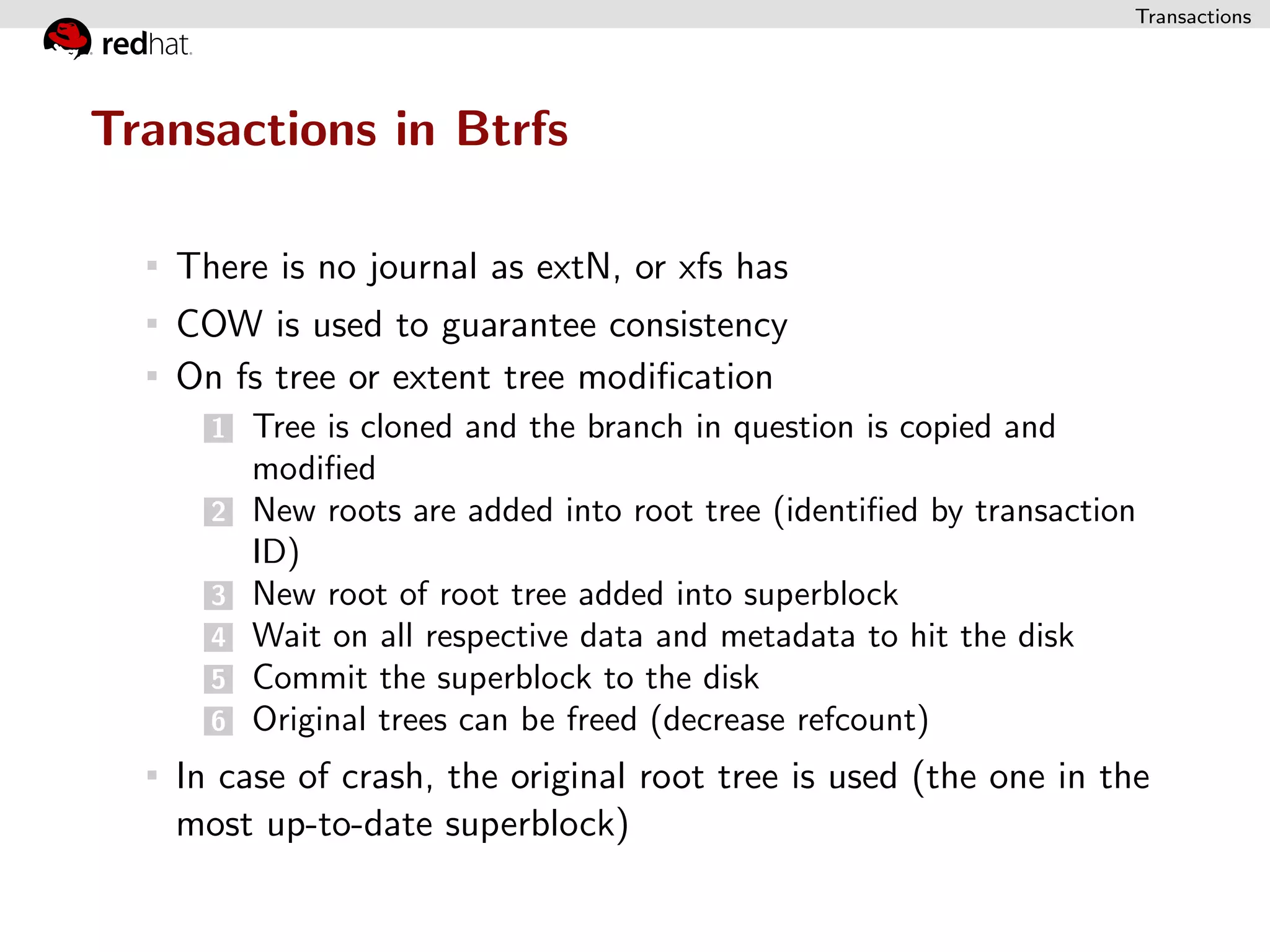
Transactions in Btrfs

   There is no journal as extN, or xfs has
   COW is used to guarantee consistency
   On fs tree or extent tree modification
     1   Tree is cloned and the branch in question is copied and
         modified
     2   New roots are added into root tree (identified by transaction
         ID)
     3   New root of root tree added into superblock
     4   Wait on all respective data and metadata to hit the disk
     5   Commit the superblock to the disk
     6   Original trees can be freed (decrease refcount)
   In case of crash, the original root tree is used (the one in the
   most up-to-date superblock)
Snapshots


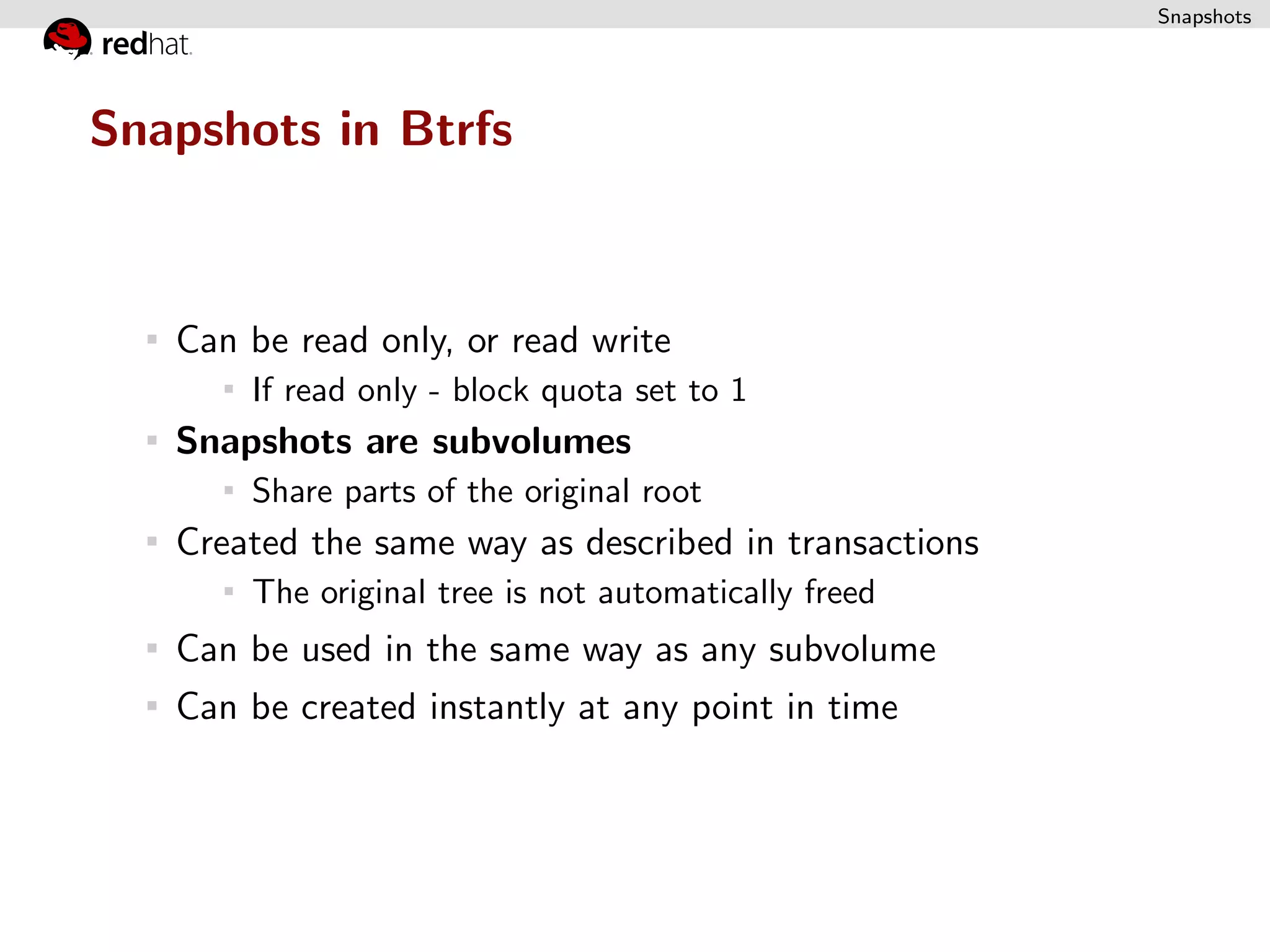
Snapshots in Btrfs


   Can be read only, or read write
       If read only - block quota set to 1
   Snapshots are subvolumes
       Share parts of the original root
   Created the same way as described in transactions
       The original tree is not automatically freed
   Can be used in the same way as any subvolume
   Can be created instantly at any point in time
Checksums


Checksums in Btrfs


   Both metadata and data are checksummed
   Checksummed blocks of different sizes (data extents)
   Calculated only before written out to the disk
   Data + Metadata can be verified after read from disk
   Improves reliability
   Online failover
   Online scrub
Online scrub


File system scrub


   Using checksums to validate all data + metadata
   Can fix errors if possible (mirror setup)
   Works online at a background
   start, cancel, resume, status
   btrfs scrub start [-Bdqr] {<path>|<device>}
Volume management


Volume management


   Multi-disk support
       Easy to add / remove drives - pooling
       Multiple extent allocation trees
       Raid0, Raid1, Raid10
   Subvolumes
       Multiple fs roots allows creating multiple subvolumes
       Each subvolume appears as directory in root volume
       Create snapshot of a subvolume (snapshot of snapshot of ...)
       You can easily mount a subvolume with -o subvol=<name>
       or subvolid=<ID>
       Users manage subvolumes in their subvolume
       Easy-to-use management
File system check


File system check


   It is ready now (sort of)
   Should be really ready by this summer (maybe)
   Has ambitions to be really fast
   Memory consumption should be quite low
And more


And more


   Online defragmentation
   Online balancing
   Transparent compression
   Data deduplication
   Data encryption
   Volume balancing
Part IV
Current status
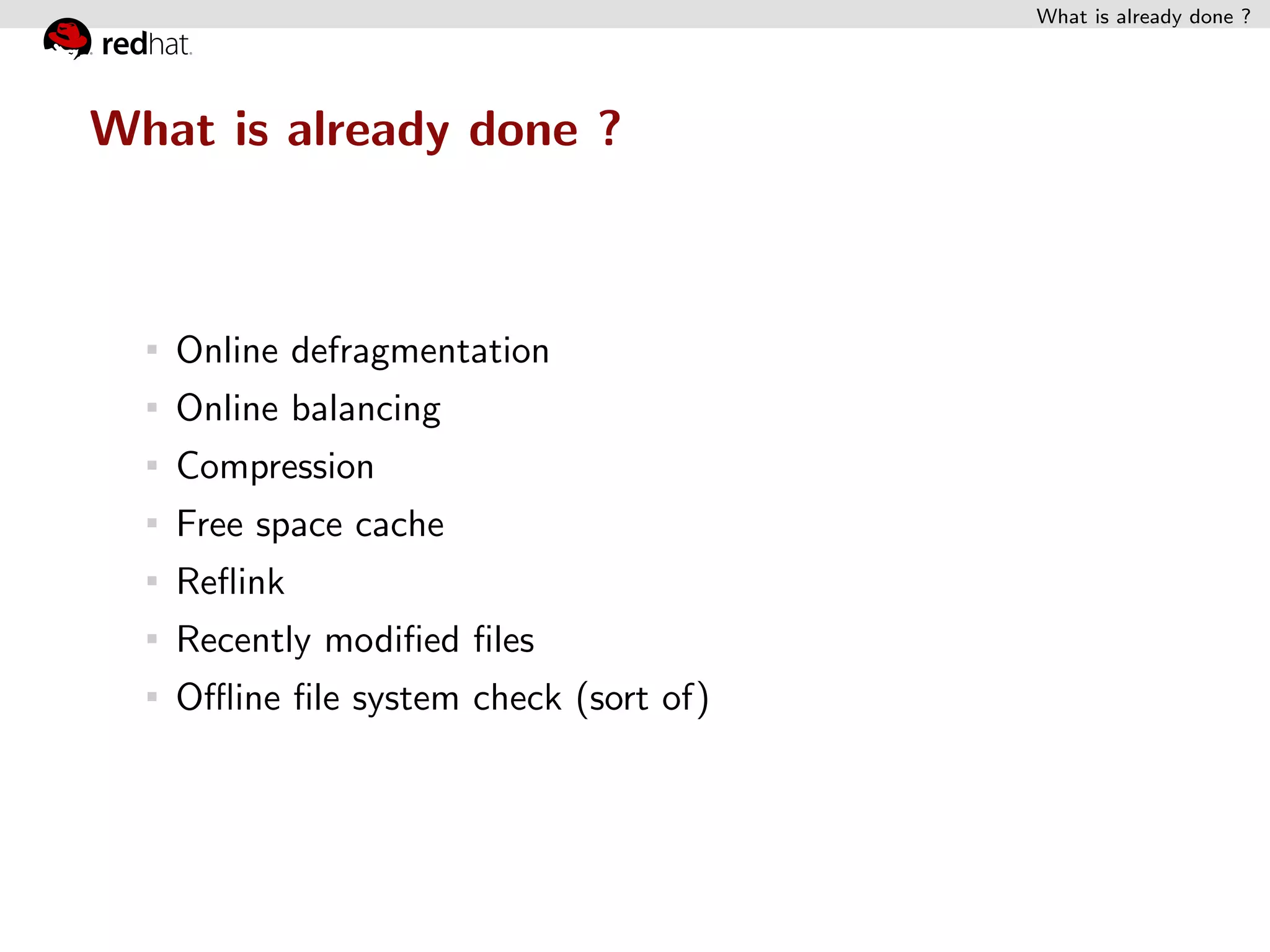
What is already done ?


What is already done ?


   Online defragmentation
   Online balancing
   Compression
   Free space cache
   Reflink
   Recently modified files
   Offline file system check (sort of)
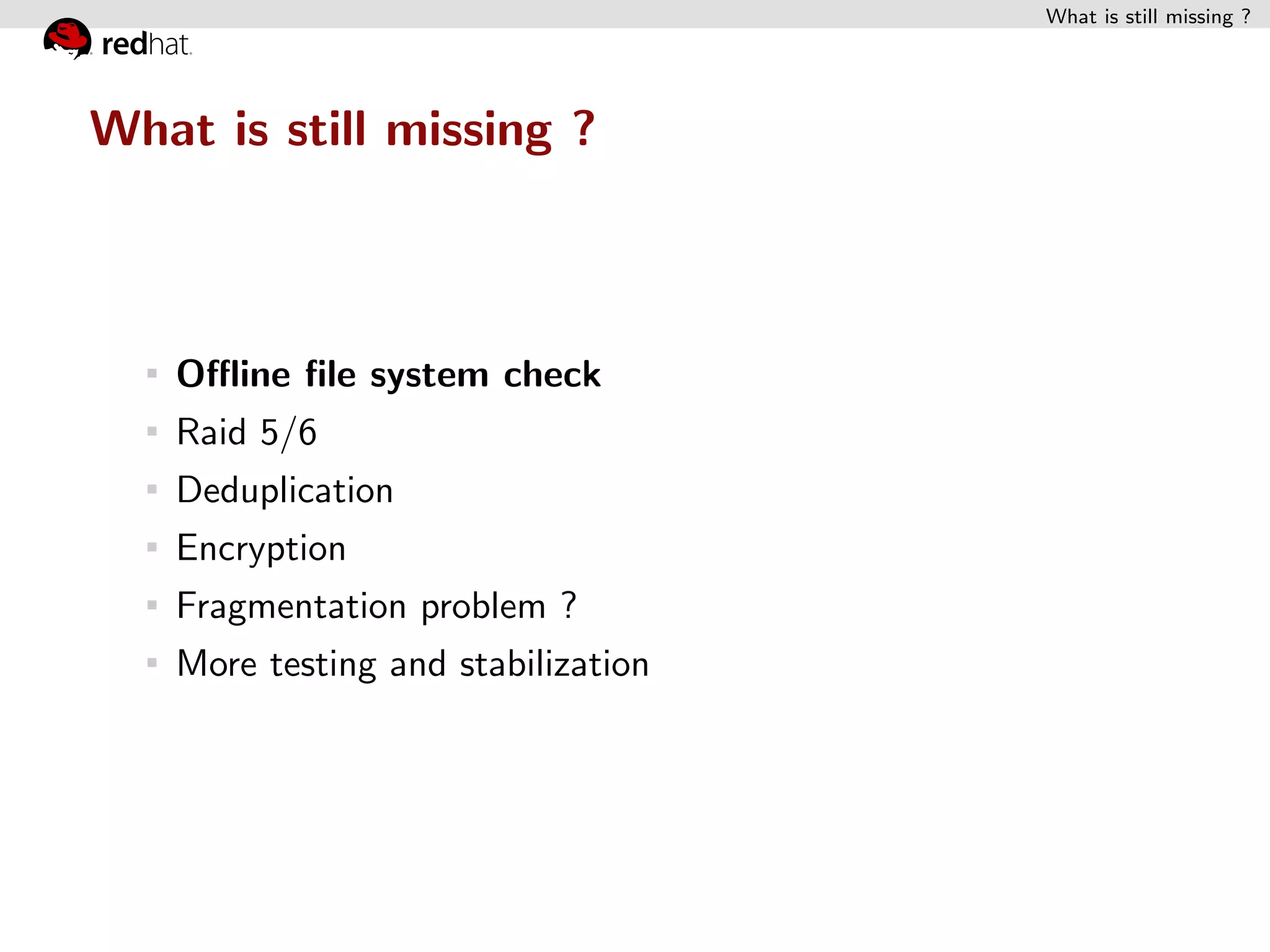
What is still missing ?


What is still missing ?


   Offline file system check
   Raid 5/6
   Deduplication
   Encryption
   Fragmentation problem ?
   More testing and stabilization
Part V
Who writes Btrfs?
Who writes Btrfs?


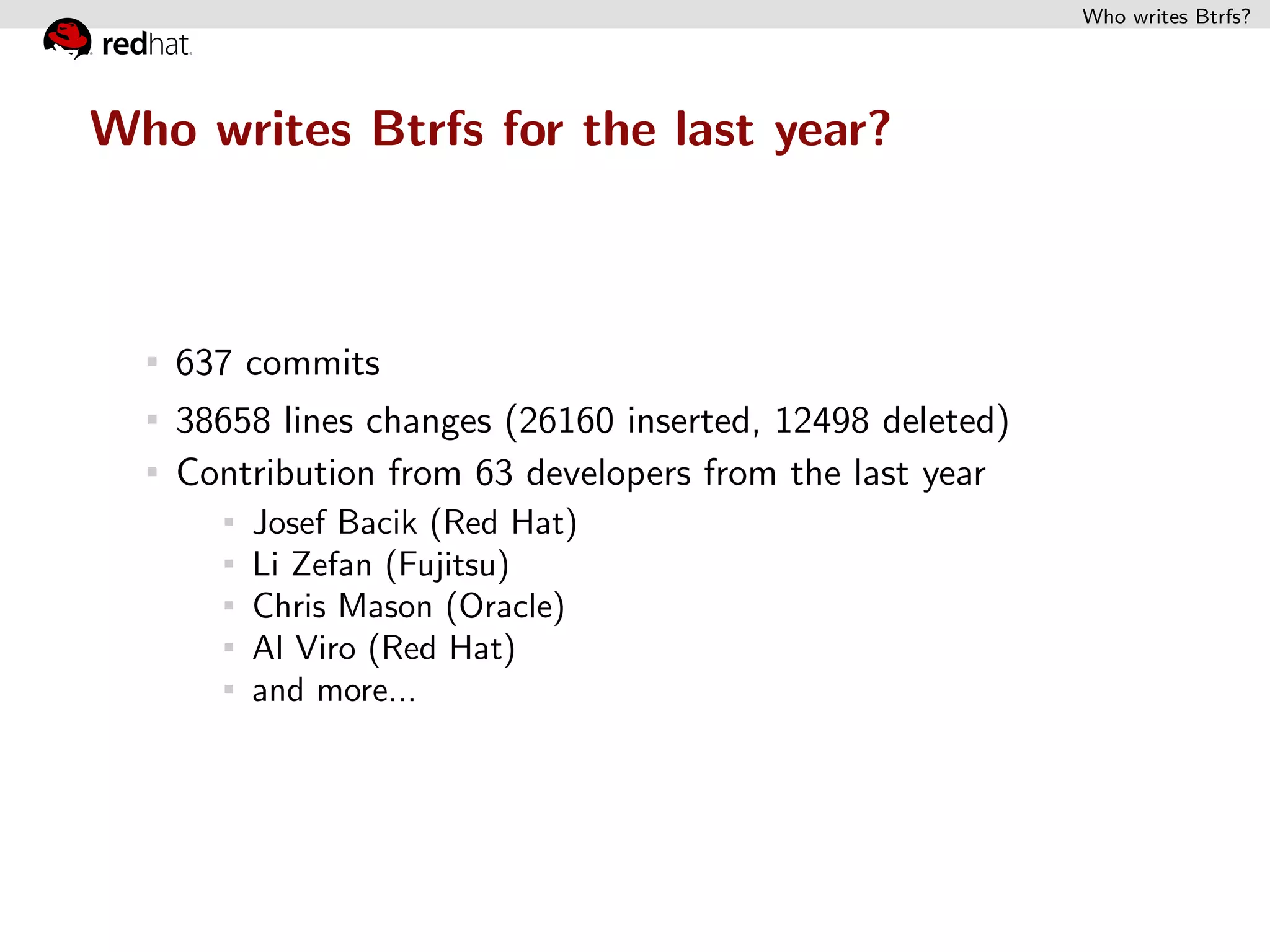
Who writes Btrfs for the last year?


   637 commits
   38658 lines changes (26160 inserted, 12498 deleted)
   Contribution from 63 developers from the last year
       Josef Bacik (Red Hat)
       Li Zefan (Fujitsu)
       Chris Mason (Oracle)
       Al Viro (Red Hat)
       and more...
The end.
Thanks for listening.

Btrfs: Design, Implementation and the Current Status

  • 1.
    Btrfs Design, Implementation andthe Current Status Red Hat Luk´ˇ Czerner as February 18, 2012
  • 2.
    Copyright © 2012 Luk´ˇ Czerner, Red Hat. as Permission is granted to copy, distribute and/or modify this document under the terms of the GNU Free Documentation License, Version 1.3 or any later version published by the Free Software Foundation; with no Invariant Sections, no Front-Cover Texts, and no Back-Cover Texts. A copy of the license is included in the COPYING file.
  • 3.
    Agenda 1 Btrfs and its place in the Linux file system world 2 Design and implementation of Btrfs 3 Btrfs Features 4 Current status 5 Who writes Btrfs
  • 4.
    Part I Btrfs andits place in the Linux file system world
  • 5.
    Linux file systems Linuxkernel file systems There are approximately 55 kernel file systems in Linux kernel tree A lot of them has limited or specific use ExtN file system family considered the only ”general purpose file system” for a long time Most active local file systems = xfs, btrfs, ext4
  • 6.
    Linux file systems Linuxkernel file systems challenges Scalability - ability to grow and remain efficient ext4 just breached 16TB limit xfs scale up to 200TB and more Reliability - ability to recover from incidents Silent data corruption Metadata corruption tolerance File system repair on huge file systems Advanced Features - more than just storing data Snapshotting Encryption Ease of use - reduce administration overhead Growing storage stack - administration overhead
  • 7.
    Place for Btrfs WhatBtrfs has to offer ? Scalability Does not have fixed positions for metadata (mostly) 16 EiB file/file system size limit Reliability Very fast file system creation Possibly very fast file system check Data + metadata checksumming Incremental backup + snapshotting Online scrub to find and fix problems Advanced features Integrated volume management (RAID) Integrated snapshotting support Reflink Ease of use Integrated easy-to-use volume management
  • 8.
    Brief history ofBtrfs The idea IBM researcher Ohad Rodeh at Linux Storage and File system workshop 2007 COW friendly btree Leaves can not be linked to their neighbors Reference counting for easy tree cloning Proactive merge/split
  • 9.
    Brief history ofBtrfs The file system Chris Mason liked the idea of COW friendly Btrees Lot of previous experience from Reiserfs Using COW btree for every object in the file system COW advantages for free
  • 10.
    Part II Design andimplementation of Btrfs
  • 11.
    Design Generic btree implementationfor all objects The tree does not care about object types Each tree block carries header and key Header stores the location on disk + pointers to other blocks The key defines order in the tree block layout Regardless on the operation btrfs uses the same code path Reads Writes Data / Metadata allocation
  • 12.
    File system layout Superblock Stored on all devices Mirror copies of superblock kept up-to-date (not in SSD case) Main trees positions root tree chunk tree log tree
  • 13.
    File system layout Everythingis stored in Btrees Single btree manipulation code Few different types of trees 1 root tree - roots of other trees 2 chunk tree - logical to physical mapping 3 device allocation tree - device parts into chunks 4 extent allocation tree - file system wide 5 fs tree - inodes, files, directories 6 checksum tree - block checksums 7 data relocation tree 8 log root tree Each tree has its own specific ID Only leaves stores the actual data
  • 14.
    File system layout Leavesand nodes Every tree block is either leaf or node Every leaf and node begins with the header Nodes [header, key ptr0....key ptrN] struct btrfs_node { struct btrfs_key_ptr { struct btrfs_header header; struct btrfs_disk_key; struct btrfs_key_ptr ptrs[]; __le64 blockptr; } __le64 generation; } Leaves [item0....itemN] [free space] [dataN...data0] struct btrfs_leaf { struct btrfs_item { struct btrfs_header header; struct btrfs_disk_key key; struct btrfs_item items[]; __le32 offset; } __le32 size; }
  • 15.
  • 16.
    Transactions Transactions in Btrfs There is no journal as extN, or xfs has COW is used to guarantee consistency On fs tree or extent tree modification 1 Tree is cloned and the branch in question is copied and modified 2 New roots are added into root tree (identified by transaction ID) 3 New root of root tree added into superblock 4 Wait on all respective data and metadata to hit the disk 5 Commit the superblock to the disk 6 Original trees can be freed (decrease refcount) In case of crash, the original root tree is used (the one in the most up-to-date superblock)
  • 17.
    Snapshots Snapshots in Btrfs Can be read only, or read write If read only - block quota set to 1 Snapshots are subvolumes Share parts of the original root Created the same way as described in transactions The original tree is not automatically freed Can be used in the same way as any subvolume Can be created instantly at any point in time
  • 18.
    Checksums Checksums in Btrfs Both metadata and data are checksummed Checksummed blocks of different sizes (data extents) Calculated only before written out to the disk Data + Metadata can be verified after read from disk Improves reliability Online failover Online scrub
  • 19.
    Online scrub File systemscrub Using checksums to validate all data + metadata Can fix errors if possible (mirror setup) Works online at a background start, cancel, resume, status btrfs scrub start [-Bdqr] {<path>|<device>}
  • 20.
    Volume management Volume management Multi-disk support Easy to add / remove drives - pooling Multiple extent allocation trees Raid0, Raid1, Raid10 Subvolumes Multiple fs roots allows creating multiple subvolumes Each subvolume appears as directory in root volume Create snapshot of a subvolume (snapshot of snapshot of ...) You can easily mount a subvolume with -o subvol=<name> or subvolid=<ID> Users manage subvolumes in their subvolume Easy-to-use management
  • 21.
    File system check Filesystem check It is ready now (sort of) Should be really ready by this summer (maybe) Has ambitions to be really fast Memory consumption should be quite low
  • 22.
    And more And more Online defragmentation Online balancing Transparent compression Data deduplication Data encryption Volume balancing
  • 23.
  • 24.
    What is alreadydone ? What is already done ? Online defragmentation Online balancing Compression Free space cache Reflink Recently modified files Offline file system check (sort of)
  • 25.
    What is stillmissing ? What is still missing ? Offline file system check Raid 5/6 Deduplication Encryption Fragmentation problem ? More testing and stabilization
  • 26.
  • 27.
    Who writes Btrfs? Whowrites Btrfs for the last year? 637 commits 38658 lines changes (26160 inserted, 12498 deleted) Contribution from 63 developers from the last year Josef Bacik (Red Hat) Li Zefan (Fujitsu) Chris Mason (Oracle) Al Viro (Red Hat) and more...
  • 28.