A BT Group Case Study:  Finance transformation – Finance Shared services  Ralph Geertsema Head of Finance Transformation BT Group plc, London
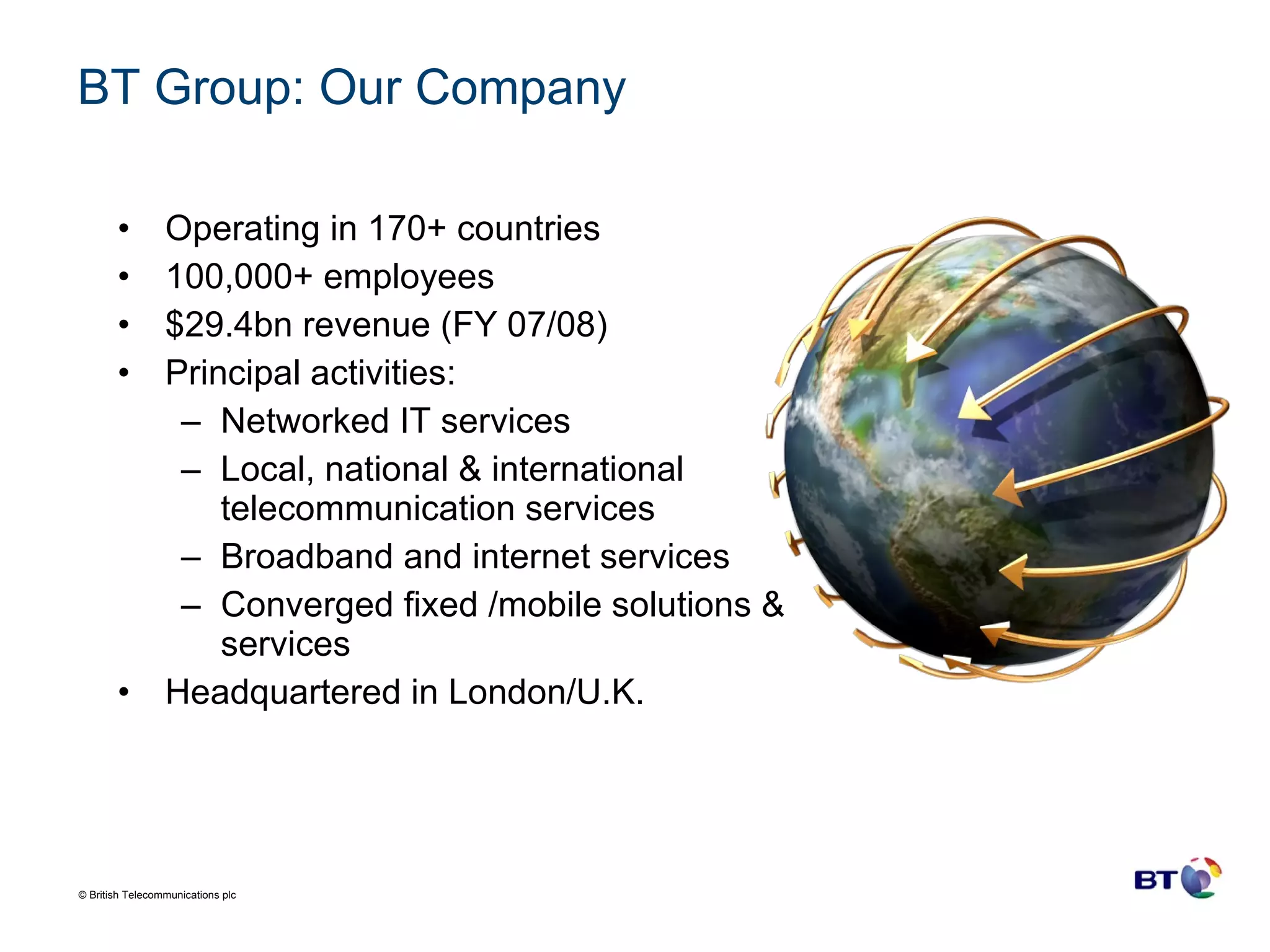
BT Group: Our Company Operating in 170+ countries 100,000+ employees $29.4bn revenue (FY 07/08)  Principal activities:  Networked IT services Local, national & international telecommunication services Broadband and internet services Converged fixed /mobile solutions & services Headquartered in London/U.K.
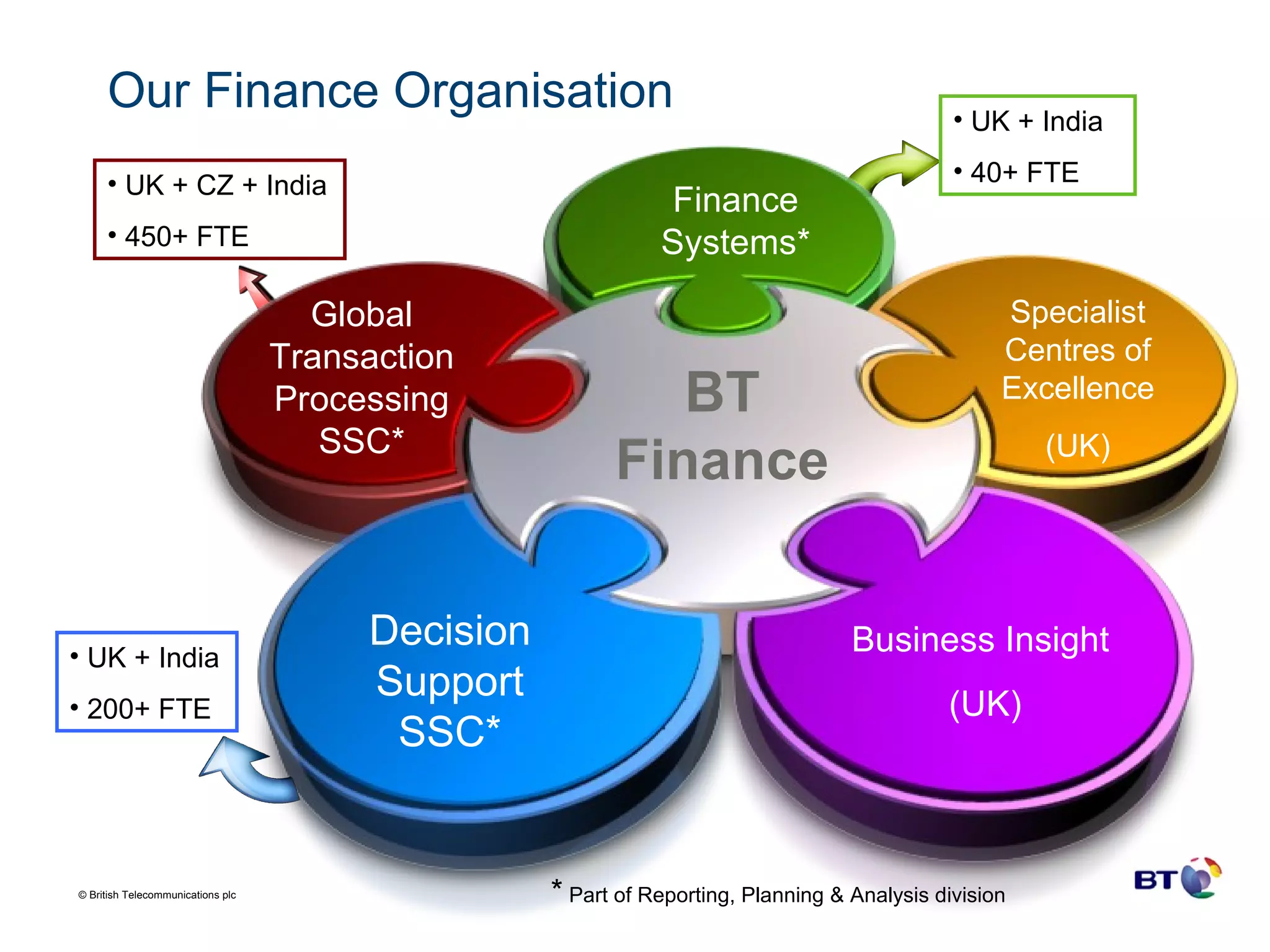
Our Finance Organisation BT Finance Global Transaction Processing SSC* Decision Support SSC* Finance Systems* Business Insight  (UK) Specialist Centres of Excellence (UK) UK + India 200+ FTE UK + CZ + India 450+ FTE UK + India 40+ FTE *  Part of Reporting, Planning & Analysis division
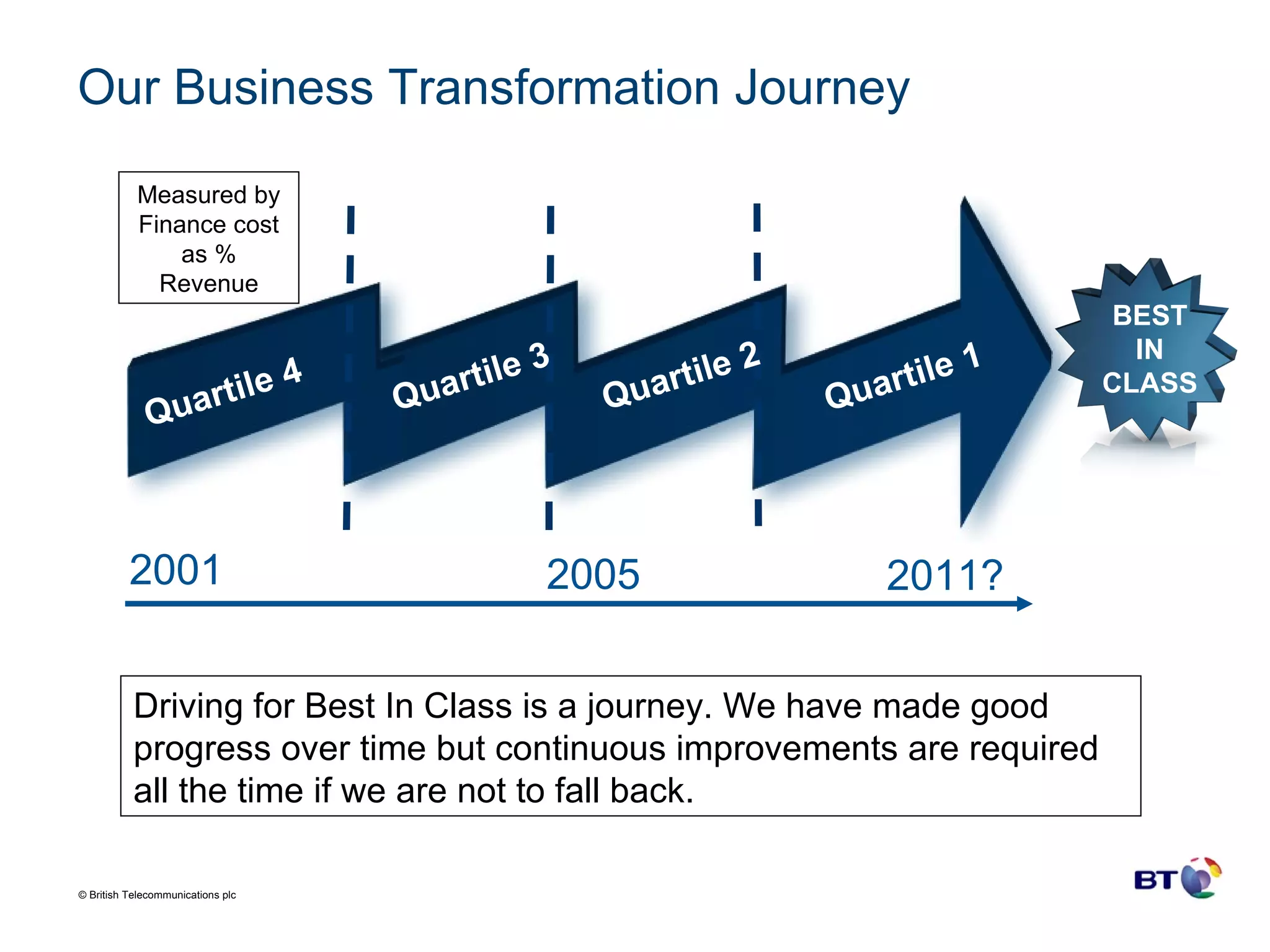
Our Business Transformation Journey 2011? Quartile 4 BEST IN CLASS Quartile 3 Quartile 2 Quartile 1 2001 Driving for Best In Class is a journey. We have made good progress over time but continuous improvements are required all the time if we are not to fall back. 2005 Measured by Finance cost as % Revenue
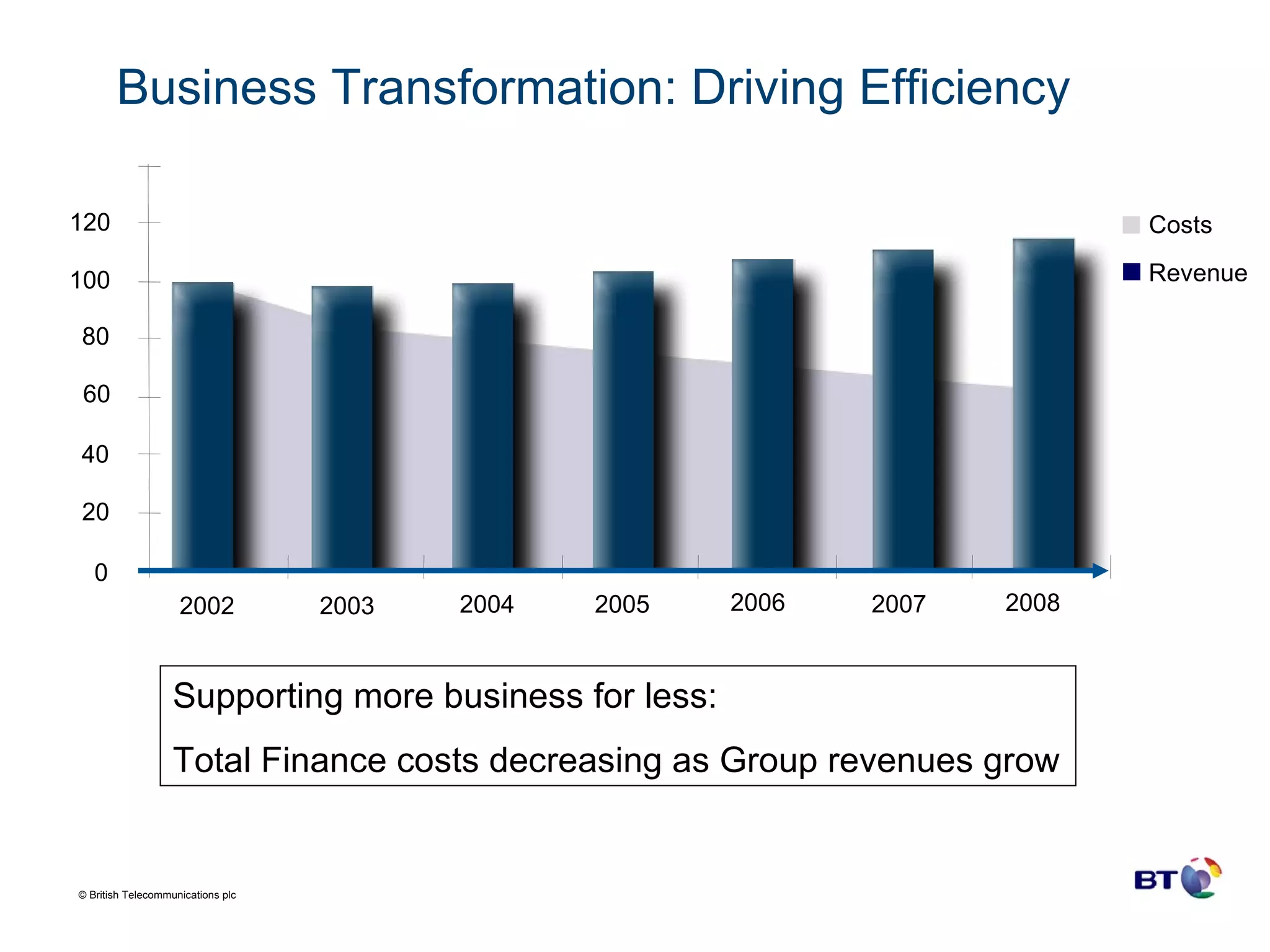
Business Transformation: Driving Efficiency Supporting more business for less:  Total Finance costs decreasing as Group revenues grow 2002 2003 2004 2005 2006 2007 2008 Costs Revenue 40 20 0 60 80 100 120
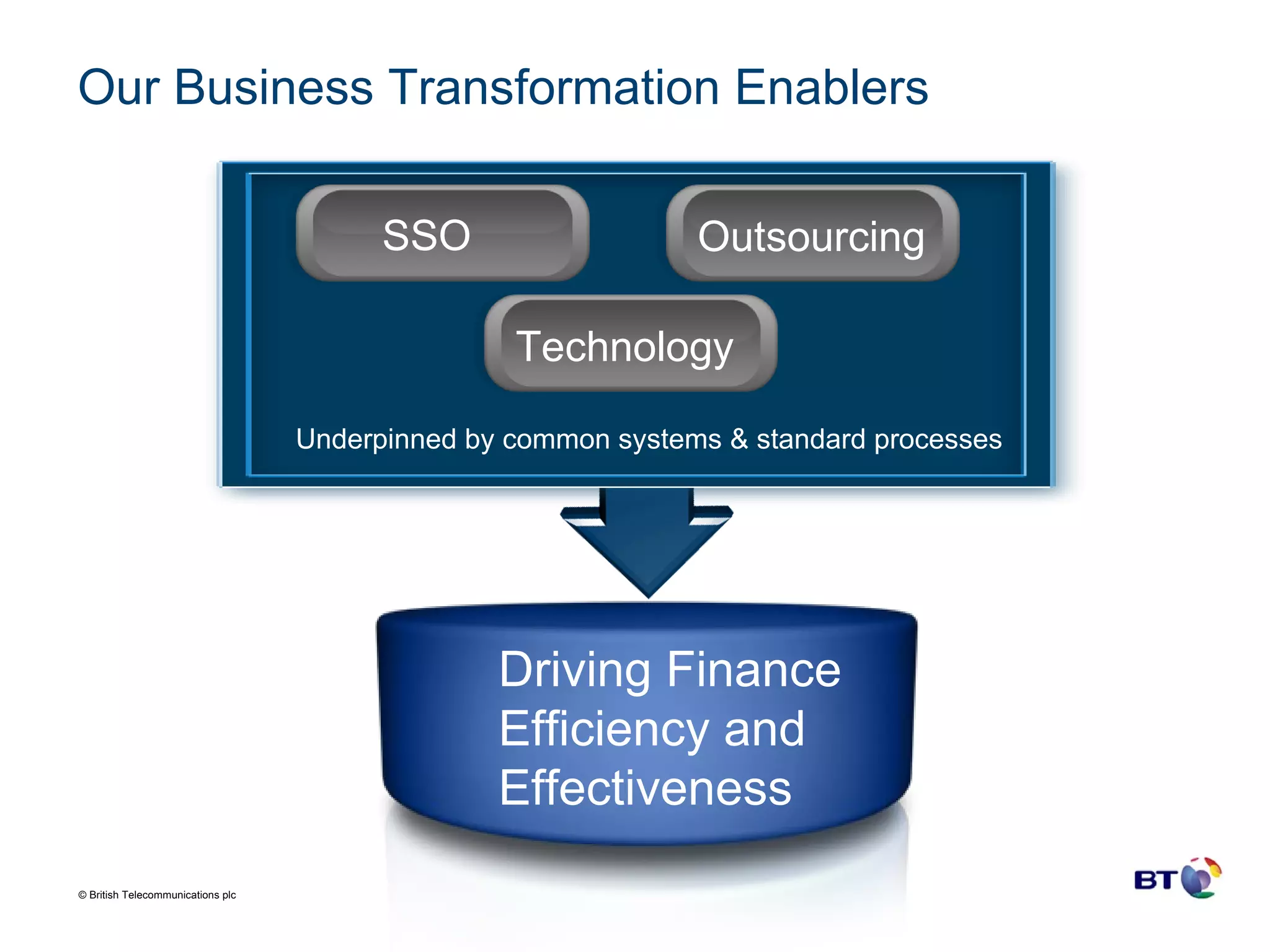
Our Business Transformation Enablers SSO Technology Outsourcing Driving Finance Efficiency and Effectiveness Underpinned by common systems & standard processes
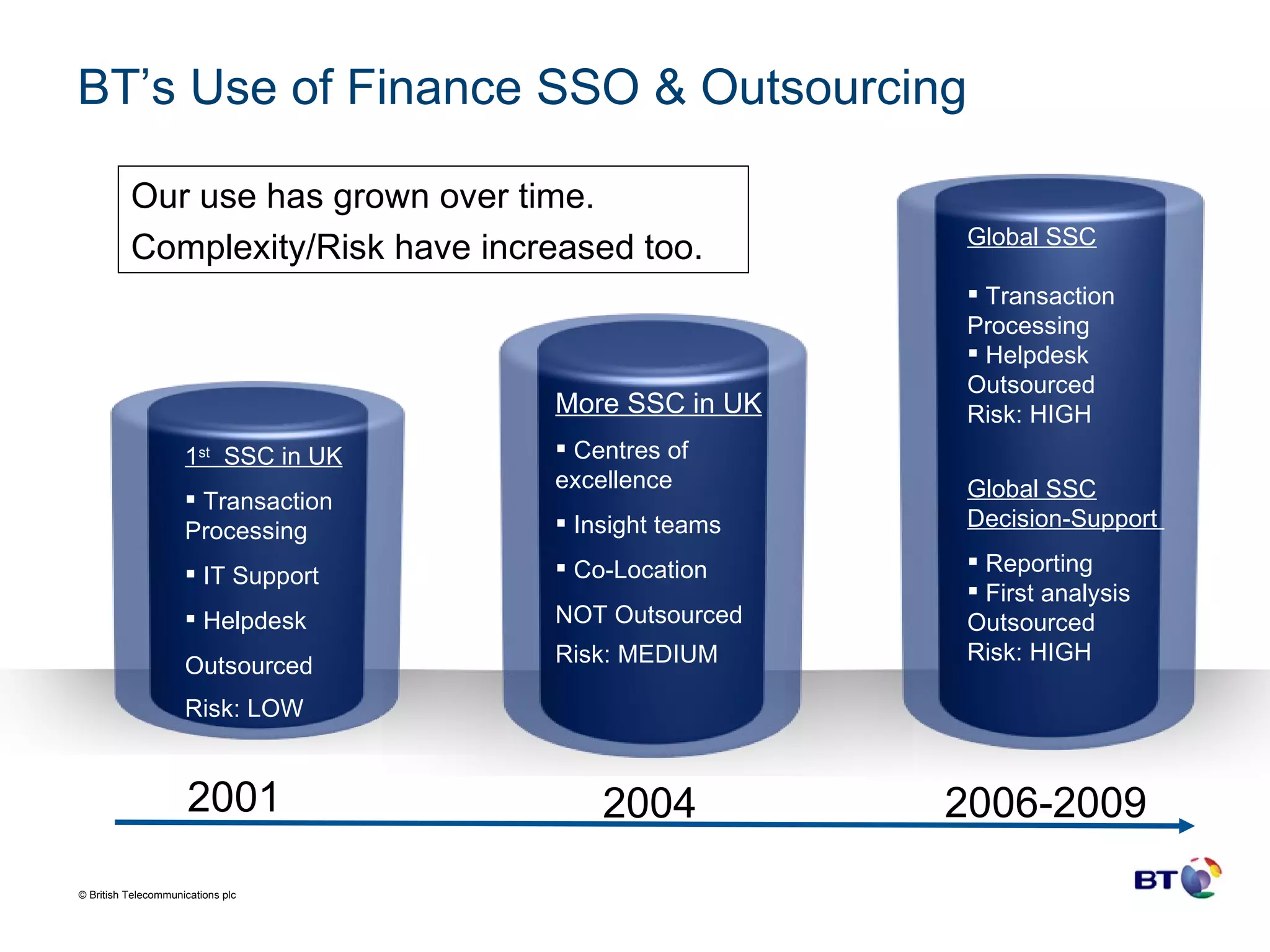
BT’s Use of Finance SSO & Outsourcing  2001 2004 2006-2009 1 st   SSC in UK Transaction Processing  IT Support Helpdesk Outsourced Risk: LOW   More SSC in UK Centres of  excellence Insight teams Co-Location  NOT Outsourced Risk: MEDIUM   Global SSC Transaction Processing Helpdesk Outsourced Risk: HIGH Global SSC Decision-Support  Reporting First analysis Outsourced  Risk: HIGH Our use has grown over time. Complexity/Risk have increased too.
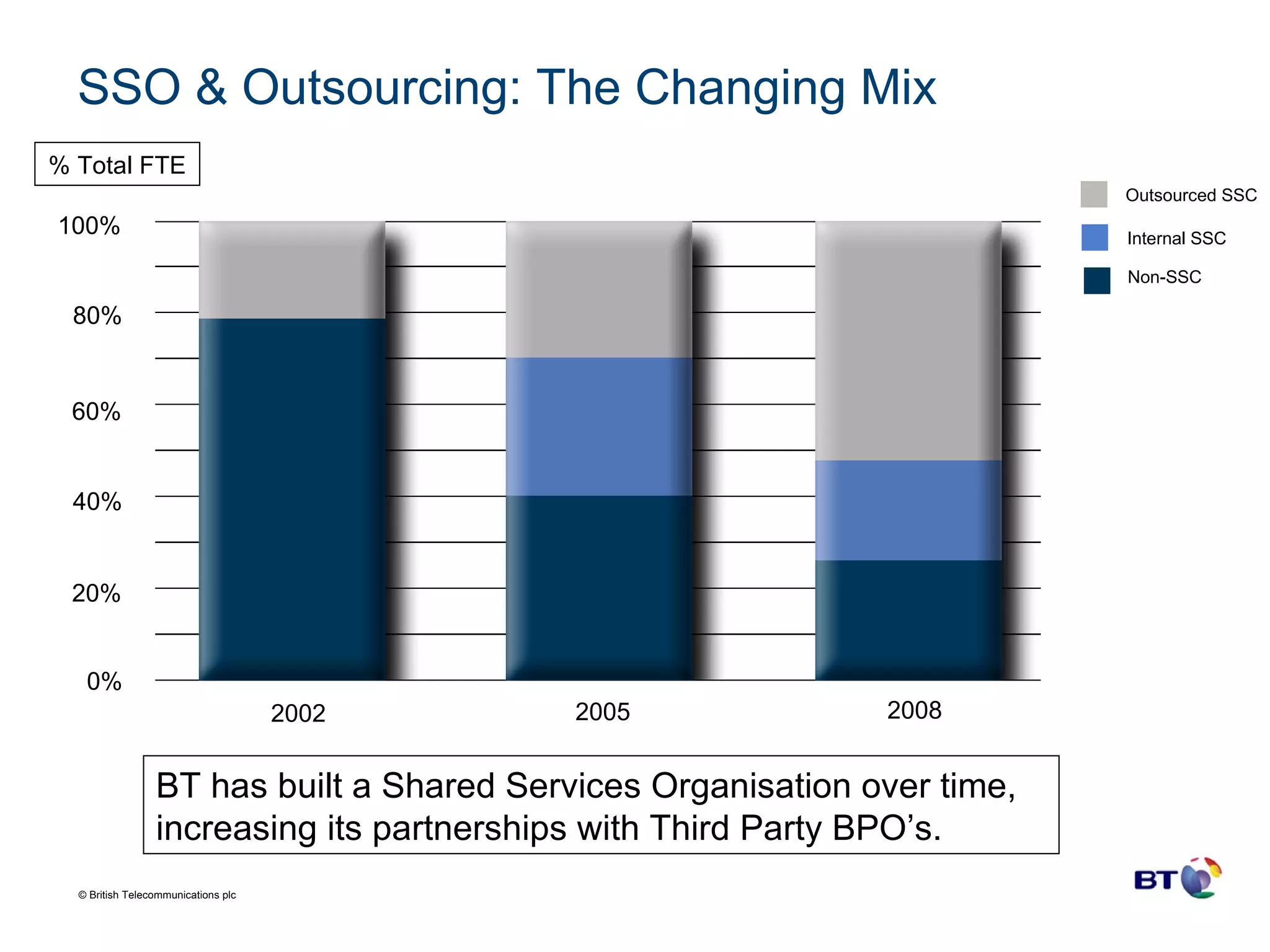
SSO & Outsourcing: The Changing Mix Outsourced SSC Internal SSC Non-SSC BT has built a Shared Services Organisation over time, increasing its partnerships with Third Party BPO’s. 80% 20% 0% 40% 60% 100% 2002 2005 2008 % Total FTE
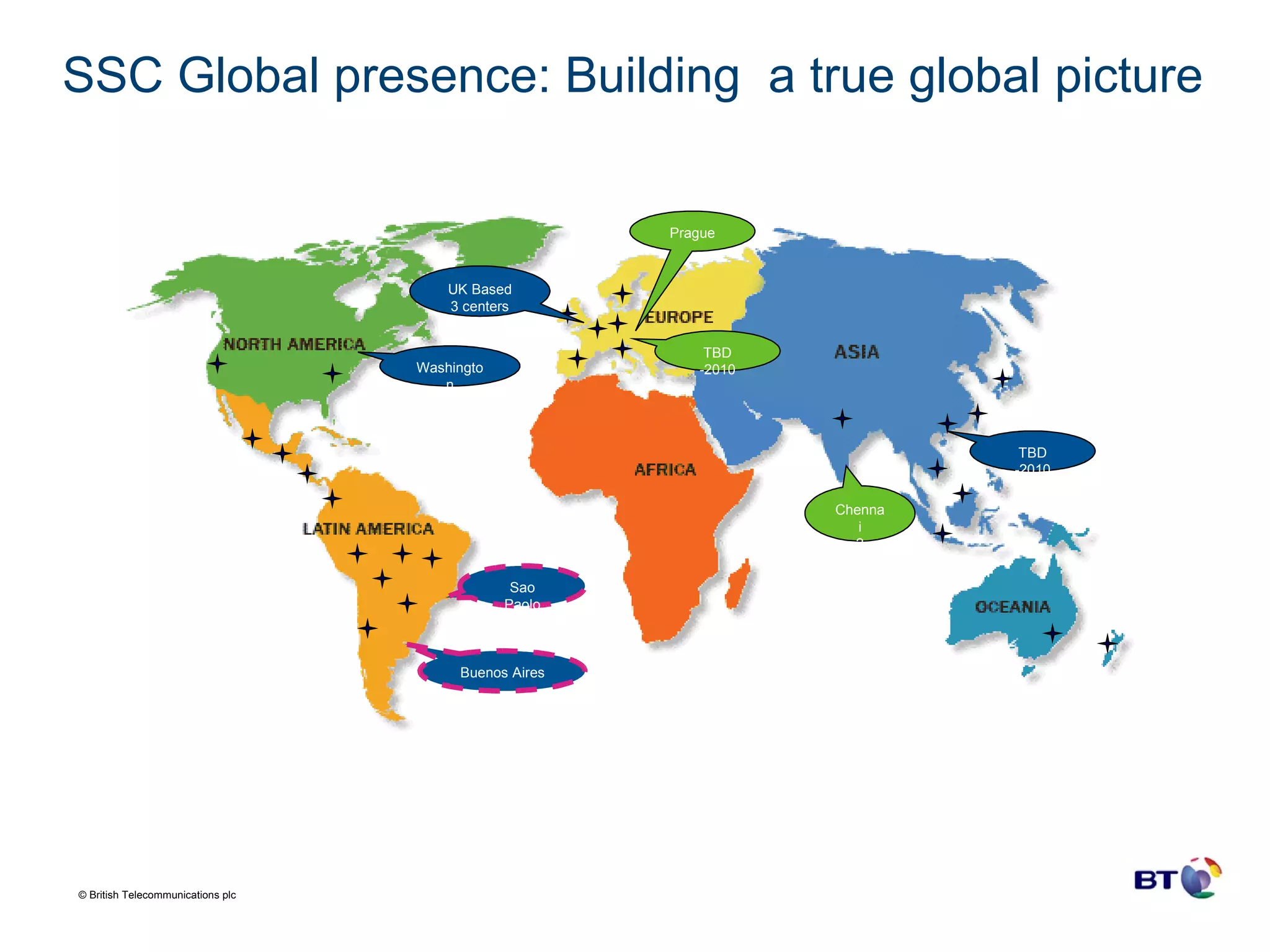
SSC Global presence: Building  a true global picture Sao Paolo Washington Chennai 2 centres TBD -2010 TBD -2010 Buenos Aires UK Based 3 centers Prague
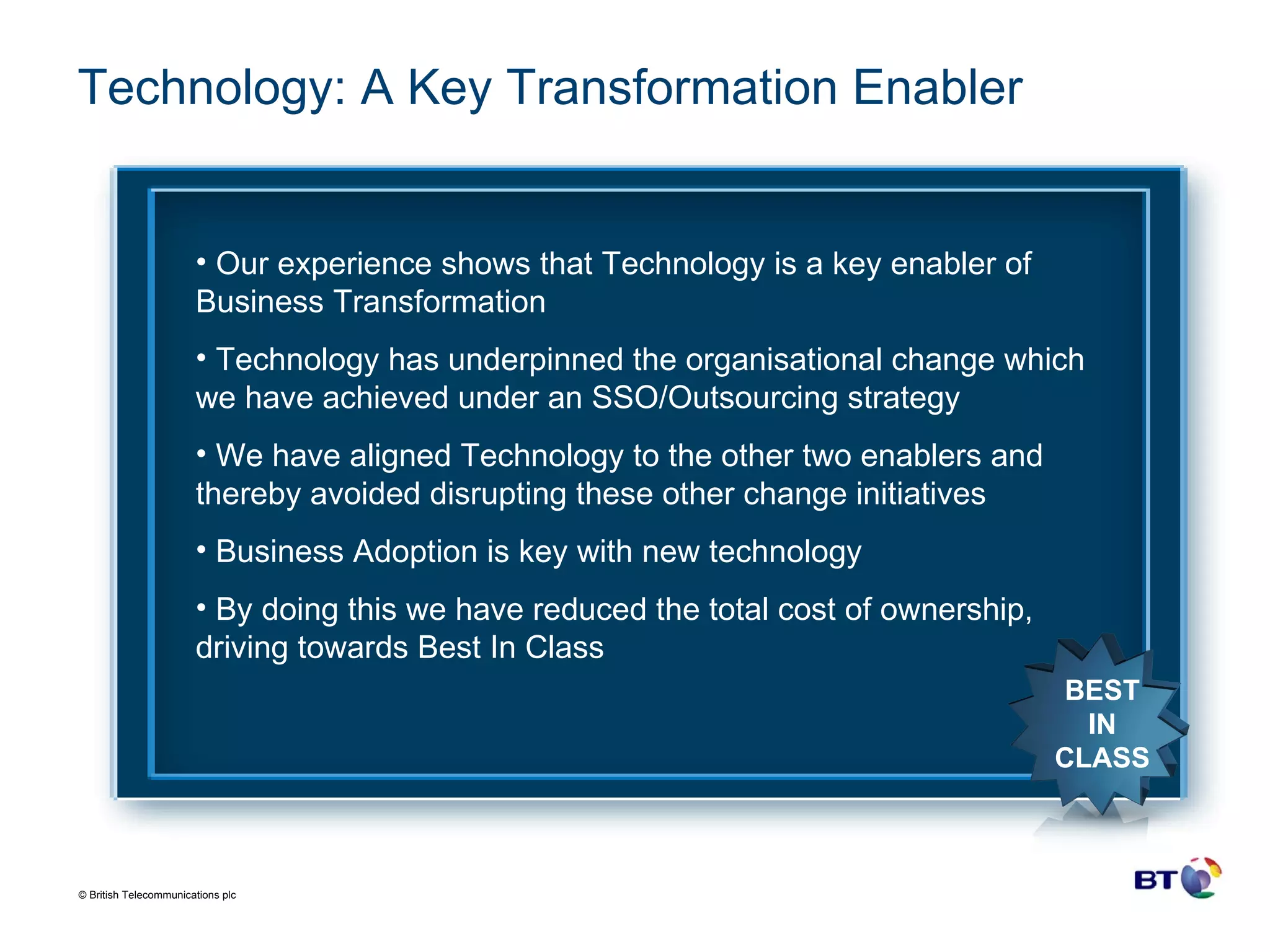
Technology: A Key Transformation Enabler  Our experience shows that Technology is a key enabler of Business Transformation Technology has underpinned the organisational change which we have achieved under an SSO/Outsourcing strategy We have aligned Technology to the other two enablers and thereby avoided disrupting these other change initiatives Business Adoption is key with new technology By doing this we have reduced the total cost of ownership, driving towards Best In Class BEST IN CLASS
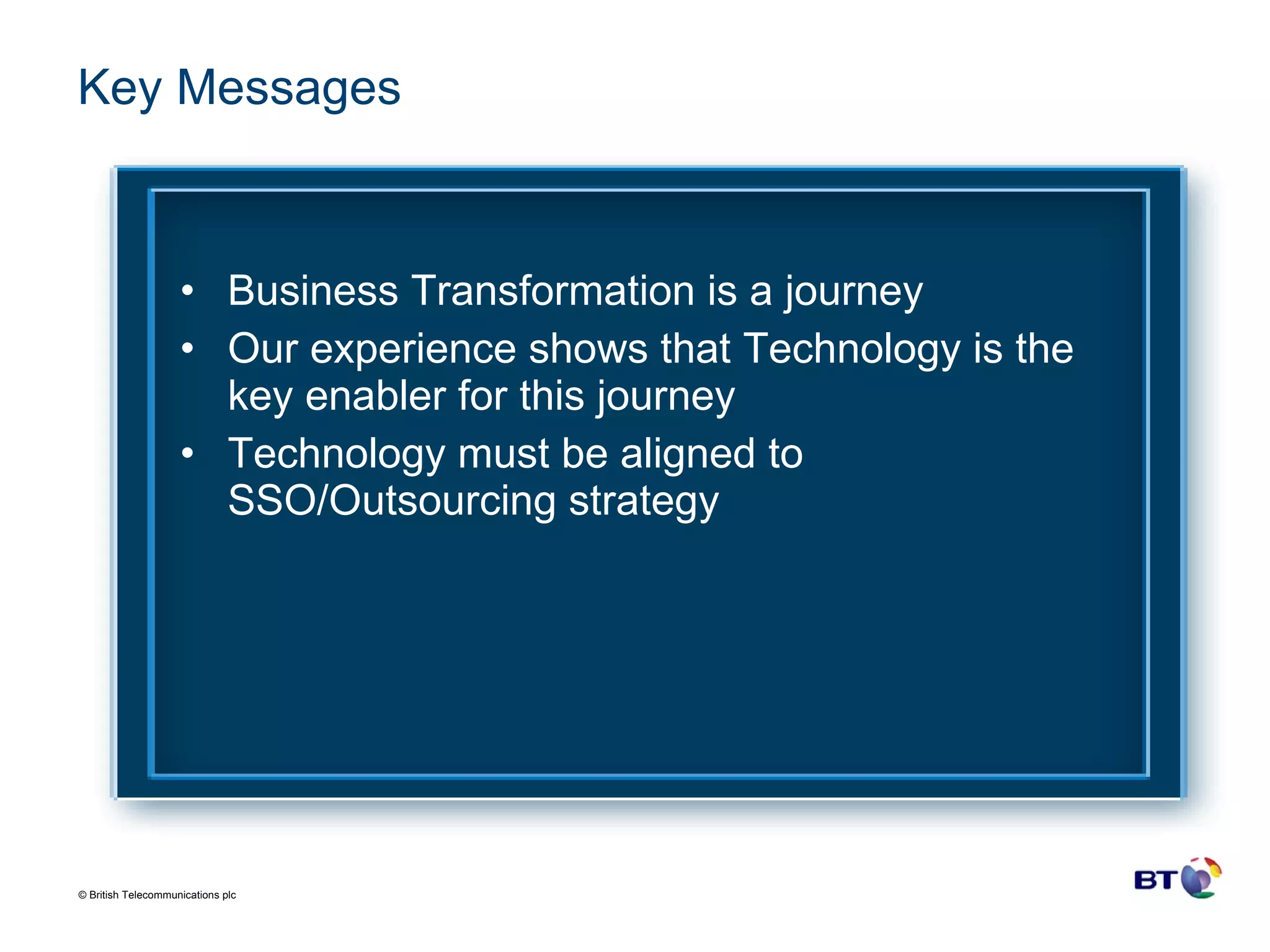
Key Messages Business Transformation is a journey Our experience shows that Technology is the key enabler for this journey Technology must be aligned to SSO/Outsourcing strategy
Any Questions?
 

BT Finance Transformation Finance Shared Service Final

  • 1.
    A BT GroupCase Study: Finance transformation – Finance Shared services Ralph Geertsema Head of Finance Transformation BT Group plc, London
  • 2.
    BT Group: OurCompany Operating in 170+ countries 100,000+ employees $29.4bn revenue (FY 07/08) Principal activities: Networked IT services Local, national & international telecommunication services Broadband and internet services Converged fixed /mobile solutions & services Headquartered in London/U.K.
  • 3.
    Our Finance OrganisationBT Finance Global Transaction Processing SSC* Decision Support SSC* Finance Systems* Business Insight (UK) Specialist Centres of Excellence (UK) UK + India 200+ FTE UK + CZ + India 450+ FTE UK + India 40+ FTE * Part of Reporting, Planning & Analysis division
  • 4.
    Our Business TransformationJourney 2011? Quartile 4 BEST IN CLASS Quartile 3 Quartile 2 Quartile 1 2001 Driving for Best In Class is a journey. We have made good progress over time but continuous improvements are required all the time if we are not to fall back. 2005 Measured by Finance cost as % Revenue
  • 5.
    Business Transformation: DrivingEfficiency Supporting more business for less: Total Finance costs decreasing as Group revenues grow 2002 2003 2004 2005 2006 2007 2008 Costs Revenue 40 20 0 60 80 100 120
  • 6.
    Our Business TransformationEnablers SSO Technology Outsourcing Driving Finance Efficiency and Effectiveness Underpinned by common systems & standard processes
  • 7.
    BT’s Use ofFinance SSO & Outsourcing 2001 2004 2006-2009 1 st SSC in UK Transaction Processing IT Support Helpdesk Outsourced Risk: LOW More SSC in UK Centres of excellence Insight teams Co-Location NOT Outsourced Risk: MEDIUM Global SSC Transaction Processing Helpdesk Outsourced Risk: HIGH Global SSC Decision-Support Reporting First analysis Outsourced Risk: HIGH Our use has grown over time. Complexity/Risk have increased too.
  • 8.
    SSO & Outsourcing:The Changing Mix Outsourced SSC Internal SSC Non-SSC BT has built a Shared Services Organisation over time, increasing its partnerships with Third Party BPO’s. 80% 20% 0% 40% 60% 100% 2002 2005 2008 % Total FTE
  • 9.
    SSC Global presence:Building a true global picture Sao Paolo Washington Chennai 2 centres TBD -2010 TBD -2010 Buenos Aires UK Based 3 centers Prague
  • 10.
    Technology: A KeyTransformation Enabler Our experience shows that Technology is a key enabler of Business Transformation Technology has underpinned the organisational change which we have achieved under an SSO/Outsourcing strategy We have aligned Technology to the other two enablers and thereby avoided disrupting these other change initiatives Business Adoption is key with new technology By doing this we have reduced the total cost of ownership, driving towards Best In Class BEST IN CLASS
  • 11.
    Key Messages BusinessTransformation is a journey Our experience shows that Technology is the key enabler for this journey Technology must be aligned to SSO/Outsourcing strategy
  • 12.
  • 13.

Editor's Notes

  • #3 This slide provides a general overview of BT Group BT Finance is now a global operation supporting global activities in 170+ countries
  • #4 This slide shows the organisational structure of BT Finance and provides location/FTE details for the three divisions within Reporting, Planning & Analysis (marked by an asterix on the illustration). The teams are led by: Global Transaction Processing: Adrian Cooper (Head of Global Process Outsourcing) Decision Support SSC (India): James Watson (Business Change, RPA) Finance Systems (UK/India)(incl. RDM): Joe Armistead (Head of Finance Systems) The above teams are part of the Reporting, Planning & Analysis (RPA) division within Group Finance. RPA is responsible for global transaction processing, management reporting/first level decision-support (analysis) as well as system transformation. The division operates a Global Shared Services Organisation with major operations out of India and some activities still performed onshore in the U.K. A significant amount of activities have been outsourced to strategic third party BPO providers. Business Insight units are Finance teams which provide high value decision support to each business unit within BT. They use reports and first level analysis provided by the Reporting, Planning & Analysis teams as input for their value-add analysis. Specialist Finance tasks such as Tax, Internal Audit, Investor Relations etc are performed by specialist teams grouped into corresponding centres of excellence.
  • #5 BT Finance has set itself the goal to become a world class Finance organisation (Best In Class) Finance Transformation (Business Transformation) is defined here as all activities aimed at increasing the function’s efficiency and effectiveness Increased efficiency (here applied to the function of Finance) refers to the state where fewer inputs/resources (people and technology) are required to produce a given output (mainly information for decision-making). This results in a lower cost base for the function. Increased business effectiveness (here also applied to the Finance function) refers to the state where Finance is producing higher quality output (mainly information for decision-making) that helps BT achieve its desired corporate objectives (e.g. creation of shareholder value). Please note: It is usually more difficult to prove progress towards increased Finance/Business effectiveness as this involves a degree of subjectivity. However, BT uses a variety of surveys to monitor performance as well as to incentivise SSC staff (e.g. Project KT has found that this is the best way to increase SSC staff’s focus on quality/effectiveness). The picture shows BT’s progression through the various Finance benchmarking quartiles over time as measured by Finance costs as a percentage of Group Revenues. The graph is for illustrative purposes only and does not indicate measurements reached at each stage. The key message of this slide is that Business (Finance) Transformation is a continuous journey which does not stop once a new quartile has been reached. Hackett benchmarking data (PLEASE QUOTE HACKETT IF MENTIONED DURING THE PRESENTATION) indicates that we were in quartile 2 in 2005 excluding Revenue Cycle data. This represented at the time approx. 1.03% of group revenues. Lowest Q4 member scored 2.73% and highest Q1 member scored 0.52% back then. BT experienced set-backs on this journey. These had to be overcome but lessons have been learnt on the way leading to continuous improvements in our use of Business Transformation enablers.
  • #6 This slide illustrates the increasing effectiveness of Finance as measured by Finance costs expressed as a percentage of revenue. The slide backs up the previous claim that BT has made progress towards Best In Class over time (start year 2002) whilst growing business/revenue over the same period.
  • #7 The enablers for successful Finance Transformation are organisational and technological BT Finance is using all three enablers: These are Shared Service Operations (SSO), Outsourcing & Technology Combined these enablers deliver the efficiency and effectiveness gained sought from Business transformation Enabler 1 (SSO) can help to: Remove duplication of activities (resulting in higher staff productivity / Staff can also be freed up for higher value work) Reduce the number of physical locations (lower accommodation overhead) Increase shared learning and communication between co-located staff resulting in fewer errors and un-coordinated activities Facilitate the standardisation of processes Achieve better internal controls (through co-location, standardisation of processes and potentially automation) Enabler 2 (OUTSOURCING) can help to: Gain access to higher quality services (clearly documented in SLA) as third party can leverage multi-client experience and skill base Allow the Finance function to concentrate on core activities such as higher value insight (analysis) Reduce the cost base in a contractually agreed, predictable manner Enabler 3 (TECHNOLOGY) can help to: Reduce reliance on legacy systems that perform poorly and are not integrated (this can lead to people efficiencies and better controls) Support an SSO/Outsourcing strategy by offering a scalable technological platform around which standard processes can be built Accelerated Finance Transformation can only be achieved if all 3 components are combined A key underpinning factor is standardisation of systems/platforms and business processes in order to maximise economies of scale and efficiencies sought under all transformation strategies. This drives simplification and allows scalability in operations.
  • #8 BT’s use of Finance SSO in-house or combined with Outsourcing has grown over time and will continue to grow (SSC in Latam etc) The level of complexity and therefore risk has grown with each phase as indicated in the slides The ongoing pursuit of efficiency and effectiveness gains over the years arguably increased BT Finance’s appetite for risk when selecting the next steps in its Finance Transformation (‘low hanging fruit first’ – then what?) BT Finance has learnt along the way and been able to successfully mitigate the ever increasing risks of its Finance Transformation activities More specifically: 2001: Creation of first Finance SSO in UK (Putney) Scope: Transaction processing, application support and helpdesk (xxx FTE – tbc by Matt Robinson) Aim: 30% reduction in cost base over 7 years Outsourced in UK but low risk because operation carved out of BT Finance (same people, same technology, same processes at first) 2004: Creation of pan Finance SSC’s (Centres of Excellence) (Project Sam) Distinction between Insight Finance and Centres of Excellence operating as SSC Co-Location strategy for CoE’s – creation of hubs across the UK Scope: Reporting & First level/decision support analysis Aim: Increased effectiveness and cost reductions of up to 25 % (original Project SAM slides) Not outsourced Medium risk because of radical organisational shake-up 2006 - Date: 1) Creation of global SSC for non-UK transaction processing (Apollo) Scope: Transaction processing & Helpdesk (ca 120 FTE) Outsourced to India and Czech Republic Risk: High – Language challenge, non-uniform financial systems 2) Creation of global SSC for higher value F&A activities/decision support activities (UK only) Scope: Reporting & First Level Analysis, all lines of business in the UK Aggressive savings of up to 50% (before implementation costs) over lifetime of contract (as confirmed by Louise Otto, Project KT) Outsourced to India Risk: High – New territory for BT, critical Finance activities that had to be maintained during transition
  • #9 These slides show the changing mix of SSC and non-SSC staff. In 2002, BT Finance used 75% of non-SSC staff and only 25% of SSC staff. This profile ‘flipped’ over the space of 6 years. Today BT has a 75% SSC/25% non-SSC mix. Also important to note is the large increase in outsourced resources used. Internal SSC refers to SSC staff employed by BT (e.g. RPA) Outsourced SSC refers to staff employed by a third party business process outsourcer. Non-SSC staff refers to Finance staff employed by BT not operating in an SSC environment. The data demonstrates the radical organisational changes that have been made over the last few years in BT Finance.
  • #11 This slide introduces technology as the third key enabler of Finance Transformation Technology can become a risk to transformation if not effectively managed: It can quickly undermine the benefits delivered by the other two change initiatives so can become a show-stopper or a cost of failure in itself. To ensure Technology accelerates Business Transformation, it must be well managed and aligned to the other change initiatives. To avoid sub-optimal outcomes/disruption it is important to align the deployment of Technology such that it supports the objectives of the other two areas of change (e.g. BT now goes live both on GFP/GFO at the same time, this has proven to yield the best results). This is particularly true in the light of BT Finance’s global Finance operations across multiple continents, sometimes in remote locations. Technology failure (e.g. connectivity or lack of bandwidth) can cut of or seriously impede the SSC operation. By technology we mean the use of: A standard (common) integrated ERP platform A global data warehouse that collects the relevant data for reporting purposes Standard reporting suite (Hyperion) to report information from executive level to operational level in a one truth fashion HACKETT Benchmarking data (Please quote if applicable Hackett Benchmarking & Best Practices Conference 2007) indicate that Best in Class companies spend more on IT per Finance FTE than their peers, almost twice the investment level than peers (2006 data – ca. $33,300 v $16,100). Since BT is investing heavily into Chorus, BT has selected a proven Best In Class strategy that will help it on its transformation journey. Technology usually works – often it is users’ perception or lack of training that leads to a ‘blame the technology’ culture. Business adoption/change management and stakeholder management are therefore key for Business Transformation through Technology: Users who know how to use the system thanks to effective business adoption (training & communication) will help to avoid costs of failure and increase exploitation of systems, thereby providing better performance and a higher return on investment. Well managed stakeholders will be less inclined to make a negative judgment about system performance that is not based on fact (e.g. e-mail chains being sent in panic during month end period as a result of system failure). Project KT has shown that ‘train the trainer’ (or ‘buddy training’) works best when it comes to Technology. However, the trainers must be of high calibre. Satisfied SSC users as a result of good system training increases the worker’s productivity but also his/her job satisfaction, KT team has found, thus reducing the SSC attrition rate.