GENERAL REQUIREMENTS
FOR A BSL-3/4 LABORATORY
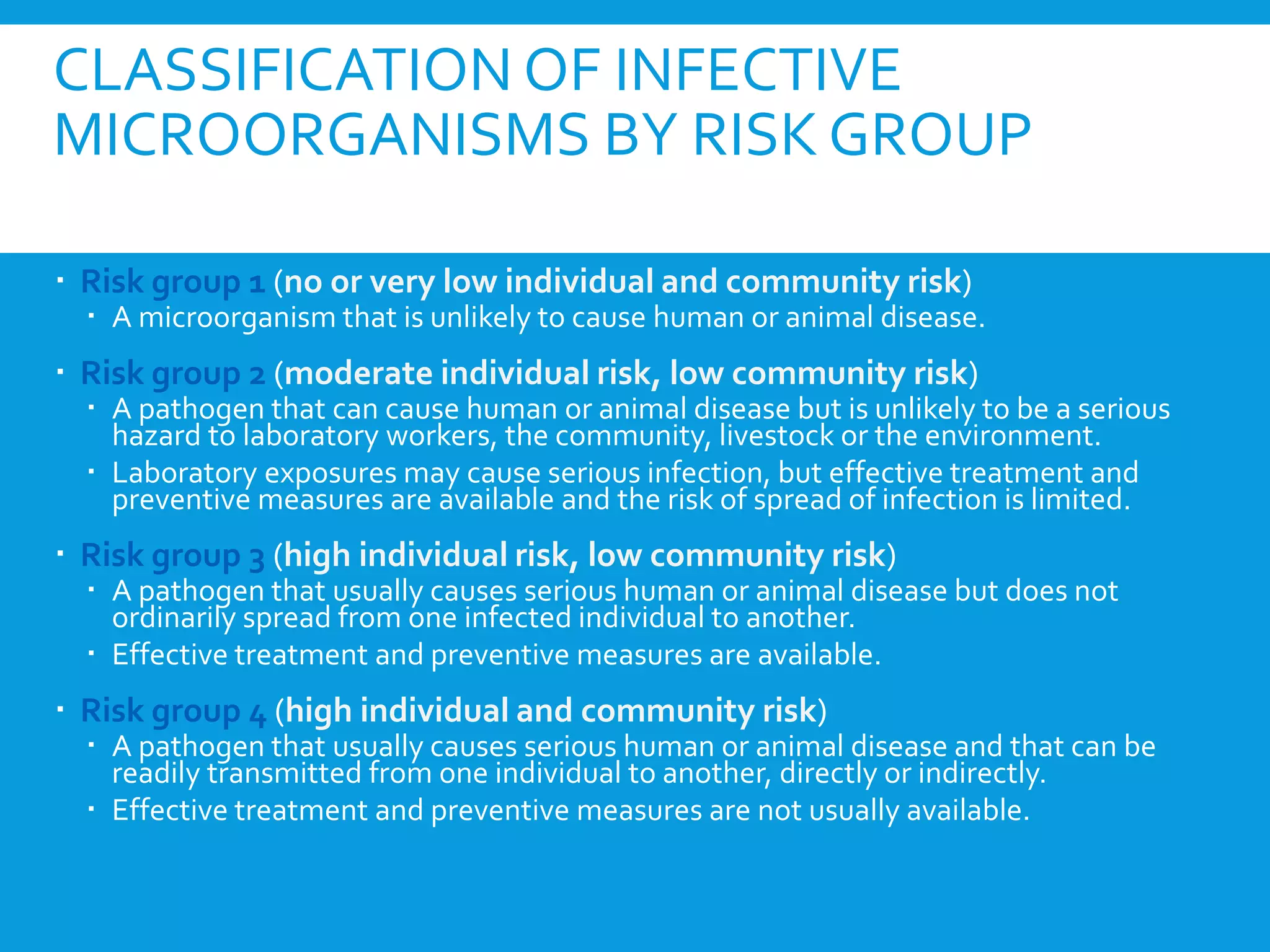
CLASSIFICATION OF INFECTIVE
MICROORGANISMS BY RISK GROUP
 Risk group 1 (no or very low individual and community risk)
 A microorganism that is unlikely to cause human or animal disease.
 Risk group 2 (moderate individual risk, low community risk)
 A pathogen that can cause human or animal disease but is unlikely to be a serious
hazard to laboratory workers, the community, livestock or the environment.
 Laboratory exposures may cause serious infection, but effective treatment and
preventive measures are available and the risk of spread of infection is limited.
 Risk group 3 (high individual risk, low community risk)
 A pathogen that usually causes serious human or animal disease but does not
ordinarily spread from one infected individual to another.
 Effective treatment and preventive measures are available.
 Risk group 4 (high individual and community risk)
 A pathogen that usually causes serious human or animal disease and that can be
readily transmitted from one individual to another, directly or indirectly.
 Effective treatment and preventive measures are not usually available.
NATIONAL OR REGIONAL CLASSIFICATIONOF
MICROORGANISMS BY RISK GROUP
 Pathogenicity of the organism
 Mode of transmission and host range of the organism
 Existing levels of immunity in the local population
 Density and movement of the host population
 Presence of appropriate vectors
 Standards of environmental hygiene
 Local availability of effective preventive measures
 Prophylaxis by immunization or administration of antisera
 Sanitary measures (food and water hygiene)
 Control of animal reservoirs or arthropod vectors
 Local availability of effective treatment
 Passive immunization
 Post exposure vaccination
 Use of antimicrobial, antiviral and chemotherapeutic agents
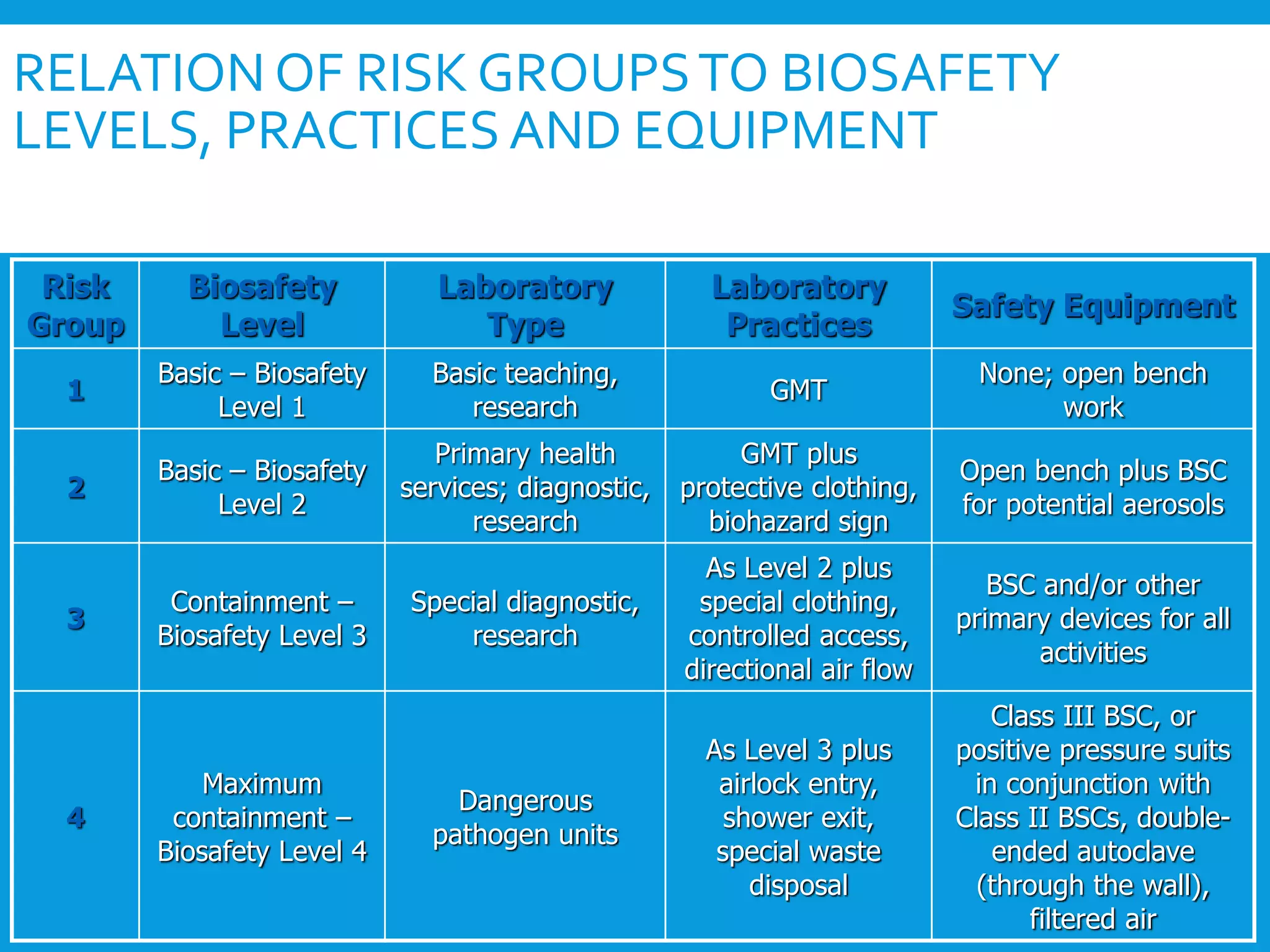
Risk
Group
Biosafety
Level
Laboratory
Type
Laboratory
Practices
Safety Equipment
1
Basic – Biosafety
Level 1
Basic teaching,
research
GMT
None; open bench
work
2
Basic – Biosafety
Level 2
Primary health
services; diagnostic,
research
GMT plus
protective clothing,
biohazard sign
Open bench plus BSC
for potential aerosols
3
Containment –
Biosafety Level 3
Special diagnostic,
research
As Level 2 plus
special clothing,
controlled access,
directional air flow
BSC and/or other
primary devices for all
activities
4
Maximum
containment –
Biosafety Level 4
Dangerous
pathogen units
As Level 3 plus
airlock entry,
shower exit,
special waste
disposal
Class III BSC, or
positive pressure suits
in conjunction with
Class II BSCs, double-
ended autoclave
(through the wall),
filtered air
RELATION OF RISK GROUPSTO BIOSAFETY
LEVELS, PRACTICES AND EQUIPMENT
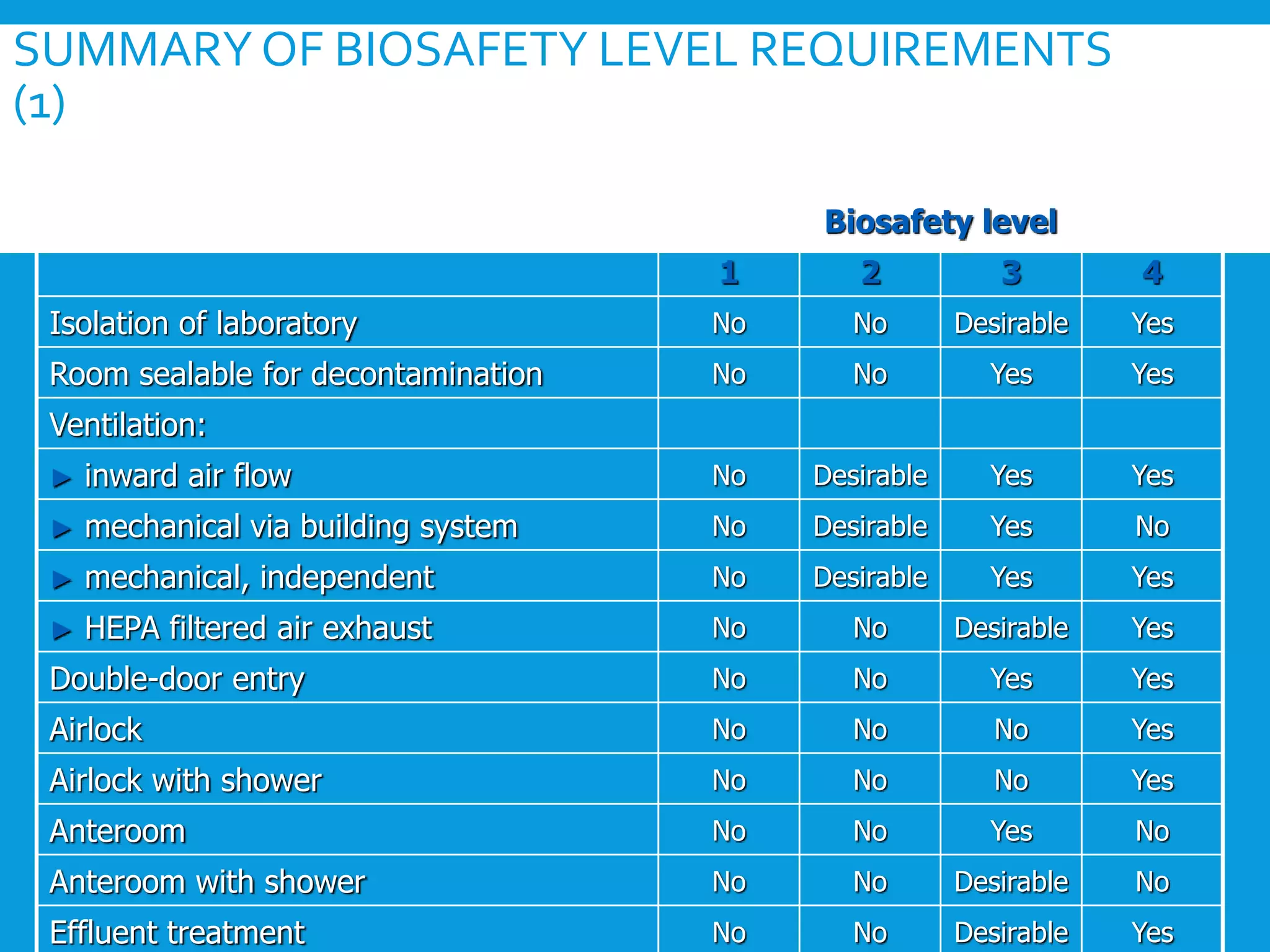
Biosafety level
1 2 3 4
Isolation of laboratory No No Desirable Yes
Room sealable for decontamination No No Yes Yes
Ventilation:
► inward air flow No Desirable Yes Yes
► mechanical via building system No Desirable Yes No
► mechanical, independent No Desirable Yes Yes
► HEPA filtered air exhaust No No Desirable Yes
Double-door entry No No Yes Yes
Airlock No No No Yes
Airlock with shower No No No Yes
Anteroom No No Yes No
Anteroom with shower No No Desirable No
Effluent treatment No No Desirable Yes
SUMMARY OF BIOSAFETY LEVEL REQUIREMENTS
(1)
Biosafety level
1 2 3 4
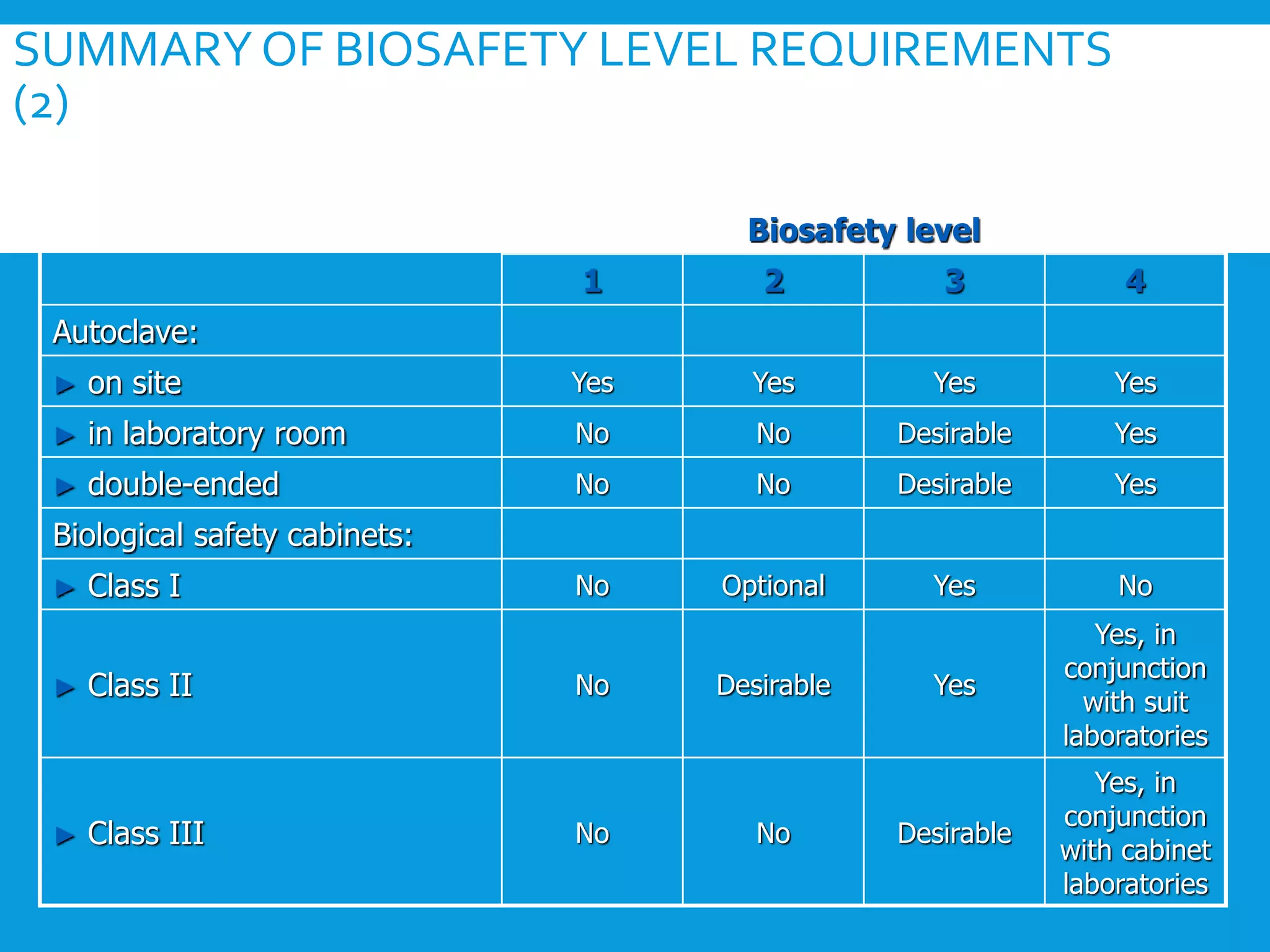
Autoclave:
► on site Yes Yes Yes Yes
► in laboratory room No No Desirable Yes
► double-ended No No Desirable Yes
Biological safety cabinets:
► Class I No Optional Yes No
► Class II No Desirable Yes
Yes, in
conjunction
with suit
laboratories
► Class III No No Desirable
Yes, in
conjunction
with cabinet
laboratories
SUMMARY OF BIOSAFETY LEVEL REQUIREMENTS
(2)
BSL-4 PROJECT
BSL-4 project or facility can operate correctly and in safe
condition if we have:
 A good design, engineering, construction and validation of the
installation.
 A trained personnel and good procedure system.
 A good maintenance team which ensure the well state of the
installation.
GENERAL CONSIDERATIONS
REGARDING BSL-4 LABORATORY –
FROMTHE OUTSIDE
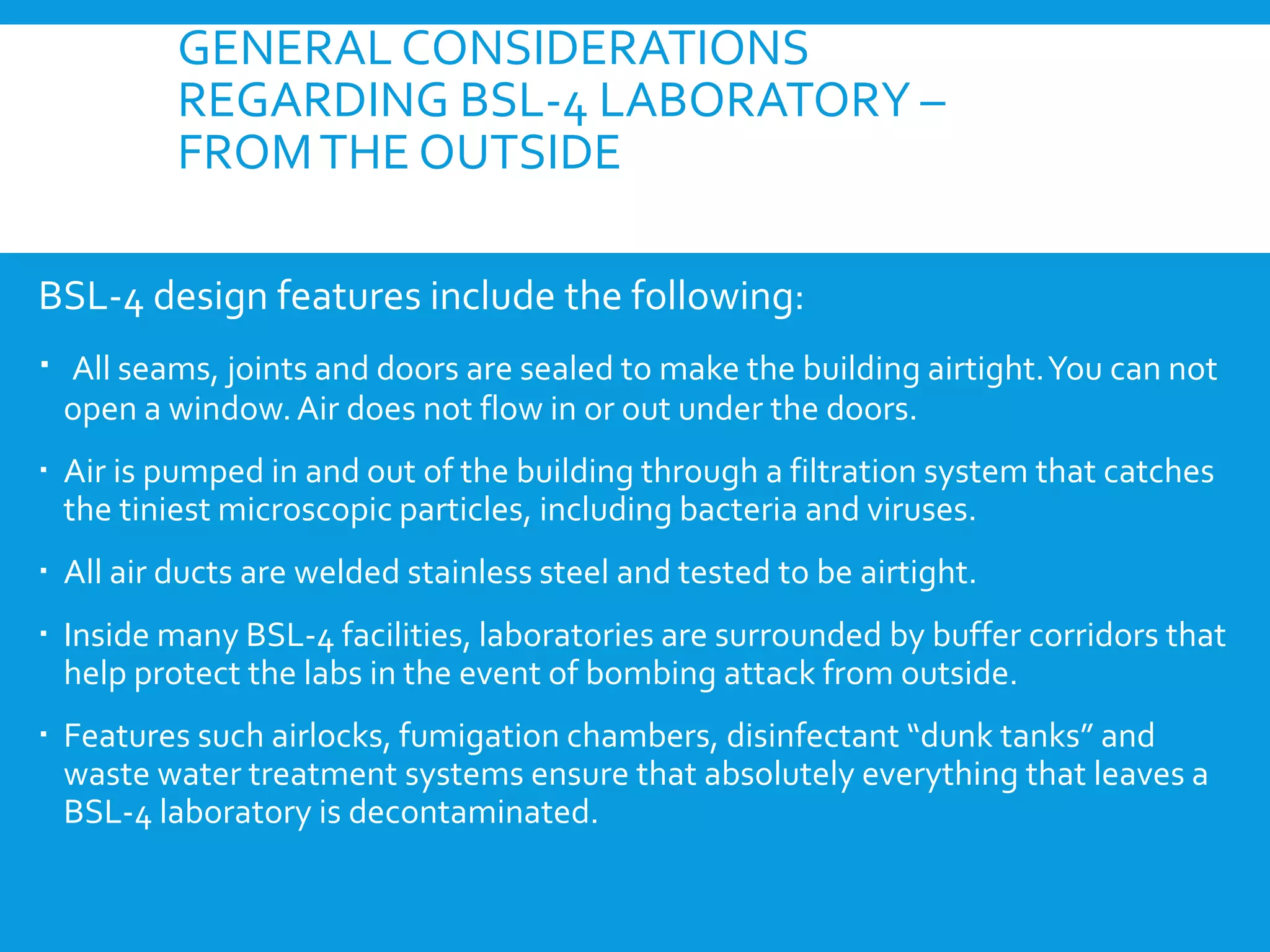
BSL-4 design features include the following:
 All seams, joints and doors are sealed to make the building airtight.You can not
open a window.Air does not flow in or out under the doors.
 Air is pumped in and out of the building through a filtration system that catches
the tiniest microscopic particles, including bacteria and viruses.
 All air ducts are welded stainless steel and tested to be airtight.
 Inside many BSL-4 facilities, laboratories are surrounded by buffer corridors that
help protect the labs in the event of bombing attack from outside.
 Features such airlocks, fumigation chambers, disinfectant “dunk tanks” and
waste water treatment systems ensure that absolutely everything that leaves a
BSL-4 laboratory is decontaminated.
1. A security checkpoint at the entry to the site
2. A secured perimeter around the building
3. A buffer between the building and parking areas, drop-off zones
4. On-site 24-hour surveillance
5. An additional vehicle checkpoint for lab employees, visitors
6. A secured entryway, including security guards, surveillance cameras, an intercom system and card access readers
7. A delivery vehicle inspection area
8. The building also contains numerous safety and security measures throughout
GENERAL CONSIDERATIONS
REGARDING BSL-4 LABORATORY –
INTERIOR SECURITY
 Once pass outside security, BSL-4 lab workers must pass an interior
security station
 Security measures will include combinations of the following:
 Extensive background checks prior to employment for everyone who works in
the building
 Guards who check everyone’s identification and credentials
 Special identification cards that are scanned to provide an electronic record of
who goes in and out, and when
 Identifications devices such as retinal or fingerprint scanners
SCOURINGTHE AIR –
HEPA FILTER AND FILTRATION INSPECTION
VERIFICATION
CHANGING ROOM
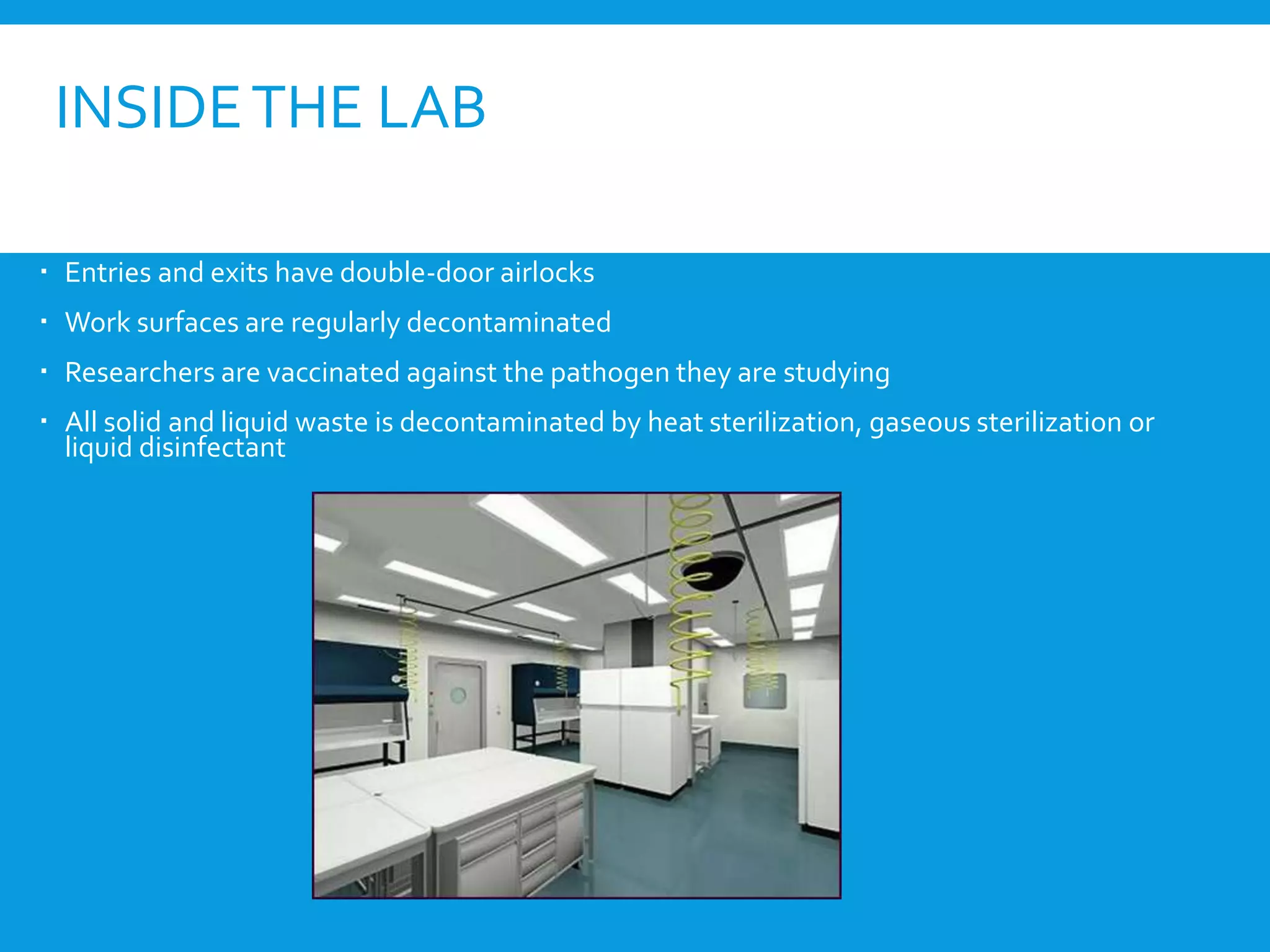
INSIDETHE LAB
 Entries and exits have double-door airlocks
 Work surfaces are regularly decontaminated
 Researchers are vaccinated against the pathogen they are studying
 All solid and liquid waste is decontaminated by heat sterilization, gaseous sterilization or
liquid disinfectant
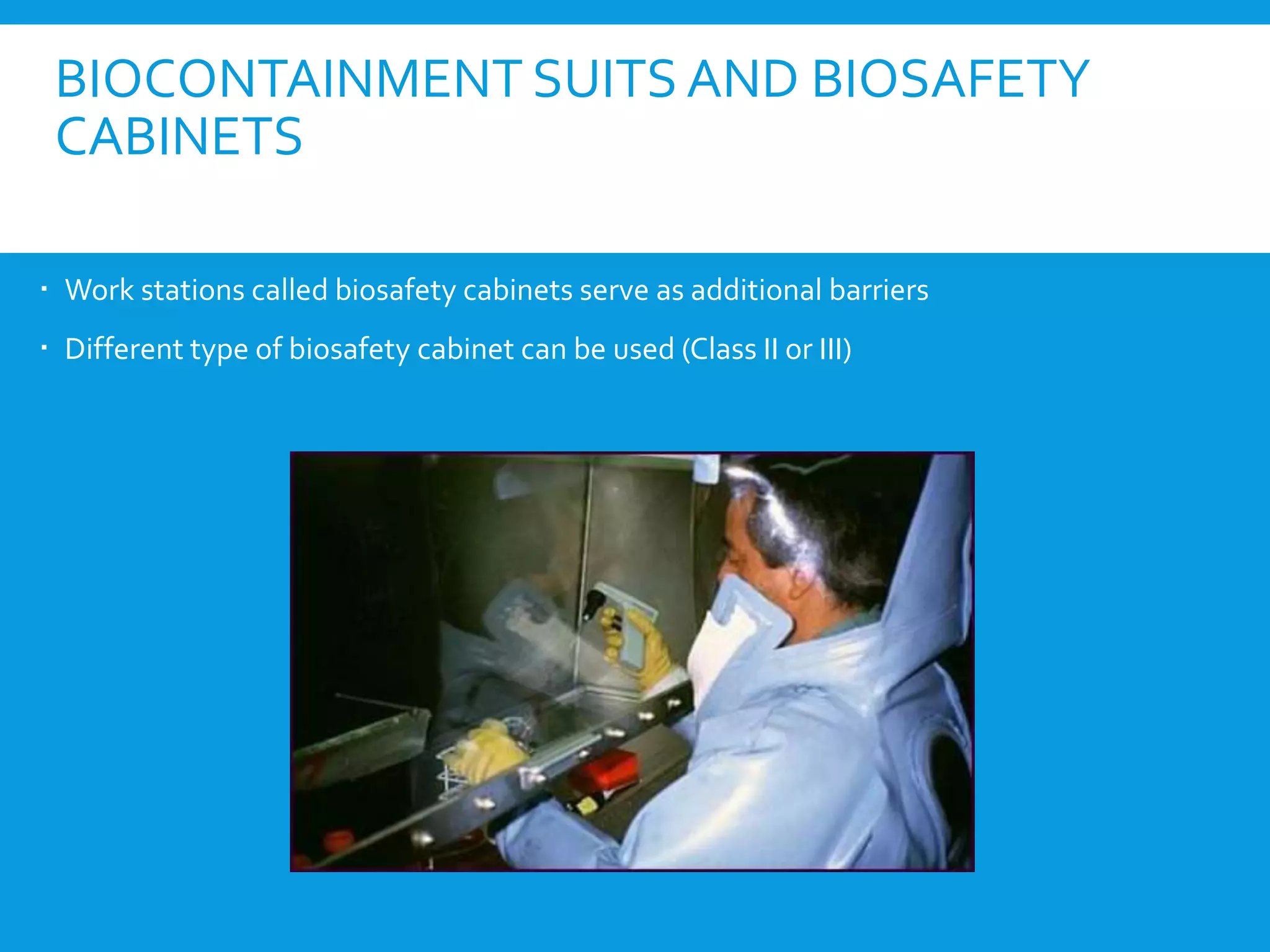
BIOCONTAINMENT SUITS AND BIOSAFETY
CABINETS
 The airtight, pressurized suits have dedicated life support systems that include air
compressors, alarms and emergency backup air tanks and a HEPA air filtration system
 Work stations called biosafety cabinets serve as additional barriers
 Different type of biosafety cabinet can be used (Class II or III)

BSL-3 OR 4 Laboratory_KAVITAPANGHAL.ppt

  • 1.
    GENERAL REQUIREMENTS FOR ABSL-3/4 LABORATORY
  • 2.
    CLASSIFICATION OF INFECTIVE MICROORGANISMSBY RISK GROUP  Risk group 1 (no or very low individual and community risk)  A microorganism that is unlikely to cause human or animal disease.  Risk group 2 (moderate individual risk, low community risk)  A pathogen that can cause human or animal disease but is unlikely to be a serious hazard to laboratory workers, the community, livestock or the environment.  Laboratory exposures may cause serious infection, but effective treatment and preventive measures are available and the risk of spread of infection is limited.  Risk group 3 (high individual risk, low community risk)  A pathogen that usually causes serious human or animal disease but does not ordinarily spread from one infected individual to another.  Effective treatment and preventive measures are available.  Risk group 4 (high individual and community risk)  A pathogen that usually causes serious human or animal disease and that can be readily transmitted from one individual to another, directly or indirectly.  Effective treatment and preventive measures are not usually available.
  • 3.
    NATIONAL OR REGIONALCLASSIFICATIONOF MICROORGANISMS BY RISK GROUP  Pathogenicity of the organism  Mode of transmission and host range of the organism  Existing levels of immunity in the local population  Density and movement of the host population  Presence of appropriate vectors  Standards of environmental hygiene  Local availability of effective preventive measures  Prophylaxis by immunization or administration of antisera  Sanitary measures (food and water hygiene)  Control of animal reservoirs or arthropod vectors  Local availability of effective treatment  Passive immunization  Post exposure vaccination  Use of antimicrobial, antiviral and chemotherapeutic agents
  • 4.
    Risk Group Biosafety Level Laboratory Type Laboratory Practices Safety Equipment 1 Basic –Biosafety Level 1 Basic teaching, research GMT None; open bench work 2 Basic – Biosafety Level 2 Primary health services; diagnostic, research GMT plus protective clothing, biohazard sign Open bench plus BSC for potential aerosols 3 Containment – Biosafety Level 3 Special diagnostic, research As Level 2 plus special clothing, controlled access, directional air flow BSC and/or other primary devices for all activities 4 Maximum containment – Biosafety Level 4 Dangerous pathogen units As Level 3 plus airlock entry, shower exit, special waste disposal Class III BSC, or positive pressure suits in conjunction with Class II BSCs, double- ended autoclave (through the wall), filtered air RELATION OF RISK GROUPSTO BIOSAFETY LEVELS, PRACTICES AND EQUIPMENT
  • 5.
    Biosafety level 1 23 4 Isolation of laboratory No No Desirable Yes Room sealable for decontamination No No Yes Yes Ventilation: ► inward air flow No Desirable Yes Yes ► mechanical via building system No Desirable Yes No ► mechanical, independent No Desirable Yes Yes ► HEPA filtered air exhaust No No Desirable Yes Double-door entry No No Yes Yes Airlock No No No Yes Airlock with shower No No No Yes Anteroom No No Yes No Anteroom with shower No No Desirable No Effluent treatment No No Desirable Yes SUMMARY OF BIOSAFETY LEVEL REQUIREMENTS (1)
  • 6.
    Biosafety level 1 23 4 Autoclave: ► on site Yes Yes Yes Yes ► in laboratory room No No Desirable Yes ► double-ended No No Desirable Yes Biological safety cabinets: ► Class I No Optional Yes No ► Class II No Desirable Yes Yes, in conjunction with suit laboratories ► Class III No No Desirable Yes, in conjunction with cabinet laboratories SUMMARY OF BIOSAFETY LEVEL REQUIREMENTS (2)
  • 7.
    BSL-4 PROJECT BSL-4 projector facility can operate correctly and in safe condition if we have:  A good design, engineering, construction and validation of the installation.  A trained personnel and good procedure system.  A good maintenance team which ensure the well state of the installation.
  • 8.
    GENERAL CONSIDERATIONS REGARDING BSL-4LABORATORY – FROMTHE OUTSIDE BSL-4 design features include the following:  All seams, joints and doors are sealed to make the building airtight.You can not open a window.Air does not flow in or out under the doors.  Air is pumped in and out of the building through a filtration system that catches the tiniest microscopic particles, including bacteria and viruses.  All air ducts are welded stainless steel and tested to be airtight.  Inside many BSL-4 facilities, laboratories are surrounded by buffer corridors that help protect the labs in the event of bombing attack from outside.  Features such airlocks, fumigation chambers, disinfectant “dunk tanks” and waste water treatment systems ensure that absolutely everything that leaves a BSL-4 laboratory is decontaminated.
  • 10.
    1. A securitycheckpoint at the entry to the site 2. A secured perimeter around the building 3. A buffer between the building and parking areas, drop-off zones 4. On-site 24-hour surveillance 5. An additional vehicle checkpoint for lab employees, visitors 6. A secured entryway, including security guards, surveillance cameras, an intercom system and card access readers 7. A delivery vehicle inspection area 8. The building also contains numerous safety and security measures throughout
  • 11.
    GENERAL CONSIDERATIONS REGARDING BSL-4LABORATORY – INTERIOR SECURITY  Once pass outside security, BSL-4 lab workers must pass an interior security station  Security measures will include combinations of the following:  Extensive background checks prior to employment for everyone who works in the building  Guards who check everyone’s identification and credentials  Special identification cards that are scanned to provide an electronic record of who goes in and out, and when  Identifications devices such as retinal or fingerprint scanners
  • 12.
    SCOURINGTHE AIR – HEPAFILTER AND FILTRATION INSPECTION VERIFICATION
  • 13.
  • 14.
    INSIDETHE LAB  Entriesand exits have double-door airlocks  Work surfaces are regularly decontaminated  Researchers are vaccinated against the pathogen they are studying  All solid and liquid waste is decontaminated by heat sterilization, gaseous sterilization or liquid disinfectant
  • 15.
    BIOCONTAINMENT SUITS ANDBIOSAFETY CABINETS  The airtight, pressurized suits have dedicated life support systems that include air compressors, alarms and emergency backup air tanks and a HEPA air filtration system  Work stations called biosafety cabinets serve as additional barriers  Different type of biosafety cabinet can be used (Class II or III)