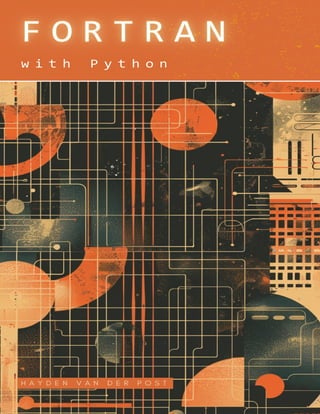
Fortran with Python: Integrating legacy systems with Python Bisette
Fortran with Python: Integrating legacy systems with Python Bisette
Fortran with Python: Integrating legacy systems with Python Bisette
Fortran with Python: Integrating legacy systems with Python Bisette
Fortran with Python: Integrating legacy systems with Python Bisette
1.
Fortran with Python:Integrating legacy systems with
Python Bisette download pdf
https://ebookmass.com/product/fortran-with-python-integrating-legacy-
systems-with-python-bisette/
Visit ebookmass.com today to download the complete set of
ebook or textbook!
2.
Here are somerecommended products for you. Click the link to
download, or explore more at ebookmass.com
Python for Finance: A Crash Course Modern Guide: Learn
Python Fast Bisette
https://ebookmass.com/product/python-for-finance-a-crash-course-
modern-guide-learn-python-fast-bisette/
Learning Scientific Programming with Python Hill
https://ebookmass.com/product/learning-scientific-programming-with-
python-hill/
Data-Driven SEO with Python: Solve SEO Challenges with
Data Science Using Python 1st Edition Andreas Voniatis
https://ebookmass.com/product/data-driven-seo-with-python-solve-seo-
challenges-with-data-science-using-python-1st-edition-andreas-
voniatis/
Mastering Functional Programming with Python Brett
Neutreon
https://ebookmass.com/product/mastering-functional-programming-with-
python-brett-neutreon/
3.
Python Real-World Projects:Crafting your Python Portfolio
with Deployable Applications Steven F. Lott
https://ebookmass.com/product/python-real-world-projects-crafting-
your-python-portfolio-with-deployable-applications-steven-f-lott/
Market Master: Trading with Python Van Der Post
https://ebookmass.com/product/market-master-trading-with-python-van-
der-post/
Python Fundamentals for Finance: A survey of Algorithmic
Options trading with Python Van Der Post
https://ebookmass.com/product/python-fundamentals-for-finance-a-
survey-of-algorithmic-options-trading-with-python-van-der-post/
Learning Scientific Programming with Python 2nd Edition
Christian Hill
https://ebookmass.com/product/learning-scientific-programming-with-
python-2nd-edition-christian-hill-2/
Programming and Problem Solving with Python Ashok Namdev
Kamthane
https://ebookmass.com/product/programming-and-problem-solving-with-
python-ashok-namdev-kamthane/
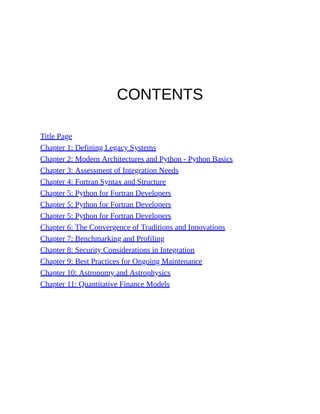
CONTENTS
Title Page
Chapter 1:Defining Legacy Systems
Chapter 2: Modern Architectures and Python - Python Basics
Chapter 3: Assessment of Integration Needs
Chapter 4: Fortran Syntax and Structure
Chapter 5: Python for Fortran Developers
Chapter 5: Python for Fortran Developers
Chapter 5: Python for Fortran Developers
Chapter 6: The Convergence of Traditions and Innovations
Chapter 7: Benchmarking and Profiling
Chapter 8: Security Considerations in Integration
Chapter 9: Best Practices for Ongoing Maintenance
Chapter 10: Astronomy and Astrophysics
Chapter 11: Quantitative Finance Models
8.
CHAPTER 1: DEFINING
LEGACYSYSTEMS
A legacy system refers to any software, hardware, or integrated
environment that was once at the frontier of technology but now exists in a
state of obsolescence. However, this obsolescence is not a mere function of
age. A system becomes "legacy" not when it merely ages, but when it
begins to hinder adaptability and growth due to its outdated structures and
technologies.
In Vancouver, a city known for its rapid embrace of innovative tech
startups, legacy systems are often hidden beneath layers of modern
interfaces. The contrast between the city's forward-looking tech scene and
the aged underpinnings of its digital infrastructure serves as a poignant local
anecdote. This juxtaposition underscores the ubiquitous presence and silent
importance of legacy systems in facilitating day-to-day operations, from
financial transactions to public transportation systems.
Legacy systems are characterized by several distinctive features. Firstly,
they often operate on older operating systems or hardware that
manufacturers no longer support. This lack of support poses significant
challenges, from security vulnerabilities to compatibility issues with
modern software.
Secondly, the programming languages used to develop these systems, such
as COBOL or Fortran, are often considered outdated in today’s
development environment. Yet, these languages carry the logic and
functionality of critical business operations for numerous organizations.
9.
Furthermore, legacy systemstypically lack comprehensive documentation,
making maintenance and troubleshooting a daunting task for contemporary
IT professionals. This scenario is exacerbated by the dwindling number of
experts familiar with these older technologies.
Despite these challenges, legacy systems hold immense value. They
embody decades of accumulated knowledge and operational logic that are
crucial for the organizations that rely on them. The financial and logistical
implications of replacing these systems are often prohibitive, leading many
to opt for maintenance rather than replacement.
Moreover, legacy systems frequently continue to perform their intended
functions reliably, albeit within the constraints of their outdated
architecture. This reliability, born out of years of refinement and debugging,
presents a compelling case for their continued use.
Bridging the Old and the New
defining legacy systems is an exercise in understanding technology's
temporal journey. It is about recognizing the enduring relevance of what
came before and finding ways to bridge it with the incessant march of
innovation. As we delve deeper into integrating Fortran with Python, the
narrative is not merely about juxtaposing the old against the new but about
crafting a symbiosis that leverages the strengths of each. The challenge,
therefore, lies not in discarding the past but in harmoniously integrating it
with the future, much like the blend of historical and modern architectures
that characterizes Vancouver's skyline. In this quest, the definition of legacy
systems serves as our starting point, guiding us through the complexities of
technological evolution toward a future where past and present seamlessly
converge.
The Importance and Prevalence of Legacy Systems in Modern Industry
To understand the prevalence of legacy systems, one must first
acknowledge their omnipresence across industries. From the financial
10.
sector, where theyprocess billions in transactions daily, to healthcare,
managing patient records and critical life-support functions, legacy systems
are the unseen backbone supporting the edifice of modern commerce and
service delivery.
In the financial world, legacy systems are the silent guardians of
transactional integrity. The banking industry, for instance, relies heavily on
systems that were developed decades ago, primarily because they offer
unmatched reliability and have been tested by time. The New York Stock
Exchange, a nerve center of global finance, has its operations deeply
intertwined with legacy technologies, ensuring the seamless execution of
millions of trades each day.
The healthcare sector presents another arena where legacy systems are
indispensable. Hospital management software developed in the late 20th
century continues to be used, managing everything from patient records to
pharmaceutical inventories. Similarly, emergency response systems,
including those for fire, police, and ambulance services, often run on
software and hardware considered obsolete by current standards but are
crucial for their reliability and speed.
The importance of legacy systems extends beyond their operational
applications to encapsulate a broader spectrum of benefits that underscore
their indispensability.
One of the foremost advantages of legacy systems is their proven stability.
Having been in operation for years, if not decades, these systems offer a
level of reliability that newer technologies struggle to match. The iterative
improvements made over the years have fine-tuned these systems to near
perfection, making them the gold standard for mission-critical applications
where failure is not an option.
Economically, the argument for maintaining legacy systems is compelling.
The sunk cost in these technologies—encompassing hardware, software,
and the training of specialized personnel—represents a significant
investment. Furthermore, the cost and risks associated with system overhaul
or replacement are often prohibitive. For many organizations, the pragmatic
11.
approach is toextend the life of their existing systems through maintenance
and incremental upgrades, ensuring continuity while managing costs.
Legacy systems often possess specialized functionality that is deeply
integrated into business processes. These systems have been customized
over time to fit the unique needs of the organizations they serve, making
them irreplaceable components of the operational framework. The depth of
integration means that these systems support workflows and data processes
that newer systems would find challenging to replicate without significant
effort and expense.
The Path Forward
The dialogue surrounding legacy systems should not be framed as a choice
between the old and the new but rather as a conversation about integration
and coexistence. As industries evolve, the role of legacy systems becomes
not less, but more critical. They represent a bridge to the past, holding the
accumulated wisdom and data that are invaluable to the future growth and
evolution of organizations.
In embracing the future, the focus should be on leveraging the strengths of
legacy systems while mitigating their limitations through thoughtful
integration with newer technologies. This approach ensures that
organizations can benefit from the best of both worlds—harnessing the
reliability and specialized functionality of legacy systems while tapping into
the flexibility, scalability, and efficiency of modern technologies.
The importance and prevalence of legacy systems in modern industry
cannot be overstated. They are not relics of a bygone era but vital cogs in
the machinery of contemporary commerce and public service.
Understanding and appreciating their value is the first step toward a future
where legacy and modernity harmoniously coexist, driving innovation and
efficiency in an ever-evolving digital landscape.
Illuminating the Shadows
12.
The aerospace industry,known for its stringent demands for precision and
reliability, remains one of the bastions of Fortran's legacy. NASA, for
instance, has utilized Fortran for decades to simulate and analyze flight
dynamics and control systems. The Shuttle Orbiter's software, pivotal for
mission success, was developed using Fortran, showcasing the language's
reliability and performance for critical real-time systems. Despite
advancements in computational tools, Fortran's mathematical and numerical
operations' efficacy keeps it at the forefront of aerospace research and
operations.
Weather forecasting and climate modeling owe a significant debt to Fortran-
based systems. The complexity and scale of meteorological data processing
demand robust and efficient computational capabilities—qualities inherent
in Fortran. The European Centre for Medium-Range Weather Forecasts, for
example, relies on a Fortran-based Integrated Forecasting System (IFS) to
generate weather predictions with remarkable accuracy. Similarly, the
Community Earth System Model (CESM), a cornerstone in climate
research, utilizes Fortran for its unparalleled computational efficiency in
simulating global climate phenomena over decades and centuries.
While not immediately associated with the financial industry, Fortran has
made notable contributions, particularly in the world of quantitative
finance. Algorithms for complex financial models, risk assessment, and
portfolio optimization have been developed in Fortran, benefiting from its
computational precision and efficiency. Legacy Fortran systems still
underpin some of the critical operations in finance, from actuarial
computations to algorithmic trading platforms, demonstrating the
language's adaptability and enduring utility.
Perhaps the most profound impact of Fortran-based legacy systems is
observed in the domain of scientific research. High-performance computing
(HPC) applications, from particle physics simulations at CERN to genomic
sequence analysis in bioinformatics, have been built on the shoulders of
Fortran. The language's array-handling capabilities and mathematical
function libraries make it an ideal choice for scientific investigations that
demand high degrees of computational accuracy and scalability.
13.
The Challenges andOpportunities of Fortran Legacy Systems
While Fortran's legacy systems are indispensable assets, they present
unique challenges in an era dominated by rapid technological evolution.
Interoperability with modern programming languages and platforms, code
maintenance and readability, and the dwindling number of Fortran-literate
programmers are significant hurdles. However, these challenges also open
avenues for innovation—integrating these systems with contemporary
technologies without sacrificing their proven capabilities offers a pathway
to modernizing legacy systems that are so deeply ingrained in our
technological landscape.
Fortran-based legacy systems are more than historical artifacts; they are
active, critical components of modern industry and scientific research. Their
examples across various sectors highlight not only their importance but also
the need for strategies to preserve their utility and integrate them into the
future of computational technology. As we advance, the dialogue should not
be about replacing these systems but rather about understanding,
preserving, and innovating upon the legacy of Fortran in the ever-evolving
digital epoch.
Navigating the Past for the Future - The Dichotomy of Legacy Systems
Legacy systems stand as monumental testaments to the ingenuity and
innovation of previous generations. These systems, often characterized by
their use of languages like Fortran, encapsulate a complex mix of
challenges and benefits that demand a nuanced understanding. As we delve
deeper into the intricacies of maintaining these technological relics, we
uncover the paradoxes they present to modern industry and research.
Integration Complexity: A primary challenge in maintaining legacy systems
is their integration with modern technologies. The architectural differences
between older systems and today's platforms can create significant barriers
to seamless integration. The disparity in programming paradigms, data
formats, and communication protocols necessitates creative and often
complex bridging solutions to enable interoperability without
compromising system integrity.
14.
Skill Gap: Thedwindling pool of professionals proficient in legacy
languages like Fortran constitutes a significant challenge. As the tech
industry leans towards newer, more versatile languages, the expertise
required to maintain and troubleshoot legacy systems becomes rarer, posing
risks of knowledge loss and operational inefficiency.
Security Vulnerabilities: Legacy systems, designed in an era with different
cybersecurity threats, often lack the robust security measures required to
thwart modern attacks. This vulnerability not only poses risks to the
systems themselves but also to the broader networked infrastructure they
interact with, making them potential weak links in cybersecurity defenses.
Cost Implications: The financial aspect of maintaining legacy systems can
be prohibitive. The costs associated with upgrading, integrating, or even
just sustaining operations can strain budgets, especially when weighed
against the perceived advantages of transitioning to modern alternatives.
Reliability and Stability: One of the most compelling reasons for
maintaining legacy systems is their proven reliability and stability. Systems
that have been operational for decades provide a level of assurance in their
performance and output accuracy that is invaluable, particularly in critical
applications such as aerospace, banking, and scientific research.
Specialized Functionality: Legacy systems often contain specialized
functionalities that are deeply embedded in their design, making them
irreplaceable components of certain operational workflows. The cost and
effort to replicate these functionalities in modern systems can be daunting
and sometimes impossible, further cementing the rationale for their
maintenance.
Data Integrity: The historical data contained within legacy systems is a
treasure trove of insights and information. Maintaining these systems
ensures the continued accessibility and integrity of this data, which can be
crucial for longitudinal studies, regulatory compliance, and strategic
decision-making.
15.
Visit https://ebookmass.com todayto explore
a vast collection of ebooks across various
genres, available in popular formats like
PDF, EPUB, and MOBI, fully compatible with
all devices. Enjoy a seamless reading
experience and effortlessly download high-
quality materials in just a few simple steps.
Plus, don’t miss out on exciting offers that
let you access a wealth of knowledge at the
best prices!
16.
Sustainability: From anenvironmental perspective, extending the lifecycle
of existing systems can be more sustainable than the production,
deployment, and disposal associated with frequent technology refresh
cycles. This consideration, though often overlooked, adds another
dimension to the debate on legacy system maintenance.
Bridging the Divide
The journey of maintaining legacy systems is fraught with challenges but
also marked by unique benefits that underscore their continued relevance.
The key lies in striking a balance—leveraging the strengths of these
systems while mitigating their limitations through strategic integration with
modern technologies. Initiatives like creating interoperability layers,
upskilling the workforce in legacy languages, and adopting a security-
focused approach to system updates are pivotal.
The blend of old and new symbolizes not just a technical integration but a
philosophical reconciliation between the enduring value of legacy systems
and the innovative potential of modern technologies. As we navigate this
complex terrain, the goal remains clear: to harness the best of both worlds
in crafting a resilient, efficient, and forward-looking digital infrastructure.
In this context, maintaining legacy systems is not merely an act of
preservation but a forward-thinking strategy that acknowledges the intricate
layers of our technological evolution. The legacy of Fortran and its
counterparts, thus, continues to be a guiding light, illuminating the path
towards a harmonious technological future.
Navigating the Past for the Future - Weighing the Scales: Maintenance
vs. Upgradation
Maintenance Costs: Legacy systems, by their very nature, entail ongoing
maintenance costs that can burgeon over time. These costs manifest in
various forms, including specialized labor, outdated hardware replacements,
and software license renewals. The scarcity of expertise in languages such
as Fortran further inflates these costs, posing a significant financial burden.
17.
Upgradation Costs: Onthe flip side, the initial investment required to
upgrade legacy systems to modern platforms is substantial. This includes
not just the cost of new software and hardware but also the expenses related
to data migration, system testing, and employee training. However, these
costs are often one-time or spread over the system's lifecycle, potentially
offering a more predictable financial model.
Maintenance Efficiency: Maintaining legacy systems can lead to efficiency
bottlenecks. These systems may be stable but often operate on outdated
architectures that are not optimized for current operational demands. The
resulting inefficiencies can stifle productivity and innovation, hindering the
organization's ability to respond to market changes swiftly.
Efficiency Gains through Upgrading: Transitioning to modern systems can
significantly enhance operational efficiency. New technologies offer
streamlined workflows, improved data processing capabilities, and better
integration with other contemporary tools, collectively boosting
organizational agility and competitiveness.
The Cultural Aspect: The decision to maintain or upgrade impacts the
organizational culture. Maintenance might signal a risk-averse or
preservationist mindset, potentially stifling innovation. Conversely,
upgrading can catalyze a culture of innovation and adaptability, although it
may also introduce change management challenges.
Skill Development: Upgrading legacy systems necessitates upskilling
employees to handle new technologies, fostering a learning culture within
the organization. While this is a benefit, it also represents a short-term
challenge in terms of training costs and the learning curve.
Maintaining for Stability: Legacy systems often provide a stable platform
that businesses understand well. In industries where change is minimal, and
the existing systems adequately support operational requirements,
maintenance might be the prudent choice, ensuring business continuity
without the disruptions associated with system overhauls.
18.
Upgrading for Growth:In contrast, upgrading positions the organization for
future growth. It not only addresses current operational inefficiencies but
also prepares the infrastructure to incorporate emerging technologies such
as artificial intelligence, big data analytics, and cloud computing. This
foresight can be critical in industries characterized by rapid technological
advancements and intense competition.
The decision between maintaining legacy systems and upgrading to modern
platforms is multifaceted, involving a careful consideration of financial
implications, operational efficiency, organizational impact, and future
readiness. Each organization must weigh these factors in light of its unique
circumstances, goals, and industry dynamics.
While the allure of modern technology is undeniable, the decision to
upgrade should not be taken lightly. A phased approach, where legacy
systems are incrementally integrated with modern technologies, might offer
a middle path. This strategy leverages the reliability of legacy systems
while gradually introducing the benefits of modernization, thus minimizing
disruption and spreading the financial burden over time.
The choice between maintenance and upgrading is not just a technical
decision but a strategic one that shapes the organization's trajectory towards
innovation and growth. In navigating this decision, the wisdom lies not in
the extremes but in finding a harmonious balance that aligns with the
organization's long-term vision and capabilities.
The Intersection of Eras: Interoperability Challenges with Modern
Systems
Interoperability, the ability of different systems, devices, applications, and
platforms to communicate and work together seamlessly, is a cornerstone of
modern computing. However, when legacy systems such as those written in
Fortran are introduced into the mix, the seamless exchange of information
becomes a complex puzzle. The crux of the matter lies not only in the
technological disparities but also in the architectural and philosophical
differences between legacy and modern systems.
19.
Language Compatibility: Thefirst hurdle is the stark difference in
programming languages. Legacy systems, often written in languages like
Fortran, operate under different paradigms compared to modern, object-
oriented languages like Python. Bridging this gap requires intricate
wrappers or middleware that can translate data and function calls between
the two, often leading to performance overheads and increased complexity.
Data Formats and Protocols: Legacy and modern systems frequently rely on
divergent data formats and communication protocols. While XML or JSON
are staples of modern web services, legacy systems may use fixed-length
records or proprietary formats, necessitating conversion utilities that can
lead to data integrity and loss issues.
Monolithic vs. Microservices: Many legacy systems are monolithic,
designed to run on single, often large-scale machines. In contrast, modern
systems tend toward distributed architectures, like microservices, which can
create compatibility challenges. Ensuring these fundamentally different
architectures can communicate effectively often requires significant re-
architecting or the introduction of an intermediary service layer.
Synchronous vs. Asynchronous: Legacy systems typically operate
synchronously, waiting for tasks to complete before moving on to the next.
Modern systems, however, increasingly lean on asynchronous operations,
especially in web services, to improve scalability and responsiveness.
Integrating these systems necessitates a reevaluation of process flows and
may involve refactoring legacy code to handle asynchronous calls.
Agile vs. Waterfall: The shift in development methodologies from the
waterfall model, common in legacy system development, to agile practices
prevalent in modern software projects, reflects broader changes in the IT
landscape. This cultural shift impacts not just the technical integration but
also the management and ongoing development of integrated systems,
requiring teams to adapt to more fluid, iterative development cycles with a
focus on continuous delivery.
Open Source vs. Proprietary: Legacy systems often rely on proprietary
technologies, while modern systems are increasingly built on open-source
20.
software. This shifttowards open-source has implications for
interoperability, as it affects everything from software licensing to
community support and the availability of integration tools.
To navigate these challenges, organizations must adopt a multifaceted
approach:
- Middleware and APIs: Developing or utilizing existing middleware
solutions and APIs that facilitate communication between legacy and
modern systems can provide a bridge between disparate technologies.
- Containerization: Leveraging container technology like Docker can
encapsulate legacy applications, making them more compatible with
modern cloud environments and microservices architectures.
- Incremental Modernization: Adopting a strategy of gradual modernization
allows for the phased refactoring of legacy systems, reducing risk and
allowing for incremental improvement in interoperability.
- Cultural Integration: Fostering a culture that values both legacy
knowledge and modern development practices is crucial. This includes
cross-training teams, promoting collaboration, and adopting practices that
accommodate both paradigms.
The integration of legacy systems with modern platforms is fraught with
challenges that span the technological, architectural, and philosophical
domains. By understanding and addressing these challenges head-on,
organizations can pave the way for a future where legacy and modern
systems not only coexist but complement and enhance each other, driving
innovation and efficiency. The journey towards interoperability is complex,
but with the right strategies and mindset, it is both achievable and essential
for leveraging the full spectrum of computational capabilities in today's
diverse IT landscape.
Harnessing the Value: Potential for Leveraging Existing Investments in
Legacy Systems
21.
Legacy systems oftencarry a connotation of obsolescence, conjuring
images of antiquated hardware and software, isolated in a modern digital
environment. However, beneath this surface perception lies untapped
potential. Legacy systems, particularly those operating on Fortran, embody
decades of refined logic, precise calculations, and domain-specific
functionalities that remain invaluable. The challenge and opportunity lie in
leveraging these existing investments to meet contemporary needs without
compromising their inherent value.
Institutional Knowledge: Legacy systems are repositories of institutional
knowledge and business logic that have been honed over years. This
knowledge, encoded in software, is often critical to the operations of
organizations, especially in sectors like finance, aerospace, and scientific
research, where Fortran systems are prevalent.
Cost Efficiency: The financial investment in legacy systems is substantial.
Replacement or wholesale modernization is not only costly but risky.
Leveraging existing systems while gradually integrating modern
functionalities can provide a cost-effective pathway to digital
transformation.
Reliability and Stability: Legacy systems have been battle-tested, offering a
level of reliability and stability that new systems may struggle to match
initially. Their enduring presence is a testament to their functionality and
performance in mission-critical operations.
Wrapping and Interface Development: Creating interfaces or wrappers
around legacy code allows modern systems, particularly those developed in
Python, to interact with legacy functionalities seamlessly. This approach
preserves the core logic of legacy systems while providing the flexibility
and user-friendly interfaces expected in modern applications.
Microservices Architecture: By decomposing functionalities of legacy
systems into microservices, organizations can selectively modernize aspects
of their IT infrastructure. This strategy allows for the incremental
replacement or augmentation of legacy components, reducing the risk of
system-wide failures and facilitating a smoother transition.
22.
Data Liberation: Legacysystems often contain vast amounts of valuable
data locked in outdated formats or databases. Developing tools to extract,
transform, and load (ETL) this data into modern databases or data lakes can
enable advanced analytics and insights, thus multiplying the value of
existing investments.
Scientific Computing: In scientific research, legacy Fortran programs for
computational models remain irreplaceable. By integrating these programs
with Python-based data analysis and visualization tools, researchers can
enhance the accessibility and usability of complex simulations.
Finance: Financial institutions leverage decades-old Fortran systems for
their unmatched speed and precision in calculations. Wrapping these
systems in modern interfaces enables the integration with real-time data
feeds and contemporary risk management tools, thus maintaining
competitive edge without forsaking proven algorithms.
Aerospace: The aerospace industry relies on legacy Fortran code for
simulation and design. Modernizing these systems through interface
development allows for integration with CAD software and other
engineering tools, streamlining the design process while preserving the core
computational capabilities.
The potential for leveraging existing investments in legacy systems extends
far beyond mere cost savings or technological necessity. It represents a
strategic opportunity to blend the tried-and-true with the cutting-edge,
creating a computing environment that is both robust and innovative. By
reframing our perspective on legacy systems, particularly those based on
Fortran, we can uncover pathways to synergize these assets with modern
programming paradigms like Python. This approach not only honors the
past contributions of legacy systems but also ensures their continued
relevance and utility in the digital age, driving forward the ongoing
evolution of computational science and industry practices.
Overview of Common Legacy Systems Programming Languages
23.
Fortran, short forFormula Translation, emerged in the 1950s as the world's
first high-level programming language. It was designed to address the
complex mathematical computations required in scientific research,
engineering, and physics. Fortran's syntax and structure were revolutionary,
offering a way to express detailed computational algorithms in a form that
was both readable and efficient for the machine.
Enduring Relevance: Despite its age, Fortran remains a cornerstone in fields
that demand high-performance numerical computations. Its efficiency in
array operations, linear algebra, and complex mathematical functions has
ensured its survival and evolution through numerous versions, the most
recent being Fortran 2018.
COBOL (Common Business-Oriented Language) was developed in the late
1950s with the aim of creating a universal programming language that
could run on any computer. It was specifically designed for business
applications that require extensive data processing, such as payroll,
accounting, and inventory management.
Legacy and Continuation: COBOL systems are deeply entrenched in the
financial sector, government agencies, and large corporations. Estimates
suggest that billions of lines of COBOL code are still in use today,
underpinning vital operations in banking and commerce.
Introduced in the late 1960s by Niklaus Wirth, Pascal was designed as a
teaching tool for good programming practices. Its structure and syntax
encourage clear, concise, and organized code, making it an ideal language
for introducing students to concepts in structured and object-oriented
programming.
Legacy in Software Development: While Pascal's use in commercial
applications has waned, its influence persists in the design of several
modern programming languages. Moreover, it served as the basis for
Borland Delphi, a rapid application development tool for Windows, which
brought Pascal into the world of professional software development.
24.
These legacy languagesshare a common attribute: they were crafted to
solve specific categories of problems efficiently. Their longevity attests to
the reliability and performance of the solutions they provide. However, the
evolution of technology and the advent of new programming paradigms
have prompted a shift towards more versatile and user-friendly languages
like Python.
Bridging The Gap: From Legacy to Modernity
The transition from legacy languages to modern programming
environments is not about replacement but integration. Each of these legacy
languages—Fortran for its unparalleled numeric computation, COBOL for
its business processing robustness, and Pascal for its clarity and structure—
offers unique benefits that modern languages strive to encompass but rarely
surpass in specialized areas.
Integration Strategies: Modern programming, particularly with Python,
emphasizes versatility, rapid development, and extensive libraries.
Integrating the computational muscle of languages like Fortran with
Python's flexibility allows for the creation of powerful, efficient
applications that leverage the strengths of both legacy and contemporary
technologies.
The integration of Fortran with Python exemplifies how legacy and modern
systems can collaborate to solve today's computational challenges. Python's
simplicity and extensive libraries, combined with Fortran's computational
efficiency, create a synergy that enhances scientific computing, data
analysis, and engineering simulations.
The journey through the common legacy systems programming languages
underscores a critical insight: the innovations of the past form the bedrock
for the future. Understanding and leveraging these languages—Fortran,
COBOL, Pascal—provides not only a connection to the origins of
computing but also a toolkit for addressing contemporary challenges. By
integrating the old with the new, we pave the way for advancements that
respect the legacy of computing while pushing the boundaries of what is
technologically possible.
25.
- A JourneyThrough Time: The Evolution of Programming Languages
in Legacy Systems
The story begins in the 1940s and 1950s, an era characterized by the use of
machine language and assembly language. These early forms of
programming were closely tied to the hardware, requiring programmers to
manually manipulate the ones and zeros of machine code or use mnemonics
in assembly language. This was a time-intensive and error-prone process,
necessitating a shift towards more abstract and user-friendly forms of
coding.
The introduction of Fortran (Formula Translation) in 1957 by IBM was a
revolutionary step forward. As the first high-level programming language,
Fortran abstracted the coding process from the underlying hardware,
allowing scientists and engineers to focus on solving computational
problems rather than wrestling with the complexities of the machine's
language. Its development marked the beginning of a new era in
programming, characterized by an emphasis on accessibility and efficiency.
Parallel to Fortran's impact on scientific computing, COBOL (Common
Business-Oriented Language) emerged in 1959 as a language designed for
business data processing. COBOL's development was driven by the need
for a standardized, high-level language that could be used across different
machines, making it immensely popular for financial and administrative
applications. It introduced features that were groundbreaking at the time,
such as English-like syntax and data structures that mirrored business
records.
The 1970s saw the advent of Pascal, developed by Niklaus Wirth as a tool
for teaching structured programming and encouraging good coding
practices. Pascal's clarity, simplicity, and efficiency in compilation set a
new standard for programming languages. It paved the way for the
development of subsequent languages like C, which further refined the
concept of structured programming and introduced capabilities that made it
suitable for a wide range of applications, from operating systems to
embedded systems.
26.
Visit https://ebookmass.com todayto explore
a vast collection of ebooks across various
genres, available in popular formats like
PDF, EPUB, and MOBI, fully compatible with
all devices. Enjoy a seamless reading
experience and effortlessly download high-
quality materials in just a few simple steps.
Plus, don’t miss out on exciting offers that
let you access a wealth of knowledge at the
best prices!
Enfin, nous touchâmesle sommet de notre calvaire, le seuil de la
prison de Saint-Gervais! Nous étions chez nous.
L’escalier se perdait dans une tour humide et noire. Nous
atteignîmes bientôt un palier assez spacieux. Un homme était là, la
tige d’un carel accrochée au bout des doigts.
—C’est donc le jour des Frères aujourd’hui? dit ce personnage
sinistre.
Les gendarmes éclatèrent de rire.
—Il paraît bien! répondit l’un d’eux.
—Il y avait longtemps que nous guettions Barnabé, ajouta un
autre.
—Il porte plus d’un gros péché sur la conscience, continua un
troisième.
—Sans parler de M. Cœurdevache, de Saint-Pons, conclut le
quatrième gendarme.
Une lourde porte, ferrée de gros clous faisant saillie sur le bois,
fut ouverte. On nous poussa; puis la porte, retirée vivement, se
referma.
Nous restâmes debout dans les ténèbres, consternés, écrasés,
anéantis. Après avoir pleuré, sangloté, je poussai des cris. Je n’étais
pas maître de ne pas crier. Soudain, une main me frôla. C’était
évidemment la main de Barnabé. J’eus un frisson d’horreur.
—Voulez-vous me laisser! lui dis-je, reculant.
—Pauvre mignon! articula une voix attendrie.
Et la main, qui avait tenté de me saisir, me caressa.
En un trou de la muraille, un lampion brûlait dans un verre
huileux. Un à un les objets, indistincts à mon entrée dans la prison,
émergeaient peu à peu de l’obscurité: une cruche, de la paille, une
escabelle de bois...
J’ouvris plus grands mes yeux obscurcis par les larmes, et,
devant moi, la mine inquiète, apitoyée, se dressa Venceslas
Labinowski. Il m’embrassa. Dans mon affreuse détresse, je me
laissai faire, je m’en souviens, avec une sorte de plaisir.
29.
—Comment, misérable, s’écrial’ancien Frère de Cavimont,
s’adressant à l’ermite de Saint-Michel toujours silencieux, immobile,
pétrifié, comment, vous avez osé mêler le neveu de M. le curé des
Aires à vos aventures! Vous ne savez donc pas que cette peur est
capable de le tuer! Pour une femme, j’ai volé les vases sacrés de
mon ermitage et les ai vendus à des juifs; mais jamais il ne me fût
venu l’idée d’assassiner un enfant, et vous assassinez celui-ci, bête
brute que vous êtes!...
Venceslas ne put se tenir de m’embrasser de nouveau.
—Ne pleure pas, mon cher mignon: tu ne passeras pas de
longues heures en prison, va. Demain matin, le brigadier de
gendarmerie viendra, il est l’ami de M. le curé de Saint-Gervais, il
connaît même ton oncle, je crois, et, sois tranquille, tu sortiras d’ici
et retourneras aux Aires...
Il arrêta sur Barnabé des regards chargés d’une colère terrible.
—Voyons, vous qui ne cessiez de m’injurier ce matin dans la rue,
allez-vous me dire ce que vous avez fait, pour que je sache jusqu’à
quel point vous avez exposé ce pauvre petit.
L’ermite de Saint-Michel, fiché dans les dalles comme un pieu, ne
bougeait ni pieds ni langue. Labinowski, incapable de se contenir,
l’agrippa aux épaules et le secoua à le renverser.
—Je suis perdu, frère Venceslas, bredouilla-t-il.
—Je l’espère bien!
—Oh! Frère, mon brave frère Venceslas!...
Il pleura abondamment.
—Est-il lâche, cet animal! s’écria Venceslas exaspéré... Je vous
demande ce que vous avez fait?
—J’ai tué Jacques Molinier.
—Vous... avez... tué?...
—Quand je pense que c’est pour un jambon...
—Et le neveu de M. le curé était là?
—Oui.
—Mais il n’a pas trempé dans cette horreur, je suppose?
30.
—Oh! non.
—Cher enfant!murmura Labinowski avec un soupir de
soulagement.
Il se tourna vers moi et me sourit.
—Alors, Jacques Molinier est mort? s’informa-t-il.
—Je le crains. Il s’est fendu la tête en tombant.
—Eh bien! voilà le plus joli coup de votre vie, et si votre affaire
avec M. Cœurdevache était embrouillée, celle-ci est claire comme le
jour...
—Quoi? demanda stupidement Barnabé.
—Parbleu! en vous voyant entrer ici, j’ai bien compris que nous
voyagerions ensemble jusqu’à Brest ou à Toulon. Mais puisque vous
poussez les choses, vous, jusqu’à ce que mort s’ensuive, je vois que
nous n’irons ensemble que jusqu’à Montpellier.
—Vous me laisserez?
—Certes!
—Où donc, frère Venceslas?
—Ecoutez, imbécile. De Saint-Gervais, on nous mènera ensemble
et en voiture, s’il vous plaît, jusqu’au Palais-de-Justice, à Montpellier.
Là on nous jugera, et, après le jugement, tandis que moi, je prendrai
la route du bagne, vous, toujours en voiture, vous irez sur
l’Esplanade, où un monsieur bien habillé vous dira deux mots à
l’oreille.
—Pourquoi faire? balbutia l’ermite, hébété.
—Pour vous couper le cou, scélérat!
Barnabé, qu’une tension nerveuse extrême, une sorte de tétanos
momentané, avait maintenu debout, raide, inflexible comme une
barre de fer, sentit fléchir ses genoux. Pour ne pas tomber, il
s’appuya sur le bras de Venceslas. Celui-ci le conduisit vers une botte
de paille étalée en un coin, et, sans le soutenir autrement, ainsi
qu’une masse, le laissa s’affaisser sur le carreau. Le Polonais
éprouvait je ne sais quel amer et profond dégoût.
31.
Cependant, Barnabé, dontune catastrophe aussi subite
qu’inattendue avait pour ainsi dire paralysé le cerveau, sentit la
lumière de la pensée s’y infiltrer peu à peu; sa langue incontinent se
délia.
—Que deviendra Félibien? marmotta-t-il, que deviendra mon
Félibien?... Moi qui ne travaillais que pour lui!... Sachant trouver de
l’ouvrage, je lui aurais gagné, à force de peine un magasin aussi
beau que celui de M. Briguemal, à Béziers... Maintenant tout est fini:
je suis pris, et, puisque j’ai tué Jacques Molinier, il faudra bien que la
justice me tue. Chacun son tour, l’honnête homme comme celui qui
ne l’est pas!... Ah! mon Dieu! moi qui suis si méritant aux yeux de
toute la contrée, pour la bagatelle d’un jambon!... Aussi pourquoi
Molinier est-il retourné de Mèze, près de la mer! D’abord, je suis vif
de mon naturel... J’ai poussé mon ennemi, et le malheur est arrivé
tout seul... Etre en prison, moi, Barnabé Lavérune, ermite de Saint-
Michel, qui suis allé une fois à Saint-Jacques de Compostelle et deux
fois à Rome pour voir le saint-père et lui faire mes compliments!...
—Tiens, j’y suis bien, en prison, moi, Venceslas Labinowski,
ermite de Notre-Dame de Cavimont...
—Vous, c’est différent...
—C’est cela, moi, je suis un brigand de la Calabre, comme vous
dites; mais vous, vous êtes un petit Saint-Jean qu’il faudra placer
dans une niche... Nous verrons devant la cour d’assises...
—La cour d’assises?
—Nous verrons, devant la cour d’assises, lequel de nous deux il
conviendra de canoniser... Le brigadier de gendarmerie, durant la
visite qu’il m’a faite cette après-midi, m’a longuement entretenu de
vos fredaines; il les connaît toutes.
—Toutes? gémit Barnabé, courbant le front.
—Du reste, qu’a-t-on besoin de revenir sur tous les tours que
vous avez joués pour vous condamner, l’assassinat de Jacques
Molinier suffira bien.
—Il suffira?
—Et vous irez embrasser M. le bourreau.
32.
—M. le bourreau?répéta le Frère, dont une terreur écrasante
bouleversait de nouveau les idées.
—Oui, M. le bourreau, répéta énergiquement Venceslas
Labinowski.
Barnabé, terrassé par ce coup de massue, s’étendit de tout son
long, les quatre membres inertes, les yeux morts, vitreux, la bouche
contractée par un intraduisible désespoir. Il se retourna
brusquement, enfouit son visage dans la paille profonde et
recommença ses sanglots, pareils à des hurlements.
Ce campagnard effronté, volontaire, cynique, violent jusqu’à la
férocité, était vaincu. La structure puissante de sa machine, bâtie à
chaux et à sable, arc-boutée des muscles d’un centaure, avait fait
jusqu’ici toute l’audace de l’ermite, et, cette audace mise à néant par
une défaite imprévue, il ne lui restait plus aucun ressort. Les
sentiments qui, même quand le monde entier l’écrase, restent
l’honneur de la nature humaine, en affirmant chez elle la
prédominance d’un principe indestructible, divin: la fierté, le
courage, cette noblesse de l’attitude, preuve manifeste qu’il ne
dépend pas des hasards de la vie de nous abaisser jusqu’au niveau
de la brute, étaient inconnus de Barnabé. Venceslas Labinowski,
malgré les crimes qui le chargeaient, soit par quelque finesse de son
organisme, soit par quelque culture dont autrefois dans son pays il
avait enrichi son esprit, percevait la pleine sensation de sa dignité.
Mais le Frère de Saint-Michel était le paysan grossier, avide
seulement d’argent et de mangeaille, sourd aux voix élevées de
l’âme, courageux tant qu’il avait été le plus fort, amoindri, déprimé,
bas, abject, dès qu’une force supérieure, le saisissant au collet, lui
faisait ployer les genoux.
—Pétiot, mon pétiot, barbouilla-t-il, m’appelant.
Je m’approchai.
—Il ne m’arrivera rien de bon, mon pétiot, je le crains. Mais tu
sauveras mon trésor de Saint-Michel pour Félibien, n’est-il pas
vrai?... Oh! je demande bien pardon à ton oncle, à Marianne
pareillement... Va, je ne t’aurais pas amené avec ta soutane et ton
surplis, si j’avais su... Tu recommanderas à ton oncle de lever le
33.
troisième pavé dela sixième rangée, dans ma chambre de Saint-
Michel... Mon ermitage si joli, il faut le quitter, je ne le verrai plus!...
Et Baptiste? Je pense qu’on le nourrit bien à la Gendarmerie... Sous
ce troisième pavé, M. le curé découvrira ma cachette, puis tout au
fond, en un recoin, sous un tas de feuilles sèches, un long bas plein
comme un œuf. Il y a sept mille neuf cent nonante-trois francs huit
sous. Quelle fortune, Jésus-Seigneur!... C’est comme ça...
Il s’interrompit, se redressa sur son séant, puis se fouilla. Un
éclair fugitif de vie illumina ses yeux éteints, quand le bout de ses
doigts toucha le fond de son gousset. J’ouïs un léger bruit de
monnaie.
—Tiens, mon fillot, reprit-il me tendant quelques menues pièces
blanches, voici six francs douze sous, tout ce qui me reste de mes
quêtes et de mes ventes. Justement ça complète les huit mille francs
de Félibien... Tu donneras cette somme à ton oncle, et tu lui diras
que, pour tout le bien que je t’ai fait pendant qu’il buvait les eaux de
M. Anselme Benoît, je ne lui réclame qu’une grâce: c’est de veiller à
ce que mon Félibien ait tout mon magot, à ce qu’il n’en revienne pas
un denier à la justice. Je pense bien qu’ayant pris l’homme, elle n’a
pas besoin de lui voler le sac de ses économies, la justice!... Pour
mes malheurs d’aujourd’hui, tu n’en parleras ni aux Combal, ni aux
Garidel, ni à Braguibus, ni à Baptiste...
Sans mot dire, je reçus l’argent de Barnabé.
—Alors, vous ne gardez pas un sou? lui demanda Venceslas.
—A quelles fins, mon Dieu?
—Pour vous procurer des douceurs dans les prisons de
Montpellier, avant le jugement... Moi, je conserve en poche soixante
francs.
—Le magot de frère Pastourel, de Saint-Sauveur, sans doute?
—La fin du magot, hélas!... Une chose me console, c’est que j’ai
pu laisser une avance à Catherine... Qui sait si je ne parviendrai pas,
un jour, à la rejoindre!... Enfin... Pourvu qu’on ne me fouille pas, du
reste!...
34.
Il s’arrêta, puisse passa la main sur le front comme pour chasser
des pensées pénibles.
—Barnabé, reprit-il, gardez quelques sous, je vous le conseille.
—Je n’ai besoin de rien, répondit l’ermite d’une voix accablée.
—Dans ce cas, attendez-vous à tirer plus d’une fois la langue de
faim, surtout de soif.
—Et si je n’y allais pas, dans vos prisons de Montpellier! s’écria le
Frère, se plantant debout et gesticulant avec fureur.
—Comment ferez-vous pour ne pas y aller?
—Et si je leur glissais dans les doigts, à ces gendarmes du
gouvernement! vociféra-t-il.
Venceslas lui cingla la face d’un rire ironique, cruel, impitoyable,
haussa dédaigneusement les épaules, et, se retournant vers moi:
—Mignon, me dit-il de sa voix si affectueuse de la Grappe-d’Or,
avec de la paille je vais t’arranger un petit lit près de moi. Tu
dormiras, et cette affreuse nuit passera plus vite... Demain matin
viendra le brigadier de gendarmerie. C’est un brave homme, malgré
son métier. Je te le promets, il te conduira lui-même chez M. le curé
de Saint-Gervais, qui prendra soin de toi...
En me consolant ainsi, Venceslas, qui avait enlevé plusieurs
brassées de paille, m’accommodait une couchette le long du mur. Il
me saisit une main.
—Dieu! s’écria-t-il, quelle fièvre!
Il m’embrassa sur le front, et, me sentant mourir, après m’être
suspendu au cou de Venceslas, qui, j’ai quelque honte à l’avouer,
était redevenu mon Venceslas de Bédarieux, je me couchai sans
dépouiller ni ma calotte, ni ma soutanelle, ni mon surplis.
J’ignore combien de temps je demeurai encore les yeux ouverts,
regardant la lune, dont les rayons venaient de frapper les barreaux
d’une haute fenêtre percée juste en face de moi. J’aurais pu compter
des milliers d’étoiles tremblotant dans un ciel tranquille. Etaient-elles
heureuses, ces étoiles, libres là-haut dans l’espace infini! Venceslas
s’arrangea une place à mes pieds et s’y étendit, m’ayant souri une
dernière fois.
35.
J’éprouvais de tempsà autre comme des suffocations, des envies
irrésistibles de pleurer. Ces convulsions de la peur et du désespoir,
malgré que j’en eusse, me tenaient éveillé. Pourtant, il était des
minutes où je me sentais rassuré, où je parvenais à fixer ma pensée
haletante sur le bonheur qui m’attendait, le lendemain matin, quand
le brigadier de gendarmerie, convaincu de mon innocence, me
remettrait aux mains de M. le curé de Saint-Gervais. De quel élan je
volerais vers les Aires, vers Lunel, si Marianne n’était pas de retour
d’Eric!
Un moment, je me trouvai amené, par mon extrême fatigue, à
cet état indécis où l’intelligence se noie, où l’âme et le corps, de
conserve, vont s’abîmer dans le sommeil...
—Et Baptiste? et Baptiste? cria-t-on près de moi.
J’eus un redressement galvanique.
Qui donc avait parlé?
C’était Barnabé. Il allait à travers la prison, tenant dans ses
mains la corde blanche, à nœuds solides, qui lui ceignait les reins, et
dont les bouts flottants se confondaient avec son chapelet.
Evidemment le Frère détachait son vêtement et, comme moi, se
disposait à se coucher.
Venceslas ronflait bruyamment. Je me renversai sur la paille et
m’endormis les poings fermés.
Après plusieurs heures d’un repos inquiet, agité, fiévreux,
quelque chose m’effleura le visage. Peut-être une nouvelle caresse
de Venceslas Labinowski. Non, l’aile d’une hirondelle qui m’avait frôlé
légèrement. J’en vis une, deux, trois, dix, volant à travers la prison,
comme des fleurs blanches et noires entraînées dans un tourbillon.
Les premières clartés de l’aube blanchissant les murailles, je pus
distinguer, bâti au-dessus de ma tête, contre une poutrelle
vermoulue, un nid d’où sortait une queue fourchue.
Mes yeux, en quête à travers l’espace, s’arrêtèrent à la grande
fenêtre sans vitres, obstruée de tiges de fer entre-croisées. Quelle
était cette forme longue accrochée aux barreaux? Oh! c’était
É
36.
Barnabé! Éveillé avantmoi, il se hissait sur la pointe des orteils pour
respirer l’air frais du matin et jouir du spectacle de la rue. Il n’avait
pas son chapeau sur la tête, et le vent, d’ordinaire assez vif aux pays
de montagnes, soulevait ses cheveux gris, en éparpillait les mêches
pointues de toutes parts.
Quelle immobilité! Peut-être le Frère suivait-il de l’œil les
gendarmes, qui se dirigeaient vers le clocher et tout à l’heure
allaient entrer ici. Soudain il me parut, le jour grandissant toujours
davantage, que les pieds de l’ermite ne touchaient pas le sol.
Je me mis debout...
Je m’approchai pour voir... Horreur!... Il s’échappa de ma poitrine
un cri terrible; puis je reculai d’épouvante, appelant:
—Venceslas! Venceslas!
—Eh bien? demanda celui-ci, réveillé en sursaut.
Je bondis à la porte de la prison, et, frappant avec fureur, je criai
désespérément, comme chez Gathon Molinier:
—Au secours! au secours!
L’homme qui, la veille, tenait la lampe de cuivre devant les
gendarmes, ouvrit un petit judas.
—Qu’est-ce que vous voulez, vous autres? demanda-t-il.
—Le frère Barnabé s’est pendu, lui répondit Labinowski
froidement. Vite, portez un couteau pour couper la corde.
Le geôlier, lequel était en même temps sonneur et sacristain de
la paroisse, occupait un logement sur le palier de la prison. Il entra
chez lui et reparut tout de suite, un énorme couteau de cuisine à la
main.
Quand le bonhomme, ayant fait sauter les verrous, entra, suivi de
sa femme à moitié vêtue, il était pâle comme un linge. Songez donc,
pareille catastrophe ne s’était évidemment jamais produite à Saint-
Gervais.
—Que faut-il faire? que faut-il faire? répétait-il, la tête perdue.
—Passez-moi le couteau, lui dit Venceslas avec un calme
admirable, et courez au galop prévenir le brigadier de gendarmerie.
37.
Moi, je mecharge de décrocher mon confrère et de lui donner les
premiers soins.
L’honnête geôlier partit comme une flèche.
Quand le bruit de ses pas eut cessé de retentir sur les marches
de pierre de taille, l’ancien ermite de Cavimont, d’une voix câline,
insinuante, émue, dit à la femme du sonneur:
—Brave personne, dépêchez-vous d’aller, rue de l’Espinouse, chez
le médecin, car, pour sauver le pendu, il faut le saigner tout de suite,
et ce n’est pas mon métier.
A peine la naïve geôlière, en imbibant son mouchoir de ses
larmes, se fut-elle éloignée à son tour, que Venceslas Labinowski,
rayonnant, me prit dans ses bras, m’embrassa et disparut...
Que fis-je dans la prison de Saint-Gervais, durant les éternelles
minutes que j’y passai tout seul avec Barnabé, dont la face violacée,
hideuse, où se lisaient les convulsions d’une horrible agonie, m’avait
rempli d’un effroi à me rendre fou? Je ne saurais le dire. Je ne me
souviens ni de l’arrivée des gendarmes, ni des reproches qu’ils
adressèrent sans doute au geôlier, coupable d’avoir laissé s’évader
Venceslas, ni des efforts qu’on dut tenter pour rappeler à la vie
l’ermite de Saint-Michel. Vraisemblablement la méningite qui, dans
quelques instants, allait bouleverser ma pauvre tête et me retenir
plusieurs semaines dans un lit au presbytère de Saint-Gervais,
m’envahissait déjà le cerveau et ne me permettait aucune perception
bien distincte.
On m’a raconté depuis que, dans mon trajet du clocher à la cure
de Saint-Gervais, je balbutiais à chaque pas:
—Je veux retourner chez mon oncle... Je veux retourner chez
mon oncle... J’ai peur de Barnabé... J’ai peur...
FIN DU LIVRE TROISIÈME
39.
C O NC L U S I O N
Je ne restai pas moins de trois semaines à Saint-Gervais. Enfin
mon oncle, arrivé la veille des Pyrénées, vint me chercher, et le
médecin de la rue de l’Espinouse, dont j’ai oublié le nom, pas plus
que M. Anselme Benoît, lequel, en cette circonstance, me témoigna
la plus vive affection, ne s’y opposant, nous partîmes pour les Aires.
Il faisait une journée de mai douce, tempérée, suave. Le cheval
des Garidel traînait la carriole, où nous étions entassés pêle-mêle:
mon oncle, Marianne, Liette, qui avait voulu être du voyage parce
que Simonnet en était, M. Combal, attaché à ses chers enfants à ne
pouvoir plus s’en déprendre, moi enfin. Devant nous, allait M.
Anselme Benoît, éclairant la route avec sa mule fringante,
magnifiquement caparaçonnée. Derrière, fermant la marche, venait
Braguibus chevauchant Baptiste, retiré depuis peu de la fourrière et
gravissant la montée des Treize-Vents à petits pas.
Mon oncle, à qui les eaux d’Amélie avaient procuré du
soulagement, bien qu’il se reprochât certainement de m’avoir confié
à Barnabé, paraissait tout heureux. Il ne hasarda pas un mot sur
l’ermite.
Le lendemain, fut célébré le mariage de Simonnet Garidel avec
Juliette Combal. La cérémonie eut lieu avec toute la pompe possible.
C’est moi qui assistai mon oncle à l’autel, revêtu de mes jolies nippes
sacerdotales, que Marianne, en vue de la cérémonie, avait fait
40.
remettre en état.J’étais content, et cela me donna des forces. Je
dois avouer pourtant qu’à l’Élévation, quand j’entendis le fifre de
Braguibus, autorisé à mêler, lui aussi, sa note joyeuse à la fête, je
reçus un tel coup que je sentis comme si le cœur me manquait.
Cette musique me rappelait trop Saint-Michel, Barnabé, le drame
poignant où j’avais failli périr.
Du reste, cette mélopée matrimoniale fut le dernier élan, comme
qui dirait le chant du cygne de Braguibus. Le dimanche d’après, en
effet, aux vêpres, mon oncle, avant de donner la bénédiction du
Saint-Sacrement, annonça à ses ouailles assemblées qu’avec
l’agrément de Monseigneur il venait de nommer Jean Maniglier
ermite de Saint-Michel, en remplacement de Barnabé Lavérune,
«dont la paroisse devait oublier la vie et surtout la mort.»
Au même instant, Braguibus, ses membres grêles ensevelis dans
un vaste froc de bure, un bourdon neuf et brillant à la main, sortit de
la sacristie. Il s’avança vers le chœur à pas comptés, déposa en ex-
voto son fifre sur le maître-autel, à la porte du tabernacle, puis
s’agenouillant, selon l’usage, récita: «Je me confesse....»
Mon oncle, alors, lui adressa quelques paroles sur la Confrérie
des Frères libres de Saint-François. Il rappela que Saint-Michel avait
connu des ermites qui non-seulement furent des sujets d’édification
pour la paroisse des Aires, mais pour toute la vallée d’Orb. Il
anathématisa Barnabé Lavérune, lequel, ayant manqué de donner la
mort à Jacques Molinier, de Saint-Gervais, dont la blessure
heureusement se trouvait cicatrisée aujourd’hui, en était arrivé à
désespérer du ciel et à s’ouvrir de ses propres mains les portes de
l’enfer. Enfin il lança la malédiction divine contre le frère Venceslas
Labinowski, de Notre-Dame de Cavimont, ce criminel endurci...
«Si ce malheureux, dit-il, est parvenu, par la ruse, à fuir la justice
des hommes, il ne réussira pas à éviter le jugement de Dieu.»
Durant cette instruction, Braguibus ne cessa de pleurer à
chaudes larmes, et de se frapper la poitrine en répétant: «C’est ma
faute, c’est ma faute, c’est ma très-grande faute!...»
41.
—Et Félibien? vame demander le lecteur.
—Félibien Lavérune n’avait eu garde, en apprenant la mort de
son père, de demeurer à Moret, «département du Jura.» Il était
accouru, avait palpé le magot enfoui sous «le troisième pavé de la
sixième rangée;» puis, ayant vendu Baptiste à Braguibus, entiché de
l’ermitage de Saint-Michel, était reparti allégrement.
Félibien Lavérune est établi depuis longtemps; il possède un
magasin qui laisse bien loin derrière lui, par le luxe de l’étalage et
l’abondance des marchandises, la pauvre boutique de M. Briguemal,
de Béziers, objet des convoitises de son père l’ermite. La devanture
de cet établissement magnifique, qui se développe sur une façade
de quinze mètres au moins, est surmontée de cette enseigne
triomphante:
AU MOUVEMENT PERPÉTUEL.
Félibien Lavérune, horloger de 1re classe.
—Où donc? où donc?
—A Lyon, cher lecteur, à Lyon, rue Mercière.
—A Lyon! est-ce possible?
—Dieu! si Barnabé vivait!...
Libourne, septembre 1872.—Paris, octobre 1873.
FIN
43.
*** END OFTHE PROJECT GUTENBERG EBOOK BARNABÉ ***
Updated editions will replace the previous one—the old editions
will be renamed.
Creating the works from print editions not protected by U.S.
copyright law means that no one owns a United States
copyright in these works, so the Foundation (and you!) can copy
and distribute it in the United States without permission and
without paying copyright royalties. Special rules, set forth in the
General Terms of Use part of this license, apply to copying and
distributing Project Gutenberg™ electronic works to protect the
PROJECT GUTENBERG™ concept and trademark. Project
Gutenberg is a registered trademark, and may not be used if
you charge for an eBook, except by following the terms of the
trademark license, including paying royalties for use of the
Project Gutenberg trademark. If you do not charge anything for
copies of this eBook, complying with the trademark license is
very easy. You may use this eBook for nearly any purpose such
as creation of derivative works, reports, performances and
research. Project Gutenberg eBooks may be modified and
printed and given away—you may do practically ANYTHING in
the United States with eBooks not protected by U.S. copyright
law. Redistribution is subject to the trademark license, especially
commercial redistribution.
START: FULL LICENSE
PLEASE READ THISBEFORE YOU DISTRIBUTE OR USE THIS WORK
To protect the Project Gutenberg™ mission of promoting the
free distribution of electronic works, by using or distributing this
work (or any other work associated in any way with the phrase
“Project Gutenberg”), you agree to comply with all the terms of
the Full Project Gutenberg™ License available with this file or
online at www.gutenberg.org/license.
Section 1. General Terms of Use and
Redistributing Project Gutenberg™
electronic works
1.A. By reading or using any part of this Project Gutenberg™
electronic work, you indicate that you have read, understand,
agree to and accept all the terms of this license and intellectual
property (trademark/copyright) agreement. If you do not agree
to abide by all the terms of this agreement, you must cease
using and return or destroy all copies of Project Gutenberg™
electronic works in your possession. If you paid a fee for
obtaining a copy of or access to a Project Gutenberg™
electronic work and you do not agree to be bound by the terms
of this agreement, you may obtain a refund from the person or
entity to whom you paid the fee as set forth in paragraph 1.E.8.
1.B. “Project Gutenberg” is a registered trademark. It may only
be used on or associated in any way with an electronic work by
people who agree to be bound by the terms of this agreement.
There are a few things that you can do with most Project
Gutenberg™ electronic works even without complying with the
full terms of this agreement. See paragraph 1.C below. There
are a lot of things you can do with Project Gutenberg™
electronic works if you follow the terms of this agreement and
help preserve free future access to Project Gutenberg™
electronic works. See paragraph 1.E below.
46.
1.C. The ProjectGutenberg Literary Archive Foundation (“the
Foundation” or PGLAF), owns a compilation copyright in the
collection of Project Gutenberg™ electronic works. Nearly all the
individual works in the collection are in the public domain in the
United States. If an individual work is unprotected by copyright
law in the United States and you are located in the United
States, we do not claim a right to prevent you from copying,
distributing, performing, displaying or creating derivative works
based on the work as long as all references to Project
Gutenberg are removed. Of course, we hope that you will
support the Project Gutenberg™ mission of promoting free
access to electronic works by freely sharing Project Gutenberg™
works in compliance with the terms of this agreement for
keeping the Project Gutenberg™ name associated with the
work. You can easily comply with the terms of this agreement
by keeping this work in the same format with its attached full
Project Gutenberg™ License when you share it without charge
with others.
1.D. The copyright laws of the place where you are located also
govern what you can do with this work. Copyright laws in most
countries are in a constant state of change. If you are outside
the United States, check the laws of your country in addition to
the terms of this agreement before downloading, copying,
displaying, performing, distributing or creating derivative works
based on this work or any other Project Gutenberg™ work. The
Foundation makes no representations concerning the copyright
status of any work in any country other than the United States.
1.E. Unless you have removed all references to Project
Gutenberg:
1.E.1. The following sentence, with active links to, or other
immediate access to, the full Project Gutenberg™ License must
appear prominently whenever any copy of a Project
Gutenberg™ work (any work on which the phrase “Project
47.
Gutenberg” appears, orwith which the phrase “Project
Gutenberg” is associated) is accessed, displayed, performed,
viewed, copied or distributed:
This eBook is for the use of anyone anywhere in the United
States and most other parts of the world at no cost and
with almost no restrictions whatsoever. You may copy it,
give it away or re-use it under the terms of the Project
Gutenberg License included with this eBook or online at
www.gutenberg.org. If you are not located in the United
States, you will have to check the laws of the country
where you are located before using this eBook.
1.E.2. If an individual Project Gutenberg™ electronic work is
derived from texts not protected by U.S. copyright law (does not
contain a notice indicating that it is posted with permission of
the copyright holder), the work can be copied and distributed to
anyone in the United States without paying any fees or charges.
If you are redistributing or providing access to a work with the
phrase “Project Gutenberg” associated with or appearing on the
work, you must comply either with the requirements of
paragraphs 1.E.1 through 1.E.7 or obtain permission for the use
of the work and the Project Gutenberg™ trademark as set forth
in paragraphs 1.E.8 or 1.E.9.
1.E.3. If an individual Project Gutenberg™ electronic work is
posted with the permission of the copyright holder, your use and
distribution must comply with both paragraphs 1.E.1 through
1.E.7 and any additional terms imposed by the copyright holder.
Additional terms will be linked to the Project Gutenberg™
License for all works posted with the permission of the copyright
holder found at the beginning of this work.
1.E.4. Do not unlink or detach or remove the full Project
Gutenberg™ License terms from this work, or any files
48.
containing a partof this work or any other work associated with
Project Gutenberg™.
1.E.5. Do not copy, display, perform, distribute or redistribute
this electronic work, or any part of this electronic work, without
prominently displaying the sentence set forth in paragraph 1.E.1
with active links or immediate access to the full terms of the
Project Gutenberg™ License.
1.E.6. You may convert to and distribute this work in any binary,
compressed, marked up, nonproprietary or proprietary form,
including any word processing or hypertext form. However, if
you provide access to or distribute copies of a Project
Gutenberg™ work in a format other than “Plain Vanilla ASCII” or
other format used in the official version posted on the official
Project Gutenberg™ website (www.gutenberg.org), you must,
at no additional cost, fee or expense to the user, provide a copy,
a means of exporting a copy, or a means of obtaining a copy
upon request, of the work in its original “Plain Vanilla ASCII” or
other form. Any alternate format must include the full Project
Gutenberg™ License as specified in paragraph 1.E.1.
1.E.7. Do not charge a fee for access to, viewing, displaying,
performing, copying or distributing any Project Gutenberg™
works unless you comply with paragraph 1.E.8 or 1.E.9.
1.E.8. You may charge a reasonable fee for copies of or
providing access to or distributing Project Gutenberg™
electronic works provided that:
• You pay a royalty fee of 20% of the gross profits you derive
from the use of Project Gutenberg™ works calculated using the
method you already use to calculate your applicable taxes. The
fee is owed to the owner of the Project Gutenberg™ trademark,
but he has agreed to donate royalties under this paragraph to
the Project Gutenberg Literary Archive Foundation. Royalty
49.
payments must bepaid within 60 days following each date on
which you prepare (or are legally required to prepare) your
periodic tax returns. Royalty payments should be clearly marked
as such and sent to the Project Gutenberg Literary Archive
Foundation at the address specified in Section 4, “Information
about donations to the Project Gutenberg Literary Archive
Foundation.”
• You provide a full refund of any money paid by a user who
notifies you in writing (or by e-mail) within 30 days of receipt
that s/he does not agree to the terms of the full Project
Gutenberg™ License. You must require such a user to return or
destroy all copies of the works possessed in a physical medium
and discontinue all use of and all access to other copies of
Project Gutenberg™ works.
• You provide, in accordance with paragraph 1.F.3, a full refund of
any money paid for a work or a replacement copy, if a defect in
the electronic work is discovered and reported to you within 90
days of receipt of the work.
• You comply with all other terms of this agreement for free
distribution of Project Gutenberg™ works.
1.E.9. If you wish to charge a fee or distribute a Project
Gutenberg™ electronic work or group of works on different
terms than are set forth in this agreement, you must obtain
permission in writing from the Project Gutenberg Literary
Archive Foundation, the manager of the Project Gutenberg™
trademark. Contact the Foundation as set forth in Section 3
below.
1.F.
1.F.1. Project Gutenberg volunteers and employees expend
considerable effort to identify, do copyright research on,
transcribe and proofread works not protected by U.S. copyright
50.
law in creatingthe Project Gutenberg™ collection. Despite these
efforts, Project Gutenberg™ electronic works, and the medium
on which they may be stored, may contain “Defects,” such as,
but not limited to, incomplete, inaccurate or corrupt data,
transcription errors, a copyright or other intellectual property
infringement, a defective or damaged disk or other medium, a
computer virus, or computer codes that damage or cannot be
read by your equipment.
1.F.2. LIMITED WARRANTY, DISCLAIMER OF DAMAGES - Except
for the “Right of Replacement or Refund” described in
paragraph 1.F.3, the Project Gutenberg Literary Archive
Foundation, the owner of the Project Gutenberg™ trademark,
and any other party distributing a Project Gutenberg™ electronic
work under this agreement, disclaim all liability to you for
damages, costs and expenses, including legal fees. YOU AGREE
THAT YOU HAVE NO REMEDIES FOR NEGLIGENCE, STRICT
LIABILITY, BREACH OF WARRANTY OR BREACH OF CONTRACT
EXCEPT THOSE PROVIDED IN PARAGRAPH 1.F.3. YOU AGREE
THAT THE FOUNDATION, THE TRADEMARK OWNER, AND ANY
DISTRIBUTOR UNDER THIS AGREEMENT WILL NOT BE LIABLE
TO YOU FOR ACTUAL, DIRECT, INDIRECT, CONSEQUENTIAL,
PUNITIVE OR INCIDENTAL DAMAGES EVEN IF YOU GIVE
NOTICE OF THE POSSIBILITY OF SUCH DAMAGE.
1.F.3. LIMITED RIGHT OF REPLACEMENT OR REFUND - If you
discover a defect in this electronic work within 90 days of
receiving it, you can receive a refund of the money (if any) you
paid for it by sending a written explanation to the person you
received the work from. If you received the work on a physical
medium, you must return the medium with your written
explanation. The person or entity that provided you with the
defective work may elect to provide a replacement copy in lieu
of a refund. If you received the work electronically, the person
or entity providing it to you may choose to give you a second
opportunity to receive the work electronically in lieu of a refund.
51.
If the secondcopy is also defective, you may demand a refund
in writing without further opportunities to fix the problem.
1.F.4. Except for the limited right of replacement or refund set
forth in paragraph 1.F.3, this work is provided to you ‘AS-IS’,
WITH NO OTHER WARRANTIES OF ANY KIND, EXPRESS OR
IMPLIED, INCLUDING BUT NOT LIMITED TO WARRANTIES OF
MERCHANTABILITY OR FITNESS FOR ANY PURPOSE.
1.F.5. Some states do not allow disclaimers of certain implied
warranties or the exclusion or limitation of certain types of
damages. If any disclaimer or limitation set forth in this
agreement violates the law of the state applicable to this
agreement, the agreement shall be interpreted to make the
maximum disclaimer or limitation permitted by the applicable
state law. The invalidity or unenforceability of any provision of
this agreement shall not void the remaining provisions.
1.F.6. INDEMNITY - You agree to indemnify and hold the
Foundation, the trademark owner, any agent or employee of the
Foundation, anyone providing copies of Project Gutenberg™
electronic works in accordance with this agreement, and any
volunteers associated with the production, promotion and
distribution of Project Gutenberg™ electronic works, harmless
from all liability, costs and expenses, including legal fees, that
arise directly or indirectly from any of the following which you
do or cause to occur: (a) distribution of this or any Project
Gutenberg™ work, (b) alteration, modification, or additions or
deletions to any Project Gutenberg™ work, and (c) any Defect
you cause.
Section 2. Information about the Mission
of Project Gutenberg™
52.
Project Gutenberg™ issynonymous with the free distribution of
electronic works in formats readable by the widest variety of
computers including obsolete, old, middle-aged and new
computers. It exists because of the efforts of hundreds of
volunteers and donations from people in all walks of life.
Volunteers and financial support to provide volunteers with the
assistance they need are critical to reaching Project
Gutenberg™’s goals and ensuring that the Project Gutenberg™
collection will remain freely available for generations to come. In
2001, the Project Gutenberg Literary Archive Foundation was
created to provide a secure and permanent future for Project
Gutenberg™ and future generations. To learn more about the
Project Gutenberg Literary Archive Foundation and how your
efforts and donations can help, see Sections 3 and 4 and the
Foundation information page at www.gutenberg.org.
Section 3. Information about the Project
Gutenberg Literary Archive Foundation
The Project Gutenberg Literary Archive Foundation is a non-
profit 501(c)(3) educational corporation organized under the
laws of the state of Mississippi and granted tax exempt status
by the Internal Revenue Service. The Foundation’s EIN or
federal tax identification number is 64-6221541. Contributions
to the Project Gutenberg Literary Archive Foundation are tax
deductible to the full extent permitted by U.S. federal laws and
your state’s laws.
The Foundation’s business office is located at 809 North 1500
West, Salt Lake City, UT 84116, (801) 596-1887. Email contact
links and up to date contact information can be found at the
Foundation’s website and official page at
www.gutenberg.org/contact
53.
Section 4. Informationabout Donations to
the Project Gutenberg Literary Archive
Foundation
Project Gutenberg™ depends upon and cannot survive without
widespread public support and donations to carry out its mission
of increasing the number of public domain and licensed works
that can be freely distributed in machine-readable form
accessible by the widest array of equipment including outdated
equipment. Many small donations ($1 to $5,000) are particularly
important to maintaining tax exempt status with the IRS.
The Foundation is committed to complying with the laws
regulating charities and charitable donations in all 50 states of
the United States. Compliance requirements are not uniform
and it takes a considerable effort, much paperwork and many
fees to meet and keep up with these requirements. We do not
solicit donations in locations where we have not received written
confirmation of compliance. To SEND DONATIONS or determine
the status of compliance for any particular state visit
www.gutenberg.org/donate.
While we cannot and do not solicit contributions from states
where we have not met the solicitation requirements, we know
of no prohibition against accepting unsolicited donations from
donors in such states who approach us with offers to donate.
International donations are gratefully accepted, but we cannot
make any statements concerning tax treatment of donations
received from outside the United States. U.S. laws alone swamp
our small staff.
Please check the Project Gutenberg web pages for current
donation methods and addresses. Donations are accepted in a
number of other ways including checks, online payments and
54.
credit card donations.To donate, please visit:
www.gutenberg.org/donate.
Section 5. General Information About
Project Gutenberg™ electronic works
Professor Michael S. Hart was the originator of the Project
Gutenberg™ concept of a library of electronic works that could
be freely shared with anyone. For forty years, he produced and
distributed Project Gutenberg™ eBooks with only a loose
network of volunteer support.
Project Gutenberg™ eBooks are often created from several
printed editions, all of which are confirmed as not protected by
copyright in the U.S. unless a copyright notice is included. Thus,
we do not necessarily keep eBooks in compliance with any
particular paper edition.
Most people start at our website which has the main PG search
facility: www.gutenberg.org.
This website includes information about Project Gutenberg™,
including how to make donations to the Project Gutenberg
Literary Archive Foundation, how to help produce our new
eBooks, and how to subscribe to our email newsletter to hear
about new eBooks.
55.
Welcome to ourwebsite – the perfect destination for book lovers and
knowledge seekers. We believe that every book holds a new world,
offering opportunities for learning, discovery, and personal growth.
That’s why we are dedicated to bringing you a diverse collection of
books, ranging from classic literature and specialized publications to
self-development guides and children's books.
More than just a book-buying platform, we strive to be a bridge
connecting you with timeless cultural and intellectual values. With an
elegant, user-friendly interface and a smart search system, you can
quickly find the books that best suit your interests. Additionally,
our special promotions and home delivery services help you save time
and fully enjoy the joy of reading.
Join us on a journey of knowledge exploration, passion nurturing, and
personal growth every day!
ebookmasss.com