Full download ebook at ebookmass.com
Fortran with Python: Integrating legacy systems
with Python Bisette
https://ebookmass.com/product/fortran-with-python-
integrating-legacy-systems-with-python-bisette/
For dowload this book click link below
OR CLICK BUTTON
DOWLOAD EBOOK
Download more ebook from https://ebookmass.com
More products digital (pdf, epub, mobi) instant
download maybe you interests ...
Python for Finance: A Crash Course Modern Guide: Learn
Python Fast Bisette
https://ebookmass.com/product/python-for-finance-a-crash-course-
modern-guide-learn-python-fast-bisette/
Learning Scientific Programming with Python Hill
https://ebookmass.com/product/learning-scientific-programming-
with-python-hill/
Data-Driven SEO with Python: Solve SEO Challenges with
Data Science Using Python 1st Edition Andreas Voniatis
https://ebookmass.com/product/data-driven-seo-with-python-solve-
seo-challenges-with-data-science-using-python-1st-edition-
andreas-voniatis/
Mastering Functional Programming with Python Brett
Neutreon
https://ebookmass.com/product/mastering-functional-programming-
with-python-brett-neutreon/
Python Real-World Projects: Crafting your Python
Portfolio with Deployable Applications Steven F. Lott
https://ebookmass.com/product/python-real-world-projects-
crafting-your-python-portfolio-with-deployable-applications-
steven-f-lott/
Market Master: Trading with Python Van Der Post
https://ebookmass.com/product/market-master-trading-with-python-
van-der-post/
Python Fundamentals for Finance: A survey of
Algorithmic Options trading with Python Van Der Post
https://ebookmass.com/product/python-fundamentals-for-finance-a-
survey-of-algorithmic-options-trading-with-python-van-der-post/
Learning Scientific Programming with Python 2nd Edition
Christian Hill
https://ebookmass.com/product/learning-scientific-programming-
with-python-2nd-edition-christian-hill-2/
Programming and Problem Solving with Python Ashok
Namdev Kamthane
https://ebookmass.com/product/programming-and-problem-solving-
with-python-ashok-namdev-kamthane/
FORTRAN WITH
PYTHON
Hayden Van Der Post
Vincent Bisette
Reactive Publishing
CONTENTS
Title Page
Chapter 1: Defining Legacy Systems
Chapter 2: Modern Architectures and Python - Python Basics
Chapter 3: Assessment of Integration Needs
Chapter 4: Fortran Syntax and Structure
Chapter 5: Python for Fortran Developers
Chapter 6: The Convergence of Traditions and Innovations
Chapter 7: Benchmarking and Profiling
Chapter 8: Security Considerations in Integration
Chapter 9: Best Practices for Ongoing Maintenance
Chapter 10: Astronomy and Astrophysics
Chapter 11: Quantitative Finance Models
CHAPTER 1: DEFINING
LEGACY SYSTEMS
A legacy system refers to any software, hardware, or integrated
environment that was once at the frontier of technology but now exists in a
state of obsolescence. However, this obsolescence is not a mere function of
age. A system becomes "legacy" not when it merely ages, but when it
begins to hinder adaptability and growth due to its outdated structures and
technologies.
In Vancouver, a city known for its rapid embrace of innovative tech
startups, legacy systems are often hidden beneath layers of modern
interfaces. The contrast between the city's forward-looking tech scene and
the aged underpinnings of its digital infrastructure serves as a poignant local
anecdote. This juxtaposition underscores the ubiquitous presence and silent
importance of legacy systems in facilitating day-to-day operations, from
financial transactions to public transportation systems.
Legacy systems are characterized by several distinctive features. Firstly,
they often operate on older operating systems or hardware that
manufacturers no longer support. This lack of support poses significant
challenges, from security vulnerabilities to compatibility issues with
modern software.
Secondly, the programming languages used to develop these systems, such
as COBOL or Fortran, are often considered outdated in today’s
development environment. Yet, these languages carry the logic and
functionality of critical business operations for numerous organizations.
Furthermore, legacy systems typically lack comprehensive documentation,
making maintenance and troubleshooting a daunting task for contemporary
IT professionals. This scenario is exacerbated by the dwindling number of
experts familiar with these older technologies.
Despite these challenges, legacy systems hold immense value. They
embody decades of accumulated knowledge and operational logic that are
crucial for the organizations that rely on them. The financial and logistical
implications of replacing these systems are often prohibitive, leading many
to opt for maintenance rather than replacement.
Moreover, legacy systems frequently continue to perform their intended
functions reliably, albeit within the constraints of their outdated
architecture. This reliability, born out of years of refinement and debugging,
presents a compelling case for their continued use.
Bridging the Old and the New
defining legacy systems is an exercise in understanding technology's
temporal journey. It is about recognizing the enduring relevance of what
came before and finding ways to bridge it with the incessant march of
innovation. As we delve deeper into integrating Fortran with Python, the
narrative is not merely about juxtaposing the old against the new but about
crafting a symbiosis that leverages the strengths of each. The challenge,
therefore, lies not in discarding the past but in harmoniously integrating it
with the future, much like the blend of historical and modern architectures
that characterizes Vancouver's skyline. In this quest, the definition of legacy
systems serves as our starting point, guiding us through the complexities of
technological evolution toward a future where past and present seamlessly
converge.
The Importance and Prevalence of Legacy Systems in Modern Industry
To understand the prevalence of legacy systems, one must first
acknowledge their omnipresence across industries. From the financial
sector, where they process billions in transactions daily, to healthcare,
managing patient records and critical life-support functions, legacy systems
are the unseen backbone supporting the edifice of modern commerce and
service delivery.
In the financial world, legacy systems are the silent guardians of
transactional integrity. The banking industry, for instance, relies heavily on
systems that were developed decades ago, primarily because they offer
unmatched reliability and have been tested by time. The New York Stock
Exchange, a nerve center of global finance, has its operations deeply
intertwined with legacy technologies, ensuring the seamless execution of
millions of trades each day.
The healthcare sector presents another arena where legacy systems are
indispensable. Hospital management software developed in the late 20th
century continues to be used, managing everything from patient records to
pharmaceutical inventories. Similarly, emergency response systems,
including those for fire, police, and ambulance services, often run on
software and hardware considered obsolete by current standards but are
crucial for their reliability and speed.
The importance of legacy systems extends beyond their operational
applications to encapsulate a broader spectrum of benefits that underscore
their indispensability.
One of the foremost advantages of legacy systems is their proven stability.
Having been in operation for years, if not decades, these systems offer a
level of reliability that newer technologies struggle to match. The iterative
improvements made over the years have fine-tuned these systems to near
perfection, making them the gold standard for mission-critical applications
where failure is not an option.
Economically, the argument for maintaining legacy systems is compelling.
The sunk cost in these technologies—encompassing hardware, software,
and the training of specialized personnel—represents a significant
investment. Furthermore, the cost and risks associated with system overhaul
or replacement are often prohibitive. For many organizations, the pragmatic
approach is to extend the life of their existing systems through maintenance
and incremental upgrades, ensuring continuity while managing costs.
Legacy systems often possess specialized functionality that is deeply
integrated into business processes. These systems have been customized
over time to fit the unique needs of the organizations they serve, making
them irreplaceable components of the operational framework. The depth of
integration means that these systems support workflows and data processes
that newer systems would find challenging to replicate without significant
effort and expense.
The Path Forward
The dialogue surrounding legacy systems should not be framed as a choice
between the old and the new but rather as a conversation about integration
and coexistence. As industries evolve, the role of legacy systems becomes
not less, but more critical. They represent a bridge to the past, holding the
accumulated wisdom and data that are invaluable to the future growth and
evolution of organizations.
In embracing the future, the focus should be on leveraging the strengths of
legacy systems while mitigating their limitations through thoughtful
integration with newer technologies. This approach ensures that
organizations can benefit from the best of both worlds—harnessing the
reliability and specialized functionality of legacy systems while tapping into
the flexibility, scalability, and efficiency of modern technologies.
The importance and prevalence of legacy systems in modern industry
cannot be overstated. They are not relics of a bygone era but vital cogs in
the machinery of contemporary commerce and public service.
Understanding and appreciating their value is the first step toward a future
where legacy and modernity harmoniously coexist, driving innovation and
efficiency in an ever-evolving digital landscape.
Illuminating the Shadows
The aerospace industry, known for its stringent demands for precision and
reliability, remains one of the bastions of Fortran's legacy. NASA, for
instance, has utilized Fortran for decades to simulate and analyze flight
dynamics and control systems. The Shuttle Orbiter's software, pivotal for
mission success, was developed using Fortran, showcasing the language's
reliability and performance for critical real-time systems. Despite
advancements in computational tools, Fortran's mathematical and numerical
operations' efficacy keeps it at the forefront of aerospace research and
operations.
Weather forecasting and climate modeling owe a significant debt to Fortran-
based systems. The complexity and scale of meteorological data processing
demand robust and efficient computational capabilities—qualities inherent
in Fortran. The European Centre for Medium-Range Weather Forecasts, for
example, relies on a Fortran-based Integrated Forecasting System (IFS) to
generate weather predictions with remarkable accuracy. Similarly, the
Community Earth System Model (CESM), a cornerstone in climate
research, utilizes Fortran for its unparalleled computational efficiency in
simulating global climate phenomena over decades and centuries.
While not immediately associated with the financial industry, Fortran has
made notable contributions, particularly in the world of quantitative
finance. Algorithms for complex financial models, risk assessment, and
portfolio optimization have been developed in Fortran, benefiting from its
computational precision and efficiency. Legacy Fortran systems still
underpin some of the critical operations in finance, from actuarial
computations to algorithmic trading platforms, demonstrating the
language's adaptability and enduring utility.
Perhaps the most profound impact of Fortran-based legacy systems is
observed in the domain of scientific research. High-performance computing
(HPC) applications, from particle physics simulations at CERN to genomic
sequence analysis in bioinformatics, have been built on the shoulders of
Fortran. The language's array-handling capabilities and mathematical
function libraries make it an ideal choice for scientific investigations that
demand high degrees of computational accuracy and scalability.
The Challenges and Opportunities of Fortran Legacy Systems
While Fortran's legacy systems are indispensable assets, they present
unique challenges in an era dominated by rapid technological evolution.
Interoperability with modern programming languages and platforms, code
maintenance and readability, and the dwindling number of Fortran-literate
programmers are significant hurdles. However, these challenges also open
avenues for innovation—integrating these systems with contemporary
technologies without sacrificing their proven capabilities offers a pathway
to modernizing legacy systems that are so deeply ingrained in our
technological landscape.
Fortran-based legacy systems are more than historical artifacts; they are
active, critical components of modern industry and scientific research. Their
examples across various sectors highlight not only their importance but also
the need for strategies to preserve their utility and integrate them into the
future of computational technology. As we advance, the dialogue should not
be about replacing these systems but rather about understanding,
preserving, and innovating upon the legacy of Fortran in the ever-evolving
digital epoch.
Navigating the Past for the Future - The Dichotomy of Legacy Systems
Legacy systems stand as monumental testaments to the ingenuity and
innovation of previous generations. These systems, often characterized by
their use of languages like Fortran, encapsulate a complex mix of
challenges and benefits that demand a nuanced understanding. As we delve
deeper into the intricacies of maintaining these technological relics, we
uncover the paradoxes they present to modern industry and research.
Integration Complexity: A primary challenge in maintaining legacy systems
is their integration with modern technologies. The architectural differences
between older systems and today's platforms can create significant barriers
to seamless integration. The disparity in programming paradigms, data
formats, and communication protocols necessitates creative and often
complex bridging solutions to enable interoperability without
compromising system integrity.
Skill Gap: The dwindling pool of professionals proficient in legacy
languages like Fortran constitutes a significant challenge. As the tech
industry leans towards newer, more versatile languages, the expertise
required to maintain and troubleshoot legacy systems becomes rarer, posing
risks of knowledge loss and operational inefficiency.
Security Vulnerabilities: Legacy systems, designed in an era with different
cybersecurity threats, often lack the robust security measures required to
thwart modern attacks. This vulnerability not only poses risks to the
systems themselves but also to the broader networked infrastructure they
interact with, making them potential weak links in cybersecurity defenses.
Cost Implications: The financial aspect of maintaining legacy systems can
be prohibitive. The costs associated with upgrading, integrating, or even
just sustaining operations can strain budgets, especially when weighed
against the perceived advantages of transitioning to modern alternatives.
Reliability and Stability: One of the most compelling reasons for
maintaining legacy systems is their proven reliability and stability. Systems
that have been operational for decades provide a level of assurance in their
performance and output accuracy that is invaluable, particularly in critical
applications such as aerospace, banking, and scientific research.
Specialized Functionality: Legacy systems often contain specialized
functionalities that are deeply embedded in their design, making them
irreplaceable components of certain operational workflows. The cost and
effort to replicate these functionalities in modern systems can be daunting
and sometimes impossible, further cementing the rationale for their
maintenance.
Data Integrity: The historical data contained within legacy systems is a
treasure trove of insights and information. Maintaining these systems
ensures the continued accessibility and integrity of this data, which can be
crucial for longitudinal studies, regulatory compliance, and strategic
decision-making.
Sustainability: From an environmental perspective, extending the lifecycle
of existing systems can be more sustainable than the production,
deployment, and disposal associated with frequent technology refresh
cycles. This consideration, though often overlooked, adds another
dimension to the debate on legacy system maintenance.
Bridging the Divide
The journey of maintaining legacy systems is fraught with challenges but
also marked by unique benefits that underscore their continued relevance.
The key lies in striking a balance—leveraging the strengths of these
systems while mitigating their limitations through strategic integration with
modern technologies. Initiatives like creating interoperability layers,
upskilling the workforce in legacy languages, and adopting a security-
focused approach to system updates are pivotal.
The blend of old and new symbolizes not just a technical integration but a
philosophical reconciliation between the enduring value of legacy systems
and the innovative potential of modern technologies. As we navigate this
complex terrain, the goal remains clear: to harness the best of both worlds
in crafting a resilient, efficient, and forward-looking digital infrastructure.
In this context, maintaining legacy systems is not merely an act of
preservation but a forward-thinking strategy that acknowledges the intricate
layers of our technological evolution. The legacy of Fortran and its
counterparts, thus, continues to be a guiding light, illuminating the path
towards a harmonious technological future.
Navigating the Past for the Future - Weighing the Scales: Maintenance
vs. Upgradation
Maintenance Costs: Legacy systems, by their very nature, entail ongoing
maintenance costs that can burgeon over time. These costs manifest in
various forms, including specialized labor, outdated hardware replacements,
and software license renewals. The scarcity of expertise in languages such
as Fortran further inflates these costs, posing a significant financial burden.
Upgradation Costs: On the flip side, the initial investment required to
upgrade legacy systems to modern platforms is substantial. This includes
not just the cost of new software and hardware but also the expenses related
to data migration, system testing, and employee training. However, these
costs are often one-time or spread over the system's lifecycle, potentially
offering a more predictable financial model.
Maintenance Efficiency: Maintaining legacy systems can lead to efficiency
bottlenecks. These systems may be stable but often operate on outdated
architectures that are not optimized for current operational demands. The
resulting inefficiencies can stifle productivity and innovation, hindering the
organization's ability to respond to market changes swiftly.
Efficiency Gains through Upgrading: Transitioning to modern systems can
significantly enhance operational efficiency. New technologies offer
streamlined workflows, improved data processing capabilities, and better
integration with other contemporary tools, collectively boosting
organizational agility and competitiveness.
The Cultural Aspect: The decision to maintain or upgrade impacts the
organizational culture. Maintenance might signal a risk-averse or
preservationist mindset, potentially stifling innovation. Conversely,
upgrading can catalyze a culture of innovation and adaptability, although it
may also introduce change management challenges.
Skill Development: Upgrading legacy systems necessitates upskilling
employees to handle new technologies, fostering a learning culture within
the organization. While this is a benefit, it also represents a short-term
challenge in terms of training costs and the learning curve.
Maintaining for Stability: Legacy systems often provide a stable platform
that businesses understand well. In industries where change is minimal, and
the existing systems adequately support operational requirements,
maintenance might be the prudent choice, ensuring business continuity
without the disruptions associated with system overhauls.
Upgrading for Growth: In contrast, upgrading positions the organization for
future growth. It not only addresses current operational inefficiencies but
also prepares the infrastructure to incorporate emerging technologies such
as artificial intelligence, big data analytics, and cloud computing. This
foresight can be critical in industries characterized by rapid technological
advancements and intense competition.
The decision between maintaining legacy systems and upgrading to modern
platforms is multifaceted, involving a careful consideration of financial
implications, operational efficiency, organizational impact, and future
readiness. Each organization must weigh these factors in light of its unique
circumstances, goals, and industry dynamics.
While the allure of modern technology is undeniable, the decision to
upgrade should not be taken lightly. A phased approach, where legacy
systems are incrementally integrated with modern technologies, might offer
a middle path. This strategy leverages the reliability of legacy systems
while gradually introducing the benefits of modernization, thus minimizing
disruption and spreading the financial burden over time.
The choice between maintenance and upgrading is not just a technical
decision but a strategic one that shapes the organization's trajectory towards
innovation and growth. In navigating this decision, the wisdom lies not in
the extremes but in finding a harmonious balance that aligns with the
organization's long-term vision and capabilities.
The Intersection of Eras: Interoperability Challenges with Modern
Systems
Interoperability, the ability of different systems, devices, applications, and
platforms to communicate and work together seamlessly, is a cornerstone of
modern computing. However, when legacy systems such as those written in
Fortran are introduced into the mix, the seamless exchange of information
becomes a complex puzzle. The crux of the matter lies not only in the
technological disparities but also in the architectural and philosophical
differences between legacy and modern systems.
Language Compatibility: The first hurdle is the stark difference in
programming languages. Legacy systems, often written in languages like
Fortran, operate under different paradigms compared to modern, object-
oriented languages like Python. Bridging this gap requires intricate
wrappers or middleware that can translate data and function calls between
the two, often leading to performance overheads and increased complexity.
Data Formats and Protocols: Legacy and modern systems frequently rely on
divergent data formats and communication protocols. While XML or JSON
are staples of modern web services, legacy systems may use fixed-length
records or proprietary formats, necessitating conversion utilities that can
lead to data integrity and loss issues.
Monolithic vs. Microservices: Many legacy systems are monolithic,
designed to run on single, often large-scale machines. In contrast, modern
systems tend toward distributed architectures, like microservices, which can
create compatibility challenges. Ensuring these fundamentally different
architectures can communicate effectively often requires significant re-
architecting or the introduction of an intermediary service layer.
Synchronous vs. Asynchronous: Legacy systems typically operate
synchronously, waiting for tasks to complete before moving on to the next.
Modern systems, however, increasingly lean on asynchronous operations,
especially in web services, to improve scalability and responsiveness.
Integrating these systems necessitates a reevaluation of process flows and
may involve refactoring legacy code to handle asynchronous calls.
Agile vs. Waterfall: The shift in development methodologies from the
waterfall model, common in legacy system development, to agile practices
prevalent in modern software projects, reflects broader changes in the IT
landscape. This cultural shift impacts not just the technical integration but
also the management and ongoing development of integrated systems,
requiring teams to adapt to more fluid, iterative development cycles with a
focus on continuous delivery.
Open Source vs. Proprietary: Legacy systems often rely on proprietary
technologies, while modern systems are increasingly built on open-source
software. This shift towards open-source has implications for
interoperability, as it affects everything from software licensing to
community support and the availability of integration tools.
To navigate these challenges, organizations must adopt a multifaceted
approach:
- Middleware and APIs: Developing or utilizing existing middleware
solutions and APIs that facilitate communication between legacy and
modern systems can provide a bridge between disparate technologies.
- Containerization: Leveraging container technology like Docker can
encapsulate legacy applications, making them more compatible with
modern cloud environments and microservices architectures.
- Incremental Modernization: Adopting a strategy of gradual modernization
allows for the phased refactoring of legacy systems, reducing risk and
allowing for incremental improvement in interoperability.
- Cultural Integration: Fostering a culture that values both legacy
knowledge and modern development practices is crucial. This includes
cross-training teams, promoting collaboration, and adopting practices that
accommodate both paradigms.
The integration of legacy systems with modern platforms is fraught with
challenges that span the technological, architectural, and philosophical
domains. By understanding and addressing these challenges head-on,
organizations can pave the way for a future where legacy and modern
systems not only coexist but complement and enhance each other, driving
innovation and efficiency. The journey towards interoperability is complex,
but with the right strategies and mindset, it is both achievable and essential
for leveraging the full spectrum of computational capabilities in today's
diverse IT landscape.
Harnessing the Value: Potential for Leveraging Existing Investments in
Legacy Systems
Legacy systems often carry a connotation of obsolescence, conjuring
images of antiquated hardware and software, isolated in a modern digital
environment. However, beneath this surface perception lies untapped
potential. Legacy systems, particularly those operating on Fortran, embody
decades of refined logic, precise calculations, and domain-specific
functionalities that remain invaluable. The challenge and opportunity lie in
leveraging these existing investments to meet contemporary needs without
compromising their inherent value.
Institutional Knowledge: Legacy systems are repositories of institutional
knowledge and business logic that have been honed over years. This
knowledge, encoded in software, is often critical to the operations of
organizations, especially in sectors like finance, aerospace, and scientific
research, where Fortran systems are prevalent.
Cost Efficiency: The financial investment in legacy systems is substantial.
Replacement or wholesale modernization is not only costly but risky.
Leveraging existing systems while gradually integrating modern
functionalities can provide a cost-effective pathway to digital
transformation.
Reliability and Stability: Legacy systems have been battle-tested, offering a
level of reliability and stability that new systems may struggle to match
initially. Their enduring presence is a testament to their functionality and
performance in mission-critical operations.
Wrapping and Interface Development: Creating interfaces or wrappers
around legacy code allows modern systems, particularly those developed in
Python, to interact with legacy functionalities seamlessly. This approach
preserves the core logic of legacy systems while providing the flexibility
and user-friendly interfaces expected in modern applications.
Microservices Architecture: By decomposing functionalities of legacy
systems into microservices, organizations can selectively modernize aspects
of their IT infrastructure. This strategy allows for the incremental
replacement or augmentation of legacy components, reducing the risk of
system-wide failures and facilitating a smoother transition.
Data Liberation: Legacy systems often contain vast amounts of valuable
data locked in outdated formats or databases. Developing tools to extract,
transform, and load (ETL) this data into modern databases or data lakes can
enable advanced analytics and insights, thus multiplying the value of
existing investments.
Scientific Computing: In scientific research, legacy Fortran programs for
computational models remain irreplaceable. By integrating these programs
with Python-based data analysis and visualization tools, researchers can
enhance the accessibility and usability of complex simulations.
Finance: Financial institutions leverage decades-old Fortran systems for
their unmatched speed and precision in calculations. Wrapping these
systems in modern interfaces enables the integration with real-time data
feeds and contemporary risk management tools, thus maintaining
competitive edge without forsaking proven algorithms.
Aerospace: The aerospace industry relies on legacy Fortran code for
simulation and design. Modernizing these systems through interface
development allows for integration with CAD software and other
engineering tools, streamlining the design process while preserving the core
computational capabilities.
The potential for leveraging existing investments in legacy systems extends
far beyond mere cost savings or technological necessity. It represents a
strategic opportunity to blend the tried-and-true with the cutting-edge,
creating a computing environment that is both robust and innovative. By
reframing our perspective on legacy systems, particularly those based on
Fortran, we can uncover pathways to synergize these assets with modern
programming paradigms like Python. This approach not only honors the
past contributions of legacy systems but also ensures their continued
relevance and utility in the digital age, driving forward the ongoing
evolution of computational science and industry practices.
Overview of Common Legacy Systems Programming Languages
Fortran, short for Formula Translation, emerged in the 1950s as the world's
first high-level programming language. It was designed to address the
complex mathematical computations required in scientific research,
engineering, and physics. Fortran's syntax and structure were revolutionary,
offering a way to express detailed computational algorithms in a form that
was both readable and efficient for the machine.
Enduring Relevance: Despite its age, Fortran remains a cornerstone in fields
that demand high-performance numerical computations. Its efficiency in
array operations, linear algebra, and complex mathematical functions has
ensured its survival and evolution through numerous versions, the most
recent being Fortran 2018.
COBOL (Common Business-Oriented Language) was developed in the late
1950s with the aim of creating a universal programming language that
could run on any computer. It was specifically designed for business
applications that require extensive data processing, such as payroll,
accounting, and inventory management.
Legacy and Continuation: COBOL systems are deeply entrenched in the
financial sector, government agencies, and large corporations. Estimates
suggest that billions of lines of COBOL code are still in use today,
underpinning vital operations in banking and commerce.
Introduced in the late 1960s by Niklaus Wirth, Pascal was designed as a
teaching tool for good programming practices. Its structure and syntax
encourage clear, concise, and organized code, making it an ideal language
for introducing students to concepts in structured and object-oriented
programming.
Legacy in Software Development: While Pascal's use in commercial
applications has waned, its influence persists in the design of several
modern programming languages. Moreover, it served as the basis for
Borland Delphi, a rapid application development tool for Windows, which
brought Pascal into the world of professional software development.
These legacy languages share a common attribute: they were crafted to
solve specific categories of problems efficiently. Their longevity attests to
the reliability and performance of the solutions they provide. However, the
evolution of technology and the advent of new programming paradigms
have prompted a shift towards more versatile and user-friendly languages
like Python.
Bridging The Gap: From Legacy to Modernity
The transition from legacy languages to modern programming
environments is not about replacement but integration. Each of these legacy
languages—Fortran for its unparalleled numeric computation, COBOL for
its business processing robustness, and Pascal for its clarity and structure—
offers unique benefits that modern languages strive to encompass but rarely
surpass in specialized areas.
Integration Strategies: Modern programming, particularly with Python,
emphasizes versatility, rapid development, and extensive libraries.
Integrating the computational muscle of languages like Fortran with
Python's flexibility allows for the creation of powerful, efficient
applications that leverage the strengths of both legacy and contemporary
technologies.
The integration of Fortran with Python exemplifies how legacy and modern
systems can collaborate to solve today's computational challenges. Python's
simplicity and extensive libraries, combined with Fortran's computational
efficiency, create a synergy that enhances scientific computing, data
analysis, and engineering simulations.
The journey through the common legacy systems programming languages
underscores a critical insight: the innovations of the past form the bedrock
for the future. Understanding and leveraging these languages—Fortran,
COBOL, Pascal—provides not only a connection to the origins of
computing but also a toolkit for addressing contemporary challenges. By
integrating the old with the new, we pave the way for advancements that
respect the legacy of computing while pushing the boundaries of what is
technologically possible.
- A Journey Through Time: The Evolution of Programming Languages
in Legacy Systems
The story begins in the 1940s and 1950s, an era characterized by the use of
machine language and assembly language. These early forms of
programming were closely tied to the hardware, requiring programmers to
manually manipulate the ones and zeros of machine code or use mnemonics
in assembly language. This was a time-intensive and error-prone process,
necessitating a shift towards more abstract and user-friendly forms of
coding.
The introduction of Fortran (Formula Translation) in 1957 by IBM was a
revolutionary step forward. As the first high-level programming language,
Fortran abstracted the coding process from the underlying hardware,
allowing scientists and engineers to focus on solving computational
problems rather than wrestling with the complexities of the machine's
language. Its development marked the beginning of a new era in
programming, characterized by an emphasis on accessibility and efficiency.
Parallel to Fortran's impact on scientific computing, COBOL (Common
Business-Oriented Language) emerged in 1959 as a language designed for
business data processing. COBOL's development was driven by the need
for a standardized, high-level language that could be used across different
machines, making it immensely popular for financial and administrative
applications. It introduced features that were groundbreaking at the time,
such as English-like syntax and data structures that mirrored business
records.
The 1970s saw the advent of Pascal, developed by Niklaus Wirth as a tool
for teaching structured programming and encouraging good coding
practices. Pascal's clarity, simplicity, and efficiency in compilation set a
new standard for programming languages. It paved the way for the
development of subsequent languages like C, which further refined the
concept of structured programming and introduced capabilities that made it
suitable for a wide range of applications, from operating systems to
embedded systems.
Another random document with
no related content on Scribd:
“Some of the fruits were as big as a trunk”
Chee-Chee!—Poor little timid Chee-Chee, who conquered your
own fears and volunteered to go ahead of us, alone, into the jungle
to find food when our strength was giving out. To the world you
were just an organ-grinder’s monkey. But to us whom you saved
from starvation, when terror beset you at every step, you will forever
be ranked high in the list of the great heroes of all time. Thank
goodness we had you with us! Our bones might to-day be
mouldering in the sands of the Moon if it had not been for your un-
taught science, your jungle skill—and, above all, your courage that
overcame your fear!
Well, to return: as I ate these strange fruits and sipped the water
that brought life back I gazed upward and saw before me a sort of
ridge. On its level top a vegetation, a kind of tangled forest,
flourished; and trailing down from this ridge were little outposts of
the Vegetable Kingdom, groups of bushes and single trees, that
scattered and dribbled away in several directions from the main
mass. Why and how that lone tree survived so far away we could
never satisfactorily explain. The nearest John Dolittle could come to
it was that some underground spring supplied it with enough water
or moisture to carry on. Yet there can be no doubt that to have
reached such enormous proportions it must have been there
hundreds—perhaps thousands—of years. Anyway it is a good thing
for us it was there. If it had not been, as a pointer towards this
habitable quarter of the Moon—it is most likely our whole expedition
would have perished.
When the Doctor and I had finished our mysterious breakfast we
started to question Chee-Chee about the forest from which he had
produced the food we had eaten.
“ ‘I climbed a tree’ ”
“I don’t know how I did it,” said Chee-Chee when we asked him,
“I just shut my eyes most of the time—terribly afraid. I passed trees,
plants, creepers, roots. I smelt—Goodness! I too was hungry,
remember. I smelt hard as I could. And soon of course I spotted
food, fruits. I climbed a tree—half the time with my eyes shut. Then
I see some monster, golly! What a jungle—different from any
monkey ever seen before—Woolly, woolly!—Ooh, ooh! All the same,
nuts smell good. Catch a few. Chase down the tree. Run some more.
Smell again. Good!—Up another tree. Different fruit, good just the
same. Catch a few. Down again. Run home. On the way smell good
root. Same as ginger—only better. Dig a little. Keep eyes shut—don’t
want to see monster. Catch a piece of root. Run all the way home.
Here I am. Finish!”
Well, dear old Chee-Chee’s story was descriptive of his own
heroic adventures but it did not give us much idea of the moon
forest which we were to explore. Nevertheless, rested and fit, we
now felt much more inclined to look into things ourselves.
Leaving what luggage we had brought with us from our original
landing point, we proceeded towards the line of trees at the summit
of the bluff, about four miles ahead of us. We now felt that we could
find our way back without much difficulty to the two last camps we
had established.
The going was about the same, loose sand—only that as we
approached the bluff we found the sand firmer to the tread.
On the way up the last lap towards the vegetation line we were
out of view of the top itself. Often the going was steep. All the way I
had the feeling that we were about to make new and great
discoveries—that for the first time we were to learn something
important about the true nature of the mysterious Moon.
I
THE FIFTH CHAPTER
On the Plateau
ndeed our first close acquaintance with the forests of the Moon
was made in quite a dramatic manner. If it had been on a stage
it could not have been arranged better for effect. Suddenly as
our heads topped the bluff we saw a wall of jungle some mile or so
ahead of us. It would take a very long time to describe those trees
in detail. It wasn’t that there were so many kinds but each one was
so utterly different from any tree we had seen on the Earth. And yet,
curiously enough, they did remind you of vegetable forms you had
seen, but not of trees.
For instance, there was one whole section, several square miles
in extent apparently, that looked exactly like ferns. Another
reminded me of a certain flowering plant (I can’t recall the name of
it) which grows a vast number of small blossoms on a flat surface at
the top. The stems are a curious whitish green. This moon tree was
exactly the same, only nearly a thousand times as big. The
denseness of the foliage (or flowering) at the top was so compact
and solid that we later found no rain could penetrate it. And for this
reason the Doctor and I gave it the name of the Umbrella Tree. But
not one single tree was there which was the same as any tree we
had seen before. And there were many, many more curious growths
that dimly reminded you of something, though you could not always
say exactly what.
“We approached the bluff on whose brow the vegetation
flourished”
One odd thing that disturbed us quite a little was a strange
sound. Noises of any kind, no matter how faint, we already knew
could travel long distances on the Moon. As soon as we had gained
the plateau on top of the bluff we heard it. It was a musical sound.
And yet not the sound of a single instrument. It seemed almost as
though there was a small orchestra somewhere playing very, very
softly. We were by this time becoming accustomed to strange things.
But I must confess that this distant hidden music upset me quite a
little and so, I know, it did the Doctor.
The Umbrella Tree
At the top of the bluff we rested to get our wind before we
covered the last mile up to the jungle itself. It was curious how
clearly marked and separated were those sections of the Moon’s
landscape. And yet doubtless the smaller scale of all the
geographical features of this world, so much less in bulk than our
own, could partly account for that. In front of us a plateau stretched
out, composed of hard sand, level and smooth as a lake, bounded in
front by the jungle and to the rear of us by the cliff we had just
scaled. I wondered as I looked across at the forest what scenery
began on the other side of the woods and if it broke off in as sharp a
change as it did here.
As the most important thing to attend to first was the
establishment of a water supply, Chee-Chee was asked to act as
guide. The monkey set out ahead of us to follow his own tracks
which he had made last night. This he had little difficulty in doing
across the open plateau. But when we reached the edge of the
forest it was not so easy. Much of his traveling here had been done
by swinging through the trees. He always felt safer so, he said, while
explaining to us how he had been guided to the water by the sense
of smell.
Again I realized how lucky we had been to have him with us. No
one but a monkey could have found his way through that dense,
dimly lit forest to water. He asked us to stay behind a moment on
the edge of the woods while he went forward to make sure that he
could retrace his steps. We sat down again and waited.
“Did you wake up at all during the night, Stubbins?” the Doctor
asked after a little.
“No,” I said. “I was far too tired. Why?”
“Did you, Polynesia?” he asked, ignoring my question.
“Yes,” said she. “I was awake several times.”
“Did you hear or see anything er—unusual?”
“Yes,” said she. “I can’t be absolutely certain. But I sort of felt
there was something moving around the camp keeping a watch on
us.”
“Humph!” muttered the Doctor. “So did I.”
Then he relapsed into silence.
“‘Yes,’ said she, ‘I was awake several times’”
Another rather strange thing that struck me as I gazed over the
landscape while we waited for Chee-Chee to return was the
appearance of the horizon. The Moon’s width being so much smaller
than the Earth’s, the distance one could see was a great deal
shorter. This did not apply so much where the land was hilly or
mountainous; but on the level, or the nearly level, it made a very
striking difference. The roundness of this world was much more
easily felt and understood than was that of the world we had left.
On this plateau, for example, you could only see seven or eight
miles, it seemed, over the level before the curve cut off your vision.
And it gave quite a new character even to the hills, where peaks
showed behind other ranges, dropping downward in a way that
misled you entirely as to their actual height.
“‘You bet they were not!’ grunted Polynesia”
Finally Chee-Chee came back to us and said he had successfully
retraced his steps to the water he had found the night before. He
was now prepared to lead us to it. He looked kind of scared and ill at
ease. The Doctor asked him the reason for this, but he didn’t seem
able to give any.
“Everything’s all right, Doctor,” said he—“at least I suppose it is.
It was partly that—oh, I don’t know—I can’t quite make out what it
is they have asked you here for. I haven’t actually laid eyes on any
animal life since we left the moth who brought us. Yet I feel certain
that there’s lots of it here. It doesn’t appear to want to be seen.
That’s what puzzles me. On the Earth the animals were never slow
in coming forward when they were in need of your services.”
“You bet they were not!” grunted Polynesia. “No one who ever
saw them clamoring around the surgery door could doubt that.”
“Humph!” the Doctor muttered. “I’ve noticed it myself already. I
don’t understand it quite—either. It almost looks as though there
were something about our arrival which they didn’t like. . . . I
wonder. . . . Well, anyway, I wish the animal life here would get in
touch with us and let us know what it is all about. This state of
things is, to say the least—er—upsetting.”
A
THE SIXTH CHAPTER
The Moon Lake
nd so we went forward with Chee-Chee as guide to find the
water. Our actual entrance into that jungle was quite an
experience and very different from merely a distant view of it.
The light outside was not bright; inside the woods it was dimmer
still. My only other experience of jungle life had been in
Spidermonkey Island. This was something like the Spidermonkey
forest and yet it was strikingly different.
From the appearance and size of that first tree we had reached,
the Doctor had guessed its age to be very, very great. Here the
vegetable life in general seemed to bear out that idea beyond all
question. The enormous trees with their gigantic trunks looked as
though they had been there since the beginning of time. And there
was surprisingly little decay—a few shed limbs and leaves. That was
all. In unkept earthly forests one saw dead trees everywhere, fallen
to the ground or caught half-way in the crotches of other trees,
withered and dry. Not so here. Every tree looked as though it had
stood so and grown in peace for centuries.
At length after a good deal of arduous travel—the going for the
most part was made slow by the heaviest kind of undergrowth, with
vines and creepers as thick as your leg—we came to a sort of open
place in which lay a broad calm lake with a pleasant waterfall at one
end. The woods that surrounded it were most peculiar. They looked
like enormous asparagus. For many, many square miles their
tremendous masts rose, close together, in ranks. No creepers or
vines had here been given a chance to flourish. The enormous stalks
had taken up all the room and the nourishment of the crowded
earth. The tapering tops, hundreds of feet above our heads, looked
good enough to eat. Yet I’ve no doubt that if we had ever got up to
them they would have been found as hard as oaks.
The Doctor walked down to the clean sandy shore of the lake
and tried the water. Chee-Chee and I did the same. It was pure and
clear and quenching to the thirst. The lake must have been at least
five miles wide in the center.
“I would like,” said John Dolittle, “to explore this by boat. Do you
suppose, Chee-Chee, that we could find the makings of a canoe or a
raft anywhere?”
“I should think so,” said the monkey. “Wait a minute and I will
take a look around and see.”
So, with Chee-Chee in the lead, we proceeded along the shore in
search of materials for a boat. On account of that scarcity of dead or
dried wood which we had already noticed, our search did not at first
appear a very promising one. Nearly all the standing trees were
pretty heavy and full of sap. For our work of boat building a light
hatchet on the Doctor’s belt was the best tool we had. It looked
sadly small compared with the great timber that reared up from the
shores of the lake.
But after we had gone along about a mile I noticed Chee-Chee
up ahead stop and peer into the jungle. Then, after he had
motioned to us with his hand to hurry, he disappeared into the edge
of the forest. On coming up with him we found him stripping the
creepers and moss off some contrivance that lay just within the
woods, not more than a hundred yards from the water’s edge.
We all fell to, helping him, without any idea of what it might be
we were uncovering. There seemed almost no end to it. It was a
long object, immeasurably long. To me it looked like a dead tree—
the first dead, lying tree we had seen.
“What do you think it is, Chee-Chee?” asked the Doctor.
“It’s a boat,” said the monkey in a firm and matter-of-fact voice.
“No doubt of it at all in my mind. It’s a dug-out canoe. They used to
use them in Africa.”
“But, Chee-Chee,” cried John Dolittle, “look at the length! It’s a
full-sized Asparagus Tree. We’ve uncovered a hundred feet of it
already and still there’s more to come.”
“I can’t help that,” said Chee-Chee. “It’s a dug-out canoe just the
same. Crawl down with me here underneath it, Doctor, and I’ll show
you the marks of tools and fire. It has been turned upside down.”
With the monkey guiding him, the Doctor scrabbled down below
the queer object; and when he came forth there was a puzzled look
on his face.
“Well, they might be the marks of tools, Chee-Chee,” he was
saying. “But then again they might not. The traces of fire are more
clear. But that could be accidental. If the tree burned down it could
very easily—”
“The natives in my part of Africa,” Chee-Chee interrupted,
“always used fire to eat out the insides of their dug-out canoes.
They built little fires all along the tree, to hollow out the trunk so
that they could sit in it. The tools they used were very simple, just
stone scoops to chop out the charred wood with. I am sure this is a
canoe, Doctor. But it hasn’t been used in a long time. See how the
bow has been shaped up into a point.”
“I know,” said the Doctor. “But the Asparagus Tree has a natural
point at one end anyhow.”
“And, Chee-Chee,” put in Polynesia, “who in the name of
goodness could ever handle such a craft? Why, look, the thing is as
long as a battleship!”
Then followed a half-hour’s discussion, between the Doctor and
Polynesia on the one side and Chee-Chee on the other, as to
whether the find we had made was, or was not, a canoe. For me, I
had no opinion. To my eyes the object looked like an immensely long
log, hollowed somewhat on the one side, but whether by accident or
design I could not tell.
In any case it was certainly too heavy and cumbersome for us to
use. And presently I edged into the argument with the suggestion
that we go on further and find materials for a raft or boat we could
handle.
The Doctor seemed rather glad of this excuse to end a fruitless
controversy, and soon we moved on in search of something which
would enable us to explore the waters of the lake. A march of a mile
further along the shore brought us to the woods that were not so
heavy. Here the immense asparagus forests gave way to a growth of
smaller girth; and the Doctor’s hatchet soon felled enough poles for
us to make a raft from. We laced them together with thongs of bark
and found them sufficiently buoyant when launched to carry us and
our small supply of baggage with ease. Where the water was
shallow we used a long pole to punt with; and when we wished to
explore greater depths we employed sweeps, or oars, which we
fashioned roughly with the hatchet.
From the first moment we were afloat the Doctor kept me busy
taking notes for him. In the equipment he had brought with him
there was a fine-meshed landing net: and with it he searched along
the shores for signs of life in this moon lake, the first of its kind we
had met with.
“It is very important, Stubbins,” said he, “to find out what fish we
have here. In evolution the fish life is a very important matter.”
“What is evolution?” asked Chee-Chee.
“We used a long pole to punt with”
I started out to explain it to him but was soon called upon by the
Doctor to make more notes—for which I was not sorry, as the task
turned out to be a long and heavy one. Polynesia however took it up
where I left off and made short work of it.
“Evolution, Chee-Chee,” said she, “is the story of how Tommy got
rid of the tail you are carrying—because he didn’t need it any more
—and the story of how you grew it and kept it because you did need
it. . . . Evolution! Poof!—Professors’ talk. A long word for a simple
matter.”
It turned out that our examination of the lake was neither
exciting nor profitable. We brought up all sorts of water-flies, many
larvæ of perfectly tremendous size, but we found as yet no fishes.
The plant life—water plant I mean—was abundant.
“I think,” said the Doctor, after we had poled ourselves around
the lake for several hours, “that there can be no doubt now that the
Vegetable Kingdom here is much more important than the Animal
Kingdom. And what there is of the Animal Kingdom seems to be
mostly insect. However, we will camp on the shore of this pleasant
lake and perhaps we shall see more later.”
So we brought our raft to anchor at about the place from which
he had started out and pitched camp on a stretch of clean yellow
sand.
I shall never forget that night. It was uncanny. None of us slept
well. All through the hours of darkness we heard things moving
around us. Enormous things. Yet never did we see them or find out
what they were. The four of us were nevertheless certain we were
being watched. Even Polynesia was disturbed. There seemed no
doubt that there was plenty of animal life in the Moon, but it did not
as yet want to show itself to us. The newness of our surroundings
alone was disturbing enough, without this very uncomfortable
feeling that something had made the moon folks distrustful of us.
A
THE SEVENTH CHAPTER
Tracks of a Giant
nother thing which added to our sleeplessness that night was
the continuance of the mysterious music. But then so many
strange things contributed to our general mystification and
vague feeling of anxiety that it is hard to remember and distinguish
them all.
The next morning after breakfasting on what remained of our
fruits we packed up and started off for further exploration. While the
last of the packing had been in progress Chee-Chee and Polynesia
had gone ahead to do a little advanced scouting for us. They formed
an admirable team for such work. Polynesia would fly above the
forest and get long-distance impressions from the air of what lay
ahead while Chee-Chee would examine the more lowly levels of the
route to be followed, from the trees and the ground.
The Doctor and I were just helping one another on with our
packs when Chee-Chee came rushing back to us in great excitement.
His teeth were chattering so he could hardly speak.
“What do you think, Doctor!” he stammered. “We’ve found tracks
back there. Tracks of a man! But so enormous! You’ve no idea.
Come quick and I’ll show you.”
The Doctor looked up sharply at the scared and excited monkey,
pausing a moment as though about to question him. Then he
seemed to change his mind and turned once more to the business of
taking up the baggage. With loads hoisted we gave a last glance
around the camping ground to see if anything had been forgotten or
left.
“‘What do you think, Doctor?’ he stammered”
Our route did not lie directly across the lake, which mostly
sprawled away to the right of our line of march. But we had to make
our way partly around the lower end of it. Wondering what new
chapter lay ahead of us, we fell in behind Chee-Chee and in silence
started off along the shore.
After about half an hour’s march we came to the mouth of a river
which ran into the upper end of the lake. Along the margin of this
we followed Chee-Chee for what seemed like another mile or so.
Soon the shores of the stream widened out and the woods fell back
quite a distance from the water’s edge. The nature of the ground
was still clean firm sand. Presently we saw Polynesia’s tiny figure
ahead, waiting for us.
When we drew up with her we saw that she was standing by an
enormous foot-print. There was no doubt about its being a man’s,
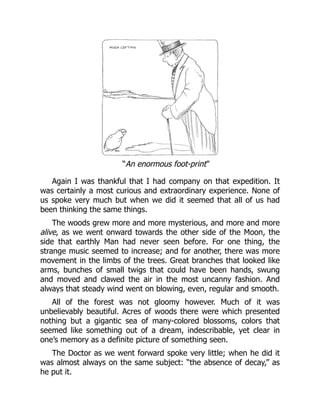
clear in every detail. It was the most gigantic thing I have ever seen,
a barefoot track fully four yards in length. There wasn’t only one,
either. Down the shore the trail went on for a considerable distance;
and the span that the prints lay apart gave one some idea of the
enormous stride of the giant who had left this trail behind him.
Questioning and alarmed, Chee-Chee and Polynesia gazed
silently up at the Doctor for an explanation.
“Humph!” he muttered after a while. “So Man is here, too. My
goodness, what a monster! Let us follow the trail.”
Chee-Chee was undoubtedly scared of such a plan. It was clearly
both his and Polynesia’s idea that the further we got away from the
maker of those tracks the better. I could see terror and fright in the
eyes of both of them. But neither made any objection; and in silence
we plodded along, following in the path of this strange human who
must, it would seem, be something out of a fairy tale.
But alas! It was not more than a mile further on that the foot-
prints turned into the woods where, on the mosses and leaves
beneath the trees, no traces had been left at all. Then we turned
about and followed the river quite a distance to see if the creature
had come back out on the sands again. But never a sign could we
see. Chee-Chee spent a good deal of time too at the Doctor’s
request trying to find his path through the forest by any signs, such
as broken limbs or marks in the earth which he might have left
behind. But not another trace could we find. Deciding that he had
merely come down to the stream to get a drink, we gave up the
pursuit and turned back to the line of our original march.
“An enormous foot-print”
Again I was thankful that I had company on that expedition. It
was certainly a most curious and extraordinary experience. None of
us spoke very much but when we did it seemed that all of us had
been thinking the same things.
The woods grew more and more mysterious, and more and more
alive, as we went onward towards the other side of the Moon, the
side that earthly Man had never seen before. For one thing, the
strange music seemed to increase; and for another, there was more
movement in the limbs of the trees. Great branches that looked like
arms, bunches of small twigs that could have been hands, swung
and moved and clawed the air in the most uncanny fashion. And
always that steady wind went on blowing, even, regular and smooth.
All of the forest was not gloomy however. Much of it was
unbelievably beautiful. Acres of woods there were which presented
nothing but a gigantic sea of many-colored blossoms, colors that
seemed like something out of a dream, indescribable, yet clear in
one’s memory as a definite picture of something seen.
The Doctor as we went forward spoke very little; when he did it
was almost always on the same subject: “the absence of decay,” as
he put it.
“I am utterly puzzled, Stubbins,” said he, in one of his longer
outbursts when we were resting. “Why, there is hardly any leaf-
mould at all!”
“What difference would that make, Doctor?” I asked.
“Well, that’s what the trees live on, mostly, in our world,” said he.
“The forest growth, I mean—the soil that is formed by dying trees
and rotting leaves—that is the nourishment that brings forth the
seedlings which finally grow into new trees. But here! Well, of course
there is some soil—and some shedding of leaves. But I’ve hardly
seen a dead tree since I’ve been in these woods. One would almost
think that there were some—er—balance. Some arrangement of—er
—well—I can’t explain it. . . . It beats me entirely.”
I did not, at the time, completely understand what he meant.
And yet it did seem as though every one of these giant plants that
rose about us led a life of peaceful growth, undisturbed by rot, by
blight or by disease.
“There was more movement in the limbs of the trees”
Suddenly in our march we found ourselves at the end of the
wooded section. Hills and mountains again spread before us. They
were not the same as those we had first seen, however. These had
vegetation, of a kind, on them. Low shrubs and heath plants clothed
this rolling land with a dense growth—often very difficult to get
through.
But still no sign of decay—little or no leaf-mould. The Doctor now
decided that perhaps part of the reason for this was the seasons—or
rather the lack of seasons. He said that we would probably find that
here there was no regular winter or summer. It was an entirely new
problem, so far as the struggle for existence was concerned, such as
we knew in our world.
I
THE EIGHTH CHAPTER
The Singing Trees
nto this new heath and hill country we traveled for miles. And
presently we arrived upon a rather curious thing. It was a sort of
basin high up and enclosed by hills or knolls. The strange part of
it was that here there were not only more tracks of the Giant Man,
just as we had seen lower down, but there were also unmistakable
signs of fire. In an enormous hollow ashes lay among the sands. The
Doctor was very interested in those ashes. He took some and added
chemicals to them and tested them in many ways. He confessed
himself at last entirely puzzled by their nature. But he said he
nevertheless felt quite sure we had stumbled on the scene of the
smoke signaling we had seen from Puddleby. Curiously long ago, it
seemed, that time when Too-Too, the owl, had insisted he saw
smoke burst from the side of the Moon. That was when the giant
moth lay helpless in our garden. And yet—how long was it? Only a
few days!
“It was from here, Stubbins,” said the Doctor, “that the signals
we saw from the Earth were given out, I feel certain. This place, as
you see, is miles and miles across. But what was used to make an
explosion as large as the one we saw from my house I have no
idea.”
“But it was smoke we saw,” said I, “not a flash.”
“That’s just it,” he said. “Some curious material must have been
used that we have as yet no knowledge of. I thought that by testing
the ashes I could discover what it was. But I can’t. However we may
yet find out.”
“It was a sort of basin”
For two reasons the Doctor was anxious for the present not to
get too far from the forest section. (We did not know then, you see,
that there were other wooded areas beside this through which we
had just come.) One reason was that we had to keep in touch with
our food supply which consisted of the fruits and vegetables of the
jungle. The other was that John Dolittle was absorbed now in the
study of this Vegetable Kingdom which he felt sure had many
surprises in store for the student naturalist.
After a while we began to get over the feeling of uncanny
creepiness, which at the beginning had made us so uncomfortable.
We decided that our fears were mostly caused by the fact that these
woods and plants were so different from our own. There was no
unfriendliness in these forests after all, we assured ourselves—
except that we were being watched. That we knew—and that we
were beginning to get used to.
As soon as the Doctor had decided that we would set up our new
headquarters on the edge of the forest, and we had our camp
properly established, we began making excursions in all directions
through the jungle. And from then on I was again kept very busy
taking notes of the Doctor’s experiments and studies.
One of the first discoveries we made in our study of the Moon’s
Vegetable Kingdom was that there was practically no warfare going
on between it and the Animal Kingdom. In the world we had left we
had been accustomed to see the horses and other creatures eating
up the grass in great quantities and many further examples of the
struggle that continually goes on between the two. Here, on the
other hand, the animals (or, more strictly speaking, the insects, for
there seemed as yet hardly any traces of other animal species) and
the vegetable life seemed for the most part to help one another
rather than to fight and destroy. Indeed we found the whole system
of Life on the Moon a singularly peaceful business. I will speak of
this again later on.
We spent three whole days in the investigation of the strange
music we had heard. You will remember that the Doctor, with his
skill on the flute, was naturally fond of music; and this curious thing
we had met with interested him a great deal. After several
expeditions we found patches of the jungle where we were able to
see and hear the tree music working at its best.
There was no doubt about it at all: The trees were making the
sounds and they were doing it deliberately. In the way that an
Æolian harp works when set in the wind at the right angle, the trees
moved their branches to meet the wind so that certain notes would
be given out. The evening that the Doctor made this discovery of
what he called the Singing Trees, he told me to mark down in the
diary of the expedition as a Red Letter Date. I shall never forget it.
We had been following the sound for hours, the Doctor carrying a
tuning-fork in his hand, ringing it every once in a while to make sure
of the notes we heard around us. Suddenly we came upon a little
clearing about which great giants of the forest stood in a circle. It
was for all the world like an orchestra. Spellbound, we stood and
gazed up at them, as first one and then another would turn a branch
to the steady blowing wind and a note would boom out upon the
night, clear and sweet. Then a group, three or four trees around the
glade, would swing a limb and a chord would strike the air, and go
murmuring through the jungle. Fantastic and crazy as it sounds, no
one could have any doubt who heard and watched that these trees
were actually making sounds, which they wanted to make, with the
aid of the wind.
Of course, as the Doctor remarked, unless the wind had always
blown steadily and evenly such a thing would have been impossible.
John Dolittle himself was most anxious to find out on what scale of
music they were working. To me, I must confess, it sounded just
mildly pleasant. There was a time: I could hear that. And some
whole phrases repeated once in a while, but not often. For the most
part the melody was wild, sad and strange. But even to my
uneducated ear it was beyond all question a quite clear effort at
orchestration; there were certainly treble voices and bass voices and
the combination was sweet and agreeable.
“Spellbound we gazed up at them”
I was excited enough myself, but the Doctor was worked up to a
pitch of interest such as I have seldom seen in him.
“Why, Stubbins,” said he, “do you realize what this means?—It’s
terrific. If these trees can sing, a choir understands one another and
all that, they must have a language.—They can talk! A language in
the Vegetable Kingdom! We must get after it. Who knows? I may yet
learn it myself. Stubbins, this is a great day!”
“For quite a long while he sat watching certain shrubs”
And so, as usual on such occasions, the good man’s enthusiasm
just carried him away bodily. For days, often without food, often
without sleep, he pursued this new study. And at his heels I trotted
with my note book always ready—though, to be sure, he put in far
more work than I did because frequently when we got home he
would go on wrestling for hours over the notes or new apparatus he
was building, by which he hoped to learn the language of the trees.
You will remember that even before we left the Earth John
Dolittle had mentioned the possibility of the moon-bells having some
means of communicating with one another. That they could move,
within the limits of their fixed position, had been fully established. To
that we had grown so used and accustomed that we no longer
thought anything of it. The Doctor had in fact wondered if this might
possibly be a means of conversation in itself—the movement of limbs
and twigs and leaves, something like a flag signal code. And for
quite a long while he sat watching certain trees and shrubs to see if
they used this method for talking between themselves.
A
THE NINTH CHAPTER
The Study of Plant Languages
bout this time there was one person whom both the Doctor
and I were continually reminded of, and continually wishing
for, and that was Long Arrow, the Indian naturalist whom we
had met in Spidermonkey Island. To be sure, he had never admitted
to the Doctor that he had had speech with plant life. But his
knowledge of botany and the natural history of the Vegetable
Kingdom was of such a curious kind we felt that here he would have
been of great help to us. Long Arrow, the son of Golden Arrow,
never booked a scientific note in his life. How would he—when he
was unable to write? Just the same he could tell you why a certain
colored bee visited a certain colored flower; why that moth chose
that shrub to lay its eggs in; why this particular grub attacked the
roots of this kind of water plant.
Often of an evening the Doctor and I would speak of him,
wondering where he was and what he was doing. When we sailed
away from Spidermonkey Island he was left behind. But that would
not mean he stayed there. A natural-born tramp who rejoiced in
defying the elements and the so-called laws of Nature, he could be
looked for anywhere in the two American continents.
And again, the Doctor would often refer to my parents. He
evidently had a very guilty feeling about them—despite the fact that
it was no fault of his that I had stowed away aboard the moth that
brought us here. A million and one things filled his mind these days,
of course; but whenever there was a let-down, a gap, in the stream
of his scientific enquiry, he would come back to the subject.
“Stubbins,” he’d say, “you shouldn’t have come. . . . Yes, yes, I
know, you did it for me. But Jacob, your father—and your mother
too—they must be fretting themselves sick about your
disappearance. And I am responsible. . . . Well, we can’t do anything
about that now, I suppose. Let’s get on with the work.”
And then he’d plunge ahead into some new subject and the
matter would be dropped—till it bothered him again.
Throughout all our investigations of the Moon’s Vegetable
Kingdom we could not get away from the idea that the animal life
was still, for some unknown reason, steering clear of us. By night,
when we were settling down to sleep, we’d often get the impression
that huge moths, butterflies or beetles were flying or crawling near
us.
We made quite sure of this once or twice by jumping out of our
beds and seeing a giant shadow disappear into the gloom. Yet never
could we get near enough to distinguish what the creatures were
before they escaped beyond the range of sight. But that they had
come—whatever they were—to keep an eye on us seemed quite
certain. Also that all of them were winged. The Doctor had a theory
that the lighter gravity of the Moon had encouraged the
development of wings to a much greater extent than it had on the
Earth.
And again those tracks of the strange Giant Man. They were
always turning up in the most unexpected places; I believe that if
the Doctor had allowed Polynesia and Chee-Chee complete liberty to
follow them that the enormous Human would have been run down in
a very short time. But John Dolittle seemed still anxious to keep his
family together. I imagine that with his curiously good instinctive
judgment he feared an attempt to separate us. And in any case of
course both Chee-Chee and Polynesia were quite invaluable in a
tight place. They were neither of them heavy-weight fighters, it is
true; but their usefulness as scouts and guides was enormous. I
have often heard John Dolittle say that he would sooner have that
monkey or the parrot Polynesia with him in savage countries than he
would the escort of a dozen regiments.
“Seeing a giant shadow disappear into the gloom”
With some of our experimental work we wandered off long
distances into the heath lands to see what we could do with the
gorgeous flowering shrubs that thronged the rolling downs; and
often we followed the streams many miles to study the gigantic lilies
that swayed their stately heads over the sedgy banks.
And little by little our very arduous labors began to be repaid.
I was quite astonished when I came to realize how well the
Doctor had prepared for this expedition. Shortly after he decided
that he would set to work on the investigation of this supposed
language of the plants he told me we would have to go back and
fetch the remainder of our baggage which we had left at the point of
our first arrival.
So the following morning, bright and early, he, Chee-Chee and I
set out to retrace our steps. Polynesia was left behind. The Doctor
told none of us why he did this but we decided afterwards that, as
usual, he knew what he was doing.
It was a long and hard trip. It took us a day and a half going
there and two days coming back with the load of the baggage. At
our original landing place we again found many tracks of the Giant

Fortran with Python: Integrating legacy systems with Python Bisette download pdf

  • 1.
    Full download ebookat ebookmass.com Fortran with Python: Integrating legacy systems with Python Bisette https://ebookmass.com/product/fortran-with-python- integrating-legacy-systems-with-python-bisette/ For dowload this book click link below OR CLICK BUTTON DOWLOAD EBOOK Download more ebook from https://ebookmass.com
  • 2.
    More products digital(pdf, epub, mobi) instant download maybe you interests ... Python for Finance: A Crash Course Modern Guide: Learn Python Fast Bisette https://ebookmass.com/product/python-for-finance-a-crash-course- modern-guide-learn-python-fast-bisette/ Learning Scientific Programming with Python Hill https://ebookmass.com/product/learning-scientific-programming- with-python-hill/ Data-Driven SEO with Python: Solve SEO Challenges with Data Science Using Python 1st Edition Andreas Voniatis https://ebookmass.com/product/data-driven-seo-with-python-solve- seo-challenges-with-data-science-using-python-1st-edition- andreas-voniatis/ Mastering Functional Programming with Python Brett Neutreon https://ebookmass.com/product/mastering-functional-programming- with-python-brett-neutreon/
  • 3.
    Python Real-World Projects:Crafting your Python Portfolio with Deployable Applications Steven F. Lott https://ebookmass.com/product/python-real-world-projects- crafting-your-python-portfolio-with-deployable-applications- steven-f-lott/ Market Master: Trading with Python Van Der Post https://ebookmass.com/product/market-master-trading-with-python- van-der-post/ Python Fundamentals for Finance: A survey of Algorithmic Options trading with Python Van Der Post https://ebookmass.com/product/python-fundamentals-for-finance-a- survey-of-algorithmic-options-trading-with-python-van-der-post/ Learning Scientific Programming with Python 2nd Edition Christian Hill https://ebookmass.com/product/learning-scientific-programming- with-python-2nd-edition-christian-hill-2/ Programming and Problem Solving with Python Ashok Namdev Kamthane https://ebookmass.com/product/programming-and-problem-solving- with-python-ashok-namdev-kamthane/
  • 5.
    FORTRAN WITH PYTHON Hayden VanDer Post Vincent Bisette Reactive Publishing
  • 6.
    CONTENTS Title Page Chapter 1:Defining Legacy Systems Chapter 2: Modern Architectures and Python - Python Basics Chapter 3: Assessment of Integration Needs Chapter 4: Fortran Syntax and Structure Chapter 5: Python for Fortran Developers Chapter 5: Python for Fortran Developers Chapter 5: Python for Fortran Developers Chapter 6: The Convergence of Traditions and Innovations Chapter 7: Benchmarking and Profiling Chapter 8: Security Considerations in Integration Chapter 9: Best Practices for Ongoing Maintenance Chapter 10: Astronomy and Astrophysics Chapter 11: Quantitative Finance Models
  • 7.
    CHAPTER 1: DEFINING LEGACYSYSTEMS A legacy system refers to any software, hardware, or integrated environment that was once at the frontier of technology but now exists in a state of obsolescence. However, this obsolescence is not a mere function of age. A system becomes "legacy" not when it merely ages, but when it begins to hinder adaptability and growth due to its outdated structures and technologies. In Vancouver, a city known for its rapid embrace of innovative tech startups, legacy systems are often hidden beneath layers of modern interfaces. The contrast between the city's forward-looking tech scene and the aged underpinnings of its digital infrastructure serves as a poignant local anecdote. This juxtaposition underscores the ubiquitous presence and silent importance of legacy systems in facilitating day-to-day operations, from financial transactions to public transportation systems. Legacy systems are characterized by several distinctive features. Firstly, they often operate on older operating systems or hardware that manufacturers no longer support. This lack of support poses significant challenges, from security vulnerabilities to compatibility issues with modern software. Secondly, the programming languages used to develop these systems, such as COBOL or Fortran, are often considered outdated in today’s development environment. Yet, these languages carry the logic and functionality of critical business operations for numerous organizations.
  • 8.
    Furthermore, legacy systemstypically lack comprehensive documentation, making maintenance and troubleshooting a daunting task for contemporary IT professionals. This scenario is exacerbated by the dwindling number of experts familiar with these older technologies. Despite these challenges, legacy systems hold immense value. They embody decades of accumulated knowledge and operational logic that are crucial for the organizations that rely on them. The financial and logistical implications of replacing these systems are often prohibitive, leading many to opt for maintenance rather than replacement. Moreover, legacy systems frequently continue to perform their intended functions reliably, albeit within the constraints of their outdated architecture. This reliability, born out of years of refinement and debugging, presents a compelling case for their continued use. Bridging the Old and the New defining legacy systems is an exercise in understanding technology's temporal journey. It is about recognizing the enduring relevance of what came before and finding ways to bridge it with the incessant march of innovation. As we delve deeper into integrating Fortran with Python, the narrative is not merely about juxtaposing the old against the new but about crafting a symbiosis that leverages the strengths of each. The challenge, therefore, lies not in discarding the past but in harmoniously integrating it with the future, much like the blend of historical and modern architectures that characterizes Vancouver's skyline. In this quest, the definition of legacy systems serves as our starting point, guiding us through the complexities of technological evolution toward a future where past and present seamlessly converge. The Importance and Prevalence of Legacy Systems in Modern Industry To understand the prevalence of legacy systems, one must first acknowledge their omnipresence across industries. From the financial
  • 9.
    sector, where theyprocess billions in transactions daily, to healthcare, managing patient records and critical life-support functions, legacy systems are the unseen backbone supporting the edifice of modern commerce and service delivery. In the financial world, legacy systems are the silent guardians of transactional integrity. The banking industry, for instance, relies heavily on systems that were developed decades ago, primarily because they offer unmatched reliability and have been tested by time. The New York Stock Exchange, a nerve center of global finance, has its operations deeply intertwined with legacy technologies, ensuring the seamless execution of millions of trades each day. The healthcare sector presents another arena where legacy systems are indispensable. Hospital management software developed in the late 20th century continues to be used, managing everything from patient records to pharmaceutical inventories. Similarly, emergency response systems, including those for fire, police, and ambulance services, often run on software and hardware considered obsolete by current standards but are crucial for their reliability and speed. The importance of legacy systems extends beyond their operational applications to encapsulate a broader spectrum of benefits that underscore their indispensability. One of the foremost advantages of legacy systems is their proven stability. Having been in operation for years, if not decades, these systems offer a level of reliability that newer technologies struggle to match. The iterative improvements made over the years have fine-tuned these systems to near perfection, making them the gold standard for mission-critical applications where failure is not an option. Economically, the argument for maintaining legacy systems is compelling. The sunk cost in these technologies—encompassing hardware, software, and the training of specialized personnel—represents a significant investment. Furthermore, the cost and risks associated with system overhaul or replacement are often prohibitive. For many organizations, the pragmatic
  • 10.
    approach is toextend the life of their existing systems through maintenance and incremental upgrades, ensuring continuity while managing costs. Legacy systems often possess specialized functionality that is deeply integrated into business processes. These systems have been customized over time to fit the unique needs of the organizations they serve, making them irreplaceable components of the operational framework. The depth of integration means that these systems support workflows and data processes that newer systems would find challenging to replicate without significant effort and expense. The Path Forward The dialogue surrounding legacy systems should not be framed as a choice between the old and the new but rather as a conversation about integration and coexistence. As industries evolve, the role of legacy systems becomes not less, but more critical. They represent a bridge to the past, holding the accumulated wisdom and data that are invaluable to the future growth and evolution of organizations. In embracing the future, the focus should be on leveraging the strengths of legacy systems while mitigating their limitations through thoughtful integration with newer technologies. This approach ensures that organizations can benefit from the best of both worlds—harnessing the reliability and specialized functionality of legacy systems while tapping into the flexibility, scalability, and efficiency of modern technologies. The importance and prevalence of legacy systems in modern industry cannot be overstated. They are not relics of a bygone era but vital cogs in the machinery of contemporary commerce and public service. Understanding and appreciating their value is the first step toward a future where legacy and modernity harmoniously coexist, driving innovation and efficiency in an ever-evolving digital landscape. Illuminating the Shadows
  • 11.
    The aerospace industry,known for its stringent demands for precision and reliability, remains one of the bastions of Fortran's legacy. NASA, for instance, has utilized Fortran for decades to simulate and analyze flight dynamics and control systems. The Shuttle Orbiter's software, pivotal for mission success, was developed using Fortran, showcasing the language's reliability and performance for critical real-time systems. Despite advancements in computational tools, Fortran's mathematical and numerical operations' efficacy keeps it at the forefront of aerospace research and operations. Weather forecasting and climate modeling owe a significant debt to Fortran- based systems. The complexity and scale of meteorological data processing demand robust and efficient computational capabilities—qualities inherent in Fortran. The European Centre for Medium-Range Weather Forecasts, for example, relies on a Fortran-based Integrated Forecasting System (IFS) to generate weather predictions with remarkable accuracy. Similarly, the Community Earth System Model (CESM), a cornerstone in climate research, utilizes Fortran for its unparalleled computational efficiency in simulating global climate phenomena over decades and centuries. While not immediately associated with the financial industry, Fortran has made notable contributions, particularly in the world of quantitative finance. Algorithms for complex financial models, risk assessment, and portfolio optimization have been developed in Fortran, benefiting from its computational precision and efficiency. Legacy Fortran systems still underpin some of the critical operations in finance, from actuarial computations to algorithmic trading platforms, demonstrating the language's adaptability and enduring utility. Perhaps the most profound impact of Fortran-based legacy systems is observed in the domain of scientific research. High-performance computing (HPC) applications, from particle physics simulations at CERN to genomic sequence analysis in bioinformatics, have been built on the shoulders of Fortran. The language's array-handling capabilities and mathematical function libraries make it an ideal choice for scientific investigations that demand high degrees of computational accuracy and scalability.
  • 12.
    The Challenges andOpportunities of Fortran Legacy Systems While Fortran's legacy systems are indispensable assets, they present unique challenges in an era dominated by rapid technological evolution. Interoperability with modern programming languages and platforms, code maintenance and readability, and the dwindling number of Fortran-literate programmers are significant hurdles. However, these challenges also open avenues for innovation—integrating these systems with contemporary technologies without sacrificing their proven capabilities offers a pathway to modernizing legacy systems that are so deeply ingrained in our technological landscape. Fortran-based legacy systems are more than historical artifacts; they are active, critical components of modern industry and scientific research. Their examples across various sectors highlight not only their importance but also the need for strategies to preserve their utility and integrate them into the future of computational technology. As we advance, the dialogue should not be about replacing these systems but rather about understanding, preserving, and innovating upon the legacy of Fortran in the ever-evolving digital epoch. Navigating the Past for the Future - The Dichotomy of Legacy Systems Legacy systems stand as monumental testaments to the ingenuity and innovation of previous generations. These systems, often characterized by their use of languages like Fortran, encapsulate a complex mix of challenges and benefits that demand a nuanced understanding. As we delve deeper into the intricacies of maintaining these technological relics, we uncover the paradoxes they present to modern industry and research. Integration Complexity: A primary challenge in maintaining legacy systems is their integration with modern technologies. The architectural differences between older systems and today's platforms can create significant barriers to seamless integration. The disparity in programming paradigms, data formats, and communication protocols necessitates creative and often complex bridging solutions to enable interoperability without compromising system integrity.
  • 13.
    Skill Gap: Thedwindling pool of professionals proficient in legacy languages like Fortran constitutes a significant challenge. As the tech industry leans towards newer, more versatile languages, the expertise required to maintain and troubleshoot legacy systems becomes rarer, posing risks of knowledge loss and operational inefficiency. Security Vulnerabilities: Legacy systems, designed in an era with different cybersecurity threats, often lack the robust security measures required to thwart modern attacks. This vulnerability not only poses risks to the systems themselves but also to the broader networked infrastructure they interact with, making them potential weak links in cybersecurity defenses. Cost Implications: The financial aspect of maintaining legacy systems can be prohibitive. The costs associated with upgrading, integrating, or even just sustaining operations can strain budgets, especially when weighed against the perceived advantages of transitioning to modern alternatives. Reliability and Stability: One of the most compelling reasons for maintaining legacy systems is their proven reliability and stability. Systems that have been operational for decades provide a level of assurance in their performance and output accuracy that is invaluable, particularly in critical applications such as aerospace, banking, and scientific research. Specialized Functionality: Legacy systems often contain specialized functionalities that are deeply embedded in their design, making them irreplaceable components of certain operational workflows. The cost and effort to replicate these functionalities in modern systems can be daunting and sometimes impossible, further cementing the rationale for their maintenance. Data Integrity: The historical data contained within legacy systems is a treasure trove of insights and information. Maintaining these systems ensures the continued accessibility and integrity of this data, which can be crucial for longitudinal studies, regulatory compliance, and strategic decision-making.
  • 14.
    Sustainability: From anenvironmental perspective, extending the lifecycle of existing systems can be more sustainable than the production, deployment, and disposal associated with frequent technology refresh cycles. This consideration, though often overlooked, adds another dimension to the debate on legacy system maintenance. Bridging the Divide The journey of maintaining legacy systems is fraught with challenges but also marked by unique benefits that underscore their continued relevance. The key lies in striking a balance—leveraging the strengths of these systems while mitigating their limitations through strategic integration with modern technologies. Initiatives like creating interoperability layers, upskilling the workforce in legacy languages, and adopting a security- focused approach to system updates are pivotal. The blend of old and new symbolizes not just a technical integration but a philosophical reconciliation between the enduring value of legacy systems and the innovative potential of modern technologies. As we navigate this complex terrain, the goal remains clear: to harness the best of both worlds in crafting a resilient, efficient, and forward-looking digital infrastructure. In this context, maintaining legacy systems is not merely an act of preservation but a forward-thinking strategy that acknowledges the intricate layers of our technological evolution. The legacy of Fortran and its counterparts, thus, continues to be a guiding light, illuminating the path towards a harmonious technological future. Navigating the Past for the Future - Weighing the Scales: Maintenance vs. Upgradation Maintenance Costs: Legacy systems, by their very nature, entail ongoing maintenance costs that can burgeon over time. These costs manifest in various forms, including specialized labor, outdated hardware replacements, and software license renewals. The scarcity of expertise in languages such as Fortran further inflates these costs, posing a significant financial burden.
  • 15.
    Upgradation Costs: Onthe flip side, the initial investment required to upgrade legacy systems to modern platforms is substantial. This includes not just the cost of new software and hardware but also the expenses related to data migration, system testing, and employee training. However, these costs are often one-time or spread over the system's lifecycle, potentially offering a more predictable financial model. Maintenance Efficiency: Maintaining legacy systems can lead to efficiency bottlenecks. These systems may be stable but often operate on outdated architectures that are not optimized for current operational demands. The resulting inefficiencies can stifle productivity and innovation, hindering the organization's ability to respond to market changes swiftly. Efficiency Gains through Upgrading: Transitioning to modern systems can significantly enhance operational efficiency. New technologies offer streamlined workflows, improved data processing capabilities, and better integration with other contemporary tools, collectively boosting organizational agility and competitiveness. The Cultural Aspect: The decision to maintain or upgrade impacts the organizational culture. Maintenance might signal a risk-averse or preservationist mindset, potentially stifling innovation. Conversely, upgrading can catalyze a culture of innovation and adaptability, although it may also introduce change management challenges. Skill Development: Upgrading legacy systems necessitates upskilling employees to handle new technologies, fostering a learning culture within the organization. While this is a benefit, it also represents a short-term challenge in terms of training costs and the learning curve. Maintaining for Stability: Legacy systems often provide a stable platform that businesses understand well. In industries where change is minimal, and the existing systems adequately support operational requirements, maintenance might be the prudent choice, ensuring business continuity without the disruptions associated with system overhauls.
  • 16.
    Upgrading for Growth:In contrast, upgrading positions the organization for future growth. It not only addresses current operational inefficiencies but also prepares the infrastructure to incorporate emerging technologies such as artificial intelligence, big data analytics, and cloud computing. This foresight can be critical in industries characterized by rapid technological advancements and intense competition. The decision between maintaining legacy systems and upgrading to modern platforms is multifaceted, involving a careful consideration of financial implications, operational efficiency, organizational impact, and future readiness. Each organization must weigh these factors in light of its unique circumstances, goals, and industry dynamics. While the allure of modern technology is undeniable, the decision to upgrade should not be taken lightly. A phased approach, where legacy systems are incrementally integrated with modern technologies, might offer a middle path. This strategy leverages the reliability of legacy systems while gradually introducing the benefits of modernization, thus minimizing disruption and spreading the financial burden over time. The choice between maintenance and upgrading is not just a technical decision but a strategic one that shapes the organization's trajectory towards innovation and growth. In navigating this decision, the wisdom lies not in the extremes but in finding a harmonious balance that aligns with the organization's long-term vision and capabilities. The Intersection of Eras: Interoperability Challenges with Modern Systems Interoperability, the ability of different systems, devices, applications, and platforms to communicate and work together seamlessly, is a cornerstone of modern computing. However, when legacy systems such as those written in Fortran are introduced into the mix, the seamless exchange of information becomes a complex puzzle. The crux of the matter lies not only in the technological disparities but also in the architectural and philosophical differences between legacy and modern systems.
  • 17.
    Language Compatibility: Thefirst hurdle is the stark difference in programming languages. Legacy systems, often written in languages like Fortran, operate under different paradigms compared to modern, object- oriented languages like Python. Bridging this gap requires intricate wrappers or middleware that can translate data and function calls between the two, often leading to performance overheads and increased complexity. Data Formats and Protocols: Legacy and modern systems frequently rely on divergent data formats and communication protocols. While XML or JSON are staples of modern web services, legacy systems may use fixed-length records or proprietary formats, necessitating conversion utilities that can lead to data integrity and loss issues. Monolithic vs. Microservices: Many legacy systems are monolithic, designed to run on single, often large-scale machines. In contrast, modern systems tend toward distributed architectures, like microservices, which can create compatibility challenges. Ensuring these fundamentally different architectures can communicate effectively often requires significant re- architecting or the introduction of an intermediary service layer. Synchronous vs. Asynchronous: Legacy systems typically operate synchronously, waiting for tasks to complete before moving on to the next. Modern systems, however, increasingly lean on asynchronous operations, especially in web services, to improve scalability and responsiveness. Integrating these systems necessitates a reevaluation of process flows and may involve refactoring legacy code to handle asynchronous calls. Agile vs. Waterfall: The shift in development methodologies from the waterfall model, common in legacy system development, to agile practices prevalent in modern software projects, reflects broader changes in the IT landscape. This cultural shift impacts not just the technical integration but also the management and ongoing development of integrated systems, requiring teams to adapt to more fluid, iterative development cycles with a focus on continuous delivery. Open Source vs. Proprietary: Legacy systems often rely on proprietary technologies, while modern systems are increasingly built on open-source
  • 18.
    software. This shifttowards open-source has implications for interoperability, as it affects everything from software licensing to community support and the availability of integration tools. To navigate these challenges, organizations must adopt a multifaceted approach: - Middleware and APIs: Developing or utilizing existing middleware solutions and APIs that facilitate communication between legacy and modern systems can provide a bridge between disparate technologies. - Containerization: Leveraging container technology like Docker can encapsulate legacy applications, making them more compatible with modern cloud environments and microservices architectures. - Incremental Modernization: Adopting a strategy of gradual modernization allows for the phased refactoring of legacy systems, reducing risk and allowing for incremental improvement in interoperability. - Cultural Integration: Fostering a culture that values both legacy knowledge and modern development practices is crucial. This includes cross-training teams, promoting collaboration, and adopting practices that accommodate both paradigms. The integration of legacy systems with modern platforms is fraught with challenges that span the technological, architectural, and philosophical domains. By understanding and addressing these challenges head-on, organizations can pave the way for a future where legacy and modern systems not only coexist but complement and enhance each other, driving innovation and efficiency. The journey towards interoperability is complex, but with the right strategies and mindset, it is both achievable and essential for leveraging the full spectrum of computational capabilities in today's diverse IT landscape. Harnessing the Value: Potential for Leveraging Existing Investments in Legacy Systems
  • 19.
    Legacy systems oftencarry a connotation of obsolescence, conjuring images of antiquated hardware and software, isolated in a modern digital environment. However, beneath this surface perception lies untapped potential. Legacy systems, particularly those operating on Fortran, embody decades of refined logic, precise calculations, and domain-specific functionalities that remain invaluable. The challenge and opportunity lie in leveraging these existing investments to meet contemporary needs without compromising their inherent value. Institutional Knowledge: Legacy systems are repositories of institutional knowledge and business logic that have been honed over years. This knowledge, encoded in software, is often critical to the operations of organizations, especially in sectors like finance, aerospace, and scientific research, where Fortran systems are prevalent. Cost Efficiency: The financial investment in legacy systems is substantial. Replacement or wholesale modernization is not only costly but risky. Leveraging existing systems while gradually integrating modern functionalities can provide a cost-effective pathway to digital transformation. Reliability and Stability: Legacy systems have been battle-tested, offering a level of reliability and stability that new systems may struggle to match initially. Their enduring presence is a testament to their functionality and performance in mission-critical operations. Wrapping and Interface Development: Creating interfaces or wrappers around legacy code allows modern systems, particularly those developed in Python, to interact with legacy functionalities seamlessly. This approach preserves the core logic of legacy systems while providing the flexibility and user-friendly interfaces expected in modern applications. Microservices Architecture: By decomposing functionalities of legacy systems into microservices, organizations can selectively modernize aspects of their IT infrastructure. This strategy allows for the incremental replacement or augmentation of legacy components, reducing the risk of system-wide failures and facilitating a smoother transition.
  • 20.
    Data Liberation: Legacysystems often contain vast amounts of valuable data locked in outdated formats or databases. Developing tools to extract, transform, and load (ETL) this data into modern databases or data lakes can enable advanced analytics and insights, thus multiplying the value of existing investments. Scientific Computing: In scientific research, legacy Fortran programs for computational models remain irreplaceable. By integrating these programs with Python-based data analysis and visualization tools, researchers can enhance the accessibility and usability of complex simulations. Finance: Financial institutions leverage decades-old Fortran systems for their unmatched speed and precision in calculations. Wrapping these systems in modern interfaces enables the integration with real-time data feeds and contemporary risk management tools, thus maintaining competitive edge without forsaking proven algorithms. Aerospace: The aerospace industry relies on legacy Fortran code for simulation and design. Modernizing these systems through interface development allows for integration with CAD software and other engineering tools, streamlining the design process while preserving the core computational capabilities. The potential for leveraging existing investments in legacy systems extends far beyond mere cost savings or technological necessity. It represents a strategic opportunity to blend the tried-and-true with the cutting-edge, creating a computing environment that is both robust and innovative. By reframing our perspective on legacy systems, particularly those based on Fortran, we can uncover pathways to synergize these assets with modern programming paradigms like Python. This approach not only honors the past contributions of legacy systems but also ensures their continued relevance and utility in the digital age, driving forward the ongoing evolution of computational science and industry practices. Overview of Common Legacy Systems Programming Languages
  • 21.
    Fortran, short forFormula Translation, emerged in the 1950s as the world's first high-level programming language. It was designed to address the complex mathematical computations required in scientific research, engineering, and physics. Fortran's syntax and structure were revolutionary, offering a way to express detailed computational algorithms in a form that was both readable and efficient for the machine. Enduring Relevance: Despite its age, Fortran remains a cornerstone in fields that demand high-performance numerical computations. Its efficiency in array operations, linear algebra, and complex mathematical functions has ensured its survival and evolution through numerous versions, the most recent being Fortran 2018. COBOL (Common Business-Oriented Language) was developed in the late 1950s with the aim of creating a universal programming language that could run on any computer. It was specifically designed for business applications that require extensive data processing, such as payroll, accounting, and inventory management. Legacy and Continuation: COBOL systems are deeply entrenched in the financial sector, government agencies, and large corporations. Estimates suggest that billions of lines of COBOL code are still in use today, underpinning vital operations in banking and commerce. Introduced in the late 1960s by Niklaus Wirth, Pascal was designed as a teaching tool for good programming practices. Its structure and syntax encourage clear, concise, and organized code, making it an ideal language for introducing students to concepts in structured and object-oriented programming. Legacy in Software Development: While Pascal's use in commercial applications has waned, its influence persists in the design of several modern programming languages. Moreover, it served as the basis for Borland Delphi, a rapid application development tool for Windows, which brought Pascal into the world of professional software development.
  • 22.
    These legacy languagesshare a common attribute: they were crafted to solve specific categories of problems efficiently. Their longevity attests to the reliability and performance of the solutions they provide. However, the evolution of technology and the advent of new programming paradigms have prompted a shift towards more versatile and user-friendly languages like Python. Bridging The Gap: From Legacy to Modernity The transition from legacy languages to modern programming environments is not about replacement but integration. Each of these legacy languages—Fortran for its unparalleled numeric computation, COBOL for its business processing robustness, and Pascal for its clarity and structure— offers unique benefits that modern languages strive to encompass but rarely surpass in specialized areas. Integration Strategies: Modern programming, particularly with Python, emphasizes versatility, rapid development, and extensive libraries. Integrating the computational muscle of languages like Fortran with Python's flexibility allows for the creation of powerful, efficient applications that leverage the strengths of both legacy and contemporary technologies. The integration of Fortran with Python exemplifies how legacy and modern systems can collaborate to solve today's computational challenges. Python's simplicity and extensive libraries, combined with Fortran's computational efficiency, create a synergy that enhances scientific computing, data analysis, and engineering simulations. The journey through the common legacy systems programming languages underscores a critical insight: the innovations of the past form the bedrock for the future. Understanding and leveraging these languages—Fortran, COBOL, Pascal—provides not only a connection to the origins of computing but also a toolkit for addressing contemporary challenges. By integrating the old with the new, we pave the way for advancements that respect the legacy of computing while pushing the boundaries of what is technologically possible.
  • 23.
    - A JourneyThrough Time: The Evolution of Programming Languages in Legacy Systems The story begins in the 1940s and 1950s, an era characterized by the use of machine language and assembly language. These early forms of programming were closely tied to the hardware, requiring programmers to manually manipulate the ones and zeros of machine code or use mnemonics in assembly language. This was a time-intensive and error-prone process, necessitating a shift towards more abstract and user-friendly forms of coding. The introduction of Fortran (Formula Translation) in 1957 by IBM was a revolutionary step forward. As the first high-level programming language, Fortran abstracted the coding process from the underlying hardware, allowing scientists and engineers to focus on solving computational problems rather than wrestling with the complexities of the machine's language. Its development marked the beginning of a new era in programming, characterized by an emphasis on accessibility and efficiency. Parallel to Fortran's impact on scientific computing, COBOL (Common Business-Oriented Language) emerged in 1959 as a language designed for business data processing. COBOL's development was driven by the need for a standardized, high-level language that could be used across different machines, making it immensely popular for financial and administrative applications. It introduced features that were groundbreaking at the time, such as English-like syntax and data structures that mirrored business records. The 1970s saw the advent of Pascal, developed by Niklaus Wirth as a tool for teaching structured programming and encouraging good coding practices. Pascal's clarity, simplicity, and efficiency in compilation set a new standard for programming languages. It paved the way for the development of subsequent languages like C, which further refined the concept of structured programming and introduced capabilities that made it suitable for a wide range of applications, from operating systems to embedded systems.
  • 24.
    Another random documentwith no related content on Scribd:
  • 25.
    “Some of thefruits were as big as a trunk” Chee-Chee!—Poor little timid Chee-Chee, who conquered your own fears and volunteered to go ahead of us, alone, into the jungle to find food when our strength was giving out. To the world you were just an organ-grinder’s monkey. But to us whom you saved from starvation, when terror beset you at every step, you will forever be ranked high in the list of the great heroes of all time. Thank goodness we had you with us! Our bones might to-day be mouldering in the sands of the Moon if it had not been for your un- taught science, your jungle skill—and, above all, your courage that overcame your fear! Well, to return: as I ate these strange fruits and sipped the water that brought life back I gazed upward and saw before me a sort of ridge. On its level top a vegetation, a kind of tangled forest, flourished; and trailing down from this ridge were little outposts of the Vegetable Kingdom, groups of bushes and single trees, that scattered and dribbled away in several directions from the main mass. Why and how that lone tree survived so far away we could never satisfactorily explain. The nearest John Dolittle could come to it was that some underground spring supplied it with enough water or moisture to carry on. Yet there can be no doubt that to have
  • 26.
    reached such enormousproportions it must have been there hundreds—perhaps thousands—of years. Anyway it is a good thing for us it was there. If it had not been, as a pointer towards this habitable quarter of the Moon—it is most likely our whole expedition would have perished. When the Doctor and I had finished our mysterious breakfast we started to question Chee-Chee about the forest from which he had produced the food we had eaten. “ ‘I climbed a tree’ ” “I don’t know how I did it,” said Chee-Chee when we asked him, “I just shut my eyes most of the time—terribly afraid. I passed trees, plants, creepers, roots. I smelt—Goodness! I too was hungry, remember. I smelt hard as I could. And soon of course I spotted food, fruits. I climbed a tree—half the time with my eyes shut. Then I see some monster, golly! What a jungle—different from any monkey ever seen before—Woolly, woolly!—Ooh, ooh! All the same, nuts smell good. Catch a few. Chase down the tree. Run some more. Smell again. Good!—Up another tree. Different fruit, good just the same. Catch a few. Down again. Run home. On the way smell good root. Same as ginger—only better. Dig a little. Keep eyes shut—don’t
  • 27.
    want to seemonster. Catch a piece of root. Run all the way home. Here I am. Finish!” Well, dear old Chee-Chee’s story was descriptive of his own heroic adventures but it did not give us much idea of the moon forest which we were to explore. Nevertheless, rested and fit, we now felt much more inclined to look into things ourselves. Leaving what luggage we had brought with us from our original landing point, we proceeded towards the line of trees at the summit of the bluff, about four miles ahead of us. We now felt that we could find our way back without much difficulty to the two last camps we had established. The going was about the same, loose sand—only that as we approached the bluff we found the sand firmer to the tread. On the way up the last lap towards the vegetation line we were out of view of the top itself. Often the going was steep. All the way I had the feeling that we were about to make new and great discoveries—that for the first time we were to learn something important about the true nature of the mysterious Moon.
  • 28.
    I THE FIFTH CHAPTER Onthe Plateau ndeed our first close acquaintance with the forests of the Moon was made in quite a dramatic manner. If it had been on a stage it could not have been arranged better for effect. Suddenly as our heads topped the bluff we saw a wall of jungle some mile or so ahead of us. It would take a very long time to describe those trees in detail. It wasn’t that there were so many kinds but each one was so utterly different from any tree we had seen on the Earth. And yet, curiously enough, they did remind you of vegetable forms you had seen, but not of trees. For instance, there was one whole section, several square miles in extent apparently, that looked exactly like ferns. Another reminded me of a certain flowering plant (I can’t recall the name of it) which grows a vast number of small blossoms on a flat surface at the top. The stems are a curious whitish green. This moon tree was exactly the same, only nearly a thousand times as big. The denseness of the foliage (or flowering) at the top was so compact and solid that we later found no rain could penetrate it. And for this reason the Doctor and I gave it the name of the Umbrella Tree. But not one single tree was there which was the same as any tree we had seen before. And there were many, many more curious growths that dimly reminded you of something, though you could not always say exactly what.
  • 29.
    “We approached thebluff on whose brow the vegetation flourished” One odd thing that disturbed us quite a little was a strange sound. Noises of any kind, no matter how faint, we already knew could travel long distances on the Moon. As soon as we had gained the plateau on top of the bluff we heard it. It was a musical sound. And yet not the sound of a single instrument. It seemed almost as though there was a small orchestra somewhere playing very, very softly. We were by this time becoming accustomed to strange things. But I must confess that this distant hidden music upset me quite a little and so, I know, it did the Doctor.
  • 30.
    The Umbrella Tree Atthe top of the bluff we rested to get our wind before we covered the last mile up to the jungle itself. It was curious how clearly marked and separated were those sections of the Moon’s landscape. And yet doubtless the smaller scale of all the geographical features of this world, so much less in bulk than our own, could partly account for that. In front of us a plateau stretched out, composed of hard sand, level and smooth as a lake, bounded in front by the jungle and to the rear of us by the cliff we had just scaled. I wondered as I looked across at the forest what scenery began on the other side of the woods and if it broke off in as sharp a change as it did here. As the most important thing to attend to first was the establishment of a water supply, Chee-Chee was asked to act as guide. The monkey set out ahead of us to follow his own tracks which he had made last night. This he had little difficulty in doing across the open plateau. But when we reached the edge of the forest it was not so easy. Much of his traveling here had been done by swinging through the trees. He always felt safer so, he said, while explaining to us how he had been guided to the water by the sense of smell.
  • 31.
    Again I realizedhow lucky we had been to have him with us. No one but a monkey could have found his way through that dense, dimly lit forest to water. He asked us to stay behind a moment on the edge of the woods while he went forward to make sure that he could retrace his steps. We sat down again and waited. “Did you wake up at all during the night, Stubbins?” the Doctor asked after a little. “No,” I said. “I was far too tired. Why?” “Did you, Polynesia?” he asked, ignoring my question. “Yes,” said she. “I was awake several times.” “Did you hear or see anything er—unusual?” “Yes,” said she. “I can’t be absolutely certain. But I sort of felt there was something moving around the camp keeping a watch on us.” “Humph!” muttered the Doctor. “So did I.” Then he relapsed into silence. “‘Yes,’ said she, ‘I was awake several times’”
  • 32.
    Another rather strangething that struck me as I gazed over the landscape while we waited for Chee-Chee to return was the appearance of the horizon. The Moon’s width being so much smaller than the Earth’s, the distance one could see was a great deal shorter. This did not apply so much where the land was hilly or mountainous; but on the level, or the nearly level, it made a very striking difference. The roundness of this world was much more easily felt and understood than was that of the world we had left. On this plateau, for example, you could only see seven or eight miles, it seemed, over the level before the curve cut off your vision. And it gave quite a new character even to the hills, where peaks showed behind other ranges, dropping downward in a way that misled you entirely as to their actual height. “‘You bet they were not!’ grunted Polynesia” Finally Chee-Chee came back to us and said he had successfully retraced his steps to the water he had found the night before. He was now prepared to lead us to it. He looked kind of scared and ill at ease. The Doctor asked him the reason for this, but he didn’t seem able to give any. “Everything’s all right, Doctor,” said he—“at least I suppose it is. It was partly that—oh, I don’t know—I can’t quite make out what it
  • 33.
    is they haveasked you here for. I haven’t actually laid eyes on any animal life since we left the moth who brought us. Yet I feel certain that there’s lots of it here. It doesn’t appear to want to be seen. That’s what puzzles me. On the Earth the animals were never slow in coming forward when they were in need of your services.” “You bet they were not!” grunted Polynesia. “No one who ever saw them clamoring around the surgery door could doubt that.” “Humph!” the Doctor muttered. “I’ve noticed it myself already. I don’t understand it quite—either. It almost looks as though there were something about our arrival which they didn’t like. . . . I wonder. . . . Well, anyway, I wish the animal life here would get in touch with us and let us know what it is all about. This state of things is, to say the least—er—upsetting.”
  • 34.
    A THE SIXTH CHAPTER TheMoon Lake nd so we went forward with Chee-Chee as guide to find the water. Our actual entrance into that jungle was quite an experience and very different from merely a distant view of it. The light outside was not bright; inside the woods it was dimmer still. My only other experience of jungle life had been in Spidermonkey Island. This was something like the Spidermonkey forest and yet it was strikingly different. From the appearance and size of that first tree we had reached, the Doctor had guessed its age to be very, very great. Here the vegetable life in general seemed to bear out that idea beyond all question. The enormous trees with their gigantic trunks looked as though they had been there since the beginning of time. And there was surprisingly little decay—a few shed limbs and leaves. That was all. In unkept earthly forests one saw dead trees everywhere, fallen to the ground or caught half-way in the crotches of other trees, withered and dry. Not so here. Every tree looked as though it had stood so and grown in peace for centuries. At length after a good deal of arduous travel—the going for the most part was made slow by the heaviest kind of undergrowth, with vines and creepers as thick as your leg—we came to a sort of open place in which lay a broad calm lake with a pleasant waterfall at one end. The woods that surrounded it were most peculiar. They looked like enormous asparagus. For many, many square miles their tremendous masts rose, close together, in ranks. No creepers or vines had here been given a chance to flourish. The enormous stalks had taken up all the room and the nourishment of the crowded earth. The tapering tops, hundreds of feet above our heads, looked good enough to eat. Yet I’ve no doubt that if we had ever got up to them they would have been found as hard as oaks.
  • 35.
    The Doctor walkeddown to the clean sandy shore of the lake and tried the water. Chee-Chee and I did the same. It was pure and clear and quenching to the thirst. The lake must have been at least five miles wide in the center. “I would like,” said John Dolittle, “to explore this by boat. Do you suppose, Chee-Chee, that we could find the makings of a canoe or a raft anywhere?” “I should think so,” said the monkey. “Wait a minute and I will take a look around and see.” So, with Chee-Chee in the lead, we proceeded along the shore in search of materials for a boat. On account of that scarcity of dead or dried wood which we had already noticed, our search did not at first appear a very promising one. Nearly all the standing trees were pretty heavy and full of sap. For our work of boat building a light hatchet on the Doctor’s belt was the best tool we had. It looked sadly small compared with the great timber that reared up from the shores of the lake. But after we had gone along about a mile I noticed Chee-Chee up ahead stop and peer into the jungle. Then, after he had motioned to us with his hand to hurry, he disappeared into the edge of the forest. On coming up with him we found him stripping the creepers and moss off some contrivance that lay just within the woods, not more than a hundred yards from the water’s edge. We all fell to, helping him, without any idea of what it might be we were uncovering. There seemed almost no end to it. It was a long object, immeasurably long. To me it looked like a dead tree— the first dead, lying tree we had seen. “What do you think it is, Chee-Chee?” asked the Doctor. “It’s a boat,” said the monkey in a firm and matter-of-fact voice. “No doubt of it at all in my mind. It’s a dug-out canoe. They used to use them in Africa.”
  • 36.
    “But, Chee-Chee,” criedJohn Dolittle, “look at the length! It’s a full-sized Asparagus Tree. We’ve uncovered a hundred feet of it already and still there’s more to come.” “I can’t help that,” said Chee-Chee. “It’s a dug-out canoe just the same. Crawl down with me here underneath it, Doctor, and I’ll show you the marks of tools and fire. It has been turned upside down.” With the monkey guiding him, the Doctor scrabbled down below the queer object; and when he came forth there was a puzzled look on his face. “Well, they might be the marks of tools, Chee-Chee,” he was saying. “But then again they might not. The traces of fire are more clear. But that could be accidental. If the tree burned down it could very easily—” “The natives in my part of Africa,” Chee-Chee interrupted, “always used fire to eat out the insides of their dug-out canoes. They built little fires all along the tree, to hollow out the trunk so that they could sit in it. The tools they used were very simple, just stone scoops to chop out the charred wood with. I am sure this is a canoe, Doctor. But it hasn’t been used in a long time. See how the bow has been shaped up into a point.” “I know,” said the Doctor. “But the Asparagus Tree has a natural point at one end anyhow.” “And, Chee-Chee,” put in Polynesia, “who in the name of goodness could ever handle such a craft? Why, look, the thing is as long as a battleship!” Then followed a half-hour’s discussion, between the Doctor and Polynesia on the one side and Chee-Chee on the other, as to whether the find we had made was, or was not, a canoe. For me, I had no opinion. To my eyes the object looked like an immensely long log, hollowed somewhat on the one side, but whether by accident or design I could not tell.
  • 37.
    In any caseit was certainly too heavy and cumbersome for us to use. And presently I edged into the argument with the suggestion that we go on further and find materials for a raft or boat we could handle. The Doctor seemed rather glad of this excuse to end a fruitless controversy, and soon we moved on in search of something which would enable us to explore the waters of the lake. A march of a mile further along the shore brought us to the woods that were not so heavy. Here the immense asparagus forests gave way to a growth of smaller girth; and the Doctor’s hatchet soon felled enough poles for us to make a raft from. We laced them together with thongs of bark and found them sufficiently buoyant when launched to carry us and our small supply of baggage with ease. Where the water was shallow we used a long pole to punt with; and when we wished to explore greater depths we employed sweeps, or oars, which we fashioned roughly with the hatchet. From the first moment we were afloat the Doctor kept me busy taking notes for him. In the equipment he had brought with him there was a fine-meshed landing net: and with it he searched along the shores for signs of life in this moon lake, the first of its kind we had met with. “It is very important, Stubbins,” said he, “to find out what fish we have here. In evolution the fish life is a very important matter.” “What is evolution?” asked Chee-Chee.
  • 38.
    “We used along pole to punt with” I started out to explain it to him but was soon called upon by the Doctor to make more notes—for which I was not sorry, as the task turned out to be a long and heavy one. Polynesia however took it up where I left off and made short work of it. “Evolution, Chee-Chee,” said she, “is the story of how Tommy got rid of the tail you are carrying—because he didn’t need it any more —and the story of how you grew it and kept it because you did need it. . . . Evolution! Poof!—Professors’ talk. A long word for a simple matter.” It turned out that our examination of the lake was neither exciting nor profitable. We brought up all sorts of water-flies, many larvæ of perfectly tremendous size, but we found as yet no fishes. The plant life—water plant I mean—was abundant. “I think,” said the Doctor, after we had poled ourselves around the lake for several hours, “that there can be no doubt now that the Vegetable Kingdom here is much more important than the Animal Kingdom. And what there is of the Animal Kingdom seems to be mostly insect. However, we will camp on the shore of this pleasant lake and perhaps we shall see more later.”
  • 39.
    So we broughtour raft to anchor at about the place from which he had started out and pitched camp on a stretch of clean yellow sand. I shall never forget that night. It was uncanny. None of us slept well. All through the hours of darkness we heard things moving around us. Enormous things. Yet never did we see them or find out what they were. The four of us were nevertheless certain we were being watched. Even Polynesia was disturbed. There seemed no doubt that there was plenty of animal life in the Moon, but it did not as yet want to show itself to us. The newness of our surroundings alone was disturbing enough, without this very uncomfortable feeling that something had made the moon folks distrustful of us.
  • 40.
    A THE SEVENTH CHAPTER Tracksof a Giant nother thing which added to our sleeplessness that night was the continuance of the mysterious music. But then so many strange things contributed to our general mystification and vague feeling of anxiety that it is hard to remember and distinguish them all. The next morning after breakfasting on what remained of our fruits we packed up and started off for further exploration. While the last of the packing had been in progress Chee-Chee and Polynesia had gone ahead to do a little advanced scouting for us. They formed an admirable team for such work. Polynesia would fly above the forest and get long-distance impressions from the air of what lay ahead while Chee-Chee would examine the more lowly levels of the route to be followed, from the trees and the ground. The Doctor and I were just helping one another on with our packs when Chee-Chee came rushing back to us in great excitement. His teeth were chattering so he could hardly speak. “What do you think, Doctor!” he stammered. “We’ve found tracks back there. Tracks of a man! But so enormous! You’ve no idea. Come quick and I’ll show you.” The Doctor looked up sharply at the scared and excited monkey, pausing a moment as though about to question him. Then he seemed to change his mind and turned once more to the business of taking up the baggage. With loads hoisted we gave a last glance around the camping ground to see if anything had been forgotten or left.
  • 41.
    “‘What do youthink, Doctor?’ he stammered” Our route did not lie directly across the lake, which mostly sprawled away to the right of our line of march. But we had to make our way partly around the lower end of it. Wondering what new chapter lay ahead of us, we fell in behind Chee-Chee and in silence started off along the shore. After about half an hour’s march we came to the mouth of a river which ran into the upper end of the lake. Along the margin of this we followed Chee-Chee for what seemed like another mile or so. Soon the shores of the stream widened out and the woods fell back quite a distance from the water’s edge. The nature of the ground was still clean firm sand. Presently we saw Polynesia’s tiny figure ahead, waiting for us. When we drew up with her we saw that she was standing by an enormous foot-print. There was no doubt about its being a man’s, clear in every detail. It was the most gigantic thing I have ever seen, a barefoot track fully four yards in length. There wasn’t only one, either. Down the shore the trail went on for a considerable distance; and the span that the prints lay apart gave one some idea of the enormous stride of the giant who had left this trail behind him.
  • 42.
    Questioning and alarmed,Chee-Chee and Polynesia gazed silently up at the Doctor for an explanation. “Humph!” he muttered after a while. “So Man is here, too. My goodness, what a monster! Let us follow the trail.” Chee-Chee was undoubtedly scared of such a plan. It was clearly both his and Polynesia’s idea that the further we got away from the maker of those tracks the better. I could see terror and fright in the eyes of both of them. But neither made any objection; and in silence we plodded along, following in the path of this strange human who must, it would seem, be something out of a fairy tale. But alas! It was not more than a mile further on that the foot- prints turned into the woods where, on the mosses and leaves beneath the trees, no traces had been left at all. Then we turned about and followed the river quite a distance to see if the creature had come back out on the sands again. But never a sign could we see. Chee-Chee spent a good deal of time too at the Doctor’s request trying to find his path through the forest by any signs, such as broken limbs or marks in the earth which he might have left behind. But not another trace could we find. Deciding that he had merely come down to the stream to get a drink, we gave up the pursuit and turned back to the line of our original march.
  • 43.
    “An enormous foot-print” AgainI was thankful that I had company on that expedition. It was certainly a most curious and extraordinary experience. None of us spoke very much but when we did it seemed that all of us had been thinking the same things. The woods grew more and more mysterious, and more and more alive, as we went onward towards the other side of the Moon, the side that earthly Man had never seen before. For one thing, the strange music seemed to increase; and for another, there was more movement in the limbs of the trees. Great branches that looked like arms, bunches of small twigs that could have been hands, swung and moved and clawed the air in the most uncanny fashion. And always that steady wind went on blowing, even, regular and smooth. All of the forest was not gloomy however. Much of it was unbelievably beautiful. Acres of woods there were which presented nothing but a gigantic sea of many-colored blossoms, colors that seemed like something out of a dream, indescribable, yet clear in one’s memory as a definite picture of something seen. The Doctor as we went forward spoke very little; when he did it was almost always on the same subject: “the absence of decay,” as he put it.
  • 44.
    “I am utterlypuzzled, Stubbins,” said he, in one of his longer outbursts when we were resting. “Why, there is hardly any leaf- mould at all!” “What difference would that make, Doctor?” I asked. “Well, that’s what the trees live on, mostly, in our world,” said he. “The forest growth, I mean—the soil that is formed by dying trees and rotting leaves—that is the nourishment that brings forth the seedlings which finally grow into new trees. But here! Well, of course there is some soil—and some shedding of leaves. But I’ve hardly seen a dead tree since I’ve been in these woods. One would almost think that there were some—er—balance. Some arrangement of—er —well—I can’t explain it. . . . It beats me entirely.” I did not, at the time, completely understand what he meant. And yet it did seem as though every one of these giant plants that rose about us led a life of peaceful growth, undisturbed by rot, by blight or by disease. “There was more movement in the limbs of the trees” Suddenly in our march we found ourselves at the end of the wooded section. Hills and mountains again spread before us. They were not the same as those we had first seen, however. These had
  • 45.
    vegetation, of akind, on them. Low shrubs and heath plants clothed this rolling land with a dense growth—often very difficult to get through. But still no sign of decay—little or no leaf-mould. The Doctor now decided that perhaps part of the reason for this was the seasons—or rather the lack of seasons. He said that we would probably find that here there was no regular winter or summer. It was an entirely new problem, so far as the struggle for existence was concerned, such as we knew in our world.
  • 46.
    I THE EIGHTH CHAPTER TheSinging Trees nto this new heath and hill country we traveled for miles. And presently we arrived upon a rather curious thing. It was a sort of basin high up and enclosed by hills or knolls. The strange part of it was that here there were not only more tracks of the Giant Man, just as we had seen lower down, but there were also unmistakable signs of fire. In an enormous hollow ashes lay among the sands. The Doctor was very interested in those ashes. He took some and added chemicals to them and tested them in many ways. He confessed himself at last entirely puzzled by their nature. But he said he nevertheless felt quite sure we had stumbled on the scene of the smoke signaling we had seen from Puddleby. Curiously long ago, it seemed, that time when Too-Too, the owl, had insisted he saw smoke burst from the side of the Moon. That was when the giant moth lay helpless in our garden. And yet—how long was it? Only a few days! “It was from here, Stubbins,” said the Doctor, “that the signals we saw from the Earth were given out, I feel certain. This place, as you see, is miles and miles across. But what was used to make an explosion as large as the one we saw from my house I have no idea.” “But it was smoke we saw,” said I, “not a flash.” “That’s just it,” he said. “Some curious material must have been used that we have as yet no knowledge of. I thought that by testing the ashes I could discover what it was. But I can’t. However we may yet find out.”
  • 47.
    “It was asort of basin” For two reasons the Doctor was anxious for the present not to get too far from the forest section. (We did not know then, you see, that there were other wooded areas beside this through which we had just come.) One reason was that we had to keep in touch with our food supply which consisted of the fruits and vegetables of the jungle. The other was that John Dolittle was absorbed now in the study of this Vegetable Kingdom which he felt sure had many surprises in store for the student naturalist. After a while we began to get over the feeling of uncanny creepiness, which at the beginning had made us so uncomfortable. We decided that our fears were mostly caused by the fact that these woods and plants were so different from our own. There was no unfriendliness in these forests after all, we assured ourselves— except that we were being watched. That we knew—and that we were beginning to get used to. As soon as the Doctor had decided that we would set up our new headquarters on the edge of the forest, and we had our camp properly established, we began making excursions in all directions through the jungle. And from then on I was again kept very busy taking notes of the Doctor’s experiments and studies.
  • 48.
    One of thefirst discoveries we made in our study of the Moon’s Vegetable Kingdom was that there was practically no warfare going on between it and the Animal Kingdom. In the world we had left we had been accustomed to see the horses and other creatures eating up the grass in great quantities and many further examples of the struggle that continually goes on between the two. Here, on the other hand, the animals (or, more strictly speaking, the insects, for there seemed as yet hardly any traces of other animal species) and the vegetable life seemed for the most part to help one another rather than to fight and destroy. Indeed we found the whole system of Life on the Moon a singularly peaceful business. I will speak of this again later on. We spent three whole days in the investigation of the strange music we had heard. You will remember that the Doctor, with his skill on the flute, was naturally fond of music; and this curious thing we had met with interested him a great deal. After several expeditions we found patches of the jungle where we were able to see and hear the tree music working at its best. There was no doubt about it at all: The trees were making the sounds and they were doing it deliberately. In the way that an Æolian harp works when set in the wind at the right angle, the trees moved their branches to meet the wind so that certain notes would be given out. The evening that the Doctor made this discovery of what he called the Singing Trees, he told me to mark down in the diary of the expedition as a Red Letter Date. I shall never forget it. We had been following the sound for hours, the Doctor carrying a tuning-fork in his hand, ringing it every once in a while to make sure of the notes we heard around us. Suddenly we came upon a little clearing about which great giants of the forest stood in a circle. It was for all the world like an orchestra. Spellbound, we stood and gazed up at them, as first one and then another would turn a branch to the steady blowing wind and a note would boom out upon the night, clear and sweet. Then a group, three or four trees around the glade, would swing a limb and a chord would strike the air, and go murmuring through the jungle. Fantastic and crazy as it sounds, no
  • 49.
    one could haveany doubt who heard and watched that these trees were actually making sounds, which they wanted to make, with the aid of the wind. Of course, as the Doctor remarked, unless the wind had always blown steadily and evenly such a thing would have been impossible. John Dolittle himself was most anxious to find out on what scale of music they were working. To me, I must confess, it sounded just mildly pleasant. There was a time: I could hear that. And some whole phrases repeated once in a while, but not often. For the most part the melody was wild, sad and strange. But even to my uneducated ear it was beyond all question a quite clear effort at orchestration; there were certainly treble voices and bass voices and the combination was sweet and agreeable. “Spellbound we gazed up at them” I was excited enough myself, but the Doctor was worked up to a pitch of interest such as I have seldom seen in him. “Why, Stubbins,” said he, “do you realize what this means?—It’s terrific. If these trees can sing, a choir understands one another and all that, they must have a language.—They can talk! A language in
  • 50.
    the Vegetable Kingdom!We must get after it. Who knows? I may yet learn it myself. Stubbins, this is a great day!” “For quite a long while he sat watching certain shrubs” And so, as usual on such occasions, the good man’s enthusiasm just carried him away bodily. For days, often without food, often without sleep, he pursued this new study. And at his heels I trotted with my note book always ready—though, to be sure, he put in far more work than I did because frequently when we got home he would go on wrestling for hours over the notes or new apparatus he was building, by which he hoped to learn the language of the trees. You will remember that even before we left the Earth John Dolittle had mentioned the possibility of the moon-bells having some means of communicating with one another. That they could move, within the limits of their fixed position, had been fully established. To that we had grown so used and accustomed that we no longer thought anything of it. The Doctor had in fact wondered if this might possibly be a means of conversation in itself—the movement of limbs and twigs and leaves, something like a flag signal code. And for quite a long while he sat watching certain trees and shrubs to see if they used this method for talking between themselves.
  • 52.
    A THE NINTH CHAPTER TheStudy of Plant Languages bout this time there was one person whom both the Doctor and I were continually reminded of, and continually wishing for, and that was Long Arrow, the Indian naturalist whom we had met in Spidermonkey Island. To be sure, he had never admitted to the Doctor that he had had speech with plant life. But his knowledge of botany and the natural history of the Vegetable Kingdom was of such a curious kind we felt that here he would have been of great help to us. Long Arrow, the son of Golden Arrow, never booked a scientific note in his life. How would he—when he was unable to write? Just the same he could tell you why a certain colored bee visited a certain colored flower; why that moth chose that shrub to lay its eggs in; why this particular grub attacked the roots of this kind of water plant. Often of an evening the Doctor and I would speak of him, wondering where he was and what he was doing. When we sailed away from Spidermonkey Island he was left behind. But that would not mean he stayed there. A natural-born tramp who rejoiced in defying the elements and the so-called laws of Nature, he could be looked for anywhere in the two American continents. And again, the Doctor would often refer to my parents. He evidently had a very guilty feeling about them—despite the fact that it was no fault of his that I had stowed away aboard the moth that brought us here. A million and one things filled his mind these days, of course; but whenever there was a let-down, a gap, in the stream of his scientific enquiry, he would come back to the subject. “Stubbins,” he’d say, “you shouldn’t have come. . . . Yes, yes, I know, you did it for me. But Jacob, your father—and your mother too—they must be fretting themselves sick about your disappearance. And I am responsible. . . . Well, we can’t do anything about that now, I suppose. Let’s get on with the work.”
  • 53.
    And then he’dplunge ahead into some new subject and the matter would be dropped—till it bothered him again. Throughout all our investigations of the Moon’s Vegetable Kingdom we could not get away from the idea that the animal life was still, for some unknown reason, steering clear of us. By night, when we were settling down to sleep, we’d often get the impression that huge moths, butterflies or beetles were flying or crawling near us. We made quite sure of this once or twice by jumping out of our beds and seeing a giant shadow disappear into the gloom. Yet never could we get near enough to distinguish what the creatures were before they escaped beyond the range of sight. But that they had come—whatever they were—to keep an eye on us seemed quite certain. Also that all of them were winged. The Doctor had a theory that the lighter gravity of the Moon had encouraged the development of wings to a much greater extent than it had on the Earth. And again those tracks of the strange Giant Man. They were always turning up in the most unexpected places; I believe that if the Doctor had allowed Polynesia and Chee-Chee complete liberty to follow them that the enormous Human would have been run down in a very short time. But John Dolittle seemed still anxious to keep his family together. I imagine that with his curiously good instinctive judgment he feared an attempt to separate us. And in any case of course both Chee-Chee and Polynesia were quite invaluable in a tight place. They were neither of them heavy-weight fighters, it is true; but their usefulness as scouts and guides was enormous. I have often heard John Dolittle say that he would sooner have that monkey or the parrot Polynesia with him in savage countries than he would the escort of a dozen regiments.
  • 54.
    “Seeing a giantshadow disappear into the gloom” With some of our experimental work we wandered off long distances into the heath lands to see what we could do with the gorgeous flowering shrubs that thronged the rolling downs; and often we followed the streams many miles to study the gigantic lilies that swayed their stately heads over the sedgy banks. And little by little our very arduous labors began to be repaid. I was quite astonished when I came to realize how well the Doctor had prepared for this expedition. Shortly after he decided that he would set to work on the investigation of this supposed language of the plants he told me we would have to go back and fetch the remainder of our baggage which we had left at the point of our first arrival. So the following morning, bright and early, he, Chee-Chee and I set out to retrace our steps. Polynesia was left behind. The Doctor told none of us why he did this but we decided afterwards that, as usual, he knew what he was doing. It was a long and hard trip. It took us a day and a half going there and two days coming back with the load of the baggage. At our original landing place we again found many tracks of the Giant