BS 7121-1:2006
Code of practice for safe
use of cranes –
Part 1: General
ICS 53.020.20
NO COPYING WITHOUT BSI PERMISSION EXCEPT AS PERMITTED BY COPYRIGHT LAW
BRITISH STANDARD
Licensed
Copy:
Gaynor
Haywood,
Thames
Water
Utilities
Ltd,
Tue
Aug
01
14:03:35
BST
2006,
Uncontrolled
Copy,
(c)
BSI
Publishing and copyright information
The BSI copyright notice displayed in this document indicates when the
document was last issued.
© BSI 28 February 2006
ISBN 0 580 47825 4
The following BSI references relate to the work on this standard:
Committee reference MHE/3/11
Draft for comment 05/30082472 DC
Publication history
First published, as section one of CP 3010, November 1972 and, as
section 1 of BS 5744, November 1979
First published as BS 7121-1, May 1989
First revision February 2006
Amendments issued since publication
Amd. no. Date Text affected
BS 7121-1:2006
Licensed
Copy:
Gaynor
Haywood,
Thames
Water
Utilities
Ltd,
Tue
Aug
01
14:03:35
BST
2006,
Uncontrolled
Copy,
(c)
BSI
© BSI FEBRUARY 2006 • i
BS 7121-1:2006
Contents
Foreword ii
1 Scope 1
2 Normative references 1
3 Terms and definitions 1
4 Management of installation and lifting operations 5
5 Contract lift or crane hire 11
6 Planning of the lifting operation 13
7 Selection and duties of personnel 15
8 Minimum attributes of personnel 17
9 Selection of cranes 22
10 Safety 23
11 Crane documentation 26
12 Siting of cranes 27
13 Erection and dismantling 30
14 Procedures and precautions 32
15 Maintenance 35
16 Operating conditions 36
17 Multiple lifting 39
18 Weather conditions 41
19 Slinging and handling of loads 42
20 Signalling systems 44
21 Thorough examination including testing 45
22 Ropes 46
23 Special applications of cranes 53
Annexes
Annex A (normative) Training of crane operators and slingers 58
Annex B (informative) Background to the BS 7121 series 67
Bibliography 69
List of figures
Figure 1 – Adverse effect of a swinging load on load radius 4
Figure 2 – Contract options 12
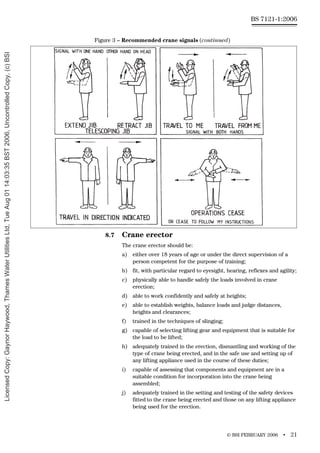
Figure 3 – Recommended crane signals 20
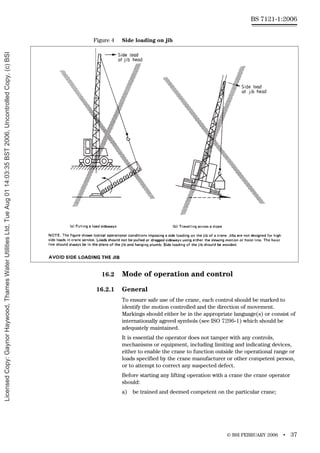
Figure 4 – Side loading on jib 37
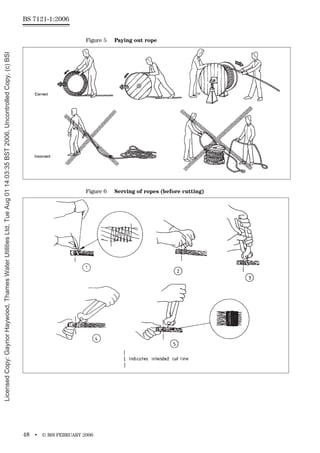
Figure 5 – Paying out rope 48
Figure 6 – Serving of ropes (before cutting) 48
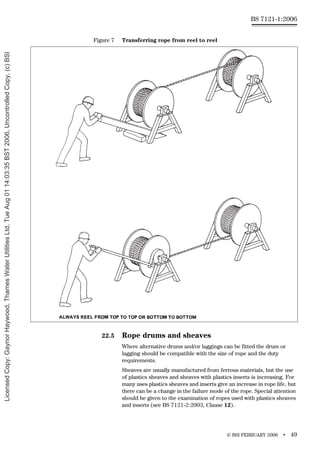
Figure 7 – Transferring rope from reel to reel 49
List of tables
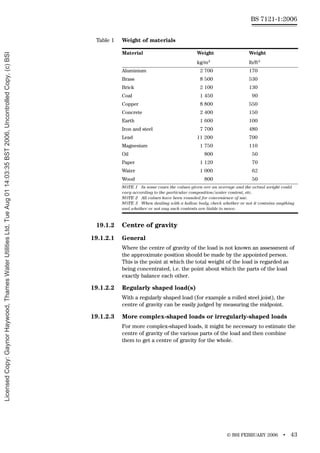
Table 1 – Weight of materials 43
Summary of pages
This document comprises a front cover, an inside front cover,
pages i to iii, a blank page, pages 1 to 71 and a back cover.
Licensed
Copy:
Gaynor
Haywood,
Thames
Water
Utilities
Ltd,
Tue
Aug
01
14:03:35
BST
2006,
Uncontrolled
Copy,
(c)
BSI
BS 7121-1:2006
ii • © BSI FEBRUARY 2006
Foreword
Publishing information
This part of BS 7121 was published by BSI and came into effect
on 28 February 2006. It was prepared by Subcommittee MHE/3/11,
Crane safety and testing, under the authority of Technical Committee
MHE/3, Cranes and derricks. A list of organizations represented on
this committee can be obtained on request to its secretary.
Supersession
This part of BS 7121 supersedes BS 7121-1:1989, which is withdrawn.
Relationship with other publications
The Lifting Operations and Lifting Equipment Regulations
(LOLER) [1] and the Provision and Use of Work Equipment
Regulations (PUWER) [2] came into force on the 5th December 1998.
Details of the Regulations, an Approved Code of Practice plus
HSE guidance can be found in the HSE books Safe use of lifting
equipment [3] and Safe use of work equipment [4].
BS 7121-1 provides general recommendations for crane types not
covered in an additional part of BS 7121. BS 7121-2 covers in-service
inspection, thorough examination and, where appropriate, testing for
the safe use of all types of crane. Subsequent parts of BS 7121 deal
with the specific crane types as follows:
• Part 3: Mobile cranes;
• Part 4: Lorry loaders;
• Part 5: Tower cranes;
• Part 6: Derrick cranes;
• Part 7: Overhead/under-hung travelling and goliath cranes;
• Part 8: High pedestal and portal jib dockside cranes;
• Part 9: Container handling cranes;
• Part 10: Rail mounted cranes;
• Part 11: Offshore cranes;
• Part 12: Recovery vehicles and equipment;
• Part 13: Hydraulic gantry lifting systems;
• Part 14: Side boom pipelayers.
When all parts of BS 7121 have been published, CP 3010 will be
withdrawn and BS 5744 will be revised to cover manually operated and
light cranes only.
Information on the background to the development and use of BS 7121
since the initial publication of BS 7121-1 in 1989 is given in Annex B.
The BS 7121 series has been accepted as representing the consensus
of practical experience for safety on cranes.
Licensed
Copy:
Gaynor
Haywood,
Thames
Water
Utilities
Ltd,
Tue
Aug
01
14:03:35
BST
2006,
Uncontrolled
Copy,
(c)
BSI
© BSI FEBRUARY 2006 • iii
BS 7121-1:2006
Information about this document
This new edition represents a full revision of the standard. It is
intended to be used in conjunction with other parts of BS 7121 to
ensure, so far as is reasonably practicable, that lifting operations are
carried out safely.

The Health and Safety Executive (HSE) commends the use of this
British Standard to those who have duties under the Health and Safety
at Work etc. Act 1974 [5]. This standard was drawn up with the
participation of HSE representatives and will be referred to in relevant
HSE publications.
Use of this document
As a code of practice, this British Standard takes the form of guidance
and recommendations. It should not be quoted as if it were a
specification and particular care should be taken to ensure that claims
of compliance are not misleading.
Any user claiming compliance with this British Standard is expected to
be able to justify any course of action that deviates from its
recommendations.
It has been assumed in the preparation of this British Standard that the
execution of its provisions will be entrusted to appropriately qualified
and experienced people, for whose use it has been produced.
Presentational conventions
The provisions in this standard are presented in roman (i.e. upright)
type. Its recommendations are expressed in sentences in which the
principal auxiliary verb is “should”.
Commentary, explanation and general informative material is
presented in smaller italic type, and does not constitute a
normative element.
Contractual and legal considerations
This publication does not purport to include all the necessary
provisions of a contract. Users are responsible for its correct
application.
Compliance with a British Standard cannot confer immunity
from legal obligations.
Licensed
Copy:
Gaynor
Haywood,
Thames
Water
Utilities
Ltd,
Tue
Aug
01
14:03:35
BST
2006,
Uncontrolled
Copy,
(c)
BSI
iv • © BSI FEBRUARY 2006 This page deliberately left blank
BS 7121-1:2006
Licensed
Copy:
Gaynor
Haywood,
Thames
Water
Utilities
Ltd,
Tue
Aug
01
14:03:35
BST
2006,
Uncontrolled
Copy,
(c)
BSI
© BSI FEBRUARY 2006 • 1
BS 7121-1:2006
1 Scope
This part of BS 7121 gives recommendations for the safe use of cranes.
Subjects covered include safe systems of work, management, planning,
selection, erection and dismantling, inspection, testing, examination,
operation and maintenance of cranes and the planning and
management of lifting operations.
2 Normative references
The following referenced documents are indispensable for the
application of this document. For dated references, only the edition
cited applies. For undated references, the latest edition of the
referenced document (including any amendments) applies.
BS 7121 (all parts), Code of practice for safe use of cranes
BS 7671, Requirements for electrical installations – IEE Wiring
Regulations. Sixteenth edition
BS EN 12077-2:1999, Cranes safety – Requirements for health and
safety – Part 2: Limiting and indicating devices
[14] HSE Guidance Note GS 6, Avoidance of danger from overhead
power lines. Sudbury: HSE Books, 1997
[18] HSE Guidance Note HS G 141, Electrical installations on
construction sites. Sudbury: HSE Books
3 Terms and definitions
For the purposes of this part of BS 7121, the following terms and
definitions apply.
3.1 appointed person
person with the training, practical and theoretical knowledge and
experience required to comply with 4.3
3.2 carrier
device that supports persons during lifting and lowering
NOTE This may also be known as a “manrider”.
3.3 competent person
person who has such practical and theoretical knowledge and
experience of the crane and the equipment used in the lifting operation
as is necessary to carry out the function to which the term relates in
each particular context
3.4 configuration
combination of structural members, counterweights, support or
outrigger position, hook block reeving and similar items assembled,
positioned and erected according to manufacturers’ instructions and
ready for operation
3.5 control gear
switching devices in combination with associated control, measuring,
protective and regulating equipment
Licensed
Copy:
Gaynor
Haywood,
Thames
Water
Utilities
Ltd,
Tue
Aug
01
14:03:35
BST
2006,
Uncontrolled
Copy,
(c)
BSI
BS 7121-1:2006
2 • © BSI FEBRUARY 2006
3.6 crane coordinator
person who plans and directs the sequence of operations of cranes to
ensure that they do not collide with other cranes, loads and other
equipment (e.g. concrete placing booms, telehandlers, piling rigs)
3.7 crane operator
person who is operating the crane for the purpose of positioning loads
or erection of the crane
NOTE Sometimes referred to as “crane driver”.
3.8 crane supervisor
person who controls the lifting operation, and ensures that it is carried
out in accordance with the appointed person’s safe system of work
3.9 employing organization
person or organization who requires a lifting operation to be carried
out and is responsible for safe use of the crane
NOTE In the case of a hired crane the degree of the employing
organization’s responsibility for the safe use of the crane depends on
whether the crane is being supplied under a crane hire contract or a part
of a contract lift. See Clause 5.
3.10 indicator
device which provides warnings and/or data to facilitate the competent
control of the crane within its design parameters
3.11 lifting
movement of loads or persons necessitating, at a given moment, a
change of level
3.11.1 basic lift
lifting operation where the weight of the load(s) can be simply
established, and there are no hazards or obstructions within the area of
the operation
3.11.2 standard lift
lifting operation where there are hazards, either within the working
area of the crane or on the access route to the working area, but no
multiple crane lifting is required
3.11.3 complex lift
lifting operation which requires more than one crane to lift the load, or
cranes using load enhancement equipment, lifting of persons or when
the lifting operation is at a location with exceptional hazards
NOTE An example of a location with exceptional hazards is a chemical
plant.
3.12 lifting accessory
equipment from which the load can be suspended
NOTE This might also be known as load lifting attachment, accessory for
lifting, lifting tackle and lifting gear.
3.13 lifting equipment
work equipment (crane) for lifting or lowering loads, including
attachments used for anchoring, fixing or supporting the load
Licensed
Copy:
Gaynor
Haywood,
Thames
Water
Utilities
Ltd,
Tue
Aug
01
14:03:35
BST
2006,
Uncontrolled
Copy,
(c)
BSI
© BSI FEBRUARY 2006 • 3
BS 7121-1:2006
3.14 load
weight which is lifted by the crane
NOTE If cranes are used to lift loads from water, the load could also
include forces due to water flow or suction and the effect of loss of
buoyancy.
3.15 method statement
document produced by the appointed person to describe how the
lifting operation is to be carried out
3.16 motion limit device
device which restricts a crane motion or initiates the stopping of a
motion
3.17 performance limiting device
device which automatically prevents a design performance
characteristic from being exceeded
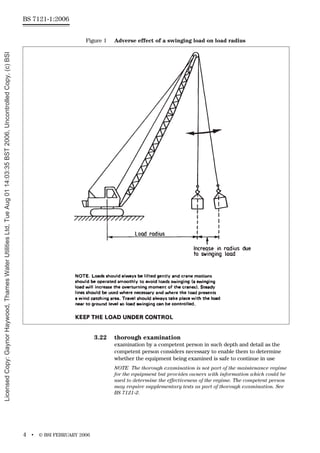
3.18 radius
horizontal distance between the axis of rotation of the crane and the
vertical centreline passing through the load lifting attachment (see
Figure 1)
NOTE For non-slewing cranes, the horizontal distance from the centreline of a
load lifting attachment to the centreline of the nearest axle, bogie or track,
measured at ground level, may be assumed to be the radius for the purpose of this
definition.
3.19 rated capacity
load that the crane is designed to lift for a given operating condition
(e.g. configuration, position of the load)
NOTE The rated capacity was formerly known as “safe working load”
(SWL).
3.20 rated capacity indicator/limiter
RCI/L
device(s) that warns of the approach to overload and prevents the
crane from being overloaded as described in BS EN 12077-2
NOTE This was previously known as an “automatic safe load
indicator” (ASLI) and “overload protection”. For information on ASLIs see
BS 7262.
3.21 service conditions
3.21.1 in-service
condition where the crane is handling loads not exceeding the rated
capacities within permissible wind speeds and other conditions as
specified by the manufacturer
3.21.2 out-of-service
condition where the crane is either not required for use or is out of use,
without a load on the hook and in conditions as specified by the
manufacturer
NOTE These conditions may include a higher wind speed than that
permitted for the in-service conditions.
Licensed
Copy:
Gaynor
Haywood,
Thames
Water
Utilities
Ltd,
Tue
Aug
01
14:03:35
BST
2006,
Uncontrolled
Copy,
(c)
BSI
BS 7121-1:2006
4 • © BSI FEBRUARY 2006
Figure 1 Adverse effect of a swinging load on load radius
3.22 thorough examination
examination by a competent person in such depth and detail as the
competent person considers necessary to enable them to determine
whether the equipment being examined is safe to continue in use
NOTE The thorough examination is not part of the maintenance regime
for the equipment but provides owners with information which could be
used to determine the effectiveness of the regime. The competent person
may require supplementary tests as part of thorough examination. See
BS 7121-2.
Licensed
Copy:
Gaynor
Haywood,
Thames
Water
Utilities
Ltd,
Tue
Aug
01
14:03:35
BST
2006,
Uncontrolled
Copy,
(c)
BSI
© BSI FEBRUARY 2006 • 5
BS 7121-1:2006
3.23 use
<of work equipment> activity of any kind involving work equipment
NOTE Including starting, stopping, programming, setting, transporting,
repairing, modifying, servicing and cleaning.
3.24 user
person or organization that has control of both the lifting operation
and the crane operator, and has a responsibility to ensure that cranes
and other equipment are properly maintained and are thoroughly
examined by a competent person
3.25 work equipment
device and any assembly of components which, in order to achieve a
common end, are arranged and controlled so that they function as a
whole
NOTE The work equipment can be an item of machinery, an appliance, a
piece of apparatus or a tool.
4 Management of installation and
lifting operations
4.1 Safe system of work
A safe system of work should be established and followed for every
crane installation operation or lifting operation whether it be an
individual lift or a group of repetitive operations. The same principles
should be applied when the operations are carried out at a temporary
site, for example construction, or when the crane is a permanent
fixture, for example in a factory or at a dock.
The safe system of work should include:
a) planning of the operation;
b) selection, provision and use of a suitable crane(s) and work
equipment;
NOTE Crane specifiers have a duty to ensure that cranes are
selected with adequate capacity for the intended use. Crane users
have a duty to ensure that the crane is only used for its intended
purpose.
c) any necessary preparation of a site and erection and dismantling
of the crane(s);
d) maintenance, examination and where necessary testing of the
crane(s) and equipment;
e) the provision of properly trained and competent personnel who
have been made aware of their relevant responsibilities under the
Health and Safety at Work etc. Act 1974 [5];
f) adequate supervision by properly trained and competent
personnel having the necessary authority;
g) ensuring that all necessary reports of thorough examination and
other documents are available;
h) preventing unauthorized movement or use at all times;
i) the safety of persons not involved in the installation or lifting
operation.
Licensed
Copy:
Gaynor
Haywood,
Thames
Water
Utilities
Ltd,
Tue
Aug
01
14:03:35
BST
2006,
Uncontrolled
Copy,
(c)
BSI
BS 7121-1:2006
6 • © BSI FEBRUARY 2006
The safe system of work should be communicated to all parties
concerned.
It is essential for the safety of the operation to ensure that all personnel
can communicate clearly in the same language.
Cranes are work equipment and it is essential that they are not used for
the lifting of persons for entertainment purposes, including joyriding,
bungee jumping and stunts.
4.2 Control of the lifting operation
4.2.1 General
In order to implement the safe system of work effectively, one person
should be appointed to have overall control of the lifting operation to
act on behalf of the management of the employing organization. The
appointment of the person does not remove any legal responsibility
from the management but enables them to use the appointed person’s
expertise, the better to fulfil their responsibilities. The person
appointed may have other duties and need not be an employee of the
employing organization. The appointed person should have adequate
training and experience to enable these duties to be carried out
competently.
On large construction sites where multiple lifting operations are
carried out by various subcontractors, the principal contractor should
appoint the appointed person for the site. Each of the subcontractors
on site may employ individuals who have undergone appointed person
training but they should remain subservient to the principal
contractor’s appointed person. The principal contractor’s appointed
person should ensure that the crane coordinator is advised of all lifting
operations in order that they may perform their duties.
4.2.2 Selection of appointed person
When selecting and assessing an appointed person the employing
organization should take into account the variety and complexity of the
operation, as well as all the problems that could arise from proximity
hazards and environmental causes. The appointed person should be
notified formally in writing of their appointment. The appointed person
should be given authority to carry out the duties involved, including
consulting others with specialist knowledge and experience, and
should be able to delegate duties and tasks for any part of the safe
system of work to suitably qualified individuals.
NOTE To assist in selection of an appointed person, some examples of
lifting operations that require different levels of expertise, training and
experience, and that impose different duties on the appointed person, are
given in 4.3.
The employing organization should review the performance of the
appointed person periodically. Different lifting operations might entail
selection of a new appointed person, as appropriate, or provision of
additional training to the existing appointed person.
Licensed
Copy:
Gaynor
Haywood,
Thames
Water
Utilities
Ltd,
Tue
Aug
01
14:03:35
BST
2006,
Uncontrolled
Copy,
(c)
BSI
© BSI FEBRUARY 2006 • 7
BS 7121-1:2006
4.2.3 Other particulars
On sites where there is a possibility of collision between cranes and
other equipment, the crane coordinator (see 7.2.2) should plan the
sequence of crane movements to prevent collisions. Any corresponding
instructions from the crane coordinator to the crane operators should
be given via the respective signallers. In such circumstances the
signallers should obtain the agreement of the crane coordinator before
carrying out any operation.
The positioning of the crane and components in the out-of-service
condition, as specified by the manufacturer’s instructions, should be
such that no collisions can take place, see 14.4.
4.3 Duties of the person appointed to control the
lifting operation
4.3.1 General
The appointed person’s duties should include the following.
a) Being familiar with the relevant parts of the project Health and
Safety Plan where the lifting operation is being carried out on
a site where the Construction (Design and Management)
Regulations [6] apply.
b) Assessing the lifting operation to provide such planning, selection
of crane(s), lifting accessories and equipment, instruction and
supervision as is necessary for the task to be undertaken safely.
This may include consultation with other responsible bodies if
necessary and ensuring that, where different organizations are
involved, they collaborate as necessary.
c) Ensuring that adequate inspection/examination and maintenance
of the equipment has been carried out. For further information see
BS 7121-2.
d) Ensuring that there is an effective procedure for reporting defects
and incidents and taking any necessary corrective action.
e) Taking responsibility for the organization and control of the lifting
operation.
f) Ensuring that the crane supervisor is fully briefed on the contents
of the method statement (see 6.3).
The appointed person should be given the necessary authority for the
performance of all these duties and, in particular, authority to stop the
operation whenever they consider that danger is likely to arise if the
operation were to continue.
Duties, but not responsibilities, may be delegated to another person
where considered appropriate.
NOTE On cranes with control cabins or where the operator cannot always
see the load, it would not be appropriate to appoint the operator to be in
control of the lifting operation. For a basic lifting operation, the
management of the employing organization may consider it appropriate
to appoint the slinger to be in control of the lifting operation.
Licensed
Copy:
Gaynor
Haywood,
Thames
Water
Utilities
Ltd,
Tue
Aug
01
14:03:35
BST
2006,
Uncontrolled
Copy,
(c)
BSI
BS 7121-1:2006
8 • © BSI FEBRUARY 2006
The duties of appointed persons for crane operations can vary
according to the complexity of the operation. The duties for a basic lift
are considerably fewer and less demanding than for a lift at a
hazardous location. An appointed person employed for a basic lift
might not be suitably trained or experienced for a more complicated
operation, and another appointment could be required for this. The
information given in 4.3.2 to 4.3.4 can be used to assist in ensuring
that an appropriate appointment is made and a suitable method
statement produced for each lifting operation.
4.3.2 Basic lift
If the weight of the load(s) can be simply established, and there are no
hazards or obstructions within the area of the operation, then the
duties of the appointed person should include the following.
a) Establishing the weight of the load. This can be by a reliable
source of information, weighing the load, or calculation (with
allowance for possible inaccuracies).
NOTE If cranes are used to lift loads from water, the load could also
include forces due to water flow or suction and the effect of loss of
buoyancy.
b) Selection of the crane, based on the weight of the load, including
the crane hook block and any lifting tackle; the maximum height
of lift and the maximum radius required. The rated capacity of the
crane should be specified by the manufacturer in the information
for use supplied with the crane, or else on the current report of
thorough examination issued by the competent person.
Manufacturer’s sales leaflets should not be relied on for the rated
capacity for a specific crane.
c) Consideration of the location of the operation, taking into account
the access and egress required for the crane, and the suitability of
the ground to take the loads imposed on the crane during
preparation for the lift and during the lift itself.
d) Ensuring that the crane is not operated in wind speeds in excess of
those given in the instruction manual for the crane. Consideration
should also be given to the wind area of the load to ensure that its
movement in the wind does not present a hazard.
e) Ensuring that the crane has been thoroughly examined at least
within the previous 6 months (for lifting of persons) or 12 months
(including testing where appropriate), inspected and checked
before use.
f) Ensuring that a system for reporting defects is in place.
g) Selecting appropriate lifting accessories, including their method of
attachment to the load, and any protection used to prevent
damage.
h) Ensuring that lifting accessories are thoroughly examined, at least
within the previous 6 months, inspected and checked before use.
i) Designating a person to check the lifting accessories and any
lifting points that are provided on the load to ensure they are free
from any obvious defect before attaching the load to the crane.
Licensed
Copy:
Gaynor
Haywood,
Thames
Water
Utilities
Ltd,
Tue
Aug
01
14:03:35
BST
2006,
Uncontrolled
Copy,
(c)
BSI
© BSI FEBRUARY 2006 • 9
BS 7121-1:2006
j) Briefing all persons involved in the lifting operation to ensure that
the safe system of work described in the method statement is
understood. All persons involved in the lifting operation should be
instructed to seek advice from the appointed person if any change
is required to the lifting operation, or if any doubts about safety
arise. If one or more handlines/taglines are required to give more
control of the load, the appointed person should designate persons
to handle the lines.
k) Checking, if numerous loads are to be lifted over a long period,
that no changes are required in the safe system of work.
l) Ensuring that there is a crane supervisor (see 7.2.1) designated to
direct personnel and that the operation is carried out in
accordance with the method statement.
The appointed person and crane supervisor should be aware of the
limits of their knowledge and experience concerning lifting operations,
and when conditions exceed these limits, further advice should be
sought.
4.3.3 Standard lift
If there are hazards, either within the working area of the crane or
on the access route to the working area, the duties of the appointed
person should include the following, in addition to the duties listed
in 4.3.2.
a) Investigating all hazards in the operating area, including any
areas required for access or erection/dismantling of the
crane.
NOTE Hazards can be from surrounding buildings, or over ground
or underground services.
b) Taking account of increased risks if the load is lifted from a
structure at a height above the standing position of the
crane.
NOTE Additional risks can arise from the crane operator not being
able to observe the load while taking the initial strain, and
movements due to deflections as the load is lifted clear of the
supporting structure, making it not possible to put the load back
down.
c) Liaison with any other person or authority, as required to
overcome any hazard, by including any necessary corrective action
or special measures in the safe system of work.
d) Consideration of the effect of the lifting operation on surrounding
property or persons, including the general public. This should lead
to arranging for appropriate action to minimize any adverse
effects, and to giving appropriate notice to all persons
concerned.
Licensed
Copy:
Gaynor
Haywood,
Thames
Water
Utilities
Ltd,
Tue
Aug
01
14:03:35
BST
2006,
Uncontrolled
Copy,
(c)
BSI
BS 7121-1:2006
10 • © BSI FEBRUARY 2006
4.3.4 Complex lift
If the lifting operation is at a location with exceptional hazards (for
example, at a chemical plant, demolition or lifting a load from height),
persons are being lifted, demolition is being carried out, or the load
being lifted is a complex shape or with a large wind area then the
appointed person should ensure, in addition to the duties listed in 4.3.2
and 4.3.3, that:
a) the weight of the load and the position of its centre of gravity are
accurately known;
b) the wind area of the load is known and a limiting wind speed for
lifting is established;
c) any lifting points provided on the load are adequate for the loads
applied;
d) the method statement includes access, ground conditions, erection
etc., as well as the exact sequence of operations when lifting the
load;
e) where persons are being lifted, the requirements of Annex A are
met.
4.4 Duties of the persons involved in construction
projects
The Construction (Design and Management) (CDM) Regulations [6]
require that designers, planning supervisors, principal contractors,
subcontractors and clients consider health and safety matters
throughout all stages of a construction project from conception, design
and planning through to carrying out the work, including maintenance,
repair and/or demolition.
Lifting operations are commonly carried out using cranes and they
should be included in the Health and Safety Plan required by the
CDM [6] so that factors influencing crane safety can be assessed at a
sufficiently early stage.
When constructing the Plan, the ways in which the cranes are intended
to be used, i.e. by the manufacturer and hirer, and any limitations that
would affect safety in the conditions expected on site should be taken
into account.
The Plan should include information to allow all parties involved in
the specification, installation or use of cranes to be made aware of
the fundamental criteria and planning issues needed to ensure that
lifting operations are initiated and proceed in a logical and safe
manner.
Designers should obtain and make available to the CDM planning
supervisor, information relating to the site and type(s) of crane to be
used.
Licensed
Copy:
Gaynor
Haywood,
Thames
Water
Utilities
Ltd,
Tue
Aug
01
14:03:35
BST
2006,
Uncontrolled
Copy,
(c)
BSI
© BSI FEBRUARY 2006 • 11
BS 7121-1:2006
When designing a structure to be assembled by cranes, designers
should consult an appropriate appointed person at the design stage to
ensure compatibility between structure components and the cranes
that are likely to be lifting them into position. Further advice is given in
CIRIA C654 [7] and the Construction Industry Council General
Information Note I 002 [8].
NOTE Contractors have a duty to operate cranes safely, and this can be
made extremely difficult by thoughtless design which puts pressure on
them to use cranes at their operating limits and sometimes encourages
improper use.
5 Contract lift or crane hire
5.1 General
Given the wide variety of contractual arrangements used in the
construction industry, it is important to ensure that the planning,
organization control and management of lifting operations is not
compromised. In general, any organization requiring a load to be
moved by crane, which does not have its own craneage, has two basic
options: hiring a crane (Hired Crane) or employing a contractor to
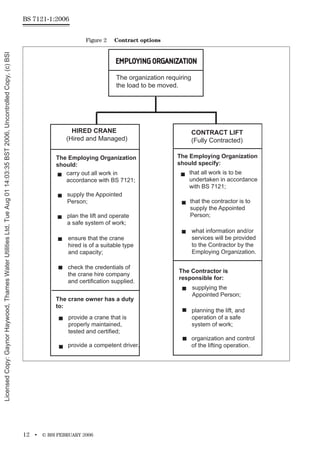
carry out the lifting operation (Contract Lift). The difference between
the two options is summarized in Figure 2.
If an individual or organization does not have expertise in lifting
operations they should not hire cranes but should opt for a contract
lift. Before entering into a contract, employing organizations should
satisfy themselves that the contractor has the necessary competence to
carry out the work.
NOTE Responsibilities for insurance in terms of the crane, personnel, the
load and third parties might also need to be clarified.
5.2 Contract lifting operations
The employing organization may enter into a contract with a
contractor who undertakes the work on their behalf.
The parties to the contract should ensure that:
a) all work is carried out in accordance with the BS 7121 series;
b) the contractor appoints a person, in accordance with 4.3 to the
satisfaction of the employing organization;
c) all information or services provided by the employing organization
to facilitate compliance with the BS 7121 series are notified to the
contractor in writing.
The contractor should carry out lifting operations in accordance with
the BS 7121 series. The contractor should be given full authority by the
employing organization to work in accordance with the BS 7121 series
including, where appropriate, authority to control and instruct the
employing organization’s personnel.
NOTE Although the BS 7121 series is intended to assist organizations to
comply with their statutory and common law obligations, it does not
relieve them from these obligations.
Before entering into a contract, employing organizations should ensure
that the contractor has the necessary competence to carry out the work
in accordance with the BS 7121 series.
Licensed
Copy:
Gaynor
Haywood,
Thames
Water
Utilities
Ltd,
Tue
Aug
01
14:03:35
BST
2006,
Uncontrolled
Copy,
(c)
BSI
BS 7121-1:2006
12 • © BSI FEBRUARY 2006
Figure 2 Contract options
EMPLOYING ORGANIZATION
The organization requiring
the load to be moved.
HIRED CRANE
(Hired and Managed)
The Employing Organization
should:
carry out all work in
accordance with BS 7121;
supply the Appointed
Person;
plan the lift and operate
a safe system of work;
ensure that the crane
hired is of a suitable type
and capacity;
check the credentials of
the crane hire company
and certification supplied.
The crane owner has a duty
to:
provide a crane that is
properly maintained,
tested and certified;
provide a competent driver.
CONTRACT LIFT
(Fully Contracted)
The Employing Organization
should specify:
that all work is to be
undertaken in accordance
with BS 7121;
that the contractor is to
supply the Appointed
Person;
what information and/or
services will be provided
to the Contractor by the
Employing Organization.
The Contractor is
responsible for:
supplying the
Appointed Person;
planning the lift, and
operation of a safe
system of work;
organization and control
of the lifting operation.
Licensed
Copy:
Gaynor
Haywood,
Thames
Water
Utilities
Ltd,
Tue
Aug
01
14:03:35
BST
2006,
Uncontrolled
Copy,
(c)
BSI
© BSI FEBRUARY 2006 • 13
BS 7121-1:2006
5.3 User’s duties when using hired cranes
When a crane is hired out together with an operator to the user
organization, the crane owner should provide a competent operator
and a crane that is properly maintained, inspected and tested in
accordance with BS 7121-2, and has a current report of thorough
examination.
The user organization retains the responsibility for nominating the
appointed person in accordance with 4.3 and for following the
recommendations given in the BS 7121 series. Notwithstanding any
advice the crane owner might have offered concerning the selection of
a particular crane or any other relevant matter, for example clearances,
ground conditions, the responsibility for ensuring that the crane is of a
suitable type, size and capacity for the task being undertaken and for
planning the operation remains with the user organization.
Therefore if an individual or organization does not have expertise in
lifting operations, they should not hire cranes but should opt for a
contract lift.
6 Planning of the lifting operation
6.1 General
All lifting operations should be planned to ensure that they are carried
out safely and that all foreseeable risks have been taken into account.
Planning should be carried out by an appointed person who has the
appropriate knowledge for the lift being undertaken (see 4.3.2
and 4.3.3).
In cases of repetitive or routine basic lifting operations, this planning
might only be necessary in the first instance, with periodic reviews to
ensure that no factors have changed.
For lifting operations carried out on construction projects, further
information on the duties of personnel is given in 4.4.
Planning of the lifting operation should take into account:
a) the load, its characteristics and the method of lifting paying
particular attention when loads are lifted out of water, e.g. flow,
suction and loss of buoyancy;
NOTE It may also be necessary to make allowance for any adhesion
between the load and its support.
b) the selection of a suitable crane(s) appropriate to the operation
ensuring that adequate clearances are maintained between the
load(s) and the crane structure (see Clause 9);
c) the selection of accessories for lifting/lifting attachments, the
weight to be taken into account when assessing the load on the
crane(s);
d) the position of the crane(s) and of the load before, during and
after the operation;
e) the site of the operation including proximity hazards, space
availability and suitability of the ground or foundations;
Licensed
Copy:
Gaynor
Haywood,
Thames
Water
Utilities
Ltd,
Tue
Aug
01
14:03:35
BST
2006,
Uncontrolled
Copy,
(c)
BSI
BS 7121-1:2006
14 • © BSI FEBRUARY 2006
f) any necessary erection and dismantling of the crane(s);
g) the environmental conditions that exist or might occur at the site
of the operation or the effect of the load on the crane, e.g. lifting
with a floating crane might involve a change of angle of heel or
trim of the supporting vessel if lifting on water, which could
necessitate stopping the operation when conditions are unsuitable.
6.2 Risk assessment
6.2.1 As part of the planning process a risk assessment is carried out
by the appointed person to identify the hazards associated with the
proposed lifting operation. The assessment should evaluate the risks
involved and the nature and extent of any measures required to
mitigate those risks. The appointed person should also take into
consideration hazards identified by the overall site risk assessments.
NOTE Attention is drawn to the Management of Health and Safety at
Work Regulations [9] which requires a risk assessment to be carried out.
6.2.2 Generic risk assessments are unlikely to be sufficient since most
sites have hazards that are unique to that situation which should be
taken into account in the separate site specific assessment.
The results of the risk assessment should be recorded in writing and
used in the preparation of the method statement (see 6.3) for that site.
6.2.3 The risk assessment together with the manufacturer’s
instructions, should then be used to develop a detailed method
statement for the safe transportation, assembly, erection, use and
dismantling of the equipment at that site.
6.3 Method statements
6.3.1 Once the risk assessment has been carried out, the appointed
person (see 4.3) should ensure that a full method statement is
prepared, detailing the safe system of work (see 4.1) for the lifting
operation and including the risk assessment.
6.3.2 The appointed person should, when necessary, consult with
others with specialized knowledge and experience.
The method statement should include:
a) the tasks to be achieved, together with the configuration of the
crane at the end of each days work;
b) details of the steps to be taken to eliminate danger to personnel
not involved in the lifting operation, and where necessary, prevent
their entry into danger zones e.g. by organizing for road closures if
necessary;
NOTE Exclusion zones generally require the agreement of the
principal contractor.
c) the requirement for pre-use checks to be completed;
d) a clear statement of the allocation of tasks to all parties involved in
the lifting operation.
Licensed
Copy:
Gaynor
Haywood,
Thames
Water
Utilities
Ltd,
Tue
Aug
01
14:03:35
BST
2006,
Uncontrolled
Copy,
(c)
BSI
© BSI FEBRUARY 2006 • 15
BS 7121-1:2006
6.3.4 The lifting operation will be under the control of a crane
supervisor who has the authority to stop the work if local conditions
are unsatisfactory.
6.3.5 The crane supervisor should ensure that the team are inducted in
the general site precautions and the specific features of the method
statement at the start of the job.
6.3.6 A copy of the method statement and associated operating
instructions should be given to all those involved in the lifting
operation.
6.3.7 The method statement should be sufficient to provide the basis
for a briefing or induction of each member of the team.
The crane supervisor or principal contractor’s representative should
normally take the opportunity during the site induction to seek the
views of the team about any arrangements for health and safety that
might be relevant to them.
6.3.8 To be effective the method statement needs to specify clear roles
for each member of the team. Arrangements for effective
communication among the team (and if necessary with adjacent crane
operators in case of danger) should be available.
7 Selection and duties of personnel
NOTE See 4.3 for the selection and duties of the appointed person.
7.1 Selection of personnel
Safe lifting operations (including installation) depend upon the
selection of suitable personnel who are competent to carry out the
required duties. Records of training and experience of persons such as
the crane operator assist in the selection of suitable personnel. Crane
operators and slingers should be trained in accordance with the
recommendations given in Annex A.
Those responsible for the selection of personnel should ensure that the
personnel involved in the operation are efficiently organized in order to
ensure good team-work in the working situation.
Work associated with lifting operations should not be carried out by
personnel whose efficiency is impaired by alcohol, drugs or other
influences. It is essential that all personnel in the team are made aware
of both this fact and their other duties (see 7.2).
Where personnel are undergoing training, they should be supervised
by appropriate personnel.
NOTE For basic lifts it may be appropriate for one person to undertake
more than one of the duties identified in 7.2, depending on the hazards
identified by the risk assessment.
Licensed
Copy:
Gaynor
Haywood,
Thames
Water
Utilities
Ltd,
Tue
Aug
01
14:03:35
BST
2006,
Uncontrolled
Copy,
(c)
BSI
BS 7121-1:2006
16 • © BSI FEBRUARY 2006
7.2 Duties of personnel
7.2.1 Crane supervisor
The crane supervisor should direct and supervise the lifting operation,
ensuring that these are carried out in accordance with the method
statement. The crane supervisor should be competent and suitably
trained and should have sufficient experience to carry out all relevant
duties. The crane supervisor should have sufficient authority to stop
the lifting operation if they consider it dangerous to proceed.
NOTE The appointed person may decide to undertake the duties of the crane
supervisor or to delegate these to another person with appropriate expertise for
the lifting operation.
7.2.2 Crane coordinator
The crane coordinator should plan and direct the sequence of
operations of cranes to ensure that they do not collide with other
cranes, loads and other equipment (e.g. concrete placing booms,
telehandlers, piling rigs).
7.2.3 Crane operator
The crane operator should be responsible for the correct operation of
the crane in accordance with the manufacturer’s instructions and
within the safe system of work (see 4.1).
The crane operator should at any one time only respond to the signals
from one slinger/signaller who should be clearly identified (see 10.4).
In an emergency a commonly recognized stop signal may be given by
any person observing a situation leading to danger and the crane
operator should respond to that signal.
7.2.4 Slinger
The slinger should be responsible for attaching and detaching the load
to and from the crane load lifting attachment and for the use of the
correct accessories for lifting and other equipment in accordance with
the planning of the operation.
The slinger is responsible for initiating and directing the safe
movement of the crane [see 8.5h)]. If there is more than one slinger,
only one of them should have this responsibility at any one time,
depending on their positions relative to the crane.
Where continuity of signalling is required and this slinger is not visible
to the crane operator, another slinger or signaller may be necessary to
relay signals to the crane operator. Alternatively, other audio or visual
methods may be used.
Where audio or visual methods are used, the equipment or its means of
use should be such that the operator is immediately aware of failure of
the equipment, to enable them to stop crane movements.
Licensed
Copy:
Gaynor
Haywood,
Thames
Water
Utilities
Ltd,
Tue
Aug
01
14:03:35
BST
2006,
Uncontrolled
Copy,
(c)
BSI
© BSI FEBRUARY 2006 • 17
BS 7121-1:2006
Typical examples of audio or visual methods used are as follows.
a) A blank screen on a television monitor immediately indicates that
the operator should stop all crane movements.
b) A slinger using a radio should continuously instruct the operator to
lower a load, e.g. by saying “Lower-lower-lower...”, and failure of
this continuous instruction from the slinger indicates that the
operator should halt all crane movements.
If, during the lifting operation, responsibility for directing the crane
and load is to be transferred to another nominated person, the slinger
should clearly indicate to the crane operator that this responsibility is
being transferred and to whom, and the slinger should clearly indicate
to the new nominated person that this transfer is taking place.
Furthermore, the operator and the new nominated person should
clearly indicate that they accept the transfer of responsibility.
7.2.5 Signaller
The signaller should be responsible for relaying the signal from the
slinger to the crane operator. The signaller may be given the
responsibility for directing movement of the crane and load instead of
the slinger, provided that only one person has the responsibility.
7.2.6 Crane erector
The crane erector should be responsible for working on the erection of
the crane in accordance with the manufacturer’s instructions
(see 13.2). Where two or more crane erectors are required, one should
be nominated by the appointed person or employing organization as
“erector in charge” to control the operation.
NOTE Further information on the selection, appointment and control of
erectors is given in BS 7121-5.
7.2.7 Maintenance personnel
The maintenance personnel should be responsible for maintaining the
crane and ensuring its safe and satisfactory operation. They should
carry out all necessary maintenance in accordance with the
manufacturer’s maintenance manual and within the safe system of
work (see 4.1).
8 Minimum attributes of personnel
NOTE See 4.3 for the duties of the appointed person in lifting operations.
8.1 General
All personnel should be:
a) competent to perform the tasks required of them;
b) adequately trained and/or successfully assessed;
c) able to present a record of training and assessment;
d) physically able to carry out the work.
NOTE Competency requirements for crane operators, slingers, signallers
and assessors are given in BS ISO 15513.
Licensed
Copy:
Gaynor
Haywood,
Thames
Water
Utilities
Ltd,
Tue
Aug
01
14:03:35
BST
2006,
Uncontrolled
Copy,
(c)
BSI
BS 7121-1:2006
18 • © BSI FEBRUARY 2006
8.2 Crane supervisor
The crane supervisor should be:
a) authorized to carry out the duties listed in 7.2.1;
b) fully conversant with the duties of all persons involved in the
lifting operation;
c) able to give clear, unambiguous instructions to all other members
of the team;
d) able to assess danger to the lifting operation from changed
circumstances on site, and to call a halt to the operation if the
risk becomes unacceptable, so that the appointed person
can be referred to for further instructions if necessary.
If the crane supervisor is also a crane operator, then the crane
supervisor should not operate any crane involved in the lifting
operation being supervised.
8.3 Crane coordinator
The crane coordinator should be:
a) over 18 years of age;
b) fit, with particular regard to eyesight, hearing, reflexes and
agility;
c) capable of giving precise and clear verbal instructions where audio
equipment (e.g. radio) is employed, and capable of operating such
equipment in accordance with Clause 20.
8.4 Crane operator
The crane operator should be:
a) either over 18 years of age or under the direct supervision of a
person competent for the purpose of training;
b) fit, with particular regard to eyesight, hearing and reflexes;
c) physically able to operate the crane safely;
d) able to judge distances, heights and clearances;
e) adequately trained for the type of crane being driven and have
sufficient knowledge of the crane, its operating instructions and its
safety devices;
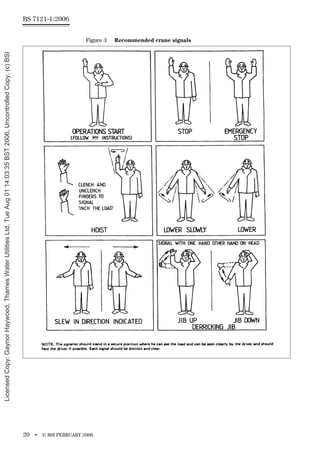
f) fully conversant with the duties of the slinger and signaller, and
have been instructed in the signal code shown in Figure 3 and any
alternative methods of relaying the signals that are to be used, in
order to implement safely the instruction of the slinger or
signaller;
g) trained in the use of the fire extinguishing/fighting equipment on
the crane (where provided);
h) trained in the use of any means provided for escape in case of
emergency;
i) authorized to operate the crane.
Licensed
Copy:
Gaynor
Haywood,
Thames
Water
Utilities
Ltd,
Tue
Aug
01
14:03:35
BST
2006,
Uncontrolled
Copy,
(c)
BSI
© BSI FEBRUARY 2006 • 19
BS 7121-1:2006
Evidence that the operator is medically fit to drive a crane should be
obtained at not more than 5 yearly intervals. The type of evidence
obtained is dependant on the type of crane being operated and the
risks to the operator and others involved in the operation.
8.5 Slinger
The slinger should be:
a) either over 18 years of age or under the direct supervision of a
person competent for the purpose of training;
b) fit, with particular regard to eyesight, hearing, reflexes and agility;
c) physically able to handle accessories for lifting and equipment;
d) able to establish weights, balance loads and judge distances,
heights and clearances;
e) trained in the techniques of slinging;
f) capable of selecting accessories for lifting and equipment in
suitable condition for the load to be lifted;
g) trained in the techniques of signalling and have been instructed in
the signal code shown in Figure 3;
h) capable of giving precise and clear verbal instructions where audio
equipment (e.g. radio) is used and capable of operating the
equipment in accordance with Clause 20;
i) capable of initiating and directing the safe movement of the crane
and load;
j) authorized to carry out slinging duties.
8.6 Signaller
The signaller should be:
a) either over 18 years of age or under the direct supervision of a
person competent for the purpose of training;
b) fit, with particular regard to eyesight, hearing, reflexes and
mobility;
c) able to judge distances, heights and clearances;
d) trained in the techniques of signalling and have been instructed in
the signal code shown in Figure 3;
e) capable of giving precise and clear verbal instructions where audio
equipment (e.g. radio) is employed and capable of operating the
equipment in accordance with Clause 20;
f) capable of directing the safe movement of the crane and load;
g) authorized to carry out signalling duties;
h) aware of the responsibilities allocated by the appointed person
(see 7.2.5) to the crane operator and slinger.
Licensed
Copy:
Gaynor
Haywood,
Thames
Water
Utilities
Ltd,
Tue
Aug
01
14:03:35
BST
2006,
Uncontrolled
Copy,
(c)
BSI
BS 7121-1:2006
20 • © BSI FEBRUARY 2006
Figure 3 Recommended crane signals
Licensed
Copy:
Gaynor
Haywood,
Thames
Water
Utilities
Ltd,
Tue
Aug
01
14:03:35
BST
2006,
Uncontrolled
Copy,
(c)
BSI
© BSI FEBRUARY 2006 • 21
BS 7121-1:2006
Figure 3 – Recommended crane signals (continued)
8.7 Crane erector
The crane erector should be:
a) either over 18 years of age or under the direct supervision of a
person competent for the purpose of training;
b) fit, with particular regard to eyesight, hearing, reflexes and agility;
c) physically able to handle safely the loads involved in crane
erection;
d) able to work confidently and safely at heights;
e) able to establish weights, balance loads and judge distances,
heights and clearances;
f) trained in the techniques of slinging;
g) capable of selecting lifting gear and equipment that is suitable for
the load to be lifted;
h) adequately trained in the erection, dismantling and working of the
type of crane being erected, and in the safe use and setting up of
any lifting appliance used in the course of these duties;
i) capable of assessing that components and equipment are in a
suitable condition for incorporation into the crane being
assembled;
j) adequately trained in the setting and testing of the safety devices
fitted to the crane being erected and those on any lifting appliance
being used for the erection.
Licensed
Copy:
Gaynor
Haywood,
Thames
Water
Utilities
Ltd,
Tue
Aug
01
14:03:35
BST
2006,
Uncontrolled
Copy,
(c)
BSI
BS 7121-1:2006
22 • © BSI FEBRUARY 2006
8.8 Maintenance personnel
Maintenance personnel should be:
a) fully conversant with the machinery they are required to maintain
and its hazards;
b) properly instructed and trained. Where special machinery is
involved this should include attending appropriate courses given
by the supplier of the equipment;
c) familiar with the procedures and precautions recommended in
Clause 14;
d) fully conversant with the appropriate sections of the
manufacturer’s instruction manual;
e) familiar with the use of permit to work systems where required by
the safe system of work and able to operate it correctly;
f) familiar with all aspects of their personal protective equipment and
capable of using it correctly.
9 Selection of cranes
NOTE See the appropriate part of BS 7121 for details of the different types
of crane and their operational characteristics.
Cranes are available in a number of forms and the characteristics of the
various machines should be considered in relation to the job
requirements. Having decided upon the type of crane and knowing the
overall requirements involved, a crane that can carry out the planned
lift safely should be selected.
Points to be taken into account when making the selection of the crane
include the following:
a) weights, dimensions and characteristics of loads;
b) operational speeds, radii, heights of lifts and areas of movement;
c) number, frequency and types of lifting operations;
d) length of time for which the crane is required;
e) remaining life expectancy;
f) site, ground and environmental conditions, or restrictions arising
from the use of existing buildings;
g) space available for crane access, erection, travelling, operation
and dismantling;
h) any special operational requirements or limitations imposed.
Licensed
Copy:
Gaynor
Haywood,
Thames
Water
Utilities
Ltd,
Tue
Aug
01
14:03:35
BST
2006,
Uncontrolled
Copy,
(c)
BSI
© BSI FEBRUARY 2006 • 23
BS 7121-1:2006
10 Safety
10.1 General
The person or organization, having overall control of the place of work
and the employers of personnel involved in the lifting operation have
the responsibility for safety during lifting operations. In order that this
responsibility can be effectively discharged, the appointed person
(see 4.3) should be given the necessary authority to ensure that
adequate systems to achieve safety are in operation. Safety matters
relating to lifting operations include the use, maintenance, repair and
renewal of safety equipment and the instruction of, and allocation of
responsibilities to, the various personnel in relation to the equipment.
10.2 Modifications and materials
Modifications to the structure, controls systems or any other part of
the crane may only be carried out with the written approval of the
crane manufacturer, or where the crane manufacturer is no longer in
existence, a competent engineer familiar with the design of the
particular crane.
Most crane parts are constructed from special materials and may only
be repaired or replaced in accordance with the manufacturer’s
specification. Such components should be marked to indicate this has
taken place.
Welding or other heat treatments should be carried out in accordance
with the manufacturer’s specification.
Nuts and bolts manufactured from high tensile steel or other special
steels carry markings so that they can be distinguished from other nuts
and bolts. It is essential that the re-use of high tensile bolts is in
accordance with the manufacturer’s conditions.
High strength friction grip bolts are of high tensile strength and used in
conjunction with high strength nuts and hardened steel washers for
shear connections in structural steelwork. The bolts are tightened to a
specified minimum shank tension so that transverse loads are
transferred across the joint by friction between the plates rather than
by shear across the bolt shank. High strength friction grip bolts should
not be reused once a joint has been dismantled.
Bolts used to secure slew races should be renewed whenever they are
removed. They should only be tightened in accordance with the
manufacturer’s instructions.
10.3 Wind loading
Cranes are designed to withstand the forces produced by winds of a
specified velocity, both in-service and out-of-service. It is important
that the wind areas of the crane, and hence the forces acting on it, are
not increased by the addition of signs, banners or panels without the
written approval of the crane manufacturer. Guidance on the
assessment of wind loading is given in CIRIA C654 [7] and BS 2573-1.
Licensed
Copy:
Gaynor
Haywood,
Thames
Water
Utilities
Ltd,
Tue
Aug
01
14:03:35
BST
2006,
Uncontrolled
Copy,
(c)
BSI
BS 7121-1:2006
24 • © BSI FEBRUARY 2006
10.4 Identification of person directing crane
movements
The person directing crane movements (slinger or signaller) should be
easily identifiable to the crane operator, for example by wearing high
visibility clothing or by using radio call signs.
When choosing high visibility clothing, backgrounds, type of
illumination and other relevant factors should be taken into
account.
10.5 Personal safety equipment
The appointed person should ensure that:
a) personal safety equipment that is appropriate for the conditions of
the location is available, such as helmets, safety spectacles, fall
protection equipment, safety boots, ear defenders and life jackets
or other buoyancy aids;
b) equipment is inspected before and after use and maintained in
good working order or replaced where appropriate;
NOTE Further information on selection, use and maintenance of
personal fall protection systems and equipment is given in
BS 8437.
c) a record of inspection and repairs is maintained where
appropriate.
Certain safety equipment, for example helmets, safety spectacles and
fall protection equipment, can deteriorate with age and should
therefore be considered for renewal periodically. Damaged safety
equipment should be replaced immediately.
NOTE The Health and Safety at Work etc. Act [5] and the PPE
Regulations [10] require that employees cooperate with their employer
and use and report defects of appropriate personal protective equipment
provided for their safety.
10.6 Use of personal protective equipment
All personnel working on, visiting or in the vicinity of the crane should
be made aware of the requirements relating to their personal safety and
to the use of the personal protective equipment provided.
It is essential that personnel are instructed in the correct use of the
appropriate personal protective equipment provided.
NOTE Attention is drawn to the Personal Protective Equipment at Work
Regulations [10] which require that any PPE provided is used.
Licensed
Copy:
Gaynor
Haywood,
Thames
Water
Utilities
Ltd,
Tue
Aug
01
14:03:35
BST
2006,
Uncontrolled
Copy,
(c)
BSI
© BSI FEBRUARY 2006 • 25
BS 7121-1:2006
10.7 Access and emergency escape
10.7.1 General
Requirements for safe access and means of emergency escape are
detailed in product standards such as BS EN 13557, BS EN 13586,
prEN 14502-1 and BS EN 14502-2, and standards for particular crane
types such as BS EN 13000. If additional means of access/emergency
escape are required on the crane, these should be incorporated only
with agreement of the crane manufacturer or appropriate design
authority. All access including that for the driving position(s) of the
crane and for inspection, maintenance, repair, erection and
dismantling of the crane should be maintained in good condition.
NOTE Attention is drawn to the Work at Height Regulations [11]
regarding the provisions for safe access and rescue.
All access ways should be kept clear of obstructions and other hazards.
10.7.2 Boarding and leaving the crane
Persons may only board or leave a crane with the operator’s
permission. The operator should be made aware of the precautions that
are necessary while the person(s) is boarding or leaving.
If the boarding or leaving point is out of sight of the operator, means
should be provided so that the operator can be aware of the other
person(s) whereabouts and a notice advising of the boarding
procedure should be posted at the boarding point.
Personnel should be instructed to use only the proper access and
means of emergency escape.
10.8 Fire extinguishers
The selection, location, use and maintenance of fire extinguishers
should be made in conjunction with advice from the relevant Fire
Authority following a suitable and sufficient risk assessment. Potential
users of fire extinguishers should be adequately trained.
10.9 Limiting and indicating devices
10.9.1 General
The correct operation of all limiting and indicating devices should be
verified regularly and they should be maintained in good working order
in accordance with the manufacturers’ instructions.
NOTE Further guidance on limiting and indicating devices can be found
in BS EN 12077-2 and BS 7262.
10.9.2 Level indicators and inclinometers
Where fitted, crane level indicators and inclinometers should be used
in accordance with the instruction manual and maintained in good
working order.
Licensed
Copy:
Gaynor
Haywood,
Thames
Water
Utilities
Ltd,
Tue
Aug
01
14:03:35
BST
2006,
Uncontrolled
Copy,
(c)
BSI
BS 7121-1:2006
26 • © BSI FEBRUARY 2006
10.9.3 Wind-speed indicating and monitoring devices
Where fitted, anemometers or other wind-speed measuring devices
should have their indicators located in clear view of the crane operator
and, if appropriate, the person controlling the lift. The correct
operation of these devices should be determined regularly and they
should be maintained in good working order.
The sensor of the indicator should be positioned so that it can measure
air flow uninterrupted by the crane or adjacent structures. Sensors are
often positioned on the highest point of the crane.
NOTE Frequent calibration of wind-speed indicators is not generally
required as they are an indicator to the crane operator to assist in a
judgement about when to take a crane out of service because of increasing
wind speed.
10.9.4 Working space limiter (zoning device)
A working space limiter should be fitted to prevent a fixed load
attachment and/or parts of the crane from entering a prohibited space.
10.9.5 Anti-collision device
An anti-collision device(s) should be used to prevent a fixed load
attachment and cranes or parts of cranes from colliding when they are
manoeuvred simultaneously in the same space.
These devices are a useful aid to the operator when operating on
multi-crane sites but should not be relied on exclusively in place of
operator vigilance and a safe system of work, including the use of
“crash radios”.
10.9.6 Machinery guarding
All machinery guarding should be properly fitted whenever the crane is
in motion or use and maintained in good condition.
NOTE Attention is drawn to PD 5304, ISO 11660-2 and the appropriate
crane specifications.
11 Crane documentation
11.1 Rated capacity charts
Readily understandable rated capacity charts applicable to the various
specified operating conditions of the crane, with appropriate de-rating
for special applications such as magnet or grabbing duties, should be
prominently displayed to the operator.
NOTE Operation of the crane outside these parameters, even in an
unloaded situation could be dangerous.
11.2 Instruction manuals
Operating instructions in the appropriate language(s), containing
adequate information on the erection, use, alteration and dismantling
of the crane should either be kept on site or with the crane if it moves
from one site to another.
Licensed
Copy:
Gaynor
Haywood,
Thames
Water
Utilities
Ltd,
Tue
Aug
01
14:03:35
BST
2006,
Uncontrolled
Copy,
(c)
BSI
© BSI FEBRUARY 2006 • 27
BS 7121-1:2006
11.3 Reports of thorough examination/test
certificates
All current reports of thorough examination and any current test
certificates for cranes and accessories for lifting should either be kept
on site or with the crane if it moves from one site to another.
11.4 Records
Records should be maintained for each crane that are sufficient to
enable the condition of the crane to be determined and its fitness for
further operation to be properly assessed.
The records should include the following:
a) technical information including maintenance instructions and
performance data provided by the manufacturer;
b) records of reports of thorough examinations, any test certificates
and records of inspections, including ropes (see Clause 22),
carried out on the crane (whether statutory or not);
c) records of significant repairs and modifications to the crane
including renewal of major parts and confirmation of completion
including signatures of responsible person(s);
d) details of occurrences that are of more than short-term relevance
[see 14.3 c), d) and e)].
Except where specific forms are required by legislation, the format in
which records are kept is not important. Whatever method is used
should be adequate to ensure that the records allow a relevant and
coherent history of the crane to be readily retrieved. The records
should be clearly identifiable with the crane to which they refer.
12 Siting of cranes
12.1 General
Siting of the crane should take account of all the factors that could
affect its safe operation, particularly the following:
a) the crane standing and support conditions;
b) the presence and proximity of other hazards;
c) the effect of wind during in-service and out-of-service conditions,
see 18.2;
d) the adequacy of access to allow the placing or erection of the
crane in its working position and for dismantling and removing the
crane following completion of lifting operations.
NOTE Further details regarding the siting of mobile and tower cranes
are given in CIRIA publication C703 [12] which may also provide
information on other types of cranes, and further details regarding the
siting of loader cranes is given in the ALLMI publication [13].
Licensed
Copy:
Gaynor
Haywood,
Thames
Water
Utilities
Ltd,
Tue
Aug
01
14:03:35
BST
2006,
Uncontrolled
Copy,
(c)
BSI
BS 7121-1:2006
28 • © BSI FEBRUARY 2006
12.2 Crane standing or support conditions
The appointed person should ensure that the loads imposed by cranes
that are not permanently installed in a fixed position can be sustained
by the ground or any means of support, by obtaining the assessment of
a competent person.
NOTE Guidance on the assessment of ground conditions is given in CIRIA
publication C703 [12].
The loads imposed by the crane should be obtained from the crane
manufacturer or other authority on crane design and construction. The
loadings should include the combined effects of the following:
a) the dead weight of the crane (including any counterweight, ballast
or foundation where appropriate);
b) the dead weight of the load(s) and any accessories for lifting;
c) dynamic forces caused by movements of the crane. For floating
cranes consideration should be given to the sea state at the time of
lifting;
d) wind loadings resulting from wind speeds up to the maximum
permitted, taking into account the degree of exposure of the site
(see BS 6399-2).
It is likely that in-service conditions produce the greater imposed
loading but out-of-service and erection/dismantling conditions should
be taken into account.
The vertical and horizontal forces are unlikely to be uniformly
distributed and an allowance should therefore be made for these and
for any other unpredictable effects.
The appointed person should ensure that the ground or any means of
support is such that the crane can operate within the levels and other
parameters specified by the manufacturer.
12.3 Proximity hazards
12.3.1 General
Consideration should be given to the presence of proximity
hazards such as overhead electric lines or cables, nearby
structures, other cranes, vehicles or ships being loaded or
unloaded, stacked goods and public access areas including
highways, railways and rivers.
Where any part of the crane or its load can not be kept clear of
such hazards the appropriate authority should be consulted.
The danger to or from underground services, such as gas mains
or electric cables, should not be overlooked. Precautions should
be taken to ensure that the crane foundation is clear of any
underground services or, where this is not possible, that the
services are adequately protected against damage.
Licensed
Copy:
Gaynor
Haywood,
Thames
Water
Utilities
Ltd,
Tue
Aug
01
14:03:35
BST
2006,
Uncontrolled
Copy,
(c)
BSI
© BSI FEBRUARY 2006 • 29
BS 7121-1:2006
At any place where a crane or its load passes an obstacle, the following
apply.
a) Where practicable, the crane path should be clearly defined by
marking to ensure that it is kept free from obstruction, and a
clearance of not less than 600 mm should be arranged between
any part of the crane and any obstacle. Where it is not reasonably
practicable to achieve this clearance, effective precautions should
be taken to prevent access to any trapping hazards.
b) Where goods are regularly stacked near a crane, boundary lines
for the stacking of goods should be permanently marked on the
ground.
12.3.2 Overhead electric lines and cables
Many fatal accidents have occurred due to some part of a crane,
including rope, slings or load, touching, or even coming near to,
overhead electric lines or cables. Where the cables form a proximity
hazard and it is reasonably practical to turn the power off, steps should
be taken by the appointed person to isolate the power.
Where this cannot be done the appointed person should ensure that the
guidance given in HSE Guidance Note GS 6 [14] is followed. All
distances should be measured at ground level from a position
estimated by eye to be vertically below the outermost conductor at a
tower or pole position and should include an allowance for the load.
WARNING. All overhead lines and other electrical apparatus should
be treated as live unless declared “dead” and “safe” by the line
operator. If in doubt, seek advice.
A notice bearing the following wording should be placed in the cab of
all cranes likely to work in the vicinity of overhead electric lines or
cables.
“If machine makes contact with live electric line or cable, observe
following precautions.
a) Remain inside cab.
b) Warn all other personnel to keep away from crane and not to touch
any part of the crane, rope or load.
c) If the machine can not be moved away, remain inside the cab. If
possible, get someone to inform the electricity supply authority at
once. Take no action until it has been confirmed that conditions
are safe.
d) If it is essential to leave the cab because of fire or some other
reason, jump clear as far away from the crane as possible. Do not
touch the crane and the ground at the same time.
e) Inform the responsible engineer of the works or authority
concerned of situation immediately and until assistance is received
someone should remain near the crane to warn of the danger.”
Devices are available that are designed to be fitted on cranes to give
warning when the crane comes within a predetermined distance of
overhead electric lines and cables. Such devices are not recommended
and should not be considered as a substitute for a safe system of work.
Licensed
Copy:
Gaynor
Haywood,
Thames
Water
Utilities
Ltd,
Tue
Aug
01
14:03:35
BST
2006,
Uncontrolled
Copy,
(c)
BSI
BS 7121-1:2006
30 • © BSI FEBRUARY 2006
12.3.3 Crane control in the vicinity of aerodromes/airfields
If a crane is to be used within 6 km of an aerodrome/airfield and its
height exceeds 10 m or that of surrounding structures or trees, if
higher, the appointed person should consult the aerodrome/airfield
manager for prior permission to work. Restrictions could be placed on
the overall height of the crane and there could be a requirement to fit
warning (obstacle) lights to the top of the crane. Further details are
contained in Cranes and planes – A guide to procedures for
operation of cranes in vicinity of aerodromes [15].
Guidance on this topic can also be found in A voluntary code of
practice for the safe use of cranes in and around airports [16].
NOTE The Air Navigation Order [17] makes it an offence to act recklessly
or negligently in a manner likely to endanger aircraft.
13 Erection and dismantling
13.1 Planning
Erection and dismantling of the crane should be thoroughly planned
and properly supervised in the same way as the lifting operation (see
Clause 6). Any supporting structure on which the crane is to be erected
should be checked by a competent person to ensure it is adequate for
the loads to be imposed.
The planning should take account of the need to dismantle the crane
after use.
NOTE Detailed guidance on the erection and dismantling of specific
crane types is given in other parts of the BS 7121 series.
A correctly planned erection and dismantling procedure should ensure
that:
a) erection of the crane does not commence unless an instruction
manual is available for reference by erection staff and they have
indicated an understanding of its relevant contents;
b) the erection/dismantling manual is appropriate to the particular
crane and bears the crane manufacturer’s serial and type numbers
and the owner’s identification;
c) the entire erection and dismantling operation is controlled by the
erector in charge (see 7.2.6);
d) all personnel involved have confirmed they have a sound
knowledge of their part in the operation;
e) any departure from prescribed procedure is approved by the
designer of the crane or another competent engineer;
f) only correct parts and components are used when replacement is
necessary;
g) the manufacturer’s recommendations for the method of moving a
crane from the place of erection to its place of work are followed;
h) the crane is level to within the limits specified by the
manufacturer;
i) a safe means of access is provided.
NOTE Attention is drawn to the Work at Height Regulations [11].
Licensed
Copy:
Gaynor
Haywood,
Thames
Water
Utilities
Ltd,
Tue
Aug
01
14:03:35
BST
2006,
Uncontrolled
Copy,
(c)
BSI
© BSI FEBRUARY 2006 • 31
BS 7121-1:2006
13.2 Manufacturer’s erection and dismantling
instructions
The crane manufacturer’s instructions should be closely followed. Any
departure from the specified sequential procedure should be approved
by the designer or another competent engineer, to ensure stability of
the crane and that structural and mechanical parts are not subjected to
excessive loading.
Manuals sometimes deal with dismantling procedures by the simple
statement that they are the reverse of erection procedures. The
appointed person should ensure that such a statement is correct and if
there is any doubt, obtain further information from the manufacturer.
13.3 Identification of components and materials
13.3.1 Components
All major components that form part of a crane and are dismantled for
transportation, particularly those that are load bearing or ensure the
stability of the assembled crane, should carry a clear identification
mark.
Diagrams and drawings in the crane instruction manual relating to
erection and dismantling should use the same system of marking and
show the correct location and orientation of components.
NOTE LOLER [1] states that it is necessary to identify any part of a crane
jib that can be removed so as to indicate the crane of which it is a part.
Care should be taken to avoid a mismatch of thread forms of fasteners
(nuts and bolts), for example between imperial and metric.
13.3.2 Materials
Where components have been manufactured from special materials
they should be marked to indicate this.
Nuts and bolts manufactured from high tensile steel or other special
steels carry markings so that they can be distinguished from other nuts
and bolts.
High strength friction grip bolts are of high tensile strength and used in
conjunction with high strength nuts and hardened steel washers for
shear connections in structural steelwork. The bolts are tightened to a
specified minimum shank tension so that transverse loads are
transferred across the joint by friction between the plates rather than
by shear across the bolt shank. High strength friction grip bolts should
not be re-used once a joint has been dismantled.
13.4 Electrical supply
The following points are important if a crane is electrically operated
from a source external to the crane.
a) Electrically operated cranes should have an effective earth
connection. In the case of cranes mounted on rails, at least one rail
track should be electrically bonded at each rail joint and the track
should be effectively earthed. Crane wheels should not be used for
earthing the crane.
Licensed
Copy:
Gaynor
Haywood,
Thames
Water
Utilities
Ltd,
Tue
Aug
01
14:03:35
BST
2006,
Uncontrolled
Copy,
(c)
BSI
BS 7121-1:2006
32 • © BSI FEBRUARY 2006
b) The crane structure, motor frames and conducting cases of all
electrical equipment, including metal conduit and cable guards,
should be effectively and directly connected to earth.
c) The characteristics of the power supply and of the crane
equipment should be checked for compatibility before connection.
d) Cables providing power to the crane should be protected from
mechanical damage by one or more of the following means:
1) running in conduit, trunking or on trays;
2) being clipped to a structure in a position where they are
protected from mechanical damage;
3) being of armoured construction.
Where conducting material is used for protection, it should be bonded
to earth at each end. In no case should the protection be used as an
earth conductor.
Where practicable, the power supply to a travelling crane should either
be through a cable winding drum or a properly installed, insulated and
protected collector system.
Care should be taken to ensure that any trailing cable is not damaged
during operational movement or when the crane is travelling. The
travel distance should be well within the length of the trailing cable.
In addition to any isolator within the crane that is capable of cutting off
the electrical supply to the crane motions, there should be an identified
isolator remote from the crane that can be used to cut off the electrical
supply to the crane itself. All isolators should be capable of being
locked in the off position and be identified with the individual crane
power supplies they control.
The installation of electrical supplies should be in accordance
with HS G 141 [18] and BS 7671.
14 Procedures and precautions
14.1 Crane operation
Whenever a crane is moved, whether or not it is lifting a load, it should
only be driven by a competent operator (see 8.4) nominated by the
appointed person.
However the appointed person may nominate a trainee operator
provided they are under the direct supervision of a competent operator
who has also been nominated for that purpose by the appointed
person.
Maintenance personnel who are required to move cranes during
maintenance work and thorough examination/testing should be
competent and trained in crane driving to the extent necessary to
enable them to carry out their duties safely.
NOTE Special arrangements might be necessary when carrying out
maintenance or repairs on the crane (see 14.2 and Clause 15).
Licensed
Copy:
Gaynor
Haywood,
Thames
Water
Utilities
Ltd,
Tue
Aug
01
14:03:35
BST
2006,
Uncontrolled
Copy,
(c)
BSI
© BSI FEBRUARY 2006 • 33
BS 7121-1:2006
14.2 Working on cranes
14.2.1 General
When personnel are required to work on cranes for inspection,
maintenance or other reasons, a system should be in operation to
ensure that:
a) they are not endangered by movement of the crane;
b) a safe working place and access are provided.
NOTE Attention is drawn to the Work at Height Regulations [11]
regarding the provision of a safe working place.
For small and simple cranes where the operator has a clear view of all
the moving parts, the system may be by means of verbal
communication provided that it is clearly defined and readily
understood by all personnel. For larger and more complex cranes a
permit to work system might be necessary.
14.2.2 Permit to work
An effective permit to work system is intended to ensure that the crane
is physically incapable of movement (by removal of fuses or by some
other means) before written authority is given to the person who is to
undertake the work. The system requires a specifically designed form
or certificate to be issued only when the safety precautions necessary
to achieve the safe system of work have been taken.
The recipient of the permit to work should sign the document and take
it into safe custody noting that they are responsible for the work and
the personnel associated with that work. Upon completion of the work,
the person who has been responsible for the work should sign the
clearance section of the form or certificate certifying that all personnel
have been withdrawn, that all gear, tools and loose materials have been
removed, that all guards have been replaced and that all safety devices
are operating.
Following the clearance of the form or certificate and the cancellation
by the issuer, the safety precautions taken can then be removed and
the crane returned to its normal mode of operation.
To achieve and maintain a safe system of work for the implementation
of a permit system several conditions need to be met and these should
include the following:
a) Allocation of responsibilities for coordinating, monitoring, issuing,
receiving, clearing and cancelling permits to work.
b) Clear identification of the crane and its associated plant and
apparatus.
c) Effective means of isolation and making it safe from all sources of
danger.
d) Secure means of retaining any keys, fuses or other devices
essential for maintaining the isolation of plant and apparatus.
e) Demarcation of, and any special precautions taken to maintain, a
safe working area.
Licensed
Copy:
Gaynor
Haywood,
Thames
Water
Utilities
Ltd,
Tue
Aug
01
14:03:35
BST
2006,
Uncontrolled
Copy,
(c)
BSI
BS 7121-1:2006
34 • © BSI FEBRUARY 2006
14.2.3 Periodic checks
The appointed person should ensure that the appropriate pre-use
checks and in-service inspections are carried out and that there is a
system in place to rectify any defects disclosed by the checks and
inspections (see BS 7121-2:2003, Clause 5 and BS 7121-2:2003,
Clause 6).
14.2.4 Crane not in regular use
In cases where a crane is not used for an extended period of time the
user should ensure that the competent person specifies a special
programme of pre-use checks, in-service inspections and thorough
examination before it is used. The extent and thoroughness of this
programme depends not only on the length of the period that the crane
was out of use but also on the location of the crane during this period
(see BS 7121-2:2003, Clause 8).
14.3 Reporting of defects and incidents
The appointed person should ensure that there is an effective
procedure for reporting defects and incidents. This procedure should
include notification to the appointed person, recording of action taken
to rectify any defects and clearance of the crane for further service.
This procedure should include the immediate notification of the
following:
a) any defects found during daily or weekly checks;
b) defects found at any other time;
c) incidents or accidents, however slight;
d) shock loads, however they occur;
e) dangerous occurrences or reportable accidents.
NOTE Attention is drawn to RIDDOR [19] in relation to the reporting of
defects and incidents.
The procedure should include provision for an examination by a
competent person after any incident, whether or not a repair is
necessary, to ensure that the crane is fit for further service.
NOTE See also BS 7121-2:2003, 6.4 and BS 7121-2:2003, 9.13.
14.4 Leaving the crane unattended
It is essential that a crane operator is present when a load is suspended
from a crane.
When a crane is left unattended for even a short period, it is essential
that:
• all loads have been removed from the lifting attachment/accessory
and the lifting attachment/accessory has been left in a safe
position;
• the power supplies to all motions have been switched off or the
engine has been stopped;
• appropriate motion brakes and locks have been applied to put the
machine in a safe condition.
Licensed
Copy:
Gaynor
Haywood,
Thames
Water
Utilities
Ltd,
Tue
Aug
01
14:03:35
BST
2006,
Uncontrolled
Copy,
(c)
BSI
© BSI FEBRUARY 2006 • 35
BS 7121-1:2006
The operator should remove the ignition key and any other keys from
the crane whenever they leave the machine unattended.
For longer periods and for out-of-service conditions, switches should
be locked off, fuel supplies cut off and any doors giving access to
machinery or control cabs locked to prevent unauthorized access.
Machinery should be left in the out-of-service condition in accordance
with the operating instructions.
For details of methods to safeguard particular types of cranes, see the
appropriate part of the BS 7121 series.
15 Maintenance
NOTE This clause also includes checks and inspections as part of
maintenance.
15.1 General
Provision should be made to ensure that throughout its use the
crane and other equipment used in the lifting operation are maintained
in a satisfactory condition. The appointed person should be satisfied
that adequate information, e.g. manufacturer’s instructions, is
available and that the maintenance is carried out by trained and
assessed as competent personnel who have adequate knowledge of the
correct procedures. The frequency and extent of such maintenance
should take account of all factors that affect the crane in carrying out
its work.
15.2 Planned maintenance
To ensure safe and satisfactory operation of the crane, a properly
planned maintenance system should be established and used.
Manufacturers’ instruction manuals recommend that specific tasks be
carried out at stated intervals, and these periods should not be
exceeded. They also specify the lubrication points that require
attention, the interval or frequency of greasing and oil changes and the
grades and quality of lubricant to be used. Instruction manuals also
cover other essential maintenance such as tightness of electrical
connections, frequency for checking the security of fixing bolts,
recommended torque settings, inspection and setting of clutches and
brakes, and functional testing.
LOLER [1] requires a competent person to assess whether or not
the crane is fit for service at the time of the thorough examination.
The thorough examination does not cover the absolute legal
requirements to ensure that the equipment is properly maintained.
Therefore a more frequent inspection should be carried out that takes
account of the frequency of use of the crane and the environmental
conditions.
An effective planned maintenance system should recognize the
possible need to prohibit the use of the crane until essential
maintenance work is carried out.
Licensed
Copy:
Gaynor
Haywood,
Thames
Water
Utilities
Ltd,
Tue
Aug
01
14:03:35
BST
2006,
Uncontrolled
Copy,
(c)
BSI
BS 7121-1:2006
36 • © BSI FEBRUARY 2006
Where appropriate, in addition to any statutory requirements, a record
should be kept for every crane, giving information on the major
components used in the crane manufacture, e.g. rope diameters,
lengths, construction and breaking loads, tyre sizes and ply ratings,
make and model of motors, pumps, gear boxes, winches, drives,
electrical and hydraulic equipment and switch-gear.
The availability and source of replacement items should be checked
and noted in the record/technical file.
Consideration should be given, where appropriate, to stocking certain
expendable items and other parts to minimize down time in the event
of crane breakdown.
It is essential that the calibration of a crane’s RCI/L is checked as part
of the planned maintenance.
NOTE See BS 7121-2:2003, 9.8 for further information.
15.3 Replacement components
Replacement components should be in accordance with the
manufacturers’ specification.
15.4 Use of special materials in crane construction
Modern cranes make extensive use of high tensile steels. When repairs
are carried out to any parts of the crane structure, the correct
procedure laid down by the manufacturer should be strictly followed to
avoid changing the properties of the material.
16 Operating conditions
16.1 Rated capacity
The rated capacity of a crane may only be exceeded when testing the
crane under the supervision of a competent person. The rated capacity
of any item used to attach a load to a crane may only be exceeded when
testing the item under the supervision of a competent person.
Care should be taken to prevent pendulum swinging of the load, by
careful control of the operating motions to match the swing of the load
and to keep it under control at all times (see Figure 1).
Rated capacities apply only to freely suspended loads. The hoisting,
slewing, traversing, luffing or travelling motions of a crane should not
be used to drag any load along the ground with the hoist rope out of
the vertical position. Before lifting a load, the hoist line should be
plumb (see Figure 4). Failure to observe these points can adversely
affect the stability of the crane or introduce loadings (stresses) into the
crane for which it has not been designed and, even with a rated
capacity indicator/limiter fitted, a structural failure can result without
warning.
The competent person installing a crane on a floating vessel should
take into account the possible heel angle of the vessel in determining
the rated capacity of the crane in these conditions.
Licensed
Copy:
Gaynor
Haywood,
Thames
Water
Utilities
Ltd,
Tue
Aug
01
14:03:35
BST
2006,
Uncontrolled
Copy,
(c)
BSI
© BSI FEBRUARY 2006 • 37
BS 7121-1:2006
Figure 4 Side loading on jib
16.2 Mode of operation and control
16.2.1 General
To ensure safe use of the crane, each control should be marked to
identify the motion controlled and the direction of movement.
Markings should either be in the appropriate language(s) or consist of
internationally agreed symbols (see ISO 7296-1) which should be
adequately maintained.
It is essential the operator does not tamper with any controls,
mechanisms or equipment, including limiting and indicating devices,
either to enable the crane to function outside the operational range or
loads specified by the crane manufacturer or other competent person,
or to attempt to correct any suspected defect.
Before starting any lifting operation with a crane the crane operator
should:
a) be trained and deemed competent on the particular crane;
Licensed
Copy:
Gaynor
Haywood,
Thames
Water
Utilities
Ltd,
Tue
Aug
01
14:03:35
BST
2006,
Uncontrolled
Copy,
(c)
BSI
BS 7121-1:2006
38 • © BSI FEBRUARY 2006
b) have a clear and unrestricted view of the load and operational area
or act under the directions of a slinger or an authorized signaller
who is positioned to have a clear and uninterrupted view. The
operator should also be in a position to receive warnings from any
indicating devices;
c) ensure that lifts can be carried out without causing damage and
that loads and crane hoist ropes are suitably clear of obstructions;
d) ensure that the calling signal is functioning satisfactorily and that
verbal messages can be clearly heard, especially where telephone,
radio or closed-circuit television communications are being used.
The hoist rope or, if applicable, the hoist chain should be vertical at the
start of and throughout the hoisting operation. The load should initially
be lifted just clear of the supporting surface and be brought to rest
while the slings, balance of the load, etc. are checked, before
proceeding. Care should be exercised by the operator at all times to
avoid shock or side loadings on the jib or structure. Care should also
be taken to avoid the load lifting attachment or accessories coming into
contact with the structure.
Motion motors should only be reversed before the motor has come to
rest when the control gear is specifically designed to allow this.
The crane safety devices should not be regarded as routine means of
stopping the motion(s).
Where necessary, all travelling cranes that move close to where
personnel have to pass or work should be distinguished at the leading
end of the crane by a suitable warning, e.g. a lamp.
Before any crane is moved along its track(s), a warning should be
given to all personnel who might be endangered. A warning bell or
klaxon may be fitted for this purpose.
16.2.2 Remote-controlled cranes
To prevent unauthorized use, the operator of a crane that is controlled
by transmitted signals, e.g. radio, should either retain the transmitter
in their physical possession or remove the key from its key-lock switch
and, for short periods, retain the key in their possession. For longer
periods, or when the crane is not in use, the transmitter should be
deposited in safe storage. Provision should be made for the security of
the transmitter when the crane is not in use.
When the transmitter is fitted with a belt or harness, the operator
should be wearing the harness before switching on the transmitter so
that accidental operation of the crane is prevented. The transmitter
should only be switched on when operating the crane and be switched
off before removing the harness.
Where it is provided on a remote-controlled crane, the operator should
test the controlled-range feature at regular intervals. The controlled-
range feature should also either be checked at the beginning of each
shift or whenever there is a change of operator to ensure that it
operates within the limits specified.
NOTE Specifications for cableless controls and control systems are given
in BS EN 13557:2003, Annex C.
Licensed
Copy:
Gaynor
Haywood,
Thames
Water
Utilities
Ltd,
Tue
Aug
01
14:03:35
BST
2006,
Uncontrolled
Copy,
(c)
BSI
© BSI FEBRUARY 2006 • 39
BS 7121-1:2006
16.3 Handling of loads near persons
When loads have to be handled in the vicinity of persons, extreme care
should be exercised and adequate clearances allowed. The route of the
load should be planned to prevent lifting over persons. Operators and
signallers should pay particular attention to possible dangers of
persons working out of sight.
All persons should be instructed to stand clear of the load being lifted.
When lifting a load from a stack, all persons should be instructed to
stand away from the stack in case adjacent materials or objects are
displaced.
Where possible lifting of loads over highways, railways, rivers or other
places to which the public have access should be avoided. If this is not
possible, permission should be obtained from the appropriate authority
and the area kept clear of traffic and persons.
17 Multiple lifting
17.1 General
Lifting a load with two or more cranes requires greater attention to
planning and supervision than lifting with one crane because the
effects of the relative motion between the cranes can induce additional
loads on the cranes, the load and the lifting accessories/attachments.
Because of this and the difficulty in monitoring these additional loads,
multiple lifting should only be used when the physical dimensions,
characteristics, weight or required movement of the load prevent the
operation being carried out by a single crane.
Multiple lifting should be planned with extreme care and include an
accurate assessment of the proportion of the load to be carried by each
crane. It is essential that the planning ensures that the hoist ropes
remain vertical (see Figure 4). The cranes should not be subjected to
forces in excess of those that would occur were they handling their
rated capacities as single lifts. Multiple lifting should not be carried out
using tower cranes (see BS 7121-5).
17.2 Main factors to be considered when planning
multiple lifting
17.2.1 Weight of the load
The total weight of the load and its distribution should be either known
or calculated. Where the information is taken from a drawing, due
allowance should be made for casting and rolling margins and
manufacturing tolerances.
17.2.2 Centre of gravity
Owing to the variable effect of manufacturing tolerances and rolling
margins, quantity of weld metal, etc., the centre of gravity of the load
might not be known accurately and the proportion of the load being
carried by each crane could therefore be uncertain.
Licensed
Copy:
Gaynor
Haywood,
Thames
Water
Utilities
Ltd,
Tue
Aug
01
14:03:35
BST
2006,
Uncontrolled
Copy,
(c)
BSI
BS 7121-1:2006
40 • © BSI FEBRUARY 2006
17.2.3 Weight of the lifting accessories/attachments
The weight of the lifting accessories/attachments should be part of the
calculated load on the crane. When handling heavy or awkwardly
shaped loads, the deduction from the rated capacity of the crane to
allow for the weight of the lifting accessories/attachments might be
significant. The weight of the lifting accessories/attachments, and hook
blocks, where appropriate, and its distribution should therefore be
accurately known.
In cases where the crane ropes are reeved round pulleys that are part
of a specially designed lifting accessory/attachment, e.g. a lifting beam,
the weight of the removed hook block and hook may be taken into
consideration when determining the net weight of the lifting
accessories/attachments.
17.2.4 Capacities of the lifting accessories/attachments
The distribution within the lifting accessories/attachments of the forces
that arise during the lifting operation should be established. The lifting
accessories/attachments used should, unless specially designed for the
particular lifting operation, have a capacity margin well in excess of
that needed for its proportioned load.
Special lifting accessories/attachments might be necessary to suit the
maximum variation in distribution and direction of application of loads
or forces that can occur during multiple lifting.
17.2.5 Synchronization of crane motions
If the variations in the direction and magnitude of the forces acting on
the crane during the multiple lift are to be kept to a minimum, it is
essential that the crane motions are synchronous in their effect.
Cranes of equal capacity and similar characteristics should therefore
be used whenever possible. In practice, there is always some variation
due to differences in response to the activation of the motion controller
and the setting and efficiency of the braking system.
The rated capacity of a crane is calculated on the assumption that the
load is raised and lowered in a vertical plane. The crane structure is
designed to withstand any lateral loads imposed by accelerations in the
various crane motions, but it is unsafe to rely on this lateral strength to
withstand horizontal components of out-of-plumb lifts.
If the cranes have dissimilar characteristics, it is unlikely that the
motions of the cranes are accurately synchronized, therefore an
assessment should be made of the effect of variation in plumb of the
hoist ropes, which could arise from inequalities of speed, together with
a determination of the means for keeping such inequalities to a
minimum.
17.2.6 Instrumentation
Instruments are available to monitor the angle of the load and
verticality and the force in each hoist rope constantly throughout the
lifting operation. The use of such instruments and the restriction of the
motion speeds, together with the strict use of one motion at any one
time, can assist in the control of the loads on the cranes within the
planned values.
Licensed
Copy:
Gaynor
Haywood,
Thames
Water
Utilities
Ltd,
Tue
Aug
01
14:03:35
BST
2006,
Uncontrolled
Copy,
(c)
BSI
© BSI FEBRUARY 2006 • 41
BS 7121-1:2006
17.2.7 Supervision
One competent person should be in attendance and in overall control
of a multiple crane operation. Only this person should give instructions
to personnel operating or driving machines except in an emergency,
when a commonly recognized stop signal may be given by any person
observing a situation leading to danger.
If all the necessary points cannot be observed from one position, other
personnel are required at various positions to observe and report to the
person in charge of the operation.
17.2.8 Recommended rated capacity during multiple lifting
If the appointed person is satisfied that all the relevant factors given
in 17.2 have been accurately identified and are being monitored by
instruments, the crane may be used up to its rated capacity.
When all the factors cannot be accurately evaluated, an appropriate
down-rating should be applied to all the cranes involved. The
down-rating might have to be 20 % or more.
18 Weather conditions
18.1 General
The operation of cranes in situations where they are likely to be
affected by the weather should be given careful consideration. Certain
weather conditions such as electric storms, strong wind, heavy rains,
ice or snow can impose loads on a crane and adversely affect the safety
of crane operations.
18.2 Wind
The crane should not be operated in wind speeds that are in excess
of those specified in the operating instructions for the crane.
Gusting wind conditions can have an additional adverse effect on
the safe handling of the load and the safety of a crane. Even in
relatively light wind conditions, extra care should be taken when
handling loads presenting large wind catching areas which can act
as sails and affect their ability to be handled safely or the stability
of the crane.
The limitations on wind speed for erecting, testing and dismantling the
crane could be lower than the limitations for normal operation and in
cases of doubt advice should be obtained from the designer or a
competent engineer.
Test sites should not be located in areas which are known to be
exposed to extreme weather conditions.
Advice issued by the crane manufacturer regarding the out-of-service
conditions should be strictly followed.
Licensed
Copy:
Gaynor
Haywood,
Thames
Water
Utilities
Ltd,
Tue
Aug
01
14:03:35
BST
2006,
Uncontrolled
Copy,
(c)
BSI
BS 7121-1:2006
42 • © BSI FEBRUARY 2006
18.3 Wind speed indication
In the case of cranes positioned where they could be adversely affected
by high winds, an anemometer should be located/mounted at a suitable
point(s), preferably on the crane structure and supplemented with
hand held anemometer(s), where necessary.
The wind speed should be monitored with the anemometer throughout
a crane operation.
NOTE Wind speed increases with height and could be greater at a height
of 20 m above ground level.
18.4 Visibility
In poor visibility, suitable means of communication should be provided
to ensure the safe operation of the crane. In extreme conditions, crane
operations should be stopped until there is sufficient improvement in
visibility to enable operations to be resumed safely.
18.5 Rain, snow/ice
During adverse weather conditions, the appointed person should
ensure that adequate precautions are taken to avoid danger when the
crane or the load is affected by rain, snow/ice.
18.6 Sea state
Where a crane is mounted on a vessel and subject to adverse sea states,
account should be taken of the angles of heel being experienced and of
the vessel stability.
19 Slinging and handling of loads
19.1 Weight and centre of gravity of the load
19.1.1 Weight of the load
It is essential that the weight of the load to be lifted is known to a
reasonable accuracy. The weight should be determined by any of the
following procedures.
a) Look to see if the weight is marked on the load. If it is, check to
ensure that it is the weight of all parts of the load (a machine tool,
for example, might not include the drive motor).
b) Check the weight stated on any documentation.
c) Look at a drawing of the load. If the weight is marked, check in the
same way as in item a) to ensure it includes all parts of the
load.
d) If the load is still on a trailer or truck, use a weighbridge.
e) Estimate the weight of the load by using tables of weights. BS 4-1
gives the weight of rolled steel sections and Table 1 gives weights
for other materials.
Licensed
Copy:
Gaynor
Haywood,
Thames
Water
Utilities
Ltd,
Tue
Aug
01
14:03:35
BST
2006,
Uncontrolled
Copy,
(c)
BSI
© BSI FEBRUARY 2006 • 43
BS 7121-1:2006
Table 1 Weight of materials
19.1.2 Centre of gravity
19.1.2.1 General
Where the centre of gravity of the load is not known an assessment of
the approximate position should be made by the appointed person.
This is the point at which the total weight of the load is regarded as
being concentrated, i.e. the point about which the parts of the load
exactly balance each other.
19.1.2.2 Regularly shaped load(s)
With a regularly shaped load (for example a rolled steel joist), the
centre of gravity can be easily judged by measuring the midpoint.
19.1.2.3 More complex-shaped loads or irregularly-shaped loads
For more complex-shaped loads, it might be necessary to estimate the
centre of gravity of the various parts of the load and then combine
them to get a centre of gravity for the whole.
Material Weight Weight
kg/m3 lb/ft3
Aluminium 2 700 170
Brass 8 500 530
Brick 2 100 130
Coal 1 450 90
Copper 8 800 550
Concrete 2 400 150
Earth 1 600 100
Iron and steel 7 700 480
Lead 11 200 700
Magnesium 1 750 110
Oil 800 50
Paper 1 120 70
Water 1 000 62
Wood 800 50
NOTE 1 In some cases the values given are an average and the actual weight could
vary according to the particular composition/water content, etc.
NOTE 2 All values have been rounded for convenience of use.
NOTE 3 When dealing with a hollow body, check whether or not it contains anything
and whether or not any such contents are liable to move.
Licensed
Copy:
Gaynor
Haywood,
Thames
Water
Utilities
Ltd,
Tue
Aug
01
14:03:35
BST
2006,
Uncontrolled
Copy,
(c)
BSI
BS 7121-1:2006
44 • © BSI FEBRUARY 2006
19.2 Use of lifting accessories/attachments
Only slings and other lifting accessories/attachments for which a valid
report of thorough examination (and if produced, a valid test
certificate) has been issued within the previous six months or in
accordance with a scheme of thorough examination should be used.
Lifting accessories/attachments should be clearly marked with the
rated capacity and an identification number (for record purposes).
Lifting accessories/attachments should be visually inspected on each
occasion before use.
When not in use such lifting accessories/attachments should be stored
in secure dry conditions, where they cannot get tangled, wet or
contaminated by dirt, grease, concrete etc.
Lifting accessories/attachments should be released from the store only
on the instruction of a person in charge of them.
Under no circumstances should slings be knotted.
When used in connection with the handling of molten metal or slag, the
rated capacity of all lifting accessories/attachments should be de-rated
to half the normal rated capacity.
Checks should be made to ensure that the lifting accessories/
attachments can withstand the environment in which they are to be
used and that they have been protected from mechanical damage and
other hazards such as heat, cold or corrosive substances.
Under no circumstances should chains be joined by means of bolts or
wire and when shackles are used it is essential that the correct pins are
fitted.
Lifting accessories/attachments should not be dragged along the
ground or floor.
NOTE The Code of practice for the safe use of lifting equipment [20] provides
further information regarding the selection and use of equipment. See also
BS 6210, BS 6968 and BS 6166-3.
20 Signalling systems
Copies of the code of hand signals shown in Figure 3 should be issued
to all crane operators, slingers and other personnel involved in the
carrying out of a lifting operation to ensure that a universal signalling
code is used.
In situations where hand signals alone are inadequate, other forms of
communication should be used, by means of either radio or telephone,
to supplement the hand signal code.
When radio is used as a means of signalling, the channel selected
should be kept clear of all other communications. All personnel
involved in the signalling should be given a clear and unique call sign
and all communications should be preceded by this call sign. The crane
operator should not respond to any command that is not preceded by
the given call sign.
During the carrying out of the lifting operation, hand signals and any
voice instruction to the crane operator(s) should only be given by one
person at a time.
Licensed
Copy:
Gaynor
Haywood,
Thames
Water
Utilities
Ltd,
Tue
Aug
01
14:03:35
BST
2006,
Uncontrolled
Copy,
(c)
BSI
© BSI FEBRUARY 2006 • 45
BS 7121-1:2006
21 Thorough examination including
testing
21.1 General
BS 7121-2 gives comprehensive guidance on the thorough examination
of cranes.
21.2 Responsibilities of the crane user
21.2.1 General
The crane user should ensure that the crane is taken out of use for the
period of time required by the competent person to carry out the
thorough examination. The user should also ensure that a safe system
of work is in place to prevent the competent person from being
exposed to danger by inadvertent operation of the crane.
Where the crane is hired from a third-party, the user should ensure that
the thorough examinations are undertaken at the required intervals.
The user might come to an arrangement with the owner whereby the
owner carries out the thorough examinations but the user should
ensure they are carried out.
21.2.2 Provision of facilities and services
The crane user should ensure that facilities or services which are
required by the competent person to carry out the thorough
examination are provided. These could include the following:
• Appropriate area, cordoned off to prevent access by persons not
directly involved in the examination where the risk assessment
identifies a risk of dropping objects and materials onto persons
below which could cause injury.
• Operator for the crane.
• Person(s) to remove covers or open up parts of the crane.
• Preparation of parts or areas of the crane for NDT.
21.2.3 Provision of information
Information regarding for example rated capacities, alterations,
maintenance repairs, renewals, operators’ instructions, should be
made available to the competent person if these are necessary to carry
out the thorough examination.
NOTE 1 Attention is drawn to the Supply of Machinery (Safety)
Regulations [21] which require that cranes and other equipment acquired
after 1st January 1995 are CE marked and supplied with a Declaration
of Conformity or incorporation together with the supporting technical
documentation.
A “Report of thorough examination after installation” should be
supplied, where appropriate, and retained.
NOTE 2 Attention is drawn to the requirements of LOLER 1998 [1] and
where appropriate the requirements of the Merchant Shipping (Hatches &
Lifting Plant) Regulations 1988 [22] for the format and content of the
report.
Licensed
Copy:
Gaynor
Haywood,
Thames
Water
Utilities
Ltd,
Tue
Aug
01
14:03:35
BST
2006,
Uncontrolled
Copy,
(c)
BSI
BS 7121-1:2006
46 • © BSI FEBRUARY 2006
22 Ropes
22.1 Rope replacement
Only ropes of the size, type, strength and construction specified in the
crane manufacturer’s handbook should be fitted to the crane unless an
alternative rope has been approved by the crane designer, rope
manufacturer or other competent engineer (see BS EN 12385-1,
BS EN 12385-2, BS EN 12385-3 and BS EN 12385-4).
22.2 Rope length
The length of the rope used should be sufficient for the particular
application for which the crane is to be used and be such that in the
extreme positions:
a) there are at least two turns of rope left on the drum;
b) the drum flanges project at least two rope diameters beyond the
outer layer of the rope.
22.3 Offloading, storage, uncoiling and handling,
installation and running in
22.3.1 Offloading
To avoid physical damage ropes should be offloaded with care. The
reels or coils should not be dropped. Coils of wire rope may only be
lifted by their securing bands if it is known that the bands are
especially designed for this purpose.
22.3.2 Storage
Ropes that have been removed from a machine for future use should
be thoroughly cleaned and a dressing applied before storage.
Ropes should be stored in a cool, dry building and not be in
contact with the floor or where they are liable to be affected by
chemical fumes, steam or other corrosive agents. Ropes in storage
should be examined regularly and a rope dressing applied if necessary.
Ropes having a length in excess of 30 m should be stored on a
reel.
22.3.3 Uncoiling and handling
22.3.3.1 General
To prevent the possibility of kinking or disturbance of the lay,
ropes should be paid out without slack and in a straight line (see
Figure 5).
Licensed
Copy:
Gaynor
Haywood,
Thames
Water
Utilities
Ltd,
Tue
Aug
01
14:03:35
BST
2006,
Uncontrolled
Copy,
(c)
BSI
© BSI FEBRUARY 2006 • 47
BS 7121-1:2006
It is preferred that coils of rope are paid out from a turntable.
Alternatively, where the coil is short, one end may be made free and the
remainder rolled along the ground. For ease of handling, the inside end
should first be secured to an adjacent turn. A rope should never be
unwound by throwing off turns with the coil or reel flat on the ground
(see Figure 5). The rope should be kept as clean as possible during this
operation.
When any rope is cut the manufacturer’s instructions should be
followed.
NOTE The manufacturer’s instructions for cutting rope generally entail
serving the rope on either side of the intended cut. Figure 6 shows a
common method.
22.3.3.2 Multi-strand ropes
Great care should be taken with multi-strand ropes to ensure that they
are installed without imparting any rotation to the rope. A free end has
no pronounced tendency to rotate but caution should be exercised to
ensure that the lay of the rope is not disturbed, either by turns in or
turns out. If the strands are disturbed, malformation of the rope can
develop during subsequent use.
22.3.4 Installing and transferring rope from reel to reel/drum
NOTE Figure 7 illustrates how to transfer rope from reel to reel.
The lay of the rope should not be disturbed during installation, i.e. turn
should be neither put in nor taken out of the rope. Ordinary lay ropes
are usually stable but special care should be taken with Lang lay and
multi-strand ropes. When winding a rope from a reel to a drum, the
rope should be bent in the same direction. Re-reeling should be from
the top of the reel to the top of the reel/drum or from the bottom of the
reel to the bottom of the reel/drum. A tensioning load should also be
applied to the rope to achieve good coiling. A simple brake such as a
plank rigged to bear against the reel flanges can provide ample rope
tension. The reel and the reel/drum should be spaced well apart to
facilitate even coiling.
22.3.5 Running in
After fitting a new running rope it is advisable to run through its
operating cycle for a number of operations at reduced speeds and
loads to permit the new rope to adjust to the working conditions. This
is particularly important for multi-strand ropes.
All new ropes when first installed stretch due to the wires and strands
bedding in. This is normally accommodated by the installation. If not it
might be necessary to cut and re-terminate the rope.
22.4 Rollers and guide sheaves
Rollers or guide sheaves are sometimes fitted on the jib of a crane
to ensure that the rope does not rub against the jib structure. A
seized roller or sheave causes serious damage to a rope, leading
to its premature failure, therefore rollers and guide sheaves should
be checked at regular intervals to ensure that they are free to
rotate.
Licensed
Copy:
Gaynor
Haywood,
Thames
Water
Utilities
Ltd,
Tue
Aug
01
14:03:35
BST
2006,
Uncontrolled
Copy,
(c)
BSI
BS 7121-1:2006
48 • © BSI FEBRUARY 2006
Figure 5 Paying out rope
Figure 6 Serving of ropes (before cutting)
Licensed
Copy:
Gaynor
Haywood,
Thames
Water
Utilities
Ltd,
Tue
Aug
01
14:03:35
BST
2006,
Uncontrolled
Copy,
(c)
BSI
© BSI FEBRUARY 2006 • 49
BS 7121-1:2006
Figure 7 Transferring rope from reel to reel
22.5 Rope drums and sheaves
Where alternative drums and/or laggings can be fitted the drum or
lagging should be compatible with the size of rope and the duty
requirements.
Sheaves are usually manufactured from ferrous materials, but the use
of plastics sheaves and sheaves with plastics inserts is increasing. For
many uses plastics sheaves and inserts give an increase in rope life, but
there can be a change in the failure mode of the rope. Special attention
should be given to the examination of ropes used with plastics sheaves
and inserts (see BS 7121-2:2003, Clause 12).
Licensed
Copy:
Gaynor
Haywood,
Thames
Water
Utilities
Ltd,
Tue
Aug
01
14:03:35
BST
2006,
Uncontrolled
Copy,
(c)
BSI
BS 7121-1:2006
50 • © BSI FEBRUARY 2006
22.6 Rope terminations
22.6.1 General
Only rope termination as specified by the crane and/or rope
manufacturer should be used to attach a rope to a drum, a hook block
or the structure of a crane. Care should be taken to ensure that
anchorage points are securely fastened.
Terminations should be examined for mechanical damage, e.g.
elongation of the holes of clevis type fittings, for the presence of
broken wires (see BS 7121-2:2003, Clause 12) and for evidence of the
rope pulling through the termination. Consideration should be given to
the possibility of internal corrosion; discard after a period specified by
the rope/crane manufacturer could be the only solution to this
problem.
Rope terminations can be of permanent or non-permanent type and
special attention should be given to the assembly and use of the latter,
which normally take the form of a wedge and socket that can be fitted
to the rope at site.
Wire rope grips as the sole means of terminating a rope can be
dangerous and they should not therefore be used for this purpose. The
Liverpool Splice should not normally be used.
22.6.2 Wedge and socket terminations for ropes
22.6.2.1 Assembly
The following points apply when assembling wedge and socket
terminations.
a) It is essential that only wedge and socket terminations of the
correct dimensions and strength for the particular rope used.
Failure to do so can result in the rope pulling through the
fitting.
b) Wedges and sockets for a particular size of rope should be
matched to each other and therefore not be obtained from
different manufacturers. The fit of the wedge (with rope) in the
socket should always be checked at the time of assembly. An
oversize wedge or a wedge of incorrect taper does not enter the
socket sufficiently to give a secure termination; too small a wedge
protrudes too far through the socket and the high localized loading
can cause the socket to crack and open out, allowing the wedge to
pull through.
c) The rope should be fitted so that the “live” or loaded part of the
rope is not kinked where it leaves the socket, but pulls directly in
line with the point of attachment of the socket. Incorrect fitting
results in premature failure of the rope.
d) When the termination is made up, the tail-end length of rope left
protruding from the socket should be long enough for the securing
method used [see item h)].
Licensed
Copy:
Gaynor
Haywood,
Thames
Water
Utilities
Ltd,
Tue
Aug
01
14:03:35
BST
2006,
Uncontrolled
Copy,
(c)
BSI
© BSI FEBRUARY 2006 • 51
BS 7121-1:2006
e) Multi-strand ropes tend to show distortion when they are bent
around small radii and might require temporary serving, e.g. with
electricians’ tape, during the fitting of the socket. This serving
should be subsequently removed as far as possible to allow for
rope inspection.
f) After a wedge and socket termination has been made or remade, it
is essential that the wedge and rope is properly seated in the
socket before the equipment is put into service. Failure to do so
can result in the rope pulling through the fitting or, particularly
when the rope is new, the wedge springing out of the socket.
g) Initially the wedge should be hammered home using a wooden
packer to protect the fitting and rope against damage, and
simultaneously a second person should pull on the end of the rope.
A substantial load should then be raised and left suspended (but
not unattended) to seat the wedge and rope firmly into the socket
before the assembly is put into service.
h) There are two ways of securing the dead-end lengths of rope
protruding from the socket depending on the circumstances of
use, as follows.
1) The tail-end could be looped back on itself and secured by a
wire rope grip or clamp to form a loop. The loop should be
lashed to the live part of the rope by suitable means, such as
soft binding wire, to prevent flexing of the rope in service. If
this method is used, the tail-end length of the rope should be
approximately 15 times the diameter of the rope, e.g. 195 mm
tail-end length for a 13 mm diameter rope. The clamp or wire
rope grip should not be allowed to encroach on the fused end
of the rope.
2) Where there is a possibility of the loop interfering with an
obstruction, such as the working structure, which might cause
the wedge to loosen and the rope to pull free, the tail-end
length of the rope should not be looped back but be fitted with
a simple clamp or wire rope grip and laid parallel to the live
rope. If a wire rope grip is used, a distance piece or a short
length of rope of the same diameter ensures that the rope is
adequately gripped. If necessary the tail-end could be lashed
to the live part with soft binding wire.
NOTE In items 1) and 2) the clamp is used to ensure that the rope
cannot slip through the anchorage before the wedge has seated
properly.
i) When remaking wedge and socket terminations it is essential that
care is taken to ensure that only a section of rope of full nominal
diameter is used and that any waisted sections from previous
terminations are discarded.
j) Special care should be taken when tension could be completely
removed from the rope, e.g. when a load is set down, where there
is a possibility that the wedge could become loosened.
Licensed
Copy:
Gaynor
Haywood,
Thames
Water
Utilities
Ltd,
Tue
Aug
01
14:03:35
BST
2006,
Uncontrolled
Copy,
(c)
BSI
BS 7121-1:2006
52 • © BSI FEBRUARY 2006
22.6.2.2 Inspection
When inspecting wedge and socket rope anchorages particular
attention should be paid to:
a) rope damage, e.g. broken wires or deformation of the rope where
it emerges from the socket;
b) the condition of the socket including the lugs, e.g. cracks, possible
deformation or other defects, particularly if the wedge is seen to
protrude excessively;
c) the security and tightness of the wedge fitting.
The wedge and socket and the part of the rope lying inside the fitting
should be examined each time the termination is dismantled for any
reason.
A wedge and socket termination that is found to be damaged should be
replaced.
A length of rope that has previously been fitted with a wedge and
socket termination should not be straightened and used for
load-bearing.
22.7 Maintenance
22.7.1 General
Good maintenance generally increases rope life, and regular cleaning
and service dressing is a necessary part of good maintenance.
Records should be kept of the maintenance of wire ropes (see 11.4).
The maintenance of wire ropes is normally confined to cleaning and
application of dressings. The dressings are usually of mineral oil origin
and are used to provide lubrication of the wires and strands and
protection against corrosion.
Corrosion is a common cause of deterioration of ropes, especially
those working out of doors. Internal as well as external corrosion can
occur and the former is more dangerous because it can lead to an
appreciable reduction in the strength of the rope before becoming
apparent.
The dressings used for ropes should therefore penetrate easily into the
rope, displace moisture from metal surfaces, give good corrosion
protection, be resistant to wash off by water, be reasonably resistant to
emulsification and not cause build up on the surface so as to cause
displacement of the rope.
In certain environmental conditions, the application of a dressing
might aggravate the wear, e.g. by retaining abrasive materials, and in
these conditions the application of dressings should be avoided unless
it is required to protect the rope against corrosion.
The dressing should be compatible with the type of lubricant applied
during the manufacture of the rope and in this respect the rope
manufacturer’s advice should be obtained.
Licensed
Copy:
Gaynor
Haywood,
Thames
Water
Utilities
Ltd,
Tue
Aug
01
14:03:35
BST
2006,
Uncontrolled
Copy,
(c)
BSI
© BSI FEBRUARY 2006 • 53
BS 7121-1:2006
22.7.2 Frequency of dressing
The frequency of dressing depends on the installation and on the
environment in which the rope is working. However, there are certain
general principles to be followed in order to obtain the best rope life
which are as follows.
a) Wherever practical, a dressing should be applied when the rope is
fitted to the crane.
b) The dressing should be reapplied at regular intervals and before
the rope shows signs of corrosion or dryness.
22.7.3 Application of dressing
There are several methods of applying dressings and the most suitable
for any particular rope depends upon the viscosity of the dressing and
the length of rope involved. The methods of application include
brushing, spraying, dripfeed and by automatic applicators.
For maximum effect, where possible the lubricant should be applied to
the rope where it “opens up” as it travels over a sheave or winds on to a
drum.
If the existing dressing on the rope is heavily loaded with dirt, sand,
grit, etc. or if loose corrosion products are present, these should be
removed with a wire brush or other suitable means.
22.8 Assessment of rope condition and discard
criteria
Detailed guidance on the assessment of wire rope condition and
discard criteria is given in BS 7121-2:2003, Clause 12.
23 Special applications of cranes
23.1 Raising or lowering of personnel
23.1.1 General
Raising and lowering of personnel by equipment that is not specifically
designed for this purpose should only be carried out in exceptional
circumstances, when it is not practicable to do so by other less
hazardous means.
Careful planning of the event should be carried out prior to each
raising and lowering operation.
NOTE 1 Attention is drawn to LOLER [1] regarding the planning of lifting
operations.
NOTE 2 Further details on raising and lowering personnel are given in
ISO 12480-1 and prEN 14502-1.
23.1.2 Carrier
The type of carrier selected when raising/lowering personnel should
depend on a risk assessment and varies according to the application,
for example construction, forestry, rescue.
Licensed
Copy:
Gaynor
Haywood,
Thames
Water
Utilities
Ltd,
Tue
Aug
01
14:03:35
BST
2006,
Uncontrolled
Copy,
(c)
BSI
BS 7121-1:2006
54 • © BSI FEBRUARY 2006
23.1.3 Compatibility of carrier and crane
23.1.3.1 Capacity
The crane selected to lift the carrier should have a rated capacity on
the fixed load lifting attachment of at least twice the minimum rated
capacity of the crane configuration in use.
23.1.3.2 Motion control system
The crane should be equipped with a motion control system that brings
motion to rest automatically when the controls are released.
The crane should be equipped with power lowering. Cranes with
free-fall capability should not be used to lower and raise persons unless
the free-fall facility is locked out.
Load bearing hydraulic cylinders should be fitted with a device to stop
movement in case of hose rupture or pipe fracture.
The crane control system should be able to provide a smooth transition
of the carrier. The working speed of the carrier should be limited to a
maximum of 0.5 m/s on all motions.
Means should be provided so that if the power supply or control system
fails, the carrier can be positioned to enable access/egress without risk.
23.1.3.3 Ropes
Ropes used for hoisting and lowering the carrier should have a
minimum diameter of 8 mm.
23.1.3.4 Hook
The crane hook should be provided with a safety catch.
23.1.4 Thorough examination and pre-use checks
Additional recommendations for the thorough examination and pre-use
checks of cranes and carriers for lifting persons are given in
BS 7121-2:2003, Clause 11.
23.1.5 Other devices/facilities
23.1.5.1 Anemometer
The crane should be fitted with an anemometer or other device to
monitor in-service wind speeds.
23.1.5.2 Storage
Storage accommodation for equipment, including any emergency
egress equipment, should be provided in the carrier.
23.1.5.3 Rated capacity limiter/rated capacity indicator
The rated capacity limiter/rated capacity indicator on the crane should
be maintained in good working order.
Limit switches should be provided to prevent over-hoisting,
over-lowering or over-derricking.
Licensed
Copy:
Gaynor
Haywood,
Thames
Water
Utilities
Ltd,
Tue
Aug
01
14:03:35
BST
2006,
Uncontrolled
Copy,
(c)
BSI
© BSI FEBRUARY 2006 • 55
BS 7121-1:2006
The operator should check limit switches for correct operation each
day before personnel carrying operations are carried out. Limit
switches are not necessarily fail safe and therefore care should be
taken if motion limits are approached.
A fail safe procedure should be provided to ensure that sufficient hoist
rope remains on the winch drum at all times to prevent the end of the
rope running off the drum while lowering the carrier.
To ensure that sufficient rope remains on the drum at all times, the
carrier should be lowered to the bottom of the shaft, cofferdam or
caisson as follows:
a) the first time it is lowered;
b) after each time the shaft, cofferdam or caisson depth increases;
c) if the crane hoist rope is replaced.
Care should be taken when the crane is moved to different locations to
ensure that sufficient rope is fitted for each operation.
Operation of limit switches, check valves and similar devices could
prevent some motions of the crane with the carrier still suspended.
Precautions should be taken to ensure that persons in the carrier
are not left suspended for an excessive period, and/or a procedure
for raising or lowering the carrier to a safe position should be
provided.
23.1.6 Operation
23.1.6.1 Organizational requirements
Lifting, lowering and supporting the carrier should be carried out by
the operator in controlled conditions directed by an appointed
signaller.
It is essential that the crane operator is present at the normal crane
control station when the carrier is occupied. Visible and audible
communication should be possible between the persons in the carrier
and the crane operator at all times during the lifting operation.
During the operation:
a) an adequately trained and briefed person should be present to
perform any emergency recovery procedure;
b) the crane operator and signaller should not perform any other
work at the same time. The crane operator and signaller should
only be responsible for operating one crane or directing one
carrier;
c) machines should not operate simultaneously in the same place if
there could be a risk of collision;
d) all movements should proceed gently and not exceed 0.5 m/s.
Load lifting attachments for carriers should not be used for any other
purpose.
Licensed
Copy:
Gaynor
Haywood,
Thames
Water
Utilities
Ltd,
Tue
Aug
01
14:03:35
BST
2006,
Uncontrolled
Copy,
(c)
BSI
BS 7121-1:2006
56 • © BSI FEBRUARY 2006
Carriers should not be used in the following conditions:
1) winds exceeding 7 m/s (25 km/h). Windspeed measurements
should be taken using a calibrated handheld anemometer at a
similar level to that to which the carrier will be lifted;
2) electrical storms;
3) snow or ice;
4) fog;
5) sleet;
6) other weather conditions that could affect the safety of
personnel.
Unintentional rotation of the carrier should be prevented, for example
by using guide ropes or anchoring. The means of preventing
unintentional rotation should not inhibit any emergency procedures
and otherwise interfere with the safe operation of the carrier.
Lifts should not be made on any other hoist lines of the crane while any
person occupies a carrier attached to the crane.
The crane, load lifting attachments and carrier should be inspected
every working day during use.
NOTE For further information on inspections see BS 7121-2. An example
of a personnel carrier pre-use check form is given in BS 7121-2:2003,
Annex E.
23.1.6.2 Precautions for persons in the carrier
The payload of the carrier should not be exceeded.
The stability of the carrier should not be affected by the operation.
Additional care should be taken if the carrier is of a length that could
lead to excessive tilting through movement of persons or tools within
the carrier.
It is strongly recommended that all users of carriers wear suitable full
body harnesses with work restraint systems attached to a suitable
anchorage point in the carrier. The most suitable type of work restraint
system is an adjustable lanyard, adjusted to be as short as possible to
ensure that a person is restrained within the carrier. Further
information on the use of personal fall protection equipment is given in
BS 8437.
Consideration should be given to the rescue of persons from carriers if
the carrier is unable to be lowered for any reason, such as machine
malfunction or carrier entanglement. Any rescue procedure should be
properly planned, taking into account the reasons why the carrier is
stranded at height and any need for urgent action. In many
circumstances the rescue plan simply involves lowering of the carrier
by the supporting crane.
In the event that fall arrest equipment is selected, a rescue plan is
required to avoid the consequences of suspension trauma when a
person is suspended from a fall arrest harness.
Any tools/materials in the carrier should be secured to prevent
displacement, tipping and/or falling out.
Licensed
Copy:
Gaynor
Haywood,
Thames
Water
Utilities
Ltd,
Tue
Aug
01
14:03:35
BST
2006,
Uncontrolled
Copy,
(c)
BSI
© BSI FEBRUARY 2006 • 57
BS 7121-1:2006
Personnel should remain entirely inside the carrier during raising,
lowering and positioning to avoid pinch points. Personnel should only
stand on or work from the floor of the carrier.
Carriers should be secured so that access and egress can be
accomplished without danger.
23.1.7 Work from a carrier
NOTE 1 Exposed electrical conductors in the vicinity of the lifting
operation can present electrical hazards. Exposed high voltage conductors
can cause electric shocks or burns even if not touched by personnel. If there
are electrical conductors adjacent to the work area, seek advice from the
owner of the conductor. Overhead lines usually belong to the local
electricity supplier or the National Grid company. These suppliers can
provide advice on safe working distances from electrical conductors.
If electric arc welding is carried out from a carrier, precautions should
be taken to prevent stray welding return currents from flowing through
the load lifting attachments, crane hoist rope, or other part of the
crane. Electric arc welding should be carried out in accordance with
HS G 118 [23]. The return welding current lead should be secured to
the welded part, as close as practicable to the point of the weld.
NOTE 2 Complete insulation of the crane hoist rope or use of clean dry
webbing lifting attachments can also prevent stray currents.
Electric powered hand tools, if used, should be battery powered.
Power cables provided to the carrier should not interfere with safe
operation of the carrier.
Power cables should not be used as steady lines.
23.2 Other special applications
Guidance on other special applications can be found in other parts of
the BS 7121 series.
a) Grabbing and magnet crane services, see BS 7121-3:2000, 12.6.2.
b) Vacuum lifting devices, see BS 7121-3:2000, 12.6.3.
c) Piling operations, see BS 7121-3:2000, Annex A.
d) Demolition and balling operations, see BS 7121-3:2000, Annex B.
e) Dismantling operations, see BS 7121-3:2000, Annex C.
f) Dynamic compaction, see BS 7121-3:2000, Annex A.
Licensed
Copy:
Gaynor
Haywood,
Thames
Water
Utilities
Ltd,
Tue
Aug
01
14:03:35
BST
2006,
Uncontrolled
Copy,
(c)
BSI
BS 7121-1:2006
58 • © BSI FEBRUARY 2006
Annex A (normative) Training of crane operators and
slingers
A.1 General
The employment of competent, trained operators and slingers is one of
the important factors in the safe use of cranes. Inadequate employee
training is a contributory cause of crane accidents, which result not
only in significant damage to plant, but also in severe injury to those
doing the work or those nearby. Training enables suitable employees to
learn the basic elements of crane driving and slinging which, with
experience, help them to become competent.
These recommendations are relevant to work associated with
conventional types of crane. Machines which can be converted to be
used as cranes (e.g. fork lift trucks), which are particularly simple in
operation (e.g. hoists used by machine operators) or are special in
their design or use (e.g. lorry loaders) present different problems and
are not covered.
Detailed information about the content of training courses varies
depending on the individual circumstances, so the information given is
intended to assist organizations, running training courses internally or
as a service to other organizations, to determine whether their courses
are adequate.
A.2 Employers’ duties
Training of personnel should be treated as an important element in the
overall safe planning and supervision of lifting operations. Therefore
employers should:
a) use appropriate procedures to ensure that suitable potential
trainees are selected (see A.4);
b) provide adequate basic training in the principles of crane driving
and slinging (see A.5 and A.8);
c) train employees in the use of the particular equipment (cranes or
lifting attachments) which they are expected to use, and instruct
them in the jobs they are required to do and any particular hazards
of the sites where they could work (see A.7);
d) use only authorized employees who have reached an adequate
standard in their training and who show themselves to be
competent (see A.9);
e) provide adequate supervision so that the competence of operators
and slingers can be monitored and the need for any refresher
training assessed.
Licensed
Copy:
Gaynor
Haywood,
Thames
Water
Utilities
Ltd,
Tue
Aug
01
14:03:35
BST
2006,
Uncontrolled
Copy,
(c)
BSI
© BSI FEBRUARY 2006 • 59
BS 7121-1:2006
A.3 Machine specific training
A.3.1 General
As cranes vary widely in the way they are operated and the
circumstances in which they are used, the knowledge and expertise
required by the operator varies accordingly. It should be recognized
that an operator who is competent to operate one type of crane might
not have the necessary knowledge and experience needed to operate
other types.
A.3.2 Appropriate training
It is essential that training is related to the knowledge and experience
of the operator, to likely job hazards, and to the size and complexity of
the crane itself. For example, a small pendant operated overhead
travelling crane used for a limited range of simple lifting operations is
not likely to require a lengthy formal training course, while a large
mobile crane capable of being used in different ways for various
complex lifting operations and in different work locations, requires
wider and more detailed training.
A.3.3 Slinger training
Similar principles should apply to the training of slingers; they need to
be trained in safe lifting practices for possibly varying types of load.
A.3.4 Instructors
The success of any training depends largely on the effectiveness of the
instructors. Training should be carried out by people who have been
selected and trained for the purpose. To guide organizations who
employ trainers (part-time or full-time), some information on their
selection and training is given in A.10.
A.4 Selection of operators and slingers
A.4.1 General
Potential operators and slingers should be carefully selected by the
employer on the basis of appropriate criteria. Selection tests may be
used as part of the process. Careful selection of employees before
training starts helps to ensure that resources are not wasted.
A.4.2 Selection criteria
The criteria to be used when selecting potential crane operators or
slingers include the following points.
a) The person should be reliable, with the ability to work in a
responsible and safe manner. Some crane operators (e.g. for
mobile cranes) might need an appropriate current driving licence.
In general crane operators should be at least 18, although younger
people might be sufficiently mature to be trained.
NOTE Attention is drawn to The Management of Health and Safety
at Work Regulations as amended [9] which require crane operators
to be over 18 unless they are under the direct supervision of a
competent person for the purpose of training.
Licensed
Copy:
Gaynor
Haywood,
Thames
Water
Utilities
Ltd,
Tue
Aug
01
14:03:35
BST
2006,
Uncontrolled
Copy,
(c)
BSI
BS 7121-1:2006
60 • © BSI FEBRUARY 2006
b) The person should be able to demonstrate an understanding of
what is involved in safe operation. Some cranes have complex
controls or require a detailed understanding of load charts etc.
Crane operators and slingers might need to estimate or calculate
loads, assess angles and use charts. A reasonable level of
mathematical and mechanical aptitude is therefore likely to be
required.
c) The person should be able to demonstrate their fitness to do the
job, both physically and mentally. People with handicaps or
disabilities are not necessarily unable to work safely with cranes,
but extra care might be needed in their selection. Where the
employer has reason to believe medical advice might be needed
about a person’s suitability, it should be obtained.
A.4.3 Assessment of training needs
Following selection, or as part of it, an assessment should be made of
the extent of training which is needed for an individual, bearing in
mind that this could be influenced by any previous training and
experience. When operators or slingers are recruited it is essential that
employers check that their qualifications and experience relate to the
job they are to do. Where the type of crane to be operated or the
slinging procedures to be used are outside the employee’s previous
experience, additional training should be provided. In any event, some
further training is likely to be necessary to familiarize the employee
with specific requirements of the new job.
A.5 Basic training of operators
A.5.1 General
Basic training covers the principles, both theoretical and practical,
governing the safe operation of a given type of crane.
A basic training course is usually designed with the requirements of
novice operators in mind but it would be unwise to assume that more
experienced employees do not need basic training. Many training
organizations acknowledge this and run short courses for those with
experience, recognizing that less time is necessary for training in the
fundamental aspects. There are also short courses designed to judge
the competence of an experienced operator. These can provide an
assessment of skill, an opportunity for limited instruction in weak areas
and a practical test of competence.
With such a wide range of cranes, employee experience and company
requirements, some training organizations arrange for a basic course
to be tailored to meet a client company’s requirements. This should be
discussed with them before the course commences. Similarly, those
companies designing internal courses might wish to fit the basic course
to their more special needs. It is desirable that the content of such
courses matches the information provided by the employer.
Licensed
Copy:
Gaynor
Haywood,
Thames
Water
Utilities
Ltd,
Tue
Aug
01
14:03:35
BST
2006,
Uncontrolled
Copy,
(c)
BSI
© BSI FEBRUARY 2006 • 61
BS 7121-1:2006
A.5.2 Training venue
Training should be given either at a suitable training centre or at the
employer’s premises. Where it is given at the employer’s premises it
should (at least for the larger and more complex cranes) be carried out
independently of the trainee’s normal work. This means that the
instructors and trainees together with the crane and loads should,
during the basic training, be wholly devoted to that training.
A.5.3 Cranes used for training
A crane used for training should have similar characteristics to the type
the trainee would normally use after training. It should be in good
condition and safe for the particular operations covered.
A.5.4 Training area access
Where possible, access to the training area should, for safety reasons,
be restricted to the instructor and trainees. If there is access by other
people, e.g. when training on an overhead travelling crane is done in an
occupied workshop, precautions should be taken to ensure that all
personnel are made aware of the situation, the area is appropriately
marked and people not involved in the training are adequately
protected.
A.5.5 Appropriateness of training
As far as possible the training should include practice in the range of
loads and conditions likely to be met by the trainees including any
particular hazards met in normal operations. The employer should
ensure that if another organization carries out the training it is made
aware of the sort of work which the trainee is likely to be doing.
A.5.6 Facilities and training aids
Suitable facilities and training aids should be available so that the
instructor can cover the theory of crane operation under reasonable
conditions.
A.5.7 Course duration
The course should be largely practical in nature and sufficiently long to
enable trainees to master the necessary skills.
A.5.8 Course structure
The course should follow a carefully devised programme which ensures
that each operation is introduced at an appropriate point in the course,
building on what has gone before, allowing adequate time for learning
and practice before moving on to subsequent operations. At each stage
the instructor should explain and demonstrate the operation and
trainees should then practice it under supervision.
The simpler tasks with less potential hazard should be dealt with first
before progressing to more complex operations. Training in safe
operation should be provided an as integral part of the course and not
separately, nor should the course be altered to suit immediate
operational requirements.
Licensed
Copy:
Gaynor
Haywood,
Thames
Water
Utilities
Ltd,
Tue
Aug
01
14:03:35
BST
2006,
Uncontrolled
Copy,
(c)
BSI
BS 7121-1:2006
62 • © BSI FEBRUARY 2006
A.5.9 Multiple crane types
If there is a requirement to operate more than one type of crane,
training should be given for each type and, although this would not
normally require a re-run of the complete basic training course, it
should cater for the differences between types of crane. Practical
experience of each should be enough to enable the trainee to pass a
test on each type.
A.5.10 Trainee/Instructor ratio
It is important that the ratio of instructors, machines and trainees suits
the particular aspect of training being covered. There should be
sufficient time for the instructor to demonstrate each part of the
practical training and then for each trainee to practice the skills while
also being able to learn from observing other trainees. While one
instructor can deal with a number of trainees when teaching in a
classroom, practical work should have a more individual approach.
A.6 The training programme
A.6.1 General
As a minimum the training programme should cover those subjects
given in A.6.2 and A.6.3 which are relevant to the type of crane for
which training is being given.
A.6.2 Theoretical topics
Theoretical topics should include:
a) an introduction to the course syllabus, with reasons for the
importance of training;
b) the relevant legal requirements, including those to do with crane
construction, maintenance, examination, certification and use and
the different responsibilities of all the individuals involved with a
lifting operation.
NOTE Reference could be made to relevant published material
including British Standards and HSE or other guidance;
c) an introduction to cranes, explaining the purpose of all main
components, including the location and function of controls,
instruments, indicators and safety devices;
d) principles of mechanical, hydraulic, pneumatic and electrical
systems as they are relevant to the safe operation of cranes;
e) routine inspection, reporting, servicing, maintenance, erection and
dismantling in accordance with manufacturer’s instructions,
detailing those tasks which are generally within the trainee’s
responsibilities;
f) limitations on the uses of cranes including the relevance of the
strength and stability of cranes, ground conditions, the distribution
of the total load (i.e. the load being lifted and the load due to the
equipment’s weight) through the supports, e.g. outriggers or
building structures, and dynamic, e.g. shock, wind etc., loadings;
g) assessment of loads, including estimation of weights and centres
of gravity, and their stability;
Licensed
Copy:
Gaynor
Haywood,
Thames
Water
Utilities
Ltd,
Tue
Aug
01
14:03:35
BST
2006,
Uncontrolled
Copy,
(c)
BSI
© BSI FEBRUARY 2006 • 63
BS 7121-1:2006
h) good operating practices including operation near other cranes,
precautions near overhead lines, structures etc., and multiple
lifting;
i) signalling methods including the recognized code of manual
signals (see Figure 3);
j) maintenance of relevant records including, if appropriate, the
relevant statutory forms.
A.6.3 Practical topics
Practical topics should include:
a) routine inspection, maintenance and reporting of defects and,
where necessary, completion of relevant records;
b) if relevant to the type of crane, travel without a load, both between
sites and, where erected, at the worksite;
c) siting of cranes and preparation of the ground and crane for
lifting;
d) assessment of loads, crane lifting duties and selection of
correct cranes and lifting accessories for lifting/load lifting
attachments;
e) elementary operation of all controls under “no-load”
conditions;
f) using the crane to lift and position loads in progressively more
demanding situations, both for the crane and the operator, using as
many configurations of the crane as is practicable, including
travelling with a load and, if appropriate, multiple lifting and use
near structures;
g) practice in working with a signaller;
h) use and testing of safety devices;
i) use of emergency escape devices where fitted;
j) erection and dismantling of the crane as necessary and as is within
the responsibility of the trainee;
k) procedures for isolating the crane for maintenance etc. including
the proper use of permits-to-work where appropriate to the type of
crane.
A.6.4 Training in slinging
Most operators should also be given training in slinging (see A.8)
either because they need an appreciation of those skills or because
they are likely to be acting as the slinger as well as operating the
crane.
Licensed
Copy:
Gaynor
Haywood,
Thames
Water
Utilities
Ltd,
Tue
Aug
01
14:03:35
BST
2006,
Uncontrolled
Copy,
(c)
BSI
BS 7121-1:2006
64 • © BSI FEBRUARY 2006
A.7 Advanced training for operators
A.7.1 General
Advanced training of operators should follow the completion of basic
training. It should be tailored to the employer’s needs and include the
following elements.
a) Instruction in the operating principles and controls of the specific
crane(s) to be used, especially where these relate to special
attachments and loads. Also details of the routine inspection and
servicing of the equipment in accordance with the manufacturer’s
handbook or instructions, to the extent that is the employee’s
responsibility.
b) Training in using the equipment in the conditions the operator is
likely to meet on the job, and on the particular work to be
undertaken.
A.7.2 Training venue and course content
Advanced training should either be carried out on the employer’s or
in some cases the manufacturer’s premises, and include the
application, under normal working conditions, of the skills learned
during the first stages. It should be carried out under supervision. The
training should include particular information on site layout,
emergency procedures and any other matter which it is not practicable
to teach “off-the-job”.
A.8 Training of slingers
A.8.1 General
The training of slingers (who may also be operators) should provide
information and practical experience on the principles of care,
maintenance, selection and use of lifting accessories for lifting/load
lifting attachments.
A.8.2 Training focus
The trainees and instructors should, during the training, be solely
concerned with that training.
A.8.3 Training equipment
There should be a good range of lifting accessories for lifting/load
lifting attachments available including, where possible, any special
purpose accessories for lifting/load lifting attachments which the
employee is likely to use. The accessories for lifting/load lifting
attachments should be in good condition and safe for whatever
operations are being covered.
A.8.4 Training facilities
Suitable facilities and training aids should be made available so that the
instructor can cover the theoretical parts of the training. Courses
should however be as practically based as possible.
Licensed
Copy:
Gaynor
Haywood,
Thames
Water
Utilities
Ltd,
Tue
Aug
01
14:03:35
BST
2006,
Uncontrolled
Copy,
(c)
BSI
© BSI FEBRUARY 2006 • 65
BS 7121-1:2006
A.8.5 Course duration
While courses for slingers often do not need to be very long, sufficient
time should be available to cover the subject adequately and to allow
time for practical work.
A.8.6 Course content
A.8.6.1 Theoretical topics
Theoretical topics should include:
a) introduction to the course syllabus, with reasons for training;
b) relevant legal requirements and published guidance material;
c) introduction to the different types of lifting accessories for
lifting/load lifting attachments, their functions, limitations and
reasons for possible failure;
d) routine care, inspection, maintenance and reporting of defects.
Information should be given on the criteria for rejection (although
it is not expected that the trainees would have sufficient
knowledge or experience to be able to act as competent persons to
carry out thorough examinations);
e) assessment of loads, including estimation of weights and centres
of gravity;
f) selection, correct use and practice in the use of appropriate lifting
accessories for lifting/load lifting attachments, including methods
of slinging, the methods of rating for multi-legged slings, the
concepts of working load limit and safe working load,
interpretation of markings and de-rating of lifting accessories for
lifting/load lifting attachments for any particular adverse
conditions of use;
g) signalling methods, including the recognized code of manual
signals;
h) record keeping to the extent that it is the slinger’s responsibility.
A.8.6.2 Practical topics
Practical topics should include:
a) practical work on selecting accessories for lifting/load lifting
attachments for particular loads;
b) where signalling is included, giving appropriate signals to a crane
operator;
c) particular hazards or situations which the employee is likely to
meet in the normal job.
A.9 Appraisal and authorization
A.9.1 General
Continuous assessment of trainees’ progress should be made by the
instructor during training to ensure the required standards are reached
at each stage.
Licensed
Copy:
Gaynor
Haywood,
Thames
Water
Utilities
Ltd,
Tue
Aug
01
14:03:35
BST
2006,
Uncontrolled
Copy,
(c)
BSI
BS 7121-1:2006
66 • © BSI FEBRUARY 2006
A.9.2 Crane operator’s test
At the end of the training programme, crane operators should take a
test (which may be partly written) to determine their ability to perform
the following tasks satisfactorily.
a) Routine maintenance, safety checks and inspections and
completion of records.
b) Proper siting of the crane and use of out-riggers, etc.
c) If relevant, setting up, erection and dismantling of the crane.
d) Use and testing of safety devices.
e) Handling different loads in a variety of conditions and, if
appropriate, crane configurations.
f) Use of correct and adequate signalling techniques (see Figure 3).
g) Description of emergency procedures.
A.9.3 Slinger’s test
Slingers should also be assessed by means of a suitable test which
confirms their ability to perform their duties satisfactorily.
A.9.4 Training records and certification
Trainees who have satisfactorily completed a training course should be
awarded a certificate to that effect. Where training has been given in a
number of stages in particular, the employee, or employer on their
behalf, should keep a record of what training has been carried out.
A.9.5 Authorization of employees
Employers should give specific authorization to employees to drive
cranes and/or act as slingers. Employers should be satisfied that the
employee has had appropriate training and is competent to do the job.
Where the crane is simple to operate and there is not likely to be
confusion as to who is authorized, this authorization need not be in
writing. However, where the tasks are complex and the crane operator
needs to be highly competent, there should be a formal written
authorization which makes it clear who may carry out the job. The
authorization for slingers might be contained in their job description or
similar document as long as there is no confusion about who may do
the job.
A.9.6 Continuing assessment
Even after training has been completed and authorization given, a
periodic assessment of personnel should be carried out to determine
continued competence. Refresher training might appropriate.
A.10 Selection and training of instructors
A.10.1 General
Training should be carried out by instructors who are competent,
carefully selected and trained for the purpose.
Licensed
Copy:
Gaynor
Haywood,
Thames
Water
Utilities
Ltd,
Tue
Aug
01
14:03:35
BST
2006,
Uncontrolled
Copy,
(c)
BSI
© BSI FEBRUARY 2006 • 67
BS 7121-1:2006
A.10.2 Previous experience
As training contains a lot of practical work, instructors should be
competent and experienced in the use of the relevant equipment.
A.10.3 Instructor qualities
In addition to operating competence, an instructor should have the
motivation to be an instructor and the ability to communicate
effectively, to be able to lead and control and to be responsive to the
varying needs of different trainees.
A.10.4 Instructor training course content
Instructors’ training should cover at least the following topics.
a) Principles of instruction, including classroom techniques and
practice demonstration techniques.
b) Assessment and analysis of work activities in order to set a training
specification in an objective form.
c) Course design, to meet the training specification devised in list
item b).
d) Design, construction and use of practical tests to assess trainees’
performance.
A.10.5 Assessment and certification
Instructors should be assessed and issued with a certificate if they have
reached a satisfactory standard of effectiveness. Their competency as
instructors should be reviewed periodically and refresher training
given if needed.
Annex B (informative) Background to the BS 7121 series
The misuse of cranes through lack of knowledge and understanding of
hazards and/or safe working procedures is a major cause of accidents.
This code of practice therefore aims to:
a) describe the principal characteristics of the various forms of
cranes of the types most commonly used;
b) draw attention to some of the more common hazards and potential
dangers which might be encountered in their use;
c) recommend general precautions to be taken and procedures to be
followed to avoid accidents.
d) implement legislation by providing guidance drawn together by
expert parties on good practice in the use of various types of
cranes.
These codes of practice have been prepared by Committees of
representatives from different branches of the crane industry and the
HSE. Their combined experience and specialist knowledge in the fields
of crane design, manufacture, application and safety ensure that the
recommendations are well founded and practical.
For over 28 years UK experts have worked together codifying
recommendations to address these issues that have been adopted and
used by the crane industry.
Licensed
Copy:
Gaynor
Haywood,
Thames
Water
Utilities
Ltd,
Tue
Aug
01
14:03:35
BST
2006,
Uncontrolled
Copy,
(c)
BSI
BS 7121-1:2006
68 • © BSI FEBRUARY 2006
It has long been recognized by the Committees that the safe use of a
crane ultimately rests with the operational personnel taking account of
manufacturers/suppliers information.
Committee members are unanimous in their view that there is a need
for the introduction of national systems e.g. for licensing crane
operators to operate only those types of cranes for which they have
received training and have demonstrated their competence.
Management have the overall responsibility for safety and supervision
and it is to management that these codes of practice are primarily
directed.
The intention is that these codes are used by management both as a
working guide and in the training of personnel in safe working
practices, and that appropriate information and recommendations are
incorporated in their company standing instructions for the safe use of
cranes.
These recommendations were originally published before LOLER was
written and it is worth noting that the guidance published by the HSE
in support of LOLER makes eight references to the BS 7121 series.
The Health and Safety at Work etc. Act 1974 [5] requires duty holders
to have in place safe systems for all work activities. The systems
require adequate:
a) planning;
b) management and supervision;
c) training of personnel;
d) clear instructions.
The BS 7121 series has been accepted as representing the consensus
of practical experience for safety on cranes. Therefore as far as safe
crane operations are concerned, the benchmark for safe working
practices is the BS 7121 series.
Licensed
Copy:
Gaynor
Haywood,
Thames
Water
Utilities
Ltd,
Tue
Aug
01
14:03:35
BST
2006,
Uncontrolled
Copy,
(c)
BSI
© BSI FEBRUARY 2006 • 69
BS 7121-1:2006
Bibliography
Standards publications
BS 4-1:2005, Structural steel sections – Part 1: Specification for
hot-rolled sections
BS 2573-1:1983, Rules for the design of cranes – Part 1:
Specification for classification, stress calculations and design
criteria for structures
BS 5744:1979, Code of practice for safe use of cranes
(overhead/underhung travelling and goliath cranes, high
pedestal and portal jib dockside cranes, manually-operated and
light cranes, container handling cranes and rail-mounted low
carriage cranes)
BS 6166-3:1988, Lifting slings – Part 3: Guide to the selection and
safe use of lifting slings for multi-purposes
BS 6210:1983, Code of practice for the safe use of wire rope slings
for general lifting purposes
BS 6399-2:1997, Loading for buildings – Part 2: Code of practice
for wind loads
BS 6968:1988, Guide for use and maintenance of non-calibrated
round steel lifting chain and chain slings
BS 7121-2:2003, Code of practice for safe use of cranes – Part 2:
Inspection, testing and examination
BS 7121-3:2000, Code of practice for safe use of cranes – Part 3:
Mobile cranes
BS 7262:1990, Specification for automatic safe load indicators
BS EN 12385-1:2002, Steel wire ropes – Safety – Part 1: General
requirements
BS EN 12385-2:2002, Steel wire ropes – Safety – Part 2:
Definitions, designation and classification
BS EN 12385-3:2004, Steel wire ropes – Safety – Part 3:
Information for use and maintenance
BS EN 12385-4:2002, Steel wire ropes – Safety – Part 4: Stranded
ropes for general lifting applications
BS EN 13557:2003, Cranes – Controls and control stations
BS EN 13586:2004, Cranes – Access
BS EN 13000:2004, Cranes – Mobile cranes
prEN 14502-1, Cranes – Equipment for the lifting of persons –
Part 1: Suspended baskets
BS EN 14502-2:2005, Cranes – Equipment for the lifting of
persons – Part 2: Elevating control stations
BS ISO 15513:2000, Cranes – Competency requirements for crane
drivers (operators), slingers, signallers and assessors
ISO 7296-1:1991, Cranes – Graphic symbols – Part 1: General
Licensed
Copy:
Gaynor
Haywood,
Thames
Water
Utilities
Ltd,
Tue
Aug
01
14:03:35
BST
2006,
Uncontrolled
Copy,
(c)
BSI
BS 7121-1:2006
70 • © BSI FEBRUARY 2006
ISO 11660-2:1994, Cranes – Access guards and restraints – Part 2:
Mobile cranes
ISO 12480-1:1997, Cranes – Safe use – Part 1: General
PD 5304:2005, Guidance on safe use of machinery
CP 3010:1972, Code of practice for safe use of cranes (mobile
cranes, tower cranes and derrick cranes)
Other publications
[1] GREAT BRITAIN. The Lifting Operations and Lifting Equipment
Regulations (LOLER) 1998. London: The Stationery Office.
[2] GREAT BRITAIN. Provision and Use of Work Equipment
Regulations (PUWER) 1998. London: The Stationery Office.
[3] Safe use of lifting equipment. Sudbury: HSE Books.
[4] Safe use of work equipment. Sudbury: HSE Books.
[5] GREAT BRITAIN. Health and Safety at Work etc. Act 1974.
London: The Stationery Office.
[6] GREAT BRITAIN. The Construction (Design and Management)
(CDM) Regulations 1994. London: The Stationery Office.
[7] Tower crane stability, 2006. CIRIA C654. London: Construction
Industry Research and Information Association.1)
[8] General Information Note I 002. London: Construction Industry
Council.
[9] GREAT BRITAIN. The Management of Health and Safety at Work
Regulations 1999 as amended. London: The Stationery Office.
[10] GREAT BRITAIN. Personal Protective Equipment at Work
Regulations 1992. London: The Stationery Office.
[11] GREAT BRITAIN. Work at Height Regulations 2005. London: The
Stationery Office.
[12] Crane Stability on Site, 2003. CIRIA C703. London:
Construction Industry Research and Information Association.
[13] Code of Practice for the Installation, Application and
Operation of Lorry Loaders. Association of Lorry Loader
Manufacturers and Importers.
[15] Cranes and planes – A guide to procedures for operation of
cranes in the vicinity of aerodromes. Airport Operators Association
(AOA).
[16] A voluntary code of practice for the safe use of cranes in and
around airports. Off-highway Plant and Equipment Research Centre.
[17] GREAT BRITAIN. The Air Navigation Order 2000. London: The
Stationery Office.
[19] GREAT BRITAIN. The Reporting of Injuries, Diseases and
Dangerous Occurrences Regulations (RIDDOR) 1995. London: The
Stationery Office.
1) In preparation.
Licensed
Copy:
Gaynor
Haywood,
Thames
Water
Utilities
Ltd,
Tue
Aug
01
14:03:35
BST
2006,
Uncontrolled
Copy,
(c)
BSI
© BSI FEBRUARY 2006 • 71
BS 7121-1:2006
[20] Code of practice for the safe use of lifting equipment. Lifting
Equipment Engineers’ Association.
[21] GREAT BRITAIN. The Supply of Machinery (Safety) Regulations
1992. London: The Stationery Office.
[22] GREAT BRITAIN. Merchant Shipping (Hatches & Lifting Plant)
Regulations 1988. London: The Stationery Office.
[23] HSE Guidance Note HS G 118, Electrical safety in arc welding.
Sudbury: HSE Books, 1994.
Licensed
Copy:
Gaynor
Haywood,
Thames
Water
Utilities
Ltd,
Tue
Aug
01
14:03:35
BST
2006,
Uncontrolled
Copy,
(c)
BSI
BSI – British Standards Institution
BSI is the independent national body responsible for preparing British Standards.
It presents the UK view on standards in Europe and at the international level.
It is incorporated by Royal Charter.
Revisions
British Standards are updated by amendment or revision. Users of British Standards
should make sure that they possess the latest amendments or editions.
It is the constant aim of BSI to improve the quality of our products and services.
We would be grateful if anyone finding an inaccuracy or ambiguity while using this
British Standard would inform the Secretary of the technical committee responsible,
the identity of which can be found on the inside back cover.
Tel: +44 (0)20 8996 9000. Fax: +44 (0)20 8996 7400.
BSI offers members an individual updating service called PLUS which ensures that
subscribers automatically receive the latest editions of standards.
Buying standards
Orders for all BSI, international and foreign standards publications should be
addressed to Customer Services. Tel: +44 (0)20 8996 9001.
Fax: +44 (0)20 8996 7001. Email: orders@bsi-global.com. Standards are also
available from the BSI website at http://www.bsi-global.com.
In response to orders for international standards, it is BSI policy to supply the BSI
implementation of those that have been published as British Standards, unless
otherwise requested.
Information on standards
BSI provides a wide range of information on national, European and international
standards through its Library and its Technical Help to Exporters Service. Various
BSI electronic information services are also available which give details on all its
products and services. Contact the Information Centre. Tel: +44 (0)20 8996 7111.
Fax: +44 (0)20 8996 7048. Email: info@bsi-global.com.
Subscribing members of BSI are kept up to date with standards developments and
receive substantial discounts on the purchase price of standards. For details of these
and other benefits contact Membership Administration. Tel: +44 (0)20 8996 7002.
Fax: +44 (0)20 8996 7001. Email: membership@bsi-global.com.
Information regarding online access to British Standards via British Standards
Online can be found at http://www.bsi-global.com/bsonline.
Further information about BSI is available on the BSI website at
http://www.bsi-global.com.
Copyright
Copyright subsists in all BSI publications. BSI also holds the copyright, in the UK, of
the publications of the international standardization bodies. Except as permitted
under the Copyright, Designs and Patents Act 1988 no extract may be reproduced,
stored in a retrieval system or transmitted in any form or by any means – electronic,
photocopying, recording or otherwise – without prior written permission from BSI.
This does not preclude the free use, in the course of implementing the standard, of
necessary details such as symbols, and size, type or grade designations. If these
details are to be used for any other purpose than implementation then the prior
written permission of BSI must be obtained.
Details and advice can be obtained from the Copyright & Licensing Manager.
Tel: +44 (0)20 8996 7070. Fax: +44 (0)20 8996 7553.
Email: copyright@bsi-global.com.
BS7121-1:2006
389 Chiswick High Road
London
W4 4AL
Licensed
Copy:
Gaynor
Haywood,
Thames
Water
Utilities
Ltd,
Tue
Aug
01
14:03:35
BST
2006,
Uncontrolled
Copy,
(c)
BSI

BS 7121-1 Cranes General 06.pdf

  • 1.
    BS 7121-1:2006 Code ofpractice for safe use of cranes – Part 1: General ICS 53.020.20 NO COPYING WITHOUT BSI PERMISSION EXCEPT AS PERMITTED BY COPYRIGHT LAW BRITISH STANDARD Licensed Copy: Gaynor Haywood, Thames Water Utilities Ltd, Tue Aug 01 14:03:35 BST 2006, Uncontrolled Copy, (c) BSI
  • 2.
    Publishing and copyrightinformation The BSI copyright notice displayed in this document indicates when the document was last issued. © BSI 28 February 2006 ISBN 0 580 47825 4 The following BSI references relate to the work on this standard: Committee reference MHE/3/11 Draft for comment 05/30082472 DC Publication history First published, as section one of CP 3010, November 1972 and, as section 1 of BS 5744, November 1979 First published as BS 7121-1, May 1989 First revision February 2006 Amendments issued since publication Amd. no. Date Text affected BS 7121-1:2006 Licensed Copy: Gaynor Haywood, Thames Water Utilities Ltd, Tue Aug 01 14:03:35 BST 2006, Uncontrolled Copy, (c) BSI
  • 3.
    © BSI FEBRUARY2006 • i BS 7121-1:2006 Contents Foreword ii 1 Scope 1 2 Normative references 1 3 Terms and definitions 1 4 Management of installation and lifting operations 5 5 Contract lift or crane hire 11 6 Planning of the lifting operation 13 7 Selection and duties of personnel 15 8 Minimum attributes of personnel 17 9 Selection of cranes 22 10 Safety 23 11 Crane documentation 26 12 Siting of cranes 27 13 Erection and dismantling 30 14 Procedures and precautions 32 15 Maintenance 35 16 Operating conditions 36 17 Multiple lifting 39 18 Weather conditions 41 19 Slinging and handling of loads 42 20 Signalling systems 44 21 Thorough examination including testing 45 22 Ropes 46 23 Special applications of cranes 53 Annexes Annex A (normative) Training of crane operators and slingers 58 Annex B (informative) Background to the BS 7121 series 67 Bibliography 69 List of figures Figure 1 – Adverse effect of a swinging load on load radius 4 Figure 2 – Contract options 12 Figure 3 – Recommended crane signals 20 Figure 4 – Side loading on jib 37 Figure 5 – Paying out rope 48 Figure 6 – Serving of ropes (before cutting) 48 Figure 7 – Transferring rope from reel to reel 49 List of tables Table 1 – Weight of materials 43 Summary of pages This document comprises a front cover, an inside front cover, pages i to iii, a blank page, pages 1 to 71 and a back cover. Licensed Copy: Gaynor Haywood, Thames Water Utilities Ltd, Tue Aug 01 14:03:35 BST 2006, Uncontrolled Copy, (c) BSI
  • 4.
    BS 7121-1:2006 ii •© BSI FEBRUARY 2006 Foreword Publishing information This part of BS 7121 was published by BSI and came into effect on 28 February 2006. It was prepared by Subcommittee MHE/3/11, Crane safety and testing, under the authority of Technical Committee MHE/3, Cranes and derricks. A list of organizations represented on this committee can be obtained on request to its secretary. Supersession This part of BS 7121 supersedes BS 7121-1:1989, which is withdrawn. Relationship with other publications The Lifting Operations and Lifting Equipment Regulations (LOLER) [1] and the Provision and Use of Work Equipment Regulations (PUWER) [2] came into force on the 5th December 1998. Details of the Regulations, an Approved Code of Practice plus HSE guidance can be found in the HSE books Safe use of lifting equipment [3] and Safe use of work equipment [4]. BS 7121-1 provides general recommendations for crane types not covered in an additional part of BS 7121. BS 7121-2 covers in-service inspection, thorough examination and, where appropriate, testing for the safe use of all types of crane. Subsequent parts of BS 7121 deal with the specific crane types as follows: • Part 3: Mobile cranes; • Part 4: Lorry loaders; • Part 5: Tower cranes; • Part 6: Derrick cranes; • Part 7: Overhead/under-hung travelling and goliath cranes; • Part 8: High pedestal and portal jib dockside cranes; • Part 9: Container handling cranes; • Part 10: Rail mounted cranes; • Part 11: Offshore cranes; • Part 12: Recovery vehicles and equipment; • Part 13: Hydraulic gantry lifting systems; • Part 14: Side boom pipelayers. When all parts of BS 7121 have been published, CP 3010 will be withdrawn and BS 5744 will be revised to cover manually operated and light cranes only. Information on the background to the development and use of BS 7121 since the initial publication of BS 7121-1 in 1989 is given in Annex B. The BS 7121 series has been accepted as representing the consensus of practical experience for safety on cranes. Licensed Copy: Gaynor Haywood, Thames Water Utilities Ltd, Tue Aug 01 14:03:35 BST 2006, Uncontrolled Copy, (c) BSI
  • 5.
    © BSI FEBRUARY2006 • iii BS 7121-1:2006 Information about this document This new edition represents a full revision of the standard. It is intended to be used in conjunction with other parts of BS 7121 to ensure, so far as is reasonably practicable, that lifting operations are carried out safely. The Health and Safety Executive (HSE) commends the use of this British Standard to those who have duties under the Health and Safety at Work etc. Act 1974 [5]. This standard was drawn up with the participation of HSE representatives and will be referred to in relevant HSE publications. Use of this document As a code of practice, this British Standard takes the form of guidance and recommendations. It should not be quoted as if it were a specification and particular care should be taken to ensure that claims of compliance are not misleading. Any user claiming compliance with this British Standard is expected to be able to justify any course of action that deviates from its recommendations. It has been assumed in the preparation of this British Standard that the execution of its provisions will be entrusted to appropriately qualified and experienced people, for whose use it has been produced. Presentational conventions The provisions in this standard are presented in roman (i.e. upright) type. Its recommendations are expressed in sentences in which the principal auxiliary verb is “should”. Commentary, explanation and general informative material is presented in smaller italic type, and does not constitute a normative element. Contractual and legal considerations This publication does not purport to include all the necessary provisions of a contract. Users are responsible for its correct application. Compliance with a British Standard cannot confer immunity from legal obligations. Licensed Copy: Gaynor Haywood, Thames Water Utilities Ltd, Tue Aug 01 14:03:35 BST 2006, Uncontrolled Copy, (c) BSI

  • 6.
    iv • ©BSI FEBRUARY 2006 This page deliberately left blank BS 7121-1:2006 Licensed Copy: Gaynor Haywood, Thames Water Utilities Ltd, Tue Aug 01 14:03:35 BST 2006, Uncontrolled Copy, (c) BSI
  • 7.
    © BSI FEBRUARY2006 • 1 BS 7121-1:2006 1 Scope This part of BS 7121 gives recommendations for the safe use of cranes. Subjects covered include safe systems of work, management, planning, selection, erection and dismantling, inspection, testing, examination, operation and maintenance of cranes and the planning and management of lifting operations. 2 Normative references The following referenced documents are indispensable for the application of this document. For dated references, only the edition cited applies. For undated references, the latest edition of the referenced document (including any amendments) applies. BS 7121 (all parts), Code of practice for safe use of cranes BS 7671, Requirements for electrical installations – IEE Wiring Regulations. Sixteenth edition BS EN 12077-2:1999, Cranes safety – Requirements for health and safety – Part 2: Limiting and indicating devices [14] HSE Guidance Note GS 6, Avoidance of danger from overhead power lines. Sudbury: HSE Books, 1997 [18] HSE Guidance Note HS G 141, Electrical installations on construction sites. Sudbury: HSE Books 3 Terms and definitions For the purposes of this part of BS 7121, the following terms and definitions apply. 3.1 appointed person person with the training, practical and theoretical knowledge and experience required to comply with 4.3 3.2 carrier device that supports persons during lifting and lowering NOTE This may also be known as a “manrider”. 3.3 competent person person who has such practical and theoretical knowledge and experience of the crane and the equipment used in the lifting operation as is necessary to carry out the function to which the term relates in each particular context 3.4 configuration combination of structural members, counterweights, support or outrigger position, hook block reeving and similar items assembled, positioned and erected according to manufacturers’ instructions and ready for operation 3.5 control gear switching devices in combination with associated control, measuring, protective and regulating equipment Licensed Copy: Gaynor Haywood, Thames Water Utilities Ltd, Tue Aug 01 14:03:35 BST 2006, Uncontrolled Copy, (c) BSI
  • 8.
    BS 7121-1:2006 2 •© BSI FEBRUARY 2006 3.6 crane coordinator person who plans and directs the sequence of operations of cranes to ensure that they do not collide with other cranes, loads and other equipment (e.g. concrete placing booms, telehandlers, piling rigs) 3.7 crane operator person who is operating the crane for the purpose of positioning loads or erection of the crane NOTE Sometimes referred to as “crane driver”. 3.8 crane supervisor person who controls the lifting operation, and ensures that it is carried out in accordance with the appointed person’s safe system of work 3.9 employing organization person or organization who requires a lifting operation to be carried out and is responsible for safe use of the crane NOTE In the case of a hired crane the degree of the employing organization’s responsibility for the safe use of the crane depends on whether the crane is being supplied under a crane hire contract or a part of a contract lift. See Clause 5. 3.10 indicator device which provides warnings and/or data to facilitate the competent control of the crane within its design parameters 3.11 lifting movement of loads or persons necessitating, at a given moment, a change of level 3.11.1 basic lift lifting operation where the weight of the load(s) can be simply established, and there are no hazards or obstructions within the area of the operation 3.11.2 standard lift lifting operation where there are hazards, either within the working area of the crane or on the access route to the working area, but no multiple crane lifting is required 3.11.3 complex lift lifting operation which requires more than one crane to lift the load, or cranes using load enhancement equipment, lifting of persons or when the lifting operation is at a location with exceptional hazards NOTE An example of a location with exceptional hazards is a chemical plant. 3.12 lifting accessory equipment from which the load can be suspended NOTE This might also be known as load lifting attachment, accessory for lifting, lifting tackle and lifting gear. 3.13 lifting equipment work equipment (crane) for lifting or lowering loads, including attachments used for anchoring, fixing or supporting the load Licensed Copy: Gaynor Haywood, Thames Water Utilities Ltd, Tue Aug 01 14:03:35 BST 2006, Uncontrolled Copy, (c) BSI
  • 9.
    © BSI FEBRUARY2006 • 3 BS 7121-1:2006 3.14 load weight which is lifted by the crane NOTE If cranes are used to lift loads from water, the load could also include forces due to water flow or suction and the effect of loss of buoyancy. 3.15 method statement document produced by the appointed person to describe how the lifting operation is to be carried out 3.16 motion limit device device which restricts a crane motion or initiates the stopping of a motion 3.17 performance limiting device device which automatically prevents a design performance characteristic from being exceeded 3.18 radius horizontal distance between the axis of rotation of the crane and the vertical centreline passing through the load lifting attachment (see Figure 1) NOTE For non-slewing cranes, the horizontal distance from the centreline of a load lifting attachment to the centreline of the nearest axle, bogie or track, measured at ground level, may be assumed to be the radius for the purpose of this definition. 3.19 rated capacity load that the crane is designed to lift for a given operating condition (e.g. configuration, position of the load) NOTE The rated capacity was formerly known as “safe working load” (SWL). 3.20 rated capacity indicator/limiter RCI/L device(s) that warns of the approach to overload and prevents the crane from being overloaded as described in BS EN 12077-2 NOTE This was previously known as an “automatic safe load indicator” (ASLI) and “overload protection”. For information on ASLIs see BS 7262. 3.21 service conditions 3.21.1 in-service condition where the crane is handling loads not exceeding the rated capacities within permissible wind speeds and other conditions as specified by the manufacturer 3.21.2 out-of-service condition where the crane is either not required for use or is out of use, without a load on the hook and in conditions as specified by the manufacturer NOTE These conditions may include a higher wind speed than that permitted for the in-service conditions. Licensed Copy: Gaynor Haywood, Thames Water Utilities Ltd, Tue Aug 01 14:03:35 BST 2006, Uncontrolled Copy, (c) BSI
  • 10.
    BS 7121-1:2006 4 •© BSI FEBRUARY 2006 Figure 1 Adverse effect of a swinging load on load radius 3.22 thorough examination examination by a competent person in such depth and detail as the competent person considers necessary to enable them to determine whether the equipment being examined is safe to continue in use NOTE The thorough examination is not part of the maintenance regime for the equipment but provides owners with information which could be used to determine the effectiveness of the regime. The competent person may require supplementary tests as part of thorough examination. See BS 7121-2. Licensed Copy: Gaynor Haywood, Thames Water Utilities Ltd, Tue Aug 01 14:03:35 BST 2006, Uncontrolled Copy, (c) BSI
  • 11.
    © BSI FEBRUARY2006 • 5 BS 7121-1:2006 3.23 use <of work equipment> activity of any kind involving work equipment NOTE Including starting, stopping, programming, setting, transporting, repairing, modifying, servicing and cleaning. 3.24 user person or organization that has control of both the lifting operation and the crane operator, and has a responsibility to ensure that cranes and other equipment are properly maintained and are thoroughly examined by a competent person 3.25 work equipment device and any assembly of components which, in order to achieve a common end, are arranged and controlled so that they function as a whole NOTE The work equipment can be an item of machinery, an appliance, a piece of apparatus or a tool. 4 Management of installation and lifting operations 4.1 Safe system of work A safe system of work should be established and followed for every crane installation operation or lifting operation whether it be an individual lift or a group of repetitive operations. The same principles should be applied when the operations are carried out at a temporary site, for example construction, or when the crane is a permanent fixture, for example in a factory or at a dock. The safe system of work should include: a) planning of the operation; b) selection, provision and use of a suitable crane(s) and work equipment; NOTE Crane specifiers have a duty to ensure that cranes are selected with adequate capacity for the intended use. Crane users have a duty to ensure that the crane is only used for its intended purpose. c) any necessary preparation of a site and erection and dismantling of the crane(s); d) maintenance, examination and where necessary testing of the crane(s) and equipment; e) the provision of properly trained and competent personnel who have been made aware of their relevant responsibilities under the Health and Safety at Work etc. Act 1974 [5]; f) adequate supervision by properly trained and competent personnel having the necessary authority; g) ensuring that all necessary reports of thorough examination and other documents are available; h) preventing unauthorized movement or use at all times; i) the safety of persons not involved in the installation or lifting operation. Licensed Copy: Gaynor Haywood, Thames Water Utilities Ltd, Tue Aug 01 14:03:35 BST 2006, Uncontrolled Copy, (c) BSI
  • 12.
    BS 7121-1:2006 6 •© BSI FEBRUARY 2006 The safe system of work should be communicated to all parties concerned. It is essential for the safety of the operation to ensure that all personnel can communicate clearly in the same language. Cranes are work equipment and it is essential that they are not used for the lifting of persons for entertainment purposes, including joyriding, bungee jumping and stunts. 4.2 Control of the lifting operation 4.2.1 General In order to implement the safe system of work effectively, one person should be appointed to have overall control of the lifting operation to act on behalf of the management of the employing organization. The appointment of the person does not remove any legal responsibility from the management but enables them to use the appointed person’s expertise, the better to fulfil their responsibilities. The person appointed may have other duties and need not be an employee of the employing organization. The appointed person should have adequate training and experience to enable these duties to be carried out competently. On large construction sites where multiple lifting operations are carried out by various subcontractors, the principal contractor should appoint the appointed person for the site. Each of the subcontractors on site may employ individuals who have undergone appointed person training but they should remain subservient to the principal contractor’s appointed person. The principal contractor’s appointed person should ensure that the crane coordinator is advised of all lifting operations in order that they may perform their duties. 4.2.2 Selection of appointed person When selecting and assessing an appointed person the employing organization should take into account the variety and complexity of the operation, as well as all the problems that could arise from proximity hazards and environmental causes. The appointed person should be notified formally in writing of their appointment. The appointed person should be given authority to carry out the duties involved, including consulting others with specialist knowledge and experience, and should be able to delegate duties and tasks for any part of the safe system of work to suitably qualified individuals. NOTE To assist in selection of an appointed person, some examples of lifting operations that require different levels of expertise, training and experience, and that impose different duties on the appointed person, are given in 4.3. The employing organization should review the performance of the appointed person periodically. Different lifting operations might entail selection of a new appointed person, as appropriate, or provision of additional training to the existing appointed person. Licensed Copy: Gaynor Haywood, Thames Water Utilities Ltd, Tue Aug 01 14:03:35 BST 2006, Uncontrolled Copy, (c) BSI
  • 13.
    © BSI FEBRUARY2006 • 7 BS 7121-1:2006 4.2.3 Other particulars On sites where there is a possibility of collision between cranes and other equipment, the crane coordinator (see 7.2.2) should plan the sequence of crane movements to prevent collisions. Any corresponding instructions from the crane coordinator to the crane operators should be given via the respective signallers. In such circumstances the signallers should obtain the agreement of the crane coordinator before carrying out any operation. The positioning of the crane and components in the out-of-service condition, as specified by the manufacturer’s instructions, should be such that no collisions can take place, see 14.4. 4.3 Duties of the person appointed to control the lifting operation 4.3.1 General The appointed person’s duties should include the following. a) Being familiar with the relevant parts of the project Health and Safety Plan where the lifting operation is being carried out on a site where the Construction (Design and Management) Regulations [6] apply. b) Assessing the lifting operation to provide such planning, selection of crane(s), lifting accessories and equipment, instruction and supervision as is necessary for the task to be undertaken safely. This may include consultation with other responsible bodies if necessary and ensuring that, where different organizations are involved, they collaborate as necessary. c) Ensuring that adequate inspection/examination and maintenance of the equipment has been carried out. For further information see BS 7121-2. d) Ensuring that there is an effective procedure for reporting defects and incidents and taking any necessary corrective action. e) Taking responsibility for the organization and control of the lifting operation. f) Ensuring that the crane supervisor is fully briefed on the contents of the method statement (see 6.3). The appointed person should be given the necessary authority for the performance of all these duties and, in particular, authority to stop the operation whenever they consider that danger is likely to arise if the operation were to continue. Duties, but not responsibilities, may be delegated to another person where considered appropriate. NOTE On cranes with control cabins or where the operator cannot always see the load, it would not be appropriate to appoint the operator to be in control of the lifting operation. For a basic lifting operation, the management of the employing organization may consider it appropriate to appoint the slinger to be in control of the lifting operation. Licensed Copy: Gaynor Haywood, Thames Water Utilities Ltd, Tue Aug 01 14:03:35 BST 2006, Uncontrolled Copy, (c) BSI
  • 14.
    BS 7121-1:2006 8 •© BSI FEBRUARY 2006 The duties of appointed persons for crane operations can vary according to the complexity of the operation. The duties for a basic lift are considerably fewer and less demanding than for a lift at a hazardous location. An appointed person employed for a basic lift might not be suitably trained or experienced for a more complicated operation, and another appointment could be required for this. The information given in 4.3.2 to 4.3.4 can be used to assist in ensuring that an appropriate appointment is made and a suitable method statement produced for each lifting operation. 4.3.2 Basic lift If the weight of the load(s) can be simply established, and there are no hazards or obstructions within the area of the operation, then the duties of the appointed person should include the following. a) Establishing the weight of the load. This can be by a reliable source of information, weighing the load, or calculation (with allowance for possible inaccuracies). NOTE If cranes are used to lift loads from water, the load could also include forces due to water flow or suction and the effect of loss of buoyancy. b) Selection of the crane, based on the weight of the load, including the crane hook block and any lifting tackle; the maximum height of lift and the maximum radius required. The rated capacity of the crane should be specified by the manufacturer in the information for use supplied with the crane, or else on the current report of thorough examination issued by the competent person. Manufacturer’s sales leaflets should not be relied on for the rated capacity for a specific crane. c) Consideration of the location of the operation, taking into account the access and egress required for the crane, and the suitability of the ground to take the loads imposed on the crane during preparation for the lift and during the lift itself. d) Ensuring that the crane is not operated in wind speeds in excess of those given in the instruction manual for the crane. Consideration should also be given to the wind area of the load to ensure that its movement in the wind does not present a hazard. e) Ensuring that the crane has been thoroughly examined at least within the previous 6 months (for lifting of persons) or 12 months (including testing where appropriate), inspected and checked before use. f) Ensuring that a system for reporting defects is in place. g) Selecting appropriate lifting accessories, including their method of attachment to the load, and any protection used to prevent damage. h) Ensuring that lifting accessories are thoroughly examined, at least within the previous 6 months, inspected and checked before use. i) Designating a person to check the lifting accessories and any lifting points that are provided on the load to ensure they are free from any obvious defect before attaching the load to the crane. Licensed Copy: Gaynor Haywood, Thames Water Utilities Ltd, Tue Aug 01 14:03:35 BST 2006, Uncontrolled Copy, (c) BSI
  • 15.
    © BSI FEBRUARY2006 • 9 BS 7121-1:2006 j) Briefing all persons involved in the lifting operation to ensure that the safe system of work described in the method statement is understood. All persons involved in the lifting operation should be instructed to seek advice from the appointed person if any change is required to the lifting operation, or if any doubts about safety arise. If one or more handlines/taglines are required to give more control of the load, the appointed person should designate persons to handle the lines. k) Checking, if numerous loads are to be lifted over a long period, that no changes are required in the safe system of work. l) Ensuring that there is a crane supervisor (see 7.2.1) designated to direct personnel and that the operation is carried out in accordance with the method statement. The appointed person and crane supervisor should be aware of the limits of their knowledge and experience concerning lifting operations, and when conditions exceed these limits, further advice should be sought. 4.3.3 Standard lift If there are hazards, either within the working area of the crane or on the access route to the working area, the duties of the appointed person should include the following, in addition to the duties listed in 4.3.2. a) Investigating all hazards in the operating area, including any areas required for access or erection/dismantling of the crane. NOTE Hazards can be from surrounding buildings, or over ground or underground services. b) Taking account of increased risks if the load is lifted from a structure at a height above the standing position of the crane. NOTE Additional risks can arise from the crane operator not being able to observe the load while taking the initial strain, and movements due to deflections as the load is lifted clear of the supporting structure, making it not possible to put the load back down. c) Liaison with any other person or authority, as required to overcome any hazard, by including any necessary corrective action or special measures in the safe system of work. d) Consideration of the effect of the lifting operation on surrounding property or persons, including the general public. This should lead to arranging for appropriate action to minimize any adverse effects, and to giving appropriate notice to all persons concerned. Licensed Copy: Gaynor Haywood, Thames Water Utilities Ltd, Tue Aug 01 14:03:35 BST 2006, Uncontrolled Copy, (c) BSI
  • 16.
    BS 7121-1:2006 10 •© BSI FEBRUARY 2006 4.3.4 Complex lift If the lifting operation is at a location with exceptional hazards (for example, at a chemical plant, demolition or lifting a load from height), persons are being lifted, demolition is being carried out, or the load being lifted is a complex shape or with a large wind area then the appointed person should ensure, in addition to the duties listed in 4.3.2 and 4.3.3, that: a) the weight of the load and the position of its centre of gravity are accurately known; b) the wind area of the load is known and a limiting wind speed for lifting is established; c) any lifting points provided on the load are adequate for the loads applied; d) the method statement includes access, ground conditions, erection etc., as well as the exact sequence of operations when lifting the load; e) where persons are being lifted, the requirements of Annex A are met. 4.4 Duties of the persons involved in construction projects The Construction (Design and Management) (CDM) Regulations [6] require that designers, planning supervisors, principal contractors, subcontractors and clients consider health and safety matters throughout all stages of a construction project from conception, design and planning through to carrying out the work, including maintenance, repair and/or demolition. Lifting operations are commonly carried out using cranes and they should be included in the Health and Safety Plan required by the CDM [6] so that factors influencing crane safety can be assessed at a sufficiently early stage. When constructing the Plan, the ways in which the cranes are intended to be used, i.e. by the manufacturer and hirer, and any limitations that would affect safety in the conditions expected on site should be taken into account. The Plan should include information to allow all parties involved in the specification, installation or use of cranes to be made aware of the fundamental criteria and planning issues needed to ensure that lifting operations are initiated and proceed in a logical and safe manner. Designers should obtain and make available to the CDM planning supervisor, information relating to the site and type(s) of crane to be used. Licensed Copy: Gaynor Haywood, Thames Water Utilities Ltd, Tue Aug 01 14:03:35 BST 2006, Uncontrolled Copy, (c) BSI
  • 17.
    © BSI FEBRUARY2006 • 11 BS 7121-1:2006 When designing a structure to be assembled by cranes, designers should consult an appropriate appointed person at the design stage to ensure compatibility between structure components and the cranes that are likely to be lifting them into position. Further advice is given in CIRIA C654 [7] and the Construction Industry Council General Information Note I 002 [8]. NOTE Contractors have a duty to operate cranes safely, and this can be made extremely difficult by thoughtless design which puts pressure on them to use cranes at their operating limits and sometimes encourages improper use. 5 Contract lift or crane hire 5.1 General Given the wide variety of contractual arrangements used in the construction industry, it is important to ensure that the planning, organization control and management of lifting operations is not compromised. In general, any organization requiring a load to be moved by crane, which does not have its own craneage, has two basic options: hiring a crane (Hired Crane) or employing a contractor to carry out the lifting operation (Contract Lift). The difference between the two options is summarized in Figure 2. If an individual or organization does not have expertise in lifting operations they should not hire cranes but should opt for a contract lift. Before entering into a contract, employing organizations should satisfy themselves that the contractor has the necessary competence to carry out the work. NOTE Responsibilities for insurance in terms of the crane, personnel, the load and third parties might also need to be clarified. 5.2 Contract lifting operations The employing organization may enter into a contract with a contractor who undertakes the work on their behalf. The parties to the contract should ensure that: a) all work is carried out in accordance with the BS 7121 series; b) the contractor appoints a person, in accordance with 4.3 to the satisfaction of the employing organization; c) all information or services provided by the employing organization to facilitate compliance with the BS 7121 series are notified to the contractor in writing. The contractor should carry out lifting operations in accordance with the BS 7121 series. The contractor should be given full authority by the employing organization to work in accordance with the BS 7121 series including, where appropriate, authority to control and instruct the employing organization’s personnel. NOTE Although the BS 7121 series is intended to assist organizations to comply with their statutory and common law obligations, it does not relieve them from these obligations. Before entering into a contract, employing organizations should ensure that the contractor has the necessary competence to carry out the work in accordance with the BS 7121 series. Licensed Copy: Gaynor Haywood, Thames Water Utilities Ltd, Tue Aug 01 14:03:35 BST 2006, Uncontrolled Copy, (c) BSI
  • 18.
    BS 7121-1:2006 12 •© BSI FEBRUARY 2006 Figure 2 Contract options EMPLOYING ORGANIZATION EMPLOYING ORGANIZATION The organization requiring the load to be moved. HIRED CRANE (Hired and Managed) The Employing Organization should: carry out all work in accordance with BS 7121; supply the Appointed Person; plan the lift and operate a safe system of work; ensure that the crane hired is of a suitable type and capacity; check the credentials of the crane hire company and certification supplied. The crane owner has a duty to: provide a crane that is properly maintained, tested and certified; provide a competent driver. CONTRACT LIFT (Fully Contracted) The Employing Organization should specify: that all work is to be undertaken in accordance with BS 7121; that the contractor is to supply the Appointed Person; what information and/or services will be provided to the Contractor by the Employing Organization. The Contractor is responsible for: supplying the Appointed Person; planning the lift, and operation of a safe system of work; organization and control of the lifting operation. Licensed Copy: Gaynor Haywood, Thames Water Utilities Ltd, Tue Aug 01 14:03:35 BST 2006, Uncontrolled Copy, (c) BSI
  • 19.
    © BSI FEBRUARY2006 • 13 BS 7121-1:2006 5.3 User’s duties when using hired cranes When a crane is hired out together with an operator to the user organization, the crane owner should provide a competent operator and a crane that is properly maintained, inspected and tested in accordance with BS 7121-2, and has a current report of thorough examination. The user organization retains the responsibility for nominating the appointed person in accordance with 4.3 and for following the recommendations given in the BS 7121 series. Notwithstanding any advice the crane owner might have offered concerning the selection of a particular crane or any other relevant matter, for example clearances, ground conditions, the responsibility for ensuring that the crane is of a suitable type, size and capacity for the task being undertaken and for planning the operation remains with the user organization. Therefore if an individual or organization does not have expertise in lifting operations, they should not hire cranes but should opt for a contract lift. 6 Planning of the lifting operation 6.1 General All lifting operations should be planned to ensure that they are carried out safely and that all foreseeable risks have been taken into account. Planning should be carried out by an appointed person who has the appropriate knowledge for the lift being undertaken (see 4.3.2 and 4.3.3). In cases of repetitive or routine basic lifting operations, this planning might only be necessary in the first instance, with periodic reviews to ensure that no factors have changed. For lifting operations carried out on construction projects, further information on the duties of personnel is given in 4.4. Planning of the lifting operation should take into account: a) the load, its characteristics and the method of lifting paying particular attention when loads are lifted out of water, e.g. flow, suction and loss of buoyancy; NOTE It may also be necessary to make allowance for any adhesion between the load and its support. b) the selection of a suitable crane(s) appropriate to the operation ensuring that adequate clearances are maintained between the load(s) and the crane structure (see Clause 9); c) the selection of accessories for lifting/lifting attachments, the weight to be taken into account when assessing the load on the crane(s); d) the position of the crane(s) and of the load before, during and after the operation; e) the site of the operation including proximity hazards, space availability and suitability of the ground or foundations; Licensed Copy: Gaynor Haywood, Thames Water Utilities Ltd, Tue Aug 01 14:03:35 BST 2006, Uncontrolled Copy, (c) BSI
  • 20.
    BS 7121-1:2006 14 •© BSI FEBRUARY 2006 f) any necessary erection and dismantling of the crane(s); g) the environmental conditions that exist or might occur at the site of the operation or the effect of the load on the crane, e.g. lifting with a floating crane might involve a change of angle of heel or trim of the supporting vessel if lifting on water, which could necessitate stopping the operation when conditions are unsuitable. 6.2 Risk assessment 6.2.1 As part of the planning process a risk assessment is carried out by the appointed person to identify the hazards associated with the proposed lifting operation. The assessment should evaluate the risks involved and the nature and extent of any measures required to mitigate those risks. The appointed person should also take into consideration hazards identified by the overall site risk assessments. NOTE Attention is drawn to the Management of Health and Safety at Work Regulations [9] which requires a risk assessment to be carried out. 6.2.2 Generic risk assessments are unlikely to be sufficient since most sites have hazards that are unique to that situation which should be taken into account in the separate site specific assessment. The results of the risk assessment should be recorded in writing and used in the preparation of the method statement (see 6.3) for that site. 6.2.3 The risk assessment together with the manufacturer’s instructions, should then be used to develop a detailed method statement for the safe transportation, assembly, erection, use and dismantling of the equipment at that site. 6.3 Method statements 6.3.1 Once the risk assessment has been carried out, the appointed person (see 4.3) should ensure that a full method statement is prepared, detailing the safe system of work (see 4.1) for the lifting operation and including the risk assessment. 6.3.2 The appointed person should, when necessary, consult with others with specialized knowledge and experience. The method statement should include: a) the tasks to be achieved, together with the configuration of the crane at the end of each days work; b) details of the steps to be taken to eliminate danger to personnel not involved in the lifting operation, and where necessary, prevent their entry into danger zones e.g. by organizing for road closures if necessary; NOTE Exclusion zones generally require the agreement of the principal contractor. c) the requirement for pre-use checks to be completed; d) a clear statement of the allocation of tasks to all parties involved in the lifting operation. Licensed Copy: Gaynor Haywood, Thames Water Utilities Ltd, Tue Aug 01 14:03:35 BST 2006, Uncontrolled Copy, (c) BSI
  • 21.
    © BSI FEBRUARY2006 • 15 BS 7121-1:2006 6.3.4 The lifting operation will be under the control of a crane supervisor who has the authority to stop the work if local conditions are unsatisfactory. 6.3.5 The crane supervisor should ensure that the team are inducted in the general site precautions and the specific features of the method statement at the start of the job. 6.3.6 A copy of the method statement and associated operating instructions should be given to all those involved in the lifting operation. 6.3.7 The method statement should be sufficient to provide the basis for a briefing or induction of each member of the team. The crane supervisor or principal contractor’s representative should normally take the opportunity during the site induction to seek the views of the team about any arrangements for health and safety that might be relevant to them. 6.3.8 To be effective the method statement needs to specify clear roles for each member of the team. Arrangements for effective communication among the team (and if necessary with adjacent crane operators in case of danger) should be available. 7 Selection and duties of personnel NOTE See 4.3 for the selection and duties of the appointed person. 7.1 Selection of personnel Safe lifting operations (including installation) depend upon the selection of suitable personnel who are competent to carry out the required duties. Records of training and experience of persons such as the crane operator assist in the selection of suitable personnel. Crane operators and slingers should be trained in accordance with the recommendations given in Annex A. Those responsible for the selection of personnel should ensure that the personnel involved in the operation are efficiently organized in order to ensure good team-work in the working situation. Work associated with lifting operations should not be carried out by personnel whose efficiency is impaired by alcohol, drugs or other influences. It is essential that all personnel in the team are made aware of both this fact and their other duties (see 7.2). Where personnel are undergoing training, they should be supervised by appropriate personnel. NOTE For basic lifts it may be appropriate for one person to undertake more than one of the duties identified in 7.2, depending on the hazards identified by the risk assessment. Licensed Copy: Gaynor Haywood, Thames Water Utilities Ltd, Tue Aug 01 14:03:35 BST 2006, Uncontrolled Copy, (c) BSI
  • 22.
    BS 7121-1:2006 16 •© BSI FEBRUARY 2006 7.2 Duties of personnel 7.2.1 Crane supervisor The crane supervisor should direct and supervise the lifting operation, ensuring that these are carried out in accordance with the method statement. The crane supervisor should be competent and suitably trained and should have sufficient experience to carry out all relevant duties. The crane supervisor should have sufficient authority to stop the lifting operation if they consider it dangerous to proceed. NOTE The appointed person may decide to undertake the duties of the crane supervisor or to delegate these to another person with appropriate expertise for the lifting operation. 7.2.2 Crane coordinator The crane coordinator should plan and direct the sequence of operations of cranes to ensure that they do not collide with other cranes, loads and other equipment (e.g. concrete placing booms, telehandlers, piling rigs). 7.2.3 Crane operator The crane operator should be responsible for the correct operation of the crane in accordance with the manufacturer’s instructions and within the safe system of work (see 4.1). The crane operator should at any one time only respond to the signals from one slinger/signaller who should be clearly identified (see 10.4). In an emergency a commonly recognized stop signal may be given by any person observing a situation leading to danger and the crane operator should respond to that signal. 7.2.4 Slinger The slinger should be responsible for attaching and detaching the load to and from the crane load lifting attachment and for the use of the correct accessories for lifting and other equipment in accordance with the planning of the operation. The slinger is responsible for initiating and directing the safe movement of the crane [see 8.5h)]. If there is more than one slinger, only one of them should have this responsibility at any one time, depending on their positions relative to the crane. Where continuity of signalling is required and this slinger is not visible to the crane operator, another slinger or signaller may be necessary to relay signals to the crane operator. Alternatively, other audio or visual methods may be used. Where audio or visual methods are used, the equipment or its means of use should be such that the operator is immediately aware of failure of the equipment, to enable them to stop crane movements. Licensed Copy: Gaynor Haywood, Thames Water Utilities Ltd, Tue Aug 01 14:03:35 BST 2006, Uncontrolled Copy, (c) BSI
  • 23.
    © BSI FEBRUARY2006 • 17 BS 7121-1:2006 Typical examples of audio or visual methods used are as follows. a) A blank screen on a television monitor immediately indicates that the operator should stop all crane movements. b) A slinger using a radio should continuously instruct the operator to lower a load, e.g. by saying “Lower-lower-lower...”, and failure of this continuous instruction from the slinger indicates that the operator should halt all crane movements. If, during the lifting operation, responsibility for directing the crane and load is to be transferred to another nominated person, the slinger should clearly indicate to the crane operator that this responsibility is being transferred and to whom, and the slinger should clearly indicate to the new nominated person that this transfer is taking place. Furthermore, the operator and the new nominated person should clearly indicate that they accept the transfer of responsibility. 7.2.5 Signaller The signaller should be responsible for relaying the signal from the slinger to the crane operator. The signaller may be given the responsibility for directing movement of the crane and load instead of the slinger, provided that only one person has the responsibility. 7.2.6 Crane erector The crane erector should be responsible for working on the erection of the crane in accordance with the manufacturer’s instructions (see 13.2). Where two or more crane erectors are required, one should be nominated by the appointed person or employing organization as “erector in charge” to control the operation. NOTE Further information on the selection, appointment and control of erectors is given in BS 7121-5. 7.2.7 Maintenance personnel The maintenance personnel should be responsible for maintaining the crane and ensuring its safe and satisfactory operation. They should carry out all necessary maintenance in accordance with the manufacturer’s maintenance manual and within the safe system of work (see 4.1). 8 Minimum attributes of personnel NOTE See 4.3 for the duties of the appointed person in lifting operations. 8.1 General All personnel should be: a) competent to perform the tasks required of them; b) adequately trained and/or successfully assessed; c) able to present a record of training and assessment; d) physically able to carry out the work. NOTE Competency requirements for crane operators, slingers, signallers and assessors are given in BS ISO 15513. Licensed Copy: Gaynor Haywood, Thames Water Utilities Ltd, Tue Aug 01 14:03:35 BST 2006, Uncontrolled Copy, (c) BSI
  • 24.
    BS 7121-1:2006 18 •© BSI FEBRUARY 2006 8.2 Crane supervisor The crane supervisor should be: a) authorized to carry out the duties listed in 7.2.1; b) fully conversant with the duties of all persons involved in the lifting operation; c) able to give clear, unambiguous instructions to all other members of the team; d) able to assess danger to the lifting operation from changed circumstances on site, and to call a halt to the operation if the risk becomes unacceptable, so that the appointed person can be referred to for further instructions if necessary. If the crane supervisor is also a crane operator, then the crane supervisor should not operate any crane involved in the lifting operation being supervised. 8.3 Crane coordinator The crane coordinator should be: a) over 18 years of age; b) fit, with particular regard to eyesight, hearing, reflexes and agility; c) capable of giving precise and clear verbal instructions where audio equipment (e.g. radio) is employed, and capable of operating such equipment in accordance with Clause 20. 8.4 Crane operator The crane operator should be: a) either over 18 years of age or under the direct supervision of a person competent for the purpose of training; b) fit, with particular regard to eyesight, hearing and reflexes; c) physically able to operate the crane safely; d) able to judge distances, heights and clearances; e) adequately trained for the type of crane being driven and have sufficient knowledge of the crane, its operating instructions and its safety devices; f) fully conversant with the duties of the slinger and signaller, and have been instructed in the signal code shown in Figure 3 and any alternative methods of relaying the signals that are to be used, in order to implement safely the instruction of the slinger or signaller; g) trained in the use of the fire extinguishing/fighting equipment on the crane (where provided); h) trained in the use of any means provided for escape in case of emergency; i) authorized to operate the crane. Licensed Copy: Gaynor Haywood, Thames Water Utilities Ltd, Tue Aug 01 14:03:35 BST 2006, Uncontrolled Copy, (c) BSI
  • 25.
    © BSI FEBRUARY2006 • 19 BS 7121-1:2006 Evidence that the operator is medically fit to drive a crane should be obtained at not more than 5 yearly intervals. The type of evidence obtained is dependant on the type of crane being operated and the risks to the operator and others involved in the operation. 8.5 Slinger The slinger should be: a) either over 18 years of age or under the direct supervision of a person competent for the purpose of training; b) fit, with particular regard to eyesight, hearing, reflexes and agility; c) physically able to handle accessories for lifting and equipment; d) able to establish weights, balance loads and judge distances, heights and clearances; e) trained in the techniques of slinging; f) capable of selecting accessories for lifting and equipment in suitable condition for the load to be lifted; g) trained in the techniques of signalling and have been instructed in the signal code shown in Figure 3; h) capable of giving precise and clear verbal instructions where audio equipment (e.g. radio) is used and capable of operating the equipment in accordance with Clause 20; i) capable of initiating and directing the safe movement of the crane and load; j) authorized to carry out slinging duties. 8.6 Signaller The signaller should be: a) either over 18 years of age or under the direct supervision of a person competent for the purpose of training; b) fit, with particular regard to eyesight, hearing, reflexes and mobility; c) able to judge distances, heights and clearances; d) trained in the techniques of signalling and have been instructed in the signal code shown in Figure 3; e) capable of giving precise and clear verbal instructions where audio equipment (e.g. radio) is employed and capable of operating the equipment in accordance with Clause 20; f) capable of directing the safe movement of the crane and load; g) authorized to carry out signalling duties; h) aware of the responsibilities allocated by the appointed person (see 7.2.5) to the crane operator and slinger. Licensed Copy: Gaynor Haywood, Thames Water Utilities Ltd, Tue Aug 01 14:03:35 BST 2006, Uncontrolled Copy, (c) BSI
  • 26.
    BS 7121-1:2006 20 •© BSI FEBRUARY 2006 Figure 3 Recommended crane signals Licensed Copy: Gaynor Haywood, Thames Water Utilities Ltd, Tue Aug 01 14:03:35 BST 2006, Uncontrolled Copy, (c) BSI
  • 27.
    © BSI FEBRUARY2006 • 21 BS 7121-1:2006 Figure 3 – Recommended crane signals (continued) 8.7 Crane erector The crane erector should be: a) either over 18 years of age or under the direct supervision of a person competent for the purpose of training; b) fit, with particular regard to eyesight, hearing, reflexes and agility; c) physically able to handle safely the loads involved in crane erection; d) able to work confidently and safely at heights; e) able to establish weights, balance loads and judge distances, heights and clearances; f) trained in the techniques of slinging; g) capable of selecting lifting gear and equipment that is suitable for the load to be lifted; h) adequately trained in the erection, dismantling and working of the type of crane being erected, and in the safe use and setting up of any lifting appliance used in the course of these duties; i) capable of assessing that components and equipment are in a suitable condition for incorporation into the crane being assembled; j) adequately trained in the setting and testing of the safety devices fitted to the crane being erected and those on any lifting appliance being used for the erection. Licensed Copy: Gaynor Haywood, Thames Water Utilities Ltd, Tue Aug 01 14:03:35 BST 2006, Uncontrolled Copy, (c) BSI
  • 28.
    BS 7121-1:2006 22 •© BSI FEBRUARY 2006 8.8 Maintenance personnel Maintenance personnel should be: a) fully conversant with the machinery they are required to maintain and its hazards; b) properly instructed and trained. Where special machinery is involved this should include attending appropriate courses given by the supplier of the equipment; c) familiar with the procedures and precautions recommended in Clause 14; d) fully conversant with the appropriate sections of the manufacturer’s instruction manual; e) familiar with the use of permit to work systems where required by the safe system of work and able to operate it correctly; f) familiar with all aspects of their personal protective equipment and capable of using it correctly. 9 Selection of cranes NOTE See the appropriate part of BS 7121 for details of the different types of crane and their operational characteristics. Cranes are available in a number of forms and the characteristics of the various machines should be considered in relation to the job requirements. Having decided upon the type of crane and knowing the overall requirements involved, a crane that can carry out the planned lift safely should be selected. Points to be taken into account when making the selection of the crane include the following: a) weights, dimensions and characteristics of loads; b) operational speeds, radii, heights of lifts and areas of movement; c) number, frequency and types of lifting operations; d) length of time for which the crane is required; e) remaining life expectancy; f) site, ground and environmental conditions, or restrictions arising from the use of existing buildings; g) space available for crane access, erection, travelling, operation and dismantling; h) any special operational requirements or limitations imposed. Licensed Copy: Gaynor Haywood, Thames Water Utilities Ltd, Tue Aug 01 14:03:35 BST 2006, Uncontrolled Copy, (c) BSI
  • 29.
    © BSI FEBRUARY2006 • 23 BS 7121-1:2006 10 Safety 10.1 General The person or organization, having overall control of the place of work and the employers of personnel involved in the lifting operation have the responsibility for safety during lifting operations. In order that this responsibility can be effectively discharged, the appointed person (see 4.3) should be given the necessary authority to ensure that adequate systems to achieve safety are in operation. Safety matters relating to lifting operations include the use, maintenance, repair and renewal of safety equipment and the instruction of, and allocation of responsibilities to, the various personnel in relation to the equipment. 10.2 Modifications and materials Modifications to the structure, controls systems or any other part of the crane may only be carried out with the written approval of the crane manufacturer, or where the crane manufacturer is no longer in existence, a competent engineer familiar with the design of the particular crane. Most crane parts are constructed from special materials and may only be repaired or replaced in accordance with the manufacturer’s specification. Such components should be marked to indicate this has taken place. Welding or other heat treatments should be carried out in accordance with the manufacturer’s specification. Nuts and bolts manufactured from high tensile steel or other special steels carry markings so that they can be distinguished from other nuts and bolts. It is essential that the re-use of high tensile bolts is in accordance with the manufacturer’s conditions. High strength friction grip bolts are of high tensile strength and used in conjunction with high strength nuts and hardened steel washers for shear connections in structural steelwork. The bolts are tightened to a specified minimum shank tension so that transverse loads are transferred across the joint by friction between the plates rather than by shear across the bolt shank. High strength friction grip bolts should not be reused once a joint has been dismantled. Bolts used to secure slew races should be renewed whenever they are removed. They should only be tightened in accordance with the manufacturer’s instructions. 10.3 Wind loading Cranes are designed to withstand the forces produced by winds of a specified velocity, both in-service and out-of-service. It is important that the wind areas of the crane, and hence the forces acting on it, are not increased by the addition of signs, banners or panels without the written approval of the crane manufacturer. Guidance on the assessment of wind loading is given in CIRIA C654 [7] and BS 2573-1. Licensed Copy: Gaynor Haywood, Thames Water Utilities Ltd, Tue Aug 01 14:03:35 BST 2006, Uncontrolled Copy, (c) BSI
  • 30.
    BS 7121-1:2006 24 •© BSI FEBRUARY 2006 10.4 Identification of person directing crane movements The person directing crane movements (slinger or signaller) should be easily identifiable to the crane operator, for example by wearing high visibility clothing or by using radio call signs. When choosing high visibility clothing, backgrounds, type of illumination and other relevant factors should be taken into account. 10.5 Personal safety equipment The appointed person should ensure that: a) personal safety equipment that is appropriate for the conditions of the location is available, such as helmets, safety spectacles, fall protection equipment, safety boots, ear defenders and life jackets or other buoyancy aids; b) equipment is inspected before and after use and maintained in good working order or replaced where appropriate; NOTE Further information on selection, use and maintenance of personal fall protection systems and equipment is given in BS 8437. c) a record of inspection and repairs is maintained where appropriate. Certain safety equipment, for example helmets, safety spectacles and fall protection equipment, can deteriorate with age and should therefore be considered for renewal periodically. Damaged safety equipment should be replaced immediately. NOTE The Health and Safety at Work etc. Act [5] and the PPE Regulations [10] require that employees cooperate with their employer and use and report defects of appropriate personal protective equipment provided for their safety. 10.6 Use of personal protective equipment All personnel working on, visiting or in the vicinity of the crane should be made aware of the requirements relating to their personal safety and to the use of the personal protective equipment provided. It is essential that personnel are instructed in the correct use of the appropriate personal protective equipment provided. NOTE Attention is drawn to the Personal Protective Equipment at Work Regulations [10] which require that any PPE provided is used. Licensed Copy: Gaynor Haywood, Thames Water Utilities Ltd, Tue Aug 01 14:03:35 BST 2006, Uncontrolled Copy, (c) BSI
  • 31.
    © BSI FEBRUARY2006 • 25 BS 7121-1:2006 10.7 Access and emergency escape 10.7.1 General Requirements for safe access and means of emergency escape are detailed in product standards such as BS EN 13557, BS EN 13586, prEN 14502-1 and BS EN 14502-2, and standards for particular crane types such as BS EN 13000. If additional means of access/emergency escape are required on the crane, these should be incorporated only with agreement of the crane manufacturer or appropriate design authority. All access including that for the driving position(s) of the crane and for inspection, maintenance, repair, erection and dismantling of the crane should be maintained in good condition. NOTE Attention is drawn to the Work at Height Regulations [11] regarding the provisions for safe access and rescue. All access ways should be kept clear of obstructions and other hazards. 10.7.2 Boarding and leaving the crane Persons may only board or leave a crane with the operator’s permission. The operator should be made aware of the precautions that are necessary while the person(s) is boarding or leaving. If the boarding or leaving point is out of sight of the operator, means should be provided so that the operator can be aware of the other person(s) whereabouts and a notice advising of the boarding procedure should be posted at the boarding point. Personnel should be instructed to use only the proper access and means of emergency escape. 10.8 Fire extinguishers The selection, location, use and maintenance of fire extinguishers should be made in conjunction with advice from the relevant Fire Authority following a suitable and sufficient risk assessment. Potential users of fire extinguishers should be adequately trained. 10.9 Limiting and indicating devices 10.9.1 General The correct operation of all limiting and indicating devices should be verified regularly and they should be maintained in good working order in accordance with the manufacturers’ instructions. NOTE Further guidance on limiting and indicating devices can be found in BS EN 12077-2 and BS 7262. 10.9.2 Level indicators and inclinometers Where fitted, crane level indicators and inclinometers should be used in accordance with the instruction manual and maintained in good working order. Licensed Copy: Gaynor Haywood, Thames Water Utilities Ltd, Tue Aug 01 14:03:35 BST 2006, Uncontrolled Copy, (c) BSI
  • 32.
    BS 7121-1:2006 26 •© BSI FEBRUARY 2006 10.9.3 Wind-speed indicating and monitoring devices Where fitted, anemometers or other wind-speed measuring devices should have their indicators located in clear view of the crane operator and, if appropriate, the person controlling the lift. The correct operation of these devices should be determined regularly and they should be maintained in good working order. The sensor of the indicator should be positioned so that it can measure air flow uninterrupted by the crane or adjacent structures. Sensors are often positioned on the highest point of the crane. NOTE Frequent calibration of wind-speed indicators is not generally required as they are an indicator to the crane operator to assist in a judgement about when to take a crane out of service because of increasing wind speed. 10.9.4 Working space limiter (zoning device) A working space limiter should be fitted to prevent a fixed load attachment and/or parts of the crane from entering a prohibited space. 10.9.5 Anti-collision device An anti-collision device(s) should be used to prevent a fixed load attachment and cranes or parts of cranes from colliding when they are manoeuvred simultaneously in the same space. These devices are a useful aid to the operator when operating on multi-crane sites but should not be relied on exclusively in place of operator vigilance and a safe system of work, including the use of “crash radios”. 10.9.6 Machinery guarding All machinery guarding should be properly fitted whenever the crane is in motion or use and maintained in good condition. NOTE Attention is drawn to PD 5304, ISO 11660-2 and the appropriate crane specifications. 11 Crane documentation 11.1 Rated capacity charts Readily understandable rated capacity charts applicable to the various specified operating conditions of the crane, with appropriate de-rating for special applications such as magnet or grabbing duties, should be prominently displayed to the operator. NOTE Operation of the crane outside these parameters, even in an unloaded situation could be dangerous. 11.2 Instruction manuals Operating instructions in the appropriate language(s), containing adequate information on the erection, use, alteration and dismantling of the crane should either be kept on site or with the crane if it moves from one site to another. Licensed Copy: Gaynor Haywood, Thames Water Utilities Ltd, Tue Aug 01 14:03:35 BST 2006, Uncontrolled Copy, (c) BSI
  • 33.
    © BSI FEBRUARY2006 • 27 BS 7121-1:2006 11.3 Reports of thorough examination/test certificates All current reports of thorough examination and any current test certificates for cranes and accessories for lifting should either be kept on site or with the crane if it moves from one site to another. 11.4 Records Records should be maintained for each crane that are sufficient to enable the condition of the crane to be determined and its fitness for further operation to be properly assessed. The records should include the following: a) technical information including maintenance instructions and performance data provided by the manufacturer; b) records of reports of thorough examinations, any test certificates and records of inspections, including ropes (see Clause 22), carried out on the crane (whether statutory or not); c) records of significant repairs and modifications to the crane including renewal of major parts and confirmation of completion including signatures of responsible person(s); d) details of occurrences that are of more than short-term relevance [see 14.3 c), d) and e)]. Except where specific forms are required by legislation, the format in which records are kept is not important. Whatever method is used should be adequate to ensure that the records allow a relevant and coherent history of the crane to be readily retrieved. The records should be clearly identifiable with the crane to which they refer. 12 Siting of cranes 12.1 General Siting of the crane should take account of all the factors that could affect its safe operation, particularly the following: a) the crane standing and support conditions; b) the presence and proximity of other hazards; c) the effect of wind during in-service and out-of-service conditions, see 18.2; d) the adequacy of access to allow the placing or erection of the crane in its working position and for dismantling and removing the crane following completion of lifting operations. NOTE Further details regarding the siting of mobile and tower cranes are given in CIRIA publication C703 [12] which may also provide information on other types of cranes, and further details regarding the siting of loader cranes is given in the ALLMI publication [13]. Licensed Copy: Gaynor Haywood, Thames Water Utilities Ltd, Tue Aug 01 14:03:35 BST 2006, Uncontrolled Copy, (c) BSI
  • 34.
    BS 7121-1:2006 28 •© BSI FEBRUARY 2006 12.2 Crane standing or support conditions The appointed person should ensure that the loads imposed by cranes that are not permanently installed in a fixed position can be sustained by the ground or any means of support, by obtaining the assessment of a competent person. NOTE Guidance on the assessment of ground conditions is given in CIRIA publication C703 [12]. The loads imposed by the crane should be obtained from the crane manufacturer or other authority on crane design and construction. The loadings should include the combined effects of the following: a) the dead weight of the crane (including any counterweight, ballast or foundation where appropriate); b) the dead weight of the load(s) and any accessories for lifting; c) dynamic forces caused by movements of the crane. For floating cranes consideration should be given to the sea state at the time of lifting; d) wind loadings resulting from wind speeds up to the maximum permitted, taking into account the degree of exposure of the site (see BS 6399-2). It is likely that in-service conditions produce the greater imposed loading but out-of-service and erection/dismantling conditions should be taken into account. The vertical and horizontal forces are unlikely to be uniformly distributed and an allowance should therefore be made for these and for any other unpredictable effects. The appointed person should ensure that the ground or any means of support is such that the crane can operate within the levels and other parameters specified by the manufacturer. 12.3 Proximity hazards 12.3.1 General Consideration should be given to the presence of proximity hazards such as overhead electric lines or cables, nearby structures, other cranes, vehicles or ships being loaded or unloaded, stacked goods and public access areas including highways, railways and rivers. Where any part of the crane or its load can not be kept clear of such hazards the appropriate authority should be consulted. The danger to or from underground services, such as gas mains or electric cables, should not be overlooked. Precautions should be taken to ensure that the crane foundation is clear of any underground services or, where this is not possible, that the services are adequately protected against damage. Licensed Copy: Gaynor Haywood, Thames Water Utilities Ltd, Tue Aug 01 14:03:35 BST 2006, Uncontrolled Copy, (c) BSI
  • 35.
    © BSI FEBRUARY2006 • 29 BS 7121-1:2006 At any place where a crane or its load passes an obstacle, the following apply. a) Where practicable, the crane path should be clearly defined by marking to ensure that it is kept free from obstruction, and a clearance of not less than 600 mm should be arranged between any part of the crane and any obstacle. Where it is not reasonably practicable to achieve this clearance, effective precautions should be taken to prevent access to any trapping hazards. b) Where goods are regularly stacked near a crane, boundary lines for the stacking of goods should be permanently marked on the ground. 12.3.2 Overhead electric lines and cables Many fatal accidents have occurred due to some part of a crane, including rope, slings or load, touching, or even coming near to, overhead electric lines or cables. Where the cables form a proximity hazard and it is reasonably practical to turn the power off, steps should be taken by the appointed person to isolate the power. Where this cannot be done the appointed person should ensure that the guidance given in HSE Guidance Note GS 6 [14] is followed. All distances should be measured at ground level from a position estimated by eye to be vertically below the outermost conductor at a tower or pole position and should include an allowance for the load. WARNING. All overhead lines and other electrical apparatus should be treated as live unless declared “dead” and “safe” by the line operator. If in doubt, seek advice. A notice bearing the following wording should be placed in the cab of all cranes likely to work in the vicinity of overhead electric lines or cables. “If machine makes contact with live electric line or cable, observe following precautions. a) Remain inside cab. b) Warn all other personnel to keep away from crane and not to touch any part of the crane, rope or load. c) If the machine can not be moved away, remain inside the cab. If possible, get someone to inform the electricity supply authority at once. Take no action until it has been confirmed that conditions are safe. d) If it is essential to leave the cab because of fire or some other reason, jump clear as far away from the crane as possible. Do not touch the crane and the ground at the same time. e) Inform the responsible engineer of the works or authority concerned of situation immediately and until assistance is received someone should remain near the crane to warn of the danger.” Devices are available that are designed to be fitted on cranes to give warning when the crane comes within a predetermined distance of overhead electric lines and cables. Such devices are not recommended and should not be considered as a substitute for a safe system of work. Licensed Copy: Gaynor Haywood, Thames Water Utilities Ltd, Tue Aug 01 14:03:35 BST 2006, Uncontrolled Copy, (c) BSI
  • 36.
    BS 7121-1:2006 30 •© BSI FEBRUARY 2006 12.3.3 Crane control in the vicinity of aerodromes/airfields If a crane is to be used within 6 km of an aerodrome/airfield and its height exceeds 10 m or that of surrounding structures or trees, if higher, the appointed person should consult the aerodrome/airfield manager for prior permission to work. Restrictions could be placed on the overall height of the crane and there could be a requirement to fit warning (obstacle) lights to the top of the crane. Further details are contained in Cranes and planes – A guide to procedures for operation of cranes in vicinity of aerodromes [15]. Guidance on this topic can also be found in A voluntary code of practice for the safe use of cranes in and around airports [16]. NOTE The Air Navigation Order [17] makes it an offence to act recklessly or negligently in a manner likely to endanger aircraft. 13 Erection and dismantling 13.1 Planning Erection and dismantling of the crane should be thoroughly planned and properly supervised in the same way as the lifting operation (see Clause 6). Any supporting structure on which the crane is to be erected should be checked by a competent person to ensure it is adequate for the loads to be imposed. The planning should take account of the need to dismantle the crane after use. NOTE Detailed guidance on the erection and dismantling of specific crane types is given in other parts of the BS 7121 series. A correctly planned erection and dismantling procedure should ensure that: a) erection of the crane does not commence unless an instruction manual is available for reference by erection staff and they have indicated an understanding of its relevant contents; b) the erection/dismantling manual is appropriate to the particular crane and bears the crane manufacturer’s serial and type numbers and the owner’s identification; c) the entire erection and dismantling operation is controlled by the erector in charge (see 7.2.6); d) all personnel involved have confirmed they have a sound knowledge of their part in the operation; e) any departure from prescribed procedure is approved by the designer of the crane or another competent engineer; f) only correct parts and components are used when replacement is necessary; g) the manufacturer’s recommendations for the method of moving a crane from the place of erection to its place of work are followed; h) the crane is level to within the limits specified by the manufacturer; i) a safe means of access is provided. NOTE Attention is drawn to the Work at Height Regulations [11]. Licensed Copy: Gaynor Haywood, Thames Water Utilities Ltd, Tue Aug 01 14:03:35 BST 2006, Uncontrolled Copy, (c) BSI
  • 37.
    © BSI FEBRUARY2006 • 31 BS 7121-1:2006 13.2 Manufacturer’s erection and dismantling instructions The crane manufacturer’s instructions should be closely followed. Any departure from the specified sequential procedure should be approved by the designer or another competent engineer, to ensure stability of the crane and that structural and mechanical parts are not subjected to excessive loading. Manuals sometimes deal with dismantling procedures by the simple statement that they are the reverse of erection procedures. The appointed person should ensure that such a statement is correct and if there is any doubt, obtain further information from the manufacturer. 13.3 Identification of components and materials 13.3.1 Components All major components that form part of a crane and are dismantled for transportation, particularly those that are load bearing or ensure the stability of the assembled crane, should carry a clear identification mark. Diagrams and drawings in the crane instruction manual relating to erection and dismantling should use the same system of marking and show the correct location and orientation of components. NOTE LOLER [1] states that it is necessary to identify any part of a crane jib that can be removed so as to indicate the crane of which it is a part. Care should be taken to avoid a mismatch of thread forms of fasteners (nuts and bolts), for example between imperial and metric. 13.3.2 Materials Where components have been manufactured from special materials they should be marked to indicate this. Nuts and bolts manufactured from high tensile steel or other special steels carry markings so that they can be distinguished from other nuts and bolts. High strength friction grip bolts are of high tensile strength and used in conjunction with high strength nuts and hardened steel washers for shear connections in structural steelwork. The bolts are tightened to a specified minimum shank tension so that transverse loads are transferred across the joint by friction between the plates rather than by shear across the bolt shank. High strength friction grip bolts should not be re-used once a joint has been dismantled. 13.4 Electrical supply The following points are important if a crane is electrically operated from a source external to the crane. a) Electrically operated cranes should have an effective earth connection. In the case of cranes mounted on rails, at least one rail track should be electrically bonded at each rail joint and the track should be effectively earthed. Crane wheels should not be used for earthing the crane. Licensed Copy: Gaynor Haywood, Thames Water Utilities Ltd, Tue Aug 01 14:03:35 BST 2006, Uncontrolled Copy, (c) BSI
  • 38.
    BS 7121-1:2006 32 •© BSI FEBRUARY 2006 b) The crane structure, motor frames and conducting cases of all electrical equipment, including metal conduit and cable guards, should be effectively and directly connected to earth. c) The characteristics of the power supply and of the crane equipment should be checked for compatibility before connection. d) Cables providing power to the crane should be protected from mechanical damage by one or more of the following means: 1) running in conduit, trunking or on trays; 2) being clipped to a structure in a position where they are protected from mechanical damage; 3) being of armoured construction. Where conducting material is used for protection, it should be bonded to earth at each end. In no case should the protection be used as an earth conductor. Where practicable, the power supply to a travelling crane should either be through a cable winding drum or a properly installed, insulated and protected collector system. Care should be taken to ensure that any trailing cable is not damaged during operational movement or when the crane is travelling. The travel distance should be well within the length of the trailing cable. In addition to any isolator within the crane that is capable of cutting off the electrical supply to the crane motions, there should be an identified isolator remote from the crane that can be used to cut off the electrical supply to the crane itself. All isolators should be capable of being locked in the off position and be identified with the individual crane power supplies they control. The installation of electrical supplies should be in accordance with HS G 141 [18] and BS 7671. 14 Procedures and precautions 14.1 Crane operation Whenever a crane is moved, whether or not it is lifting a load, it should only be driven by a competent operator (see 8.4) nominated by the appointed person. However the appointed person may nominate a trainee operator provided they are under the direct supervision of a competent operator who has also been nominated for that purpose by the appointed person. Maintenance personnel who are required to move cranes during maintenance work and thorough examination/testing should be competent and trained in crane driving to the extent necessary to enable them to carry out their duties safely. NOTE Special arrangements might be necessary when carrying out maintenance or repairs on the crane (see 14.2 and Clause 15). Licensed Copy: Gaynor Haywood, Thames Water Utilities Ltd, Tue Aug 01 14:03:35 BST 2006, Uncontrolled Copy, (c) BSI
  • 39.
    © BSI FEBRUARY2006 • 33 BS 7121-1:2006 14.2 Working on cranes 14.2.1 General When personnel are required to work on cranes for inspection, maintenance or other reasons, a system should be in operation to ensure that: a) they are not endangered by movement of the crane; b) a safe working place and access are provided. NOTE Attention is drawn to the Work at Height Regulations [11] regarding the provision of a safe working place. For small and simple cranes where the operator has a clear view of all the moving parts, the system may be by means of verbal communication provided that it is clearly defined and readily understood by all personnel. For larger and more complex cranes a permit to work system might be necessary. 14.2.2 Permit to work An effective permit to work system is intended to ensure that the crane is physically incapable of movement (by removal of fuses or by some other means) before written authority is given to the person who is to undertake the work. The system requires a specifically designed form or certificate to be issued only when the safety precautions necessary to achieve the safe system of work have been taken. The recipient of the permit to work should sign the document and take it into safe custody noting that they are responsible for the work and the personnel associated with that work. Upon completion of the work, the person who has been responsible for the work should sign the clearance section of the form or certificate certifying that all personnel have been withdrawn, that all gear, tools and loose materials have been removed, that all guards have been replaced and that all safety devices are operating. Following the clearance of the form or certificate and the cancellation by the issuer, the safety precautions taken can then be removed and the crane returned to its normal mode of operation. To achieve and maintain a safe system of work for the implementation of a permit system several conditions need to be met and these should include the following: a) Allocation of responsibilities for coordinating, monitoring, issuing, receiving, clearing and cancelling permits to work. b) Clear identification of the crane and its associated plant and apparatus. c) Effective means of isolation and making it safe from all sources of danger. d) Secure means of retaining any keys, fuses or other devices essential for maintaining the isolation of plant and apparatus. e) Demarcation of, and any special precautions taken to maintain, a safe working area. Licensed Copy: Gaynor Haywood, Thames Water Utilities Ltd, Tue Aug 01 14:03:35 BST 2006, Uncontrolled Copy, (c) BSI
  • 40.
    BS 7121-1:2006 34 •© BSI FEBRUARY 2006 14.2.3 Periodic checks The appointed person should ensure that the appropriate pre-use checks and in-service inspections are carried out and that there is a system in place to rectify any defects disclosed by the checks and inspections (see BS 7121-2:2003, Clause 5 and BS 7121-2:2003, Clause 6). 14.2.4 Crane not in regular use In cases where a crane is not used for an extended period of time the user should ensure that the competent person specifies a special programme of pre-use checks, in-service inspections and thorough examination before it is used. The extent and thoroughness of this programme depends not only on the length of the period that the crane was out of use but also on the location of the crane during this period (see BS 7121-2:2003, Clause 8). 14.3 Reporting of defects and incidents The appointed person should ensure that there is an effective procedure for reporting defects and incidents. This procedure should include notification to the appointed person, recording of action taken to rectify any defects and clearance of the crane for further service. This procedure should include the immediate notification of the following: a) any defects found during daily or weekly checks; b) defects found at any other time; c) incidents or accidents, however slight; d) shock loads, however they occur; e) dangerous occurrences or reportable accidents. NOTE Attention is drawn to RIDDOR [19] in relation to the reporting of defects and incidents. The procedure should include provision for an examination by a competent person after any incident, whether or not a repair is necessary, to ensure that the crane is fit for further service. NOTE See also BS 7121-2:2003, 6.4 and BS 7121-2:2003, 9.13. 14.4 Leaving the crane unattended It is essential that a crane operator is present when a load is suspended from a crane. When a crane is left unattended for even a short period, it is essential that: • all loads have been removed from the lifting attachment/accessory and the lifting attachment/accessory has been left in a safe position; • the power supplies to all motions have been switched off or the engine has been stopped; • appropriate motion brakes and locks have been applied to put the machine in a safe condition. Licensed Copy: Gaynor Haywood, Thames Water Utilities Ltd, Tue Aug 01 14:03:35 BST 2006, Uncontrolled Copy, (c) BSI
  • 41.
    © BSI FEBRUARY2006 • 35 BS 7121-1:2006 The operator should remove the ignition key and any other keys from the crane whenever they leave the machine unattended. For longer periods and for out-of-service conditions, switches should be locked off, fuel supplies cut off and any doors giving access to machinery or control cabs locked to prevent unauthorized access. Machinery should be left in the out-of-service condition in accordance with the operating instructions. For details of methods to safeguard particular types of cranes, see the appropriate part of the BS 7121 series. 15 Maintenance NOTE This clause also includes checks and inspections as part of maintenance. 15.1 General Provision should be made to ensure that throughout its use the crane and other equipment used in the lifting operation are maintained in a satisfactory condition. The appointed person should be satisfied that adequate information, e.g. manufacturer’s instructions, is available and that the maintenance is carried out by trained and assessed as competent personnel who have adequate knowledge of the correct procedures. The frequency and extent of such maintenance should take account of all factors that affect the crane in carrying out its work. 15.2 Planned maintenance To ensure safe and satisfactory operation of the crane, a properly planned maintenance system should be established and used. Manufacturers’ instruction manuals recommend that specific tasks be carried out at stated intervals, and these periods should not be exceeded. They also specify the lubrication points that require attention, the interval or frequency of greasing and oil changes and the grades and quality of lubricant to be used. Instruction manuals also cover other essential maintenance such as tightness of electrical connections, frequency for checking the security of fixing bolts, recommended torque settings, inspection and setting of clutches and brakes, and functional testing. LOLER [1] requires a competent person to assess whether or not the crane is fit for service at the time of the thorough examination. The thorough examination does not cover the absolute legal requirements to ensure that the equipment is properly maintained. Therefore a more frequent inspection should be carried out that takes account of the frequency of use of the crane and the environmental conditions. An effective planned maintenance system should recognize the possible need to prohibit the use of the crane until essential maintenance work is carried out. Licensed Copy: Gaynor Haywood, Thames Water Utilities Ltd, Tue Aug 01 14:03:35 BST 2006, Uncontrolled Copy, (c) BSI
  • 42.
    BS 7121-1:2006 36 •© BSI FEBRUARY 2006 Where appropriate, in addition to any statutory requirements, a record should be kept for every crane, giving information on the major components used in the crane manufacture, e.g. rope diameters, lengths, construction and breaking loads, tyre sizes and ply ratings, make and model of motors, pumps, gear boxes, winches, drives, electrical and hydraulic equipment and switch-gear. The availability and source of replacement items should be checked and noted in the record/technical file. Consideration should be given, where appropriate, to stocking certain expendable items and other parts to minimize down time in the event of crane breakdown. It is essential that the calibration of a crane’s RCI/L is checked as part of the planned maintenance. NOTE See BS 7121-2:2003, 9.8 for further information. 15.3 Replacement components Replacement components should be in accordance with the manufacturers’ specification. 15.4 Use of special materials in crane construction Modern cranes make extensive use of high tensile steels. When repairs are carried out to any parts of the crane structure, the correct procedure laid down by the manufacturer should be strictly followed to avoid changing the properties of the material. 16 Operating conditions 16.1 Rated capacity The rated capacity of a crane may only be exceeded when testing the crane under the supervision of a competent person. The rated capacity of any item used to attach a load to a crane may only be exceeded when testing the item under the supervision of a competent person. Care should be taken to prevent pendulum swinging of the load, by careful control of the operating motions to match the swing of the load and to keep it under control at all times (see Figure 1). Rated capacities apply only to freely suspended loads. The hoisting, slewing, traversing, luffing or travelling motions of a crane should not be used to drag any load along the ground with the hoist rope out of the vertical position. Before lifting a load, the hoist line should be plumb (see Figure 4). Failure to observe these points can adversely affect the stability of the crane or introduce loadings (stresses) into the crane for which it has not been designed and, even with a rated capacity indicator/limiter fitted, a structural failure can result without warning. The competent person installing a crane on a floating vessel should take into account the possible heel angle of the vessel in determining the rated capacity of the crane in these conditions. Licensed Copy: Gaynor Haywood, Thames Water Utilities Ltd, Tue Aug 01 14:03:35 BST 2006, Uncontrolled Copy, (c) BSI
  • 43.
    © BSI FEBRUARY2006 • 37 BS 7121-1:2006 Figure 4 Side loading on jib 16.2 Mode of operation and control 16.2.1 General To ensure safe use of the crane, each control should be marked to identify the motion controlled and the direction of movement. Markings should either be in the appropriate language(s) or consist of internationally agreed symbols (see ISO 7296-1) which should be adequately maintained. It is essential the operator does not tamper with any controls, mechanisms or equipment, including limiting and indicating devices, either to enable the crane to function outside the operational range or loads specified by the crane manufacturer or other competent person, or to attempt to correct any suspected defect. Before starting any lifting operation with a crane the crane operator should: a) be trained and deemed competent on the particular crane; Licensed Copy: Gaynor Haywood, Thames Water Utilities Ltd, Tue Aug 01 14:03:35 BST 2006, Uncontrolled Copy, (c) BSI
  • 44.
    BS 7121-1:2006 38 •© BSI FEBRUARY 2006 b) have a clear and unrestricted view of the load and operational area or act under the directions of a slinger or an authorized signaller who is positioned to have a clear and uninterrupted view. The operator should also be in a position to receive warnings from any indicating devices; c) ensure that lifts can be carried out without causing damage and that loads and crane hoist ropes are suitably clear of obstructions; d) ensure that the calling signal is functioning satisfactorily and that verbal messages can be clearly heard, especially where telephone, radio or closed-circuit television communications are being used. The hoist rope or, if applicable, the hoist chain should be vertical at the start of and throughout the hoisting operation. The load should initially be lifted just clear of the supporting surface and be brought to rest while the slings, balance of the load, etc. are checked, before proceeding. Care should be exercised by the operator at all times to avoid shock or side loadings on the jib or structure. Care should also be taken to avoid the load lifting attachment or accessories coming into contact with the structure. Motion motors should only be reversed before the motor has come to rest when the control gear is specifically designed to allow this. The crane safety devices should not be regarded as routine means of stopping the motion(s). Where necessary, all travelling cranes that move close to where personnel have to pass or work should be distinguished at the leading end of the crane by a suitable warning, e.g. a lamp. Before any crane is moved along its track(s), a warning should be given to all personnel who might be endangered. A warning bell or klaxon may be fitted for this purpose. 16.2.2 Remote-controlled cranes To prevent unauthorized use, the operator of a crane that is controlled by transmitted signals, e.g. radio, should either retain the transmitter in their physical possession or remove the key from its key-lock switch and, for short periods, retain the key in their possession. For longer periods, or when the crane is not in use, the transmitter should be deposited in safe storage. Provision should be made for the security of the transmitter when the crane is not in use. When the transmitter is fitted with a belt or harness, the operator should be wearing the harness before switching on the transmitter so that accidental operation of the crane is prevented. The transmitter should only be switched on when operating the crane and be switched off before removing the harness. Where it is provided on a remote-controlled crane, the operator should test the controlled-range feature at regular intervals. The controlled- range feature should also either be checked at the beginning of each shift or whenever there is a change of operator to ensure that it operates within the limits specified. NOTE Specifications for cableless controls and control systems are given in BS EN 13557:2003, Annex C. Licensed Copy: Gaynor Haywood, Thames Water Utilities Ltd, Tue Aug 01 14:03:35 BST 2006, Uncontrolled Copy, (c) BSI
  • 45.
    © BSI FEBRUARY2006 • 39 BS 7121-1:2006 16.3 Handling of loads near persons When loads have to be handled in the vicinity of persons, extreme care should be exercised and adequate clearances allowed. The route of the load should be planned to prevent lifting over persons. Operators and signallers should pay particular attention to possible dangers of persons working out of sight. All persons should be instructed to stand clear of the load being lifted. When lifting a load from a stack, all persons should be instructed to stand away from the stack in case adjacent materials or objects are displaced. Where possible lifting of loads over highways, railways, rivers or other places to which the public have access should be avoided. If this is not possible, permission should be obtained from the appropriate authority and the area kept clear of traffic and persons. 17 Multiple lifting 17.1 General Lifting a load with two or more cranes requires greater attention to planning and supervision than lifting with one crane because the effects of the relative motion between the cranes can induce additional loads on the cranes, the load and the lifting accessories/attachments. Because of this and the difficulty in monitoring these additional loads, multiple lifting should only be used when the physical dimensions, characteristics, weight or required movement of the load prevent the operation being carried out by a single crane. Multiple lifting should be planned with extreme care and include an accurate assessment of the proportion of the load to be carried by each crane. It is essential that the planning ensures that the hoist ropes remain vertical (see Figure 4). The cranes should not be subjected to forces in excess of those that would occur were they handling their rated capacities as single lifts. Multiple lifting should not be carried out using tower cranes (see BS 7121-5). 17.2 Main factors to be considered when planning multiple lifting 17.2.1 Weight of the load The total weight of the load and its distribution should be either known or calculated. Where the information is taken from a drawing, due allowance should be made for casting and rolling margins and manufacturing tolerances. 17.2.2 Centre of gravity Owing to the variable effect of manufacturing tolerances and rolling margins, quantity of weld metal, etc., the centre of gravity of the load might not be known accurately and the proportion of the load being carried by each crane could therefore be uncertain. Licensed Copy: Gaynor Haywood, Thames Water Utilities Ltd, Tue Aug 01 14:03:35 BST 2006, Uncontrolled Copy, (c) BSI
  • 46.
    BS 7121-1:2006 40 •© BSI FEBRUARY 2006 17.2.3 Weight of the lifting accessories/attachments The weight of the lifting accessories/attachments should be part of the calculated load on the crane. When handling heavy or awkwardly shaped loads, the deduction from the rated capacity of the crane to allow for the weight of the lifting accessories/attachments might be significant. The weight of the lifting accessories/attachments, and hook blocks, where appropriate, and its distribution should therefore be accurately known. In cases where the crane ropes are reeved round pulleys that are part of a specially designed lifting accessory/attachment, e.g. a lifting beam, the weight of the removed hook block and hook may be taken into consideration when determining the net weight of the lifting accessories/attachments. 17.2.4 Capacities of the lifting accessories/attachments The distribution within the lifting accessories/attachments of the forces that arise during the lifting operation should be established. The lifting accessories/attachments used should, unless specially designed for the particular lifting operation, have a capacity margin well in excess of that needed for its proportioned load. Special lifting accessories/attachments might be necessary to suit the maximum variation in distribution and direction of application of loads or forces that can occur during multiple lifting. 17.2.5 Synchronization of crane motions If the variations in the direction and magnitude of the forces acting on the crane during the multiple lift are to be kept to a minimum, it is essential that the crane motions are synchronous in their effect. Cranes of equal capacity and similar characteristics should therefore be used whenever possible. In practice, there is always some variation due to differences in response to the activation of the motion controller and the setting and efficiency of the braking system. The rated capacity of a crane is calculated on the assumption that the load is raised and lowered in a vertical plane. The crane structure is designed to withstand any lateral loads imposed by accelerations in the various crane motions, but it is unsafe to rely on this lateral strength to withstand horizontal components of out-of-plumb lifts. If the cranes have dissimilar characteristics, it is unlikely that the motions of the cranes are accurately synchronized, therefore an assessment should be made of the effect of variation in plumb of the hoist ropes, which could arise from inequalities of speed, together with a determination of the means for keeping such inequalities to a minimum. 17.2.6 Instrumentation Instruments are available to monitor the angle of the load and verticality and the force in each hoist rope constantly throughout the lifting operation. The use of such instruments and the restriction of the motion speeds, together with the strict use of one motion at any one time, can assist in the control of the loads on the cranes within the planned values. Licensed Copy: Gaynor Haywood, Thames Water Utilities Ltd, Tue Aug 01 14:03:35 BST 2006, Uncontrolled Copy, (c) BSI
  • 47.
    © BSI FEBRUARY2006 • 41 BS 7121-1:2006 17.2.7 Supervision One competent person should be in attendance and in overall control of a multiple crane operation. Only this person should give instructions to personnel operating or driving machines except in an emergency, when a commonly recognized stop signal may be given by any person observing a situation leading to danger. If all the necessary points cannot be observed from one position, other personnel are required at various positions to observe and report to the person in charge of the operation. 17.2.8 Recommended rated capacity during multiple lifting If the appointed person is satisfied that all the relevant factors given in 17.2 have been accurately identified and are being monitored by instruments, the crane may be used up to its rated capacity. When all the factors cannot be accurately evaluated, an appropriate down-rating should be applied to all the cranes involved. The down-rating might have to be 20 % or more. 18 Weather conditions 18.1 General The operation of cranes in situations where they are likely to be affected by the weather should be given careful consideration. Certain weather conditions such as electric storms, strong wind, heavy rains, ice or snow can impose loads on a crane and adversely affect the safety of crane operations. 18.2 Wind The crane should not be operated in wind speeds that are in excess of those specified in the operating instructions for the crane. Gusting wind conditions can have an additional adverse effect on the safe handling of the load and the safety of a crane. Even in relatively light wind conditions, extra care should be taken when handling loads presenting large wind catching areas which can act as sails and affect their ability to be handled safely or the stability of the crane. The limitations on wind speed for erecting, testing and dismantling the crane could be lower than the limitations for normal operation and in cases of doubt advice should be obtained from the designer or a competent engineer. Test sites should not be located in areas which are known to be exposed to extreme weather conditions. Advice issued by the crane manufacturer regarding the out-of-service conditions should be strictly followed. Licensed Copy: Gaynor Haywood, Thames Water Utilities Ltd, Tue Aug 01 14:03:35 BST 2006, Uncontrolled Copy, (c) BSI
  • 48.
    BS 7121-1:2006 42 •© BSI FEBRUARY 2006 18.3 Wind speed indication In the case of cranes positioned where they could be adversely affected by high winds, an anemometer should be located/mounted at a suitable point(s), preferably on the crane structure and supplemented with hand held anemometer(s), where necessary. The wind speed should be monitored with the anemometer throughout a crane operation. NOTE Wind speed increases with height and could be greater at a height of 20 m above ground level. 18.4 Visibility In poor visibility, suitable means of communication should be provided to ensure the safe operation of the crane. In extreme conditions, crane operations should be stopped until there is sufficient improvement in visibility to enable operations to be resumed safely. 18.5 Rain, snow/ice During adverse weather conditions, the appointed person should ensure that adequate precautions are taken to avoid danger when the crane or the load is affected by rain, snow/ice. 18.6 Sea state Where a crane is mounted on a vessel and subject to adverse sea states, account should be taken of the angles of heel being experienced and of the vessel stability. 19 Slinging and handling of loads 19.1 Weight and centre of gravity of the load 19.1.1 Weight of the load It is essential that the weight of the load to be lifted is known to a reasonable accuracy. The weight should be determined by any of the following procedures. a) Look to see if the weight is marked on the load. If it is, check to ensure that it is the weight of all parts of the load (a machine tool, for example, might not include the drive motor). b) Check the weight stated on any documentation. c) Look at a drawing of the load. If the weight is marked, check in the same way as in item a) to ensure it includes all parts of the load. d) If the load is still on a trailer or truck, use a weighbridge. e) Estimate the weight of the load by using tables of weights. BS 4-1 gives the weight of rolled steel sections and Table 1 gives weights for other materials. Licensed Copy: Gaynor Haywood, Thames Water Utilities Ltd, Tue Aug 01 14:03:35 BST 2006, Uncontrolled Copy, (c) BSI
  • 49.
    © BSI FEBRUARY2006 • 43 BS 7121-1:2006 Table 1 Weight of materials 19.1.2 Centre of gravity 19.1.2.1 General Where the centre of gravity of the load is not known an assessment of the approximate position should be made by the appointed person. This is the point at which the total weight of the load is regarded as being concentrated, i.e. the point about which the parts of the load exactly balance each other. 19.1.2.2 Regularly shaped load(s) With a regularly shaped load (for example a rolled steel joist), the centre of gravity can be easily judged by measuring the midpoint. 19.1.2.3 More complex-shaped loads or irregularly-shaped loads For more complex-shaped loads, it might be necessary to estimate the centre of gravity of the various parts of the load and then combine them to get a centre of gravity for the whole. Material Weight Weight kg/m3 lb/ft3 Aluminium 2 700 170 Brass 8 500 530 Brick 2 100 130 Coal 1 450 90 Copper 8 800 550 Concrete 2 400 150 Earth 1 600 100 Iron and steel 7 700 480 Lead 11 200 700 Magnesium 1 750 110 Oil 800 50 Paper 1 120 70 Water 1 000 62 Wood 800 50 NOTE 1 In some cases the values given are an average and the actual weight could vary according to the particular composition/water content, etc. NOTE 2 All values have been rounded for convenience of use. NOTE 3 When dealing with a hollow body, check whether or not it contains anything and whether or not any such contents are liable to move. Licensed Copy: Gaynor Haywood, Thames Water Utilities Ltd, Tue Aug 01 14:03:35 BST 2006, Uncontrolled Copy, (c) BSI
  • 50.
    BS 7121-1:2006 44 •© BSI FEBRUARY 2006 19.2 Use of lifting accessories/attachments Only slings and other lifting accessories/attachments for which a valid report of thorough examination (and if produced, a valid test certificate) has been issued within the previous six months or in accordance with a scheme of thorough examination should be used. Lifting accessories/attachments should be clearly marked with the rated capacity and an identification number (for record purposes). Lifting accessories/attachments should be visually inspected on each occasion before use. When not in use such lifting accessories/attachments should be stored in secure dry conditions, where they cannot get tangled, wet or contaminated by dirt, grease, concrete etc. Lifting accessories/attachments should be released from the store only on the instruction of a person in charge of them. Under no circumstances should slings be knotted. When used in connection with the handling of molten metal or slag, the rated capacity of all lifting accessories/attachments should be de-rated to half the normal rated capacity. Checks should be made to ensure that the lifting accessories/ attachments can withstand the environment in which they are to be used and that they have been protected from mechanical damage and other hazards such as heat, cold or corrosive substances. Under no circumstances should chains be joined by means of bolts or wire and when shackles are used it is essential that the correct pins are fitted. Lifting accessories/attachments should not be dragged along the ground or floor. NOTE The Code of practice for the safe use of lifting equipment [20] provides further information regarding the selection and use of equipment. See also BS 6210, BS 6968 and BS 6166-3. 20 Signalling systems Copies of the code of hand signals shown in Figure 3 should be issued to all crane operators, slingers and other personnel involved in the carrying out of a lifting operation to ensure that a universal signalling code is used. In situations where hand signals alone are inadequate, other forms of communication should be used, by means of either radio or telephone, to supplement the hand signal code. When radio is used as a means of signalling, the channel selected should be kept clear of all other communications. All personnel involved in the signalling should be given a clear and unique call sign and all communications should be preceded by this call sign. The crane operator should not respond to any command that is not preceded by the given call sign. During the carrying out of the lifting operation, hand signals and any voice instruction to the crane operator(s) should only be given by one person at a time. Licensed Copy: Gaynor Haywood, Thames Water Utilities Ltd, Tue Aug 01 14:03:35 BST 2006, Uncontrolled Copy, (c) BSI
  • 51.
    © BSI FEBRUARY2006 • 45 BS 7121-1:2006 21 Thorough examination including testing 21.1 General BS 7121-2 gives comprehensive guidance on the thorough examination of cranes. 21.2 Responsibilities of the crane user 21.2.1 General The crane user should ensure that the crane is taken out of use for the period of time required by the competent person to carry out the thorough examination. The user should also ensure that a safe system of work is in place to prevent the competent person from being exposed to danger by inadvertent operation of the crane. Where the crane is hired from a third-party, the user should ensure that the thorough examinations are undertaken at the required intervals. The user might come to an arrangement with the owner whereby the owner carries out the thorough examinations but the user should ensure they are carried out. 21.2.2 Provision of facilities and services The crane user should ensure that facilities or services which are required by the competent person to carry out the thorough examination are provided. These could include the following: • Appropriate area, cordoned off to prevent access by persons not directly involved in the examination where the risk assessment identifies a risk of dropping objects and materials onto persons below which could cause injury. • Operator for the crane. • Person(s) to remove covers or open up parts of the crane. • Preparation of parts or areas of the crane for NDT. 21.2.3 Provision of information Information regarding for example rated capacities, alterations, maintenance repairs, renewals, operators’ instructions, should be made available to the competent person if these are necessary to carry out the thorough examination. NOTE 1 Attention is drawn to the Supply of Machinery (Safety) Regulations [21] which require that cranes and other equipment acquired after 1st January 1995 are CE marked and supplied with a Declaration of Conformity or incorporation together with the supporting technical documentation. A “Report of thorough examination after installation” should be supplied, where appropriate, and retained. NOTE 2 Attention is drawn to the requirements of LOLER 1998 [1] and where appropriate the requirements of the Merchant Shipping (Hatches & Lifting Plant) Regulations 1988 [22] for the format and content of the report. Licensed Copy: Gaynor Haywood, Thames Water Utilities Ltd, Tue Aug 01 14:03:35 BST 2006, Uncontrolled Copy, (c) BSI
  • 52.
    BS 7121-1:2006 46 •© BSI FEBRUARY 2006 22 Ropes 22.1 Rope replacement Only ropes of the size, type, strength and construction specified in the crane manufacturer’s handbook should be fitted to the crane unless an alternative rope has been approved by the crane designer, rope manufacturer or other competent engineer (see BS EN 12385-1, BS EN 12385-2, BS EN 12385-3 and BS EN 12385-4). 22.2 Rope length The length of the rope used should be sufficient for the particular application for which the crane is to be used and be such that in the extreme positions: a) there are at least two turns of rope left on the drum; b) the drum flanges project at least two rope diameters beyond the outer layer of the rope. 22.3 Offloading, storage, uncoiling and handling, installation and running in 22.3.1 Offloading To avoid physical damage ropes should be offloaded with care. The reels or coils should not be dropped. Coils of wire rope may only be lifted by their securing bands if it is known that the bands are especially designed for this purpose. 22.3.2 Storage Ropes that have been removed from a machine for future use should be thoroughly cleaned and a dressing applied before storage. Ropes should be stored in a cool, dry building and not be in contact with the floor or where they are liable to be affected by chemical fumes, steam or other corrosive agents. Ropes in storage should be examined regularly and a rope dressing applied if necessary. Ropes having a length in excess of 30 m should be stored on a reel. 22.3.3 Uncoiling and handling 22.3.3.1 General To prevent the possibility of kinking or disturbance of the lay, ropes should be paid out without slack and in a straight line (see Figure 5). Licensed Copy: Gaynor Haywood, Thames Water Utilities Ltd, Tue Aug 01 14:03:35 BST 2006, Uncontrolled Copy, (c) BSI
  • 53.
    © BSI FEBRUARY2006 • 47 BS 7121-1:2006 It is preferred that coils of rope are paid out from a turntable. Alternatively, where the coil is short, one end may be made free and the remainder rolled along the ground. For ease of handling, the inside end should first be secured to an adjacent turn. A rope should never be unwound by throwing off turns with the coil or reel flat on the ground (see Figure 5). The rope should be kept as clean as possible during this operation. When any rope is cut the manufacturer’s instructions should be followed. NOTE The manufacturer’s instructions for cutting rope generally entail serving the rope on either side of the intended cut. Figure 6 shows a common method. 22.3.3.2 Multi-strand ropes Great care should be taken with multi-strand ropes to ensure that they are installed without imparting any rotation to the rope. A free end has no pronounced tendency to rotate but caution should be exercised to ensure that the lay of the rope is not disturbed, either by turns in or turns out. If the strands are disturbed, malformation of the rope can develop during subsequent use. 22.3.4 Installing and transferring rope from reel to reel/drum NOTE Figure 7 illustrates how to transfer rope from reel to reel. The lay of the rope should not be disturbed during installation, i.e. turn should be neither put in nor taken out of the rope. Ordinary lay ropes are usually stable but special care should be taken with Lang lay and multi-strand ropes. When winding a rope from a reel to a drum, the rope should be bent in the same direction. Re-reeling should be from the top of the reel to the top of the reel/drum or from the bottom of the reel to the bottom of the reel/drum. A tensioning load should also be applied to the rope to achieve good coiling. A simple brake such as a plank rigged to bear against the reel flanges can provide ample rope tension. The reel and the reel/drum should be spaced well apart to facilitate even coiling. 22.3.5 Running in After fitting a new running rope it is advisable to run through its operating cycle for a number of operations at reduced speeds and loads to permit the new rope to adjust to the working conditions. This is particularly important for multi-strand ropes. All new ropes when first installed stretch due to the wires and strands bedding in. This is normally accommodated by the installation. If not it might be necessary to cut and re-terminate the rope. 22.4 Rollers and guide sheaves Rollers or guide sheaves are sometimes fitted on the jib of a crane to ensure that the rope does not rub against the jib structure. A seized roller or sheave causes serious damage to a rope, leading to its premature failure, therefore rollers and guide sheaves should be checked at regular intervals to ensure that they are free to rotate. Licensed Copy: Gaynor Haywood, Thames Water Utilities Ltd, Tue Aug 01 14:03:35 BST 2006, Uncontrolled Copy, (c) BSI
  • 54.
    BS 7121-1:2006 48 •© BSI FEBRUARY 2006 Figure 5 Paying out rope Figure 6 Serving of ropes (before cutting) Licensed Copy: Gaynor Haywood, Thames Water Utilities Ltd, Tue Aug 01 14:03:35 BST 2006, Uncontrolled Copy, (c) BSI
  • 55.
    © BSI FEBRUARY2006 • 49 BS 7121-1:2006 Figure 7 Transferring rope from reel to reel 22.5 Rope drums and sheaves Where alternative drums and/or laggings can be fitted the drum or lagging should be compatible with the size of rope and the duty requirements. Sheaves are usually manufactured from ferrous materials, but the use of plastics sheaves and sheaves with plastics inserts is increasing. For many uses plastics sheaves and inserts give an increase in rope life, but there can be a change in the failure mode of the rope. Special attention should be given to the examination of ropes used with plastics sheaves and inserts (see BS 7121-2:2003, Clause 12). Licensed Copy: Gaynor Haywood, Thames Water Utilities Ltd, Tue Aug 01 14:03:35 BST 2006, Uncontrolled Copy, (c) BSI
  • 56.
    BS 7121-1:2006 50 •© BSI FEBRUARY 2006 22.6 Rope terminations 22.6.1 General Only rope termination as specified by the crane and/or rope manufacturer should be used to attach a rope to a drum, a hook block or the structure of a crane. Care should be taken to ensure that anchorage points are securely fastened. Terminations should be examined for mechanical damage, e.g. elongation of the holes of clevis type fittings, for the presence of broken wires (see BS 7121-2:2003, Clause 12) and for evidence of the rope pulling through the termination. Consideration should be given to the possibility of internal corrosion; discard after a period specified by the rope/crane manufacturer could be the only solution to this problem. Rope terminations can be of permanent or non-permanent type and special attention should be given to the assembly and use of the latter, which normally take the form of a wedge and socket that can be fitted to the rope at site. Wire rope grips as the sole means of terminating a rope can be dangerous and they should not therefore be used for this purpose. The Liverpool Splice should not normally be used. 22.6.2 Wedge and socket terminations for ropes 22.6.2.1 Assembly The following points apply when assembling wedge and socket terminations. a) It is essential that only wedge and socket terminations of the correct dimensions and strength for the particular rope used. Failure to do so can result in the rope pulling through the fitting. b) Wedges and sockets for a particular size of rope should be matched to each other and therefore not be obtained from different manufacturers. The fit of the wedge (with rope) in the socket should always be checked at the time of assembly. An oversize wedge or a wedge of incorrect taper does not enter the socket sufficiently to give a secure termination; too small a wedge protrudes too far through the socket and the high localized loading can cause the socket to crack and open out, allowing the wedge to pull through. c) The rope should be fitted so that the “live” or loaded part of the rope is not kinked where it leaves the socket, but pulls directly in line with the point of attachment of the socket. Incorrect fitting results in premature failure of the rope. d) When the termination is made up, the tail-end length of rope left protruding from the socket should be long enough for the securing method used [see item h)]. Licensed Copy: Gaynor Haywood, Thames Water Utilities Ltd, Tue Aug 01 14:03:35 BST 2006, Uncontrolled Copy, (c) BSI
  • 57.
    © BSI FEBRUARY2006 • 51 BS 7121-1:2006 e) Multi-strand ropes tend to show distortion when they are bent around small radii and might require temporary serving, e.g. with electricians’ tape, during the fitting of the socket. This serving should be subsequently removed as far as possible to allow for rope inspection. f) After a wedge and socket termination has been made or remade, it is essential that the wedge and rope is properly seated in the socket before the equipment is put into service. Failure to do so can result in the rope pulling through the fitting or, particularly when the rope is new, the wedge springing out of the socket. g) Initially the wedge should be hammered home using a wooden packer to protect the fitting and rope against damage, and simultaneously a second person should pull on the end of the rope. A substantial load should then be raised and left suspended (but not unattended) to seat the wedge and rope firmly into the socket before the assembly is put into service. h) There are two ways of securing the dead-end lengths of rope protruding from the socket depending on the circumstances of use, as follows. 1) The tail-end could be looped back on itself and secured by a wire rope grip or clamp to form a loop. The loop should be lashed to the live part of the rope by suitable means, such as soft binding wire, to prevent flexing of the rope in service. If this method is used, the tail-end length of the rope should be approximately 15 times the diameter of the rope, e.g. 195 mm tail-end length for a 13 mm diameter rope. The clamp or wire rope grip should not be allowed to encroach on the fused end of the rope. 2) Where there is a possibility of the loop interfering with an obstruction, such as the working structure, which might cause the wedge to loosen and the rope to pull free, the tail-end length of the rope should not be looped back but be fitted with a simple clamp or wire rope grip and laid parallel to the live rope. If a wire rope grip is used, a distance piece or a short length of rope of the same diameter ensures that the rope is adequately gripped. If necessary the tail-end could be lashed to the live part with soft binding wire. NOTE In items 1) and 2) the clamp is used to ensure that the rope cannot slip through the anchorage before the wedge has seated properly. i) When remaking wedge and socket terminations it is essential that care is taken to ensure that only a section of rope of full nominal diameter is used and that any waisted sections from previous terminations are discarded. j) Special care should be taken when tension could be completely removed from the rope, e.g. when a load is set down, where there is a possibility that the wedge could become loosened. Licensed Copy: Gaynor Haywood, Thames Water Utilities Ltd, Tue Aug 01 14:03:35 BST 2006, Uncontrolled Copy, (c) BSI
  • 58.
    BS 7121-1:2006 52 •© BSI FEBRUARY 2006 22.6.2.2 Inspection When inspecting wedge and socket rope anchorages particular attention should be paid to: a) rope damage, e.g. broken wires or deformation of the rope where it emerges from the socket; b) the condition of the socket including the lugs, e.g. cracks, possible deformation or other defects, particularly if the wedge is seen to protrude excessively; c) the security and tightness of the wedge fitting. The wedge and socket and the part of the rope lying inside the fitting should be examined each time the termination is dismantled for any reason. A wedge and socket termination that is found to be damaged should be replaced. A length of rope that has previously been fitted with a wedge and socket termination should not be straightened and used for load-bearing. 22.7 Maintenance 22.7.1 General Good maintenance generally increases rope life, and regular cleaning and service dressing is a necessary part of good maintenance. Records should be kept of the maintenance of wire ropes (see 11.4). The maintenance of wire ropes is normally confined to cleaning and application of dressings. The dressings are usually of mineral oil origin and are used to provide lubrication of the wires and strands and protection against corrosion. Corrosion is a common cause of deterioration of ropes, especially those working out of doors. Internal as well as external corrosion can occur and the former is more dangerous because it can lead to an appreciable reduction in the strength of the rope before becoming apparent. The dressings used for ropes should therefore penetrate easily into the rope, displace moisture from metal surfaces, give good corrosion protection, be resistant to wash off by water, be reasonably resistant to emulsification and not cause build up on the surface so as to cause displacement of the rope. In certain environmental conditions, the application of a dressing might aggravate the wear, e.g. by retaining abrasive materials, and in these conditions the application of dressings should be avoided unless it is required to protect the rope against corrosion. The dressing should be compatible with the type of lubricant applied during the manufacture of the rope and in this respect the rope manufacturer’s advice should be obtained. Licensed Copy: Gaynor Haywood, Thames Water Utilities Ltd, Tue Aug 01 14:03:35 BST 2006, Uncontrolled Copy, (c) BSI
  • 59.
    © BSI FEBRUARY2006 • 53 BS 7121-1:2006 22.7.2 Frequency of dressing The frequency of dressing depends on the installation and on the environment in which the rope is working. However, there are certain general principles to be followed in order to obtain the best rope life which are as follows. a) Wherever practical, a dressing should be applied when the rope is fitted to the crane. b) The dressing should be reapplied at regular intervals and before the rope shows signs of corrosion or dryness. 22.7.3 Application of dressing There are several methods of applying dressings and the most suitable for any particular rope depends upon the viscosity of the dressing and the length of rope involved. The methods of application include brushing, spraying, dripfeed and by automatic applicators. For maximum effect, where possible the lubricant should be applied to the rope where it “opens up” as it travels over a sheave or winds on to a drum. If the existing dressing on the rope is heavily loaded with dirt, sand, grit, etc. or if loose corrosion products are present, these should be removed with a wire brush or other suitable means. 22.8 Assessment of rope condition and discard criteria Detailed guidance on the assessment of wire rope condition and discard criteria is given in BS 7121-2:2003, Clause 12. 23 Special applications of cranes 23.1 Raising or lowering of personnel 23.1.1 General Raising and lowering of personnel by equipment that is not specifically designed for this purpose should only be carried out in exceptional circumstances, when it is not practicable to do so by other less hazardous means. Careful planning of the event should be carried out prior to each raising and lowering operation. NOTE 1 Attention is drawn to LOLER [1] regarding the planning of lifting operations. NOTE 2 Further details on raising and lowering personnel are given in ISO 12480-1 and prEN 14502-1. 23.1.2 Carrier The type of carrier selected when raising/lowering personnel should depend on a risk assessment and varies according to the application, for example construction, forestry, rescue. Licensed Copy: Gaynor Haywood, Thames Water Utilities Ltd, Tue Aug 01 14:03:35 BST 2006, Uncontrolled Copy, (c) BSI
  • 60.
    BS 7121-1:2006 54 •© BSI FEBRUARY 2006 23.1.3 Compatibility of carrier and crane 23.1.3.1 Capacity The crane selected to lift the carrier should have a rated capacity on the fixed load lifting attachment of at least twice the minimum rated capacity of the crane configuration in use. 23.1.3.2 Motion control system The crane should be equipped with a motion control system that brings motion to rest automatically when the controls are released. The crane should be equipped with power lowering. Cranes with free-fall capability should not be used to lower and raise persons unless the free-fall facility is locked out. Load bearing hydraulic cylinders should be fitted with a device to stop movement in case of hose rupture or pipe fracture. The crane control system should be able to provide a smooth transition of the carrier. The working speed of the carrier should be limited to a maximum of 0.5 m/s on all motions. Means should be provided so that if the power supply or control system fails, the carrier can be positioned to enable access/egress without risk. 23.1.3.3 Ropes Ropes used for hoisting and lowering the carrier should have a minimum diameter of 8 mm. 23.1.3.4 Hook The crane hook should be provided with a safety catch. 23.1.4 Thorough examination and pre-use checks Additional recommendations for the thorough examination and pre-use checks of cranes and carriers for lifting persons are given in BS 7121-2:2003, Clause 11. 23.1.5 Other devices/facilities 23.1.5.1 Anemometer The crane should be fitted with an anemometer or other device to monitor in-service wind speeds. 23.1.5.2 Storage Storage accommodation for equipment, including any emergency egress equipment, should be provided in the carrier. 23.1.5.3 Rated capacity limiter/rated capacity indicator The rated capacity limiter/rated capacity indicator on the crane should be maintained in good working order. Limit switches should be provided to prevent over-hoisting, over-lowering or over-derricking. Licensed Copy: Gaynor Haywood, Thames Water Utilities Ltd, Tue Aug 01 14:03:35 BST 2006, Uncontrolled Copy, (c) BSI
  • 61.
    © BSI FEBRUARY2006 • 55 BS 7121-1:2006 The operator should check limit switches for correct operation each day before personnel carrying operations are carried out. Limit switches are not necessarily fail safe and therefore care should be taken if motion limits are approached. A fail safe procedure should be provided to ensure that sufficient hoist rope remains on the winch drum at all times to prevent the end of the rope running off the drum while lowering the carrier. To ensure that sufficient rope remains on the drum at all times, the carrier should be lowered to the bottom of the shaft, cofferdam or caisson as follows: a) the first time it is lowered; b) after each time the shaft, cofferdam or caisson depth increases; c) if the crane hoist rope is replaced. Care should be taken when the crane is moved to different locations to ensure that sufficient rope is fitted for each operation. Operation of limit switches, check valves and similar devices could prevent some motions of the crane with the carrier still suspended. Precautions should be taken to ensure that persons in the carrier are not left suspended for an excessive period, and/or a procedure for raising or lowering the carrier to a safe position should be provided. 23.1.6 Operation 23.1.6.1 Organizational requirements Lifting, lowering and supporting the carrier should be carried out by the operator in controlled conditions directed by an appointed signaller. It is essential that the crane operator is present at the normal crane control station when the carrier is occupied. Visible and audible communication should be possible between the persons in the carrier and the crane operator at all times during the lifting operation. During the operation: a) an adequately trained and briefed person should be present to perform any emergency recovery procedure; b) the crane operator and signaller should not perform any other work at the same time. The crane operator and signaller should only be responsible for operating one crane or directing one carrier; c) machines should not operate simultaneously in the same place if there could be a risk of collision; d) all movements should proceed gently and not exceed 0.5 m/s. Load lifting attachments for carriers should not be used for any other purpose. Licensed Copy: Gaynor Haywood, Thames Water Utilities Ltd, Tue Aug 01 14:03:35 BST 2006, Uncontrolled Copy, (c) BSI
  • 62.
    BS 7121-1:2006 56 •© BSI FEBRUARY 2006 Carriers should not be used in the following conditions: 1) winds exceeding 7 m/s (25 km/h). Windspeed measurements should be taken using a calibrated handheld anemometer at a similar level to that to which the carrier will be lifted; 2) electrical storms; 3) snow or ice; 4) fog; 5) sleet; 6) other weather conditions that could affect the safety of personnel. Unintentional rotation of the carrier should be prevented, for example by using guide ropes or anchoring. The means of preventing unintentional rotation should not inhibit any emergency procedures and otherwise interfere with the safe operation of the carrier. Lifts should not be made on any other hoist lines of the crane while any person occupies a carrier attached to the crane. The crane, load lifting attachments and carrier should be inspected every working day during use. NOTE For further information on inspections see BS 7121-2. An example of a personnel carrier pre-use check form is given in BS 7121-2:2003, Annex E. 23.1.6.2 Precautions for persons in the carrier The payload of the carrier should not be exceeded. The stability of the carrier should not be affected by the operation. Additional care should be taken if the carrier is of a length that could lead to excessive tilting through movement of persons or tools within the carrier. It is strongly recommended that all users of carriers wear suitable full body harnesses with work restraint systems attached to a suitable anchorage point in the carrier. The most suitable type of work restraint system is an adjustable lanyard, adjusted to be as short as possible to ensure that a person is restrained within the carrier. Further information on the use of personal fall protection equipment is given in BS 8437. Consideration should be given to the rescue of persons from carriers if the carrier is unable to be lowered for any reason, such as machine malfunction or carrier entanglement. Any rescue procedure should be properly planned, taking into account the reasons why the carrier is stranded at height and any need for urgent action. In many circumstances the rescue plan simply involves lowering of the carrier by the supporting crane. In the event that fall arrest equipment is selected, a rescue plan is required to avoid the consequences of suspension trauma when a person is suspended from a fall arrest harness. Any tools/materials in the carrier should be secured to prevent displacement, tipping and/or falling out. Licensed Copy: Gaynor Haywood, Thames Water Utilities Ltd, Tue Aug 01 14:03:35 BST 2006, Uncontrolled Copy, (c) BSI
  • 63.
    © BSI FEBRUARY2006 • 57 BS 7121-1:2006 Personnel should remain entirely inside the carrier during raising, lowering and positioning to avoid pinch points. Personnel should only stand on or work from the floor of the carrier. Carriers should be secured so that access and egress can be accomplished without danger. 23.1.7 Work from a carrier NOTE 1 Exposed electrical conductors in the vicinity of the lifting operation can present electrical hazards. Exposed high voltage conductors can cause electric shocks or burns even if not touched by personnel. If there are electrical conductors adjacent to the work area, seek advice from the owner of the conductor. Overhead lines usually belong to the local electricity supplier or the National Grid company. These suppliers can provide advice on safe working distances from electrical conductors. If electric arc welding is carried out from a carrier, precautions should be taken to prevent stray welding return currents from flowing through the load lifting attachments, crane hoist rope, or other part of the crane. Electric arc welding should be carried out in accordance with HS G 118 [23]. The return welding current lead should be secured to the welded part, as close as practicable to the point of the weld. NOTE 2 Complete insulation of the crane hoist rope or use of clean dry webbing lifting attachments can also prevent stray currents. Electric powered hand tools, if used, should be battery powered. Power cables provided to the carrier should not interfere with safe operation of the carrier. Power cables should not be used as steady lines. 23.2 Other special applications Guidance on other special applications can be found in other parts of the BS 7121 series. a) Grabbing and magnet crane services, see BS 7121-3:2000, 12.6.2. b) Vacuum lifting devices, see BS 7121-3:2000, 12.6.3. c) Piling operations, see BS 7121-3:2000, Annex A. d) Demolition and balling operations, see BS 7121-3:2000, Annex B. e) Dismantling operations, see BS 7121-3:2000, Annex C. f) Dynamic compaction, see BS 7121-3:2000, Annex A. Licensed Copy: Gaynor Haywood, Thames Water Utilities Ltd, Tue Aug 01 14:03:35 BST 2006, Uncontrolled Copy, (c) BSI
  • 64.
    BS 7121-1:2006 58 •© BSI FEBRUARY 2006 Annex A (normative) Training of crane operators and slingers A.1 General The employment of competent, trained operators and slingers is one of the important factors in the safe use of cranes. Inadequate employee training is a contributory cause of crane accidents, which result not only in significant damage to plant, but also in severe injury to those doing the work or those nearby. Training enables suitable employees to learn the basic elements of crane driving and slinging which, with experience, help them to become competent. These recommendations are relevant to work associated with conventional types of crane. Machines which can be converted to be used as cranes (e.g. fork lift trucks), which are particularly simple in operation (e.g. hoists used by machine operators) or are special in their design or use (e.g. lorry loaders) present different problems and are not covered. Detailed information about the content of training courses varies depending on the individual circumstances, so the information given is intended to assist organizations, running training courses internally or as a service to other organizations, to determine whether their courses are adequate. A.2 Employers’ duties Training of personnel should be treated as an important element in the overall safe planning and supervision of lifting operations. Therefore employers should: a) use appropriate procedures to ensure that suitable potential trainees are selected (see A.4); b) provide adequate basic training in the principles of crane driving and slinging (see A.5 and A.8); c) train employees in the use of the particular equipment (cranes or lifting attachments) which they are expected to use, and instruct them in the jobs they are required to do and any particular hazards of the sites where they could work (see A.7); d) use only authorized employees who have reached an adequate standard in their training and who show themselves to be competent (see A.9); e) provide adequate supervision so that the competence of operators and slingers can be monitored and the need for any refresher training assessed. Licensed Copy: Gaynor Haywood, Thames Water Utilities Ltd, Tue Aug 01 14:03:35 BST 2006, Uncontrolled Copy, (c) BSI
  • 65.
    © BSI FEBRUARY2006 • 59 BS 7121-1:2006 A.3 Machine specific training A.3.1 General As cranes vary widely in the way they are operated and the circumstances in which they are used, the knowledge and expertise required by the operator varies accordingly. It should be recognized that an operator who is competent to operate one type of crane might not have the necessary knowledge and experience needed to operate other types. A.3.2 Appropriate training It is essential that training is related to the knowledge and experience of the operator, to likely job hazards, and to the size and complexity of the crane itself. For example, a small pendant operated overhead travelling crane used for a limited range of simple lifting operations is not likely to require a lengthy formal training course, while a large mobile crane capable of being used in different ways for various complex lifting operations and in different work locations, requires wider and more detailed training. A.3.3 Slinger training Similar principles should apply to the training of slingers; they need to be trained in safe lifting practices for possibly varying types of load. A.3.4 Instructors The success of any training depends largely on the effectiveness of the instructors. Training should be carried out by people who have been selected and trained for the purpose. To guide organizations who employ trainers (part-time or full-time), some information on their selection and training is given in A.10. A.4 Selection of operators and slingers A.4.1 General Potential operators and slingers should be carefully selected by the employer on the basis of appropriate criteria. Selection tests may be used as part of the process. Careful selection of employees before training starts helps to ensure that resources are not wasted. A.4.2 Selection criteria The criteria to be used when selecting potential crane operators or slingers include the following points. a) The person should be reliable, with the ability to work in a responsible and safe manner. Some crane operators (e.g. for mobile cranes) might need an appropriate current driving licence. In general crane operators should be at least 18, although younger people might be sufficiently mature to be trained. NOTE Attention is drawn to The Management of Health and Safety at Work Regulations as amended [9] which require crane operators to be over 18 unless they are under the direct supervision of a competent person for the purpose of training. Licensed Copy: Gaynor Haywood, Thames Water Utilities Ltd, Tue Aug 01 14:03:35 BST 2006, Uncontrolled Copy, (c) BSI
  • 66.
    BS 7121-1:2006 60 •© BSI FEBRUARY 2006 b) The person should be able to demonstrate an understanding of what is involved in safe operation. Some cranes have complex controls or require a detailed understanding of load charts etc. Crane operators and slingers might need to estimate or calculate loads, assess angles and use charts. A reasonable level of mathematical and mechanical aptitude is therefore likely to be required. c) The person should be able to demonstrate their fitness to do the job, both physically and mentally. People with handicaps or disabilities are not necessarily unable to work safely with cranes, but extra care might be needed in their selection. Where the employer has reason to believe medical advice might be needed about a person’s suitability, it should be obtained. A.4.3 Assessment of training needs Following selection, or as part of it, an assessment should be made of the extent of training which is needed for an individual, bearing in mind that this could be influenced by any previous training and experience. When operators or slingers are recruited it is essential that employers check that their qualifications and experience relate to the job they are to do. Where the type of crane to be operated or the slinging procedures to be used are outside the employee’s previous experience, additional training should be provided. In any event, some further training is likely to be necessary to familiarize the employee with specific requirements of the new job. A.5 Basic training of operators A.5.1 General Basic training covers the principles, both theoretical and practical, governing the safe operation of a given type of crane. A basic training course is usually designed with the requirements of novice operators in mind but it would be unwise to assume that more experienced employees do not need basic training. Many training organizations acknowledge this and run short courses for those with experience, recognizing that less time is necessary for training in the fundamental aspects. There are also short courses designed to judge the competence of an experienced operator. These can provide an assessment of skill, an opportunity for limited instruction in weak areas and a practical test of competence. With such a wide range of cranes, employee experience and company requirements, some training organizations arrange for a basic course to be tailored to meet a client company’s requirements. This should be discussed with them before the course commences. Similarly, those companies designing internal courses might wish to fit the basic course to their more special needs. It is desirable that the content of such courses matches the information provided by the employer. Licensed Copy: Gaynor Haywood, Thames Water Utilities Ltd, Tue Aug 01 14:03:35 BST 2006, Uncontrolled Copy, (c) BSI
  • 67.
    © BSI FEBRUARY2006 • 61 BS 7121-1:2006 A.5.2 Training venue Training should be given either at a suitable training centre or at the employer’s premises. Where it is given at the employer’s premises it should (at least for the larger and more complex cranes) be carried out independently of the trainee’s normal work. This means that the instructors and trainees together with the crane and loads should, during the basic training, be wholly devoted to that training. A.5.3 Cranes used for training A crane used for training should have similar characteristics to the type the trainee would normally use after training. It should be in good condition and safe for the particular operations covered. A.5.4 Training area access Where possible, access to the training area should, for safety reasons, be restricted to the instructor and trainees. If there is access by other people, e.g. when training on an overhead travelling crane is done in an occupied workshop, precautions should be taken to ensure that all personnel are made aware of the situation, the area is appropriately marked and people not involved in the training are adequately protected. A.5.5 Appropriateness of training As far as possible the training should include practice in the range of loads and conditions likely to be met by the trainees including any particular hazards met in normal operations. The employer should ensure that if another organization carries out the training it is made aware of the sort of work which the trainee is likely to be doing. A.5.6 Facilities and training aids Suitable facilities and training aids should be available so that the instructor can cover the theory of crane operation under reasonable conditions. A.5.7 Course duration The course should be largely practical in nature and sufficiently long to enable trainees to master the necessary skills. A.5.8 Course structure The course should follow a carefully devised programme which ensures that each operation is introduced at an appropriate point in the course, building on what has gone before, allowing adequate time for learning and practice before moving on to subsequent operations. At each stage the instructor should explain and demonstrate the operation and trainees should then practice it under supervision. The simpler tasks with less potential hazard should be dealt with first before progressing to more complex operations. Training in safe operation should be provided an as integral part of the course and not separately, nor should the course be altered to suit immediate operational requirements. Licensed Copy: Gaynor Haywood, Thames Water Utilities Ltd, Tue Aug 01 14:03:35 BST 2006, Uncontrolled Copy, (c) BSI
  • 68.
    BS 7121-1:2006 62 •© BSI FEBRUARY 2006 A.5.9 Multiple crane types If there is a requirement to operate more than one type of crane, training should be given for each type and, although this would not normally require a re-run of the complete basic training course, it should cater for the differences between types of crane. Practical experience of each should be enough to enable the trainee to pass a test on each type. A.5.10 Trainee/Instructor ratio It is important that the ratio of instructors, machines and trainees suits the particular aspect of training being covered. There should be sufficient time for the instructor to demonstrate each part of the practical training and then for each trainee to practice the skills while also being able to learn from observing other trainees. While one instructor can deal with a number of trainees when teaching in a classroom, practical work should have a more individual approach. A.6 The training programme A.6.1 General As a minimum the training programme should cover those subjects given in A.6.2 and A.6.3 which are relevant to the type of crane for which training is being given. A.6.2 Theoretical topics Theoretical topics should include: a) an introduction to the course syllabus, with reasons for the importance of training; b) the relevant legal requirements, including those to do with crane construction, maintenance, examination, certification and use and the different responsibilities of all the individuals involved with a lifting operation. NOTE Reference could be made to relevant published material including British Standards and HSE or other guidance; c) an introduction to cranes, explaining the purpose of all main components, including the location and function of controls, instruments, indicators and safety devices; d) principles of mechanical, hydraulic, pneumatic and electrical systems as they are relevant to the safe operation of cranes; e) routine inspection, reporting, servicing, maintenance, erection and dismantling in accordance with manufacturer’s instructions, detailing those tasks which are generally within the trainee’s responsibilities; f) limitations on the uses of cranes including the relevance of the strength and stability of cranes, ground conditions, the distribution of the total load (i.e. the load being lifted and the load due to the equipment’s weight) through the supports, e.g. outriggers or building structures, and dynamic, e.g. shock, wind etc., loadings; g) assessment of loads, including estimation of weights and centres of gravity, and their stability; Licensed Copy: Gaynor Haywood, Thames Water Utilities Ltd, Tue Aug 01 14:03:35 BST 2006, Uncontrolled Copy, (c) BSI
  • 69.
    © BSI FEBRUARY2006 • 63 BS 7121-1:2006 h) good operating practices including operation near other cranes, precautions near overhead lines, structures etc., and multiple lifting; i) signalling methods including the recognized code of manual signals (see Figure 3); j) maintenance of relevant records including, if appropriate, the relevant statutory forms. A.6.3 Practical topics Practical topics should include: a) routine inspection, maintenance and reporting of defects and, where necessary, completion of relevant records; b) if relevant to the type of crane, travel without a load, both between sites and, where erected, at the worksite; c) siting of cranes and preparation of the ground and crane for lifting; d) assessment of loads, crane lifting duties and selection of correct cranes and lifting accessories for lifting/load lifting attachments; e) elementary operation of all controls under “no-load” conditions; f) using the crane to lift and position loads in progressively more demanding situations, both for the crane and the operator, using as many configurations of the crane as is practicable, including travelling with a load and, if appropriate, multiple lifting and use near structures; g) practice in working with a signaller; h) use and testing of safety devices; i) use of emergency escape devices where fitted; j) erection and dismantling of the crane as necessary and as is within the responsibility of the trainee; k) procedures for isolating the crane for maintenance etc. including the proper use of permits-to-work where appropriate to the type of crane. A.6.4 Training in slinging Most operators should also be given training in slinging (see A.8) either because they need an appreciation of those skills or because they are likely to be acting as the slinger as well as operating the crane. Licensed Copy: Gaynor Haywood, Thames Water Utilities Ltd, Tue Aug 01 14:03:35 BST 2006, Uncontrolled Copy, (c) BSI
  • 70.
    BS 7121-1:2006 64 •© BSI FEBRUARY 2006 A.7 Advanced training for operators A.7.1 General Advanced training of operators should follow the completion of basic training. It should be tailored to the employer’s needs and include the following elements. a) Instruction in the operating principles and controls of the specific crane(s) to be used, especially where these relate to special attachments and loads. Also details of the routine inspection and servicing of the equipment in accordance with the manufacturer’s handbook or instructions, to the extent that is the employee’s responsibility. b) Training in using the equipment in the conditions the operator is likely to meet on the job, and on the particular work to be undertaken. A.7.2 Training venue and course content Advanced training should either be carried out on the employer’s or in some cases the manufacturer’s premises, and include the application, under normal working conditions, of the skills learned during the first stages. It should be carried out under supervision. The training should include particular information on site layout, emergency procedures and any other matter which it is not practicable to teach “off-the-job”. A.8 Training of slingers A.8.1 General The training of slingers (who may also be operators) should provide information and practical experience on the principles of care, maintenance, selection and use of lifting accessories for lifting/load lifting attachments. A.8.2 Training focus The trainees and instructors should, during the training, be solely concerned with that training. A.8.3 Training equipment There should be a good range of lifting accessories for lifting/load lifting attachments available including, where possible, any special purpose accessories for lifting/load lifting attachments which the employee is likely to use. The accessories for lifting/load lifting attachments should be in good condition and safe for whatever operations are being covered. A.8.4 Training facilities Suitable facilities and training aids should be made available so that the instructor can cover the theoretical parts of the training. Courses should however be as practically based as possible. Licensed Copy: Gaynor Haywood, Thames Water Utilities Ltd, Tue Aug 01 14:03:35 BST 2006, Uncontrolled Copy, (c) BSI
  • 71.
    © BSI FEBRUARY2006 • 65 BS 7121-1:2006 A.8.5 Course duration While courses for slingers often do not need to be very long, sufficient time should be available to cover the subject adequately and to allow time for practical work. A.8.6 Course content A.8.6.1 Theoretical topics Theoretical topics should include: a) introduction to the course syllabus, with reasons for training; b) relevant legal requirements and published guidance material; c) introduction to the different types of lifting accessories for lifting/load lifting attachments, their functions, limitations and reasons for possible failure; d) routine care, inspection, maintenance and reporting of defects. Information should be given on the criteria for rejection (although it is not expected that the trainees would have sufficient knowledge or experience to be able to act as competent persons to carry out thorough examinations); e) assessment of loads, including estimation of weights and centres of gravity; f) selection, correct use and practice in the use of appropriate lifting accessories for lifting/load lifting attachments, including methods of slinging, the methods of rating for multi-legged slings, the concepts of working load limit and safe working load, interpretation of markings and de-rating of lifting accessories for lifting/load lifting attachments for any particular adverse conditions of use; g) signalling methods, including the recognized code of manual signals; h) record keeping to the extent that it is the slinger’s responsibility. A.8.6.2 Practical topics Practical topics should include: a) practical work on selecting accessories for lifting/load lifting attachments for particular loads; b) where signalling is included, giving appropriate signals to a crane operator; c) particular hazards or situations which the employee is likely to meet in the normal job. A.9 Appraisal and authorization A.9.1 General Continuous assessment of trainees’ progress should be made by the instructor during training to ensure the required standards are reached at each stage. Licensed Copy: Gaynor Haywood, Thames Water Utilities Ltd, Tue Aug 01 14:03:35 BST 2006, Uncontrolled Copy, (c) BSI
  • 72.
    BS 7121-1:2006 66 •© BSI FEBRUARY 2006 A.9.2 Crane operator’s test At the end of the training programme, crane operators should take a test (which may be partly written) to determine their ability to perform the following tasks satisfactorily. a) Routine maintenance, safety checks and inspections and completion of records. b) Proper siting of the crane and use of out-riggers, etc. c) If relevant, setting up, erection and dismantling of the crane. d) Use and testing of safety devices. e) Handling different loads in a variety of conditions and, if appropriate, crane configurations. f) Use of correct and adequate signalling techniques (see Figure 3). g) Description of emergency procedures. A.9.3 Slinger’s test Slingers should also be assessed by means of a suitable test which confirms their ability to perform their duties satisfactorily. A.9.4 Training records and certification Trainees who have satisfactorily completed a training course should be awarded a certificate to that effect. Where training has been given in a number of stages in particular, the employee, or employer on their behalf, should keep a record of what training has been carried out. A.9.5 Authorization of employees Employers should give specific authorization to employees to drive cranes and/or act as slingers. Employers should be satisfied that the employee has had appropriate training and is competent to do the job. Where the crane is simple to operate and there is not likely to be confusion as to who is authorized, this authorization need not be in writing. However, where the tasks are complex and the crane operator needs to be highly competent, there should be a formal written authorization which makes it clear who may carry out the job. The authorization for slingers might be contained in their job description or similar document as long as there is no confusion about who may do the job. A.9.6 Continuing assessment Even after training has been completed and authorization given, a periodic assessment of personnel should be carried out to determine continued competence. Refresher training might appropriate. A.10 Selection and training of instructors A.10.1 General Training should be carried out by instructors who are competent, carefully selected and trained for the purpose. Licensed Copy: Gaynor Haywood, Thames Water Utilities Ltd, Tue Aug 01 14:03:35 BST 2006, Uncontrolled Copy, (c) BSI
  • 73.
    © BSI FEBRUARY2006 • 67 BS 7121-1:2006 A.10.2 Previous experience As training contains a lot of practical work, instructors should be competent and experienced in the use of the relevant equipment. A.10.3 Instructor qualities In addition to operating competence, an instructor should have the motivation to be an instructor and the ability to communicate effectively, to be able to lead and control and to be responsive to the varying needs of different trainees. A.10.4 Instructor training course content Instructors’ training should cover at least the following topics. a) Principles of instruction, including classroom techniques and practice demonstration techniques. b) Assessment and analysis of work activities in order to set a training specification in an objective form. c) Course design, to meet the training specification devised in list item b). d) Design, construction and use of practical tests to assess trainees’ performance. A.10.5 Assessment and certification Instructors should be assessed and issued with a certificate if they have reached a satisfactory standard of effectiveness. Their competency as instructors should be reviewed periodically and refresher training given if needed. Annex B (informative) Background to the BS 7121 series The misuse of cranes through lack of knowledge and understanding of hazards and/or safe working procedures is a major cause of accidents. This code of practice therefore aims to: a) describe the principal characteristics of the various forms of cranes of the types most commonly used; b) draw attention to some of the more common hazards and potential dangers which might be encountered in their use; c) recommend general precautions to be taken and procedures to be followed to avoid accidents. d) implement legislation by providing guidance drawn together by expert parties on good practice in the use of various types of cranes. These codes of practice have been prepared by Committees of representatives from different branches of the crane industry and the HSE. Their combined experience and specialist knowledge in the fields of crane design, manufacture, application and safety ensure that the recommendations are well founded and practical. For over 28 years UK experts have worked together codifying recommendations to address these issues that have been adopted and used by the crane industry. Licensed Copy: Gaynor Haywood, Thames Water Utilities Ltd, Tue Aug 01 14:03:35 BST 2006, Uncontrolled Copy, (c) BSI
  • 74.
    BS 7121-1:2006 68 •© BSI FEBRUARY 2006 It has long been recognized by the Committees that the safe use of a crane ultimately rests with the operational personnel taking account of manufacturers/suppliers information. Committee members are unanimous in their view that there is a need for the introduction of national systems e.g. for licensing crane operators to operate only those types of cranes for which they have received training and have demonstrated their competence. Management have the overall responsibility for safety and supervision and it is to management that these codes of practice are primarily directed. The intention is that these codes are used by management both as a working guide and in the training of personnel in safe working practices, and that appropriate information and recommendations are incorporated in their company standing instructions for the safe use of cranes. These recommendations were originally published before LOLER was written and it is worth noting that the guidance published by the HSE in support of LOLER makes eight references to the BS 7121 series. The Health and Safety at Work etc. Act 1974 [5] requires duty holders to have in place safe systems for all work activities. The systems require adequate: a) planning; b) management and supervision; c) training of personnel; d) clear instructions. The BS 7121 series has been accepted as representing the consensus of practical experience for safety on cranes. Therefore as far as safe crane operations are concerned, the benchmark for safe working practices is the BS 7121 series. Licensed Copy: Gaynor Haywood, Thames Water Utilities Ltd, Tue Aug 01 14:03:35 BST 2006, Uncontrolled Copy, (c) BSI
  • 75.
    © BSI FEBRUARY2006 • 69 BS 7121-1:2006 Bibliography Standards publications BS 4-1:2005, Structural steel sections – Part 1: Specification for hot-rolled sections BS 2573-1:1983, Rules for the design of cranes – Part 1: Specification for classification, stress calculations and design criteria for structures BS 5744:1979, Code of practice for safe use of cranes (overhead/underhung travelling and goliath cranes, high pedestal and portal jib dockside cranes, manually-operated and light cranes, container handling cranes and rail-mounted low carriage cranes) BS 6166-3:1988, Lifting slings – Part 3: Guide to the selection and safe use of lifting slings for multi-purposes BS 6210:1983, Code of practice for the safe use of wire rope slings for general lifting purposes BS 6399-2:1997, Loading for buildings – Part 2: Code of practice for wind loads BS 6968:1988, Guide for use and maintenance of non-calibrated round steel lifting chain and chain slings BS 7121-2:2003, Code of practice for safe use of cranes – Part 2: Inspection, testing and examination BS 7121-3:2000, Code of practice for safe use of cranes – Part 3: Mobile cranes BS 7262:1990, Specification for automatic safe load indicators BS EN 12385-1:2002, Steel wire ropes – Safety – Part 1: General requirements BS EN 12385-2:2002, Steel wire ropes – Safety – Part 2: Definitions, designation and classification BS EN 12385-3:2004, Steel wire ropes – Safety – Part 3: Information for use and maintenance BS EN 12385-4:2002, Steel wire ropes – Safety – Part 4: Stranded ropes for general lifting applications BS EN 13557:2003, Cranes – Controls and control stations BS EN 13586:2004, Cranes – Access BS EN 13000:2004, Cranes – Mobile cranes prEN 14502-1, Cranes – Equipment for the lifting of persons – Part 1: Suspended baskets BS EN 14502-2:2005, Cranes – Equipment for the lifting of persons – Part 2: Elevating control stations BS ISO 15513:2000, Cranes – Competency requirements for crane drivers (operators), slingers, signallers and assessors ISO 7296-1:1991, Cranes – Graphic symbols – Part 1: General Licensed Copy: Gaynor Haywood, Thames Water Utilities Ltd, Tue Aug 01 14:03:35 BST 2006, Uncontrolled Copy, (c) BSI
  • 76.
    BS 7121-1:2006 70 •© BSI FEBRUARY 2006 ISO 11660-2:1994, Cranes – Access guards and restraints – Part 2: Mobile cranes ISO 12480-1:1997, Cranes – Safe use – Part 1: General PD 5304:2005, Guidance on safe use of machinery CP 3010:1972, Code of practice for safe use of cranes (mobile cranes, tower cranes and derrick cranes) Other publications [1] GREAT BRITAIN. The Lifting Operations and Lifting Equipment Regulations (LOLER) 1998. London: The Stationery Office. [2] GREAT BRITAIN. Provision and Use of Work Equipment Regulations (PUWER) 1998. London: The Stationery Office. [3] Safe use of lifting equipment. Sudbury: HSE Books. [4] Safe use of work equipment. Sudbury: HSE Books. [5] GREAT BRITAIN. Health and Safety at Work etc. Act 1974. London: The Stationery Office. [6] GREAT BRITAIN. The Construction (Design and Management) (CDM) Regulations 1994. London: The Stationery Office. [7] Tower crane stability, 2006. CIRIA C654. London: Construction Industry Research and Information Association.1) [8] General Information Note I 002. London: Construction Industry Council. [9] GREAT BRITAIN. The Management of Health and Safety at Work Regulations 1999 as amended. London: The Stationery Office. [10] GREAT BRITAIN. Personal Protective Equipment at Work Regulations 1992. London: The Stationery Office. [11] GREAT BRITAIN. Work at Height Regulations 2005. London: The Stationery Office. [12] Crane Stability on Site, 2003. CIRIA C703. London: Construction Industry Research and Information Association. [13] Code of Practice for the Installation, Application and Operation of Lorry Loaders. Association of Lorry Loader Manufacturers and Importers. [15] Cranes and planes – A guide to procedures for operation of cranes in the vicinity of aerodromes. Airport Operators Association (AOA). [16] A voluntary code of practice for the safe use of cranes in and around airports. Off-highway Plant and Equipment Research Centre. [17] GREAT BRITAIN. The Air Navigation Order 2000. London: The Stationery Office. [19] GREAT BRITAIN. The Reporting of Injuries, Diseases and Dangerous Occurrences Regulations (RIDDOR) 1995. London: The Stationery Office. 1) In preparation. Licensed Copy: Gaynor Haywood, Thames Water Utilities Ltd, Tue Aug 01 14:03:35 BST 2006, Uncontrolled Copy, (c) BSI
  • 77.
    © BSI FEBRUARY2006 • 71 BS 7121-1:2006 [20] Code of practice for the safe use of lifting equipment. Lifting Equipment Engineers’ Association. [21] GREAT BRITAIN. The Supply of Machinery (Safety) Regulations 1992. London: The Stationery Office. [22] GREAT BRITAIN. Merchant Shipping (Hatches & Lifting Plant) Regulations 1988. London: The Stationery Office. [23] HSE Guidance Note HS G 118, Electrical safety in arc welding. Sudbury: HSE Books, 1994. Licensed Copy: Gaynor Haywood, Thames Water Utilities Ltd, Tue Aug 01 14:03:35 BST 2006, Uncontrolled Copy, (c) BSI
  • 78.
    BSI – BritishStandards Institution BSI is the independent national body responsible for preparing British Standards. It presents the UK view on standards in Europe and at the international level. It is incorporated by Royal Charter. Revisions British Standards are updated by amendment or revision. Users of British Standards should make sure that they possess the latest amendments or editions. It is the constant aim of BSI to improve the quality of our products and services. We would be grateful if anyone finding an inaccuracy or ambiguity while using this British Standard would inform the Secretary of the technical committee responsible, the identity of which can be found on the inside back cover. Tel: +44 (0)20 8996 9000. Fax: +44 (0)20 8996 7400. BSI offers members an individual updating service called PLUS which ensures that subscribers automatically receive the latest editions of standards. Buying standards Orders for all BSI, international and foreign standards publications should be addressed to Customer Services. Tel: +44 (0)20 8996 9001. Fax: +44 (0)20 8996 7001. Email: orders@bsi-global.com. Standards are also available from the BSI website at http://www.bsi-global.com. In response to orders for international standards, it is BSI policy to supply the BSI implementation of those that have been published as British Standards, unless otherwise requested. Information on standards BSI provides a wide range of information on national, European and international standards through its Library and its Technical Help to Exporters Service. Various BSI electronic information services are also available which give details on all its products and services. Contact the Information Centre. Tel: +44 (0)20 8996 7111. Fax: +44 (0)20 8996 7048. Email: info@bsi-global.com. Subscribing members of BSI are kept up to date with standards developments and receive substantial discounts on the purchase price of standards. For details of these and other benefits contact Membership Administration. Tel: +44 (0)20 8996 7002. Fax: +44 (0)20 8996 7001. Email: membership@bsi-global.com. Information regarding online access to British Standards via British Standards Online can be found at http://www.bsi-global.com/bsonline. Further information about BSI is available on the BSI website at http://www.bsi-global.com. Copyright Copyright subsists in all BSI publications. BSI also holds the copyright, in the UK, of the publications of the international standardization bodies. Except as permitted under the Copyright, Designs and Patents Act 1988 no extract may be reproduced, stored in a retrieval system or transmitted in any form or by any means – electronic, photocopying, recording or otherwise – without prior written permission from BSI. This does not preclude the free use, in the course of implementing the standard, of necessary details such as symbols, and size, type or grade designations. If these details are to be used for any other purpose than implementation then the prior written permission of BSI must be obtained. Details and advice can be obtained from the Copyright & Licensing Manager. Tel: +44 (0)20 8996 7070. Fax: +44 (0)20 8996 7553. Email: copyright@bsi-global.com. BS7121-1:2006 389 Chiswick High Road London W4 4AL Licensed Copy: Gaynor Haywood, Thames Water Utilities Ltd, Tue Aug 01 14:03:35 BST 2006, Uncontrolled Copy, (c) BSI