Design and Analysisof Algorithms - Chapter 3 1
Brute Force
Brute Force
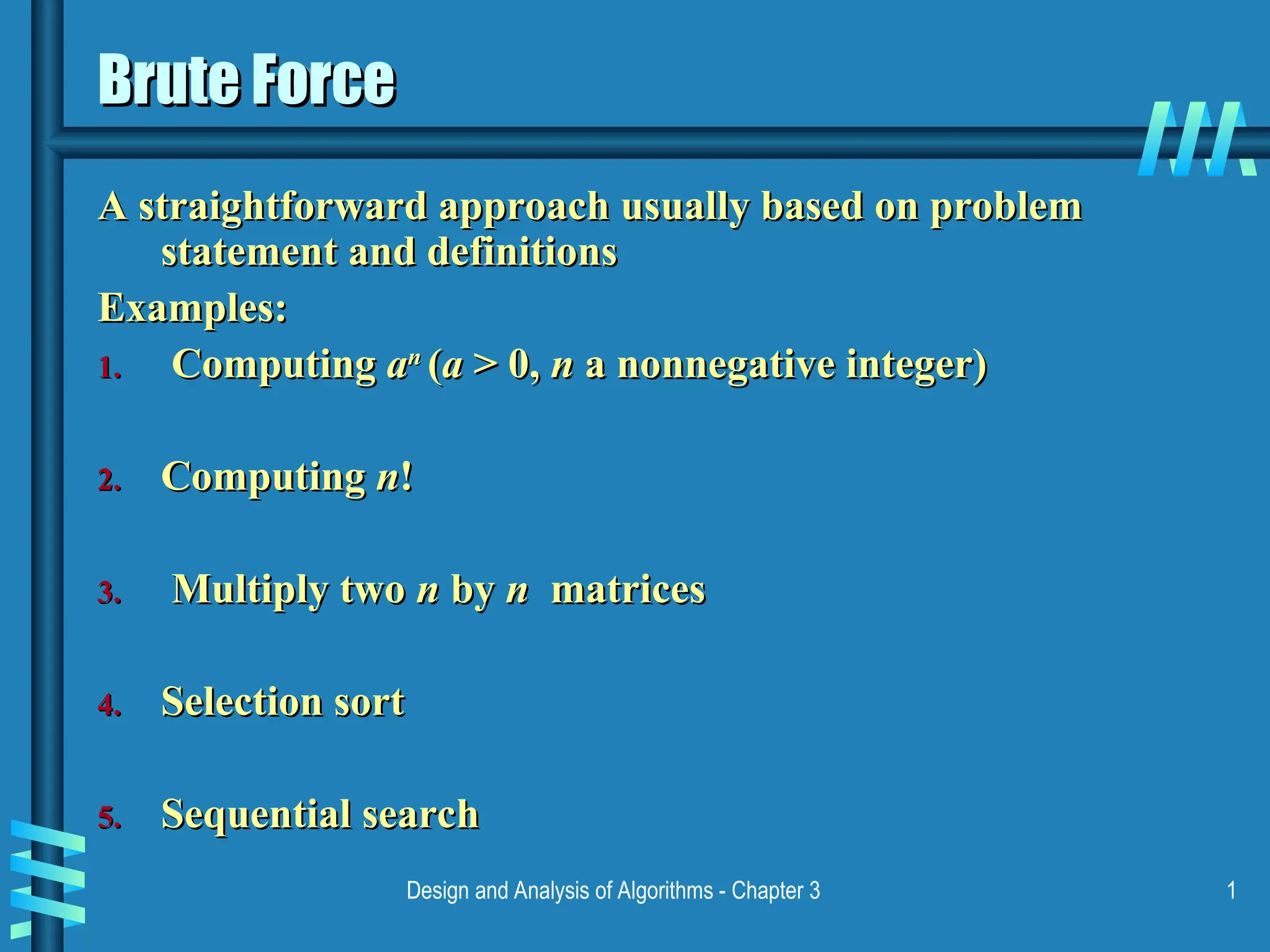
A straightforward approach usually based on problem
A straightforward approach usually based on problem
statement and definitions
statement and definitions
Examples:
Examples:
1.
1. Computing
Computing a
an
n
(
(a
a > 0,
> 0, n
n a nonnegative integer)
a nonnegative integer)
2.
2. Computing
Computing n
n!
!
3.
3. Multiply two
Multiply two n
n by
by n
n matrices
matrices
4.
4. Selection sort
Selection sort
5.
5. Sequential search
Sequential search
2.
Design and Analysisof Algorithms - Chapter 3 2
String matching
String matching
pattern
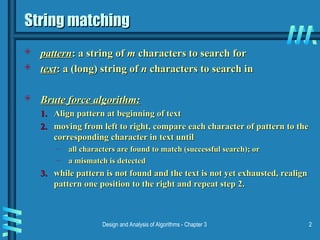
pattern: a string of
: a string of m
m characters to search for
characters to search for
text
text: a (long) string of
: a (long) string of n
n characters to search in
characters to search in
Brute force algorithm:
Brute force algorithm:
1.
1. Align pattern at beginning of text
Align pattern at beginning of text
2.
2. moving from left to right, compare each character of pattern to the
moving from left to right, compare each character of pattern to the
corresponding character in text until
corresponding character in text until
– all characters are found to match (successful search); or
all characters are found to match (successful search); or
– a mismatch is detected
a mismatch is detected
3.
3. while pattern is not found and the text is not yet exhausted, realign
while pattern is not found and the text is not yet exhausted, realign
pattern one position to the right and repeat step 2.
pattern one position to the right and repeat step 2.
3.
Design and Analysisof Algorithms - Chapter 3 3
Brute force string matching – Examples:
Brute force string matching – Examples:
1.
1. Pattern:
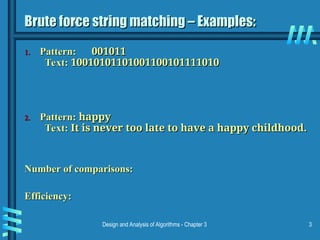
Pattern: 001011
001011
Text:
Text: 10010101101001100101111010
10010101101001100101111010
2.
2. Pattern:
Pattern: happy
happy
Text:
Text: It is never too late to have a happy childhood.
It is never too late to have a happy childhood.
Number of comparisons:
Number of comparisons:
Efficiency:
Efficiency:
4.
Design and Analysisof Algorithms - Chapter 3 4
Brute force polynomial evaluation
Brute force polynomial evaluation
Problem: Find the value of polynomial
Problem: Find the value of polynomial
p
p(
(x
x) =
) = a
an
nx
xn
n
+
+ a
an
n-1
-1x
xn
n-1
-1
+… +
+… + a
a1
1x
x1
1
+
+ a
a0
0
at a point
at a point x
x =
= x
x0
0
Algorithm:
Algorithm:
Efficiency:
Efficiency:
p
p := 0.0
:= 0.0
for
for i
i :=
:= n
n down to 0 do
down to 0 do
power := 1
power := 1
for
for j
j := 1 to
:= 1 to i
i do
do
power := power
power := power
*
* x
x
p
p :=
:= p
p +
+ a
a[
[i
i] * power
] * power
return
return p
p
5.
Design and Analysisof Algorithms - Chapter 3 5
Polynomial evaluation: improvement
Polynomial evaluation: improvement
We can do better by evaluating from right to left:
We can do better by evaluating from right to left:
Algorithm:
Algorithm:
Efficiency:
Efficiency:
p
p :=
:= a
a[0]
[0]
power := 1
power := 1
for
for i
i := 1 to
:= 1 to n
n do
do
power := power *
power := power * x
x
p
p :=
:= p
p +
+ a
a[
[i
i] * power
] * power
return
return p
p
6.
Design and Analysisof Algorithms - Chapter 3 6
More brute force algorithm examples:
More brute force algorithm examples:
Closest pair
Closest pair
• Problem
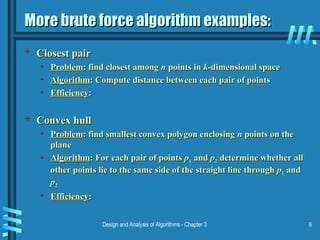
Problem: find closest among
: find closest among n
n points in
points in k
k-dimensional space
-dimensional space
• Algorithm
Algorithm: Compute distance between each pair of points
: Compute distance between each pair of points
• Efficiency
Efficiency:
:
Convex hull
Convex hull
• Problem
Problem: find smallest convex polygon enclosing
: find smallest convex polygon enclosing n
n points on the
points on the
plane
plane
• Algorithm
Algorithm: For each pair of points
: For each pair of points p
p1
1 and
and p
p2
2 determine whether all
determine whether all
other points lie to the same side of the straight line through
other points lie to the same side of the straight line through p
p1
1 and
and
p
p2
2
• Efficiency
Efficiency:
:
7.
Design and Analysisof Algorithms - Chapter 3 7
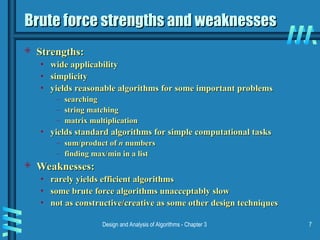
Brute force strengths and weaknesses
Brute force strengths and weaknesses
Strengths:
Strengths:
• wide applicability
wide applicability
• simplicity
simplicity
• yields reasonable algorithms for some important problems
yields reasonable algorithms for some important problems
– searching
searching
– string matching
string matching
– matrix multiplication
matrix multiplication
• yields standard algorithms for simple computational tasks
yields standard algorithms for simple computational tasks
– sum/product of
sum/product of n
n numbers
numbers
– finding max/min in a list
finding max/min in a list
Weaknesses:
Weaknesses:
• rarely yields efficient algorithms
rarely yields efficient algorithms
• some brute force algorithms unacceptably slow
some brute force algorithms unacceptably slow
• not as constructive/creative as some other design techniques
not as constructive/creative as some other design techniques
8.
Design and Analysisof Algorithms - Chapter 3 8
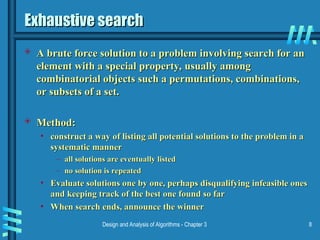
Exhaustive search
Exhaustive search
A brute force solution to a problem involving search for an
A brute force solution to a problem involving search for an
element with a special property, usually among
element with a special property, usually among
combinatorial objects such a permutations, combinations,
combinatorial objects such a permutations, combinations,
or subsets of a set.
or subsets of a set.
Method:
Method:
• construct a way of listing all potential solutions to the problem in a
construct a way of listing all potential solutions to the problem in a
systematic manner
systematic manner
– all solutions are eventually listed
all solutions are eventually listed
– no solution is repeated
no solution is repeated
• Evaluate solutions one by one, perhaps disqualifying infeasible ones
Evaluate solutions one by one, perhaps disqualifying infeasible ones
and keeping track of the best one found so far
and keeping track of the best one found so far
• When search ends, announce the winner
When search ends, announce the winner
9.
Design and Analysisof Algorithms - Chapter 3 9
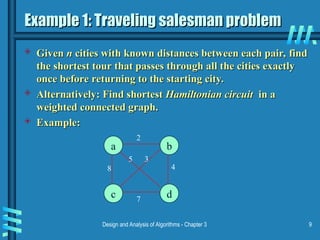
Example 1: Traveling salesman problem
Example 1: Traveling salesman problem
Given
Given n
n cities with known distances between each pair, find
cities with known distances between each pair, find
the shortest tour that passes through all the cities exactly
the shortest tour that passes through all the cities exactly
once before returning to the starting city.
once before returning to the starting city.
Alternatively: Find shortest
Alternatively: Find shortest Hamiltonian circuit
Hamiltonian circuit in a
in a
weighted connected graph.
weighted connected graph.
Example:
Example:
a b
c d
8
2
7
5 3
4
10.
Design and Analysisof Algorithms - Chapter 3 10
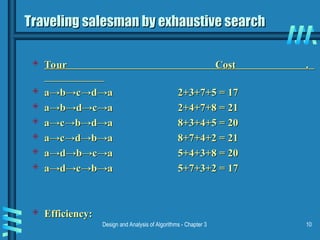
Traveling salesman by exhaustive search
Traveling salesman by exhaustive search
Tour Cost .
Tour Cost .
a
a→b→c→d→a 2+3+7+5 = 17
→b→c→d→a 2+3+7+5 = 17
a
a→b→d→c→a 2+4+7+8 = 21
→b→d→c→a 2+4+7+8 = 21
a
a→c→b→d→a 8+3+4+5 = 20
→c→b→d→a 8+3+4+5 = 20
a
a→c→d→b→a 8+7+4+2 = 21
→c→d→b→a 8+7+4+2 = 21
a
a→d→b→c→a 5+4+3+8 = 20
→d→b→c→a 5+4+3+8 = 20
a
a→d→c→b→a 5+7+3+2 = 17
→d→c→b→a 5+7+3+2 = 17
Efficiency:
Efficiency:
11.
Design and Analysisof Algorithms - Chapter 3 11
Example 2: Knapsack Problem
Example 2: Knapsack Problem
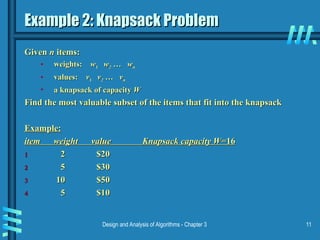
Given
Given n
n items:
items:
• weights:
weights: w
w1
1 w
w2
2 … w
… wn
n
• values:
values: v
v1
1 v
v2
2 … v
… vn
n
• a knapsack of capacity
a knapsack of capacity W
W
Find the most valuable subset of the items that fit into the knapsack
Find the most valuable subset of the items that fit into the knapsack
Example:
Example:
item weight value Knapsack capacity W=
item weight value Knapsack capacity W=16
16
1
1 2 $20
2 $20
2
2 5 $30
5 $30
3
3 10 $50
10 $50
4
4 5 $10
5 $10
12.
Design and Analysisof Algorithms - Chapter 3 12
Knapsack by exhaustive search
Knapsack by exhaustive search
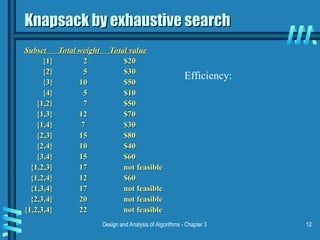
Subset Total weight Total value
Subset Total weight Total value
{1} 2 $20
{1} 2 $20
{2} 5 $30
{2} 5 $30
{3} 10 $50
{3} 10 $50
{4} 5 $10
{4} 5 $10
{1,2} 7 $50
{1,2} 7 $50
{1,3} 12 $70
{1,3} 12 $70
{1,4} 7 $30
{1,4} 7 $30
{2,3} 15 $80
{2,3} 15 $80
{2,4} 10 $40
{2,4} 10 $40
{3,4} 15 $60
{3,4} 15 $60
{1,2,3} 17 not feasible
{1,2,3} 17 not feasible
{1,2,4} 12 $60
{1,2,4} 12 $60
{1,3,4} 17 not feasible
{1,3,4} 17 not feasible
{2,3,4} 20 not feasible
{2,3,4} 20 not feasible
{1,2,3,4} 22 not feasible
{1,2,3,4} 22 not feasible
Efficiency:
13.
Design and Analysisof Algorithms - Chapter 3 13
Final comments:
Final comments:
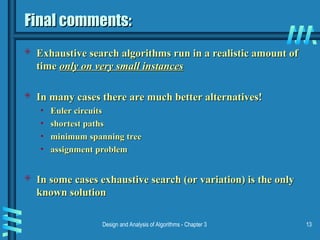
Exhaustive search algorithms run in a realistic amount of
Exhaustive search algorithms run in a realistic amount of
time
time only on very small instances
only on very small instances
In many cases there are much better alternatives!
In many cases there are much better alternatives!
• Euler circuits
Euler circuits
• shortest paths
shortest paths
• minimum spanning tree
minimum spanning tree
• assignment problem
assignment problem
In some cases exhaustive search (or variation) is the only
In some cases exhaustive search (or variation) is the only
known solution
known solution

![Design and Analysis of Algorithms - Chapter 3 4
Brute force polynomial evaluation
Brute force polynomial evaluation
Problem: Find the value of polynomial
Problem: Find the value of polynomial
p
p(
(x
x) =
) = a
an
nx
xn
n
+
+ a
an
n-1
-1x
xn
n-1
-1
+… +
+… + a
a1
1x
x1
1
+
+ a
a0
0
at a point
at a point x
x =
= x
x0
0
Algorithm:
Algorithm:
Efficiency:
Efficiency:
p
p := 0.0
:= 0.0
for
for i
i :=
:= n
n down to 0 do
down to 0 do
power := 1
power := 1
for
for j
j := 1 to
:= 1 to i
i do
do
power := power
power := power
*
* x
x
p
p :=
:= p
p +
+ a
a[
[i
i] * power
] * power
return
return p
p](https://image.slidesharecdn.com/ch03-260123003037-47508d06/85/brute-force-ppt-lsdgldslgkdsglsdghsdghsdgsg-4-320.jpg)
![Design and Analysis of Algorithms - Chapter 3 5
Polynomial evaluation: improvement
Polynomial evaluation: improvement
We can do better by evaluating from right to left:
We can do better by evaluating from right to left:
Algorithm:
Algorithm:
Efficiency:
Efficiency:
p
p :=
:= a
a[0]
[0]
power := 1
power := 1
for
for i
i := 1 to
:= 1 to n
n do
do
power := power *
power := power * x
x
p
p :=
:= p
p +
+ a
a[
[i
i] * power
] * power
return
return p
p](https://image.slidesharecdn.com/ch03-260123003037-47508d06/85/brute-force-ppt-lsdgldslgkdsglsdghsdghsdgsg-5-320.jpg)


![mini_proj[1][1] 1-1.pptxdvdsgdsgdsdsdsfdfdf](https://cdn.slidesharecdn.com/ss_thumbnails/miniproj111-1-250917011136-61752745-thumbnail.jpg?width=640&height=640&fit=bounds)


