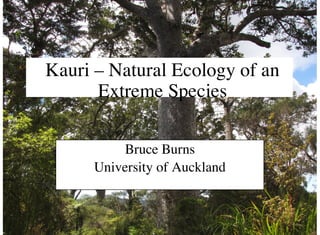
Kauri – Natural Ecology of an
Extreme Species
Bruce Burns
University of Auckland
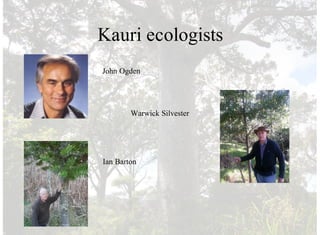
Kauri ecologists
Ian Barton
John Ogden
Warwick Silvester
Kauri is threatened by Phytophthora
‘taxon Agathis’ dieback but..
What’s so special about kauri?
Kauri is threatened by Phytophthora
‘taxon Agathis’ dieback but..
What’s so special about kauri?
• Ancient lineage
• Biologically extreme
• Foundation species creating diverse forests
• High forestry value in the past and potential for
the future
• Value as flagship species
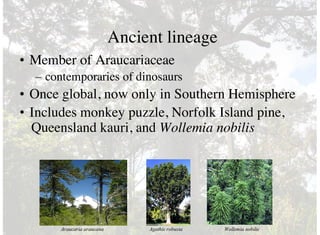
Ancient lineage
• Member of Araucariaceae
– contemporaries of dinosaurs
• Once global, now only in Southern Hemisphere
• Includes monkey puzzle, Norfolk Island pine,
Queensland kauri, and Wollemia nobilis
Araucaria araucana Wollemia nobilisAgathis robusta
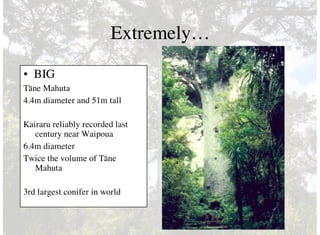
Extremely…
• BIG
Tāne Mahuta
4.4m diameter and 51m tall
Kairaru reliably recorded last
century near Waipoua
6.4m diameter
Twice the volume of Tāne
Mahuta
3rd largest conifer in world
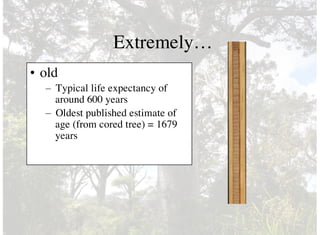
Extremely…
• old
– Typical life expectancy of
around 600 years
– Oldest published estimate of
age (from cored tree) = 1679
years
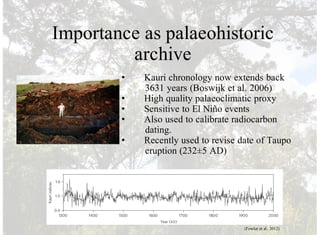
Importance as palaeohistoric
archive
• Kauri chronology now extends back
3631 years (Boswijk et al. 2006)
• High quality palaeoclimatic proxy
• Sensitive to El Niño events
• Also used to calibrate radiocarbon
dating.
• Recently used to revise date of Taupo
eruption (232±5 AD)
(Fowler et al. 2012)
Extremely…
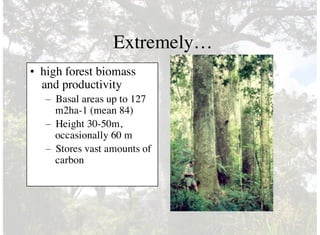
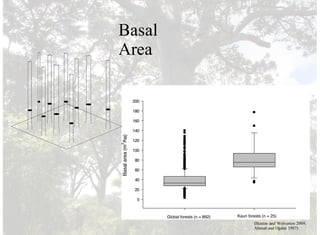
• high forest biomass
and productivity
– Basal areas up to 127
m2ha-1 (mean 84)
– Height 30-50m,
occasionally 60 m
– Stores vast amounts of
carbon
Basalarea(m
2
/ha)
0
20
40
60
80
100
120
140
160
180
200
Global forests (n = 892) Kauri forests (n = 25)
Basal
Area
(Huston and Wolverton 2009,
Ahmed and Ogden 1987)
Extremely…
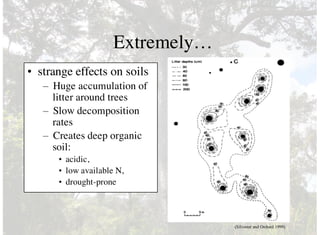
• strange effects on soils
– Huge accumulation of
litter around trees
– Slow decomposition
rates
– Creates deep organic
soil:
• acidic,
• low available N,
• drought-prone
(Silvester and Orchard 1999)
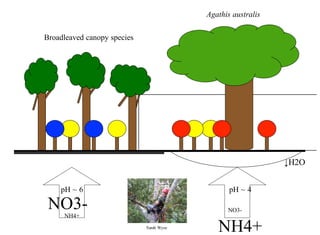
Broadleaved canopy species
Agathis australis
↓H2O
pH ~ 6
NO3-
NH4+
pH ~ 4
NO3-
NH4+Sarah Wyse
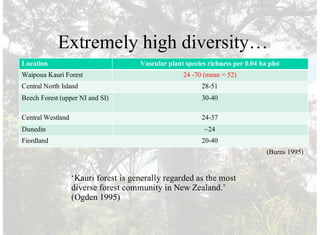
Extremely high diversity…
Location Vascular plant species richness per 0.04 ha plot
Waipoua Kauri Forest 24 -70 (mean = 52)
Central North Island 28-51
Beech Forest (upper NI and SI) 30-40
Central Westland 24-37
Dunedin ~24
Fiordland 20-40
(Burns 1995)
‘Kauri forest is generally regarded as the most
diverse forest community in New Zealand.’
(Ogden 1995)
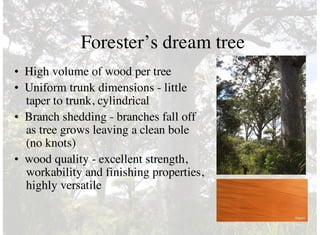
Forester’s dream tree
• High volume of wood per tree
• Uniform trunk dimensions - little
taper to trunk, cylindrical
• Branch shedding - branches fall off
as tree grows leaving a clean bole
(no knots)
• wood quality - excellent strength,
workability and finishing properties,
highly versatile
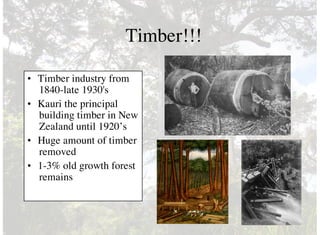
Timber!!!
• Timber industry from
1840-late 1930's
• Kauri the principal
building timber in New
Zealand until 1920’s
• Huge amount of timber
removed
• 1-3% old growth forest
remains
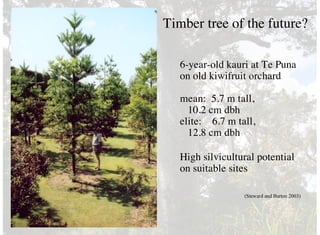
6-year-old kauri at Te Puna
on old kiwifruit orchard
mean: 5.7 m tall,
10.2 cm dbh
elite: 6.7 m tall,
12.8 cm dbh
High silvicultural potential
on suitable sites
Timber tree of the future?
(Steward and Barton 2003)
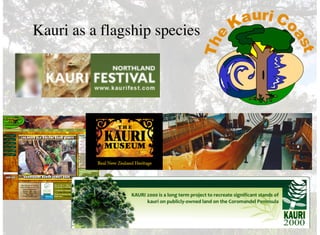
Kauri as a flagship species
Value as flagship species
• Stands of gigantic trees are awe-inspiring
• Major tourist attractions
• Creates ‘sense of place’ and cultural identity
for people of northern NZ
• Flagship species for forest conservation in NZ
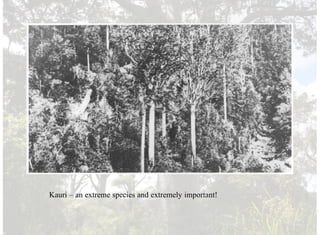
Kauri – an extreme species and extremely important!

Bruce burns

  • 1.
    Kauri – NaturalEcology of an Extreme Species Bruce Burns University of Auckland
  • 2.
    Kauri ecologists Ian Barton JohnOgden Warwick Silvester
  • 3.
    Kauri is threatenedby Phytophthora ‘taxon Agathis’ dieback but.. What’s so special about kauri?
  • 4.
    Kauri is threatenedby Phytophthora ‘taxon Agathis’ dieback but.. What’s so special about kauri? • Ancient lineage • Biologically extreme • Foundation species creating diverse forests • High forestry value in the past and potential for the future • Value as flagship species
  • 5.
    Ancient lineage • Memberof Araucariaceae – contemporaries of dinosaurs • Once global, now only in Southern Hemisphere • Includes monkey puzzle, Norfolk Island pine, Queensland kauri, and Wollemia nobilis Araucaria araucana Wollemia nobilisAgathis robusta
  • 6.
    Extremely… • BIG Tāne Mahuta 4.4mdiameter and 51m tall Kairaru reliably recorded last century near Waipoua 6.4m diameter Twice the volume of Tāne Mahuta 3rd largest conifer in world
  • 7.
    Extremely… • old – Typicallife expectancy of around 600 years – Oldest published estimate of age (from cored tree) = 1679 years
  • 8.
    Importance as palaeohistoric archive •Kauri chronology now extends back 3631 years (Boswijk et al. 2006) • High quality palaeoclimatic proxy • Sensitive to El Niño events • Also used to calibrate radiocarbon dating. • Recently used to revise date of Taupo eruption (232±5 AD) (Fowler et al. 2012)
  • 9.
    Extremely… • high forestbiomass and productivity – Basal areas up to 127 m2ha-1 (mean 84) – Height 30-50m, occasionally 60 m – Stores vast amounts of carbon
  • 10.
    Basalarea(m 2 /ha) 0 20 40 60 80 100 120 140 160 180 200 Global forests (n= 892) Kauri forests (n = 25) Basal Area (Huston and Wolverton 2009, Ahmed and Ogden 1987)
  • 11.
    Extremely… • strange effectson soils – Huge accumulation of litter around trees – Slow decomposition rates – Creates deep organic soil: • acidic, • low available N, • drought-prone (Silvester and Orchard 1999)
  • 12.
    Broadleaved canopy species Agathisaustralis ↓H2O pH ~ 6 NO3- NH4+ pH ~ 4 NO3- NH4+Sarah Wyse
  • 14.
    Extremely high diversity… LocationVascular plant species richness per 0.04 ha plot Waipoua Kauri Forest 24 -70 (mean = 52) Central North Island 28-51 Beech Forest (upper NI and SI) 30-40 Central Westland 24-37 Dunedin ~24 Fiordland 20-40 (Burns 1995) ‘Kauri forest is generally regarded as the most diverse forest community in New Zealand.’ (Ogden 1995)
  • 15.
    Forester’s dream tree •High volume of wood per tree • Uniform trunk dimensions - little taper to trunk, cylindrical • Branch shedding - branches fall off as tree grows leaving a clean bole (no knots) • wood quality - excellent strength, workability and finishing properties, highly versatile
  • 16.
    Timber!!! • Timber industryfrom 1840-late 1930's • Kauri the principal building timber in New Zealand until 1920’s • Huge amount of timber removed • 1-3% old growth forest remains
  • 17.
    6-year-old kauri atTe Puna on old kiwifruit orchard mean: 5.7 m tall, 10.2 cm dbh elite: 6.7 m tall, 12.8 cm dbh High silvicultural potential on suitable sites Timber tree of the future? (Steward and Barton 2003)
  • 18.
    Kauri as aflagship species
  • 19.
    Value as flagshipspecies • Stands of gigantic trees are awe-inspiring • Major tourist attractions • Creates ‘sense of place’ and cultural identity for people of northern NZ • Flagship species for forest conservation in NZ
  • 20.
    Kauri – anextreme species and extremely important!