The Cleveland-Youngstown-Pittsburgh Rail Corridor: A boon to
Cleveland.
Since 2007, groups in Cleveland, Youngstown, and Pittsburgh have been getting
together on various regional matters. One of these is the revival of passenger
rail service between these cities called the Cleveland-Youngstown-Pittsburgh
Corridor (or CYP).
What do I envision the route to be?
A person in Cleveland would be able to hop on a train downtown at nine in the
morning and be in Pittsburgh two hours later; including stops in Bedford, Hudson,
Ravenna, Warren, Youngstown, New Castle, and Beaver Falls.
This can be a first phase in a long term upgrade of the Capitol Limited Route
from Cleveland, Ohio to Washington DC. If the CYP corridor not only is built, but
fulfills basic expectations, then daytime railroad service from Cleveland to
Washington DC can be the next step. Thus a key segment of the much
proposed Ohio Hub Amtrak Plan can be achieved.
I see it using the latest technology; electric or flex fuel engines that would be
environmentally friendly. Not only that, the overhead electric wires can be
installed as part of smart national power grid (to upgrade our out of date one).
This can bring First Energy and other power companies on board; and who can
lobby on our behalf. Also, though Lev Gonick of Case Western Reserve
University, in an e-mail correspondence, did state there are now existing
broadband cables connecting Cleveland to Pittsburgh, another cable running the
route of the CYP can’t hurt; there can be a future need for greater broadband
capacity. All this will be enticing to outside investors.
Let’s look at interoperability: Besides just a basic upgrade of existing railroad
routes owned by the freight companies (as is the case in the Pacific Northwest
program), there should be stretches where the passenger rail company
(Amtrak?) should own newly built tracks capable of high speed. As Ken
Predergast mentioned over the phone, there are plenty of excess right of ways in
this area. For example, in the Ravenna area, there is a two mile gap of
previous track that has been removed in the past decades. It would be cost
effective to rebuild tracks in this gap for passenger service. This, and in a few
other areas (including New Castle), can not only enable trains to reach speeds
similar to the TGV in France, but be a bargaining chip with the freight companies
to minimize the regular practice of passenger trains waiting on the sidelines for
freight trains to go by. That is what primarily delays passenger railroads in
America.
CYP as a Value Capture Corridor.
The Cleveland-Youngstown-Pittsburgh High Speed Rail Corridor can be far more
than a mere economic tool; it can be a value capture corridor. Failure to restore
transportation connections such as the CYP will inhibit outside investment.
Besides, it will create jobs and stimulate the economy.
High Speed Rail (HSR) is to compliment, not compete, with other existing modes
of transportation. The CYP rail corridor can serve the short haul travel market
that Greyhound has systematically abandoned over the past few decades.
The greater the number of transportation choices, the greater the odds of a
region attracting more dollars. The rail can be what ties everything together in
regards to the Tech Belt.
There is a stronger demand for HSR along the CYP Corridor than along the
Cleveland-Columbus-Cincinnati HSR route; and scored even higher than the one
recently planned for Florida. With population densities of 6,115 (in 2005) and
5,696 respectively, Cleveland and Pittsburgh can support a rail route far better
than a similar one through Columbus and Cincinnati, which have much lower
population densities (3,474 and 3,958) even though all are considered medium
sized population centers.
Report
Cleveland Transit Region:
Population 2000: (1)
2,250,871
Jobs 2000: (2)
1,087,195
Jobs 2008: (3)
1,039,769
Median Household Income (2000): (4)
42,089
Pittsburgh Transit Region:
Population 2000: (1)
2,358,695
Jobs 2000: (2)
1,075,995
Jobs 2008: (3)
1,067,434
Median Household Income (2000): (4)
37,467
(taken from the TOD Database)
Besides that, too many people travel by car through this corridor currently. Even
PNC Bank has its’ own private bus service between Cleveland and Pittsburgh for
their employees; who could easily use the train.
It’s not that hard to get High Speed Rail to Tower City Center. Studies done in
1984, 1994-95, and currently underway for the West Shore Corridor found that it
was definitely feasible to put in passenger rail at Tower City Center and keep
existing parking spaces in the back of the complex.
What about the Amtrak station on the Lake? True, the Capitol Limited has no
problem using the current facility. Also, the Group Plan Commission for
Cleveland wants an inter-modal transportation facility there. However, by
moving the station to Tower City Center, which was once the main train station
for Cleveland, it will contribute to the economic development projects underway
around Prospect and Public Square.
Amtrak is up for grabs. As of 2013, state governments will be picking up the tab
on a lot more lines so the operating dynamic may change. Also, commuter train
authorities (such as in Chicago) have better time efficiencies. Can you get the
State to operate this? How about two? For two years now, Ohio has led the
nation in Amtrak Ridership Growth (Nation 7% 2010, Ohio 14%) Is it possible to
set up another Rail Authority to operate the CYP? How would the governors,
and State Assemblies, of Ohio and Pennsylvania feel about this? All these
questions need answers.
The year 2020 should be the target year for the start-up service of CYP to be up
and running. By that year, 2-3 daily round trips between Cleveland and
Pittsburgh should take place at 75 MPH.
Start-up service level of 2-3 daily round trips at 79mph
Capital investment: $30 million
Annual ridership: 663,000
Permanent jobs created: 16,800
5-year economic impact: $1.6 billion
(From Tech Belt Tracks: using passenger rail to energize tech belt
economic and transport assets, pg. 20)
Both express and local service can be applied to commuter service on CYP.
While some parts speeds as high as 90MPH can be attained others, like the
rebuilt line through Ravenna, would be more like 45MPH. So, a minimum
average of 67MPH should be the baseline as opposed to the 39MPH average of
the CCC. However, it must be stressed that how much time, versus how fast,
the trains are transporting someone, is the top priority. All of this is dependent
on the installation in existing and new track of Positive Train Control Signals.
Finally, it must be cost effective. To sell the CYP to Conservative-leaning
politicians such as the Governor of Ohio, it must be shown that one can obtain
the maximum amount of results for less than the $1.25 billion being invested in
the 80 mile route in Florida between Tampa and Orlando. The fact that 79-90
mph passenger rail service is possible, less expensive than immediately building
rail for 110-220 mph engines, and if proven to have average speeds easily
exceeding the ones pitched on the CCC project (and show it can be up and
running within 10 years), then there is a strong shot at getting bi-partisan support.
Therefore, it can be successfully argued that a Strategic Plan must be put in
place for the CYP project.
Bibliography;
1. Prendergast, Ken, Tech Belt Tracks: using passenger rail to energize tech
belt economic and transport assets, All Aboard Ohio, 2010
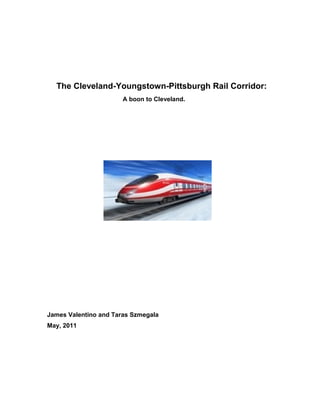
Picture on Cover page in the public domain at PublicDomainPictures.net.
The Cleveland-Youngstown-Pittsburgh Rail Corridor:
A boon to Cleveland.
James Valentino and Taras Szmegala
May, 2011

CYPcorridor_Paper

  • 1.
    The Cleveland-Youngstown-Pittsburgh RailCorridor: A boon to Cleveland. Since 2007, groups in Cleveland, Youngstown, and Pittsburgh have been getting together on various regional matters. One of these is the revival of passenger rail service between these cities called the Cleveland-Youngstown-Pittsburgh Corridor (or CYP). What do I envision the route to be? A person in Cleveland would be able to hop on a train downtown at nine in the morning and be in Pittsburgh two hours later; including stops in Bedford, Hudson, Ravenna, Warren, Youngstown, New Castle, and Beaver Falls. This can be a first phase in a long term upgrade of the Capitol Limited Route from Cleveland, Ohio to Washington DC. If the CYP corridor not only is built, but fulfills basic expectations, then daytime railroad service from Cleveland to Washington DC can be the next step. Thus a key segment of the much proposed Ohio Hub Amtrak Plan can be achieved. I see it using the latest technology; electric or flex fuel engines that would be environmentally friendly. Not only that, the overhead electric wires can be installed as part of smart national power grid (to upgrade our out of date one). This can bring First Energy and other power companies on board; and who can lobby on our behalf. Also, though Lev Gonick of Case Western Reserve University, in an e-mail correspondence, did state there are now existing broadband cables connecting Cleveland to Pittsburgh, another cable running the route of the CYP can’t hurt; there can be a future need for greater broadband capacity. All this will be enticing to outside investors.
  • 2.
    Let’s look atinteroperability: Besides just a basic upgrade of existing railroad routes owned by the freight companies (as is the case in the Pacific Northwest program), there should be stretches where the passenger rail company (Amtrak?) should own newly built tracks capable of high speed. As Ken Predergast mentioned over the phone, there are plenty of excess right of ways in this area. For example, in the Ravenna area, there is a two mile gap of previous track that has been removed in the past decades. It would be cost effective to rebuild tracks in this gap for passenger service. This, and in a few other areas (including New Castle), can not only enable trains to reach speeds similar to the TGV in France, but be a bargaining chip with the freight companies to minimize the regular practice of passenger trains waiting on the sidelines for freight trains to go by. That is what primarily delays passenger railroads in America. CYP as a Value Capture Corridor. The Cleveland-Youngstown-Pittsburgh High Speed Rail Corridor can be far more than a mere economic tool; it can be a value capture corridor. Failure to restore transportation connections such as the CYP will inhibit outside investment. Besides, it will create jobs and stimulate the economy. High Speed Rail (HSR) is to compliment, not compete, with other existing modes of transportation. The CYP rail corridor can serve the short haul travel market that Greyhound has systematically abandoned over the past few decades. The greater the number of transportation choices, the greater the odds of a region attracting more dollars. The rail can be what ties everything together in regards to the Tech Belt. There is a stronger demand for HSR along the CYP Corridor than along the Cleveland-Columbus-Cincinnati HSR route; and scored even higher than the one recently planned for Florida. With population densities of 6,115 (in 2005) and
  • 3.
    5,696 respectively, Clevelandand Pittsburgh can support a rail route far better than a similar one through Columbus and Cincinnati, which have much lower population densities (3,474 and 3,958) even though all are considered medium sized population centers. Report Cleveland Transit Region: Population 2000: (1) 2,250,871 Jobs 2000: (2) 1,087,195 Jobs 2008: (3) 1,039,769 Median Household Income (2000): (4) 42,089 Pittsburgh Transit Region: Population 2000: (1) 2,358,695 Jobs 2000: (2) 1,075,995 Jobs 2008: (3) 1,067,434 Median Household Income (2000): (4) 37,467 (taken from the TOD Database) Besides that, too many people travel by car through this corridor currently. Even PNC Bank has its’ own private bus service between Cleveland and Pittsburgh for their employees; who could easily use the train. It’s not that hard to get High Speed Rail to Tower City Center. Studies done in 1984, 1994-95, and currently underway for the West Shore Corridor found that it was definitely feasible to put in passenger rail at Tower City Center and keep existing parking spaces in the back of the complex. What about the Amtrak station on the Lake? True, the Capitol Limited has no problem using the current facility. Also, the Group Plan Commission for Cleveland wants an inter-modal transportation facility there. However, by moving the station to Tower City Center, which was once the main train station
  • 4.
    for Cleveland, itwill contribute to the economic development projects underway around Prospect and Public Square. Amtrak is up for grabs. As of 2013, state governments will be picking up the tab on a lot more lines so the operating dynamic may change. Also, commuter train authorities (such as in Chicago) have better time efficiencies. Can you get the State to operate this? How about two? For two years now, Ohio has led the nation in Amtrak Ridership Growth (Nation 7% 2010, Ohio 14%) Is it possible to set up another Rail Authority to operate the CYP? How would the governors, and State Assemblies, of Ohio and Pennsylvania feel about this? All these questions need answers. The year 2020 should be the target year for the start-up service of CYP to be up and running. By that year, 2-3 daily round trips between Cleveland and Pittsburgh should take place at 75 MPH. Start-up service level of 2-3 daily round trips at 79mph Capital investment: $30 million Annual ridership: 663,000 Permanent jobs created: 16,800 5-year economic impact: $1.6 billion (From Tech Belt Tracks: using passenger rail to energize tech belt economic and transport assets, pg. 20) Both express and local service can be applied to commuter service on CYP. While some parts speeds as high as 90MPH can be attained others, like the rebuilt line through Ravenna, would be more like 45MPH. So, a minimum average of 67MPH should be the baseline as opposed to the 39MPH average of the CCC. However, it must be stressed that how much time, versus how fast, the trains are transporting someone, is the top priority. All of this is dependent on the installation in existing and new track of Positive Train Control Signals.
  • 5.
    Finally, it mustbe cost effective. To sell the CYP to Conservative-leaning politicians such as the Governor of Ohio, it must be shown that one can obtain the maximum amount of results for less than the $1.25 billion being invested in the 80 mile route in Florida between Tampa and Orlando. The fact that 79-90 mph passenger rail service is possible, less expensive than immediately building rail for 110-220 mph engines, and if proven to have average speeds easily exceeding the ones pitched on the CCC project (and show it can be up and running within 10 years), then there is a strong shot at getting bi-partisan support. Therefore, it can be successfully argued that a Strategic Plan must be put in place for the CYP project. Bibliography;
  • 6.
    1. Prendergast, Ken,Tech Belt Tracks: using passenger rail to energize tech belt economic and transport assets, All Aboard Ohio, 2010 Picture on Cover page in the public domain at PublicDomainPictures.net.
  • 7.
    The Cleveland-Youngstown-Pittsburgh RailCorridor: A boon to Cleveland. James Valentino and Taras Szmegala May, 2011