Running head: BUSINESS ANALYTICS IN SUPPLY CHAINS 1
Business Analytics Innovations in
Supply Chain Value Discovery
Robert L. Brown
Walden University
BUSINESS ANALYTICS IN SUPPLY CHAINS 2
Abstract
Business Analytics can provide insight into the complex multidimensional supply chain systems to help
create value federations. Prior to data analytics the synergies that exist within the complexities of
interconnected and interwoven supply chains could not easily be detected. Using IBM’s SPSS
Software and Watson Artificial Intelligence System, supply chain managers now have enormous
strategic insight into the potential value that can be generated from traditional supply chains that can now
be transformed into Value Federations. The synergetic relationships between multiple suppliers within a
value federation to create more product, goods and services allows the creation of more value,
employment and entrepreneurship.
Keywords: business analytics, IBM SPSS, Watson, artificial intelligence
BUSINESS ANALYTICS IN SUPPLY CHAINS 3
Business Analytics in Supply Chain Value Discovery
Businesses in the 21st
face tremendous challenges in managing their supply chains and vendor
relationships. Disruptions in the supply chain, that are now business systems of vast interconnected
complex webs of communication methods, logistics controls, transportation systems and computer
Enterprise Resource Planning (ERP) systems is a new emerging science of management in and of itself
(Mandić & Delibašiś, 2012). The level of education and training required of employees in all these areas
is reaching near graduate level education and the pressure, emotional and cognitive, on the employees to
manage the complexity factor is exponentially increasing.
Business Profiling
Vendors and customers are often not in strategic alignment with each other’s core business
goals. In some cases, the nature of the relationship can be a strained antagonistic cognitively emotional
combative mental state in which the customer treats the supplier as a subservient entity that only exists to
the serve the needs of the customer, and not seen as an end in and of themselves. Walmart Corporation
throughout the 1990’s was notorious for many harsh practices on their suppliers has now become a
partner with their suppliers and in many cases have helped raised their supplier profits by 18% (Huang,
Nijs, Hansen & Anderson, 2012). Indeed, Walmart. Kmart, Sear and Target have learned the hard
lesson that a virtuous circle of profitability for both customer and the supplier is critical to maintain the
stability of the supply chain or what I choose to call the Value Federation. (VF).
Business Process Mapping
BUSINESS ANALYTICS IN SUPPLY CHAINS 4
Information Technology (IT) trained supply chain managers, VF managers, Business Systems
Scientists and supply chain support staff need to consider the concept of business process mapping
(Norshakkira, 2015). Business process mapping should consist of the writing down, graphically
representing or virtual world simulations actual physical, financial, legal, environmental impact and human
dimensions of the relationship between customer and supplier. The business process mapping should
also include the managerial expectations on both sides of the performance grading methods.
Additionally, and more importantly for Business Systems Scientists, the business process mapping
should identify the computer systems ERP and capabilities to try and discover if the ERP systems and
human understanding of those systems are compatible.
The business process maps and experiments should be determined if the ERP systems can
automatically work together to save human time from entering data and having human error creep into
the data entry process for example (Norshakkira, 2015). Expert Systems (ES) and Artificial Intelligence
(AI) are now becoming capable to help manage and direct through forecasting models the actual
strategic setup of sales orders, vendors’ orders and production scheduling (Gunasekaran & Ngai,
2014). Developing a business process modeling can be developed to determine the type of AI or
Virtual Employee systems to help manage the ERP system relationship between customers and suppliers
at the lower levels and mundane processes of the mutual business interaction.
Using IBM’s SPSS software, IT supply chain professionals can now create experimental
models that can create speculative forecasts on a variety of potential supply chain issues, ranging from
marketing changes, political unrest, ecological pressures and financial markets volatility to create buffer
BUSINESS ANALYTICS IN SUPPLY CHAINS 5
inventories, alternative supply lines or to stop purchasing items if a looming financial disruption is
becoming a potential reality. Using IBM SPSS statistical modeling software and Second Life’s Virtual
World simulation capability will give the IT supply chain or VF professional, enormous advantage over
traditional logistic planners relying on simple spreadsheets using rules of thumb (Sharma, Qiang, Wenjun
& Qi, 2013). In order to test these experimental models, using Second Life, IBM SPSS and IBM’s AI
system Watson are all within reach of those professionals that choose to learn these systems. In order to
create regional supply hubs, these virtual simulations need to be tested prior to implementation to
prevent costly mistakes in the designs of the supply chains and logistics systems.
Creating Regional Hubs
Suppliers need to broadened their horizons on what markets they can serve. The current world
wide unemployment crisis amongst young people could be mitigated by creating job banks of work that
a particular region needs to supply (Caruso & Gavrilovay, 2012). The current system of employment is
often haphazard and chaotic and is not viewed as a regional system issue. In many cases a supplier
receives a large sales order to fulfill, the supplier does not have the labor or intellectual capital to
complete the job for the customer Independently the supplier through internal resources of the Human
Resource department, tries to fulfill the human capital demand. Alternatively, suppliers that see
themselves as part of a VF, could trade workers and create a flexible workforce model to provide more
labor and intellectual capital cooperatively to fulfill customer needs. Capitalizing on a region’s cultural,
ethnic and ecological diversity or specificity of human capability of that region, could lead to the mass
expansion of businesses and create centers of excellence in all regions of underperforming areas of
BUSINESS ANALYTICS IN SUPPLY CHAINS 6
Value Federations (Cirullies, Schwede & Toth, 2012). Cultural differences which are often the source
of conflicts could become if managed, through regional centers, that promote profitability of all
participants into an engine of creative energy derived from the cultural and regionally difference to
promote innovative business creation.
Collaborative Governance
In many supplier and customer relationships, there is reluctance to share information,
technologies and human capital. This reluctance is based on the fear that someone in the supply chain
will steal important capabilities and in doing so damage or bankrupt a partner within the supply chain
(Lawler & Sillitoe, 2013). Peter Senge has created the idea of the Learning Organization to create an
educational model of sharing ideas, management formulas and even dreams to create a dynamic self-
recreating organization that is organic in nature, meaning change and growth come from within, and an
organization that seeks others of its own kind to share and cooperate (Lawler & Sillitoe, 2013). In the
area of Value Federations especially, in regional centers and cultural hubs, the sharing of resources from
work spaces, shop floors, technology, computing power, human capital and managerial capabilities is
becoming a necessity to drive the costs of production down while not creating mass unemployment and
civil unrest through the process of Lean Manufacturing and Economies of scale (Lawler & Sillitoe,
2013). The Learning Value Federation and Senge’s Learning and sharing federations will become the
new norm to create more businesses versus the current model of destructive competition that reduces
the number of suppliers and jobs.
Communication
BUSINESS ANALYTICS IN SUPPLY CHAINS 7
The philosopher David Hume states, “that nothing is more free than the imagination of man”
(Locke, Berkeley & Hume, 1990). By using and unleashing human imagination and allowing people the
freedom to use their imagination, the most powerful force known to human beings, supply chain
managers will be capable of creating intelligent communication systems. Human imagination along with
interconnected ERP systems to automatically communicate between the various nodes along the
complex web of bundles of supply chains that are the components of Value Federations will
fundamentally transform al businesses (Mandić & Delibašiś ,2012).
Management teams must be willing to allow their supply chain managers to create intelligent
signal systems and methods within the supply chain. These intelligent signals may be composed of email
Kanban, interactive Artificial Intelligence systems and supply chain simulations experiments within virtual
worlds such as Second Life (Sharma et al., 2013). Virtual world technology that for example can
simulate potential inventories with the addition of AI virtual assistance that are capable of decision
making 24/7 prevent supply chain disruptions. These new Virtual Employees that can control ERP
systems will be able to make real time adjustments to disruptions or emergency orders within the supply
chain. Virtual Worlds are the frontiers of logistic and supply chain management to manage both tangible
and intangible (software, virtual machines, virtual employees) capabilities.
Seamless Networking
In order to create the business concept of seamless networking, teams from the various
customers and suppliers within a Value Federation should at first create virtual simulations, using simple
paper sticky notes up to and include virtual worlds and game theory to determine the best course of
BUSINESS ANALYTICS IN SUPPLY CHAINS 8
action (Chen, 2012). Business Systems Scientists can conduct experiments on existing supply lines and
by utilizing IBM SPSS statistical software begin to detect emerging potential changes to the existing
business model that can affect the entire supply chain (Gunasekaran & Ngai, 2014).
Additionally, Artificial Intelligence can be used help monitor the conduct of participants within a
supply chain that can moral guidance systems of conduct for suppliers and customers that transcend the
management team’s ability to monitor the individual activities of employees within the typical customer
and supplier relationship (Rodgers, Söderbom & Guiral, 2015). These new systems will create
mediation systems to prevent conflict and exploitation from entering the business equation. The ideal of
moral and ethical seamless relationships is critical to maintaining the supply chains of the future.
The prevention of the exploitation of employees, customers, indigenous people and the
environment is imperative to creating a sustainable supply chain (Rehman & Shrivastava, 2011).
Seamless Networking should also provide the interconnection and mutual respect of both parties and
for all parties’ that participant in and are impacted by the supply chain process (Rehman & Shrivastva,
2011).
Placing members of the suppliers’ teams onsite at the customer to be able to efficiently to
examine and resolve the customer’s issue at a large scale production site is also a key concept to create
seamless networking in the Value Federation. This concept of embedding the supplier or customer
agents at each other’s work sites is an additional method to create seamless business relationship
(Schmeltz, 2014).
Training Alignment
BUSINESS ANALYTICS IN SUPPLY CHAINS 9
Peter Senge’s work of collaboration has now evolved into the concept for training and
education model entitles the Triple Focus (Goleman & Senge, 2014). The Triple Focus is the concept
that focuses on cognitive social and emotional learning as well as more traditional task driven outwardly
focused education. Leadership teams and managers are well aware of the emotional distress deadlines,
failed aspirations, improper organizational alignment of goals and resources that can cause intense
emotional distress of employees along an entire supply chain (Goleman & Senge, 2014). Supply chains
should be designed and managed by trained professionals within the supply chain that understand the
social and emotional effect of their decisions. These professional should be held accountable for the
health, happiness and motivation of their various teams that in the long run will create sustainable supply
chains. The Triple Focus type of educational and training alignment that is directed towards the entire
supply chain is critical to manage the shifting demographic and generational shift taking place in the work
forces of the world.
BUSINESS ANALYTICS IN SUPPLY CHAINS 10
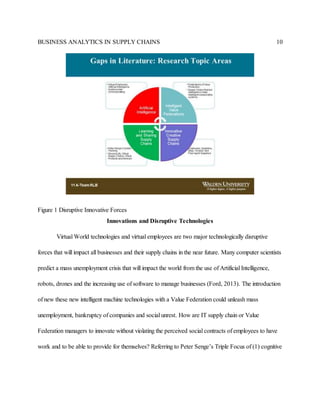
Figure 1 Disruptive Innovative Forces
Innovations and Disruptive Technologies
Virtual World technologies and virtual employees are two major technologically disruptive
forces that will impact all businesses and their supply chains in the near future. Many computer scientists
predict a mass unemployment crisis that will impact the world from the use of Artificial Intelligence,
robots, drones and the increasing use of software to manage businesses (Ford, 2013). The introduction
of new these new intelligent machine technologies with a Value Federation could unleash mass
unemployment, bankruptcy of companies and social unrest. How are IT supply chain or Value
Federation managers to innovate without violating the perceived social contracts of employees to have
work and to be able to provide for themselves? Referring to Peter Senge’s Triple Focus of (1) cognitive
BUSINESS ANALYTICS IN SUPPLY CHAINS 11
empathy, (2) emotional empathy and (3) empathic concern is a good place for managers to focus
(Goleman & Senge, 2014).
In order to maintain supply chain and even the businesses model themselves, individual citizen
consumers that are the reason supply chains exist, need to be able to have purchasing power.
Unemployed or under employed people have little to no buying power. In order to managed the
complex webs of the bundles of supply chains that comprise Value Federations, the mechanistic model
of efficiency of the past that does not consider the impact on human beings in general and in particular
indigenous people, cultures, animal life and the environment are failed models in that they do not contain
Senge’s Triple Focus (Goleman & Senge, 2014).The lack of cognitive empathy and emotional empathy
coupled with the rise of AI may become the greatest threat to the business cycle and supply chains the
world has ever experienced (Cirullies, Schwede & Toth, 2012). Value Federations will require the
engineering of cognitively emotionally aware business cultures to create a balanced humane model of
operation.
BUSINESS ANALYTICS IN SUPPLY CHAINS 12
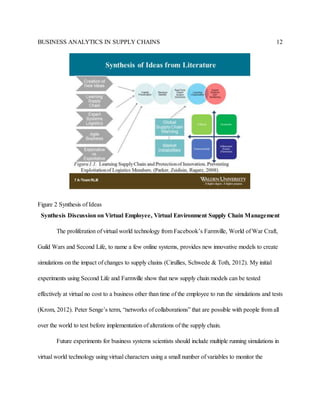
Figure 2 Synthesis of Ideas
Synthesis Discussion on Virtual Employee, Virtual Environment Supply Chain Management
The proliferation of virtual world technology from Facebook’s Farmville, World of War Craft,
Guild Wars and Second Life, to name a few online systems, provides new innovative models to create
simulations on the impact of changes to supply chains (Cirullies, Schwede & Toth, 2012). My initial
experiments using Second Life and Farmville show that new supply chain models can be tested
effectively at virtual no cost to a business other than time of the employee to run the simulations and tests
(Krom, 2012). Peter Senge’s term, “networks of collaborations” that are possible with people from all
over the world to test before implementation of alterations of the supply chain.
Future experiments for business systems scientists should include multiple running simulations in
virtual world technology using virtual characters using a small number of variables to monitor the
BUSINESS ANALYTICS IN SUPPLY CHAINS 13
efficiency of Lean Manufacturing initiatives for example (Chen, 2012). Using Facebook’s Farmville, the
loss of crops or deforestation can be simulated to determine the impact on wildlife within a virtual supply
chain experiment. Using IBM SPSS software, business systems scientists can create experiments that
can be tested using virtual characters and virtual environments that can begin to business leaders an
ability to sense the potential emerging futures and new business realities.
Business Systems Scientists now have the capabilities to study current supply chains or Value
Federations to detect a baseline of efficiency, cognitive emotional intelligence, impact on people and the
environment (Cirullies, Schwede & Toth, M. (2012). The cognitive shift for Business Systems Scientists
(BSS) that study supply chains should consider having these virtual experiments running to create
alternative hypothesis to the current supply chain paradigm that exists in the physical world. Supply
chains are a fascinating realm of study for BSS and Doctor of Business Administration (DBA) to
examine with scientific methods, tools and software.
Conclusion
Value Federations must become learning organizations that include and allow innovation and
promote cognitive emotional intelligence to create value systems that promote sustainable business
without sacrificing human beings, and the environment for short term profitability. Business leaders,
Supply Chain managers and Information Professionals must prepare for the AI revolution that is fully
underway and will begin to transform all aspects of business (Lawler & Sillitoe, 2013). IBM’s Watson
and SPSS software are critical tools for professionals to understand and to master. Billions of smart
phones with Apple’s Siri, Google or Microsoft’s Cortana are the new virtual employees that billions of
BUSINESS ANALYTICS IN SUPPLY CHAINS 14
people now have easy access to (Leber, Weber & Adam, 2014). The challenges presented are
currently underway and IT professionals and business leaders need to focus on the design of
sustainable, humane cognitively emotionally balanced systems to build sustainable Value Federations.
BUSINESS ANALYTICS IN SUPPLY CHAINS 15
References
Caruso, R., & Gavrilovay, E. (2012). Youth Unemployment, Terrorism and Political Violence,
Evidence from the Israeli/Palestinian Conflict. Peace Economics, Peace Science, &
Public Policy, 18(2), 1-35. doi:10.1515/1554-8597.1254
Chen, J.-X. (2012). Multiple criteria ABC inventory classification using two virtual items.
International Journal of Production Research, 50(6), 1702–1713.
Cirullies, J., Schwede, C., & Toth, M. (2012). Intra-simulative ecological assessment of logistics
networks: Benefits, concepts, and tool enhancement. Proceedings Title: Proceedings of
the 2012 Winter Simulation Conference (WSC), 1.
Ford, M. (2013). Viewpoint: Could Artificial Intelligence Create an Unemployment Crisis?
Communications of The ACM, 56(7), 37-39. doi:10.1145/2483852.2483865
Goleman, D., & Senge, P. (2014). The Triple Focus. Reflections, 14(1), 31-34.
Gunasekaran, A., & Ngai, E. W. T. (2014). Expert Systems and Artificial Intelligence in the 21st
Century Logistics and Supply Chain Management. 21st Century Logistics and Supply
Chain Management, 41(1), 1–4. http://doi.org/10.1016/j.eswa.2013.09.006
Krom, C. L. (2012). Using Farmville in an Introductory Managerial Accounting Course to
Engage Students, Enhance Comprehension, and Develop Social Networking Skills.
Journal of Management Education, 36(6), 848-865.
Lawler, A., & Sillitoe, J. (2013). Facilitating ‘organizational learning’ in a ‘learning institution’.
Journal of Higher Education Policy & Management, 35(5), 495-500.
BUSINESS ANALYTICS IN SUPPLY CHAINS 16
doi:10.1080/1360080X.2013.825415
Leber, M., Weber, C., & Adam, F. (2014). Mobile Application as an Innovative Supply
Chain Concept and the Impact of Social Capital. International Journal of Simulation
Modelling (IJSIMM), 13(2), 135–146.
Locke, J., Berkeley, G., & Hume, D. (1990). The empiricists. New York: Anchor
Books/Doubleday.
Mandić, K., & Delibašiś, B. (2012). Application of Multi-Agent Systems in Supply Chain
Management. Management (1820-0222), (63), 75–84.
Rehman, M. A. A., & Shrivastava, R. L. (2011). An Innovative Approach to Evaluate Green
Supply Chain Management (GSCM) Drivers by Using Interpretative Structural Modeling
(ISM). International Journal of Innovation & Technology Management, 8(2), 315–336.
Norshakkira, A. A. (2015). Web Based Expert System to Identify Trusted Partner for B2B
Collaboration. Journal of Theoretical & Applied Information Technology, 79(3), 65–369.
Plinere, D., & Borisov, A. (2014). Development of Ontological Knowledge Model for Raw
Materials Management Task. Darja Plinere, Arkādijs Borisovs. Ontoloģiskā Zināšanu
Modeļa Izstrāde Izejvielu Pārvaldības Uzdevumam., 17, 61–65.
Huang, Q., Nijs, V. R., Hansen, K., & Anderson, E. T. (2012). Wal-Mart’s Impact on Supplier
Profits. Journal of Marketing Research (JMR), 49(2), 131–143.
http://doi.org/10.1509/jmr.10.0256
BUSINESS ANALYTICS IN SUPPLY CHAINS 17
Schmeltz, L. (2014). Identical or Just Compatible? The Utility of Corporate Identity Values in
Communicating Corporate Social Responsibility. Journal of Business Communication, 51(3), 234–
258.
Sharma, G., Qiang, Y., Wenjun, S., & Qi, L. (2013). Communication in virtual world: Second
life and business opportunities. Information Systems Frontiers, 15(4), 677–694.
Visich, J. K., Gu, Q., & Khumawala, B. M. (2012). B2C Mass Customization in the Classroom.
Decision Sciences Journal of Innovative Education, 521.
Rodgers, W., Söderbom, A., & Guiral, A. (2015). Corporate Social Responsibility Enhanced Control
Systems Reducing the Likelihood of Fraud. Journal of Business Ethics, 131(4), 871–882.
BUSINESS ANALYTICS IN SUPPLY CHAINS 18

BROWN_R_WEEK_EIGHT_DDBA_FINAL_PAPER ver 02.28.2016 Final

  • 1.
    Running head: BUSINESSANALYTICS IN SUPPLY CHAINS 1 Business Analytics Innovations in Supply Chain Value Discovery Robert L. Brown Walden University
  • 2.
    BUSINESS ANALYTICS INSUPPLY CHAINS 2 Abstract Business Analytics can provide insight into the complex multidimensional supply chain systems to help create value federations. Prior to data analytics the synergies that exist within the complexities of interconnected and interwoven supply chains could not easily be detected. Using IBM’s SPSS Software and Watson Artificial Intelligence System, supply chain managers now have enormous strategic insight into the potential value that can be generated from traditional supply chains that can now be transformed into Value Federations. The synergetic relationships between multiple suppliers within a value federation to create more product, goods and services allows the creation of more value, employment and entrepreneurship. Keywords: business analytics, IBM SPSS, Watson, artificial intelligence
  • 3.
    BUSINESS ANALYTICS INSUPPLY CHAINS 3 Business Analytics in Supply Chain Value Discovery Businesses in the 21st face tremendous challenges in managing their supply chains and vendor relationships. Disruptions in the supply chain, that are now business systems of vast interconnected complex webs of communication methods, logistics controls, transportation systems and computer Enterprise Resource Planning (ERP) systems is a new emerging science of management in and of itself (Mandić & Delibašiś, 2012). The level of education and training required of employees in all these areas is reaching near graduate level education and the pressure, emotional and cognitive, on the employees to manage the complexity factor is exponentially increasing. Business Profiling Vendors and customers are often not in strategic alignment with each other’s core business goals. In some cases, the nature of the relationship can be a strained antagonistic cognitively emotional combative mental state in which the customer treats the supplier as a subservient entity that only exists to the serve the needs of the customer, and not seen as an end in and of themselves. Walmart Corporation throughout the 1990’s was notorious for many harsh practices on their suppliers has now become a partner with their suppliers and in many cases have helped raised their supplier profits by 18% (Huang, Nijs, Hansen & Anderson, 2012). Indeed, Walmart. Kmart, Sear and Target have learned the hard lesson that a virtuous circle of profitability for both customer and the supplier is critical to maintain the stability of the supply chain or what I choose to call the Value Federation. (VF). Business Process Mapping
  • 4.
    BUSINESS ANALYTICS INSUPPLY CHAINS 4 Information Technology (IT) trained supply chain managers, VF managers, Business Systems Scientists and supply chain support staff need to consider the concept of business process mapping (Norshakkira, 2015). Business process mapping should consist of the writing down, graphically representing or virtual world simulations actual physical, financial, legal, environmental impact and human dimensions of the relationship between customer and supplier. The business process mapping should also include the managerial expectations on both sides of the performance grading methods. Additionally, and more importantly for Business Systems Scientists, the business process mapping should identify the computer systems ERP and capabilities to try and discover if the ERP systems and human understanding of those systems are compatible. The business process maps and experiments should be determined if the ERP systems can automatically work together to save human time from entering data and having human error creep into the data entry process for example (Norshakkira, 2015). Expert Systems (ES) and Artificial Intelligence (AI) are now becoming capable to help manage and direct through forecasting models the actual strategic setup of sales orders, vendors’ orders and production scheduling (Gunasekaran & Ngai, 2014). Developing a business process modeling can be developed to determine the type of AI or Virtual Employee systems to help manage the ERP system relationship between customers and suppliers at the lower levels and mundane processes of the mutual business interaction. Using IBM’s SPSS software, IT supply chain professionals can now create experimental models that can create speculative forecasts on a variety of potential supply chain issues, ranging from marketing changes, political unrest, ecological pressures and financial markets volatility to create buffer
  • 5.
    BUSINESS ANALYTICS INSUPPLY CHAINS 5 inventories, alternative supply lines or to stop purchasing items if a looming financial disruption is becoming a potential reality. Using IBM SPSS statistical modeling software and Second Life’s Virtual World simulation capability will give the IT supply chain or VF professional, enormous advantage over traditional logistic planners relying on simple spreadsheets using rules of thumb (Sharma, Qiang, Wenjun & Qi, 2013). In order to test these experimental models, using Second Life, IBM SPSS and IBM’s AI system Watson are all within reach of those professionals that choose to learn these systems. In order to create regional supply hubs, these virtual simulations need to be tested prior to implementation to prevent costly mistakes in the designs of the supply chains and logistics systems. Creating Regional Hubs Suppliers need to broadened their horizons on what markets they can serve. The current world wide unemployment crisis amongst young people could be mitigated by creating job banks of work that a particular region needs to supply (Caruso & Gavrilovay, 2012). The current system of employment is often haphazard and chaotic and is not viewed as a regional system issue. In many cases a supplier receives a large sales order to fulfill, the supplier does not have the labor or intellectual capital to complete the job for the customer Independently the supplier through internal resources of the Human Resource department, tries to fulfill the human capital demand. Alternatively, suppliers that see themselves as part of a VF, could trade workers and create a flexible workforce model to provide more labor and intellectual capital cooperatively to fulfill customer needs. Capitalizing on a region’s cultural, ethnic and ecological diversity or specificity of human capability of that region, could lead to the mass expansion of businesses and create centers of excellence in all regions of underperforming areas of
  • 6.
    BUSINESS ANALYTICS INSUPPLY CHAINS 6 Value Federations (Cirullies, Schwede & Toth, 2012). Cultural differences which are often the source of conflicts could become if managed, through regional centers, that promote profitability of all participants into an engine of creative energy derived from the cultural and regionally difference to promote innovative business creation. Collaborative Governance In many supplier and customer relationships, there is reluctance to share information, technologies and human capital. This reluctance is based on the fear that someone in the supply chain will steal important capabilities and in doing so damage or bankrupt a partner within the supply chain (Lawler & Sillitoe, 2013). Peter Senge has created the idea of the Learning Organization to create an educational model of sharing ideas, management formulas and even dreams to create a dynamic self- recreating organization that is organic in nature, meaning change and growth come from within, and an organization that seeks others of its own kind to share and cooperate (Lawler & Sillitoe, 2013). In the area of Value Federations especially, in regional centers and cultural hubs, the sharing of resources from work spaces, shop floors, technology, computing power, human capital and managerial capabilities is becoming a necessity to drive the costs of production down while not creating mass unemployment and civil unrest through the process of Lean Manufacturing and Economies of scale (Lawler & Sillitoe, 2013). The Learning Value Federation and Senge’s Learning and sharing federations will become the new norm to create more businesses versus the current model of destructive competition that reduces the number of suppliers and jobs. Communication
  • 7.
    BUSINESS ANALYTICS INSUPPLY CHAINS 7 The philosopher David Hume states, “that nothing is more free than the imagination of man” (Locke, Berkeley & Hume, 1990). By using and unleashing human imagination and allowing people the freedom to use their imagination, the most powerful force known to human beings, supply chain managers will be capable of creating intelligent communication systems. Human imagination along with interconnected ERP systems to automatically communicate between the various nodes along the complex web of bundles of supply chains that are the components of Value Federations will fundamentally transform al businesses (Mandić & Delibašiś ,2012). Management teams must be willing to allow their supply chain managers to create intelligent signal systems and methods within the supply chain. These intelligent signals may be composed of email Kanban, interactive Artificial Intelligence systems and supply chain simulations experiments within virtual worlds such as Second Life (Sharma et al., 2013). Virtual world technology that for example can simulate potential inventories with the addition of AI virtual assistance that are capable of decision making 24/7 prevent supply chain disruptions. These new Virtual Employees that can control ERP systems will be able to make real time adjustments to disruptions or emergency orders within the supply chain. Virtual Worlds are the frontiers of logistic and supply chain management to manage both tangible and intangible (software, virtual machines, virtual employees) capabilities. Seamless Networking In order to create the business concept of seamless networking, teams from the various customers and suppliers within a Value Federation should at first create virtual simulations, using simple paper sticky notes up to and include virtual worlds and game theory to determine the best course of
  • 8.
    BUSINESS ANALYTICS INSUPPLY CHAINS 8 action (Chen, 2012). Business Systems Scientists can conduct experiments on existing supply lines and by utilizing IBM SPSS statistical software begin to detect emerging potential changes to the existing business model that can affect the entire supply chain (Gunasekaran & Ngai, 2014). Additionally, Artificial Intelligence can be used help monitor the conduct of participants within a supply chain that can moral guidance systems of conduct for suppliers and customers that transcend the management team’s ability to monitor the individual activities of employees within the typical customer and supplier relationship (Rodgers, Söderbom & Guiral, 2015). These new systems will create mediation systems to prevent conflict and exploitation from entering the business equation. The ideal of moral and ethical seamless relationships is critical to maintaining the supply chains of the future. The prevention of the exploitation of employees, customers, indigenous people and the environment is imperative to creating a sustainable supply chain (Rehman & Shrivastava, 2011). Seamless Networking should also provide the interconnection and mutual respect of both parties and for all parties’ that participant in and are impacted by the supply chain process (Rehman & Shrivastva, 2011). Placing members of the suppliers’ teams onsite at the customer to be able to efficiently to examine and resolve the customer’s issue at a large scale production site is also a key concept to create seamless networking in the Value Federation. This concept of embedding the supplier or customer agents at each other’s work sites is an additional method to create seamless business relationship (Schmeltz, 2014). Training Alignment
  • 9.
    BUSINESS ANALYTICS INSUPPLY CHAINS 9 Peter Senge’s work of collaboration has now evolved into the concept for training and education model entitles the Triple Focus (Goleman & Senge, 2014). The Triple Focus is the concept that focuses on cognitive social and emotional learning as well as more traditional task driven outwardly focused education. Leadership teams and managers are well aware of the emotional distress deadlines, failed aspirations, improper organizational alignment of goals and resources that can cause intense emotional distress of employees along an entire supply chain (Goleman & Senge, 2014). Supply chains should be designed and managed by trained professionals within the supply chain that understand the social and emotional effect of their decisions. These professional should be held accountable for the health, happiness and motivation of their various teams that in the long run will create sustainable supply chains. The Triple Focus type of educational and training alignment that is directed towards the entire supply chain is critical to manage the shifting demographic and generational shift taking place in the work forces of the world.
  • 10.
    BUSINESS ANALYTICS INSUPPLY CHAINS 10 Figure 1 Disruptive Innovative Forces Innovations and Disruptive Technologies Virtual World technologies and virtual employees are two major technologically disruptive forces that will impact all businesses and their supply chains in the near future. Many computer scientists predict a mass unemployment crisis that will impact the world from the use of Artificial Intelligence, robots, drones and the increasing use of software to manage businesses (Ford, 2013). The introduction of new these new intelligent machine technologies with a Value Federation could unleash mass unemployment, bankruptcy of companies and social unrest. How are IT supply chain or Value Federation managers to innovate without violating the perceived social contracts of employees to have work and to be able to provide for themselves? Referring to Peter Senge’s Triple Focus of (1) cognitive
  • 11.
    BUSINESS ANALYTICS INSUPPLY CHAINS 11 empathy, (2) emotional empathy and (3) empathic concern is a good place for managers to focus (Goleman & Senge, 2014). In order to maintain supply chain and even the businesses model themselves, individual citizen consumers that are the reason supply chains exist, need to be able to have purchasing power. Unemployed or under employed people have little to no buying power. In order to managed the complex webs of the bundles of supply chains that comprise Value Federations, the mechanistic model of efficiency of the past that does not consider the impact on human beings in general and in particular indigenous people, cultures, animal life and the environment are failed models in that they do not contain Senge’s Triple Focus (Goleman & Senge, 2014).The lack of cognitive empathy and emotional empathy coupled with the rise of AI may become the greatest threat to the business cycle and supply chains the world has ever experienced (Cirullies, Schwede & Toth, 2012). Value Federations will require the engineering of cognitively emotionally aware business cultures to create a balanced humane model of operation.
  • 12.
    BUSINESS ANALYTICS INSUPPLY CHAINS 12 Figure 2 Synthesis of Ideas Synthesis Discussion on Virtual Employee, Virtual Environment Supply Chain Management The proliferation of virtual world technology from Facebook’s Farmville, World of War Craft, Guild Wars and Second Life, to name a few online systems, provides new innovative models to create simulations on the impact of changes to supply chains (Cirullies, Schwede & Toth, 2012). My initial experiments using Second Life and Farmville show that new supply chain models can be tested effectively at virtual no cost to a business other than time of the employee to run the simulations and tests (Krom, 2012). Peter Senge’s term, “networks of collaborations” that are possible with people from all over the world to test before implementation of alterations of the supply chain. Future experiments for business systems scientists should include multiple running simulations in virtual world technology using virtual characters using a small number of variables to monitor the
  • 13.
    BUSINESS ANALYTICS INSUPPLY CHAINS 13 efficiency of Lean Manufacturing initiatives for example (Chen, 2012). Using Facebook’s Farmville, the loss of crops or deforestation can be simulated to determine the impact on wildlife within a virtual supply chain experiment. Using IBM SPSS software, business systems scientists can create experiments that can be tested using virtual characters and virtual environments that can begin to business leaders an ability to sense the potential emerging futures and new business realities. Business Systems Scientists now have the capabilities to study current supply chains or Value Federations to detect a baseline of efficiency, cognitive emotional intelligence, impact on people and the environment (Cirullies, Schwede & Toth, M. (2012). The cognitive shift for Business Systems Scientists (BSS) that study supply chains should consider having these virtual experiments running to create alternative hypothesis to the current supply chain paradigm that exists in the physical world. Supply chains are a fascinating realm of study for BSS and Doctor of Business Administration (DBA) to examine with scientific methods, tools and software. Conclusion Value Federations must become learning organizations that include and allow innovation and promote cognitive emotional intelligence to create value systems that promote sustainable business without sacrificing human beings, and the environment for short term profitability. Business leaders, Supply Chain managers and Information Professionals must prepare for the AI revolution that is fully underway and will begin to transform all aspects of business (Lawler & Sillitoe, 2013). IBM’s Watson and SPSS software are critical tools for professionals to understand and to master. Billions of smart phones with Apple’s Siri, Google or Microsoft’s Cortana are the new virtual employees that billions of
  • 14.
    BUSINESS ANALYTICS INSUPPLY CHAINS 14 people now have easy access to (Leber, Weber & Adam, 2014). The challenges presented are currently underway and IT professionals and business leaders need to focus on the design of sustainable, humane cognitively emotionally balanced systems to build sustainable Value Federations.
  • 15.
    BUSINESS ANALYTICS INSUPPLY CHAINS 15 References Caruso, R., & Gavrilovay, E. (2012). Youth Unemployment, Terrorism and Political Violence, Evidence from the Israeli/Palestinian Conflict. Peace Economics, Peace Science, & Public Policy, 18(2), 1-35. doi:10.1515/1554-8597.1254 Chen, J.-X. (2012). Multiple criteria ABC inventory classification using two virtual items. International Journal of Production Research, 50(6), 1702–1713. Cirullies, J., Schwede, C., & Toth, M. (2012). Intra-simulative ecological assessment of logistics networks: Benefits, concepts, and tool enhancement. Proceedings Title: Proceedings of the 2012 Winter Simulation Conference (WSC), 1. Ford, M. (2013). Viewpoint: Could Artificial Intelligence Create an Unemployment Crisis? Communications of The ACM, 56(7), 37-39. doi:10.1145/2483852.2483865 Goleman, D., & Senge, P. (2014). The Triple Focus. Reflections, 14(1), 31-34. Gunasekaran, A., & Ngai, E. W. T. (2014). Expert Systems and Artificial Intelligence in the 21st Century Logistics and Supply Chain Management. 21st Century Logistics and Supply Chain Management, 41(1), 1–4. http://doi.org/10.1016/j.eswa.2013.09.006 Krom, C. L. (2012). Using Farmville in an Introductory Managerial Accounting Course to Engage Students, Enhance Comprehension, and Develop Social Networking Skills. Journal of Management Education, 36(6), 848-865. Lawler, A., & Sillitoe, J. (2013). Facilitating ‘organizational learning’ in a ‘learning institution’. Journal of Higher Education Policy & Management, 35(5), 495-500.
  • 16.
    BUSINESS ANALYTICS INSUPPLY CHAINS 16 doi:10.1080/1360080X.2013.825415 Leber, M., Weber, C., & Adam, F. (2014). Mobile Application as an Innovative Supply Chain Concept and the Impact of Social Capital. International Journal of Simulation Modelling (IJSIMM), 13(2), 135–146. Locke, J., Berkeley, G., & Hume, D. (1990). The empiricists. New York: Anchor Books/Doubleday. Mandić, K., & Delibašiś, B. (2012). Application of Multi-Agent Systems in Supply Chain Management. Management (1820-0222), (63), 75–84. Rehman, M. A. A., & Shrivastava, R. L. (2011). An Innovative Approach to Evaluate Green Supply Chain Management (GSCM) Drivers by Using Interpretative Structural Modeling (ISM). International Journal of Innovation & Technology Management, 8(2), 315–336. Norshakkira, A. A. (2015). Web Based Expert System to Identify Trusted Partner for B2B Collaboration. Journal of Theoretical & Applied Information Technology, 79(3), 65–369. Plinere, D., & Borisov, A. (2014). Development of Ontological Knowledge Model for Raw Materials Management Task. Darja Plinere, Arkādijs Borisovs. Ontoloģiskā Zināšanu Modeļa Izstrāde Izejvielu Pārvaldības Uzdevumam., 17, 61–65. Huang, Q., Nijs, V. R., Hansen, K., & Anderson, E. T. (2012). Wal-Mart’s Impact on Supplier Profits. Journal of Marketing Research (JMR), 49(2), 131–143. http://doi.org/10.1509/jmr.10.0256
  • 17.
    BUSINESS ANALYTICS INSUPPLY CHAINS 17 Schmeltz, L. (2014). Identical or Just Compatible? The Utility of Corporate Identity Values in Communicating Corporate Social Responsibility. Journal of Business Communication, 51(3), 234– 258. Sharma, G., Qiang, Y., Wenjun, S., & Qi, L. (2013). Communication in virtual world: Second life and business opportunities. Information Systems Frontiers, 15(4), 677–694. Visich, J. K., Gu, Q., & Khumawala, B. M. (2012). B2C Mass Customization in the Classroom. Decision Sciences Journal of Innovative Education, 521. Rodgers, W., Söderbom, A., & Guiral, A. (2015). Corporate Social Responsibility Enhanced Control Systems Reducing the Likelihood of Fraud. Journal of Business Ethics, 131(4), 871–882.
  • 18.
    BUSINESS ANALYTICS INSUPPLY CHAINS 18