Broken Authentication & Authorization
- Sarwar Jahan M.
Disclaimer: All the views/data presented are my own and do not reflect the opinion of my current/past employer.
Who am I
Sarwar Jahan M.
AppSec Engineer at
• Secure Code Review|Web and Mobile App Security|Threat Modelling
• Synack & Bugcrowd leaderboard: Top 10 researchers (2016)
• Spoken at: n|uCon ’17
sarwarjahanm@outlook.com
+91 77 9597 8228 https://in.linkedin.com/in/sarwarjahanm
@sarwarjahanm
Outline
• Authentication?
• Authorization?
• Case Studies
– Authentication Bypass
• Case Studies
– Broken Authorization and Privilege Escalation
• Remediation
• Q/A
Authentication
Authorization
Case Studies
Authentication Bypass
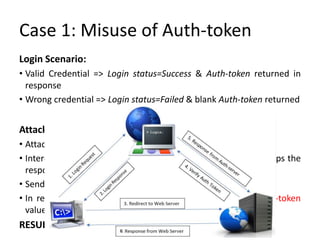
Case 1: Misuse of Auth-token
Login Scenario:
• Valid Credential => Login status=Success & Auth-token returned in
response
• Wrong credential => Login status=Failed & blank Auth-token returned
Attack Scenario:
• Attacker (user) submits valid credential.
• Intercepts the 1st Login response, copies the Auth-token & drops the
response.
• Sends login request with Target UserID+wrong Password.
• In response, sets Login status=Success & Adds his own Auth-token
value.
RESULT: Attacker gets access to Victim’s account!
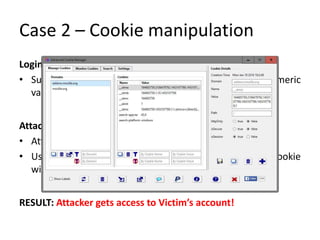
Case 2 – Cookie manipulation
Login Scenario: User-ID in session Cookie
• Successful login => App sets session cookie->user-ID (numeric
value)
Attack Scenario:
• Attacker (user) logs in to application.
• Using any cookie editor, replaces the user-ID value in cookie
with that of a victim & refreshes the page.
RESULT: Attacker gets access to Victim’s account!
Case 3 - Session Invalidation
Login Scenario:
• Multi-login allowed & Session not expired after Password
reset (>3 months).
Attack Scenario:
• Suppose a user identifies that the account is compromised
& changes the password
• The active session still remains active and there was no way
to invalidate the attacker’s session
RESULT: Once Compromised, attacker gets lifetime access of
Victim’s account.
Case 4 – Account takeover by Forgot
Password functionality
Password Reset Scenario:
• Forgot password page gives option to select recovery option
(OTP/email).
• Part of the options are masked with asterisk(*).
Attack Scenario:
• Attacker provides victim’s user ID in forgot password page.
• Selects any recovery option & using proxy tool can see and
modify the OTP/email option value in request
RESULT: Attacker receives recovery OTP/email and
compromises the victim account
Case 5 – Authentication bypass in
Mobile App
Login Scenario:
• On successful login, user session was stored in local
/AppData/ folder (sqlite db).
Attack Scenario:
• After analyzing the sqlite db, it was observed that the stored
session is nothing but triple encoding of the username in the
format [{username}]
• Attacker encodes the victim’s username thrice and pushes in
the device’s AppData folder.
• Opens the App in device.
RESULT: Attacker gets logged in to victim’s account
Case 6 – Bypass OTP & Transfer Money
from Mobile Wallet
WebService Calls:
• 1st call: UserID+Registered_Mobile_No => OTP sent to registered mobile number
• 2nd call: Recipient+Amount+OTP => Transfer money
• UserID+wrong_Mobile_No => Proper Error message
• Recipient+Amount+wrong_OTP => Transaction unsuccessful with proper Error
message
Attack Scenario:
• UserID+wrong_Mobile_No with symbol ~ => error message reveals
Registered_Mobil_No
• Initiate valid call to generate OTP (OTP sent to Victim’s mobile so attacker doesn’t
have the OTP)
• Recipient+Amount+wrong_OTP with symbol ~ error message reveals actual OTP
• Recipient+Amount+retrieved OTP => Transaction Successful
RESULT: Forcing Step-by-step error, Attacker debits money from victim’s bank
account
Case 7 – Extracting credentials by SQLi
Observation:
• All input form-fields seemed secure from SQLi.
• After login, the application shows Last Login Time.
• Found out that the time stamp was fetched from client system & sent with login
request.
Attack Scenario:
• After multiple trials, successfully executed a union based SQL injection payload in
the timestamp parameter.
RESULT: Attacker fetched credentials of all the users from the database.
Case Studies
Broken Authorization and Privilege Escalation
Case 1 - Boolean based privileges
Application Design:
• Application has only two privileges – Admin & normal user.
• Keeps track of privilege by Boolean parameter
[isAdmin/Admin/SuperManager]=[true/false].
• Admins have additional content which are unavailable for normal
user.
Attack Scenario:
• Attacker who is a Normal low privilege user logs in with valid
credential
• In response body makes the Boolean value as true
RESULT: Normal user gets admin privilege.
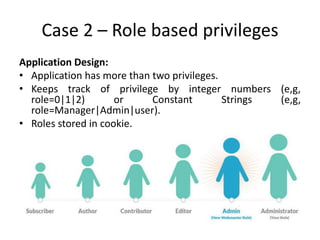
Case 2 – Role based privileges
Application Design:
• Application has more than two privileges.
• Keeps track of privilege by integer numbers (e,g,
role=0|1|2) or Constant Strings (e,g,
role=Manager|Admin|user).
• Roles stored in cookie.
Attack Scenario:
• Attacker logs in as low privilege user.
• Edits the cookie and changes the role value
RESULT: Attacker escalates the privilege.
Case 2.1 - Design Flaw – Low priv user
updates his role
Application Design:
• The PeopleManager (role=1) can create/edit other users
with view-only role (role=2). Only super admins (role=0) can
change the role of other users or delete users.
PeopleManager also cannot edit his own account.
Attack Scenario:
• While creating a new user, PeopleManager can use proxy
tool and create new users with admin priv by changing role
parameter to 0.
• While editing other user’s details, PeopleManager replaces
the userID with his own, adds “role” parameter to the
request and sets the value to 0
RESULT: Low Privilege user updates his role to Super-Admin
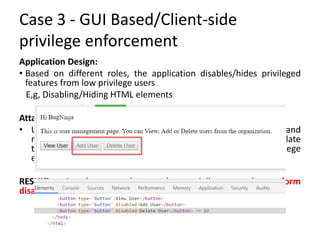
Case 3 - GUI Based/Client-side
privilege enforcement
Application Design:
• Based on different roles, the application disables/hides privileged
features from low privilege users
E,g, Disabling/Hiding HTML elements
Attack Scenario:
• Using browser dev tool (F12), attacker can inspect the elements and
remove the rules enforced on the basis of roles. Thus can escalate
the privilege and bypass the GUI Based/Client-side privilege
enforcement
RESULT: Attacker escalates the privilege and perform
disabled/hidden operations.
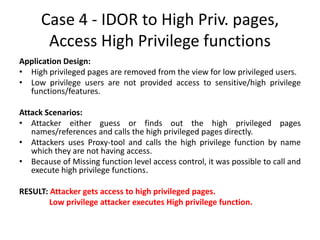
Case 4 - IDOR to High Priv. pages,
Access High Privilege functions
Application Design:
• High privileged pages are removed from the view for low privileged users.
• Low privilege users are not provided access to sensitive/high privilege
functions/features.
Attack Scenarios:
• Attacker either guess or finds out the high privileged pages
names/references and calls the high privileged pages directly.
• Attackers uses Proxy-tool and calls the high privilege function by name
which they are not having access.
• Because of Missing function level access control, it was possible to call and
execute high privilege functions.
RESULT: Attacker gets access to high privileged pages.
Low privilege attacker executes High privilege function.
Case 5 - Design Flaw - user sends
SPAM mail to anyone
Application Design:
• Normal Users can send mails only to the Team members
who are available in drop down recipient list.
• Only Admins can send mails to members of different team
Attack Scenario:
• Using proxy tool, normal user can modify the recipient
address to any non team member’s address, also he can
change the sender email ID
RESULT: Attacker sends mail to any non-team member
person on behalf of someone else (SPAMMING)
Case 6 – Deleting project by IDOR
Application Design:
• A normal user who is not owner can only view a project. There is no delete
option for the normal user
• A user can be Normal user for one project but Admin for other projects.
Attack Scenario:
• Normal user views the Project and copies the Project ID from URL
• Normal user himself creates a Project for which he/she becomes owner
• Now for this new project delete option is available
• Clicks delete and using any proxy tool replaces the ProjectID with that of
previous project
RESULT: Normal user deleted a Project for which he/she is not owner but a
normal member
Responsible Disclosure: https://hackerone.com/reports/85401
Case 7 – Injecting HTML code snippet
Application Design:
• Low privilege normal user doesn’t have permission to
add new team members
Attack Scenario:
• By adding the following HTML code snippet, a normal
user was able to add new team members
<a class="button-link u-gutter js-manage-members" href="#"><span class="icon-sm
icon-member"></span> Add Members</a>
RESULT: Low Privilege normal user added New team
members which he did not have privilege to do
Responsible Disclosure: https://hackerone.com/reports/92050
Remediation
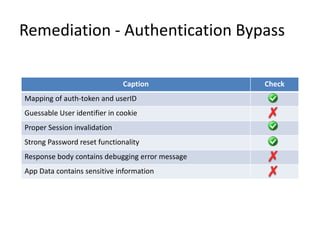
Remediation - Authentication Bypass
Caption Check
Mapping of auth-token and userID
Guessable User identifier in cookie
Proper Session invalidation
Strong Password reset functionality
Response body contains debugging error message
App Data contains sensitive information
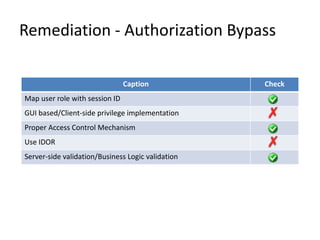
Remediation - Authorization Bypass
Caption Check
Map user role with session ID
GUI based/Client-side privilege implementation
Proper Access Control Mechanism
Use IDOR
Server-side validation/Business Logic validation
Questions/Suggestions:
sarwarjahanm@outlook.com
Slides: https://github.com/sarwarjahanm/AuthN_and_AuthZ_Bypass
Broken Authentication & authorization

Broken Authentication & authorization

  • 1.
    Broken Authentication &Authorization - Sarwar Jahan M. Disclaimer: All the views/data presented are my own and do not reflect the opinion of my current/past employer.
  • 2.
    Who am I SarwarJahan M. AppSec Engineer at • Secure Code Review|Web and Mobile App Security|Threat Modelling • Synack & Bugcrowd leaderboard: Top 10 researchers (2016) • Spoken at: n|uCon ’17 sarwarjahanm@outlook.com +91 77 9597 8228 https://in.linkedin.com/in/sarwarjahanm @sarwarjahanm
  • 3.
    Outline • Authentication? • Authorization? •Case Studies – Authentication Bypass • Case Studies – Broken Authorization and Privilege Escalation • Remediation • Q/A
  • 4.
  • 6.
  • 8.
  • 9.
    Case 1: Misuseof Auth-token Login Scenario: • Valid Credential => Login status=Success & Auth-token returned in response • Wrong credential => Login status=Failed & blank Auth-token returned Attack Scenario: • Attacker (user) submits valid credential. • Intercepts the 1st Login response, copies the Auth-token & drops the response. • Sends login request with Target UserID+wrong Password. • In response, sets Login status=Success & Adds his own Auth-token value. RESULT: Attacker gets access to Victim’s account!
  • 10.
    Case 2 –Cookie manipulation Login Scenario: User-ID in session Cookie • Successful login => App sets session cookie->user-ID (numeric value) Attack Scenario: • Attacker (user) logs in to application. • Using any cookie editor, replaces the user-ID value in cookie with that of a victim & refreshes the page. RESULT: Attacker gets access to Victim’s account!
  • 11.
    Case 3 -Session Invalidation Login Scenario: • Multi-login allowed & Session not expired after Password reset (>3 months). Attack Scenario: • Suppose a user identifies that the account is compromised & changes the password • The active session still remains active and there was no way to invalidate the attacker’s session RESULT: Once Compromised, attacker gets lifetime access of Victim’s account.
  • 12.
    Case 4 –Account takeover by Forgot Password functionality Password Reset Scenario: • Forgot password page gives option to select recovery option (OTP/email). • Part of the options are masked with asterisk(*). Attack Scenario: • Attacker provides victim’s user ID in forgot password page. • Selects any recovery option & using proxy tool can see and modify the OTP/email option value in request RESULT: Attacker receives recovery OTP/email and compromises the victim account
  • 13.
    Case 5 –Authentication bypass in Mobile App Login Scenario: • On successful login, user session was stored in local /AppData/ folder (sqlite db). Attack Scenario: • After analyzing the sqlite db, it was observed that the stored session is nothing but triple encoding of the username in the format [{username}] • Attacker encodes the victim’s username thrice and pushes in the device’s AppData folder. • Opens the App in device. RESULT: Attacker gets logged in to victim’s account
  • 14.
    Case 6 –Bypass OTP & Transfer Money from Mobile Wallet WebService Calls: • 1st call: UserID+Registered_Mobile_No => OTP sent to registered mobile number • 2nd call: Recipient+Amount+OTP => Transfer money • UserID+wrong_Mobile_No => Proper Error message • Recipient+Amount+wrong_OTP => Transaction unsuccessful with proper Error message Attack Scenario: • UserID+wrong_Mobile_No with symbol ~ => error message reveals Registered_Mobil_No • Initiate valid call to generate OTP (OTP sent to Victim’s mobile so attacker doesn’t have the OTP) • Recipient+Amount+wrong_OTP with symbol ~ error message reveals actual OTP • Recipient+Amount+retrieved OTP => Transaction Successful RESULT: Forcing Step-by-step error, Attacker debits money from victim’s bank account
  • 15.
    Case 7 –Extracting credentials by SQLi Observation: • All input form-fields seemed secure from SQLi. • After login, the application shows Last Login Time. • Found out that the time stamp was fetched from client system & sent with login request. Attack Scenario: • After multiple trials, successfully executed a union based SQL injection payload in the timestamp parameter. RESULT: Attacker fetched credentials of all the users from the database.
  • 16.
    Case Studies Broken Authorizationand Privilege Escalation
  • 17.
    Case 1 -Boolean based privileges Application Design: • Application has only two privileges – Admin & normal user. • Keeps track of privilege by Boolean parameter [isAdmin/Admin/SuperManager]=[true/false]. • Admins have additional content which are unavailable for normal user. Attack Scenario: • Attacker who is a Normal low privilege user logs in with valid credential • In response body makes the Boolean value as true RESULT: Normal user gets admin privilege.
  • 18.
    Case 2 –Role based privileges Application Design: • Application has more than two privileges. • Keeps track of privilege by integer numbers (e,g, role=0|1|2) or Constant Strings (e,g, role=Manager|Admin|user). • Roles stored in cookie. Attack Scenario: • Attacker logs in as low privilege user. • Edits the cookie and changes the role value RESULT: Attacker escalates the privilege.
  • 19.
    Case 2.1 -Design Flaw – Low priv user updates his role Application Design: • The PeopleManager (role=1) can create/edit other users with view-only role (role=2). Only super admins (role=0) can change the role of other users or delete users. PeopleManager also cannot edit his own account. Attack Scenario: • While creating a new user, PeopleManager can use proxy tool and create new users with admin priv by changing role parameter to 0. • While editing other user’s details, PeopleManager replaces the userID with his own, adds “role” parameter to the request and sets the value to 0 RESULT: Low Privilege user updates his role to Super-Admin
  • 20.
    Case 3 -GUI Based/Client-side privilege enforcement Application Design: • Based on different roles, the application disables/hides privileged features from low privilege users E,g, Disabling/Hiding HTML elements Attack Scenario: • Using browser dev tool (F12), attacker can inspect the elements and remove the rules enforced on the basis of roles. Thus can escalate the privilege and bypass the GUI Based/Client-side privilege enforcement RESULT: Attacker escalates the privilege and perform disabled/hidden operations.
  • 21.
    Case 4 -IDOR to High Priv. pages, Access High Privilege functions Application Design: • High privileged pages are removed from the view for low privileged users. • Low privilege users are not provided access to sensitive/high privilege functions/features. Attack Scenarios: • Attacker either guess or finds out the high privileged pages names/references and calls the high privileged pages directly. • Attackers uses Proxy-tool and calls the high privilege function by name which they are not having access. • Because of Missing function level access control, it was possible to call and execute high privilege functions. RESULT: Attacker gets access to high privileged pages. Low privilege attacker executes High privilege function.
  • 22.
    Case 5 -Design Flaw - user sends SPAM mail to anyone Application Design: • Normal Users can send mails only to the Team members who are available in drop down recipient list. • Only Admins can send mails to members of different team Attack Scenario: • Using proxy tool, normal user can modify the recipient address to any non team member’s address, also he can change the sender email ID RESULT: Attacker sends mail to any non-team member person on behalf of someone else (SPAMMING)
  • 23.
    Case 6 –Deleting project by IDOR Application Design: • A normal user who is not owner can only view a project. There is no delete option for the normal user • A user can be Normal user for one project but Admin for other projects. Attack Scenario: • Normal user views the Project and copies the Project ID from URL • Normal user himself creates a Project for which he/she becomes owner • Now for this new project delete option is available • Clicks delete and using any proxy tool replaces the ProjectID with that of previous project RESULT: Normal user deleted a Project for which he/she is not owner but a normal member Responsible Disclosure: https://hackerone.com/reports/85401
  • 24.
    Case 7 –Injecting HTML code snippet Application Design: • Low privilege normal user doesn’t have permission to add new team members Attack Scenario: • By adding the following HTML code snippet, a normal user was able to add new team members <a class="button-link u-gutter js-manage-members" href="#"><span class="icon-sm icon-member"></span> Add Members</a> RESULT: Low Privilege normal user added New team members which he did not have privilege to do Responsible Disclosure: https://hackerone.com/reports/92050
  • 25.
  • 26.
    Remediation - AuthenticationBypass Caption Check Mapping of auth-token and userID Guessable User identifier in cookie Proper Session invalidation Strong Password reset functionality Response body contains debugging error message App Data contains sensitive information
  • 27.
    Remediation - AuthorizationBypass Caption Check Map user role with session ID GUI based/Client-side privilege implementation Proper Access Control Mechanism Use IDOR Server-side validation/Business Logic validation
  • 28.