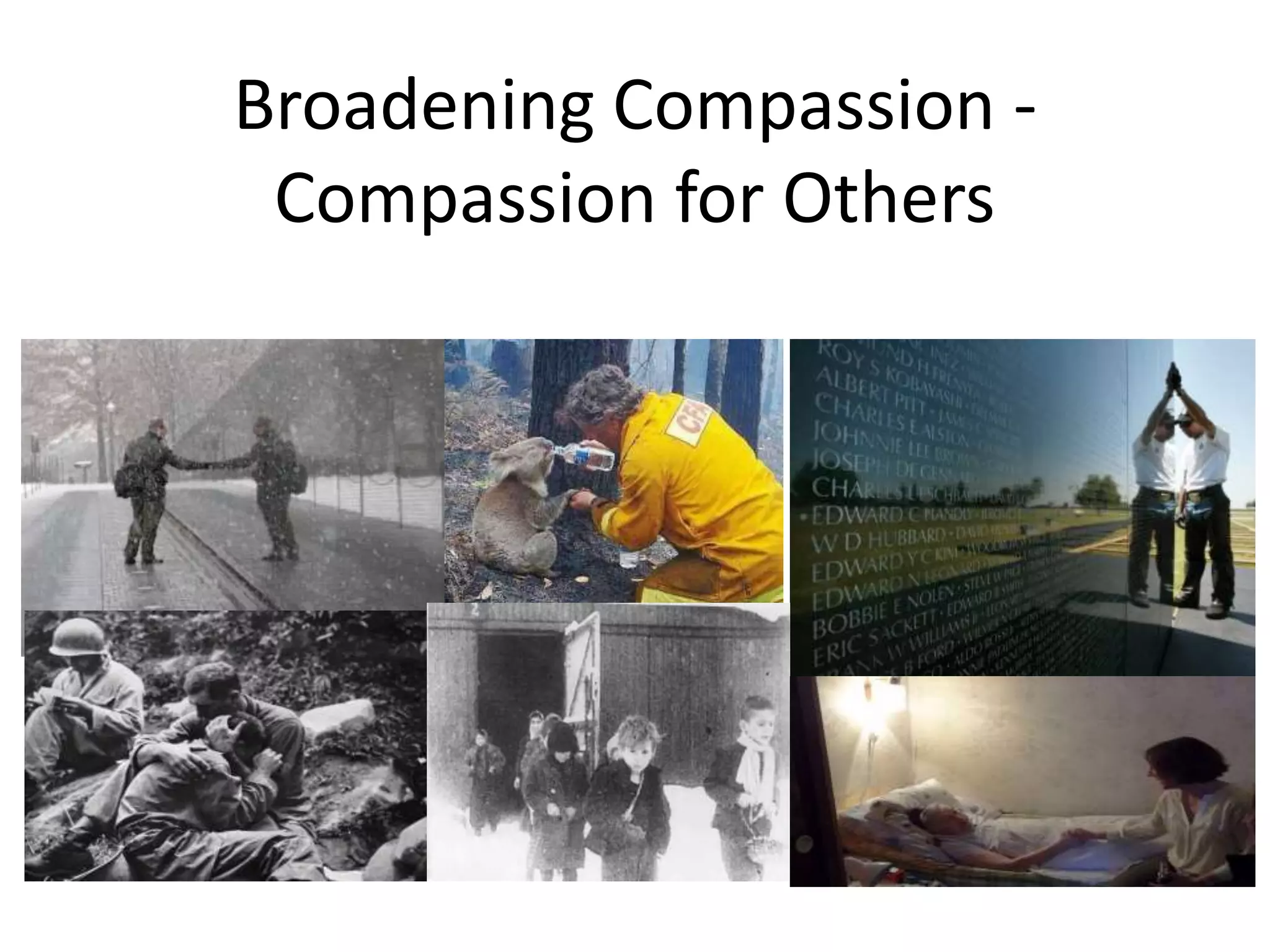
Broadening Compassion -
Compassion for Others
So, Basic Philosophy is That: We all just find ourselves here with
A brain, emotions and sense of (socially made) self we did not
choose but have to figure out . Life involves dealing with
tragedies (threats, losses, diseases, decay, death) And people do
the Best They Can. Much of what goes on in our minds is not of
‘our design’ and not our fault. We are all in the same boat
(shared humanity) De-pathologising and de-labelling –
understanding unique coping processes and how evolution has
led to us having “tricky brains”
It’s not your fault,
but it is your responsibility!
Compassion Focused Therapy
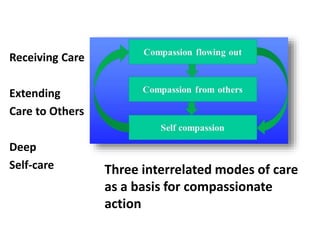
Three interrelated modes of care
as a basis for compassionate
action
Receiving Care
Extending
Care to Others
Deep
Self-care
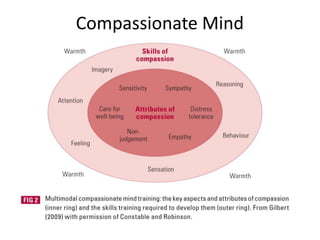
Compassionate Mind
.
Cultivating a Compassion Mind
According to Gilbert, the capacity for
compassion is rooted in and
developed by the attachment
system.
“Attachment system works
like a book closes like a book from
abuse & neglect. Compassion can
open the book where it left off
resulting in fear & experience of
trauma, reactivates emotional
memories.” (Gilbert 2011)
Furthermore the attachment system
is linked to our affiliative systems,
our need for connection and
belonging
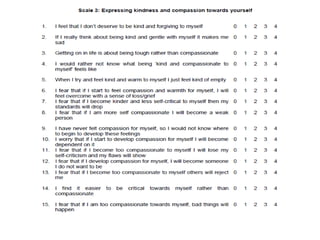
Fear of Compassion
“It is not just the absence of compassion that is
important but also the fear of compassion.
.
This means that people may actively resist
engaging in compassionate experiences or
behaviors.
.
This active resistance to compassion may be
generated by various fears, that would need
to be addressed within the therapeutic
context.” --Gilbert et al. 2011
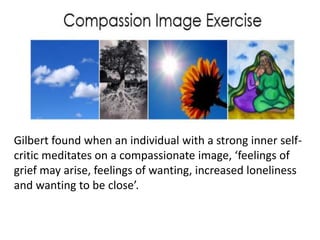
Gilbert found when an individual with a strong inner self-
critic meditates on a compassionate image, ‘feelings of
grief may arise, feelings of wanting, increased loneliness
and wanting to be close’.
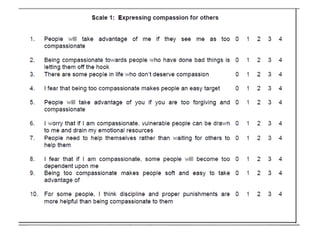
• What are our underlying fears of compassion
for others? Use compassion scale to identify
one or two statements that resonate with you.
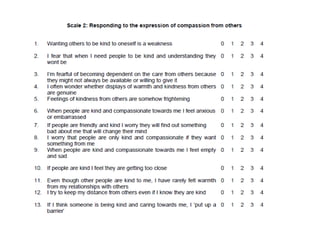
• What are your personal barriers to
broadening compassion, extending
compassion to others?
Broadening Compassion - Compassion for Others

Broadening Compassion - Compassion for Others

  • 1.
  • 3.
    So, Basic Philosophyis That: We all just find ourselves here with A brain, emotions and sense of (socially made) self we did not choose but have to figure out . Life involves dealing with tragedies (threats, losses, diseases, decay, death) And people do the Best They Can. Much of what goes on in our minds is not of ‘our design’ and not our fault. We are all in the same boat (shared humanity) De-pathologising and de-labelling – understanding unique coping processes and how evolution has led to us having “tricky brains” It’s not your fault, but it is your responsibility! Compassion Focused Therapy
  • 4.
    Three interrelated modesof care as a basis for compassionate action Receiving Care Extending Care to Others Deep Self-care
  • 5.
  • 6.
    . Cultivating a CompassionMind According to Gilbert, the capacity for compassion is rooted in and developed by the attachment system. “Attachment system works like a book closes like a book from abuse & neglect. Compassion can open the book where it left off resulting in fear & experience of trauma, reactivates emotional memories.” (Gilbert 2011) Furthermore the attachment system is linked to our affiliative systems, our need for connection and belonging
  • 7.
    Fear of Compassion “Itis not just the absence of compassion that is important but also the fear of compassion. . This means that people may actively resist engaging in compassionate experiences or behaviors. . This active resistance to compassion may be generated by various fears, that would need to be addressed within the therapeutic context.” --Gilbert et al. 2011
  • 8.
    Gilbert found whenan individual with a strong inner self- critic meditates on a compassionate image, ‘feelings of grief may arise, feelings of wanting, increased loneliness and wanting to be close’.
  • 9.
    • What areour underlying fears of compassion for others? Use compassion scale to identify one or two statements that resonate with you. • What are your personal barriers to broadening compassion, extending compassion to others?

Editor's Notes

  • #9 Gilbert found when an individual with a strong inner self-critic meditates on a compassionate image, ‘feelings of grief may arise, feelings of wanting, increased loneliness and wanting to be close’.