Ye s t e r d a y , To d a y & To m o r r o w
T h e S t o r y o f B r i s t o l R i s i n g
B r i s t o l , C o n n e c t i c u t
A p r i l 2 5 , 2 0 1 1
i B R I S T O L R I S I N G Preliminary submission
Renaissance Downtowns would like to thank the following organizations
for their ongoing participation and support throughout the last year:
•	 City of Bristol
•	 Bristol Downtown Development Corporation
•	 Bristol Rising Community
•	 Resident Committees
•	 Property Owners
•	 Business Owners
•	 Community Stakeholders
•	 Consulting Team
Downtown Concept Plan Submission
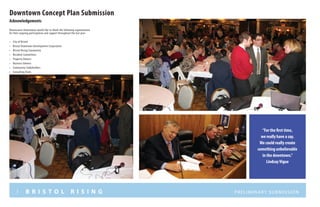
“For the first time,
we really have a say.
We could really create
something unbelievable
in the downtown.”
LindsayVigue
Acknowledgements
ii
Our Commitment To Bristol
Sincerely yours,
Donald Monti
President & CEO
Renaissance Downtowns
Ryan Porter
Vice President
For Planning & Development
Renaissance Downtowns
“When we first embarked upon this quest to work with you to create a
vibrant downtown in Bristol, we were greeted warmly. Our goal was to
involve each and every citizen in the process from day one. Since that
time, your community has made us feel like we are not only your guests,
but neighbors… and our goal is to be good neighbors and to be
contributors to an even better and brighter future for all Bristol residents”
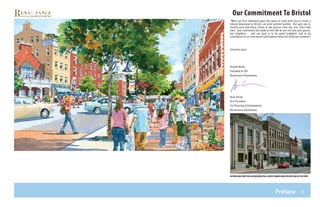
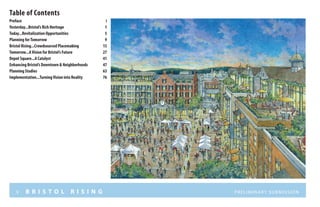
HistoricMainStreetwillbecomemorevital,asDepotSquarecompletesbothsidesofthestreet
Preface
iii B R I S T O L R I S I N G Preliminary submission
Our Vision
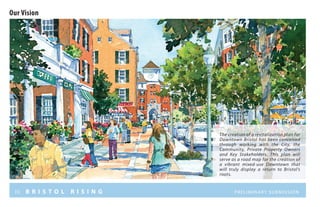
The creation of a revitalization plan for
Downtown Bristol has been conceived
through working with the City, the
Community, Private Property Owners
and Key Stakeholders. This plan will
serve as a road map for the creation of
a vibrant mixed-use Downtown that
will truly display a return to Bristol’s
roots.
iv
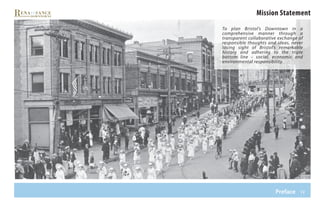
Mission Statement
To plan Bristol’s Downtown in a
comprehensive manner through a
transparent collaborative exchange of
responsible thoughts and ideas, never
losing sight of Bristol’s remarkable
history and adhering to the triple
bottom line – social, economic and
environmental responsibility.
Preface
v B R I S T O L R I S I N G Preliminary submission
Table of Contents
Preface		 i
Yesterday...Bristol’s Rich Heritage	 1
Today...Revitalization Opportunities	 5
Planning forTomorrow	 9
Bristol Rising...Crowdsourced Placemaking	 15
Tomorrow...AVision for Bristol’s Future	 27
Depot Square...A Catalyst	 41
Enhancing Bristol’s Downtown & Neighborhoods	 47
Planning Studies	 63
Implementation...TurningVision into Reality	 76
vi
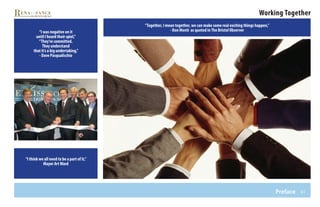
“I think we all need to be a part of it,”
Mayor ArtWard
“Together, I mean together, we can make some real exciting things happen,”
- Don Monti as quoted inThe Bristol Observer“I was negative on it
until I heard their spiel,”
“They’re committed.
They understand
that it’s a big undertaking,”
- Dave Pasqualicchio
Preface
Working Together
1 B R I S T O L R I S I N G Preliminary submission
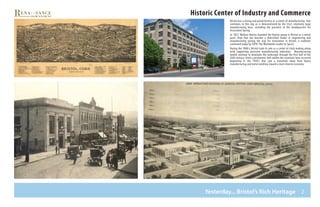
Bristol’s Proud History
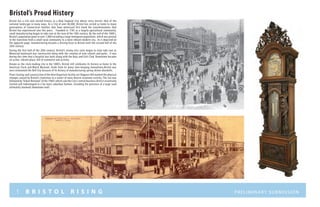
Bristol has a rich and storied history as a New England City whose story mirrors that of the
national landscape in many ways. As a City of over 60,000, Bristol has served as home to many
generations of Connecticut families that have witnessed first hand the transformations that
Bristol has experienced over the years. Founded in 1785 as a largely agricultural community,
small manufacturing began to take root at the turn of the 18th century. By the end of the 1800’s,
Bristol’s population grew to over 7,000 including a large immigrant population, which was pivotal
in the transition from a small rural community to a more vibrant modern city. As is depicted on
the opposite page, manufacturing became a driving force in Bristol until the second half of the
20th century.
During the first half of the 20th century. Bristol’s strong civic roots began to truly take root as
Memorial boulevard was constructed along with the creation of new schools and parks. It was
during this time that a hospital was built along with the Boys and Girls Club. Downtown became
an active, vibrant place, full of commerce and activity.
Known as the clock-making city in the 1800’s, Bristol still celebrates its history as home to the
American Clock and Watch Museum. Aside from its many time keeping innovations,Bristol was
once nicknamed the Bell City because of its history of manufacturing spring-driven doorbells.
Plant closings and construction of the New Departure facility on Chippens Hill marked the physical
changes caused by Bristol’s transition to a center of more diverse economic activity. This era was
followed by“Urban Renewal”of the 1960’s which saw the City’s central business district essentially
leveled and redeveloped in a far more suburban fashion, including the presence of a large (and
ultimately doomed) downtown mall.
2Yesterday... Bristol’s Rich Heritage
Bristol has a strong and proud history as a center of manufacturing that
continues to this day as is demonstrated by the City’s relatively large
manufacturing base, including the presence of the headquarters for
Associated Spring.
In 1857, Wallace Barnes founded the Barnes group in Bristol as a metal
parts shop that has become a diversified leader in engineering and
manufacturing paving the way for innovation in Bristol, a tradition
continued today by ESPN: The Worldwide Leader In Sports.
During the 1800’s, Bristol took its role as a center of clock making along
with supporting precision manufacturing industries. Manufacturing
would continue to dominate the landscape through the first half of the
20th century. Until a permanent shift within the economic base occurred
beginning in the 1950’s that saw a transition away from heavy
manufacturing and metal working toward a more diverse economy.
Historic Center of Industry and Commerce
3 B R I S T O L R I S I N G Preliminary submission
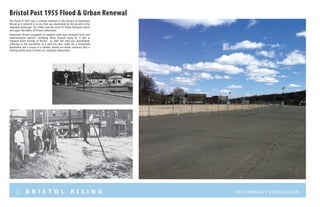
Bristol Post 1955 Flood & Urban Renewal
The flood of 1955 was a seminal moment in the history of downtown
Bristol as it ushered in an era that was dominated by the growth of the
suburban landscape. The 1960’s saw the onset of “Urban Renewal” which
tore apart the fabric of historic downtown.
Downtown Bristol struggled to compete with auto oriented retail and
entertainment options, including those located along Rt. 6 and at
regional malls outside of Bristol. In 2005 the mall was demolished,
ushering in the possibility of a new era that could see a revitalized
downtown and a return to a vibrant, mixed-use urban construct that is
lacking within most of America’s suburban downtowns.
4
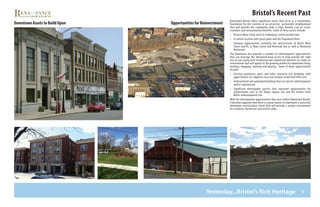
Bristol’s Recent Past
Yesterday...Bristol’s Rich Heritage
Downtown Bristol offers significant assets that serve as a tremendous
foundation for the creation of an attractive, sustainable neighborhood
that will provide the community with a Triple Bottom Line of social,
economic and environmental benefits. Some of these assets include:
•	 Historic Main Street with its traditional, native architecture
•	 A central location with great parks and the Pequabuck River
•	 Gateway opportunities including the intersections of North Main
Street and Rt. 6, Main Street and Riverside Ave as well as Memorial
Boulevard.
The Downtown also provides a number of redevelopment opportunities
that can leverage the aforementioned assets to help provide the right
mix of uses along with residential and commercial densities to create an
environment that will appeal to the growing market for downtown living,
working, shopping, learning and playing. Some of these opportunities
include:
•	 Existing warehouse space and other character-rich buildings with
opportunities for adaptive reuse and unique residential/office use
•	 Underutilized and outmoded buildings that are ripe for redevelopment
and/or repurposing
•	 Significant developable parcels that represent opportunities for
reinvestment such as the Depot Square site and the former Chick
Miller redevelopment site.
With the development opportunities that exist within Downtown Bristol,
it becomes apparent that there is a great chance to implement a successful
downtown revitalization vision that will provide a unique environment
for residents, businesses and visitors alike.
Opportunities for ReinvestmentDowntown Assets to Build Upon
5 B R I S T O L R I S I N G Preliminary submission
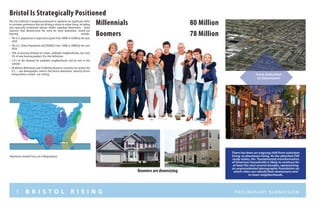
Millennials							80 Million
Boomers								78 Million
Bristol Is Strategically Positioned
There has been an ongoing shift from suburban
living, to downtown living. As the attached ZVA
study states, the “fundamental transformation
of American households is likely to continue for
at least the next several decades, representing
an unprecedented demographic foundation on
which cities can rebuild their downtowns and
in-town neighborhoods.
From Suburban
to Downtown
Population Growth Focus on 6 Megaregions
Boomers are downsizing
The City of Bristol is uniquely positioned to capitalize on significant shifts
in consumer preference that are driving a return to urban living, including
and especially residential options within suburban downtowns. Some
statistics that demonstrate the need for more downtown, mixed-use
housing include:
•	 The U.S. population is expected to grow from 300M to 420M by the year
2050
•	 The U.S. Urban Population will DOUBLE from 150M to 300M by the year
2050
•	 30% of housing demand for urban, walkable neighborhoods, but only
2% of new housing product fits that definition
•	 2/3’s of the demand for walkable neighborhoods will be met in the
suburbs
•	 80 Million Millennials and 78 Million Boomers currently live within the
U.S. – two demographic cohorts that desire downtown, amenity driven
living within a mixed -use setting.
6
The Need For Comprehensive Planning
Today... Revitalization Opportunity
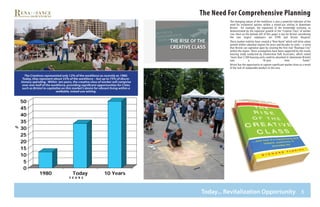
The Creatives represented only 12% of the workforce as recently as 1980.
Today, they represent about 33% of the workforce – but up to 75% of discre-
tionary spending. Within ten years, the creative class of worker will comprise
over one-half of the workforce, providing significant opportunities for Cities
such as Bristol to capitalize on this market’s desire for vibrant living within a
walkable, mixed-use setting.
0
5
10
15
20
25
30
35
40
45
50
1980 Today 10 Years
The changing nature of the workforce is also a powerful indicator of the
need for residential options within a mixed-use setting in downtown
Bristol. For example, the expansion of the knowledge economy, as
demonstrated by the explosive growth of the “Creative Class” of worker
(see chart on the bottom left of this page) is key for Bristol considering
the two largest employers are ESPN and Bristol Hospital.
These market realities have created a “New Norm” which will drive urban
growth within suburban regions for years and decades to come – a trend
that Bristol can capitalize upon by creating the first true “Boutique City”
within the region. These assumptions have been supported by the recent
housing study conducted by Zimmerman Volk Associates, which stated
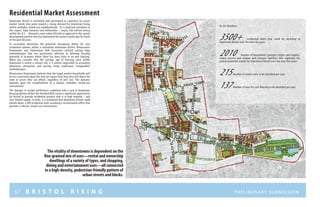
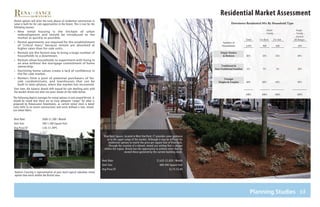
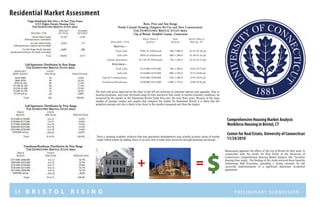
“more than 3,500 housing units could be absorbed in (downtown Bristol)
over a 10-year time frame.”
Bristol has the opportunity to capture significant market share as a result
of the lack of comparable product in the area.
%
Y E A R S
7 B R I S T O L R I S I N G Preliminary submission
New Urbanism
W h e r e wo u l d y o u r a t h e r b e ?
•	 A mix of uses that include a significant residential population, office and commercial uses, retail,
entertainment, cultural, restaurant, and hospitality
•	 Inclusion of significant public space, greenways, walking and biking paths and other community amenities
•	 Mixed-income housing to provide residential opportunities to the entire population
•	 Compact Building Design
•	 Emphasis on walkability and non-auto modes of transit
•	 Focused development within urban cores and downtowns as opposed to greenfields
•	 Higher density housing including numerous multi family options
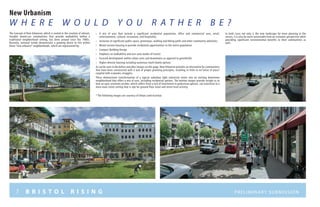
As can be seen in the before and after images on this page, New Urbanism provides an alternative for communities
that have been constructed with a lack of proper planning principles, resulting in little to no“sense of place”
coupled with economic struggles.
These demonstrate transformation of a typical suburban light industrial center into an inviting downtown
neighborhood that offers a mix of uses, including residential options. The bottom images provide insight as to
how an auto-oriented corridor, which suffers from a lack of investment in pedestrian options, can transition to a
more main street setting that is ripe for ground floor retail and street level activity.
* The following images are courtesy of Urban Land Insititue
The Concept of New Urbanism, which is rooted in the creation of vibrant,
liveable mixed-use communities that provide walkability within a
traditional neighborhood setting, has been around since the 1980’s.
Recently, national trends demonstrate a growing desire to live within
these “new urbanist” neighborhoods, which are represented by:
In both cases not only is the new landscape far more pleasing to the
senses, it is also far more sustainable from an economic perspective while
providing significant environmental benefits to their communities as
well.
8
Renaissance Downtowns Development Approach
Suburban Downtowns have a tremendous opportunity for economic
growth in the coming years based upon changing demographics and a
shift in consumer preference that has created significant pent up demand
for urban living within smaller “Boutique Cities” such as Bristol.
However, the nature of Suburban Downtowns creates a setting in which
traditional, one-off “infill” redevelopment simply does not work. The
reasons for the lack of development within suburban downtowns range
from a lack of catalytic investment capital, the absence of a cohesive
vision and the inability for a municipality to implement transformative
change within a downtown.
Renaissance Downtowns believes that the only way to successfully
implement a significant downtown revitalization in a setting such as
Bristol is to take an inclusive, comprehensive and holistic redevelopment
approach. By including both the public and private sectors at the table
along with local property owners and community stakeholders, a
cohesive, market driven vision for downtown can be created and
implemented, resulting in significant economic and social benefits for
the entire community.
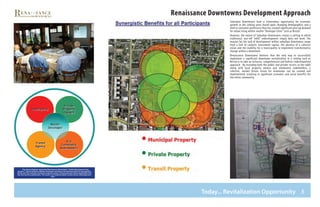
The above diagram represents Renaissance Downtowns “Unified Development Ap-
proach™” which includes a Master Developer working in Partnership with the municipality,
along with the inclusion of private property owners, transit agencies (where applicable) and
key community stakeholders. The result is an implementable, market driven redevelopment
plan.
Transit
Agency
Private
Property
Owners
Municipality
Key
Community
Stakeholders
Master
Developer
Today... Revitalization Opportunity
9 B R I S T O L R I S I N G Preliminary submission
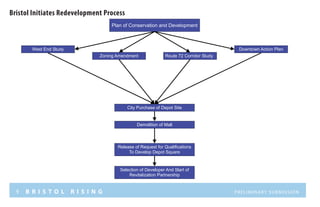
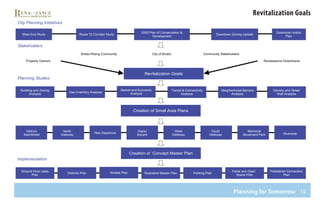
Bristol Initiates Redevelopment Process






 



10
Revitalization Goals
Planning for Tomorrow





















 














  












 
11 B R I S T O L R I S I N G Preliminary submission
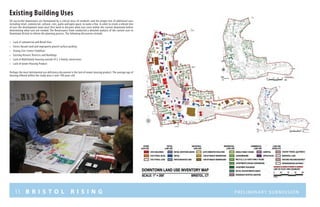
Existing Building Uses
All successful downtowns are formulated by a critical mass of residents and the proper mix of additional uses
including retail, commercial, cultural, civic, parks and open space, to name a few. In order to create a vibrant mix
of uses the development team must first work to discover what uses exist within the current downtown before
determining what uses are needed. The Renaissance Team conducted a detailed analysis of the current uses in
Downtown Bristol to inform the planning process. The following discoveries include:
•	 Lack of commercial and Retail Uses
•	 Excess Vacant land and improperly placed surface parking
•	 Strong Civic Center Stabilizer
•	 Existing Historic Districts and Buildings
•	 Lack of Multifamily Housing outside of 2-3 family conversions
•	 Lack of newer Housing Product
Perhaps the most detrimental use deficiency discovered is the lack of newer housing product. The average age of
housing offered within the study area is over 100 years old.
12
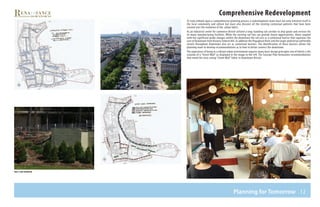
Comprehensive Redevelopment
Planning for Tomorrow
To truly embark upon a comprehensive planning process a redevelopment team must not only entrench itself in
the local community and culture but must also discover all the existing contextual patterns that have been
created over the evolution of the urban fabric.
As an industrial center for commerce Bristol utilized a long-standing rail corridor to ship goods and services for
its many manufacturing facilities. While the existing rail line can provide future opportunities, when coupled
with the significant grade changes within the downtown the rail acts as a contextual barrier that separates the
core of Downtown from Historic Federal Hill. In addition the Pequabuck River and the larger pedestrian unfriendly
streets throughout Downtown also act as contextual barriers. The identification of these barriers allows the
planning team to develop recommendations as to how to better connect the downtown.
The experience of being in a vibrant urban environment requires many basic design principles one of which is the
creation of a “Street Wall” as displayed in the image to the left. The Concept Plan formulates recommendations
that mend the once strong “Street Wall” fabric in Downtown Bristol.
Rail Line Barrier
13 B R I S T O L R I S I N G Preliminary submission
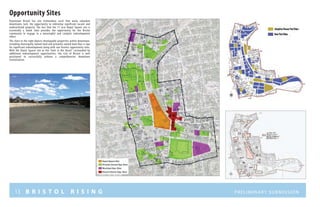
Opportunity Sites
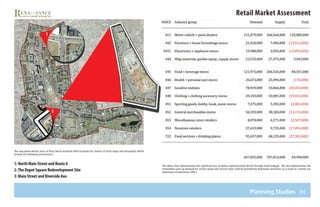
Downtown Bristol has one tremendous asset that many suburban
downtowns lack: the opportunity to redevelop significant vacant and
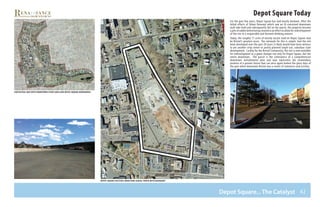
underutilized property. The fact that the 17 acre Depot Square site is
essentially a blank slate provides the opportunity for the Bristol
community to engage in a meaningful and catalytic redevelopment
effort.
The chart to the right depicts developable properties within downtown,
including municipally owned land and privately owned land that is ripe
for significant redevelopment along with rare historic opportunity sites.
With the Depot Square site as the “hole in the donut” surrounded by
additional redevelopment opportunities, the City of Bristol is well
positioned to successfully achieve a comprehensive downtown
revitalization.
14
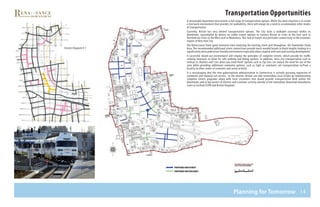
Transportation Opportunities
Planning for Tomorrow
A sustainable downtown necessitates a full range of transportation options. While the ideal situation is to create
a live/work environment that provides for walkability, there will always be a need to accommodate other modes
of transportation.
Currently, Bristol has very limited transportation options. The City lacks a walkable construct within its
downtown, exacerbated by almost no viable transit options to connect Bristol to cities to the East such as
Hartford nor Cities to the West such as Waterbury. This lack of transit also precludes connectivity to the economic
engine of New York City.
The Renaissance Team spent extensive time analyzing the existing street grid throughout the Downtown Study
Area. The recommended additional street connections provide much needed breaks in block lengths leading to a
significantly more pedestrian friendly environment especially when coupled with new and exciting development.
A successful mixed-use environment will employ the principles of complete streets, which provide for traffic
calming measures to allow for safe walking and biking options. In addition, intra-city transportation such as
trolleys or shuttles and “cars when you need them” options such as Zip-Cars can reduce the need for use of the
auto while providing additional commuter options, such as light or commuter rail transportation to/from a
locality to other nodes of economic and social activity.
It is encouraging that the new gubernatorial administration in Connecticut is actively pursuing expansion of
commuter and regional rail service. In the interim, Bristol can take tremendous local strides by implementing
complete streets programs along with local circulators that would provide transportation both within the
downtown, and to key points of interest and economic activity outside of the immediate downtown boundaries
(such as to/from ESPN and Bristol Hospital).
Streets Diagram V-1
15 B R I S T O L R I S I N G Preliminary submission
Crowdsourced Placemaking: A Platform for Positive Change
“Crowdsourcing” or Crowdsourced Placemaking is “the act of taking
development traditionally performed by real estate institutions and
sourcing it to a large, undefined community with shared values... to
transform exciting places into “places for the soul” that uplift and help us
connect to each other.”
Hundreds of Bristol stakeholders have come together to create a shared
vision for revitalizing Downtown Bristol from a place you drive through
into a place you drive to. The Bristol Rising, community is engaged in
sharing their input on the Downtown project at in-person meet-ups and
Bristol Rising’s social media portal, BristolRising.com.
GoBristolSurvey.com, is a separate survey site where registered members
have the ability to propose and vote on ideas for the Downtown. Together,
Bristol Rising members are essentially mixing their own Downtown elixir.
Bristol Rising and Renaissance Downtowns share a Triple Bottom Line
philosophy: socially, economically and environmentally responsible
development. Subscribing to such values will provide significant benefits
to the Bristol community, consistent with the creation of a vibrant,
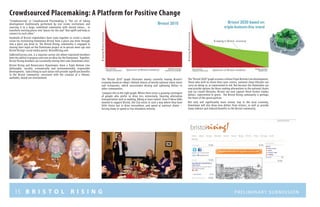
walkable, mixed use environment. The “Bristol 2010” graph illustrates money currently leaving Bristol’s
economy based on today’s limited choices of mostly national chain stores
and restaurants, which necessitates driving and siphoning dollars to
other communities.
Compare this to the right graph. Where there exists a growing contingent
of people who prefer to drive less extensively, favoring alternative
transportation such as walking, biking or mass transit. Even if these folks
wanted to support Bristol, the City exists in such a way where they have
little choice but to drive everywhere, and spend at national chains --
forcing many to spend or live elsewhere entirely.
The“Bristol 2020”graph assumes a futureTriple Bottom Line development.
Those who wish to retain their auto-centric, national chain lifestyle can
carry on doing so, as represented in red. But because the Downtown can
now provide options for those seeking alternatives to the national chains
and car-crazed lifestyles, Bristol can now capture those former exodus
dollars, represented in green. The Bristol Rising community is perhaps
the heart of the green portion.
Not only will significantly more money stay in the local economy,
Downtown will also draw new dollars from visitors, as well as provide
many indirect and induced benefits to the Bristol community.
16
Crowd Favorites
Bristol Rising...Crowdsourced Placemaking
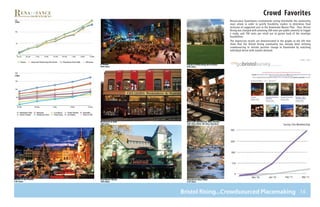
Renaissance Downtowns recommends voting thresholds the community
must attain in order to justify feasibility studies to determine final
inclusion of suggested uses in the Downtown Master Plan. Thus, Bristol
Rising was charged with attaining 200 votes per public amenity to trigger
a study, and 100 votes per retail use to garner back of the envelope
feasibilities.
The impressive results are demonstrated in the graphs to the left that
show that the Bristol Rising community has already been utilizing
crowdsourcing to initiate positive change in Downtown by matching
individual desire with market demand.
Survey Site Membership
Brew pub, Restaurant, Beer Garden
158 Likes (Pub), 56 Likes (Garden)
A Piazza
248 Likes
Visual & Performing Arts Center
236 Likes
Market in the Piazza
149 Likes
Live Music Venue
150 Likes
Bookstore & Cafe
198 Likes
Pequabuck River Walk
215 Likes
Likes
Likes
17 B R I S T O L R I S I N G Preliminary submission
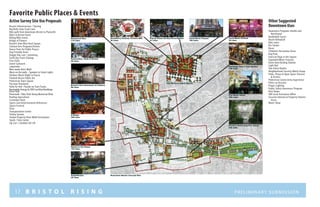
Favorite Public Places & Events
Passenger Rail & Train Station
138 Likes
A Piazza
248 Likes
Visual & Performing Arts Center
236 Likes
Live Music Venue
150 Likes
Small Movie Theater
105 Likes
Amphitheater
29 Likes
Illustrative Master Concept Plan
Bristol’s Own Downtown Art Gallery
80 Likes
Summerfest, Taste of Bristol
69 Likes
Restaurant Row
112 Likes
Strawberry Festival, Farmers Mkt.
34 Likes
Pop-up Piazza All Day Extravaganza
41 Likes
Market in the Piazza
149 Likes
Local Music Festival
32 Likes
The Piazza at Depot Square
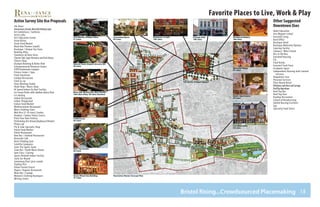
Active Survey Site Use Proposals
Bicycle Infrastructure / Sharing
Big Belly Solar Trash Cans
Bike path from downtown Bristol to Plainville
Bikes in Bristol Event
Biking/Bike rental
Bridge of Flowers
Bristol’s Own Blue Back Square
Cultural Arts Programs/Events
Dance Floor for Public Piazza
Dog Friendly Areas
Doggie Day care / grooming
Earth Day Trash Cleanup
Free Clinic
Green Carousels
Labyrinths
Man-made River Walk
Music on the walk – Speakers in Street Lights
Outdoor Movie Night in Piazza
Painted Horses Public Art
Pedestrian Town Square
Pervious Pavement
Rally for Rail -Parade on Train Tracks
Renewable Energy & LEED Certified Buildings
River Park
Riverwalk / Bike Path Along Memorial Blvd.
Rooftop Agriculture
Scavenger Hunt
Sports and Entertainment References
Sports Festival
Train
Transportation Center
Trolley System
Trudon Property River Walk Destination
Youth / Teen Center
Zip Cars / Gondola Ski Lift
Other Suggested
Downtown Uses
Awareness Programs-Health and
Nutritional
Basketball Courts
Beach Volleyball
Bike Lanes
Bio Swales
Buses
Children’s Recreation Areas
Dog Park
Exercise/Yoga in the Square
Expanded Water Features
Green Auto Docking Stations
Light Rail
Two Police Booths
Neighborhood Security Watch Group
Parks, Plazas & Open Space (Passive
& Active)
Pedestrian Connectivity Experience
Police on Bicycles
Proper Lighting
Public Safety Awareness Program
Rick Shaws
SBA Local Assistance Office
Security Internal to Property Owners
Assoc.
Water Show
18
Favorite Places to Live, Work & Play
Illustrative Master Concept Plan
Roof Top Garden
69 Likes
The Piazza at Depot Square
Live-Work Units
38 Likes
Studio Apartments
50 Likes
Green Mixed Use Building
27 Likes
Coworking Space
60 Likes
Coffeehouse
64 Likes
Flea Market, Antique Show
27 Likes
Natural Foods Organic Grocery Str.
45 Likes
Bookstore & Cafe
198 Likes
Brew pub, Restaurant, Beer Garden
158 Likes (Pub), 56 Likes (Garden)
Specialty Shops
97 Likes
Comedy Club
198 Likes
All Natural Bakery
198 Likes
Other Suggested
Downtown Uses
Adult Education
Arts Magnet School
Assisted Living
Back Office
Boutique Hotel
Boutique Maternity Options
Catering Facility
Culinary / Wine School
Doc in the Box
Enriched Housing
ESL
Food Kiosks
Gourmet Food Store
Incubator Space
Independent Housing with Limited
Services
Outpatient Care
Personal Services
Place Based Retail
RickshawsandHorseandCarriage
RoofTopAgriculture
Roof Top Bar
Roof Top Pool
Rooftop Recreation
School of Broadcasting
Skilled Nursing Facilities
Spa
Specialty Food Stores
Active Survey Site Use Proposals
50s Diner
Amusement,Arcade,MiniGolf,BattingCages
Art Exhibitions / Galleries
Artist Lofts
Arts Education Center
Asian Bistro
Asian Food Market
Black Box Theatre (small)
Boutique / Unique Toy Store
Bowling Alley
Chambres de Bain Units
Charter Oak Lager Brewery and Fish House
Cheese Shop
Duckpin Bowling & Roller Rink
Entrepreneurial Resource Center
ESPN Downtown Campus
Fitness Center / Gym
Fluid Storefront
Fondue Restaurant
Food Co-op
Glass Blowing Studio
Head Shop / Music Shop
Hi Speed Indoor Go Kart Facility
Ice Cream Parlor with Jukebox Dance floor
Ice skating
Indian Restaurant
Indoor Playground
Italian Food Market
Mediterranean Restaurant
Men’s Clothing Store
Mid-Rise (5-10 story) Condos
Outdoor / Indoor Tennis Courts
Paint Your Own Pottery
Performing Arts Venue/playhouse/theatre
Photo Lab
Pie & Cake Specialty Shop
Polish Food Market
Polish Restaurant
Raw Bar / Seafood Restaurant
Riverside Cafe
Rock Climbing Gym
Satellite Campuses
Semi-Pro Sports Team
Soda Bar / Youth Music Venue
Spin Class / Cycling
Sports Related Indoor Facility
Sushi Go-Round
Swimming Pool (year round)
Trading Post
Urban Format Grocer
Vegan / Organic Restaurant
Wine Bar / Lounge
Women’s Clothing Boutiques
Writing Center
Bristol Rising...Crowdsourced Placemaking
19 B R I S T O L R I S I N G Preliminary submission
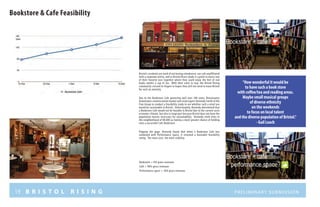
Bookstore & Cafe Feasibility
Bookstore = 0% gross revenues
Café = 90% gross revenues
Performance space = 10% gross revenues
Bristol’s residents are tired of not having a bookstore, nor cafe unaffiliated
with a corporate entity, and so Bristol Risers made it a point to marry two
of their favorite uses together where they could enjoy the feel of real
books amidst a cup of Joe. With their votes in tow, the Bristol Rising
community crossed its fingers in hopes they will not need to leave Bristol
for such an amenity.
Due to the Bookstore Cafe garnering well over 100 votes, Renaissance
Downtowns commissioned market and retail expert Kennedy Smith of the
Clue Group to conduct a feasibility study to see whether such a retail use
would be sustainable in Bristol. Unfortunately, Kennedy determined that
a Bookstore Cafe would not be feasible in Bristol due to the current socio
economic climate, but also in large part because Bristol does not have the
population masses necessary for sustainability. Kennedy cited cities in
the neighborhood of 80,000 as having a much greater chance of holding
onto a successful Cafe Bookstore.
Flipping the page, Kennedy found that when a Bookstore Cafe was
combined with Performance Space, it returned a favorable feasibility
rating. The more uses, the more viability.
“How wonderful it would be
to have such a book store
with coffee/tea and reading areas.
Maybe small musical groups
of diverse ethnicity
on the weekends
to focus on local talent
and the diverse population of Bristol.”
- Gail Leach
Likes
20
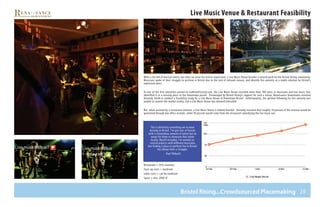
Live Music Venue & Restaurant Feasibility
Door = 5% gross revenues
Restaurant = 95% revenues
Start-up costs = moderate
Labor costs = can be moderate
Space = min. 2000 SF
Bristol Rising...Crowdsourced Placemaking
With a city full of musical talent, but short on areas for artistic expression, a Live Music Venue became a natural push for the Bristol Rising community.
Musicians spoke of their struggle to perform in Bristol due to the lack of relevant venues, and identify this amenity as a viable solution for Bristol’s
expression woes.
As one of the first amenities posted on GoBristolSurvey.com, the Live Music Venue recorded more than 100 votes as musicians and live music fans
identified it as a missing piece to the Downtown puzzle. Encouraged by Bristol Rising’s support for such a venue, Renaissance Downtowns retained
Kennedy Smith to conduct a feasibility study for a Live Music Venue in Downtown Bristol. Unfortunately, the spirited following for this amenity was
unable to counter the market reality, and a Live Music Venue was deemed infeasible.
But, when assisted by a restaurant element, a Live Music Venue is indeed feasible. Kennedy revealed that roughly 10 percent of the revenue would be
generated through box office receipts, while 90 percent would come from the restaurant subsidizing the live music use.
This is definitely something we’ve been
missing in Bristol. I’ve got tons of friends
with a tremendous amount of talent but no
venue for them to showcase that talent
locally. Myself included, I’ve worked on
several projects with different musicians
but finding a place to perform live in Bristol
has always been a struggle.
- Paul Thibault
Likes
21 B R I S T O L R I S I N G Preliminary submission
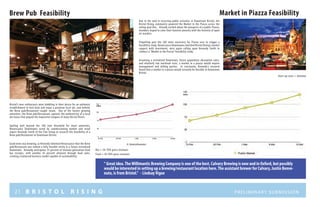
Brew Pub Feasibility
Bar = 50-70% gross revenues
Food = 30-50% gross revenues
Start-up costs = minimal
Market in Piazza Feasibility
Bristol’s beer enthusiasts were bubbling in their desire for an authentic
establishment to kick back and enjoy a premium local ale, and behold,
the Brew pub/Restaurant caught steam. One of the fastest growing
amenities, the Brew pub/Restaurant captures the authenticity of a local
ale house that piqued the inquisitive tongues of many Bristol Risers.
Spilling well beyond the 100 vote threshold for retail amenities,
Renaissance Downtowns acted by commissioning market and retail
expert Kennedy Smith of the Clue Group to research the feasibility of a
Brew pub/Restaurant in Downtown Bristol.
Good news was brewing, as Kennedy informed Renaissance that the Brew
pub/Restaurant was indeed a fully feasible entity in a future revitalized
Downtown. Kennedy anticipates 55 percent of revenue generation from
bar receipts, with another 45 percent attained through food sales,
creating a balanced business model capable of sustainability.
Due to the void in recurring public activities in Downtown Bristol, the
Bristol Rising community powered the Market in the Piazza across the
voting goal line. Already excited about the prospects of a public Piazza,
members hoped to color their favorite amenity with the festivity of open
air markets.
Propelling past the 100 votes necessary for Piazza uses to trigger a
feasibility study, Renaissance Downtowns matched Bristol Rising’s market
support with investment, once again calling upon Kennedy Smith to
conduct a “Market in the Piazza” feasibility study.
Assuming a revitalized Downtown, future population absorption rates,
and relatively low overhead costs, a market in a piazza would require
management and willing parties. In conclusion, Kennedy’s research
found that a market in a piazza would certainly be feasible in Downtown
Bristol.
“ Great idea.TheWillimantic Brewing Company is one of the best. Calvary Brewing is new and in Oxford, but possibly
would be interested in setting up a brewing/restaurant location here.The assistant brewer for Calvary, Justin Benve-
nuto, is from Bristol.” - LindsayVigue
Likes
Likes
22
Boulevard School Feasibility
Bristol Rising...Crowdsourced Placemaking
Pequabuck Riverwalk Feasibility
With historic Memorial Boulevard Middle School about to become vacant and housing a marvelous
theatre, the Bristol Rising community strongly latched onto the venue as their desired destination
for a Visual and Performing Arts Centre. With incorporated performance and arts spaces the hope is
that the building could anchor a future cultural arts district Downtown.
Responding to their vision, Bristol Rising answered the call with a five star performance, delivering
north of 200 votes. Renaissance Downtowns took notice and partnered with Fletcher-Thompson,
the architecture firm originally hired by the City of Bristol to conduct the 2008 Memorial Boulevard
Theatre study. At the time, Fletcher-Thompson was given parameters by the City to create a state of
the art performance theatre, with estimated construction costs in the $14 million range.
Armed with new direction from Bristol Risers eager to use the building in its near-existent form,
Fletcher-Thompson has begun preliminary research identifying some 42,000 square feet as
potentially revenue generating. As studies continue, the firm will investigate ADA compliance
requirements that accompany changing the use of the building from a school to a performance and
arts venue.
Thus far, the indication is that the feasibility challenge to the adaptive re-use is dependent on code
compliance, proper programming, building management, and potential subsidies in utilizing the
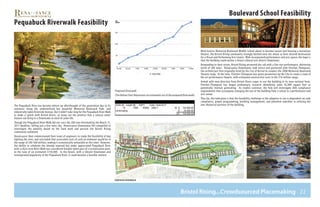
non-theatrical portions of the building.The Pequabuck River has become almost an afterthought of this generation due to its
existence along the underutilized but beautiful Memorial Boulevard Park, and
industrially laden Riverside Avenue. But it didn’t take long for the Pequabuck River Walk
to make a splash with Bristol Risers, as many see the promise that a natural water
feature can bring to a Downtown in need of some life.
Though the Pequabuck River Walk did not cross the 200 vote threshold by the March 15,
2011 deadline, falling just a few votes shy, Renaissance Downtowns felt compelled to
investigate the amenity based on the hard work and passion the Bristol Rising
community exhibited.
Renaissance then commissioned their team of engineers to study the feasibility of day
lighting the river, and concluded that associated costs of such an endeavor would be in
the range of $40-$60 million, making it economically unfeasible at this time. However,
the ability to celebrate the already exposed but under appreciated Pequabuck River
with a short term River Walk was considered feasible when part of a revitalization plan,
to the tune of an estimated $150,000. In the future, with a vibrant Downtown and
reinvigorated popularity of the Pequabuck River, it could become a feasible venture.
Proposed Riverwalk
(The Below Chart Represents an estimated cost of the proposed Riverwalk)
Likes
proposed riverwalk
23 B R I S T O L R I S I N G Preliminary submission
Piazza Feasibility
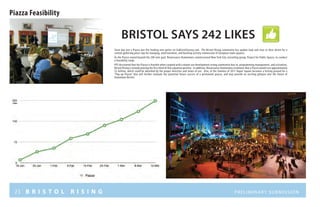
Bristol Says 242 LIKES
Since day one a Piazza was the leading vote getter on GoBristolSurvey.com. The Bristol Rising community has spoken loud and clear in their desire for a
central gathering place ripe for lounging, entertainment, and bustling activity reminiscent of European town squares.
As the Piazza roared beyond the 200 vote goal, Renaissance Downtowns commissioned New York City consulting group, Project for Public Spaces, to conduct
a feasibility study.
PPS discovered that the Piazza is feasible when coupled with a mixed-use development strong community buy-in, programming management, and activation.
Bristol Rising is already proving the first third of that equation positive. In addition, Renaissance Downtowns estimates that a Piazza would cost approximately
$2 million, which could be absorbed by the proper densities and mixes of use. Also, in the Summer of 2011 Depot Square becomes a testing ground for a
“Pop-up Piazza” that will further evaluate the potential future success of a permanent piazza, and may provide an exciting glimpse into the future of
Downtown Bristol.
Likes
24
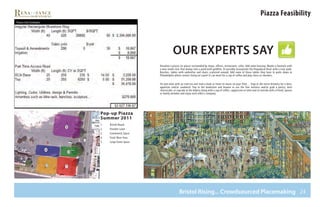
1.	 Bristol Beach
2.	 Flexible Lawn
3.	 Community Space
4.	 Food /Beer Area
5.	 Large Event Space
Piazza Feasibility
Bristol Rising... Crowdsourced Placemaking
Piazza Cost Estimates
Our experts Say
Visualize a piazza (or plaza) surrounded by shops, offices, restaurants, cafes. Add some housing. Maybe a fountain with
a man-made river that dumps into a pond with goldfish. Or possibly incorporate the Pequabuck River with a river walk.
Benches, tables with umbrellas and chairs scattered around. Add some of those tables they have in parks down in
Philadelphia where seniors living on Laurel St can meet for a cup of coffee and play chess or checkers.
Sit and relax with an iced tea and read a book or listen to music on your iPod… Stop at the micro brewery for a beer,
appetizer and/or sandwich. Pop in the bookstore and browse or use the free wireless and/or grab a pastry, mini
cheesecake, or cupcake at the bakery along with a cup of coffee, cappuccino or latte and sit outside with a friend, spouse
or family member and enjoy each other’s company.
Pop-up Piazza
Summer 2011
25 B R I S T O L R I S I N G Preliminary submission
Committees
The Parks, Open Space and Recreational committee focuses on adding vibrancy to the Downtown through the
creation & activation of public spaces, and testing their feasibility. Recognizing how important public and
recreational spaces were to the Bristol Rising community, with the top voted amenity a Public Piazza, the Parks,
Open Space, and Recreational committee geared their efforts toward actualizing such a place.
Our planning consultant Project for Public Spaces has conducted research to determine that 80 percent of the
success of a public space hinges on proper management and smart programming. That is why the Parks, Open
Space, and Recreational committee is currently working on implementing a “Pop-Up Piazza” this summer to test
the market for such an amenity.
With the help of PPS, Renaissance, and Bristol Rising, the committee will attempt to erase the downtown’s
voided feel with that of a full-range network of integrated activities, situated on Depot Square near the potential
future piazza site already incorporated into the Downtown master plan. Not only does this event test the market
for such open space amenities, but is also provides a glimpse toward an exciting future.
The Cultural Committee focuses on integrating Cultural and Entertainment
programming and venue options in the Downtown that would create a
rich fabric of activities, catapulting Downtown Bristol into a true regional
destination. Working with the ideas of the Bristol Rising community the
Cultural, Entertainment committee dissected ideas ranging from a Café/
Bookstore to a Live Music Venue.
In order to determine the viability of these cultural and entertainment
options, the committee has begun working with three Bristol Rising
members, all local artists, to create a Fluid Storefront space which would
test various uses. With the committee, Bristol Rising members,
Renaissance, and community stakeholders working together, this Fluid
Storefront project will be able to measure the feasibility of various uses
while delivering traffic and excitement in the here-and-now, prior to any
shovels hitting the ground.
The Green Initiatives Committee focuses on Green Initiative options for
the Downtown that increases livability and fosters an eco-friendly
destination for all. Green initiatives and technology will continue to be a
driving force in the US for many years to come. Already ahead of the
curve in their desire for a Triple Bottom Line development Downtown,
Bristol Rising has taken one third of that 3BL equation to heart, working
hard to ensure an environmentally responsible product. In turn, they
have provided the Green Initiatives committee plenty of green solutions
to investigate for possible implementation.
Among the researched and discussed amenities were renewable energy,
LEED certified buildings, Solar Belly Trash Cans, rooftop agriculture,
community garden plots, bicycle and pedestrian-oriented infrastructure,
and porous pavement—among other green storm water solutions.
Committee member continue to research policies, products and
development techniques that exist locally, regionally and nationally and
are relaying their findings to Renaissance to fully meet the standards of
that ever-important environmentally responsible development element.
The Land Use Committee focuses on various land uses within Downtown as well as “the management and
modification of the natural environment or wilderness into the built environment”. The management of how land
is used is primarily done through City zoning policy. It is these zoning codes that are the rules and regulations
that determine what can be built where, how it can be built, as well as the management of that constructed
locale.
Committee members have discussed and researched policies that are being proposed locally by the Bristol Rising
community as well as evaluating relevant regional and national land uses that could stimulate the greatest level
of vibrancy for Downtown Bristol. Together, the committee has discussed topics ranging from rezoning of the
industrial quarter on Riverside Avenue, to where to incorporate recreational uses such as rock climbing and
indoor sports. They will continue exploring the feasibility of uses and make recommendations based on their
findings, while channeling Bristol Rising’s suggested uses into the best physical placement for the Downtown’s
future success.
Parks, Open Space & Recreational Committee
Renaissance Downtowns
Cultural & Entertainment Committee
Renaissance Downtowns
Green Initiatives Committee
Renaissance Downtowns Land Use Committee
26
Committees
The Public Outreach Committee focuses on a spectrum of public outreach initiatives that encourages the public
to participate in the revitalization of Downtown Bristol via Bristol Rising. A primary driver of their efforts is to
reach a far-ranging cross section of Bristol stakeholders and communicate to them the importance of voting for
their desired Downtown amenities at GoBristolSurvey.com. The Public Outreach committee has provided
constructive input into adapting a more streamlined experience on both BristolRising.com and GoBristolSurvey.
com, in addition to identifying businesses and community organizations to reach out to with information on the
project.
They have also offered solutions for capturing the voices of the non-computer savvy through physical surveys
sheets. The committee has been collaborating on the design and implementation of Bristol Rising vendor
materials including banners, standing signs, brochures, and mini-cards for distribution. Public participation is
an integral component to every successful downtown and committee members continue to converse on the
implementation of in-person, technological, and media based outreach tools, while harnessing and analyzing
public feedback for outreach initiatives.
The Economic Development Committee focuses on improving and growing
the economic vitality of Downtown Bristol by determining strategies that
retain existing businesses, attract new businesses, and promote local
spending. Firmly in sync with the Triple Bottom Line approach, the
Economic Development Committee core concentrates on the social and
environmental aspects of the triad, but majors in generating local
economic stimulators.
Through the suggestions of the Bristol Rising community, the Economic
Development Committee has researched the prospects of a unique
independent retail and business base that would serve to provide the
ingredients to burgeon a vibrant live, work, shop, learn, and play
environment begetting of an authentic regional destination.
The committee has studied the possible recruitment of businesses from
ethnic markets and cultural restaurants, to clothing stores and cafes.
Members continue to work on the benefits of certain policies, namely
possible increased incentives in the Enterprise Zone, while working
toward coordinating with local, state and federal initiatives, and
suggesting potential policy recommendations.
Renaissance Downtowns
Economic Development Committee
Renaissance Downtowns Public Outreach Committee
The Transportation Committee has focused on both public and private
transportation options in and around the Downtown to ensure the
greatest connectivity, cultivating a vibrant regional destination through
complimentary transportation amenities. Committee members have
discussed policies that exist and are being proposed locally, regionally
and nationally that can have a progressive impact on the Downtown
revitalization. Transportation is an integral component to every
successful downtown.
Guided by Bristol Rising’s ideas ranging from passenger rail to intercity
trolley and bike accessibility, the Transportation Committee has zeroed in
on which organizations and decision makers to communicate with to best
determine the short and long-term feasibility of potential transportation
options. The Transportation Committee will continue to comb through
transportation policy, make potential policy recommendations, and
assess who is best to work with for multi-layer transit realization.
Renaissance Downtowns
Transportation Committee
Bristol Rising...Crowdsourced Placemaking
27 B R I S T O L R I S I N G Preliminary submission
Street Plan
New Streets
Main Arterials
Local Streets
Proposed Improvements
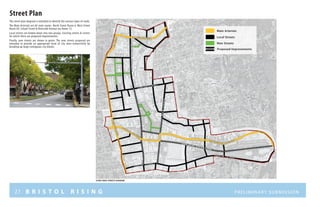
The street plan diagram is intended to identify the various types of roads.
The Main Arterials are all state routes. North Street Route 6, West Street
Route 69, School Street & Riverside Avenue are Route 72.
Local streets are broken down into two groups. Existing streets & streets
for which there are proposed improvements.
Finally, new streets are shown in green. The new streets proposed are
intended to provide an appropriate level of city inter-connectivity by
breaking up large contiguous city blocks.
N ort h S tr e e t
NORTHMAINSTREET
C E N T E R S tr e e t
WESTStreetWESTSt
S O U T H S tr e e t
R I V E R S I D EM E M O R I A L B O U L E V A R D
A V E N U E
S C H O O L
S T R
EE T
MAINStreet
study area streets diagram
28
Proposed Street Improvement Types
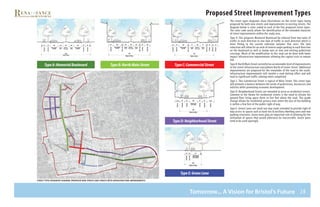
The street types diagrams show illustrations on the street types being
proposed for both new streets and improvements to existing streets. The
diagram below is color coded to each of the five proposed street types.
The color code easily allows for identification of the intended character
of street improvements within the study area.
Type A: This proposes Memorial Boulevard be reduced from two lanes of
traffic in each direction to one lane of traffic in each direction which is
more fitting to the current vehicular volumes that exist. The lane
reduction will allow for an aisle of reverse angle parking in each direction
on the boulevard as well as bump-outs at new and existing pedestrian
crossings. Much of the modification to this road can be done with lower
impact infrastructure improvements allowing the capital costs to remain
low.
Type B: North Main Street currently has an amenable level of improvements
to the street infrastructure everywhere North of Center Street. Additional
improvements are proposed for the remainder of the road to the south.
Infrastructure improvements will involve a road dieting effort and will
lead to significant traffic calming when completed.
Type C: This Commercial Street is typical of Main Street. This street type
will promote a balance between the needs of pedestrians, businesses and
vehicles while promoting economic development.
Type D: Neighborhood Streets are intended to serve as residential streets.
Common to the theme for residential streets is the need to elevate the
ground floor living space three to five feet above the road. This grade
change allows for residential privacy even when the face of the building
is within a few feet of the public right of way.
Type E: Green Lanes are small one way roads intended to provide right of
way access to spaces such as back lots & ancillary dwelling units and rear
parking structures. Green lanes play an important role of allowing for the
utilization of spaces that would otherwise be inaccessible. Green lanes
tend to be used sparingly.
Type A: Memorial Boulevard Type B: North Main Street Type C: Commercial Street
Type D: Neighborhood Street
Type E: Green Lane
N ort h S tr e e t
NORTHMAINSTREET
C E N T E R S tr e e t
WESTStreet
WESTSt
S O U T H S tr e e t
r I V E R S I D EM E M O R I A L B O U L E V A R D
a V E N U E
S C H O O L
s T R
EE T
MAINStreet
Street types heirarchy diagram (proposed new streets and streets with infrastructure improvements)
Tomorrow... A Vision for Bristol’s Future
29 B R I S T O L R I S I N G Preliminary submission
On Street Parking Plan
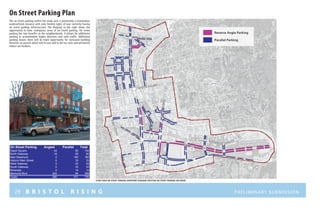
The on street parking within the study area is potentially a tremendous
underutilized resource with only limited rights of way currently having
on street parking infrastructure. The Diagram to the right shows the
opportunity to have contiguous areas of on street parking. On street
parking has two benefits to the neighborhoods. It allows for additional
parking to accommodate higher densities and calm traffic. Additional
parking means there will be more opportunity for increased building
densities on parcels which will in turn add to the tax roles and ultimately
reduce tax burdens.
Parallel Parking
Reverse Angle Parking
N ort h S tr e e t
NORTHMAINSTREET
C E N T E R S tr e e t
WESTStreet
WESTSt
S O U T H S tr e e t
R I V E R S I D EM E M O R I A L B O U L E V A R D
A V E N U E
S C H O O L
S T R
EE T
MAINStreet
study area On street parking inventory diagram (existing on street parking included)
   
   
   
   
   
   
   
   
   
   
30
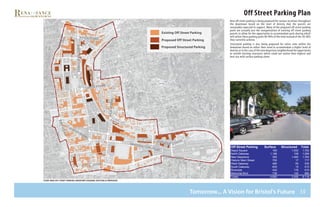
Off Street Parking Plan
New off street parking is being proposed for various locations throughout
the downtown based on the level of density that the parcels are
reasonably expected to support. Many of the proposed off street parking
pools are actually just the reorganization of existing off street parking
parcels to allow for the opportunity to accommodate park sharing which
will utilize these parking pools 80-90% of the time instead of the 30-40%
they currently achieve.
Structured parking is also being proposed for select sites within the
downtown based on either their need to accommodate a higher level of
density or in the case of the new departure neighborhood the opportunity
to retrofit existing structures which could not realize their highest and
best use with surface parking alone.
Proposed Off Street Parking
Existing Off Street Parking
Proposed Structured Parking
N ort h S tr e e t
NORTHMAINSTREET
C E N T E R S tr e e t
WESTStreet
WESTSt
S O U T H S tr e e t
R I V E R S I D EM E M O R I A L B O U L E V A R D
A V E N U E
S C H O O L
S T R
EE T
MAINStreet
study area off street parking inventory diagram (existing & proposed)
Tomorrow... A Vision for Bristol’s Future
   
   
   
   
   
   
   
   
   
   
31 B R I S T O L R I S I N G Preliminary submission
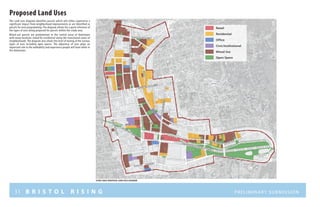
The Land uses diagram identifies parcels which will either experience a
significant impact from neighborhood improvements or are identified as
parcels for new programming. The diagram allows for a quick reference of
the types of uses being proposed for parcels within the study area.
Mixed-use parcels are predominant in the central areas of downtown
with many locations slated for residential along the transitional zones of
neighborhoods. The diagram also shows the level of mixing of the various
types of uses including open spaces. The adjacency of uses plays an
important role in the walkablity and experience people will have while in
the downtown.
Proposed Land Uses
Mixed Use
Open Space
Residential
Office
Civic/Institutional
Retail
N ort h S tr e e t
NORTHMAINSTREET
C E N T E R S tr e e t
WESTStreet
WESTSt
S O U T H S tr e e t
r I V E R S I D EM E M O R I A L B O U L E V A R D
a V E N U E
S C H O O L
s T R
EE T
MAINStreet
study area proposed land uses diagram
32
Parking
Residential
Office
Civic/Institutional
Retail
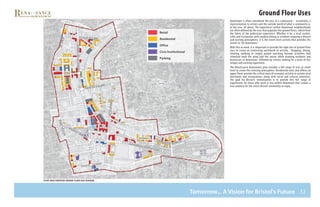
Downtown is often considered the face of a community – essentially, a
representation to visitors and the outside world of what a community is,
at the core, all about. The experiences within Downtown neighborhoods
are often defined by the uses that populate the ground floors, which form
the fabric of the pedestrian experience. Whether it be a local market,
cafés and restaurants with outdoor dining or residents enjoying a diverse
and exciting atmosphere, it is the street level activity that provides the
reason to “be downtown.”
With this in mind, it is important to provide the right mix of ground floor
uses to create an interesting patchwork of activity. Shopping, dining,
relaxing, walking or simply people watching become activities that
stimulate both the mind and the senses while drawing residents and
businesses to downtown, followed by visitors looking for a taste of this
unique and exciting experience.
The Renaissance Downtowns plan includes a full range of uses at street
level to create this enticing atmosphere. Residential units and offices on
upper floors provide the critical mass of economic activity to sustain local
merchants and restaurateurs along with social and cultural amenities.
The goal for Bristol’s revitalization is to provide this full range of
experiences for those who work or live within downtown that creates a
true amenity for the entire Bristol community to enjoy.
N ort h S tr e e t
NORTHMAINSTREET
C E N T E R S tr e e t
WESTStreet
WESTSt
S O U T H S tr e e t
R I V E R S I D EM E M O R I A L B O U L E V A R D
A V E N U E
S C H O O L
S T R
EE T
MAINStreet
study area proposed ground floor uses diagram
Tomorrow... A Vision for Bristol’s Future
Ground Floor Uses
33 B R I S T O L R I S I N G Preliminary submission
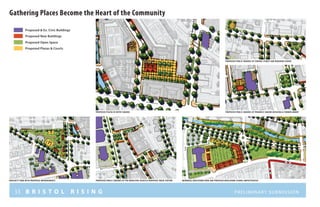
Gathering Places Become the Heart of the Community
Proposed Open Space
Proposed Plazas & Courts
Proposed New Buildings
Proposed & Ex. Civic Buildings
proposed Public squares at the municipal block & proposed train stationbrackett park with proposed improvements memorial boulevard park and proposed Boulevard school amphitheater
proposed piazza at depot square
proposed public squares at federal street and bingham school
proposed public squares at progress square building & former amory
34
Gathering Places Become the Heart of the Community
Proposed Open Space
Proposed Plazas & Courts
Proposed New Buildings
Proposed Adaptive Reuse
Proposed Parking Lots
Proposed Parking Garages
Proposed & Ex. Civic Buildings
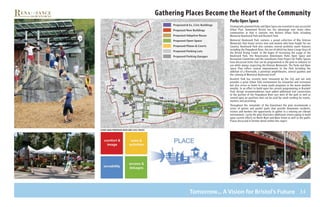
Parks Open Space
Strategically planned Parks and Open Space are essential to any successful
Urban Plan. Downtown Bristol has the advantage over many other
communities in that it contains two distinct Urban Parks including
Memorial Boulevard Park and Brackett Park.
Memorial Boulevard Park contains a proud collection of War Veteran
Memorials that honor service men and women who have fought for our
Country. Boulevard Park also contains several aesthetic water features
including the Pequabuck River, the use of which has been a large focus of
the Bristol Rising Crowd. In the hopes of increasing the usage of the
Boulevard Park, the Renaissance Downtowns Parks Open Space and
Recreation Committee and the consultants from Project for Public Spaces
have discussed items that can be programmed in the park to enhance its
use while always respecting the Veteran Memorials. The Parks and Open
Space Plan reflect several improvements to the Park including the
addition of a Riverwalk, a potential amphitheater, several gazebos and
the calming of Memorial Boulevard itself.
Brackett Park has recently been renovated by the City and not only
provides a great Urban Park environment for relaxation and recreation
but also serves as home to many youth programs in the warm weather
months. In an effort to build upon the current programming in Brackett
Park, design recommendations have added additional trail connections
to the portion of the Pequabuck River just west of the park as well as
several open air pavilions that can be used for small vending for events,
markets and picnicking.
Throughout the remainder of the Downtown the plan recommends a
series of greens and pocket parks that provide downtown residents,
visitors and workers the opportunity to gather in a relaxing yet vibrant
environment. Lastly the plan illustrates additional streetscaping to build
upon current efforts on North Main and Main Street as well as the public
Piazza discussed in further detail within this report.
N ort h S tr e e t
NORTHMAINSTREET
C E N T E R S tr e e t
WESTStreet
WESTSt
S O U T H S tr e e t
r I V E R S I D EM E M O R I A L B O U L E V A R D
a V E N U E
S C H O O L
s T R
EE T
MAINStreet
study area proposed open and civic spaces
Tomorrow... A Vision for Bristol’s Future
35 B R I S T O L R I S I N G Preliminary submission
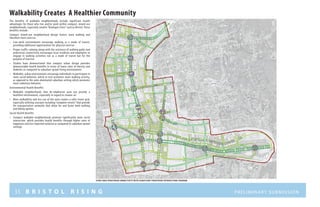
Walkability Creates A Healthier Community
The benefits of walkable neighborhoods include significant health
advantages for those who live and/or work within compact, mixed-use
neighborhoods, especially smaller “Boutique Cities” such as Bristol. These
benefits include:
Compact mixed-use neighborhood design fosters more walking and
therefore more exercise.
•	 Live-work environments encourage walking as a mode of transit,
providing additional opportunities for physical exercise
•	 Proper traffic calming along with the existence of walking paths and
pedestrian connectivity encourages local residents and employees to
engage in walking activities not as a mode of transit but for the
purpose of exercise
•	 Studies have demonstrated that compact urban design provides
demonstrable health benefits in terms of lower rates of obesity and
diabetes as compared to suburban sprawl living environments
•	 Walkable, urban environments encourage individuals to participate in
more social behavior, which in turn promotes more walking activity,
as opposed to the auto-dominated suburban setting which promotes
more sedentary behavior.
Environmental Health Benefits
•	 Walkable neighborhoods that de-emphasize auto use provide a
healthier environment, especially in regard to cleaner air
•	 More walkability and less use of the auto creates a safer street grid,
especially utilizing concepts including “complete streets” that provide
for transportation networks that allow for and foster both walking
and biking options
Social Health Benefits
•	 Compact walkable neighborhoods promote significantly more social
interaction ,which provides health benefits through higher rates of
happiness and less reported isolation as compared to suburban sprawl
settings
N ort h S tr e e t
NORTHMAINSTREET
C E N T E R S tr e e t
WESTStreet
WESTSt
S O U T H S tr e e t
r I V E R S I D EM E M O R I A L B O U L E V A R D
a V E N U E
S C H O O L
s T R
EE T
MAINStreet
study area pedestrian connectivity with significant pedestrian intersections diagram
36
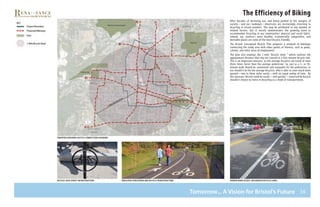
The Efficiency of Biking
After decades of declining use, and being pushed to the margins of
society—and our roadways—Americans are increasingly returning to
bicycling in record numbers. This may be attributed to any number of
related factors, but it mostly demonstrates the growing need to
accommodate bicycling in our communities’ physical and social fabric.
Indeed, our country’s most healthy, economically competitive, and
desirable places are some of the most bicycle-friendly.
The Bristol Conceptual Bicycle Plan proposes a network of bikeways
connecting the study area with other points of interest, such as parks,
schools, and other areas of employment.
The plan also employs the 1-mile “bicycle shed, ” which outlines the
approximate distance that may be covered in a five-minute bicycle ride.
This is an important measure, as the average bicyclist can travel at least
three times faster than the average pedestrian. So, just as a 5- or 10-
minute walk should be convenient and enjoyable for the pedestrian, so
too should it be for the average bicyclist, who is able to cover much more
ground—one to three miles easily—with an equal outlay of time. By
this measure, Bristol could be easily—and quickly—traversed by bicycle
should it choose to invest in bicycling as a mode of transportation.
D E P O T
S Q U A R E
R O U T E 6
R O U T E 7 2
W O L C O T T
R O A D
M U Z Z Y
F I E L D
proposed regional bicycle connections diagram
bicycle lock street infrastructure dedicated pedestrian and bicycle infrastructure shared road access: designated bicycle lanes
Tomorrow... A Vision for Bristol’s Future
37 B R I S T O L R I S I N G Preliminary submission
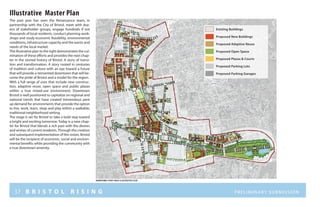
Illustrative Master Plan
Proposed Open Space
Proposed Plazas & Courts
Proposed New Buildings
Proposed Adaptive Reuse
Proposed Parking Lots
Proposed Parking Garages
Existing Buildings
The past year has seen the Renaissance team, in
partnership with the City of Bristol, meet with doz-
ens of stakeholder groups, engage hundreds if not
thousands of local residents, conduct planning work-
shops and study economic feasibility, environmental
conditions, infrastructure capacity and the wants and
needs of the local market.
The illustrative plan to the right demonstrates the cul-
mination of these efforts and provides the next chap-
ter in the storied history of Bristol. A story of transi-
tion and transformation. A story rooted in centuries
of tradition and culture with an eye toward a future
that will provide a reinvented downtown that will be-
come the pride of Bristol and a model for the region.
With a full range of uses that include new construc-
tion, adaptive reuse, open space and public plazas
within a true mixed-use environment, Downtown
Bristol is well positioned to capitalize on regional and
national trends that have created tremendous pent
up demand for environments that provide the option
to live, work, learn, shop and play within a walkable,
traditional neighborhood setting.
The stage is set for Bristol to take a bold step toward
a bright and exciting tomorrow. Today is a new chap-
ter for Bristol that blends a rich past with the desires
and wishes of current residents.Through the creation
and subsequent implementation of this vision, Bristol
will be the recipient of economic, social and environ-
mental benefits while providing the community with
a true downtown amenity.
N ort h S tr e e t
NORTHMAINSTREET
C E N T E R S tr e e t
WESTStreet
WESTSt
S O U T H S tr e e t
r I V E R S I D EM E M O R I A L B O U L E V A R D
a V E N U E
S C H O O L
s T R
EE T
MAINStreet
downtown Study area illustrative plan
38
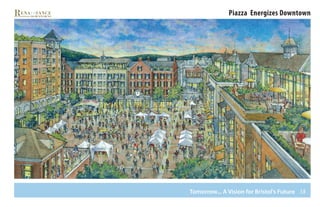
Piazza Energizes Downtown
Tomorrow... A Vision for Bristol’s Future
39 B R I S T O L R I S I N G Preliminary submission
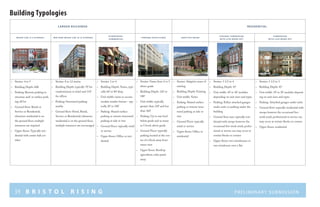
larger Buildings residential
Mixed-use (4 -5 stories) Mid-rise Mixed-use (8-12 stories)
storefront
coMMercial
parking structures adaptive reuse
stacked townhouse
with live/work opt.
townhouse
with live/work opt.
Stories: 4 to 5»
Building Depth: 60ft»
Parking: Remote parking in»
structure and/ or surface park-
ing off lot
Ground floor: Retail or»
Service or Residential;
whenever residential is on
the ground floor, multiple
entrances are required
Upper floors: Typically resi-»
dential with center hall cor-
ridor
Stories: 8 to 12 stories»
Building Depth: typically 70’ for»
condominium or hotel and 110’
for offices
Parking: Structured parking»
nearby
Ground floor: Hotel, Retail,»
Service or Residential; whenever
residential is on the ground floor,
multiple entrances are encouraged
Stories: 3 to 4»
Building Depth: Varies, typi-»
cally 60’ or 80’ deep
Unit width: varies to accom-»
modate retailer format – typ-
ically 20’ to 100’
Parking: Shared surface»
parking or remote structured
parking at side or rear
Ground Floor: typically retail»
or service
Upper floors: Office or resi-»
dential
Stories: Varies from 2 to 5»
above grade
Building Depth: 120’ or»
180’
Unit width: typically»
greater than 230’ and less
than 360’
Parking: Up to one level»
below grade and as many
as 5 levels above grade
Ground Floor: typically»
parking located at the cen-
ter of a block away from
street view
Upper floors: Rooftop»
agriculture, solar panel
array
Stories: Adaptive reuse of»
existing
Building Depth: Existing»
Unit width: Varies»
Parking: Shared surface»
parking or remote struc-
tured parking at side or
rear
Ground Floor: typically»
retail or service
Upper floors: Office or»
residential
Stories: 3 1/2 to 4»
Building Depth: 45’»
Unit width: 18’ to 30’ modules»
depending on unit sizes and types
Parking: Either attached garages»
under units or parking under the
building
Ground floor uses: typically resi-»
dential with stoops however the
occasional live-work retail, profes-
sional or service use may occur at
certain blocks or corners
Upper floors: two townhouses or»
one townhouse over a flat
Stories: 2 1/2 to 3»
Building Depth: 45’»
Unit width: 18’ to 30’ modules depend-»
ing on unit sizes and types
Parking: Attached garages under units»
Ground floor: typically residential with»
stoops however the occasional live-
work retail, professional or service use
may occur at certain blocks or corners
Upper floors: residential»
©2010urbandesignassociates
depot square: bristol, connecticut | april 2011 | urban design associates
depot square: kit of partsBuilding Typologies
40
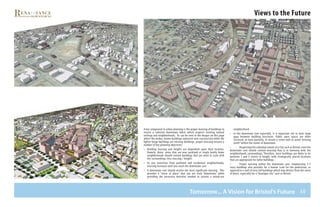
A key component to urban planning is the proper massing of buildings to
ensure a cohesive downtown fabric which respects existing natural
settings and neighborhoods. As can be seen in the images on this page
where the darker, brown buildings represent new construction while the
lighter beige buildings are existing buildings, proper massing ensures a
number of key planning objectives:
•	 Building massing and heights are dependent upon their location.
Namely, those areas that are near parkland or single family home
neighborhoods should contain buildings that are more in scale with
the surroundings (less massing / height)
•	 As you transition from parkland and residential neighborhoods,
massing increases until you reach the downtown core
•	 A downtown core should receive the most significant massing . This
provides a “sense of place” that you are truly “downtown” while
providing the necessary densities needed to sustain a mixed-use
neighborhood
•	 In the downtown core especially, it is important not to have large
gaps between building structures. Public open spaces are often
enclosed, at least partially, to ensure a street wall to avoid “missing
teeth” within the center of downtown
•	 Respecting the suburban nature of a City such as Bristol, even the
downtown core should contain massing that is in harmony with the
neighborhoods surroundings. Therefore, most buildings are likely to be
between 3 and 5 stories in height, with strategically placed locations
that are appropriate for taller buildings.
•	 Proper massing within the downtown core, emphasizing 3-5
story buildings also provides for a human scale for the pedestrian, as
opposed to a wall of very tall buildings which may detract from the sense
of place, especially for a “boutique city” such as Bristol.
Tomorrow... A Vision for Bristol’s Future
Views to the Future
41 B R I S T O L R I S I N G Preliminary submission
Depot Square Yesterday
The Depot Square site has a storied history as the center of downtown
Bristol long before Urban Renewal took hold in the middle of the 20th
century. For much of its existence, the site was divided by two essential
typologies: an undeveloped area with a creek running through it on the
western portion with a strong urban fabric to the east along Main Street.
Historically, Main Street was the center of town with a traditional double
sided streetscape of successful businesses that created a downtown fabric
reminiscent of what downtowns were in days long past. One could feel
the vitality and energy along this corridor, with a network of small,
integrated streets and alleys.
The devastation of the 1955 flood witnessed the end of the historic Main
Street era in downtown Bristol, as Depot Square became submerged, only
to re-emerge as a shell of its former self during the era of Urban Renewal.
42
Depot Square Today
For the past few years, Depot Square has laid mostly dormant. After the
failed efforts of Urban Renewal which saw an ill-conceived downtown
mall take hold and subsequently fail on the parcel, the property became
a pile of rubble before being cleared in an effort to allow for redevelopment
of the site in a responsible and forward thinking manner.
Today, the roughly 17 acres of mostly vacant land on Depot Square may
be Bristol’s greatest asset. The rationale for this is simple: had the site
been developed over the past 20 years it likely would have been witness
to yet another strip center or poorly planned single use, suburban style
development. Luckily for the Bristol Community, the site is now available
for redevelopment as a game changer not only for Depot Square, but the
entire downtown. The parcel is the centerpiece of a comprehensive
downtown revitalization plan and now represents the tremendous
promise of a greater future that can once again harken the glory days of
the past when downtown Bristol was a center of commerce and activity.
Depot square existing conditions aerial photo with boundary
Contextual map with downtown study area and depot square boundaries
Depot Square... The Catalyst
C e nt e r S T R EE T
Nort
hmain
STREET
riv e
rsid e av e nu e
mainstreet
summ
erstreet
43 B R I S T O L R I S I N G Preliminary submission
Depot Square Tomorrow
Depot Square, which at present is mostly vacant property, will soon
become the jewel of downtown and the catalyst of a revitalization effort
that will be a model for mixed-use redevelopment throughout the region.
Utilizing New Urbanist planning principles coupled with innovative
crowdsourcing methodologies, Renaissance Downtowns and the City of
Bristol are on the precipice of creating a vibrant mixed-use downtown
centered on Depot Square as the natural point of focus.
Through the Bristol Rising! Crowdsourced Placemaking program,
Renaissance has looked to the residents of Bristol to help guide the
redevelopment process, providing tremendous insight as to what people
would like to see in the downtown in which they wish to live, work or
visit in the near future.
This provides the opportunity to reconnect the lost street grid of historic
main street including the presence of a double sided main street that will
build off the remaining historic structures on the street’s east side. Along
the connected street grid we see two sided activity on North Main and
Riverside Ave as well, creating a “sense of place” that is not found in
today’s suburban communities. This provides the opportunity to employ a
full range of uses, driven by a strong residential component on the Depot
Square site and throughout downtown.
depot square contextual map depot square concept plan illustration
depot square LOCUS MAP
c e nt e r str e e t
riv e rsid e av e nu e
nort
hmain
street
rail
rig
ht
of
way
Strawberry Festival, Farmers Mkt.
34 Likes
A Piazza
248 Likes
Restaurant Row
112 Likes
Market in the Piazza
149 Likes
1.	 Mixed Use, Residential, & Park-
ing
2.	 Laurel Square
3.	 Office, Condo, & Mixed Use Retail
4.	 Station Square Potential Com-
muter Rail Station
5.	 Mixed Use & Parking
6.	 Promenade withWater Feature
7.	 Hotel & Condominiums
8.	 Commercial, Retail, Residential
9.	 Pequabuck RiverWater Feature
1
2
3
4
56
7
8
9
C e nt e r S T R EE T
Nort
hmain
STREET
riv e rsid e av e nu e
mainstreet
summ
erstreet
44
Depot Square Tomorrow
Depot Square... The Catalyst
The images and renderings on this page represent the look and feel of a
revitalized Depot Square, examined in a finer grain that gives insight as
to the true nature of what downtown Bristol will become through the
City’s revitalization efforts.
As we focus on the southern area of Depot Square, we witness the activity
in and around a grand piazza – an idea forwarded by the Bristol Rising!
crowd. A boutique hotel will be located at this location, along with a
greater array of uses, including residential options.
This area will be a true center of commerce and entertainment as the real
“heart of downtown.” Pedestrian friendly features are prevalent
throughout Depot Square, utilizing innovative parking management
strategies to help drive economic activity while calming the streets. One
can almost sense the excitement that will be present at this site, as
residents, workers and visitors all intermingle within the piazza,
experiencing a distinctive taste of urbanism within the “Boutique City” of
Bristol.
Nort
hmain
STREET
riv e rsid e av e nu e
mainstreet
summ e r str e e t
45 B R I S T O L R I S I N G Preliminary submission
Depot Square Tomorrow
Depot Square presents a true mixed-use neighborhood with a significant
office component along with a range of residential options that will
include rentals, condos and flats above ground floor retail. Located across
from City Hall this area will provide a complement to the Civic Uses,
providing daytime workers an opportunity for outdoor restaurant options,
convenient shopping and a pleasant experience to break up the workday.
This area is also notable for the potential reintroduction of train service
to Bristol – a notion that Governor Malloy has already discussed publicly.
The reinstitution of commuter rail would provide an additional benefit to
the local community and the region, fed by the ridership represented by
the residents and workers of Downtown Bristol.
As connectivity is a goal of good planning, efforts will be taken to tie the
Federal Hill neighborhood on the opposite side of the tracks into the
downtown fabric, extending the benefits of Depot Square’s mixed-use
setting to the neighboring residential community adjacent to the east.
Nort
hmain
STREET
rail
rig
ht
of
way
46
     
  
   
    
    
    
     
Depot Square Program & Phasing Plan












 
 
 
 
 

 
 
 
 

 
 
 
 
 
 
 
 
 
 





Depot Square... The Catalyst
5
4
1
2
3
244
633
169
369
66
Nort
hmain
STREET
riv e rsid e av e nu e
mainSTREET
summ
er
STREE
T
47 B R I S T O L R I S I N G Preliminary submission
A Place for Everyone
48
Neighborhood Districts
Enhancing Bristol’s Downtown Neighborhoods
The downtown is comprised of eight unique character districts offering
opportunities for redevelopment. Our planning team has studied each
district to determine the assets to build upon and the opportunities for
revitalization. The districts are:
•	 Depot Square
•	 North Gateway
•	 New Departure
•	 Historic Main Street
•	 West Gateway
•	 South Gateway
•	 Memorial Park Boulevard
•	 Riverside District
In addition to the Depot Square neighborhood already presented, the
remaining seven districts describe the existing character, proposed
character, assets to build upon and opportunities for revitalization.
proposed study area neighborhoods diagram
49 B R I S T O L R I S I N G Preliminary submission
West Gateway is bounded by Laurel Street to the North, Church Street to
the East, South Street to the South, and West Street to the West.
Much of this Neighborhood is currently utilized well. The neighborhood
has a strong identity as the western gateway to the downtown at the
intersection of West and School Streets which have a number of historic
mixed use buildings much like the character of the Historic Main Street
neighborhood.
The Northeastern edge of the site has opportunity for the urban infill
along both North Main Street and Brackett Park.
West Gateway
S C H O O L
S T R
EE T
CHURCHSTREET
WESTSTREET
L A U R E L S T R EE T
U P S O N S T R EE T
Proposed Open Space
Proposed Plazas & Courts
Proposed New Buildings
Proposed Adaptive Reuse
Proposed Parking Lots
Proposed Parking Garages
Existing Buildings
WEst gateway contextual map WEst gateway concept plan illustration
WEst gateway LOCUS MAP
Assets to Build UponAssets to Build Upon
50
West Gateway












 
 
 
 
 

 
 
 
 

 
 
 
 
 
 
 
 




Enhancing Bristol’s Downtown Neighborhoods
Our vision for West Gateway begins with a plan to enhance the vibrancy
of Bracket Park through the addition of open air market buildings,
improved parking, townhomes on the park and a mixed use retail/
residential building to the north on North Main Street. Each of these
buildings has been placed to screen the view of parking lots from the
street and increase the range of program activities in the park and
adjoining retail uses. To rectify the poor existing conditions at many of
the buildings surrounding the intersection of West Street and School
Street, we recommend a series of improvements to promote on-street
parking, pedestrian crosswalks, façade enhancements and adaptive reuse
of the aging buildings in this area.
Opportunities for ReinvestOpportunities for Reinvest
51 B R I S T O L R I S I N G Preliminary submission
South Gateway
South Gateway mainly consists of two large blocks of contiguous land;
the block containing the Chick Miller Site and the block which contains a
series of institutional use buildings.
The institutions present in this block include the telephone exchange, a
church, the school administrative unit, and the former site of the Bristol
Press which is currently for sale. There is considerable surface parking at
each parcel which could benefit from a centralized parking arrangement
and open up new opportunities for urban infill.
Proposed Open Space
Proposed Plazas & Courts
Proposed New Buildings
Proposed Adaptive Reuse
Proposed Parking Lots
Proposed Parking Garages
Existing Buildings
South Gateway is bounded by Church/Riverside Avenue to the North,
Main Street to the East, South Street to the South, and West/Upson Street
to the West.
The Former Chick Miller site in combination with the soon to be vacated
Girls Club on Upson Street comprise the primary opportunity sites in the
district due to their prominent location at the gateway to downtown
Bristol from Wolcott Road which is the main route connecting Bristol to
Waterbury, CT.
S O U T H S T R EE T
CHURCHSTREET
WESTSTREET
R I V E R S I D E A V E N U E
U P S O N S T R EE T
MAINSTREET
sOUTH gateway contextual map SOUTH gateway concept plan illustration
SOUTH gateway LOCUS MAP
Assets to Build UponAssets to Build Upon
52
South Gateway

 
 
 
 
 

 
 
 
 

 
 
 
 
 
 
 
 




Enhancing Bristol’s Downtown Neighborhoods











Opportunities for ReinvestOpportunities for Reinvest
53 B R I S T O L R I S I N G Preliminary submission
New Departure
Proposed Open Space
Proposed Plazas & Courts
Proposed New Buildings
Proposed Adaptive Reuse
Proposed Parking Lots
Proposed Parking Garages
Existing Buildings
New Departure is bounded by Race Street to the North, Richmond Place &
Summer Street to the East, Center Street to the South, and West Street to
the West.
New Departure is the former site of and automotive manufacturing
complex which has come and gone. Some of the former mill buildings
remain in place today and house a variety of different types of office and
manufacturing operations. The unique nature of these former
manufacturing buildings define the character of the neighborhood.
C E N T E R S T R EE T
R A C E S T R EE T
nORTHMAINSTREET
WESTSTREET
SUMMERSTREET
NEW DEPARTURE contextual map
NEW DEPARTURE concept plan illustration
nEW DEPARTURE LOCUS MAP
existing zipp property could become lofts
brick industrial building At West St. could be used for a grocery market
former auto assembly building could become a parking structure & lofts
a plaza could be built in front of the existing progress square
1. Proposed Grocery
1
Assets to Build Upon
54
New Departure

 
 
 
 
 

 
 
 
 

 
 
 
 
 
 
 
 




Enhancing Bristol’s Downtown Neighborhoods











New Departure offers great opportunities to adapt large surface parking
lots & out moded industrial space into a walkable neighborhood of lofts,
apartments, offices and retail.
sTACKED TOWNHOMES WILL FIt WELL AT THE TRANSITIONAL AREAS OF DEVELOPMENT
TOWNHOMES WITH SMALL OFFICE & RETAIL SPACES WILL BE ATTRACTIVE TO MANY FIRST FLOOR RETAIL sTACKED TOWNHOMES
MODERN FACADES ON OLDER BUILDINGS
NEW BUILDINGS CAN MIMIC THE Rhythm AND SCALE OF EXISTING BUILDINGS
Opportunities for Reinvest
55 B R I S T O L R I S I N G Preliminary submission
Riverside
The Riverside Neighborhood is bounded by the rail line “R.O.W” to the
North, Riverside Avenue to the East, the Pequabuck River to the South,
and the electrical sub-station to the West.
The neighborhood is defined by the existing and historical patterns of
industrial activities which run along the entire length of Riverside
Avenue. Riverside Avenue is the central spine of public access to and from
the neighborhood as well as the designated truck route and state road
(route 72) running through downtown.
The neighborhood is defined by three prominent mill buildings: The
Carousel Museum Building, The Alloy Metals Building, and The Sessions
Building. There is considerable opportunity for revitalization of these
buildings as well as urban infill between them on under utilized parcels.
Proposed Open Space
Proposed Plazas & Courts
Proposed New Buildings
Proposed Adaptive Reuse
Proposed Parking Lots
Proposed Parking Garages
Existing Buildings
R I V E R S I D E AV E N U ER A I L R I G H T O F W AY
P E Q U A B U C K R I V E R
RIVERSIDE contextual map
RIVERSIDE concept plan illustration
rIVERSIDE LOCUS MAP
Assets to Build Upon
56
Riverside












 
 
 
 
 

 
 
 
 

 
 
 
 
 
 
 
 




Enhancing Bristol’s Downtown Neighborhoods
Opportunities for Reinvestment
57 B R I S T O L R I S I N G Preliminary submission
Memorial Boulevard
Memorial Boulevard is the formal entry into downtown from the East.
This Eastern connection now links with the recently completed Route 72
connection to Interstate 84 and will likely impact current regional traffic
patterns to further reinforce this Eastern gateway as the primary
entrance into Downtown Bristol. Memorial Boulevard is characterized by
its passenger car only access which is encompassed by a large greenspace.
The existing Memorial Boulevard School is slated to close (due to
consolidation of operations) and has potential for an adaptive reuse.
Proposed Open Space
Proposed Plazas & Courts
Proposed New Buildings
Proposed Adaptive Reuse
Proposed Parking Lots
Proposed Parking Garages
Existing Buildings
P E Q U A B U C K R I V E R
M E M O R I A L B O U L E V A R D
S O U T H S T R EE T
MAINSTREET
Memorial Boulevard is bounded
by the Pequabuck River to the
North, Downs Street to the East,
South Street to the South, and
Main Street to the West. The
neighborhood is defined by the
existing large spring factory
located at the western edge of the
neighborhood.
MEMORIAL BOULEVARD contextual map
MEMORIAL BOULEVARD concept plan illustration
MEMORIAL BOULEVARD LOCUS MAP
Assets to Build Upon
proposed visual
& performing
arts center
proposed
amphitheater,
park, restaurant,
& residences
waterfront
environmental
education center
& picnic grove
58
Memorial Boulevard












 
 
 
 
 

 
 
 
 

 
 
 
 
 
 
 
 




Enhancing Bristol’s Downtown Neighborhoods
Opportunities for Reinvest
263
59 B R I S T O L R I S I N G Preliminary submission
Historic Main Street
Historic Main Street is located in the vicinity of the original
rail station and freight yard. The area is bounded by Center
Street to the North, Bellevue Avenue to the East, Riverside
Avenue to the South and the Rail “R.O.W.” to the West. Key
redevelopment sites exist mainly alongside the rail “R.O.W.” &
Summer Street.
Proposed Open Space
Proposed Plazas & Courts
Proposed New Buildings
Proposed Adaptive Reuse
Proposed Parking Lots
Proposed Parking Garages
Existing Buildings
The Historic Main Street is defined by the remaining historic mixed use buildings lining the
East side Main Street. This relatively short strip of Main Street signifies the potential start
point for future development within downtown Bristol. The remainder of the neighborhood
has a number of unique characteristics which present both opportunities and challenges to
the revitalization of the neighborhood.
The topography in combination with the rail “R.O.W.” limits the opportunities for connectivity
between neighborhoods. Existing underutilized & vacant buildings on Summer & Prospect
Streets along Main Street have excellent potential for revitalization to further reinforce the
growth of downtown.
C E N T E R S T R EE T
RAIL
RIGHT
OF
WAY
MAINSTREET
r I V E R S I D E a V E N U E
HISTORIC MAIN STREET contextual map HISTORIC MAIN STREET concept plan illustration
HISTORIC MAIN STREET LOCUS MAP Assets to Build Upon
prosp e
ct
str e e t
60
Historic Main Street












 
 
 
 
 

 
 
 
 

 
 
 
 
 
 
 
 




Enhancing Bristol’s Downtown Neighborhoods
88
61 B R I S T O L R I S I N G Preliminary submission
North Gateway
North Gateway is located in the vicinity of Route 6 (a.k.a. North Street)
and North Main Street. The gateway is bounded by Ingraham Street to the
North, the rail line “Right of Way” to the East, Race Street to the South
and West Street to the West. Key redevelopment sites exist along Federal
Street, Race Street and at the Route 6 - North Main Street intersection.
nort h str e e t
northmainstreet
rac e str e e t
west
street
NORTH GATEWAY contextual map
Proposed Open Space
Proposed Plazas & Courts
Proposed New Buildings
Proposed Adaptive Reuse
Proposed Parking Lots
Proposed Parking Garages
Existing Buildings
NORTH GATEWAY concept plan illustration
NORTH GATEWAY LOCUS MAP
The Burger King site is an opportunity for mixed use retail buildings
Existing mixed use buildings on north main Street offer activity to build on
Existing Bingham school on North Street
Empty lot at the south west corner of North Main & North Street
Assets to Build Upon
62
North Gateway
The intersection of Route 6 and North Main Street is the origin of this
gateway to downtown and as such will command a significant presence
of public space. This gateway is currently characterized by mid 20th
century auto-oriented retail businesses on North Street. A mix of single
family homes converted to businesses and mixed use commercial
buildings characterize the street wall along North Main Street.

 
 
 
 
 

 
 
 
 

 
 
 
 
 
 
 
 





 
 
 
 
 

 
 
 
 

 
 
 
 
 
 
 
 




Enhancing Bristol’s Downtown Neighborhoods
Proposed residences and shops at North Main Street
proposed greenproposed infill at Burger king site
Opportunities for Reinvest
1,378
63 B R I S T O L R I S I N G Preliminary submission
Commercial Market Assessment
Bristol has a unique opportunity to capitalize on market trends that
demonstrate significant growth potential for industries that may be
attracted to relocating to a mixed-use, urban setting as will be provided
by the Renaissance Downtowns revitalization plan. The City already
possesses strong economic engines within key industries, including
health care (Bristol Hospital) and communications / information services
(ESPN). The city has a rich manufacturing history along with a current
cluster of precision equipment companies (including Associated Spring /
The Barnes Group). In addition to these industry clusters, Bristol has the
opportunity to attract certain corporate users to a more urban downtown
setting.
To achieve the true potential for downtown Bristol, there will be a need
to create strong synergies, destination draws, and increased exposure in
order to build the market for both retail and office uses. This can be
achieved through the Depot Square project in the context of a
comprehensive downtown redevelopment effort.
It should be noted that the same mixed-use environment that is likely to
attract housing demand in downtown Bristol is also going to help attract
businesses and office tenants (many of whom will be the same people
that are going to rent or buy housing downtown). Initial phases (first
five years) should also focus on building partnerships, not only with the
health care service provider but also with the local community college,
ESPN, and the precision component industry.
Health care is the dominant industry, accounting
for 23% of jobs within Bristol, many of which are
concentrated at Bristol Hospital.
The dearth of retail, dining and entertainment activity and especially housing deadens street-fronts and reduces pedestrian activity. The lack of an existing, vibrant business
mix also limits the opportunity for additional office uses, although a comprehensive redevelopment plan would likely overcome this issue.
64
Commercial Market Assessment
Planning Studies
ESPN is the city’s largest employer, but there are a number of other media
and information service providers in the area that help strengthen the
city’s position in the industry, creating the potential for a new industry
cluster to be fostered in Bristol. As such, Bristol is in a position to become
an Information Services (IS) and media hub.
This chart demonstrates the potential absorption for commercial space,
by Square Feet, in Downtown Bristol through the year 2021. While the
potential exists for up to 975,000 square feet of additional office space to
be absorbed (assuming growth of niche markets and the attraction of
large corporate users), the Renaissance plan includes a more conservative
337,000 square feet of office space that would likely be absorbed through
the creation of a vibrant, walkable, mixed-use downtown environment.
The creation of a mixed-use neighborhood in downtown Bristol coupled with the extension of Route 72 could provide Bristol with the tools necessary
to compete with neighboring locales, which currently attract considerably more prime office users than does Bristol.
65 B R I S T O L R I S I N G Preliminary submission
Retail Market Assessment
•	 Bristol’s revitalized downtown must be marked by
strong gateways and should offer unique goods and
services in an attractive mixed-use environment
•	 A number of factors suggest significant potential for
downtown retail growth, including a lack of retail
options currently available downtown along with
significant retail leakage (per the CLUE Group report,
“This City is experiencing sales leakages in almost all
major retail categories. See chart on following page
•	 Downtown retail would benefit from the presence of
downtown area workers (i.e. the Hospital and current
Civic employees) along with the addition of 3,500
additional residential units
•	 New, downtown retail would likely complement and
not compete with existing auto-oriented businesses
along Route 6.
•	 It is estimated that downtown Bristol could absorb
up to 486,000 sf of new retail and restaurant space
assuming a dynamic, exciting mixed-use environment
with attractive buildings and a strong residential
component
•	 Conclusion: “The time is ripe for development of a
distinctive, exciting mixed-use town center in Bristol”
Potential Diagrams and Charts:
Total business entities in Bristol	 1,957
Total business entities within ½ mile of Laurel + North Main	 417
Percent of all business entities in Bristol	 21.3%
Number with more than 100 employees	 9
Est. number of downtown workers (not including Bristol Hospital)	 2,125
Est. number of downtown workers (including Bristol Hospital)	 3,175
The above chart demonstrates the significant demand that currently
exists for retail opportunities in downtown Bristol within the context
of a comprehensive mixed-use redevelopment plan.
66
Retail Market Assessment
Planning Studies
The map above details areas of focus which would be ideal locations for clusters of retail shops and restaurants which
include the following intersections:
1: North Main Street and Route 6
2:The Depot Square Redevelopment Site
3: Main Street and Riverside Ave.
The above chart demonstrates the significant loss of dollars experienced by Bristol through retail leakage. This also demonstrates the
tremendous pent up demand for certain goods and services that could be provided by downtown merchants as a result of a mixed-use
downtown revitalization effort.
1
3
67 B R I S T O L R I S I N G Preliminary submission
Residential Market Assessment
Downtown Bristol is extremely well positioned to capitalize on recent
market trends that point toward a strong demand for downtown living
within walkable, mixed-use neighborhoods. As is depicted elsewhere in
this report, baby boomers and millennials – nearly 160 million strong
within the U.S. – demand a more urban lifestyle as opposed to the sprawl
development pattern that has dominated the nation’s landscape for much
of the past 60 years.
To accurately determine the potential absorption ability for new
residential options within a revitalized downtown Bristol, Renaissance
Downtowns and Zimmerman Volk Associates utilized cutting edge
methodologies that are particularly effective in defining housing
potential in locations where there has been little or no new housing.
When you consider that the average age of housing stock within
downtown is nearly a century old, it is almost impossible to accurately
determine absorption and pricing using traditional “comparable”
methodologies.
Renaissance Downtowns believes that the target market households will
be less concerned about the rent per square foot than they will about the
rents or prices they can afford, regardless of unit size. This dynamic
depends upon the establishment of a vibrant, walkable, mixed-use
environment.
The changes in market preferences combined with a lack of downtown
housing options within the Hartford MSA create a significant opportunity
for Bristol to provide residential product that is in high demand – and
very limited supply. In total, it is estimated that downtown Bristol could
absorb about 3,500 residential units assuming a revitalization effort that
provides a vibrant, mixed-use environment.
The vitality of downtowns is dependent on the
fine-grained mix of uses—rental and ownership
dwellings of a variety of types, and shopping,
dining and entertainment uses—all connected
in a high-density, pedestrian-friendly pattern of
urban streets and blocks.
By the Numbers:
3500+ residential units that could be absorbed in
Downtown Bristol over the next ten years
2010 Number of households (younger singles and couples,
empty nesters and retirees and compact families) that represent the
annual potential market for Downtown Bristol over the next five years
215 Number of rental units to be absorbed per year
137 Number of new for-sale housing to be absorbed per year
68
Residential Market Assessment
Planning Studies
Rental options will drive the early phases of residential construction as
value is built for for-sale opportunities in the future. This is true for the
following reasons:
•	 New rental housing is the linchpin of urban
redevelopment and should be introduced to the
market as quickly as possible.
•	 Rental apartments are required for the establishment
of “critical mass,” because rentals are absorbed at
higher rates than for-sale units.
•	 Rentals are the fastest way to bring a large number of
households to a downtown.
•	 Rentals allow households to experiment with living in
an area without the mortgage commitment of home
ownership.
•	 Declining home values create a lack of confidence in
the for-sale market.
•	 Renters form a pool of potential purchasers of for-
sale condominiums, and townhouses that can be
built in later phases, when the market has recovered.
Over time, the balance should shift toward for-sale dwelling units with
the market-driven mix after ten years shown on the table below:
Hunters Crossing is representative of your more typical suburban rental
option that exists within the Bristol area.
The following depicts averages for rental options in and around Bristol. It
should be noted that there are no truly adequate “comps” for what is
proposed by Renaissance Downtowns, as current rental stock is dated
(very little to no recent construction) and exists without a true, mixed-
use urban fabric.
Rent Rate: 		 $600-$1,300 / Month
Unit Size:		 500-1,300 Square Feet
Avg Price/SF		 $.85-$1.39PS
Blue Back Square, located in West Hartford, CT provides some guidance
as to the upper range of the market. Although it may be difficult for
residential options to match the price per square foot of Blue Back,
through the creation of a vibrant, mixed-use setting that is unique
within the region, Bristol has the opportunity to achieve rents that far
exceed those garnered by the current building stock.
Rent Rate: 		 $1,635-$2,820 / Month
Unit Size:		 600-940 Square Feet
Avg Price/SF		 $2.73-$3.04
Table 2
Downtown Residential Mix By Household Type
Derived From The New Unit Rental And Purchase Propensities Of Draw Area Households
With The Potential To Move To Downtown Bristol Each Year Over The Next Five Years
Households In Groups With Annual Median Incomes Above $50,000
The Downtown Bristol Study Area
City of Bristol, Hartford County, Connecticut
Multi- Single-
. . . . . . Family . . . . . . . . Family . .
. . Attached . .
Total For-Rent For-Sale All Ranges
Number of
Households: 2,010 920 620 470
Empty Nesters
& Retirees 26% 12% 32% 45%
Traditional &
Non-Traditional Families 6% 5% 3% 10%
Younger
Singles & Couples 68% 83% 65% 45%
100% 100% 100% 100%
SOURCE: Nielsen Claritas, Inc.;
Zimmerman/Volk Associates, Inc.
Downtown Residential Mix By Household Type
Derived From The New Unit Rental And Purchase Propensities Of Draw Area Households
With The Potential To Move To Downtown Bristol Each Year Over The Next Five Years
Households In Groups With Annual Median Incomes Above $50,000
The Downtown Bristol Study Area
City of Bristol, Hartford County, Connecticut
Multi- Single-
. . . . . . Family . . . . . . . . Family . .
. . Attached . .
Total For-Rent For-Sale All Ranges
Number of
Households: 2,010 920 620 470
Empty Nesters
& Retirees 26% 12% 32% 45%
Traditional &
Non-Traditional Families 6% 5% 3% 10%
Younger
Singles & Couples 68% 83% 65% 45%
100% 100% 100% 100%
SOURCE: Nielsen Claritas, Inc.;
Zimmerman/Volk Associates, Inc.
69 B R I S T O L R I S I N G Preliminary submission
Residential Market Assessment
The rents and prices depicted on the chart to the left are exclusive of consumer options and upgrades, floor or
location premiums, and cover the broad range of rents and prices that could, in normal economic conditions, be
sustained by the market in the Downtown Bristol Study Area over the next three years. Because of the large
number of younger singles and couples that comprise the market for Downtown Bristol it is likely that the
weighted average unit size is likely to be closer to the smallest proposed unit than the largest.
Renaissance applauds the efforts of the City of Bristol for their work, in
conjunction with the Center for Real Estate of the University of
Connecticut’s Comprehensive Housing Market Analysis (the “Incentive
Housing Zone study). The findings of this study mirrored those found by
Zimmerman Volk Associates, providing a strong rationale for the
successful implementation of a significant downtown residential
population.
Comprehensive Housing Market Analysis
Workforce Housing in Bristol, CT
Center for Real Estate, University of Connecticut
11/24/2010
ZIMMERMAN/VOLK ASSOCIATES, INC.
households in 2011, and the relevant residential context in the Bristol market area, the general
range of rents and prices, in 2011 dollars, for newly-developed market-rate residential units in the
Study Area that could be supported at market-entry in 2012 or 2013 is shown on the following
page (reference also Table 5):
Rent, Price and Size Range
Newly-Created Housing (Adaptive Re-Use and New Construction)
THE DOWNTOWN BRISTOL STUDY AREA
City of Bristol, Hartford County, Connecticut
RENT/PRICE SIZE RENT/PRICE
HOUSING TYPE RANGE RANGE PER SQ. FT.
RENTAL—
Hard Lofts * $700–$1,350/month 500–1,000 sf $1.35–$1.40 psf
Soft Lofts † $850–$1,650/month 600–1,200 sf $1.38–$1.42 psf
Upscale Apartments $1,150–$1,950/month 750–1,350 sf $1.44–$1.53 psf
FOR-SALE—
Hard Lofts * $125,000–$195,000 700–1,200 sf $163–$179 psf
Soft Lofts † $150,000–$235,000 800–1,350 sf $174–$188 psf
Upscale Condominiums $185,000–$290,000 950–1,500 sf $193–$195 psf
Townhouses/Rowhouses $190,000–$325,000 1,000–1,750 sf $186–$190 psf
* Unit interiors of “hard lofts” typically have high ceilings and commercial windows and are either
minimally finished, limited to architectural elements such as columns and fin walls, or unfinished,
with no interior partitions except those for bathrooms.
† Unit interiors of “soft lofts” may or may not have high ceilings and are fully finished, with the interiors
partitioned into separate rooms.
The above rents and prices are exclusive of consumer options and upgrades, floor or location
premiums, and cover the broad range of rents and prices that could, in normal economic
conditions, be sustained by the market in the Downtown Bristol Study Area over the next three
years.
There is growing academic evidence that new apartment developments may actually increase values of nearby
single-family homes by adding choice to an area that is made more attractive through planning and design.
+ = $
70
Planning Studies
Hospitality Market Assessment
Planning Studies
The revitalization of downtown Bristol will create a walkable, mixed-use
neighborhood that provides a unique setting within the Bristol region.
When this redevelopment vision is combined with the existing economic
and cultural assets within the City, the stage is set for the successful
inclusion of hotel and hospitality components within a reinvented
downtown. A number of factors suggest a strong likelihood of success for
hotel uses within downtown Bristol:
•	 Accommodation Services is a growing sector in the Hartford regional
economy as well as in the Bristol area, providing an opportunity for
growth in the market and capture of this market by Bristol’s downtown.
•	 The number of people employed in hotels and accommodation services
increased by 20% between 1998 and 2008, adding 7,175 jobs.
•	 Bristol’s share of regional growth increased from 3.0% to 3.6%,
between 1998 and 2008, a sign that Bristol has become a competitive
location for such services.
•	 Bristol already provides a number of key assets that would support
hotel uses, including the presence of ESPN and Bristol Hospital along
with the Lake Compounce Theme Park and a variety of museums.
At present, there is little to attract either business or leisure travelers to
downtown Bristol. There is limited retail or amenity value, and downtown
lacks direct access and exposure to I-84, Route 8, and other highway-
oriented locations in the market. As a result, lodging downtown must be
somewhat destination oriented. Development of the site and the
remainder of downtown Bristol into an exciting, mixed-use live-work
integrated community will help change the dynamic for downtown
accommodations and tourism.
Assuming redevelopment efforts in downtown
Bristol do continue as planned, the downtown
would provide an environment that would be
unmatched by neighboring towns, resulting in
a strong market for hotel uses, including the
potential for a small, boutique hotel (less than
200 rooms) along with other hotel typologies.
Benefits of including a Hotel:
•	 Employees of and visitors to a hotel
would provide additional revenues
to local merchants and restaurants.
•	 Hotel visitors would provide
additional vibrancy and street life to
a revitalized downtown.
•	 Hotel visitors can help sustain
certain unique retailers that are
more suited toward travelers and
tourists as opposed to local residents
and employees.
•	 The addition of a hotel to the
downtown would help attract
additional businesses, including
larger tenants that may be more
likely to relocate to Bristol if such
accommodations are available for
business travelers.
•	 The presence of a hotel could spur
additional cultural and
entertainment uses to relocate (or
expand) within a revitalized
downtown.
71 B R I S T O L R I S I N G Preliminary submission
Downtown as an Economic Driver
The City of Bristol stands to receive significant, positive fiscal benefits
from the comprehensive, mixed-use redevelopment of the Depot Square
site along with the remainder of the downtown area. The fiscal benefits,
as is discussed in the analysis conducted by Randall Gross Development
Economics (RGDE) “will far outweigh the cost of service,” providing
significant fiscal benefits to the City and the community.
•	 Through the creation of a unique, mixed-use, walkable
environment resident, workers, as well as tourists and
day trippers would be drawn to downtown Bristol for
shopping, dining, and entertainment.
•	 The project’s housing will attract new residents with
substantial disposable income.
•	 School costs are held low because of the emphasis on
development of multi-family units that generate far
lower pupil yields than single-family housing.  Many
of these units will be geared towards urban markets
including artists, downtown workers, empty nesters,
singles, DINKS  (dual-income/no kids), and similar
niches.
•	 A  focus on downtown and mixed-use development
over suburban sprawl will also serve to lower the
marginal cost of service and reduce the potential
traffic impacts on local roads and infrastructure.  
•	 Rather than relying on the extension of new roads
and bulk services, downtown revitalization builds on
the existing infrastructure network to reduce the
long-term burden on municipal service delivery.
•	 The assessment (conducted by RGDE) determined
that the Renaissance Plan, because of the proposed
mix of uses, will generate significant economic
benefits to the City of Bristol while minimizing
economic costs. For example, the plan includes the
development of commercial space for attracting
firms that will bring income and purchasing power to
the community. Housing development is oriented to
low-impact products like transit commuter-oriented,
multi-family units rather than car-oriented suburban
“sprawl.” Synergies generated by an enlivened
downtown coupled with area visitor attractions will
serve to lengthen the stay and expand the business
impacts of tourists and other visitors.
The historic district on Main Street will become a destination and linked
with the Cultural Center, could attract residents from throughout the
region. Furthermore, such activity and housing could lengthen the
average stay for visitors to Bristol’s unique museums and tourist
attractions.
Pictured above is the last remnant of historic main street. Additional
retail and activity is necessary on the opposite side of the street to create
a more inviting environment and foster economic activity.
Illustrated below is a rendered image of Historic North Main Street on the
right along with new construction on the left of the road to provide a unique,
historic setting for residents, merchants and visitors.
72
Fiscal Benefits
Planning Studies
The Depot Square site provides the opportunity not only for a catalytic
effort to kick start an overall downtown revitalization, but also the
ability to create a focal point for residents and visitors to Bristol to enjoy.
The above picture is the Site Plan of the Depot Square redevelopment site
which has the opportunity to be a true focal point for a revitalized
downtown Bristol
The Renaissance Plan will help to create a vibrant mixed-use downtown full of activity, drawing together various specialty districts through links to housing, retail, office, hotel, and civic
spaces.
Preliminary Estimates of Downtown Revitalization
Benefits: BYTHE NUMBERS!
2,200 Construction Jobs
2,400 Permanent Jobs
$103 MILLION ANNUALLY in direct income benefits
$17 MILLION ANNUALLY to City of Bristol
$80 MILLION ANNUALLY in new purchasing power*
*Does not include purchasing power of new visitors and tourists to downtown
73 B R I S T O L R I S I N G Preliminary submission
Downtown Development Program Summary
proposed study area neighborhoods diagram
       
          
         
        
         
         
         
         
          
        
   
Average Proposed Downtown Building Heights
1-3 Stories, 67, 47%
4-5 Stories, 71, 49%
8-10 Stories, 0, 0%
6-7 Stories, 5, 3%
11-12 Stories, 1, 1%
1-3 Stories
4-5 Stories
6-7 Stories
8-10 Stories
11-12 Stories
The concept Master Plan visions is a combination of new construction, adaptive reuse and repurposing
of select sites to demonstrate the downtowns true capablities for a transformative & sustainable
development plan. Private property owners, while under no obligation to change their existing
property uses, have expressed enthusiasm for this concept and many have agreed to work with
Renaissance & the City towards the realization of seeing this vision become a reality.
Proposed Downtown Development Program
74
Zoning Changes
Existing Conditions
In response to recommendations provided in the 2000 Plan of Conservation
and Development as well as forward thinking initiatives of the Planning
Department the City of Bristol revised its Zoning regulations to encourage
development patterns that lead to a revitalized Downtown. The current
zoning designations allow for various development patterns, and even
allow for a transitional district between Downtown and residential
neighborhoods. Yet a significant portion of the study area is zoned for
either single-family development, or industrial. These two designations
would make it difficult to redevelop select identified portions of the
study area in a walkable, compact manner, with a mix of housing types
and uses. We therefore recommend the following modifications be
considered for discussion with the applicable City departments:
•	 In order to balance the mix between commercial and
residential, and develop the appropriate amount of
retail downtown, BD-1, BD-2, and BG should permit
residential as ground floor use as ‘special permit use’
when appropriate.
•	 Currently there are additional exceptions for
developments of 15 acres or greater in the BD-1 zone;
yet since redevelopment zones downtown will likely
be smaller in size, we also recommend that threshold
be reduced.
•	 Currently the R15 zone does not permit multi-family
residential, yet to encourage a diverse mix of housing
types for a range of household sizes and at varying
price points, we recommend this be changed to
permit multi-family as ‘special permit use’.
•	 The graphics to the left display potential zoning
modifications which can provide a starting point for
future zoning amendment discussions.
•	 The Renaissance Team feels the appropriate next step
is to work with the City to refine the Preliminary
Concept Plan and then revisit the current zoning
regulations and recommendations to determine any
potential amendments.
DOWNTOWN ZONING MAP 0' 200' 400' 600' 800'
SCALE
LIMIT OF STUDY AREA BOUNDARY
SCHOOL
ADMIN.
BUILDING
CHILDRENS
MUSEUM
ELKS
LODGE
MEMORIAL
BOULEVARD
SCHOOL
CAROSEL
MUSEUM
BRISTOL
GIRLS CLUB
OUTBUILDING
BRISTOL
BAPTIST
CHURCH
SAINT
ANTHONY
SCHOOL
SAINT
ANTHONY
CHURCH
BRISTOL
BOYS CLUB
SAINT ANNS
CHURCH
BRISTOL
CITY HALL
BRISTOL
POLICE /
GARAGE
UNITED
STATES
POSTAL
SERVICE
BRISTOL
FIRE
STATION
GERMAN
EVANGELICAL
LUTHERAN CHURCH
CLARENCE
A. BINGHAM
SCHOOL
STATE
ARMORY
PROSPECT
METHODIST
EPISCOPAL
CHURCH
BRISTOL
HISTORICAL
SOCIETY
TELEPHONE
EXCHANGE
BUILDING
BRISTOL
PUBLIC
LIBRARY
BRISTOL
HOSPITAL
OFFICES
BRISTOL
HOSPITAL
OFFICES
CENTRAL
CT UNITED
WAY
CT
(DOH)
GROUP
HOME
SOUTH END
GATEWAY
TO: FEDERAL
HILL HISTORIC
DISTRICT
TO: ROUTE 6
RETAIL DISTRICT
TO: ESPN HQ, &
LAKE
COMPOUNCE
TO: SOUTH
END HISTORIC
DISTRICT
TO:
WATERBURY
TO: MUZZY FIELD, ROCKWELL
PARK HISTORIC DISTRICT
NORTH END
GATEWAY
ELECTRICAL
SUB-STATION
BRISTOL
WATER DEPT.
BRISTOL
HEALTH CARE
NURSING
HOME
SAINT STANISLAUS
CHURCH
CHURCH
CENTER (CCD)
CLERGY
HOUSE
CALVARY ADVENT
CHRISTIAN
CHURCH
CLERGY
HOUSE
FUNERAL
HOME
CHURCH
CENTER
CLERGY
HOUSE
BRISTOL
HOUSING
HEAD
START
OFFICE
SCALE: 1" = 200' BRISTOL, CT
WEST END
(FORMER)
CHICK MILLER'S
AUTO SALES
GATEWAY
BD-2
BG
R-15/RM
R-15
/ BT
BD-2
BD-2
R-15
/ BT
BG
BD-2
I
BD-1
BD-2
R-15
/ BT
BD-1
BD-1
BD-1
BD-2
R-15
R-15/RM
R-15
/ BT
I
A
BG
BG
R-40
R-40
II
A
R-15 / RM
R-10
R-15 / RM
ZONING BOUNDARYGENERAL ZONING CODE KEY
BD: DOWNTOWN BUSINESS DEVELOPMENT
(BD-1, BD-2)
BT: BUSINESS TRANSITION ZONE
BG: BUSINESS GENERAL
I: INDUSTRIAL
R: RESIDENTIAL (R-10, R-15, R-40, RM, & A)
PRODUCEDBYANAUTODESKEDUCATIONALPRODUCT
PRODUCED BY AN AUTODESK EDUCATIONAL PRODUCT
Suggested Zoning Map
Current Zoning Map
The following corresponds with the suggested
zoning map to the left.
A. In the New Departure district, extending the
BD-2 zone over to West Street in order to
establish a more gradual transition from
downtown to residential neighborhoods; also
extend BD-2 a half block to the east in order to
allow ground floor residential in this area, and
therefore reinforce Main Street as the primary
commercial address.
B. Extend the BD-2 zone in the area of West
Street and Upson St in order to encourage more
compact multi-family development and provide
a transition from Downtown to neighborhood
fabric at West St.
C. Extend the BD-2 zone along the Church Street
corridor to encourage continuous walkable,
mixed-use development.
D. As a long term plan, create a new residential
neighborhood with more of an urban loft style
character along Memorial Blvd. and Riverside
Avenue by converting the currently zoned
industrial land over to BD-2.
E. Assist current zoning regulation efforts by the
City in response to the Route 72 corridor study in
the formulation of a new commercial zone for
Riverside Avenue.
Implementation...Turning Vision into Reality
75 B R I S T O L R I S I N G Preliminary submission
At the end of the day, a community’s best intentions and greatest
visioning amounts to nothing without a clear path toward implementation.
As has been demonstrated throughout this document in addition to the
months of work put in by the Renaissance team and its Municipal Partner
it takes an inclusive approach to ensure that vision becomes reality.
Renaissance is proud to have become a part of the fabric of the Bristol
community during the last year. Our team has engaged all key
stakeholders including private property owners, civic groups and any
member of the community that wished to participate – and judging by
the strong support of Bristol Rising’s 600 members, that inclusive
approach has made a difference.
Redevelopment of suburban downtowns is a complex process with
numerous stage gates and hurdles. However, it is important not to lose
site of the end user during these efforts, as the people who will ultimately
live, work, learn, shop and play in a revitalized downtown are the very
reason for the work that is underway. Because, through the creation of a
redevelopment plan that meets the wants and needs of the market, the
entire Bristol community will receive the triple bottom line of social,
economic and environmental benefits.
Kudos must be paid to the City leaders who set the stage for a process
that Renaissance has merely continued. A willing municipal partner that
had the foresight to raze a failed mall; undertook efforts in terms of
proper downtown zoning; and sought out a private sector partner are all
instrumental aspects of this collaborative approach.
That said, today represents not the finish line, but rather a key step
forward. The holistic, comprehensive nature of this process and the
inclusionary approach will continue as final refinements to the plan are
put in place setting the stage for the ultimate goal of this Public-Private
Partnership: the implementation of a transformative downtown vision
that will provide the Bristol community with significant economic and
social benefits and a redevelopment effort that will be a model for
downtowns throughout the region and the nation.
The Next Chapter
Project Sequence of Events
•	 Modifications to Preliminary Concept Plan
•	 Update 3D Animation
•	 Continue Zoning Analysis
•	 Determination of Need to Submit Project Plan
•	 Commence Infrastructure Improvement Analysis
•	 Continued collaborative Concept Planning coordination meetings
•	 Continued Public Outreach and Engagements
		 o Bristol Rising! Crowdsourced Placemaking Program
		 o Committee Meetings
		 o Stakeholder Meetings
•	 Submit Concept Project Schedule
•	 Approval of Final Concept Plan
•	 Continued Public Outreach and Engagements
		 o Bristol Rising! Continued Crowdsourced Placemaking Program
		 o Committee Meetings
		 o Stakeholder Meetings
•	 Analysis of any known zoning modifications or other approvals
required for the Approved Final Concept Plan
•	 Commence with timely submission of application(s) for any known
required zoning modifications or other approvals required for the
Approved Final Concept Plan
•	 Initial Closing Date
•	 Subsequent Closing(s) Date(s)
•	 Commencement of Construction
76Implementation...Turning Vision into Reality
“I support Bristol Rising” – Governor Malloy
“I’m really interested in the arts
and I want to see that
come to Bristol.
I’m trying to get all my friends
and family involved as well.”
Michelle St. Pierre
“I haven’t been a part of the Bristol community until now,” said Gilbert Celaya.
“It’s about time I see how I can get involved to make the community better.”
“I believe if we develop this area the crime
will be deterred and I also believe that if new
businesses are enticed to come here it will also
lessen some of the burden of taxes to our people.
I would like for people to come to our downtown
and say that it is really nice and has a lot to offer
and that they would come back. I would like our
town to be a place that people want to come to
because they like what we have to offer and feel
safe when they are here. I would like for it to be
vibrant and full of fun and life.”
Tina Matthews
“I’m impressed,”
-Dave Pasqualicchio
“When I grew up in Bristol it was such a vibrant
area. “It gives Bristol hope for a great environ-
ment that it had back when I grew up… “There’s a
lot of positive things going on”Christopher Matt
“The whole thing (is)
very interesting…
It’s bringing
young people together.
I think it’s a good thing.”
Bill Wood
77 B R I S T O L R I S I N G Preliminary submission
Thank you to our team of downtown revitalization professionals
for helping Bristol plan to reach its potential
Urban Design Associates - Planning & Urban Design
Town Planning Partnership LLC - Planning & Urban Design
The Street Plans Collaborative - Planning & Urban Design
CHA - Engineering & Landscape Architecture
CLUE Group - Commercial/ Retail Market Consultant
Randall Gross / Development Economics - Office Analysis &Fiscal Impact Consultant
Zimmerman Volk Associates - Residential Market Consultant
Project for Public Spaces - Public Space Design & Programming
Cooltown Studios - Crowdsourced Placemaking
Sincerely yours, Ryan Porter
Vice President of Planning & Development
Renaissance Downtowns

Bristol, CT Concept Plan April 2011

  • 1.
    Ye s te r d a y , To d a y & To m o r r o w T h e S t o r y o f B r i s t o l R i s i n g B r i s t o l , C o n n e c t i c u t A p r i l 2 5 , 2 0 1 1
  • 2.
    i B RI S T O L R I S I N G Preliminary submission Renaissance Downtowns would like to thank the following organizations for their ongoing participation and support throughout the last year: • City of Bristol • Bristol Downtown Development Corporation • Bristol Rising Community • Resident Committees • Property Owners • Business Owners • Community Stakeholders • Consulting Team Downtown Concept Plan Submission “For the first time, we really have a say. We could really create something unbelievable in the downtown.” LindsayVigue Acknowledgements
  • 3.
    ii Our Commitment ToBristol Sincerely yours, Donald Monti President & CEO Renaissance Downtowns Ryan Porter Vice President For Planning & Development Renaissance Downtowns “When we first embarked upon this quest to work with you to create a vibrant downtown in Bristol, we were greeted warmly. Our goal was to involve each and every citizen in the process from day one. Since that time, your community has made us feel like we are not only your guests, but neighbors… and our goal is to be good neighbors and to be contributors to an even better and brighter future for all Bristol residents” HistoricMainStreetwillbecomemorevital,asDepotSquarecompletesbothsidesofthestreet Preface
  • 4.
    iii B RI S T O L R I S I N G Preliminary submission Our Vision The creation of a revitalization plan for Downtown Bristol has been conceived through working with the City, the Community, Private Property Owners and Key Stakeholders. This plan will serve as a road map for the creation of a vibrant mixed-use Downtown that will truly display a return to Bristol’s roots.
  • 5.
    iv Mission Statement To planBristol’s Downtown in a comprehensive manner through a transparent collaborative exchange of responsible thoughts and ideas, never losing sight of Bristol’s remarkable history and adhering to the triple bottom line – social, economic and environmental responsibility. Preface
  • 6.
    v B RI S T O L R I S I N G Preliminary submission Table of Contents Preface i Yesterday...Bristol’s Rich Heritage 1 Today...Revitalization Opportunities 5 Planning forTomorrow 9 Bristol Rising...Crowdsourced Placemaking 15 Tomorrow...AVision for Bristol’s Future 27 Depot Square...A Catalyst 41 Enhancing Bristol’s Downtown & Neighborhoods 47 Planning Studies 63 Implementation...TurningVision into Reality 76
  • 7.
    vi “I think weall need to be a part of it,” Mayor ArtWard “Together, I mean together, we can make some real exciting things happen,” - Don Monti as quoted inThe Bristol Observer“I was negative on it until I heard their spiel,” “They’re committed. They understand that it’s a big undertaking,” - Dave Pasqualicchio Preface Working Together
  • 8.
    1 B RI S T O L R I S I N G Preliminary submission Bristol’s Proud History Bristol has a rich and storied history as a New England City whose story mirrors that of the national landscape in many ways. As a City of over 60,000, Bristol has served as home to many generations of Connecticut families that have witnessed first hand the transformations that Bristol has experienced over the years. Founded in 1785 as a largely agricultural community, small manufacturing began to take root at the turn of the 18th century. By the end of the 1800’s, Bristol’s population grew to over 7,000 including a large immigrant population, which was pivotal in the transition from a small rural community to a more vibrant modern city. As is depicted on the opposite page, manufacturing became a driving force in Bristol until the second half of the 20th century. During the first half of the 20th century. Bristol’s strong civic roots began to truly take root as Memorial boulevard was constructed along with the creation of new schools and parks. It was during this time that a hospital was built along with the Boys and Girls Club. Downtown became an active, vibrant place, full of commerce and activity. Known as the clock-making city in the 1800’s, Bristol still celebrates its history as home to the American Clock and Watch Museum. Aside from its many time keeping innovations,Bristol was once nicknamed the Bell City because of its history of manufacturing spring-driven doorbells. Plant closings and construction of the New Departure facility on Chippens Hill marked the physical changes caused by Bristol’s transition to a center of more diverse economic activity. This era was followed by“Urban Renewal”of the 1960’s which saw the City’s central business district essentially leveled and redeveloped in a far more suburban fashion, including the presence of a large (and ultimately doomed) downtown mall.
  • 9.
    2Yesterday... Bristol’s RichHeritage Bristol has a strong and proud history as a center of manufacturing that continues to this day as is demonstrated by the City’s relatively large manufacturing base, including the presence of the headquarters for Associated Spring. In 1857, Wallace Barnes founded the Barnes group in Bristol as a metal parts shop that has become a diversified leader in engineering and manufacturing paving the way for innovation in Bristol, a tradition continued today by ESPN: The Worldwide Leader In Sports. During the 1800’s, Bristol took its role as a center of clock making along with supporting precision manufacturing industries. Manufacturing would continue to dominate the landscape through the first half of the 20th century. Until a permanent shift within the economic base occurred beginning in the 1950’s that saw a transition away from heavy manufacturing and metal working toward a more diverse economy. Historic Center of Industry and Commerce
  • 10.
    3 B RI S T O L R I S I N G Preliminary submission Bristol Post 1955 Flood & Urban Renewal The flood of 1955 was a seminal moment in the history of downtown Bristol as it ushered in an era that was dominated by the growth of the suburban landscape. The 1960’s saw the onset of “Urban Renewal” which tore apart the fabric of historic downtown. Downtown Bristol struggled to compete with auto oriented retail and entertainment options, including those located along Rt. 6 and at regional malls outside of Bristol. In 2005 the mall was demolished, ushering in the possibility of a new era that could see a revitalized downtown and a return to a vibrant, mixed-use urban construct that is lacking within most of America’s suburban downtowns.
  • 11.
    4 Bristol’s Recent Past Yesterday...Bristol’sRich Heritage Downtown Bristol offers significant assets that serve as a tremendous foundation for the creation of an attractive, sustainable neighborhood that will provide the community with a Triple Bottom Line of social, economic and environmental benefits. Some of these assets include: • Historic Main Street with its traditional, native architecture • A central location with great parks and the Pequabuck River • Gateway opportunities including the intersections of North Main Street and Rt. 6, Main Street and Riverside Ave as well as Memorial Boulevard. The Downtown also provides a number of redevelopment opportunities that can leverage the aforementioned assets to help provide the right mix of uses along with residential and commercial densities to create an environment that will appeal to the growing market for downtown living, working, shopping, learning and playing. Some of these opportunities include: • Existing warehouse space and other character-rich buildings with opportunities for adaptive reuse and unique residential/office use • Underutilized and outmoded buildings that are ripe for redevelopment and/or repurposing • Significant developable parcels that represent opportunities for reinvestment such as the Depot Square site and the former Chick Miller redevelopment site. With the development opportunities that exist within Downtown Bristol, it becomes apparent that there is a great chance to implement a successful downtown revitalization vision that will provide a unique environment for residents, businesses and visitors alike. Opportunities for ReinvestmentDowntown Assets to Build Upon
  • 12.
    5 B RI S T O L R I S I N G Preliminary submission Millennials 80 Million Boomers 78 Million Bristol Is Strategically Positioned There has been an ongoing shift from suburban living, to downtown living. As the attached ZVA study states, the “fundamental transformation of American households is likely to continue for at least the next several decades, representing an unprecedented demographic foundation on which cities can rebuild their downtowns and in-town neighborhoods. From Suburban to Downtown Population Growth Focus on 6 Megaregions Boomers are downsizing The City of Bristol is uniquely positioned to capitalize on significant shifts in consumer preference that are driving a return to urban living, including and especially residential options within suburban downtowns. Some statistics that demonstrate the need for more downtown, mixed-use housing include: • The U.S. population is expected to grow from 300M to 420M by the year 2050 • The U.S. Urban Population will DOUBLE from 150M to 300M by the year 2050 • 30% of housing demand for urban, walkable neighborhoods, but only 2% of new housing product fits that definition • 2/3’s of the demand for walkable neighborhoods will be met in the suburbs • 80 Million Millennials and 78 Million Boomers currently live within the U.S. – two demographic cohorts that desire downtown, amenity driven living within a mixed -use setting.
  • 13.
    6 The Need ForComprehensive Planning Today... Revitalization Opportunity The Creatives represented only 12% of the workforce as recently as 1980. Today, they represent about 33% of the workforce – but up to 75% of discre- tionary spending. Within ten years, the creative class of worker will comprise over one-half of the workforce, providing significant opportunities for Cities such as Bristol to capitalize on this market’s desire for vibrant living within a walkable, mixed-use setting. 0 5 10 15 20 25 30 35 40 45 50 1980 Today 10 Years The changing nature of the workforce is also a powerful indicator of the need for residential options within a mixed-use setting in downtown Bristol. For example, the expansion of the knowledge economy, as demonstrated by the explosive growth of the “Creative Class” of worker (see chart on the bottom left of this page) is key for Bristol considering the two largest employers are ESPN and Bristol Hospital. These market realities have created a “New Norm” which will drive urban growth within suburban regions for years and decades to come – a trend that Bristol can capitalize upon by creating the first true “Boutique City” within the region. These assumptions have been supported by the recent housing study conducted by Zimmerman Volk Associates, which stated “more than 3,500 housing units could be absorbed in (downtown Bristol) over a 10-year time frame.” Bristol has the opportunity to capture significant market share as a result of the lack of comparable product in the area. % Y E A R S
  • 14.
    7 B RI S T O L R I S I N G Preliminary submission New Urbanism W h e r e wo u l d y o u r a t h e r b e ? • A mix of uses that include a significant residential population, office and commercial uses, retail, entertainment, cultural, restaurant, and hospitality • Inclusion of significant public space, greenways, walking and biking paths and other community amenities • Mixed-income housing to provide residential opportunities to the entire population • Compact Building Design • Emphasis on walkability and non-auto modes of transit • Focused development within urban cores and downtowns as opposed to greenfields • Higher density housing including numerous multi family options As can be seen in the before and after images on this page, New Urbanism provides an alternative for communities that have been constructed with a lack of proper planning principles, resulting in little to no“sense of place” coupled with economic struggles. These demonstrate transformation of a typical suburban light industrial center into an inviting downtown neighborhood that offers a mix of uses, including residential options. The bottom images provide insight as to how an auto-oriented corridor, which suffers from a lack of investment in pedestrian options, can transition to a more main street setting that is ripe for ground floor retail and street level activity. * The following images are courtesy of Urban Land Insititue The Concept of New Urbanism, which is rooted in the creation of vibrant, liveable mixed-use communities that provide walkability within a traditional neighborhood setting, has been around since the 1980’s. Recently, national trends demonstrate a growing desire to live within these “new urbanist” neighborhoods, which are represented by: In both cases not only is the new landscape far more pleasing to the senses, it is also far more sustainable from an economic perspective while providing significant environmental benefits to their communities as well.
  • 15.
    8 Renaissance Downtowns DevelopmentApproach Suburban Downtowns have a tremendous opportunity for economic growth in the coming years based upon changing demographics and a shift in consumer preference that has created significant pent up demand for urban living within smaller “Boutique Cities” such as Bristol. However, the nature of Suburban Downtowns creates a setting in which traditional, one-off “infill” redevelopment simply does not work. The reasons for the lack of development within suburban downtowns range from a lack of catalytic investment capital, the absence of a cohesive vision and the inability for a municipality to implement transformative change within a downtown. Renaissance Downtowns believes that the only way to successfully implement a significant downtown revitalization in a setting such as Bristol is to take an inclusive, comprehensive and holistic redevelopment approach. By including both the public and private sectors at the table along with local property owners and community stakeholders, a cohesive, market driven vision for downtown can be created and implemented, resulting in significant economic and social benefits for the entire community. The above diagram represents Renaissance Downtowns “Unified Development Ap- proach™” which includes a Master Developer working in Partnership with the municipality, along with the inclusion of private property owners, transit agencies (where applicable) and key community stakeholders. The result is an implementable, market driven redevelopment plan. Transit Agency Private Property Owners Municipality Key Community Stakeholders Master Developer Today... Revitalization Opportunity
  • 16.
    9 B RI S T O L R I S I N G Preliminary submission Bristol Initiates Redevelopment Process           
  • 17.
    10 Revitalization Goals Planning forTomorrow                                                      
  • 18.
    11 B RI S T O L R I S I N G Preliminary submission Existing Building Uses All successful downtowns are formulated by a critical mass of residents and the proper mix of additional uses including retail, commercial, cultural, civic, parks and open space, to name a few. In order to create a vibrant mix of uses the development team must first work to discover what uses exist within the current downtown before determining what uses are needed. The Renaissance Team conducted a detailed analysis of the current uses in Downtown Bristol to inform the planning process. The following discoveries include: • Lack of commercial and Retail Uses • Excess Vacant land and improperly placed surface parking • Strong Civic Center Stabilizer • Existing Historic Districts and Buildings • Lack of Multifamily Housing outside of 2-3 family conversions • Lack of newer Housing Product Perhaps the most detrimental use deficiency discovered is the lack of newer housing product. The average age of housing offered within the study area is over 100 years old.
  • 19.
    12 Comprehensive Redevelopment Planning forTomorrow To truly embark upon a comprehensive planning process a redevelopment team must not only entrench itself in the local community and culture but must also discover all the existing contextual patterns that have been created over the evolution of the urban fabric. As an industrial center for commerce Bristol utilized a long-standing rail corridor to ship goods and services for its many manufacturing facilities. While the existing rail line can provide future opportunities, when coupled with the significant grade changes within the downtown the rail acts as a contextual barrier that separates the core of Downtown from Historic Federal Hill. In addition the Pequabuck River and the larger pedestrian unfriendly streets throughout Downtown also act as contextual barriers. The identification of these barriers allows the planning team to develop recommendations as to how to better connect the downtown. The experience of being in a vibrant urban environment requires many basic design principles one of which is the creation of a “Street Wall” as displayed in the image to the left. The Concept Plan formulates recommendations that mend the once strong “Street Wall” fabric in Downtown Bristol. Rail Line Barrier
  • 20.
    13 B RI S T O L R I S I N G Preliminary submission Opportunity Sites Downtown Bristol has one tremendous asset that many suburban downtowns lack: the opportunity to redevelop significant vacant and underutilized property. The fact that the 17 acre Depot Square site is essentially a blank slate provides the opportunity for the Bristol community to engage in a meaningful and catalytic redevelopment effort. The chart to the right depicts developable properties within downtown, including municipally owned land and privately owned land that is ripe for significant redevelopment along with rare historic opportunity sites. With the Depot Square site as the “hole in the donut” surrounded by additional redevelopment opportunities, the City of Bristol is well positioned to successfully achieve a comprehensive downtown revitalization.
  • 21.
    14 Transportation Opportunities Planning forTomorrow A sustainable downtown necessitates a full range of transportation options. While the ideal situation is to create a live/work environment that provides for walkability, there will always be a need to accommodate other modes of transportation. Currently, Bristol has very limited transportation options. The City lacks a walkable construct within its downtown, exacerbated by almost no viable transit options to connect Bristol to cities to the East such as Hartford nor Cities to the West such as Waterbury. This lack of transit also precludes connectivity to the economic engine of New York City. The Renaissance Team spent extensive time analyzing the existing street grid throughout the Downtown Study Area. The recommended additional street connections provide much needed breaks in block lengths leading to a significantly more pedestrian friendly environment especially when coupled with new and exciting development. A successful mixed-use environment will employ the principles of complete streets, which provide for traffic calming measures to allow for safe walking and biking options. In addition, intra-city transportation such as trolleys or shuttles and “cars when you need them” options such as Zip-Cars can reduce the need for use of the auto while providing additional commuter options, such as light or commuter rail transportation to/from a locality to other nodes of economic and social activity. It is encouraging that the new gubernatorial administration in Connecticut is actively pursuing expansion of commuter and regional rail service. In the interim, Bristol can take tremendous local strides by implementing complete streets programs along with local circulators that would provide transportation both within the downtown, and to key points of interest and economic activity outside of the immediate downtown boundaries (such as to/from ESPN and Bristol Hospital). Streets Diagram V-1
  • 22.
    15 B RI S T O L R I S I N G Preliminary submission Crowdsourced Placemaking: A Platform for Positive Change “Crowdsourcing” or Crowdsourced Placemaking is “the act of taking development traditionally performed by real estate institutions and sourcing it to a large, undefined community with shared values... to transform exciting places into “places for the soul” that uplift and help us connect to each other.” Hundreds of Bristol stakeholders have come together to create a shared vision for revitalizing Downtown Bristol from a place you drive through into a place you drive to. The Bristol Rising, community is engaged in sharing their input on the Downtown project at in-person meet-ups and Bristol Rising’s social media portal, BristolRising.com. GoBristolSurvey.com, is a separate survey site where registered members have the ability to propose and vote on ideas for the Downtown. Together, Bristol Rising members are essentially mixing their own Downtown elixir. Bristol Rising and Renaissance Downtowns share a Triple Bottom Line philosophy: socially, economically and environmentally responsible development. Subscribing to such values will provide significant benefits to the Bristol community, consistent with the creation of a vibrant, walkable, mixed use environment. The “Bristol 2010” graph illustrates money currently leaving Bristol’s economy based on today’s limited choices of mostly national chain stores and restaurants, which necessitates driving and siphoning dollars to other communities. Compare this to the right graph. Where there exists a growing contingent of people who prefer to drive less extensively, favoring alternative transportation such as walking, biking or mass transit. Even if these folks wanted to support Bristol, the City exists in such a way where they have little choice but to drive everywhere, and spend at national chains -- forcing many to spend or live elsewhere entirely. The“Bristol 2020”graph assumes a futureTriple Bottom Line development. Those who wish to retain their auto-centric, national chain lifestyle can carry on doing so, as represented in red. But because the Downtown can now provide options for those seeking alternatives to the national chains and car-crazed lifestyles, Bristol can now capture those former exodus dollars, represented in green. The Bristol Rising community is perhaps the heart of the green portion. Not only will significantly more money stay in the local economy, Downtown will also draw new dollars from visitors, as well as provide many indirect and induced benefits to the Bristol community.
  • 23.
    16 Crowd Favorites Bristol Rising...CrowdsourcedPlacemaking Renaissance Downtowns recommends voting thresholds the community must attain in order to justify feasibility studies to determine final inclusion of suggested uses in the Downtown Master Plan. Thus, Bristol Rising was charged with attaining 200 votes per public amenity to trigger a study, and 100 votes per retail use to garner back of the envelope feasibilities. The impressive results are demonstrated in the graphs to the left that show that the Bristol Rising community has already been utilizing crowdsourcing to initiate positive change in Downtown by matching individual desire with market demand. Survey Site Membership Brew pub, Restaurant, Beer Garden 158 Likes (Pub), 56 Likes (Garden) A Piazza 248 Likes Visual & Performing Arts Center 236 Likes Market in the Piazza 149 Likes Live Music Venue 150 Likes Bookstore & Cafe 198 Likes Pequabuck River Walk 215 Likes Likes Likes
  • 24.
    17 B RI S T O L R I S I N G Preliminary submission Favorite Public Places & Events Passenger Rail & Train Station 138 Likes A Piazza 248 Likes Visual & Performing Arts Center 236 Likes Live Music Venue 150 Likes Small Movie Theater 105 Likes Amphitheater 29 Likes Illustrative Master Concept Plan Bristol’s Own Downtown Art Gallery 80 Likes Summerfest, Taste of Bristol 69 Likes Restaurant Row 112 Likes Strawberry Festival, Farmers Mkt. 34 Likes Pop-up Piazza All Day Extravaganza 41 Likes Market in the Piazza 149 Likes Local Music Festival 32 Likes The Piazza at Depot Square Active Survey Site Use Proposals Bicycle Infrastructure / Sharing Big Belly Solar Trash Cans Bike path from downtown Bristol to Plainville Bikes in Bristol Event Biking/Bike rental Bridge of Flowers Bristol’s Own Blue Back Square Cultural Arts Programs/Events Dance Floor for Public Piazza Dog Friendly Areas Doggie Day care / grooming Earth Day Trash Cleanup Free Clinic Green Carousels Labyrinths Man-made River Walk Music on the walk – Speakers in Street Lights Outdoor Movie Night in Piazza Painted Horses Public Art Pedestrian Town Square Pervious Pavement Rally for Rail -Parade on Train Tracks Renewable Energy & LEED Certified Buildings River Park Riverwalk / Bike Path Along Memorial Blvd. Rooftop Agriculture Scavenger Hunt Sports and Entertainment References Sports Festival Train Transportation Center Trolley System Trudon Property River Walk Destination Youth / Teen Center Zip Cars / Gondola Ski Lift Other Suggested Downtown Uses Awareness Programs-Health and Nutritional Basketball Courts Beach Volleyball Bike Lanes Bio Swales Buses Children’s Recreation Areas Dog Park Exercise/Yoga in the Square Expanded Water Features Green Auto Docking Stations Light Rail Two Police Booths Neighborhood Security Watch Group Parks, Plazas & Open Space (Passive & Active) Pedestrian Connectivity Experience Police on Bicycles Proper Lighting Public Safety Awareness Program Rick Shaws SBA Local Assistance Office Security Internal to Property Owners Assoc. Water Show
  • 25.
    18 Favorite Places toLive, Work & Play Illustrative Master Concept Plan Roof Top Garden 69 Likes The Piazza at Depot Square Live-Work Units 38 Likes Studio Apartments 50 Likes Green Mixed Use Building 27 Likes Coworking Space 60 Likes Coffeehouse 64 Likes Flea Market, Antique Show 27 Likes Natural Foods Organic Grocery Str. 45 Likes Bookstore & Cafe 198 Likes Brew pub, Restaurant, Beer Garden 158 Likes (Pub), 56 Likes (Garden) Specialty Shops 97 Likes Comedy Club 198 Likes All Natural Bakery 198 Likes Other Suggested Downtown Uses Adult Education Arts Magnet School Assisted Living Back Office Boutique Hotel Boutique Maternity Options Catering Facility Culinary / Wine School Doc in the Box Enriched Housing ESL Food Kiosks Gourmet Food Store Incubator Space Independent Housing with Limited Services Outpatient Care Personal Services Place Based Retail RickshawsandHorseandCarriage RoofTopAgriculture Roof Top Bar Roof Top Pool Rooftop Recreation School of Broadcasting Skilled Nursing Facilities Spa Specialty Food Stores Active Survey Site Use Proposals 50s Diner Amusement,Arcade,MiniGolf,BattingCages Art Exhibitions / Galleries Artist Lofts Arts Education Center Asian Bistro Asian Food Market Black Box Theatre (small) Boutique / Unique Toy Store Bowling Alley Chambres de Bain Units Charter Oak Lager Brewery and Fish House Cheese Shop Duckpin Bowling & Roller Rink Entrepreneurial Resource Center ESPN Downtown Campus Fitness Center / Gym Fluid Storefront Fondue Restaurant Food Co-op Glass Blowing Studio Head Shop / Music Shop Hi Speed Indoor Go Kart Facility Ice Cream Parlor with Jukebox Dance floor Ice skating Indian Restaurant Indoor Playground Italian Food Market Mediterranean Restaurant Men’s Clothing Store Mid-Rise (5-10 story) Condos Outdoor / Indoor Tennis Courts Paint Your Own Pottery Performing Arts Venue/playhouse/theatre Photo Lab Pie & Cake Specialty Shop Polish Food Market Polish Restaurant Raw Bar / Seafood Restaurant Riverside Cafe Rock Climbing Gym Satellite Campuses Semi-Pro Sports Team Soda Bar / Youth Music Venue Spin Class / Cycling Sports Related Indoor Facility Sushi Go-Round Swimming Pool (year round) Trading Post Urban Format Grocer Vegan / Organic Restaurant Wine Bar / Lounge Women’s Clothing Boutiques Writing Center Bristol Rising...Crowdsourced Placemaking
  • 26.
    19 B RI S T O L R I S I N G Preliminary submission Bookstore & Cafe Feasibility Bookstore = 0% gross revenues Café = 90% gross revenues Performance space = 10% gross revenues Bristol’s residents are tired of not having a bookstore, nor cafe unaffiliated with a corporate entity, and so Bristol Risers made it a point to marry two of their favorite uses together where they could enjoy the feel of real books amidst a cup of Joe. With their votes in tow, the Bristol Rising community crossed its fingers in hopes they will not need to leave Bristol for such an amenity. Due to the Bookstore Cafe garnering well over 100 votes, Renaissance Downtowns commissioned market and retail expert Kennedy Smith of the Clue Group to conduct a feasibility study to see whether such a retail use would be sustainable in Bristol. Unfortunately, Kennedy determined that a Bookstore Cafe would not be feasible in Bristol due to the current socio economic climate, but also in large part because Bristol does not have the population masses necessary for sustainability. Kennedy cited cities in the neighborhood of 80,000 as having a much greater chance of holding onto a successful Cafe Bookstore. Flipping the page, Kennedy found that when a Bookstore Cafe was combined with Performance Space, it returned a favorable feasibility rating. The more uses, the more viability. “How wonderful it would be to have such a book store with coffee/tea and reading areas. Maybe small musical groups of diverse ethnicity on the weekends to focus on local talent and the diverse population of Bristol.” - Gail Leach Likes
  • 27.
    20 Live Music Venue& Restaurant Feasibility Door = 5% gross revenues Restaurant = 95% revenues Start-up costs = moderate Labor costs = can be moderate Space = min. 2000 SF Bristol Rising...Crowdsourced Placemaking With a city full of musical talent, but short on areas for artistic expression, a Live Music Venue became a natural push for the Bristol Rising community. Musicians spoke of their struggle to perform in Bristol due to the lack of relevant venues, and identify this amenity as a viable solution for Bristol’s expression woes. As one of the first amenities posted on GoBristolSurvey.com, the Live Music Venue recorded more than 100 votes as musicians and live music fans identified it as a missing piece to the Downtown puzzle. Encouraged by Bristol Rising’s support for such a venue, Renaissance Downtowns retained Kennedy Smith to conduct a feasibility study for a Live Music Venue in Downtown Bristol. Unfortunately, the spirited following for this amenity was unable to counter the market reality, and a Live Music Venue was deemed infeasible. But, when assisted by a restaurant element, a Live Music Venue is indeed feasible. Kennedy revealed that roughly 10 percent of the revenue would be generated through box office receipts, while 90 percent would come from the restaurant subsidizing the live music use. This is definitely something we’ve been missing in Bristol. I’ve got tons of friends with a tremendous amount of talent but no venue for them to showcase that talent locally. Myself included, I’ve worked on several projects with different musicians but finding a place to perform live in Bristol has always been a struggle. - Paul Thibault Likes
  • 28.
    21 B RI S T O L R I S I N G Preliminary submission Brew Pub Feasibility Bar = 50-70% gross revenues Food = 30-50% gross revenues Start-up costs = minimal Market in Piazza Feasibility Bristol’s beer enthusiasts were bubbling in their desire for an authentic establishment to kick back and enjoy a premium local ale, and behold, the Brew pub/Restaurant caught steam. One of the fastest growing amenities, the Brew pub/Restaurant captures the authenticity of a local ale house that piqued the inquisitive tongues of many Bristol Risers. Spilling well beyond the 100 vote threshold for retail amenities, Renaissance Downtowns acted by commissioning market and retail expert Kennedy Smith of the Clue Group to research the feasibility of a Brew pub/Restaurant in Downtown Bristol. Good news was brewing, as Kennedy informed Renaissance that the Brew pub/Restaurant was indeed a fully feasible entity in a future revitalized Downtown. Kennedy anticipates 55 percent of revenue generation from bar receipts, with another 45 percent attained through food sales, creating a balanced business model capable of sustainability. Due to the void in recurring public activities in Downtown Bristol, the Bristol Rising community powered the Market in the Piazza across the voting goal line. Already excited about the prospects of a public Piazza, members hoped to color their favorite amenity with the festivity of open air markets. Propelling past the 100 votes necessary for Piazza uses to trigger a feasibility study, Renaissance Downtowns matched Bristol Rising’s market support with investment, once again calling upon Kennedy Smith to conduct a “Market in the Piazza” feasibility study. Assuming a revitalized Downtown, future population absorption rates, and relatively low overhead costs, a market in a piazza would require management and willing parties. In conclusion, Kennedy’s research found that a market in a piazza would certainly be feasible in Downtown Bristol. “ Great idea.TheWillimantic Brewing Company is one of the best. Calvary Brewing is new and in Oxford, but possibly would be interested in setting up a brewing/restaurant location here.The assistant brewer for Calvary, Justin Benve- nuto, is from Bristol.” - LindsayVigue Likes Likes
  • 29.
    22 Boulevard School Feasibility BristolRising...Crowdsourced Placemaking Pequabuck Riverwalk Feasibility With historic Memorial Boulevard Middle School about to become vacant and housing a marvelous theatre, the Bristol Rising community strongly latched onto the venue as their desired destination for a Visual and Performing Arts Centre. With incorporated performance and arts spaces the hope is that the building could anchor a future cultural arts district Downtown. Responding to their vision, Bristol Rising answered the call with a five star performance, delivering north of 200 votes. Renaissance Downtowns took notice and partnered with Fletcher-Thompson, the architecture firm originally hired by the City of Bristol to conduct the 2008 Memorial Boulevard Theatre study. At the time, Fletcher-Thompson was given parameters by the City to create a state of the art performance theatre, with estimated construction costs in the $14 million range. Armed with new direction from Bristol Risers eager to use the building in its near-existent form, Fletcher-Thompson has begun preliminary research identifying some 42,000 square feet as potentially revenue generating. As studies continue, the firm will investigate ADA compliance requirements that accompany changing the use of the building from a school to a performance and arts venue. Thus far, the indication is that the feasibility challenge to the adaptive re-use is dependent on code compliance, proper programming, building management, and potential subsidies in utilizing the non-theatrical portions of the building.The Pequabuck River has become almost an afterthought of this generation due to its existence along the underutilized but beautiful Memorial Boulevard Park, and industrially laden Riverside Avenue. But it didn’t take long for the Pequabuck River Walk to make a splash with Bristol Risers, as many see the promise that a natural water feature can bring to a Downtown in need of some life. Though the Pequabuck River Walk did not cross the 200 vote threshold by the March 15, 2011 deadline, falling just a few votes shy, Renaissance Downtowns felt compelled to investigate the amenity based on the hard work and passion the Bristol Rising community exhibited. Renaissance then commissioned their team of engineers to study the feasibility of day lighting the river, and concluded that associated costs of such an endeavor would be in the range of $40-$60 million, making it economically unfeasible at this time. However, the ability to celebrate the already exposed but under appreciated Pequabuck River with a short term River Walk was considered feasible when part of a revitalization plan, to the tune of an estimated $150,000. In the future, with a vibrant Downtown and reinvigorated popularity of the Pequabuck River, it could become a feasible venture. Proposed Riverwalk (The Below Chart Represents an estimated cost of the proposed Riverwalk) Likes proposed riverwalk
  • 30.
    23 B RI S T O L R I S I N G Preliminary submission Piazza Feasibility Bristol Says 242 LIKES Since day one a Piazza was the leading vote getter on GoBristolSurvey.com. The Bristol Rising community has spoken loud and clear in their desire for a central gathering place ripe for lounging, entertainment, and bustling activity reminiscent of European town squares. As the Piazza roared beyond the 200 vote goal, Renaissance Downtowns commissioned New York City consulting group, Project for Public Spaces, to conduct a feasibility study. PPS discovered that the Piazza is feasible when coupled with a mixed-use development strong community buy-in, programming management, and activation. Bristol Rising is already proving the first third of that equation positive. In addition, Renaissance Downtowns estimates that a Piazza would cost approximately $2 million, which could be absorbed by the proper densities and mixes of use. Also, in the Summer of 2011 Depot Square becomes a testing ground for a “Pop-up Piazza” that will further evaluate the potential future success of a permanent piazza, and may provide an exciting glimpse into the future of Downtown Bristol. Likes
  • 31.
    24 1. Bristol Beach 2. Flexible Lawn 3. Community Space 4. Food /Beer Area 5. Large Event Space Piazza Feasibility Bristol Rising... Crowdsourced Placemaking Piazza Cost Estimates Our experts Say Visualize a piazza (or plaza) surrounded by shops, offices, restaurants, cafes. Add some housing. Maybe a fountain with a man-made river that dumps into a pond with goldfish. Or possibly incorporate the Pequabuck River with a river walk. Benches, tables with umbrellas and chairs scattered around. Add some of those tables they have in parks down in Philadelphia where seniors living on Laurel St can meet for a cup of coffee and play chess or checkers. Sit and relax with an iced tea and read a book or listen to music on your iPod… Stop at the micro brewery for a beer, appetizer and/or sandwich. Pop in the bookstore and browse or use the free wireless and/or grab a pastry, mini cheesecake, or cupcake at the bakery along with a cup of coffee, cappuccino or latte and sit outside with a friend, spouse or family member and enjoy each other’s company. Pop-up Piazza Summer 2011
  • 32.
    25 B RI S T O L R I S I N G Preliminary submission Committees The Parks, Open Space and Recreational committee focuses on adding vibrancy to the Downtown through the creation & activation of public spaces, and testing their feasibility. Recognizing how important public and recreational spaces were to the Bristol Rising community, with the top voted amenity a Public Piazza, the Parks, Open Space, and Recreational committee geared their efforts toward actualizing such a place. Our planning consultant Project for Public Spaces has conducted research to determine that 80 percent of the success of a public space hinges on proper management and smart programming. That is why the Parks, Open Space, and Recreational committee is currently working on implementing a “Pop-Up Piazza” this summer to test the market for such an amenity. With the help of PPS, Renaissance, and Bristol Rising, the committee will attempt to erase the downtown’s voided feel with that of a full-range network of integrated activities, situated on Depot Square near the potential future piazza site already incorporated into the Downtown master plan. Not only does this event test the market for such open space amenities, but is also provides a glimpse toward an exciting future. The Cultural Committee focuses on integrating Cultural and Entertainment programming and venue options in the Downtown that would create a rich fabric of activities, catapulting Downtown Bristol into a true regional destination. Working with the ideas of the Bristol Rising community the Cultural, Entertainment committee dissected ideas ranging from a Café/ Bookstore to a Live Music Venue. In order to determine the viability of these cultural and entertainment options, the committee has begun working with three Bristol Rising members, all local artists, to create a Fluid Storefront space which would test various uses. With the committee, Bristol Rising members, Renaissance, and community stakeholders working together, this Fluid Storefront project will be able to measure the feasibility of various uses while delivering traffic and excitement in the here-and-now, prior to any shovels hitting the ground. The Green Initiatives Committee focuses on Green Initiative options for the Downtown that increases livability and fosters an eco-friendly destination for all. Green initiatives and technology will continue to be a driving force in the US for many years to come. Already ahead of the curve in their desire for a Triple Bottom Line development Downtown, Bristol Rising has taken one third of that 3BL equation to heart, working hard to ensure an environmentally responsible product. In turn, they have provided the Green Initiatives committee plenty of green solutions to investigate for possible implementation. Among the researched and discussed amenities were renewable energy, LEED certified buildings, Solar Belly Trash Cans, rooftop agriculture, community garden plots, bicycle and pedestrian-oriented infrastructure, and porous pavement—among other green storm water solutions. Committee member continue to research policies, products and development techniques that exist locally, regionally and nationally and are relaying their findings to Renaissance to fully meet the standards of that ever-important environmentally responsible development element. The Land Use Committee focuses on various land uses within Downtown as well as “the management and modification of the natural environment or wilderness into the built environment”. The management of how land is used is primarily done through City zoning policy. It is these zoning codes that are the rules and regulations that determine what can be built where, how it can be built, as well as the management of that constructed locale. Committee members have discussed and researched policies that are being proposed locally by the Bristol Rising community as well as evaluating relevant regional and national land uses that could stimulate the greatest level of vibrancy for Downtown Bristol. Together, the committee has discussed topics ranging from rezoning of the industrial quarter on Riverside Avenue, to where to incorporate recreational uses such as rock climbing and indoor sports. They will continue exploring the feasibility of uses and make recommendations based on their findings, while channeling Bristol Rising’s suggested uses into the best physical placement for the Downtown’s future success. Parks, Open Space & Recreational Committee Renaissance Downtowns Cultural & Entertainment Committee Renaissance Downtowns Green Initiatives Committee Renaissance Downtowns Land Use Committee
  • 33.
    26 Committees The Public OutreachCommittee focuses on a spectrum of public outreach initiatives that encourages the public to participate in the revitalization of Downtown Bristol via Bristol Rising. A primary driver of their efforts is to reach a far-ranging cross section of Bristol stakeholders and communicate to them the importance of voting for their desired Downtown amenities at GoBristolSurvey.com. The Public Outreach committee has provided constructive input into adapting a more streamlined experience on both BristolRising.com and GoBristolSurvey. com, in addition to identifying businesses and community organizations to reach out to with information on the project. They have also offered solutions for capturing the voices of the non-computer savvy through physical surveys sheets. The committee has been collaborating on the design and implementation of Bristol Rising vendor materials including banners, standing signs, brochures, and mini-cards for distribution. Public participation is an integral component to every successful downtown and committee members continue to converse on the implementation of in-person, technological, and media based outreach tools, while harnessing and analyzing public feedback for outreach initiatives. The Economic Development Committee focuses on improving and growing the economic vitality of Downtown Bristol by determining strategies that retain existing businesses, attract new businesses, and promote local spending. Firmly in sync with the Triple Bottom Line approach, the Economic Development Committee core concentrates on the social and environmental aspects of the triad, but majors in generating local economic stimulators. Through the suggestions of the Bristol Rising community, the Economic Development Committee has researched the prospects of a unique independent retail and business base that would serve to provide the ingredients to burgeon a vibrant live, work, shop, learn, and play environment begetting of an authentic regional destination. The committee has studied the possible recruitment of businesses from ethnic markets and cultural restaurants, to clothing stores and cafes. Members continue to work on the benefits of certain policies, namely possible increased incentives in the Enterprise Zone, while working toward coordinating with local, state and federal initiatives, and suggesting potential policy recommendations. Renaissance Downtowns Economic Development Committee Renaissance Downtowns Public Outreach Committee The Transportation Committee has focused on both public and private transportation options in and around the Downtown to ensure the greatest connectivity, cultivating a vibrant regional destination through complimentary transportation amenities. Committee members have discussed policies that exist and are being proposed locally, regionally and nationally that can have a progressive impact on the Downtown revitalization. Transportation is an integral component to every successful downtown. Guided by Bristol Rising’s ideas ranging from passenger rail to intercity trolley and bike accessibility, the Transportation Committee has zeroed in on which organizations and decision makers to communicate with to best determine the short and long-term feasibility of potential transportation options. The Transportation Committee will continue to comb through transportation policy, make potential policy recommendations, and assess who is best to work with for multi-layer transit realization. Renaissance Downtowns Transportation Committee Bristol Rising...Crowdsourced Placemaking
  • 34.
    27 B RI S T O L R I S I N G Preliminary submission Street Plan New Streets Main Arterials Local Streets Proposed Improvements The street plan diagram is intended to identify the various types of roads. The Main Arterials are all state routes. North Street Route 6, West Street Route 69, School Street & Riverside Avenue are Route 72. Local streets are broken down into two groups. Existing streets & streets for which there are proposed improvements. Finally, new streets are shown in green. The new streets proposed are intended to provide an appropriate level of city inter-connectivity by breaking up large contiguous city blocks. N ort h S tr e e t NORTHMAINSTREET C E N T E R S tr e e t WESTStreetWESTSt S O U T H S tr e e t S O U T H S tr e e t R I V E R S I D EM E M O R I A L B O U L E V A R D A V E N U E S C H O O L S T R EE T MAINStreet study area streets diagram
  • 35.
    28 Proposed Street ImprovementTypes The street types diagrams show illustrations on the street types being proposed for both new streets and improvements to existing streets. The diagram below is color coded to each of the five proposed street types. The color code easily allows for identification of the intended character of street improvements within the study area. Type A: This proposes Memorial Boulevard be reduced from two lanes of traffic in each direction to one lane of traffic in each direction which is more fitting to the current vehicular volumes that exist. The lane reduction will allow for an aisle of reverse angle parking in each direction on the boulevard as well as bump-outs at new and existing pedestrian crossings. Much of the modification to this road can be done with lower impact infrastructure improvements allowing the capital costs to remain low. Type B: North Main Street currently has an amenable level of improvements to the street infrastructure everywhere North of Center Street. Additional improvements are proposed for the remainder of the road to the south. Infrastructure improvements will involve a road dieting effort and will lead to significant traffic calming when completed. Type C: This Commercial Street is typical of Main Street. This street type will promote a balance between the needs of pedestrians, businesses and vehicles while promoting economic development. Type D: Neighborhood Streets are intended to serve as residential streets. Common to the theme for residential streets is the need to elevate the ground floor living space three to five feet above the road. This grade change allows for residential privacy even when the face of the building is within a few feet of the public right of way. Type E: Green Lanes are small one way roads intended to provide right of way access to spaces such as back lots & ancillary dwelling units and rear parking structures. Green lanes play an important role of allowing for the utilization of spaces that would otherwise be inaccessible. Green lanes tend to be used sparingly. Type A: Memorial Boulevard Type B: North Main Street Type C: Commercial Street Type D: Neighborhood Street Type E: Green Lane N ort h S tr e e t NORTHMAINSTREET C E N T E R S tr e e t WESTStreet WESTSt S O U T H S tr e e t S O U T H S tr e e t r I V E R S I D EM E M O R I A L B O U L E V A R D a V E N U E S C H O O L s T R EE T MAINStreet Street types heirarchy diagram (proposed new streets and streets with infrastructure improvements) Tomorrow... A Vision for Bristol’s Future
  • 36.
    29 B RI S T O L R I S I N G Preliminary submission On Street Parking Plan The on street parking within the study area is potentially a tremendous underutilized resource with only limited rights of way currently having on street parking infrastructure. The Diagram to the right shows the opportunity to have contiguous areas of on street parking. On street parking has two benefits to the neighborhoods. It allows for additional parking to accommodate higher densities and calm traffic. Additional parking means there will be more opportunity for increased building densities on parcels which will in turn add to the tax roles and ultimately reduce tax burdens. Parallel Parking Reverse Angle Parking N ort h S tr e e t NORTHMAINSTREET C E N T E R S tr e e t WESTStreet WESTSt S O U T H S tr e e t S O U T H S tr e e t R I V E R S I D EM E M O R I A L B O U L E V A R D A V E N U E S C H O O L S T R EE T MAINStreet study area On street parking inventory diagram (existing on street parking included)                                        
  • 37.
    30 Off Street ParkingPlan New off street parking is being proposed for various locations throughout the downtown based on the level of density that the parcels are reasonably expected to support. Many of the proposed off street parking pools are actually just the reorganization of existing off street parking parcels to allow for the opportunity to accommodate park sharing which will utilize these parking pools 80-90% of the time instead of the 30-40% they currently achieve. Structured parking is also being proposed for select sites within the downtown based on either their need to accommodate a higher level of density or in the case of the new departure neighborhood the opportunity to retrofit existing structures which could not realize their highest and best use with surface parking alone. Proposed Off Street Parking Existing Off Street Parking Proposed Structured Parking N ort h S tr e e t NORTHMAINSTREET C E N T E R S tr e e t WESTStreet WESTSt S O U T H S tr e e t S O U T H S tr e e t R I V E R S I D EM E M O R I A L B O U L E V A R D A V E N U E S C H O O L S T R EE T MAINStreet study area off street parking inventory diagram (existing & proposed) Tomorrow... A Vision for Bristol’s Future                                        
  • 38.
    31 B RI S T O L R I S I N G Preliminary submission The Land uses diagram identifies parcels which will either experience a significant impact from neighborhood improvements or are identified as parcels for new programming. The diagram allows for a quick reference of the types of uses being proposed for parcels within the study area. Mixed-use parcels are predominant in the central areas of downtown with many locations slated for residential along the transitional zones of neighborhoods. The diagram also shows the level of mixing of the various types of uses including open spaces. The adjacency of uses plays an important role in the walkablity and experience people will have while in the downtown. Proposed Land Uses Mixed Use Open Space Residential Office Civic/Institutional Retail N ort h S tr e e t NORTHMAINSTREET C E N T E R S tr e e t WESTStreet WESTSt S O U T H S tr e e t S O U T H S tr e e t r I V E R S I D EM E M O R I A L B O U L E V A R D a V E N U E S C H O O L s T R EE T MAINStreet study area proposed land uses diagram
  • 39.
    32 Parking Residential Office Civic/Institutional Retail Downtown is oftenconsidered the face of a community – essentially, a representation to visitors and the outside world of what a community is, at the core, all about. The experiences within Downtown neighborhoods are often defined by the uses that populate the ground floors, which form the fabric of the pedestrian experience. Whether it be a local market, cafés and restaurants with outdoor dining or residents enjoying a diverse and exciting atmosphere, it is the street level activity that provides the reason to “be downtown.” With this in mind, it is important to provide the right mix of ground floor uses to create an interesting patchwork of activity. Shopping, dining, relaxing, walking or simply people watching become activities that stimulate both the mind and the senses while drawing residents and businesses to downtown, followed by visitors looking for a taste of this unique and exciting experience. The Renaissance Downtowns plan includes a full range of uses at street level to create this enticing atmosphere. Residential units and offices on upper floors provide the critical mass of economic activity to sustain local merchants and restaurateurs along with social and cultural amenities. The goal for Bristol’s revitalization is to provide this full range of experiences for those who work or live within downtown that creates a true amenity for the entire Bristol community to enjoy. N ort h S tr e e t NORTHMAINSTREET C E N T E R S tr e e t WESTStreet WESTSt S O U T H S tr e e t S O U T H S tr e e t R I V E R S I D EM E M O R I A L B O U L E V A R D A V E N U E S C H O O L S T R EE T MAINStreet study area proposed ground floor uses diagram Tomorrow... A Vision for Bristol’s Future Ground Floor Uses
  • 40.
    33 B RI S T O L R I S I N G Preliminary submission Gathering Places Become the Heart of the Community Proposed Open Space Proposed Plazas & Courts Proposed New Buildings Proposed & Ex. Civic Buildings proposed Public squares at the municipal block & proposed train stationbrackett park with proposed improvements memorial boulevard park and proposed Boulevard school amphitheater proposed piazza at depot square proposed public squares at federal street and bingham school proposed public squares at progress square building & former amory
  • 41.
    34 Gathering Places Becomethe Heart of the Community Proposed Open Space Proposed Plazas & Courts Proposed New Buildings Proposed Adaptive Reuse Proposed Parking Lots Proposed Parking Garages Proposed & Ex. Civic Buildings Parks Open Space Strategically planned Parks and Open Space are essential to any successful Urban Plan. Downtown Bristol has the advantage over many other communities in that it contains two distinct Urban Parks including Memorial Boulevard Park and Brackett Park. Memorial Boulevard Park contains a proud collection of War Veteran Memorials that honor service men and women who have fought for our Country. Boulevard Park also contains several aesthetic water features including the Pequabuck River, the use of which has been a large focus of the Bristol Rising Crowd. In the hopes of increasing the usage of the Boulevard Park, the Renaissance Downtowns Parks Open Space and Recreation Committee and the consultants from Project for Public Spaces have discussed items that can be programmed in the park to enhance its use while always respecting the Veteran Memorials. The Parks and Open Space Plan reflect several improvements to the Park including the addition of a Riverwalk, a potential amphitheater, several gazebos and the calming of Memorial Boulevard itself. Brackett Park has recently been renovated by the City and not only provides a great Urban Park environment for relaxation and recreation but also serves as home to many youth programs in the warm weather months. In an effort to build upon the current programming in Brackett Park, design recommendations have added additional trail connections to the portion of the Pequabuck River just west of the park as well as several open air pavilions that can be used for small vending for events, markets and picnicking. Throughout the remainder of the Downtown the plan recommends a series of greens and pocket parks that provide downtown residents, visitors and workers the opportunity to gather in a relaxing yet vibrant environment. Lastly the plan illustrates additional streetscaping to build upon current efforts on North Main and Main Street as well as the public Piazza discussed in further detail within this report. N ort h S tr e e t NORTHMAINSTREET C E N T E R S tr e e t WESTStreet WESTSt S O U T H S tr e e t S O U T H S tr e e t r I V E R S I D EM E M O R I A L B O U L E V A R D a V E N U E S C H O O L s T R EE T MAINStreet study area proposed open and civic spaces Tomorrow... A Vision for Bristol’s Future
  • 42.
    35 B RI S T O L R I S I N G Preliminary submission Walkability Creates A Healthier Community The benefits of walkable neighborhoods include significant health advantages for those who live and/or work within compact, mixed-use neighborhoods, especially smaller “Boutique Cities” such as Bristol. These benefits include: Compact mixed-use neighborhood design fosters more walking and therefore more exercise. • Live-work environments encourage walking as a mode of transit, providing additional opportunities for physical exercise • Proper traffic calming along with the existence of walking paths and pedestrian connectivity encourages local residents and employees to engage in walking activities not as a mode of transit but for the purpose of exercise • Studies have demonstrated that compact urban design provides demonstrable health benefits in terms of lower rates of obesity and diabetes as compared to suburban sprawl living environments • Walkable, urban environments encourage individuals to participate in more social behavior, which in turn promotes more walking activity, as opposed to the auto-dominated suburban setting which promotes more sedentary behavior. Environmental Health Benefits • Walkable neighborhoods that de-emphasize auto use provide a healthier environment, especially in regard to cleaner air • More walkability and less use of the auto creates a safer street grid, especially utilizing concepts including “complete streets” that provide for transportation networks that allow for and foster both walking and biking options Social Health Benefits • Compact walkable neighborhoods promote significantly more social interaction ,which provides health benefits through higher rates of happiness and less reported isolation as compared to suburban sprawl settings N ort h S tr e e t NORTHMAINSTREET C E N T E R S tr e e t WESTStreet WESTSt S O U T H S tr e e t S O U T H S tr e e t r I V E R S I D EM E M O R I A L B O U L E V A R D a V E N U E S C H O O L s T R EE T MAINStreet study area pedestrian connectivity with significant pedestrian intersections diagram
  • 43.
    36 The Efficiency ofBiking After decades of declining use, and being pushed to the margins of society—and our roadways—Americans are increasingly returning to bicycling in record numbers. This may be attributed to any number of related factors, but it mostly demonstrates the growing need to accommodate bicycling in our communities’ physical and social fabric. Indeed, our country’s most healthy, economically competitive, and desirable places are some of the most bicycle-friendly. The Bristol Conceptual Bicycle Plan proposes a network of bikeways connecting the study area with other points of interest, such as parks, schools, and other areas of employment. The plan also employs the 1-mile “bicycle shed, ” which outlines the approximate distance that may be covered in a five-minute bicycle ride. This is an important measure, as the average bicyclist can travel at least three times faster than the average pedestrian. So, just as a 5- or 10- minute walk should be convenient and enjoyable for the pedestrian, so too should it be for the average bicyclist, who is able to cover much more ground—one to three miles easily—with an equal outlay of time. By this measure, Bristol could be easily—and quickly—traversed by bicycle should it choose to invest in bicycling as a mode of transportation. D E P O T S Q U A R E R O U T E 6 R O U T E 7 2 W O L C O T T R O A D M U Z Z Y F I E L D proposed regional bicycle connections diagram bicycle lock street infrastructure dedicated pedestrian and bicycle infrastructure shared road access: designated bicycle lanes Tomorrow... A Vision for Bristol’s Future
  • 44.
    37 B RI S T O L R I S I N G Preliminary submission Illustrative Master Plan Proposed Open Space Proposed Plazas & Courts Proposed New Buildings Proposed Adaptive Reuse Proposed Parking Lots Proposed Parking Garages Existing Buildings The past year has seen the Renaissance team, in partnership with the City of Bristol, meet with doz- ens of stakeholder groups, engage hundreds if not thousands of local residents, conduct planning work- shops and study economic feasibility, environmental conditions, infrastructure capacity and the wants and needs of the local market. The illustrative plan to the right demonstrates the cul- mination of these efforts and provides the next chap- ter in the storied history of Bristol. A story of transi- tion and transformation. A story rooted in centuries of tradition and culture with an eye toward a future that will provide a reinvented downtown that will be- come the pride of Bristol and a model for the region. With a full range of uses that include new construc- tion, adaptive reuse, open space and public plazas within a true mixed-use environment, Downtown Bristol is well positioned to capitalize on regional and national trends that have created tremendous pent up demand for environments that provide the option to live, work, learn, shop and play within a walkable, traditional neighborhood setting. The stage is set for Bristol to take a bold step toward a bright and exciting tomorrow. Today is a new chap- ter for Bristol that blends a rich past with the desires and wishes of current residents.Through the creation and subsequent implementation of this vision, Bristol will be the recipient of economic, social and environ- mental benefits while providing the community with a true downtown amenity. N ort h S tr e e t NORTHMAINSTREET C E N T E R S tr e e t WESTStreet WESTSt S O U T H S tr e e t S O U T H S tr e e t r I V E R S I D EM E M O R I A L B O U L E V A R D a V E N U E S C H O O L s T R EE T MAINStreet downtown Study area illustrative plan
  • 45.
    38 Piazza Energizes Downtown Tomorrow...A Vision for Bristol’s Future
  • 46.
    39 B RI S T O L R I S I N G Preliminary submission larger Buildings residential Mixed-use (4 -5 stories) Mid-rise Mixed-use (8-12 stories) storefront coMMercial parking structures adaptive reuse stacked townhouse with live/work opt. townhouse with live/work opt. Stories: 4 to 5» Building Depth: 60ft» Parking: Remote parking in» structure and/ or surface park- ing off lot Ground floor: Retail or» Service or Residential; whenever residential is on the ground floor, multiple entrances are required Upper floors: Typically resi-» dential with center hall cor- ridor Stories: 8 to 12 stories» Building Depth: typically 70’ for» condominium or hotel and 110’ for offices Parking: Structured parking» nearby Ground floor: Hotel, Retail,» Service or Residential; whenever residential is on the ground floor, multiple entrances are encouraged Stories: 3 to 4» Building Depth: Varies, typi-» cally 60’ or 80’ deep Unit width: varies to accom-» modate retailer format – typ- ically 20’ to 100’ Parking: Shared surface» parking or remote structured parking at side or rear Ground Floor: typically retail» or service Upper floors: Office or resi-» dential Stories: Varies from 2 to 5» above grade Building Depth: 120’ or» 180’ Unit width: typically» greater than 230’ and less than 360’ Parking: Up to one level» below grade and as many as 5 levels above grade Ground Floor: typically» parking located at the cen- ter of a block away from street view Upper floors: Rooftop» agriculture, solar panel array Stories: Adaptive reuse of» existing Building Depth: Existing» Unit width: Varies» Parking: Shared surface» parking or remote struc- tured parking at side or rear Ground Floor: typically» retail or service Upper floors: Office or» residential Stories: 3 1/2 to 4» Building Depth: 45’» Unit width: 18’ to 30’ modules» depending on unit sizes and types Parking: Either attached garages» under units or parking under the building Ground floor uses: typically resi-» dential with stoops however the occasional live-work retail, profes- sional or service use may occur at certain blocks or corners Upper floors: two townhouses or» one townhouse over a flat Stories: 2 1/2 to 3» Building Depth: 45’» Unit width: 18’ to 30’ modules depend-» ing on unit sizes and types Parking: Attached garages under units» Ground floor: typically residential with» stoops however the occasional live- work retail, professional or service use may occur at certain blocks or corners Upper floors: residential» ©2010urbandesignassociates depot square: bristol, connecticut | april 2011 | urban design associates depot square: kit of partsBuilding Typologies
  • 47.
    40 A key componentto urban planning is the proper massing of buildings to ensure a cohesive downtown fabric which respects existing natural settings and neighborhoods. As can be seen in the images on this page where the darker, brown buildings represent new construction while the lighter beige buildings are existing buildings, proper massing ensures a number of key planning objectives: • Building massing and heights are dependent upon their location. Namely, those areas that are near parkland or single family home neighborhoods should contain buildings that are more in scale with the surroundings (less massing / height) • As you transition from parkland and residential neighborhoods, massing increases until you reach the downtown core • A downtown core should receive the most significant massing . This provides a “sense of place” that you are truly “downtown” while providing the necessary densities needed to sustain a mixed-use neighborhood • In the downtown core especially, it is important not to have large gaps between building structures. Public open spaces are often enclosed, at least partially, to ensure a street wall to avoid “missing teeth” within the center of downtown • Respecting the suburban nature of a City such as Bristol, even the downtown core should contain massing that is in harmony with the neighborhoods surroundings. Therefore, most buildings are likely to be between 3 and 5 stories in height, with strategically placed locations that are appropriate for taller buildings. • Proper massing within the downtown core, emphasizing 3-5 story buildings also provides for a human scale for the pedestrian, as opposed to a wall of very tall buildings which may detract from the sense of place, especially for a “boutique city” such as Bristol. Tomorrow... A Vision for Bristol’s Future Views to the Future
  • 48.
    41 B RI S T O L R I S I N G Preliminary submission Depot Square Yesterday The Depot Square site has a storied history as the center of downtown Bristol long before Urban Renewal took hold in the middle of the 20th century. For much of its existence, the site was divided by two essential typologies: an undeveloped area with a creek running through it on the western portion with a strong urban fabric to the east along Main Street. Historically, Main Street was the center of town with a traditional double sided streetscape of successful businesses that created a downtown fabric reminiscent of what downtowns were in days long past. One could feel the vitality and energy along this corridor, with a network of small, integrated streets and alleys. The devastation of the 1955 flood witnessed the end of the historic Main Street era in downtown Bristol, as Depot Square became submerged, only to re-emerge as a shell of its former self during the era of Urban Renewal.
  • 49.
    42 Depot Square Today Forthe past few years, Depot Square has laid mostly dormant. After the failed efforts of Urban Renewal which saw an ill-conceived downtown mall take hold and subsequently fail on the parcel, the property became a pile of rubble before being cleared in an effort to allow for redevelopment of the site in a responsible and forward thinking manner. Today, the roughly 17 acres of mostly vacant land on Depot Square may be Bristol’s greatest asset. The rationale for this is simple: had the site been developed over the past 20 years it likely would have been witness to yet another strip center or poorly planned single use, suburban style development. Luckily for the Bristol Community, the site is now available for redevelopment as a game changer not only for Depot Square, but the entire downtown. The parcel is the centerpiece of a comprehensive downtown revitalization plan and now represents the tremendous promise of a greater future that can once again harken the glory days of the past when downtown Bristol was a center of commerce and activity. Depot square existing conditions aerial photo with boundary Contextual map with downtown study area and depot square boundaries Depot Square... The Catalyst C e nt e r S T R EE T Nort hmain STREET riv e rsid e av e nu e mainstreet summ erstreet
  • 50.
    43 B RI S T O L R I S I N G Preliminary submission Depot Square Tomorrow Depot Square, which at present is mostly vacant property, will soon become the jewel of downtown and the catalyst of a revitalization effort that will be a model for mixed-use redevelopment throughout the region. Utilizing New Urbanist planning principles coupled with innovative crowdsourcing methodologies, Renaissance Downtowns and the City of Bristol are on the precipice of creating a vibrant mixed-use downtown centered on Depot Square as the natural point of focus. Through the Bristol Rising! Crowdsourced Placemaking program, Renaissance has looked to the residents of Bristol to help guide the redevelopment process, providing tremendous insight as to what people would like to see in the downtown in which they wish to live, work or visit in the near future. This provides the opportunity to reconnect the lost street grid of historic main street including the presence of a double sided main street that will build off the remaining historic structures on the street’s east side. Along the connected street grid we see two sided activity on North Main and Riverside Ave as well, creating a “sense of place” that is not found in today’s suburban communities. This provides the opportunity to employ a full range of uses, driven by a strong residential component on the Depot Square site and throughout downtown. depot square contextual map depot square concept plan illustration depot square LOCUS MAP c e nt e r str e e t riv e rsid e av e nu e nort hmain street rail rig ht of way Strawberry Festival, Farmers Mkt. 34 Likes A Piazza 248 Likes Restaurant Row 112 Likes Market in the Piazza 149 Likes 1. Mixed Use, Residential, & Park- ing 2. Laurel Square 3. Office, Condo, & Mixed Use Retail 4. Station Square Potential Com- muter Rail Station 5. Mixed Use & Parking 6. Promenade withWater Feature 7. Hotel & Condominiums 8. Commercial, Retail, Residential 9. Pequabuck RiverWater Feature 1 2 3 4 56 7 8 9 C e nt e r S T R EE T Nort hmain STREET riv e rsid e av e nu e mainstreet summ erstreet
  • 51.
    44 Depot Square Tomorrow DepotSquare... The Catalyst The images and renderings on this page represent the look and feel of a revitalized Depot Square, examined in a finer grain that gives insight as to the true nature of what downtown Bristol will become through the City’s revitalization efforts. As we focus on the southern area of Depot Square, we witness the activity in and around a grand piazza – an idea forwarded by the Bristol Rising! crowd. A boutique hotel will be located at this location, along with a greater array of uses, including residential options. This area will be a true center of commerce and entertainment as the real “heart of downtown.” Pedestrian friendly features are prevalent throughout Depot Square, utilizing innovative parking management strategies to help drive economic activity while calming the streets. One can almost sense the excitement that will be present at this site, as residents, workers and visitors all intermingle within the piazza, experiencing a distinctive taste of urbanism within the “Boutique City” of Bristol. Nort hmain STREET riv e rsid e av e nu e mainstreet summ e r str e e t
  • 52.
    45 B RI S T O L R I S I N G Preliminary submission Depot Square Tomorrow Depot Square presents a true mixed-use neighborhood with a significant office component along with a range of residential options that will include rentals, condos and flats above ground floor retail. Located across from City Hall this area will provide a complement to the Civic Uses, providing daytime workers an opportunity for outdoor restaurant options, convenient shopping and a pleasant experience to break up the workday. This area is also notable for the potential reintroduction of train service to Bristol – a notion that Governor Malloy has already discussed publicly. The reinstitution of commuter rail would provide an additional benefit to the local community and the region, fed by the ridership represented by the residents and workers of Downtown Bristol. As connectivity is a goal of good planning, efforts will be taken to tie the Federal Hill neighborhood on the opposite side of the tracks into the downtown fabric, extending the benefits of Depot Square’s mixed-use setting to the neighboring residential community adjacent to the east. Nort hmain STREET rail rig ht of way
  • 53.
    46                                  Depot Square Program & Phasing Plan                                                          Depot Square... The Catalyst 5 4 1 2 3 244 633 169 369 66 Nort hmain STREET riv e rsid e av e nu e mainSTREET summ er STREE T
  • 54.
    47 B RI S T O L R I S I N G Preliminary submission A Place for Everyone
  • 55.
    48 Neighborhood Districts Enhancing Bristol’sDowntown Neighborhoods The downtown is comprised of eight unique character districts offering opportunities for redevelopment. Our planning team has studied each district to determine the assets to build upon and the opportunities for revitalization. The districts are: • Depot Square • North Gateway • New Departure • Historic Main Street • West Gateway • South Gateway • Memorial Park Boulevard • Riverside District In addition to the Depot Square neighborhood already presented, the remaining seven districts describe the existing character, proposed character, assets to build upon and opportunities for revitalization. proposed study area neighborhoods diagram
  • 56.
    49 B RI S T O L R I S I N G Preliminary submission West Gateway is bounded by Laurel Street to the North, Church Street to the East, South Street to the South, and West Street to the West. Much of this Neighborhood is currently utilized well. The neighborhood has a strong identity as the western gateway to the downtown at the intersection of West and School Streets which have a number of historic mixed use buildings much like the character of the Historic Main Street neighborhood. The Northeastern edge of the site has opportunity for the urban infill along both North Main Street and Brackett Park. West Gateway S C H O O L S T R EE T CHURCHSTREET WESTSTREET L A U R E L S T R EE T U P S O N S T R EE T Proposed Open Space Proposed Plazas & Courts Proposed New Buildings Proposed Adaptive Reuse Proposed Parking Lots Proposed Parking Garages Existing Buildings WEst gateway contextual map WEst gateway concept plan illustration WEst gateway LOCUS MAP Assets to Build UponAssets to Build Upon
  • 57.
    50 West Gateway                                                    Enhancing Bristol’s Downtown Neighborhoods Our vision for West Gateway begins with a plan to enhance the vibrancy of Bracket Park through the addition of open air market buildings, improved parking, townhomes on the park and a mixed use retail/ residential building to the north on North Main Street. Each of these buildings has been placed to screen the view of parking lots from the street and increase the range of program activities in the park and adjoining retail uses. To rectify the poor existing conditions at many of the buildings surrounding the intersection of West Street and School Street, we recommend a series of improvements to promote on-street parking, pedestrian crosswalks, façade enhancements and adaptive reuse of the aging buildings in this area. Opportunities for ReinvestOpportunities for Reinvest
  • 58.
    51 B RI S T O L R I S I N G Preliminary submission South Gateway South Gateway mainly consists of two large blocks of contiguous land; the block containing the Chick Miller Site and the block which contains a series of institutional use buildings. The institutions present in this block include the telephone exchange, a church, the school administrative unit, and the former site of the Bristol Press which is currently for sale. There is considerable surface parking at each parcel which could benefit from a centralized parking arrangement and open up new opportunities for urban infill. Proposed Open Space Proposed Plazas & Courts Proposed New Buildings Proposed Adaptive Reuse Proposed Parking Lots Proposed Parking Garages Existing Buildings South Gateway is bounded by Church/Riverside Avenue to the North, Main Street to the East, South Street to the South, and West/Upson Street to the West. The Former Chick Miller site in combination with the soon to be vacated Girls Club on Upson Street comprise the primary opportunity sites in the district due to their prominent location at the gateway to downtown Bristol from Wolcott Road which is the main route connecting Bristol to Waterbury, CT. S O U T H S T R EE T CHURCHSTREET WESTSTREET R I V E R S I D E A V E N U E U P S O N S T R EE T MAINSTREET sOUTH gateway contextual map SOUTH gateway concept plan illustration SOUTH gateway LOCUS MAP Assets to Build UponAssets to Build Upon
  • 59.
    52 South Gateway                                         Enhancing Bristol’s Downtown Neighborhoods            Opportunities for ReinvestOpportunities for Reinvest
  • 60.
    53 B RI S T O L R I S I N G Preliminary submission New Departure Proposed Open Space Proposed Plazas & Courts Proposed New Buildings Proposed Adaptive Reuse Proposed Parking Lots Proposed Parking Garages Existing Buildings New Departure is bounded by Race Street to the North, Richmond Place & Summer Street to the East, Center Street to the South, and West Street to the West. New Departure is the former site of and automotive manufacturing complex which has come and gone. Some of the former mill buildings remain in place today and house a variety of different types of office and manufacturing operations. The unique nature of these former manufacturing buildings define the character of the neighborhood. C E N T E R S T R EE T R A C E S T R EE T nORTHMAINSTREET WESTSTREET SUMMERSTREET NEW DEPARTURE contextual map NEW DEPARTURE concept plan illustration nEW DEPARTURE LOCUS MAP existing zipp property could become lofts brick industrial building At West St. could be used for a grocery market former auto assembly building could become a parking structure & lofts a plaza could be built in front of the existing progress square 1. Proposed Grocery 1 Assets to Build Upon
  • 61.
    54 New Departure                                         Enhancing Bristol’s Downtown Neighborhoods            New Departure offers great opportunities to adapt large surface parking lots & out moded industrial space into a walkable neighborhood of lofts, apartments, offices and retail. sTACKED TOWNHOMES WILL FIt WELL AT THE TRANSITIONAL AREAS OF DEVELOPMENT TOWNHOMES WITH SMALL OFFICE & RETAIL SPACES WILL BE ATTRACTIVE TO MANY FIRST FLOOR RETAIL sTACKED TOWNHOMES MODERN FACADES ON OLDER BUILDINGS NEW BUILDINGS CAN MIMIC THE Rhythm AND SCALE OF EXISTING BUILDINGS Opportunities for Reinvest
  • 62.
    55 B RI S T O L R I S I N G Preliminary submission Riverside The Riverside Neighborhood is bounded by the rail line “R.O.W” to the North, Riverside Avenue to the East, the Pequabuck River to the South, and the electrical sub-station to the West. The neighborhood is defined by the existing and historical patterns of industrial activities which run along the entire length of Riverside Avenue. Riverside Avenue is the central spine of public access to and from the neighborhood as well as the designated truck route and state road (route 72) running through downtown. The neighborhood is defined by three prominent mill buildings: The Carousel Museum Building, The Alloy Metals Building, and The Sessions Building. There is considerable opportunity for revitalization of these buildings as well as urban infill between them on under utilized parcels. Proposed Open Space Proposed Plazas & Courts Proposed New Buildings Proposed Adaptive Reuse Proposed Parking Lots Proposed Parking Garages Existing Buildings R I V E R S I D E AV E N U ER A I L R I G H T O F W AY P E Q U A B U C K R I V E R RIVERSIDE contextual map RIVERSIDE concept plan illustration rIVERSIDE LOCUS MAP Assets to Build Upon
  • 63.
    56 Riverside                                                    Enhancing Bristol’s Downtown Neighborhoods Opportunities for Reinvestment
  • 64.
    57 B RI S T O L R I S I N G Preliminary submission Memorial Boulevard Memorial Boulevard is the formal entry into downtown from the East. This Eastern connection now links with the recently completed Route 72 connection to Interstate 84 and will likely impact current regional traffic patterns to further reinforce this Eastern gateway as the primary entrance into Downtown Bristol. Memorial Boulevard is characterized by its passenger car only access which is encompassed by a large greenspace. The existing Memorial Boulevard School is slated to close (due to consolidation of operations) and has potential for an adaptive reuse. Proposed Open Space Proposed Plazas & Courts Proposed New Buildings Proposed Adaptive Reuse Proposed Parking Lots Proposed Parking Garages Existing Buildings P E Q U A B U C K R I V E R M E M O R I A L B O U L E V A R D S O U T H S T R EE T S O U T H S T R EE T MAINSTREET Memorial Boulevard is bounded by the Pequabuck River to the North, Downs Street to the East, South Street to the South, and Main Street to the West. The neighborhood is defined by the existing large spring factory located at the western edge of the neighborhood. MEMORIAL BOULEVARD contextual map MEMORIAL BOULEVARD concept plan illustration MEMORIAL BOULEVARD LOCUS MAP Assets to Build Upon proposed visual & performing arts center proposed amphitheater, park, restaurant, & residences waterfront environmental education center & picnic grove
  • 65.
    58 Memorial Boulevard                                                    Enhancing Bristol’s Downtown Neighborhoods Opportunities for Reinvest 263
  • 66.
    59 B RI S T O L R I S I N G Preliminary submission Historic Main Street Historic Main Street is located in the vicinity of the original rail station and freight yard. The area is bounded by Center Street to the North, Bellevue Avenue to the East, Riverside Avenue to the South and the Rail “R.O.W.” to the West. Key redevelopment sites exist mainly alongside the rail “R.O.W.” & Summer Street. Proposed Open Space Proposed Plazas & Courts Proposed New Buildings Proposed Adaptive Reuse Proposed Parking Lots Proposed Parking Garages Existing Buildings The Historic Main Street is defined by the remaining historic mixed use buildings lining the East side Main Street. This relatively short strip of Main Street signifies the potential start point for future development within downtown Bristol. The remainder of the neighborhood has a number of unique characteristics which present both opportunities and challenges to the revitalization of the neighborhood. The topography in combination with the rail “R.O.W.” limits the opportunities for connectivity between neighborhoods. Existing underutilized & vacant buildings on Summer & Prospect Streets along Main Street have excellent potential for revitalization to further reinforce the growth of downtown. C E N T E R S T R EE T RAIL RIGHT OF WAY MAINSTREET r I V E R S I D E a V E N U E HISTORIC MAIN STREET contextual map HISTORIC MAIN STREET concept plan illustration HISTORIC MAIN STREET LOCUS MAP Assets to Build Upon prosp e ct str e e t
  • 67.
    60 Historic Main Street                                                    Enhancing Bristol’s Downtown Neighborhoods 88
  • 68.
    61 B RI S T O L R I S I N G Preliminary submission North Gateway North Gateway is located in the vicinity of Route 6 (a.k.a. North Street) and North Main Street. The gateway is bounded by Ingraham Street to the North, the rail line “Right of Way” to the East, Race Street to the South and West Street to the West. Key redevelopment sites exist along Federal Street, Race Street and at the Route 6 - North Main Street intersection. nort h str e e t northmainstreet rac e str e e t west street NORTH GATEWAY contextual map Proposed Open Space Proposed Plazas & Courts Proposed New Buildings Proposed Adaptive Reuse Proposed Parking Lots Proposed Parking Garages Existing Buildings NORTH GATEWAY concept plan illustration NORTH GATEWAY LOCUS MAP The Burger King site is an opportunity for mixed use retail buildings Existing mixed use buildings on north main Street offer activity to build on Existing Bingham school on North Street Empty lot at the south west corner of North Main & North Street Assets to Build Upon
  • 69.
    62 North Gateway The intersectionof Route 6 and North Main Street is the origin of this gateway to downtown and as such will command a significant presence of public space. This gateway is currently characterized by mid 20th century auto-oriented retail businesses on North Street. A mix of single family homes converted to businesses and mixed use commercial buildings characterize the street wall along North Main Street.                                                                                   Enhancing Bristol’s Downtown Neighborhoods Proposed residences and shops at North Main Street proposed greenproposed infill at Burger king site Opportunities for Reinvest 1,378
  • 70.
    63 B RI S T O L R I S I N G Preliminary submission Commercial Market Assessment Bristol has a unique opportunity to capitalize on market trends that demonstrate significant growth potential for industries that may be attracted to relocating to a mixed-use, urban setting as will be provided by the Renaissance Downtowns revitalization plan. The City already possesses strong economic engines within key industries, including health care (Bristol Hospital) and communications / information services (ESPN). The city has a rich manufacturing history along with a current cluster of precision equipment companies (including Associated Spring / The Barnes Group). In addition to these industry clusters, Bristol has the opportunity to attract certain corporate users to a more urban downtown setting. To achieve the true potential for downtown Bristol, there will be a need to create strong synergies, destination draws, and increased exposure in order to build the market for both retail and office uses. This can be achieved through the Depot Square project in the context of a comprehensive downtown redevelopment effort. It should be noted that the same mixed-use environment that is likely to attract housing demand in downtown Bristol is also going to help attract businesses and office tenants (many of whom will be the same people that are going to rent or buy housing downtown). Initial phases (first five years) should also focus on building partnerships, not only with the health care service provider but also with the local community college, ESPN, and the precision component industry. Health care is the dominant industry, accounting for 23% of jobs within Bristol, many of which are concentrated at Bristol Hospital. The dearth of retail, dining and entertainment activity and especially housing deadens street-fronts and reduces pedestrian activity. The lack of an existing, vibrant business mix also limits the opportunity for additional office uses, although a comprehensive redevelopment plan would likely overcome this issue.
  • 71.
    64 Commercial Market Assessment PlanningStudies ESPN is the city’s largest employer, but there are a number of other media and information service providers in the area that help strengthen the city’s position in the industry, creating the potential for a new industry cluster to be fostered in Bristol. As such, Bristol is in a position to become an Information Services (IS) and media hub. This chart demonstrates the potential absorption for commercial space, by Square Feet, in Downtown Bristol through the year 2021. While the potential exists for up to 975,000 square feet of additional office space to be absorbed (assuming growth of niche markets and the attraction of large corporate users), the Renaissance plan includes a more conservative 337,000 square feet of office space that would likely be absorbed through the creation of a vibrant, walkable, mixed-use downtown environment. The creation of a mixed-use neighborhood in downtown Bristol coupled with the extension of Route 72 could provide Bristol with the tools necessary to compete with neighboring locales, which currently attract considerably more prime office users than does Bristol.
  • 72.
    65 B RI S T O L R I S I N G Preliminary submission Retail Market Assessment • Bristol’s revitalized downtown must be marked by strong gateways and should offer unique goods and services in an attractive mixed-use environment • A number of factors suggest significant potential for downtown retail growth, including a lack of retail options currently available downtown along with significant retail leakage (per the CLUE Group report, “This City is experiencing sales leakages in almost all major retail categories. See chart on following page • Downtown retail would benefit from the presence of downtown area workers (i.e. the Hospital and current Civic employees) along with the addition of 3,500 additional residential units • New, downtown retail would likely complement and not compete with existing auto-oriented businesses along Route 6. • It is estimated that downtown Bristol could absorb up to 486,000 sf of new retail and restaurant space assuming a dynamic, exciting mixed-use environment with attractive buildings and a strong residential component • Conclusion: “The time is ripe for development of a distinctive, exciting mixed-use town center in Bristol” Potential Diagrams and Charts: Total business entities in Bristol 1,957 Total business entities within ½ mile of Laurel + North Main 417 Percent of all business entities in Bristol 21.3% Number with more than 100 employees 9 Est. number of downtown workers (not including Bristol Hospital) 2,125 Est. number of downtown workers (including Bristol Hospital) 3,175 The above chart demonstrates the significant demand that currently exists for retail opportunities in downtown Bristol within the context of a comprehensive mixed-use redevelopment plan.
  • 73.
    66 Retail Market Assessment PlanningStudies The map above details areas of focus which would be ideal locations for clusters of retail shops and restaurants which include the following intersections: 1: North Main Street and Route 6 2:The Depot Square Redevelopment Site 3: Main Street and Riverside Ave. The above chart demonstrates the significant loss of dollars experienced by Bristol through retail leakage. This also demonstrates the tremendous pent up demand for certain goods and services that could be provided by downtown merchants as a result of a mixed-use downtown revitalization effort. 1 3
  • 74.
    67 B RI S T O L R I S I N G Preliminary submission Residential Market Assessment Downtown Bristol is extremely well positioned to capitalize on recent market trends that point toward a strong demand for downtown living within walkable, mixed-use neighborhoods. As is depicted elsewhere in this report, baby boomers and millennials – nearly 160 million strong within the U.S. – demand a more urban lifestyle as opposed to the sprawl development pattern that has dominated the nation’s landscape for much of the past 60 years. To accurately determine the potential absorption ability for new residential options within a revitalized downtown Bristol, Renaissance Downtowns and Zimmerman Volk Associates utilized cutting edge methodologies that are particularly effective in defining housing potential in locations where there has been little or no new housing. When you consider that the average age of housing stock within downtown is nearly a century old, it is almost impossible to accurately determine absorption and pricing using traditional “comparable” methodologies. Renaissance Downtowns believes that the target market households will be less concerned about the rent per square foot than they will about the rents or prices they can afford, regardless of unit size. This dynamic depends upon the establishment of a vibrant, walkable, mixed-use environment. The changes in market preferences combined with a lack of downtown housing options within the Hartford MSA create a significant opportunity for Bristol to provide residential product that is in high demand – and very limited supply. In total, it is estimated that downtown Bristol could absorb about 3,500 residential units assuming a revitalization effort that provides a vibrant, mixed-use environment. The vitality of downtowns is dependent on the fine-grained mix of uses—rental and ownership dwellings of a variety of types, and shopping, dining and entertainment uses—all connected in a high-density, pedestrian-friendly pattern of urban streets and blocks. By the Numbers: 3500+ residential units that could be absorbed in Downtown Bristol over the next ten years 2010 Number of households (younger singles and couples, empty nesters and retirees and compact families) that represent the annual potential market for Downtown Bristol over the next five years 215 Number of rental units to be absorbed per year 137 Number of new for-sale housing to be absorbed per year
  • 75.
    68 Residential Market Assessment PlanningStudies Rental options will drive the early phases of residential construction as value is built for for-sale opportunities in the future. This is true for the following reasons: • New rental housing is the linchpin of urban redevelopment and should be introduced to the market as quickly as possible. • Rental apartments are required for the establishment of “critical mass,” because rentals are absorbed at higher rates than for-sale units. • Rentals are the fastest way to bring a large number of households to a downtown. • Rentals allow households to experiment with living in an area without the mortgage commitment of home ownership. • Declining home values create a lack of confidence in the for-sale market. • Renters form a pool of potential purchasers of for- sale condominiums, and townhouses that can be built in later phases, when the market has recovered. Over time, the balance should shift toward for-sale dwelling units with the market-driven mix after ten years shown on the table below: Hunters Crossing is representative of your more typical suburban rental option that exists within the Bristol area. The following depicts averages for rental options in and around Bristol. It should be noted that there are no truly adequate “comps” for what is proposed by Renaissance Downtowns, as current rental stock is dated (very little to no recent construction) and exists without a true, mixed- use urban fabric. Rent Rate: $600-$1,300 / Month Unit Size: 500-1,300 Square Feet Avg Price/SF $.85-$1.39PS Blue Back Square, located in West Hartford, CT provides some guidance as to the upper range of the market. Although it may be difficult for residential options to match the price per square foot of Blue Back, through the creation of a vibrant, mixed-use setting that is unique within the region, Bristol has the opportunity to achieve rents that far exceed those garnered by the current building stock. Rent Rate: $1,635-$2,820 / Month Unit Size: 600-940 Square Feet Avg Price/SF $2.73-$3.04 Table 2 Downtown Residential Mix By Household Type Derived From The New Unit Rental And Purchase Propensities Of Draw Area Households With The Potential To Move To Downtown Bristol Each Year Over The Next Five Years Households In Groups With Annual Median Incomes Above $50,000 The Downtown Bristol Study Area City of Bristol, Hartford County, Connecticut Multi- Single- . . . . . . Family . . . . . . . . Family . . . . Attached . . Total For-Rent For-Sale All Ranges Number of Households: 2,010 920 620 470 Empty Nesters & Retirees 26% 12% 32% 45% Traditional & Non-Traditional Families 6% 5% 3% 10% Younger Singles & Couples 68% 83% 65% 45% 100% 100% 100% 100% SOURCE: Nielsen Claritas, Inc.; Zimmerman/Volk Associates, Inc. Downtown Residential Mix By Household Type Derived From The New Unit Rental And Purchase Propensities Of Draw Area Households With The Potential To Move To Downtown Bristol Each Year Over The Next Five Years Households In Groups With Annual Median Incomes Above $50,000 The Downtown Bristol Study Area City of Bristol, Hartford County, Connecticut Multi- Single- . . . . . . Family . . . . . . . . Family . . . . Attached . . Total For-Rent For-Sale All Ranges Number of Households: 2,010 920 620 470 Empty Nesters & Retirees 26% 12% 32% 45% Traditional & Non-Traditional Families 6% 5% 3% 10% Younger Singles & Couples 68% 83% 65% 45% 100% 100% 100% 100% SOURCE: Nielsen Claritas, Inc.; Zimmerman/Volk Associates, Inc.
  • 76.
    69 B RI S T O L R I S I N G Preliminary submission Residential Market Assessment The rents and prices depicted on the chart to the left are exclusive of consumer options and upgrades, floor or location premiums, and cover the broad range of rents and prices that could, in normal economic conditions, be sustained by the market in the Downtown Bristol Study Area over the next three years. Because of the large number of younger singles and couples that comprise the market for Downtown Bristol it is likely that the weighted average unit size is likely to be closer to the smallest proposed unit than the largest. Renaissance applauds the efforts of the City of Bristol for their work, in conjunction with the Center for Real Estate of the University of Connecticut’s Comprehensive Housing Market Analysis (the “Incentive Housing Zone study). The findings of this study mirrored those found by Zimmerman Volk Associates, providing a strong rationale for the successful implementation of a significant downtown residential population. Comprehensive Housing Market Analysis Workforce Housing in Bristol, CT Center for Real Estate, University of Connecticut 11/24/2010 ZIMMERMAN/VOLK ASSOCIATES, INC. households in 2011, and the relevant residential context in the Bristol market area, the general range of rents and prices, in 2011 dollars, for newly-developed market-rate residential units in the Study Area that could be supported at market-entry in 2012 or 2013 is shown on the following page (reference also Table 5): Rent, Price and Size Range Newly-Created Housing (Adaptive Re-Use and New Construction) THE DOWNTOWN BRISTOL STUDY AREA City of Bristol, Hartford County, Connecticut RENT/PRICE SIZE RENT/PRICE HOUSING TYPE RANGE RANGE PER SQ. FT. RENTAL— Hard Lofts * $700–$1,350/month 500–1,000 sf $1.35–$1.40 psf Soft Lofts † $850–$1,650/month 600–1,200 sf $1.38–$1.42 psf Upscale Apartments $1,150–$1,950/month 750–1,350 sf $1.44–$1.53 psf FOR-SALE— Hard Lofts * $125,000–$195,000 700–1,200 sf $163–$179 psf Soft Lofts † $150,000–$235,000 800–1,350 sf $174–$188 psf Upscale Condominiums $185,000–$290,000 950–1,500 sf $193–$195 psf Townhouses/Rowhouses $190,000–$325,000 1,000–1,750 sf $186–$190 psf * Unit interiors of “hard lofts” typically have high ceilings and commercial windows and are either minimally finished, limited to architectural elements such as columns and fin walls, or unfinished, with no interior partitions except those for bathrooms. † Unit interiors of “soft lofts” may or may not have high ceilings and are fully finished, with the interiors partitioned into separate rooms. The above rents and prices are exclusive of consumer options and upgrades, floor or location premiums, and cover the broad range of rents and prices that could, in normal economic conditions, be sustained by the market in the Downtown Bristol Study Area over the next three years. There is growing academic evidence that new apartment developments may actually increase values of nearby single-family homes by adding choice to an area that is made more attractive through planning and design. + = $
  • 77.
    70 Planning Studies Hospitality MarketAssessment Planning Studies The revitalization of downtown Bristol will create a walkable, mixed-use neighborhood that provides a unique setting within the Bristol region. When this redevelopment vision is combined with the existing economic and cultural assets within the City, the stage is set for the successful inclusion of hotel and hospitality components within a reinvented downtown. A number of factors suggest a strong likelihood of success for hotel uses within downtown Bristol: • Accommodation Services is a growing sector in the Hartford regional economy as well as in the Bristol area, providing an opportunity for growth in the market and capture of this market by Bristol’s downtown. • The number of people employed in hotels and accommodation services increased by 20% between 1998 and 2008, adding 7,175 jobs. • Bristol’s share of regional growth increased from 3.0% to 3.6%, between 1998 and 2008, a sign that Bristol has become a competitive location for such services. • Bristol already provides a number of key assets that would support hotel uses, including the presence of ESPN and Bristol Hospital along with the Lake Compounce Theme Park and a variety of museums. At present, there is little to attract either business or leisure travelers to downtown Bristol. There is limited retail or amenity value, and downtown lacks direct access and exposure to I-84, Route 8, and other highway- oriented locations in the market. As a result, lodging downtown must be somewhat destination oriented. Development of the site and the remainder of downtown Bristol into an exciting, mixed-use live-work integrated community will help change the dynamic for downtown accommodations and tourism. Assuming redevelopment efforts in downtown Bristol do continue as planned, the downtown would provide an environment that would be unmatched by neighboring towns, resulting in a strong market for hotel uses, including the potential for a small, boutique hotel (less than 200 rooms) along with other hotel typologies. Benefits of including a Hotel: • Employees of and visitors to a hotel would provide additional revenues to local merchants and restaurants. • Hotel visitors would provide additional vibrancy and street life to a revitalized downtown. • Hotel visitors can help sustain certain unique retailers that are more suited toward travelers and tourists as opposed to local residents and employees. • The addition of a hotel to the downtown would help attract additional businesses, including larger tenants that may be more likely to relocate to Bristol if such accommodations are available for business travelers. • The presence of a hotel could spur additional cultural and entertainment uses to relocate (or expand) within a revitalized downtown.
  • 78.
    71 B RI S T O L R I S I N G Preliminary submission Downtown as an Economic Driver The City of Bristol stands to receive significant, positive fiscal benefits from the comprehensive, mixed-use redevelopment of the Depot Square site along with the remainder of the downtown area. The fiscal benefits, as is discussed in the analysis conducted by Randall Gross Development Economics (RGDE) “will far outweigh the cost of service,” providing significant fiscal benefits to the City and the community. • Through the creation of a unique, mixed-use, walkable environment resident, workers, as well as tourists and day trippers would be drawn to downtown Bristol for shopping, dining, and entertainment. • The project’s housing will attract new residents with substantial disposable income. • School costs are held low because of the emphasis on development of multi-family units that generate far lower pupil yields than single-family housing. Many of these units will be geared towards urban markets including artists, downtown workers, empty nesters, singles, DINKS (dual-income/no kids), and similar niches. • A focus on downtown and mixed-use development over suburban sprawl will also serve to lower the marginal cost of service and reduce the potential traffic impacts on local roads and infrastructure. • Rather than relying on the extension of new roads and bulk services, downtown revitalization builds on the existing infrastructure network to reduce the long-term burden on municipal service delivery. • The assessment (conducted by RGDE) determined that the Renaissance Plan, because of the proposed mix of uses, will generate significant economic benefits to the City of Bristol while minimizing economic costs. For example, the plan includes the development of commercial space for attracting firms that will bring income and purchasing power to the community. Housing development is oriented to low-impact products like transit commuter-oriented, multi-family units rather than car-oriented suburban “sprawl.” Synergies generated by an enlivened downtown coupled with area visitor attractions will serve to lengthen the stay and expand the business impacts of tourists and other visitors. The historic district on Main Street will become a destination and linked with the Cultural Center, could attract residents from throughout the region. Furthermore, such activity and housing could lengthen the average stay for visitors to Bristol’s unique museums and tourist attractions. Pictured above is the last remnant of historic main street. Additional retail and activity is necessary on the opposite side of the street to create a more inviting environment and foster economic activity. Illustrated below is a rendered image of Historic North Main Street on the right along with new construction on the left of the road to provide a unique, historic setting for residents, merchants and visitors.
  • 79.
    72 Fiscal Benefits Planning Studies TheDepot Square site provides the opportunity not only for a catalytic effort to kick start an overall downtown revitalization, but also the ability to create a focal point for residents and visitors to Bristol to enjoy. The above picture is the Site Plan of the Depot Square redevelopment site which has the opportunity to be a true focal point for a revitalized downtown Bristol The Renaissance Plan will help to create a vibrant mixed-use downtown full of activity, drawing together various specialty districts through links to housing, retail, office, hotel, and civic spaces. Preliminary Estimates of Downtown Revitalization Benefits: BYTHE NUMBERS! 2,200 Construction Jobs 2,400 Permanent Jobs $103 MILLION ANNUALLY in direct income benefits $17 MILLION ANNUALLY to City of Bristol $80 MILLION ANNUALLY in new purchasing power* *Does not include purchasing power of new visitors and tourists to downtown
  • 80.
    73 B RI S T O L R I S I N G Preliminary submission Downtown Development Program Summary proposed study area neighborhoods diagram                                                                                                       Average Proposed Downtown Building Heights 1-3 Stories, 67, 47% 4-5 Stories, 71, 49% 8-10 Stories, 0, 0% 6-7 Stories, 5, 3% 11-12 Stories, 1, 1% 1-3 Stories 4-5 Stories 6-7 Stories 8-10 Stories 11-12 Stories The concept Master Plan visions is a combination of new construction, adaptive reuse and repurposing of select sites to demonstrate the downtowns true capablities for a transformative & sustainable development plan. Private property owners, while under no obligation to change their existing property uses, have expressed enthusiasm for this concept and many have agreed to work with Renaissance & the City towards the realization of seeing this vision become a reality. Proposed Downtown Development Program
  • 81.
    74 Zoning Changes Existing Conditions Inresponse to recommendations provided in the 2000 Plan of Conservation and Development as well as forward thinking initiatives of the Planning Department the City of Bristol revised its Zoning regulations to encourage development patterns that lead to a revitalized Downtown. The current zoning designations allow for various development patterns, and even allow for a transitional district between Downtown and residential neighborhoods. Yet a significant portion of the study area is zoned for either single-family development, or industrial. These two designations would make it difficult to redevelop select identified portions of the study area in a walkable, compact manner, with a mix of housing types and uses. We therefore recommend the following modifications be considered for discussion with the applicable City departments: • In order to balance the mix between commercial and residential, and develop the appropriate amount of retail downtown, BD-1, BD-2, and BG should permit residential as ground floor use as ‘special permit use’ when appropriate. • Currently there are additional exceptions for developments of 15 acres or greater in the BD-1 zone; yet since redevelopment zones downtown will likely be smaller in size, we also recommend that threshold be reduced. • Currently the R15 zone does not permit multi-family residential, yet to encourage a diverse mix of housing types for a range of household sizes and at varying price points, we recommend this be changed to permit multi-family as ‘special permit use’. • The graphics to the left display potential zoning modifications which can provide a starting point for future zoning amendment discussions. • The Renaissance Team feels the appropriate next step is to work with the City to refine the Preliminary Concept Plan and then revisit the current zoning regulations and recommendations to determine any potential amendments. DOWNTOWN ZONING MAP 0' 200' 400' 600' 800' SCALE LIMIT OF STUDY AREA BOUNDARY SCHOOL ADMIN. BUILDING CHILDRENS MUSEUM ELKS LODGE MEMORIAL BOULEVARD SCHOOL CAROSEL MUSEUM BRISTOL GIRLS CLUB OUTBUILDING BRISTOL BAPTIST CHURCH SAINT ANTHONY SCHOOL SAINT ANTHONY CHURCH BRISTOL BOYS CLUB SAINT ANNS CHURCH BRISTOL CITY HALL BRISTOL POLICE / GARAGE UNITED STATES POSTAL SERVICE BRISTOL FIRE STATION GERMAN EVANGELICAL LUTHERAN CHURCH CLARENCE A. BINGHAM SCHOOL STATE ARMORY PROSPECT METHODIST EPISCOPAL CHURCH BRISTOL HISTORICAL SOCIETY TELEPHONE EXCHANGE BUILDING BRISTOL PUBLIC LIBRARY BRISTOL HOSPITAL OFFICES BRISTOL HOSPITAL OFFICES CENTRAL CT UNITED WAY CT (DOH) GROUP HOME SOUTH END GATEWAY TO: FEDERAL HILL HISTORIC DISTRICT TO: ROUTE 6 RETAIL DISTRICT TO: ESPN HQ, & LAKE COMPOUNCE TO: SOUTH END HISTORIC DISTRICT TO: WATERBURY TO: MUZZY FIELD, ROCKWELL PARK HISTORIC DISTRICT NORTH END GATEWAY ELECTRICAL SUB-STATION BRISTOL WATER DEPT. BRISTOL HEALTH CARE NURSING HOME SAINT STANISLAUS CHURCH CHURCH CENTER (CCD) CLERGY HOUSE CALVARY ADVENT CHRISTIAN CHURCH CLERGY HOUSE FUNERAL HOME CHURCH CENTER CLERGY HOUSE BRISTOL HOUSING HEAD START OFFICE SCALE: 1" = 200' BRISTOL, CT WEST END (FORMER) CHICK MILLER'S AUTO SALES GATEWAY BD-2 BG R-15/RM R-15 / BT BD-2 BD-2 R-15 / BT BG BD-2 I BD-1 BD-2 R-15 / BT BD-1 BD-1 BD-1 BD-2 R-15 R-15/RM R-15 / BT I A BG BG R-40 R-40 II A R-15 / RM R-10 R-15 / RM ZONING BOUNDARYGENERAL ZONING CODE KEY BD: DOWNTOWN BUSINESS DEVELOPMENT (BD-1, BD-2) BT: BUSINESS TRANSITION ZONE BG: BUSINESS GENERAL I: INDUSTRIAL R: RESIDENTIAL (R-10, R-15, R-40, RM, & A) PRODUCEDBYANAUTODESKEDUCATIONALPRODUCT PRODUCEDBYANAUTODESKEDUCATIONALPRODUCT PRODUCEDBYANAUTODESKEDUCATIONALPRODUCT PRODUCED BY AN AUTODESK EDUCATIONAL PRODUCT Suggested Zoning Map Current Zoning Map The following corresponds with the suggested zoning map to the left. A. In the New Departure district, extending the BD-2 zone over to West Street in order to establish a more gradual transition from downtown to residential neighborhoods; also extend BD-2 a half block to the east in order to allow ground floor residential in this area, and therefore reinforce Main Street as the primary commercial address. B. Extend the BD-2 zone in the area of West Street and Upson St in order to encourage more compact multi-family development and provide a transition from Downtown to neighborhood fabric at West St. C. Extend the BD-2 zone along the Church Street corridor to encourage continuous walkable, mixed-use development. D. As a long term plan, create a new residential neighborhood with more of an urban loft style character along Memorial Blvd. and Riverside Avenue by converting the currently zoned industrial land over to BD-2. E. Assist current zoning regulation efforts by the City in response to the Route 72 corridor study in the formulation of a new commercial zone for Riverside Avenue. Implementation...Turning Vision into Reality
  • 82.
    75 B RI S T O L R I S I N G Preliminary submission At the end of the day, a community’s best intentions and greatest visioning amounts to nothing without a clear path toward implementation. As has been demonstrated throughout this document in addition to the months of work put in by the Renaissance team and its Municipal Partner it takes an inclusive approach to ensure that vision becomes reality. Renaissance is proud to have become a part of the fabric of the Bristol community during the last year. Our team has engaged all key stakeholders including private property owners, civic groups and any member of the community that wished to participate – and judging by the strong support of Bristol Rising’s 600 members, that inclusive approach has made a difference. Redevelopment of suburban downtowns is a complex process with numerous stage gates and hurdles. However, it is important not to lose site of the end user during these efforts, as the people who will ultimately live, work, learn, shop and play in a revitalized downtown are the very reason for the work that is underway. Because, through the creation of a redevelopment plan that meets the wants and needs of the market, the entire Bristol community will receive the triple bottom line of social, economic and environmental benefits. Kudos must be paid to the City leaders who set the stage for a process that Renaissance has merely continued. A willing municipal partner that had the foresight to raze a failed mall; undertook efforts in terms of proper downtown zoning; and sought out a private sector partner are all instrumental aspects of this collaborative approach. That said, today represents not the finish line, but rather a key step forward. The holistic, comprehensive nature of this process and the inclusionary approach will continue as final refinements to the plan are put in place setting the stage for the ultimate goal of this Public-Private Partnership: the implementation of a transformative downtown vision that will provide the Bristol community with significant economic and social benefits and a redevelopment effort that will be a model for downtowns throughout the region and the nation. The Next Chapter Project Sequence of Events • Modifications to Preliminary Concept Plan • Update 3D Animation • Continue Zoning Analysis • Determination of Need to Submit Project Plan • Commence Infrastructure Improvement Analysis • Continued collaborative Concept Planning coordination meetings • Continued Public Outreach and Engagements o Bristol Rising! Crowdsourced Placemaking Program o Committee Meetings o Stakeholder Meetings • Submit Concept Project Schedule • Approval of Final Concept Plan • Continued Public Outreach and Engagements o Bristol Rising! Continued Crowdsourced Placemaking Program o Committee Meetings o Stakeholder Meetings • Analysis of any known zoning modifications or other approvals required for the Approved Final Concept Plan • Commence with timely submission of application(s) for any known required zoning modifications or other approvals required for the Approved Final Concept Plan • Initial Closing Date • Subsequent Closing(s) Date(s) • Commencement of Construction
  • 83.
    76Implementation...Turning Vision intoReality “I support Bristol Rising” – Governor Malloy “I’m really interested in the arts and I want to see that come to Bristol. I’m trying to get all my friends and family involved as well.” Michelle St. Pierre “I haven’t been a part of the Bristol community until now,” said Gilbert Celaya. “It’s about time I see how I can get involved to make the community better.” “I believe if we develop this area the crime will be deterred and I also believe that if new businesses are enticed to come here it will also lessen some of the burden of taxes to our people. I would like for people to come to our downtown and say that it is really nice and has a lot to offer and that they would come back. I would like our town to be a place that people want to come to because they like what we have to offer and feel safe when they are here. I would like for it to be vibrant and full of fun and life.” Tina Matthews “I’m impressed,” -Dave Pasqualicchio “When I grew up in Bristol it was such a vibrant area. “It gives Bristol hope for a great environ- ment that it had back when I grew up… “There’s a lot of positive things going on”Christopher Matt “The whole thing (is) very interesting… It’s bringing young people together. I think it’s a good thing.” Bill Wood
  • 84.
    77 B RI S T O L R I S I N G Preliminary submission Thank you to our team of downtown revitalization professionals for helping Bristol plan to reach its potential Urban Design Associates - Planning & Urban Design Town Planning Partnership LLC - Planning & Urban Design The Street Plans Collaborative - Planning & Urban Design CHA - Engineering & Landscape Architecture CLUE Group - Commercial/ Retail Market Consultant Randall Gross / Development Economics - Office Analysis &Fiscal Impact Consultant Zimmerman Volk Associates - Residential Market Consultant Project for Public Spaces - Public Space Design & Programming Cooltown Studios - Crowdsourced Placemaking Sincerely yours, Ryan Porter Vice President of Planning & Development Renaissance Downtowns