The 10th International Computer Modelling and Simulation Conference, EUROSIM-UKSim08
April 1st – 3rd, Cambridge, UK, 2008 1
Bringing Discrete Event Simulation
Concepts into Multi-Agent Systems
Daniele Gianni
Dept. of Computer Science
University of Rome TorVergata,
Rome, Italy
gianni@info.uniroma2.it
2
Outline
 Agent-based Modelling (ABM) Paradigm
 Modelling Discrete Event Simulation (DES)
System with ABM
 Brief overview of JADE
 Design of SimJADE
 Example application
The 10th International Computer Modelling and Simulation Conference, EUROSIM-UKSim08
April 1st – 3rd, Cambridge, UK, 2008
3
Agent-based Modelling Paradigm
 Based on the concept of agent
 Agent:
• Autonomous, social, reactive
• Possibly intelligent (intelligent agent):
 Adaptation, reasoning and learning abilities
 Multi-Agent System (MAS):
• A society of agents
• Agents collaborate for a common goal, and compete
for individual goals
• Agents share a semantic base for the communication
The 10th International Computer Modelling and Simulation Conference, EUROSIM-UKSim08
April 1st – 3rd, Cambridge, UK, 2008
4
Agent-based Modelling Paradigm in Simulation
The incorporation of agents technology in
simulation systems origins from:
 Need of modelling adaptation, reasoning and
learning abilities to increase the realism of
human behaviour
 Reflection of real systems structure, which is
based on autonomous, interacting and possibly
intelligent entities
The 10th International Computer Modelling and Simulation Conference, EUROSIM-UKSim08
April 1st – 3rd, Cambridge, UK, 2008
5
DES Process Interaction (PI) Paradigm
 PI paradigm is based on:
Independent Logical Processes (LPs) that perform
internal computation and exchange events according
to properties of causality and reproducibility.
 LPs are typically:
• Simulation entities, which incorporates simulation logic
• Simulation engine, which coordinates the entities
 Other more decentralised structures are possible
(e.g. as in parallel simulation)
The 10th International Computer Modelling and Simulation Conference, EUROSIM-UKSim08
April 1st – 3rd, Cambridge, UK, 2008
6
ABM of DES PI System
DES PI System as MAS:
 LPs: autonomous, interacting
 Common goal: to carry out the simulation
according to the properties of causality and
reproducibility
 Individual goal: to use the physical resources to
carry out the simulation of their part of model
 LPs share semantic of simulation time and
simulation services (e.g. send event or time
notification)
The 10th International Computer Modelling and Simulation Conference, EUROSIM-UKSim08
April 1st – 3rd, Cambridge, UK, 2008
7
JADE
 Is a Java-based framework for the development
of MAS
 FIPA Compliant
 Defines:
• Agents (state)
• Behaviours (dynamic)
• Communications
 Message (Sender, Recipient, Performative Act, Content,
Ontology, Language)
 Basic Ontology (Concepts, Actions)
The 10th International Computer Modelling and Simulation Conference, EUROSIM-UKSim08
April 1st – 3rd, Cambridge, UK, 2008
8
SimJADE
 Java framework for Agent-based M&S
 JADE-based, thus FIPA compliant
 Defined through:
• Simulation Ontology
• Simulation Agent Society
• Simulation Behaviours
• Simulation Event Handlers
The 10th International Computer Modelling and Simulation Conference, EUROSIM-UKSim08
April 1st – 3rd, Cambridge, UK, 2008
9
DES-Ontology
 Concepts:
• Absolute Simulation Time
• Relative Simulation Time
 Actions:
• Simulation Life Cycle Management (e.g. Register
Agent, Simulation End, or Registration Successful)
• Simulation Services (e.g. Send/Notify Event, Notify
Time, or Wait Event)
The 10th International Computer Modelling and Simulation Conference, EUROSIM-UKSim08
April 1st – 3rd, Cambridge, UK, 2008
10
Simulation Agent Society
 Currently, the agent society is composed by:
• A Simulation Engine Agent, which orchestrates the
simulation agent society
• One or more Simulation Entity Agents, which
incorporate simulation logic
The 10th International Computer Modelling and Simulation Conference, EUROSIM-UKSim08
April 1st – 3rd, Cambridge, UK, 2008
11
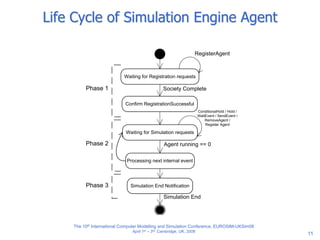
Life Cycle of Simulation Engine Agent
Waiting for Registration requests
Waiting for Simulation requests
Processing an internal event
Society Complete
Confirm RegistrationSuccessful
RegisterAgent
Agent running == 0
ConditionalHold / Hold /
WaitEvent / SendEvent /
RemoveAgent /
Register Agent
Simulation End Notification
Simulation End
Phase 1
Phase 2
Phase 3
Processing next internal event
The 10th International Computer Modelling and Simulation Conference, EUROSIM-UKSim08
April 1st – 3rd, Cambridge, UK, 2008
12
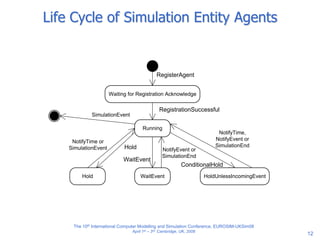
Life Cycle of Simulation Entity Agents
Running
Hold WaitEvent HoldUnlessIncomingEvent
Hold
WaitEvent
ConditionalHold
Waiting for Registration Acknowledge
RegisterAgent
RegistrationSuccessful
NotifyTime or
SimulationEvent NotifyEvent or
SimulationEnd
NotifyTime,
NotifyEvent or
SimulationEnd
SimulationEvent
The 10th International Computer Modelling and Simulation Conference, EUROSIM-UKSim08
April 1st – 3rd, Cambridge, UK, 2008
13
Simulation Behaviours
Behaviours can be of three types:
• Simulation Service Behaviours – implement
simulation services
• Simulation Life Cycle Behaviours – regulate
simulation agents’ life cycle
• Model Behaviours – “empty” behaviours to
plug conventional JADE behaviours in
SimJADE
The 10th International Computer Modelling and Simulation Conference, EUROSIM-UKSim08
April 1st – 3rd, Cambridge, UK, 2008
14
Example Application
The 10th International Computer Modelling and Simulation Conference, EUROSIM-UKSim08
April 1st – 3rd, Cambridge, UK, 2008
 Manufacturing Simulation
 Workers move around a factory and use the
machines
 They compete for the use of physical resources
and machines
 The space model is defined by nodes (possible
positions) and edges (space of movements)
 Each worker is autonomous and decides where
to go and which machines to use
 We shall not consider interactions among agents
15
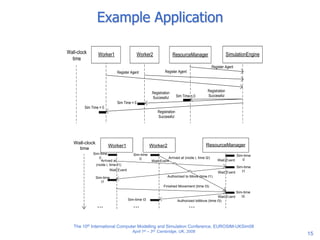
Example Application
The 10th International Computer Modelling and Simulation Conference, EUROSIM-UKSim08
April 1st – 3rd, Cambridge, UK, 2008
Civilian Civilian 2 ResourceManager
Arrived at (node i, time t2)
Arrived at
(node i, time t1)
Wall-clock
time
Authorized to Move (time t1)
Finished Movement (time t3)
Authorized toMove (time t3)
... ... ...
Sim-time
0
Sim-time
0
Sim-time
0
Sim-time
t1
Wait Event
Wait Event
Sim-time
t3
Sim-time
t1
Sim-time t3
Wait Event
Wait Event
Wait Event
Worker1 Worker2
Civilian Civilian 2 ResourceManagerWall-clock
time
... ... ...
Register Agent
SimulationEngine
Register AgentRegister Agent
Registration
Successful
Registration
Successful
Registration
Successful
...
Sim Time = 0
Sim Time = 0
Sim Time = 0
Worker1 Worker2
16
Conclusion
 Agent-technologies have been incorporated in
simulation systems to increase realism and to
ease the modelling of real systems
 We presented an agent-based formulation of
DES systems through the design of a software
framework named SimJADE
 SimJADE introduces concepts and behaviours
that can contain standard JADE component, and
thus makes the simulator development
transparent to MAS developers
The 10th International Computer Modelling and Simulation Conference, EUROSIM-UKSim08
April 1st – 3rd, Cambridge, UK, 2008

Bringing discrete event simulation concepts into multi agent systems ppt97__20080331

  • 1.
    The 10th InternationalComputer Modelling and Simulation Conference, EUROSIM-UKSim08 April 1st – 3rd, Cambridge, UK, 2008 1 Bringing Discrete Event Simulation Concepts into Multi-Agent Systems Daniele Gianni Dept. of Computer Science University of Rome TorVergata, Rome, Italy gianni@info.uniroma2.it
  • 2.
    2 Outline  Agent-based Modelling(ABM) Paradigm  Modelling Discrete Event Simulation (DES) System with ABM  Brief overview of JADE  Design of SimJADE  Example application The 10th International Computer Modelling and Simulation Conference, EUROSIM-UKSim08 April 1st – 3rd, Cambridge, UK, 2008
  • 3.
    3 Agent-based Modelling Paradigm Based on the concept of agent  Agent: • Autonomous, social, reactive • Possibly intelligent (intelligent agent):  Adaptation, reasoning and learning abilities  Multi-Agent System (MAS): • A society of agents • Agents collaborate for a common goal, and compete for individual goals • Agents share a semantic base for the communication The 10th International Computer Modelling and Simulation Conference, EUROSIM-UKSim08 April 1st – 3rd, Cambridge, UK, 2008
  • 4.
    4 Agent-based Modelling Paradigmin Simulation The incorporation of agents technology in simulation systems origins from:  Need of modelling adaptation, reasoning and learning abilities to increase the realism of human behaviour  Reflection of real systems structure, which is based on autonomous, interacting and possibly intelligent entities The 10th International Computer Modelling and Simulation Conference, EUROSIM-UKSim08 April 1st – 3rd, Cambridge, UK, 2008
  • 5.
    5 DES Process Interaction(PI) Paradigm  PI paradigm is based on: Independent Logical Processes (LPs) that perform internal computation and exchange events according to properties of causality and reproducibility.  LPs are typically: • Simulation entities, which incorporates simulation logic • Simulation engine, which coordinates the entities  Other more decentralised structures are possible (e.g. as in parallel simulation) The 10th International Computer Modelling and Simulation Conference, EUROSIM-UKSim08 April 1st – 3rd, Cambridge, UK, 2008
  • 6.
    6 ABM of DESPI System DES PI System as MAS:  LPs: autonomous, interacting  Common goal: to carry out the simulation according to the properties of causality and reproducibility  Individual goal: to use the physical resources to carry out the simulation of their part of model  LPs share semantic of simulation time and simulation services (e.g. send event or time notification) The 10th International Computer Modelling and Simulation Conference, EUROSIM-UKSim08 April 1st – 3rd, Cambridge, UK, 2008
  • 7.
    7 JADE  Is aJava-based framework for the development of MAS  FIPA Compliant  Defines: • Agents (state) • Behaviours (dynamic) • Communications  Message (Sender, Recipient, Performative Act, Content, Ontology, Language)  Basic Ontology (Concepts, Actions) The 10th International Computer Modelling and Simulation Conference, EUROSIM-UKSim08 April 1st – 3rd, Cambridge, UK, 2008
  • 8.
    8 SimJADE  Java frameworkfor Agent-based M&S  JADE-based, thus FIPA compliant  Defined through: • Simulation Ontology • Simulation Agent Society • Simulation Behaviours • Simulation Event Handlers The 10th International Computer Modelling and Simulation Conference, EUROSIM-UKSim08 April 1st – 3rd, Cambridge, UK, 2008
  • 9.
    9 DES-Ontology  Concepts: • AbsoluteSimulation Time • Relative Simulation Time  Actions: • Simulation Life Cycle Management (e.g. Register Agent, Simulation End, or Registration Successful) • Simulation Services (e.g. Send/Notify Event, Notify Time, or Wait Event) The 10th International Computer Modelling and Simulation Conference, EUROSIM-UKSim08 April 1st – 3rd, Cambridge, UK, 2008
  • 10.
    10 Simulation Agent Society Currently, the agent society is composed by: • A Simulation Engine Agent, which orchestrates the simulation agent society • One or more Simulation Entity Agents, which incorporate simulation logic The 10th International Computer Modelling and Simulation Conference, EUROSIM-UKSim08 April 1st – 3rd, Cambridge, UK, 2008
  • 11.
    11 Life Cycle ofSimulation Engine Agent Waiting for Registration requests Waiting for Simulation requests Processing an internal event Society Complete Confirm RegistrationSuccessful RegisterAgent Agent running == 0 ConditionalHold / Hold / WaitEvent / SendEvent / RemoveAgent / Register Agent Simulation End Notification Simulation End Phase 1 Phase 2 Phase 3 Processing next internal event The 10th International Computer Modelling and Simulation Conference, EUROSIM-UKSim08 April 1st – 3rd, Cambridge, UK, 2008
  • 12.
    12 Life Cycle ofSimulation Entity Agents Running Hold WaitEvent HoldUnlessIncomingEvent Hold WaitEvent ConditionalHold Waiting for Registration Acknowledge RegisterAgent RegistrationSuccessful NotifyTime or SimulationEvent NotifyEvent or SimulationEnd NotifyTime, NotifyEvent or SimulationEnd SimulationEvent The 10th International Computer Modelling and Simulation Conference, EUROSIM-UKSim08 April 1st – 3rd, Cambridge, UK, 2008
  • 13.
    13 Simulation Behaviours Behaviours canbe of three types: • Simulation Service Behaviours – implement simulation services • Simulation Life Cycle Behaviours – regulate simulation agents’ life cycle • Model Behaviours – “empty” behaviours to plug conventional JADE behaviours in SimJADE The 10th International Computer Modelling and Simulation Conference, EUROSIM-UKSim08 April 1st – 3rd, Cambridge, UK, 2008
  • 14.
    14 Example Application The 10thInternational Computer Modelling and Simulation Conference, EUROSIM-UKSim08 April 1st – 3rd, Cambridge, UK, 2008  Manufacturing Simulation  Workers move around a factory and use the machines  They compete for the use of physical resources and machines  The space model is defined by nodes (possible positions) and edges (space of movements)  Each worker is autonomous and decides where to go and which machines to use  We shall not consider interactions among agents
  • 15.
    15 Example Application The 10thInternational Computer Modelling and Simulation Conference, EUROSIM-UKSim08 April 1st – 3rd, Cambridge, UK, 2008 Civilian Civilian 2 ResourceManager Arrived at (node i, time t2) Arrived at (node i, time t1) Wall-clock time Authorized to Move (time t1) Finished Movement (time t3) Authorized toMove (time t3) ... ... ... Sim-time 0 Sim-time 0 Sim-time 0 Sim-time t1 Wait Event Wait Event Sim-time t3 Sim-time t1 Sim-time t3 Wait Event Wait Event Wait Event Worker1 Worker2 Civilian Civilian 2 ResourceManagerWall-clock time ... ... ... Register Agent SimulationEngine Register AgentRegister Agent Registration Successful Registration Successful Registration Successful ... Sim Time = 0 Sim Time = 0 Sim Time = 0 Worker1 Worker2
  • 16.
    16 Conclusion  Agent-technologies havebeen incorporated in simulation systems to increase realism and to ease the modelling of real systems  We presented an agent-based formulation of DES systems through the design of a software framework named SimJADE  SimJADE introduces concepts and behaviours that can contain standard JADE component, and thus makes the simulator development transparent to MAS developers The 10th International Computer Modelling and Simulation Conference, EUROSIM-UKSim08 April 1st – 3rd, Cambridge, UK, 2008