Focusing on Workplace Culture to
Drive Practice Change: An Exemplar
Case Synopsis
Dr Brigid Gillespie
Professor of Patient Safety
Griffith University & Gold Coast University Hospital
b.gillespie@griffith.edu.au
Acknowledgements
Research team
Prof Wendy Chaboyer, Prof Andrea Marshall, Evelyn Kang, Emma Harbeck,
Joanne Lavin, Catherine Steel, Tina Nikolic, A/Prof Teresa Withers, Dr Nicole
Fairweather, Therese Gardiner, Dr Mark Sykes, Dr Kyra Hamilton & Dr Dianne
Ball.
Stakeholders
§ Study participants
§ Princess Alexandra & Gold Coast University Hospitals
Funders
§ Australian Research Council (ARC) Discovery Early Career Research
Award (DECRA): 2012-15
§ NHMRC Translation Into Research Practice Fellowship (TRIP), 2014-16
§ National Centre for Research Excellence in Nursing Interventions
(NCREN), Griffith University
§ Australian College of periOperative Nurses (ACORN)
§ Gold Coast University Hospital & Griffith University Collaborative Grant
Background
§ Up to 60% of all adverse events occur in surgery, with 33% resulting
in permanent disability, and ≈13% resulting in patient death.
§ High-risk area of surgery more vulnerable to teamwork and
communication failures.
§ Investigating social and cognitive skills that enable or impede team
performance important to identify ways to improve team cohesion in
surgery.
§ Non-technical skills (NTS) = interpersonal (i.e., communication,
teamwork and leadership), and cognitive skills (i.e., decision making
and situational awareness).
§ Impact of work culture on use of NTS.
Case Study 1:
Effect of a brief team training program on
surgical teams’ non-technical skills:
An observational study
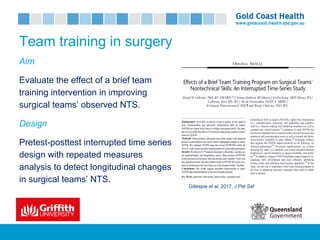
Team training in surgery
Aim
Evaluate the effect of a brief team
training intervention in improving
surgical teams’ observed NTS.
Design
Pretest-posttest interrupted time series
design with repeated measures
analysis to detect longitudinal changes
in surgical teams’ NTS.
Gillespie et al, 2017, J Pat Saf
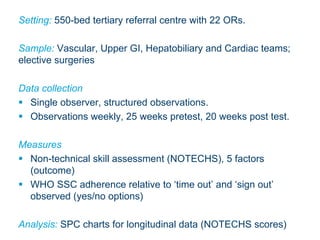
Setting: 550-bed tertiary referral centre with 22 ORs.
Sample: Vascular, Upper GI, Hepatobiliary and Cardiac teams;
elective surgeries
Data collection
§ Single observer, structured observations.
§ Observations weekly, 25 weeks pretest, 20 weeks post test.
Measures
§ Non-technical skill assessment (NOTECHS), 5 factors
(outcome)
§ WHO SSC adherence relative to ‘time out’ and ‘sign out’
observed (yes/no options)
Analysis: SPC charts for longitudinal data (NOTECHS scores)
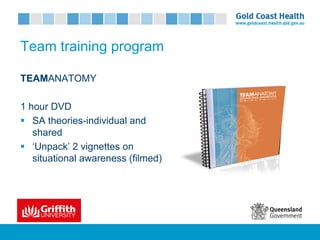
Team training program
TEAMANATOMY
1 hour DVD
§ SA theories-individual and
shared
§ ‘Unpack’ 2 vignettes on
situational awareness (filmed)
Results
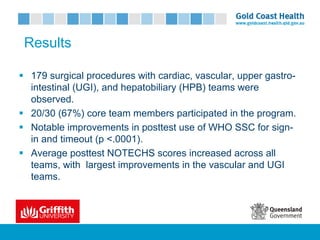
§ 179 surgical procedures with cardiac, vascular, upper gastro-
intestinal (UGI), and hepatobiliary (HPB) teams were
observed.
§ 20/30 (67%) core team members participated in the program.
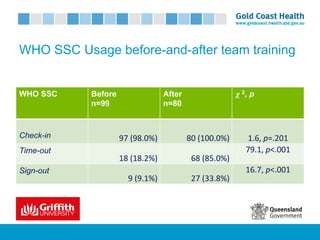
§ Notable improvements in posttest use of WHO SSC for sign-
in and timeout (p <.0001).
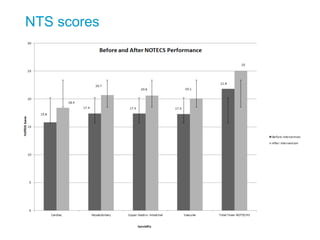
§ Average posttest NOTECHS scores increased across all
teams, with largest improvements in the vascular and UGI
teams.
WHO SSC Usage before-and-after team training
WHO SSC Before
n=99
After
n=80
c 2, p
Check-in 97	(98.0%) 80	(100.0%) 1.6,	p=.201
Time-out
18	(18.2%) 68	(85.0%)
79.1,	p<.001
Sign-out
9	(9.1%) 27	(33.8%)
16.7,	p<.001
NTS scores
Case Study 2:
Changes in Surgical Team Performance &
Perceptions of Safety Climate following
Expansion of Perioperative Services
Background
§ Increased in number of commissioned OR from 11
to 22
§ Affiliated and co-located within a university precinct.
§ On site research facilities
§ Expanded services, e.g., cardiac
§ State of the art equipment in the OR
§ Working towards Magnet Recognition program
Hospital relocation
Aim: To observe changes in surgical teams’ work process
following hospital relocation.
Design: Natualistic longitudinal before-and-after study
1. Survey (using Teamwork Climate & Safety Culture)
2. Structured observations NTS (using NOTECHS tool) &
WHO SSC compliance
§ Observations for each phase weekly, 6 months pre-relocation and
12 month post relocation
§ 25 pre, 20 post hospital relocation
§ Specialties observed; orthopaedic, paediatrics, general and thoracic
Results
§ 186 surgical procedures with general, paediatric, thoracic and
orthopaedic teams observed.
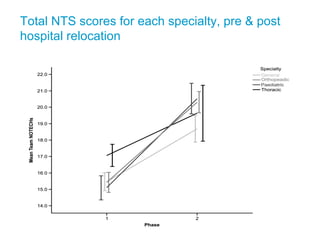
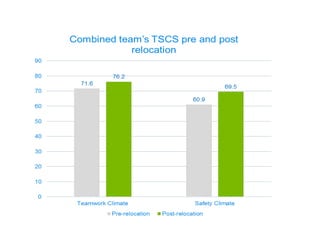
§ Increased average team and safety climate scores for all teams.
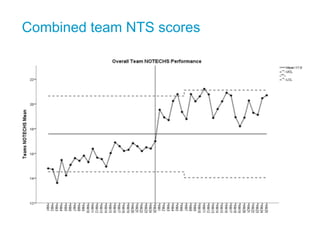
§ Mean post-relocation NOTECHS scores increased across all
teams → significant improvements (p=0.020), with largest
improvements in the paediatric team.
§ TCSC response rate 80% & 90% pre-post relocation
respectively.
§ Non-significant improvements after relocation in perceptions of
teamwork climate and safety culture.
Combined team NTS scores
Total NTS scores for each specialty, pre & post
hospital relocation
Comments
§ First study to examine process changes in surgical team
performance during such a major upheaval.
§ Results suggest a naturally occurring process change over time.
§ Environmental factors (e.g. ergonomic) may support collaborative
work.
§ Increase in staff numbers – i.e., new staff creates a positive
change in work place culture.
§ Communication & teamwork among surgical teams improved in
transient teams [Korkiakangas et al. (2016) & Gillespie et al. (2013)]
Case Study 3:
Passing The Baton to ensure Safe Care:
Evaluation of a Knowledge Translation
Intervention to Improve Use of the
Surgical Safety Checklist
Checklist implementation
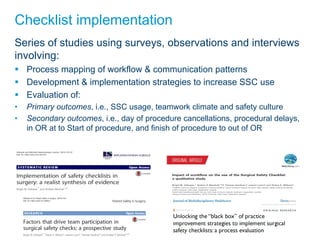
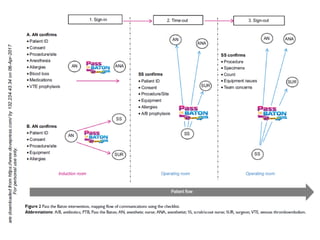
Series of studies using surveys, observations and interviews
involving:
§ Process mapping of workflow & communication patterns
§ Development & implementation strategies to increase SSC use
§ Evaluation of:
• Primary outcomes, i.e., SSC usage, teamwork climate and safety culture
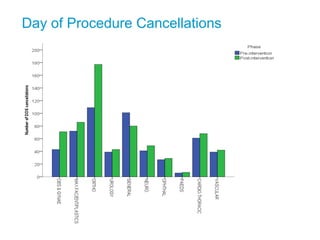
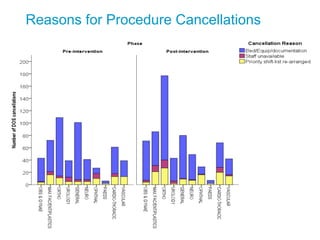
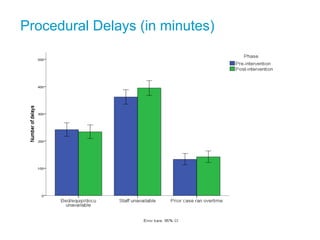
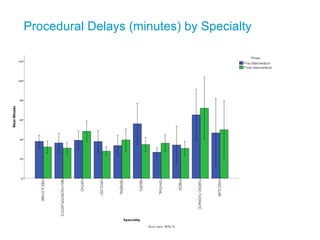
• Secondary outcomes, i.e., day of procedure cancellations, procedural delays,
in OR at to Start of procedure, and finish of procedure to out of OR
Implementation of Pass The Baton (PTB)
§ Development of multi-component intervention co-
created with stakeholders
Components included:
1. Social influence (opinion leaders, change champions)
2. Audit & feedback (information, education, knowledge
brokers)
3. Reinforcement (prompts & reminders)
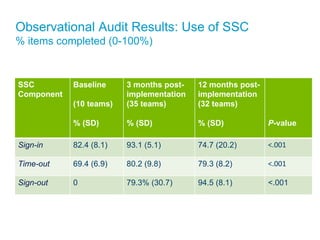
Observational Audit Results: Use of SSC
% items completed (0-100%)
SSC
Component
Baseline
(10 teams)
% (SD)
3 months post-
implementation
(35 teams)
% (SD)
12 months post-
implementation
(32 teams)
% (SD) P-value
Sign-in 82.4 (8.1) 93.1 (5.1) 74.7 (20.2) <.001
Time-out 69.4 (6.9) 80.2 (9.8) 79.3 (8.2) <.001
Sign-out 0 79.3% (30.7) 94.5 (8.1) <.001
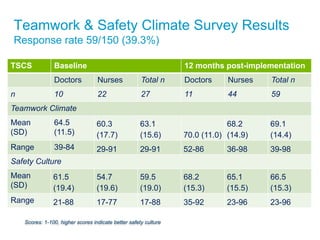
Teamwork & Safety Climate Survey Results
Response rate 59/150 (39.3%)
TSCS Baseline 12 months post-implementation
Doctors Nurses Total n Doctors Nurses Total n
n 10 22 27 11 44 59
Teamwork Climate
Mean
(SD)
64.5
(11.5)
60.3
(17.7)
63.1
(15.6) 70.0 (11.0)
68.2
(14.9)
69.1
(14.4)
Range 39-84 29-91 29-91 52-86 36-98 39-98
Safety Culture
Mean
(SD)
61.5
(19.4)
54.7
(19.6)
59.5
(19.0)
68.2
(15.3)
65.1
(15.5)
66.5
(15.3)
Range 21-88 17-77 17-88 35-92 23-96 23-96
Scores: 1-100, higher scores indicate better safety culture
Day of Procedure Cancellations
Reasons for Procedure Cancellations
Procedural Delays (in minutes)
Procedural Delays (minutes) by Specialty
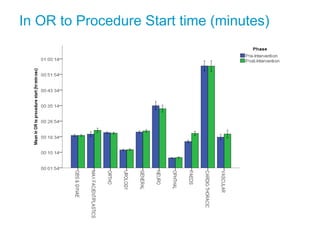
In OR to Procedure Start time (minutes)
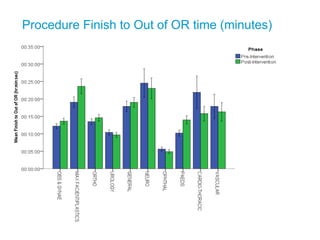
Procedure Finish to Out of OR time (minutes)
Comments
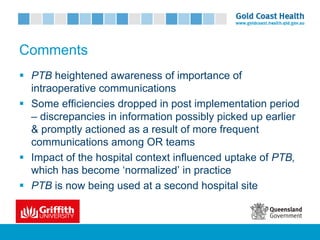
§ PTB heightened awareness of importance of
intraoperative communications
§ Some efficiencies dropped in post implementation period
– discrepancies in information possibly picked up earlier
& promptly actioned as a result of more frequent
communications among OR teams
§ Impact of the hospital context influenced uptake of PTB,
which has become ‘normalized’ in practice
§ PTB is now being used at a second hospital site
Conclusions
§ Implementation of any new innovation or evidence-
based practice, shaped by macro (organizational),
meso (departmental), and micro (individual) factors.
§ Buy-in of stakeholders at all levels, essential for
successful implementation and ongoing change.
§ Tensions b/ need to meet financial, activity-based
targets and need to maintain safety and quality.
Conclusions (2)
§ Success of Pass The Baton – why?
§ Cost-neutral, benefit recognized, addressed
workflow issues, able to be adapted in real time.
§ Barriers analysis (not undertaken when
implementing TEAMANATOMY), taking into account
organizational factors.
Conclusions (3)
§ Pragmatic approach to implementation, taking into
account the ‘messiness’ of context.
§ Strong leadership, consistency and audit; necessary
mechanisms to sustain any practice improvement
strategy.
Questions or Comments?
Dr Brigid Gillespie
Professor of Patient Safety
b.gillespie@griffith.edu.au

Brigid Gillespie - Griffith University

  • 1.
    Focusing on WorkplaceCulture to Drive Practice Change: An Exemplar Case Synopsis Dr Brigid Gillespie Professor of Patient Safety Griffith University & Gold Coast University Hospital b.gillespie@griffith.edu.au
  • 2.
    Acknowledgements Research team Prof WendyChaboyer, Prof Andrea Marshall, Evelyn Kang, Emma Harbeck, Joanne Lavin, Catherine Steel, Tina Nikolic, A/Prof Teresa Withers, Dr Nicole Fairweather, Therese Gardiner, Dr Mark Sykes, Dr Kyra Hamilton & Dr Dianne Ball. Stakeholders § Study participants § Princess Alexandra & Gold Coast University Hospitals Funders § Australian Research Council (ARC) Discovery Early Career Research Award (DECRA): 2012-15 § NHMRC Translation Into Research Practice Fellowship (TRIP), 2014-16 § National Centre for Research Excellence in Nursing Interventions (NCREN), Griffith University § Australian College of periOperative Nurses (ACORN) § Gold Coast University Hospital & Griffith University Collaborative Grant
  • 3.
    Background § Up to60% of all adverse events occur in surgery, with 33% resulting in permanent disability, and ≈13% resulting in patient death. § High-risk area of surgery more vulnerable to teamwork and communication failures. § Investigating social and cognitive skills that enable or impede team performance important to identify ways to improve team cohesion in surgery. § Non-technical skills (NTS) = interpersonal (i.e., communication, teamwork and leadership), and cognitive skills (i.e., decision making and situational awareness). § Impact of work culture on use of NTS.
  • 4.
    Case Study 1: Effectof a brief team training program on surgical teams’ non-technical skills: An observational study
  • 5.
    Team training insurgery Aim Evaluate the effect of a brief team training intervention in improving surgical teams’ observed NTS. Design Pretest-posttest interrupted time series design with repeated measures analysis to detect longitudinal changes in surgical teams’ NTS. Gillespie et al, 2017, J Pat Saf
  • 6.
    Setting: 550-bed tertiaryreferral centre with 22 ORs. Sample: Vascular, Upper GI, Hepatobiliary and Cardiac teams; elective surgeries Data collection § Single observer, structured observations. § Observations weekly, 25 weeks pretest, 20 weeks post test. Measures § Non-technical skill assessment (NOTECHS), 5 factors (outcome) § WHO SSC adherence relative to ‘time out’ and ‘sign out’ observed (yes/no options) Analysis: SPC charts for longitudinal data (NOTECHS scores)
  • 7.
    Team training program TEAMANATOMY 1hour DVD § SA theories-individual and shared § ‘Unpack’ 2 vignettes on situational awareness (filmed)
  • 8.
    Results § 179 surgicalprocedures with cardiac, vascular, upper gastro- intestinal (UGI), and hepatobiliary (HPB) teams were observed. § 20/30 (67%) core team members participated in the program. § Notable improvements in posttest use of WHO SSC for sign- in and timeout (p <.0001). § Average posttest NOTECHS scores increased across all teams, with largest improvements in the vascular and UGI teams.
  • 9.
    WHO SSC Usagebefore-and-after team training WHO SSC Before n=99 After n=80 c 2, p Check-in 97 (98.0%) 80 (100.0%) 1.6, p=.201 Time-out 18 (18.2%) 68 (85.0%) 79.1, p<.001 Sign-out 9 (9.1%) 27 (33.8%) 16.7, p<.001
  • 10.
  • 11.
    Case Study 2: Changesin Surgical Team Performance & Perceptions of Safety Climate following Expansion of Perioperative Services
  • 12.
    Background § Increased innumber of commissioned OR from 11 to 22 § Affiliated and co-located within a university precinct. § On site research facilities § Expanded services, e.g., cardiac § State of the art equipment in the OR § Working towards Magnet Recognition program
  • 13.
    Hospital relocation Aim: Toobserve changes in surgical teams’ work process following hospital relocation. Design: Natualistic longitudinal before-and-after study 1. Survey (using Teamwork Climate & Safety Culture) 2. Structured observations NTS (using NOTECHS tool) & WHO SSC compliance § Observations for each phase weekly, 6 months pre-relocation and 12 month post relocation § 25 pre, 20 post hospital relocation § Specialties observed; orthopaedic, paediatrics, general and thoracic
  • 14.
    Results § 186 surgicalprocedures with general, paediatric, thoracic and orthopaedic teams observed. § Increased average team and safety climate scores for all teams. § Mean post-relocation NOTECHS scores increased across all teams → significant improvements (p=0.020), with largest improvements in the paediatric team. § TCSC response rate 80% & 90% pre-post relocation respectively. § Non-significant improvements after relocation in perceptions of teamwork climate and safety culture.
  • 15.
  • 16.
    Total NTS scoresfor each specialty, pre & post hospital relocation
  • 18.
    Comments § First studyto examine process changes in surgical team performance during such a major upheaval. § Results suggest a naturally occurring process change over time. § Environmental factors (e.g. ergonomic) may support collaborative work. § Increase in staff numbers – i.e., new staff creates a positive change in work place culture. § Communication & teamwork among surgical teams improved in transient teams [Korkiakangas et al. (2016) & Gillespie et al. (2013)]
  • 19.
    Case Study 3: PassingThe Baton to ensure Safe Care: Evaluation of a Knowledge Translation Intervention to Improve Use of the Surgical Safety Checklist
  • 20.
    Checklist implementation Series ofstudies using surveys, observations and interviews involving: § Process mapping of workflow & communication patterns § Development & implementation strategies to increase SSC use § Evaluation of: • Primary outcomes, i.e., SSC usage, teamwork climate and safety culture • Secondary outcomes, i.e., day of procedure cancellations, procedural delays, in OR at to Start of procedure, and finish of procedure to out of OR
  • 21.
    Implementation of PassThe Baton (PTB) § Development of multi-component intervention co- created with stakeholders Components included: 1. Social influence (opinion leaders, change champions) 2. Audit & feedback (information, education, knowledge brokers) 3. Reinforcement (prompts & reminders)
  • 23.
    Observational Audit Results:Use of SSC % items completed (0-100%) SSC Component Baseline (10 teams) % (SD) 3 months post- implementation (35 teams) % (SD) 12 months post- implementation (32 teams) % (SD) P-value Sign-in 82.4 (8.1) 93.1 (5.1) 74.7 (20.2) <.001 Time-out 69.4 (6.9) 80.2 (9.8) 79.3 (8.2) <.001 Sign-out 0 79.3% (30.7) 94.5 (8.1) <.001
  • 24.
    Teamwork & SafetyClimate Survey Results Response rate 59/150 (39.3%) TSCS Baseline 12 months post-implementation Doctors Nurses Total n Doctors Nurses Total n n 10 22 27 11 44 59 Teamwork Climate Mean (SD) 64.5 (11.5) 60.3 (17.7) 63.1 (15.6) 70.0 (11.0) 68.2 (14.9) 69.1 (14.4) Range 39-84 29-91 29-91 52-86 36-98 39-98 Safety Culture Mean (SD) 61.5 (19.4) 54.7 (19.6) 59.5 (19.0) 68.2 (15.3) 65.1 (15.5) 66.5 (15.3) Range 21-88 17-77 17-88 35-92 23-96 23-96 Scores: 1-100, higher scores indicate better safety culture
  • 25.
    Day of ProcedureCancellations
  • 26.
    Reasons for ProcedureCancellations
  • 27.
  • 28.
  • 29.
    In OR toProcedure Start time (minutes)
  • 30.
    Procedure Finish toOut of OR time (minutes)
  • 31.
    Comments § PTB heightenedawareness of importance of intraoperative communications § Some efficiencies dropped in post implementation period – discrepancies in information possibly picked up earlier & promptly actioned as a result of more frequent communications among OR teams § Impact of the hospital context influenced uptake of PTB, which has become ‘normalized’ in practice § PTB is now being used at a second hospital site
  • 32.
    Conclusions § Implementation ofany new innovation or evidence- based practice, shaped by macro (organizational), meso (departmental), and micro (individual) factors. § Buy-in of stakeholders at all levels, essential for successful implementation and ongoing change. § Tensions b/ need to meet financial, activity-based targets and need to maintain safety and quality.
  • 33.
    Conclusions (2) § Successof Pass The Baton – why? § Cost-neutral, benefit recognized, addressed workflow issues, able to be adapted in real time. § Barriers analysis (not undertaken when implementing TEAMANATOMY), taking into account organizational factors.
  • 34.
    Conclusions (3) § Pragmaticapproach to implementation, taking into account the ‘messiness’ of context. § Strong leadership, consistency and audit; necessary mechanisms to sustain any practice improvement strategy.
  • 35.
    Questions or Comments? DrBrigid Gillespie Professor of Patient Safety b.gillespie@griffith.edu.au