Quantum
Computing
UOC-BSPHY-F2021/06
Mateen Arshad
Content
1. Introduction
2. History
3. Why Quantum computer
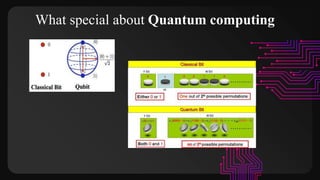
4. What special about quantum computer
5. Advantages
6. Disadvantages
Introduction
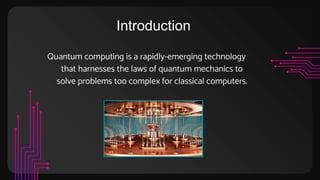
Quantum computing is a rapidly-emerging technology
that harnesses the laws of quantum mechanics to
solve problems too complex for classical computers.
HISTORY
 1982 - Feynman proposed the idea of creating machines
based on the laws of quantum mechanics instead of the laws of
classical physics.
1985 - David Deutsch developed the quantum Turing
machine, showing that quantum circuits are universal.
 1994 - Peter Shor came up with a quantum algorithm to
factor very large numbers in polynomial time.
1997 - Lov Grover develops a quantum search algorithm
with O(√N) complexity
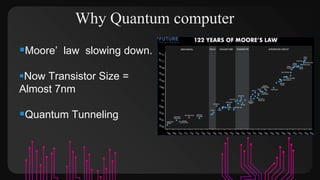
Why Quantum computer
Moore’ law slowing down.
Now Transistor Size =
Almost 7nm
Quantum Tunneling
What special about Quantum computing
Advantages
Faster computations:-
Quantum computers have computation power higher than
supercomputers also. They can process data at 1000 times faster
than normal computers and supercomputers.
Best for simulation:-
Quantum computers are best for doing data simulation computing.
There are many algorithms created that can simulate various things
like weather forecasting, chemical simulation etc.
Disadvantages
Algorithm creation:-
For every type of computation, it needs to write a new algorithm. Quantum computers
cannot work as classical computers, they need special algorithms to perform tasks in
their environment.
The low temperature needed:-
As the processing in these computers is done very deeply so it needs a temperature of
negative 273.135 degree C. This is the lowest temperature of the universe and it is very
difficult to maintain that temperature.
Not open for public:-
Due to the high range price they are not available for public use. Also, the errors in
these type of computers are high because they are still in the development phase.
Thank You

Brief Presentation on Quantum Computing.pptx

  • 1.
  • 2.
    Content 1. Introduction 2. History 3.Why Quantum computer 4. What special about quantum computer 5. Advantages 6. Disadvantages
  • 3.
    Introduction Quantum computing isa rapidly-emerging technology that harnesses the laws of quantum mechanics to solve problems too complex for classical computers.
  • 4.
    HISTORY  1982 -Feynman proposed the idea of creating machines based on the laws of quantum mechanics instead of the laws of classical physics. 1985 - David Deutsch developed the quantum Turing machine, showing that quantum circuits are universal.  1994 - Peter Shor came up with a quantum algorithm to factor very large numbers in polynomial time. 1997 - Lov Grover develops a quantum search algorithm with O(√N) complexity
  • 5.
    Why Quantum computer Moore’law slowing down. Now Transistor Size = Almost 7nm Quantum Tunneling
  • 6.
    What special aboutQuantum computing
  • 7.
    Advantages Faster computations:- Quantum computershave computation power higher than supercomputers also. They can process data at 1000 times faster than normal computers and supercomputers. Best for simulation:- Quantum computers are best for doing data simulation computing. There are many algorithms created that can simulate various things like weather forecasting, chemical simulation etc.
  • 8.
    Disadvantages Algorithm creation:- For everytype of computation, it needs to write a new algorithm. Quantum computers cannot work as classical computers, they need special algorithms to perform tasks in their environment. The low temperature needed:- As the processing in these computers is done very deeply so it needs a temperature of negative 273.135 degree C. This is the lowest temperature of the universe and it is very difficult to maintain that temperature. Not open for public:- Due to the high range price they are not available for public use. Also, the errors in these type of computers are high because they are still in the development phase.
  • 9.