Cybersecurity Professionals
Supplementary Reading
October 2017
Cyber 101: Supplementary Reading© 2017 Deloitte Touche Tohmatsu Limited
Slide 2
As long as headlines continue to report the crimes of cyber
perpetrators against organisations, cyber security is not an
optional choice and cyber security professionals are required.
Who are they?
Individuals responsible for protecting an organisation’s
network, infrastructure and computer systems. Cybersecurity
professionals have a broad range of skills beyond IT including
an understanding in business process, vendor management,
physical security, threat awareness, and business continuity
management (not just disaster recovery).
3 Must Have Skills for Cybersecurity Professionals
1. A strategist to ensure protection of network, infrastructure
and computer systems.
2. People management and communication skills to ensure
effective coordination with teams and clients. He/she needs
to communicate with every professional within an
organization about the terms of IT.
3. Technical competency. One should always re-skills with
advanced technology skills in order to be capable of
grasping technical security issue immediate and resolve the
same.
Who are Cyber Professionals?
“An asset is what we’re
trying to protect”
Asset – People, property,
and information.
http://www.disaster-resource.com/index.php?option=com_content&view=article&id=1717:the-importance-of-cyber-security-within-your-organization
https://www.simplilearn.com/it-security-professionals-key-roles-responsibilities-article
https://www.darkreading.com/careers-and-people/health-it-and-cybersecurity-5-hiring-misconceptions-to-avoid/a/d-id/1329932?
Cyber 101: Supplementary Reading© 2017 Deloitte Touche Tohmatsu Limited
Slide 3
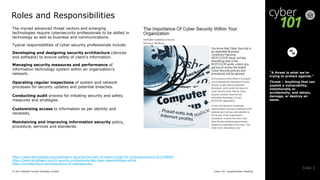
Roles and Responsibilities
The myriad advanced threat vectors and emerging
technologies require cybersecurity professionals to be skilled in
technology as well as business and communications.
Typical responsibilities of cyber security professionals include:
Developing and designing security architecture (devices
and software) to ensure safety of client’s information.
Managing security measures and performance of
information technology system within an organization’s
network.
Operating regular inspections of system and network
processes for security updates and potential breaches.
Conducting audit process for initiating security and safety
measures and strategies.
Customizing access to information as per identity and
necessity.
Maintaining and improving information security policy,
procedure, services and standards.
“A threat is what we’re
trying to protect against.”
Threat – Anything that can
exploit a vulnerability,
intentionally or
accidentally, and obtain,
damage, or destroy an
asset.
https://www.darkreading.com/application-security/the-team-of-teams-model-for-cybersecurity/a/d-id/1329840?
https://www.simplilearn.com/it-security-professionals-key-roles-responsibilities-article
https://monstercloud.com/importance-of-cybersecurity/
Cyber 101: Supplementary Reading© 2017 Deloitte Touche Tohmatsu Limited
Slide 4
Why is there a shortage?
There are no signs of the bad guys limiting their talent pools
and cybercrime is now a US$445 billion industry with a
trajectory of possibly trillions.
To illustrate, toolkits developed by cyber criminals have
adapted cloud and managed service business models to
propagate and expand cyber criminal activities. These toolkits
are easily obtainable with no formal education required to learn
how to use them. The revenue from the sales of these toolkits
go on to fund more elaborate schemes designed to create
chaos and opportunities to rob organisations of their assets.
Cybercriminals are becoming more organised and aggressive
while the good guys are struggling to fill their ranks.
In short, the frequency of successfully executed cybercrimes as
a result of current day open network society, coupled with the
use of cloud services and applications, have created an urgent
need in organisations to rapidly advance their cybersecurity
countermeasures.
Cybersecurity experts who possess the knowledge, education
and most importantly, the thought process necessary to
confront the difficulties that accompany the constantly evolving
cyber activities are in demand to tackle the challenges posed in
the cyber world.
“A vulnerability is a
weakness or gap in our
protection efforts.”
Vulnerability –
Weaknesses or gaps in a
security program that can
be exploited by threats to
gain unauthorized access
to an asset.
https://www.threatanalysis.com/2010/05/03/threat-vulnerability-risk-commonly-mixed-up-terms/
https://hbr.org/2017/05/cybersecurity-has-a-serious-talent-shortage-heres-how-to-fix-it
https://monstercloud.com/importance-of-cybersecurity/
Cyber 101: Supplementary Reading© 2017 Deloitte Touche Tohmatsu Limited
Slide 5
More facts on the shortage of cyber professionals
Reason:
• Formal education, professional certification and training are
required to become a cyber security professional
• As the rise of cyber attacks escalate, schools are not
graduating enough cyber security professionals to keep up
with the ongoing cyber attacks
• Recent research by Cisco showed that 29% of breached
organisations lost revenue and according to the World
Economic Forum’s Global Risks Report
• Most organisations face challenges in interpreting the
detection or mitigation of cyber security threats
“A vulnerability is a
weakness or gap in our
protection efforts.”
Vulnerability –
Weaknesses or gaps in a
security program that can
be exploited by threats to
gain unauthorized access
to an asset.
https://www.forbes.com/sites/quora/2017/05/31/the-top-cyber-security-challenges-experts-are-facing-today/#4b266dda2238
https://www.forbes.com/sites/jeffkauflin/2017/03/16/the-fast-growing-job-with-a-huge-skills-gap-cyber-security/#7f2f1edd5163
Cyber 101: Supplementary Reading© 2017 Deloitte Touche Tohmatsu Limited
Slide 6
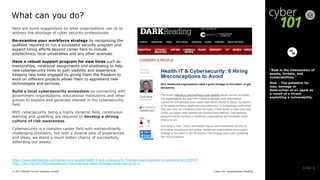
What can you do?
Here are some suggestions on what organisations can do to
address the shortage of cyber security professionals
Re-examine your workforce strategy by recognizing the
qualities required to run a successful security program and
expand hiring efforts beyond career fairs to include
polytechnics, local universities and any other avenues.
Have a robust support program for new hires such as
mentorships, rotational assignments and shadowing to help
new cybersecurity hires to gain visibility and experience.
Keeping new hires engaged by giving them the freedom to
work on different projects allows them to apprehend new
technologies and services.
Build a local cybersecurity ecosystem by connecting with
government organisations, educational institutions and other
groups to explore and generate interest in the cybersecurity
field.
With cybersecurity being a highly dynamic field, continuous
learning and upskilling are required to develop a strong
culture of risk awareness.
Cybersecurity is a complex career field with extraordinarily
challenging problems, but with a diverse pool of experiences
and ideas, we stand a much better chance of successfully
defending our assets.
“Risk is the intersection of
assets, threats, and
vulnerabilities.”
Risk – The potential for
loss, damage or
destruction of an asset as
a result of a threat
exploiting a vulnerability.
https://www.darkreading.com/careers-and-people/health-it-and-cybersecurity-5-hiring-misconceptions-to-avoid/a/d-id/1329932?
https://hbr.org/2017/05/cybersecurity-has-a-serious-talent-shortage-heres-how-to-fix-it
Deloitte refers to one or more of Deloitte Touche Tohmatsu Limited, a UK private company limited by guarantee (“DTTL”), its
network of member firms, and their related entities. DTTL and each of its member firms are legally separate and independent
entities. DTTL (also referred to as “Deloitte Global”) does not provide services to clients. Please see www.deloitte.com/about to
learn more about our global network of member firms.
Deloitte provides audit, tax, consulting, and financial advisory services to public and private clients spanning multiple industries.
With a globally connected network of member firms in more than 150 countries and territories, Deloitte brings world-class
capabilities and high-quality service to clients, delivering the insights they need to address their most complex business
challenges. Deloitte’s more than 244,000 professionals are committed to becoming the standard of excellence.
This communication contains general information only, and none of Deloitte Touche Tohmatsu Limited, its member firms, or their
related entities (collectively, the “Deloitte Network”) is, by means of this communication, rendering professional advice or services.
No entity in the Deloitte network shall be responsible for any loss whatsoever sustained by any person who relies on this
communication.
© 2017. For information, contact Deloitte Touche Tohmatsu Limited

2017 october supplementary_reading

  • 1.
  • 2.
    Cyber 101: SupplementaryReading© 2017 Deloitte Touche Tohmatsu Limited Slide 2 As long as headlines continue to report the crimes of cyber perpetrators against organisations, cyber security is not an optional choice and cyber security professionals are required. Who are they? Individuals responsible for protecting an organisation’s network, infrastructure and computer systems. Cybersecurity professionals have a broad range of skills beyond IT including an understanding in business process, vendor management, physical security, threat awareness, and business continuity management (not just disaster recovery). 3 Must Have Skills for Cybersecurity Professionals 1. A strategist to ensure protection of network, infrastructure and computer systems. 2. People management and communication skills to ensure effective coordination with teams and clients. He/she needs to communicate with every professional within an organization about the terms of IT. 3. Technical competency. One should always re-skills with advanced technology skills in order to be capable of grasping technical security issue immediate and resolve the same. Who are Cyber Professionals? “An asset is what we’re trying to protect” Asset – People, property, and information. http://www.disaster-resource.com/index.php?option=com_content&view=article&id=1717:the-importance-of-cyber-security-within-your-organization https://www.simplilearn.com/it-security-professionals-key-roles-responsibilities-article https://www.darkreading.com/careers-and-people/health-it-and-cybersecurity-5-hiring-misconceptions-to-avoid/a/d-id/1329932?
  • 3.
    Cyber 101: SupplementaryReading© 2017 Deloitte Touche Tohmatsu Limited Slide 3 Roles and Responsibilities The myriad advanced threat vectors and emerging technologies require cybersecurity professionals to be skilled in technology as well as business and communications. Typical responsibilities of cyber security professionals include: Developing and designing security architecture (devices and software) to ensure safety of client’s information. Managing security measures and performance of information technology system within an organization’s network. Operating regular inspections of system and network processes for security updates and potential breaches. Conducting audit process for initiating security and safety measures and strategies. Customizing access to information as per identity and necessity. Maintaining and improving information security policy, procedure, services and standards. “A threat is what we’re trying to protect against.” Threat – Anything that can exploit a vulnerability, intentionally or accidentally, and obtain, damage, or destroy an asset. https://www.darkreading.com/application-security/the-team-of-teams-model-for-cybersecurity/a/d-id/1329840? https://www.simplilearn.com/it-security-professionals-key-roles-responsibilities-article https://monstercloud.com/importance-of-cybersecurity/
  • 4.
    Cyber 101: SupplementaryReading© 2017 Deloitte Touche Tohmatsu Limited Slide 4 Why is there a shortage? There are no signs of the bad guys limiting their talent pools and cybercrime is now a US$445 billion industry with a trajectory of possibly trillions. To illustrate, toolkits developed by cyber criminals have adapted cloud and managed service business models to propagate and expand cyber criminal activities. These toolkits are easily obtainable with no formal education required to learn how to use them. The revenue from the sales of these toolkits go on to fund more elaborate schemes designed to create chaos and opportunities to rob organisations of their assets. Cybercriminals are becoming more organised and aggressive while the good guys are struggling to fill their ranks. In short, the frequency of successfully executed cybercrimes as a result of current day open network society, coupled with the use of cloud services and applications, have created an urgent need in organisations to rapidly advance their cybersecurity countermeasures. Cybersecurity experts who possess the knowledge, education and most importantly, the thought process necessary to confront the difficulties that accompany the constantly evolving cyber activities are in demand to tackle the challenges posed in the cyber world. “A vulnerability is a weakness or gap in our protection efforts.” Vulnerability – Weaknesses or gaps in a security program that can be exploited by threats to gain unauthorized access to an asset. https://www.threatanalysis.com/2010/05/03/threat-vulnerability-risk-commonly-mixed-up-terms/ https://hbr.org/2017/05/cybersecurity-has-a-serious-talent-shortage-heres-how-to-fix-it https://monstercloud.com/importance-of-cybersecurity/
  • 5.
    Cyber 101: SupplementaryReading© 2017 Deloitte Touche Tohmatsu Limited Slide 5 More facts on the shortage of cyber professionals Reason: • Formal education, professional certification and training are required to become a cyber security professional • As the rise of cyber attacks escalate, schools are not graduating enough cyber security professionals to keep up with the ongoing cyber attacks • Recent research by Cisco showed that 29% of breached organisations lost revenue and according to the World Economic Forum’s Global Risks Report • Most organisations face challenges in interpreting the detection or mitigation of cyber security threats “A vulnerability is a weakness or gap in our protection efforts.” Vulnerability – Weaknesses or gaps in a security program that can be exploited by threats to gain unauthorized access to an asset. https://www.forbes.com/sites/quora/2017/05/31/the-top-cyber-security-challenges-experts-are-facing-today/#4b266dda2238 https://www.forbes.com/sites/jeffkauflin/2017/03/16/the-fast-growing-job-with-a-huge-skills-gap-cyber-security/#7f2f1edd5163
  • 6.
    Cyber 101: SupplementaryReading© 2017 Deloitte Touche Tohmatsu Limited Slide 6 What can you do? Here are some suggestions on what organisations can do to address the shortage of cyber security professionals Re-examine your workforce strategy by recognizing the qualities required to run a successful security program and expand hiring efforts beyond career fairs to include polytechnics, local universities and any other avenues. Have a robust support program for new hires such as mentorships, rotational assignments and shadowing to help new cybersecurity hires to gain visibility and experience. Keeping new hires engaged by giving them the freedom to work on different projects allows them to apprehend new technologies and services. Build a local cybersecurity ecosystem by connecting with government organisations, educational institutions and other groups to explore and generate interest in the cybersecurity field. With cybersecurity being a highly dynamic field, continuous learning and upskilling are required to develop a strong culture of risk awareness. Cybersecurity is a complex career field with extraordinarily challenging problems, but with a diverse pool of experiences and ideas, we stand a much better chance of successfully defending our assets. “Risk is the intersection of assets, threats, and vulnerabilities.” Risk – The potential for loss, damage or destruction of an asset as a result of a threat exploiting a vulnerability. https://www.darkreading.com/careers-and-people/health-it-and-cybersecurity-5-hiring-misconceptions-to-avoid/a/d-id/1329932? https://hbr.org/2017/05/cybersecurity-has-a-serious-talent-shortage-heres-how-to-fix-it
  • 7.
    Deloitte refers toone or more of Deloitte Touche Tohmatsu Limited, a UK private company limited by guarantee (“DTTL”), its network of member firms, and their related entities. DTTL and each of its member firms are legally separate and independent entities. DTTL (also referred to as “Deloitte Global”) does not provide services to clients. Please see www.deloitte.com/about to learn more about our global network of member firms. Deloitte provides audit, tax, consulting, and financial advisory services to public and private clients spanning multiple industries. With a globally connected network of member firms in more than 150 countries and territories, Deloitte brings world-class capabilities and high-quality service to clients, delivering the insights they need to address their most complex business challenges. Deloitte’s more than 244,000 professionals are committed to becoming the standard of excellence. This communication contains general information only, and none of Deloitte Touche Tohmatsu Limited, its member firms, or their related entities (collectively, the “Deloitte Network”) is, by means of this communication, rendering professional advice or services. No entity in the Deloitte network shall be responsible for any loss whatsoever sustained by any person who relies on this communication. © 2017. For information, contact Deloitte Touche Tohmatsu Limited