BREAST TUMOURS
DR. ASHUTOSH SINGH
• Tumours of the female breast are common and
clinically significant but are rare in men
• Among the important benign breast tumours are
fibroadenoma, phyllodes tumour(cystosarcoma
phyllodes) and intraductal papilloma
• Carcinoma of the breast is an important malignant
tumour which occurs as non-invasive (carcinoma
in situ) and invasive cancer with its various
morphologic varieties
FIBROADENOMA
• Fibroadenoma or adenofibroma is a benign
tumour of fibrous and epithelial elements
• It is the most common benign tumour of the
female breast. Though it can occur at any age
during reproductive life, most patients are
between 15 to 30 years of age
• Clinically, fibroadenoma generally appears as
a solitary, discrete, freely mobile nodule within
the breast
MORPHOLOGIC FEATURES
• Grossly, typical fibroadenoma is a small (2-4
cm diameter), solitary, wellencapsulated,
spherical or discoid mass
• The cut surface is firm, grey-white, slightly
myxoid and may show slitlike spaces formed
by compressed ducts
• Occasionally, multiple fibroadenomas may
form part of fibrocystic disease and is termed
fibroadenomatosis
• Microscopically, fibrous tissue comprises
most of a fibroadenoma
• The arrangements between fibrous overgrowth
and ducts may produce two types of patterns
which may coexist in the same tumour
• These are intracanalicular and pericanalicular
patterns
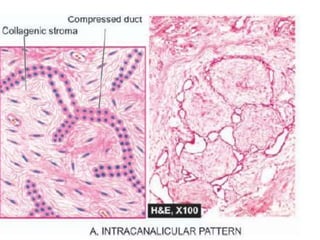
• Intracanalicular pattern is one in which the
stroma compresses the ducts so that they are
reduced to slit-like clefts lined by ductal
epithelium or may appear as cords of epithelial
elements surrounding masses of fibrous stroma
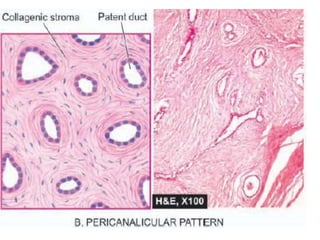
• Pericanalicular pattern is characterised by
encircling masses of fibrous stroma around the
patent or dilated ducts
• The fibrous stroma may be quite cellular, or
there may be areas of hyalinised collagen
• Sometimes, the stroma is loose and
myxomatous
CARCINOMA OF THE BREAST
• Cancer of the breast is among the commonest of human
cancers throughout the world
• Its incidence varies in different countries but is particularly
high in developed countries
• In the United States, carcinoma of the breast constitutes
about 25% of all cancers in females and causes
approximately 20%of cancer deaths among females
• Cancer of the male breast, on the other hand, is quite rare
and comprises 0.2% of malignant tumours (ratio between
male-female breast cancer is 1:100)
• The incidence of breast cancer is highest in the
perimenopausal age group and is uncommon before the age
of 25 years
• Clinically, the breast cancer usually presents as a
solitary,painless, palpable lump which is detected quite
often by self examination
• Higher the age, more are the chances of breast lump turning
out to be malignant
• Thus, all breast lumps,irrespective of the age of the patient
must be removed surgically
• Currently, emphasis is on early diagnosis by mammography,
xero-radiography and thermography
• Techniques like fine needle aspiration cytology
(FNAC),stereotactic biopsy and frozen section are
immensely valuable to the surgeon for immediate
pathological diagnosis
Etiology
• 1. Geography. The incidence of breast
cancer is about six times higher in developed
countries than the developing countries, with
the notable exception of Japan
• These geographic differences are considered
to be related to consumption of large amount
of animal fats and high caloric diet by Western
populations than the Asians (including
Japanese) and Africans
• 2. Genetic factors
• i) Family history: First-degree relatives (mother,
sister,daughter) of women with breast cancer have 2 to
6-fold higher risk of development of breast cancer
• The risk is proportionate to a few factors:
• Number of blood relatives with breast cancer.
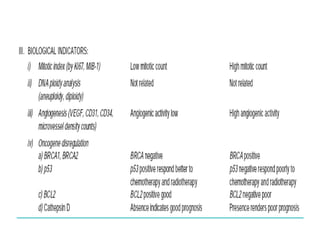
• Younger age at the time of development of breast
cancer
• Bilateral cancers
• High risk cancer families having breast and ovarian
• carcinomas.
• ii) Genetic mutations: About 10% breast
cancers have been found to have inherited
mutations
• These mutations include the following, most
important of which is breast cancer(BRCA)
susceptibility gene in inherited breast cancer
• BRCA 1 gene located on chromosome 17, a
DNA repair gene, is implicated in both breast
and ovarian cancer in inherited cases
• BRCA 2 gene located on chromosome 13,
another DNA repair gene, in its mutated form,
has a similarly higher incidence of inherited
cancer of the breast (one-third cases) and
ovary in females, and prostate in men
• Mutation in p53 tumour suppressor gene on
chromosome 17 as an acquired defect accounts
for 40% cases of sporadic breast cancer in
women but rarely in women with family
history of breast cancer
3. Oestrogen excess
• Excess endogenous oestrogen or exogenously
administered oestrogen for prolonged duration is
an important factor in the development of breast
cancer
• i) Women with prolonged reproductive life, with
menarche setting in at an early age and
menopause relatively late have greater risk
• ii) Higher risk in unmarried and nulliparous
women than in married and multiparous women
• iii) Women with first childbirth at a late age (over
30 years) are at greater risk
• iv) Lactation is said to reduce the risk of breast
cancer
• v) Bilateral oophorectomy reduces the risk of
development of breast cancer
• vi) Functioning ovarian tumours (e.g. granulosa
cell tumour) which elaborate oestrogen are
associated with increased incidence of breast
cancer
• vii) Oestrogen replacement therapy
administered to postmenopausal women may
result in increased risk of breast cancer
• viii) Long-term use of oral contraceptives has
been suspected to predispose to breast cancer
but there is no definite increased risk with
balanced oestrogen-progesterone preparations
used in oral contraceptives
• ix) Men who have been treated with oestrogen
for prostatic cancer have increased risk of
developing cancer of the male breast
• Normal breast epithelium possesses oestrogen
and progesterone receptors
• The breast cancer cells secrete many growth
factors which are oestrogen-dependent
• In this way, the interplay of high circulating
levels of oestrogen, oestrogen receptors and
growth factors brings about progression of
breast cancer
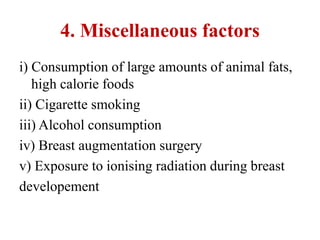
4. Miscellaneous factors
i) Consumption of large amounts of animal fats,
high calorie foods
ii) Cigarette smoking
iii) Alcohol consumption
iv) Breast augmentation surgery
v) Exposure to ionising radiation during breast
developement
General Features and Classification
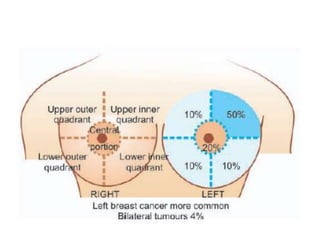
• Cancer of the breast occurs more often in left
breast than the right and is bilateral in about
4% cases
• Anatomically, upper outer quadrant is the site
of tumour in half the breast cancers; followed
in frequency by central portion, and equally in
the remaining both lower and the upper inner
quadrant
• Carcinoma of the breast arises from the ductal
epithelium in 90% cases while the remaining
10% originate from the lobular epithelium
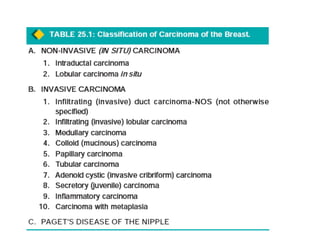
A. NON-INVASIVE (IN SITU)
BREAST CARCINOMA
• In general, two types of non-invasive or in situ
carcinoma—
• intraductal carcinoma and lobular carcinoma in
situ, are characterised histologically by
presence of tumour cells within the ducts or
lobules respectively without evidence of
invasion
Intraductal Carcinoma
• Carcinoma in situ confined within the larger
mammary ducts is called intraductal carcinoma
• The tumour initially begins with atypical
hyperplasia of ductal epithelium followed by
filling of the duct with tumour cells
• Clinically, it produces a palpable mass in 30-
75% of cases and presence of nipple discharge
in about 30% patients
MORPHOLOGIC FEATURES
• Grossly, the tumour may vary from a small
poorly-defined focus to 3-5 cm diameter mass
• On cut section, the involved area shows
cystically dilated ducts containing cheesy
necrotic material (in comedo pattern), or the
intraductal tumour may be polypoid and
friable resembling intraductal papilloma (in
papillary pattern)
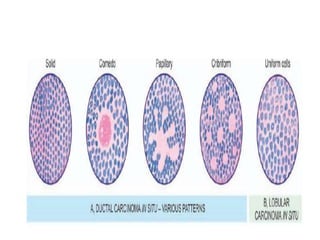
• Histologically, the proliferating tumour cells
within the ductal lumina may have 4 types of
patterns in different combinations: solid,
comedo, papillary and cribriform
Lobular Carcinoma in Situ
• Lobular carcinoma in situ is not a palpable or
grossly visible tumour
• Patients of in situ lobular carcinoma treated
with excisional biopsy alone develop invasive
cancer of the ipsilateral breast in about 25%
cases in 10 years as in intraductal carcinoma
but, in addition, have a much higher incidence
of developing a contralateral breast cancer
(30%)
MORPHOLOGIC FEATURES
• Grossly, no visible tumour is identified
• Histologically, in situ lobular carcinoma is
characterised by filling up of terminal ducts
and ductules or acini by rather uniform cells
which are loosely cohesive and have small,
rounded nuclei with indistinct cytoplasmic
margins
INVASIVE BREAST CARCINOMA
• Infiltrating (Invasive) Duct Carcinoma-NOS
• Infiltrating duct carcinoma-NOS (not
otherwise specified) is the classic breast cancer
and is the most common histologic pattern
accounting for 70% cases of breast cancer
• Clinically, majority of infiltrating duct
carcinomas have a hard consistency due to
dense collagenous stroma (scirrhous
carcinoma)
• They are found more frequently in the left
breast,often in the upper outer quadrant
• Retraction of the nipple and attachment of the
tumour to underlying chest wall may be
present
MORPHOLOGIC FEATURES
• Grossly, the tumour is irregular, 1-5 cm in
diameter, hard cartilage-like mass that cuts
with a grating sound
• The sectioned surface of the tumour is grey-
white to yellowish with chalky streaks and
often extends irregularly into the surrounding
fat
• Histologically, as the name NOS suggests, the
tumour is different from other special types in
lacking a regular and uniform pattern
throughout the lesion
Infiltrating (Invasive) Lobular
Carcinoma
• Invasive lobular carcinoma comprises about
5% of all breast cancers
• This peculiar morphologic form differs from
other invasive cancers in being more
frequently bilateral; and within the same
breast, it may have multicentric origin
MORPHOLOGIC FEATURES
• Grossly, the appearance varies from a well-
defined scirrhous mass to a poorly defined area
of induration that may remain undetected by
inspection as well as palpation
• Histologically, there are 2 distinct features
i) Pattern—A characteristic single file (Indian
file) linear arrangement of stromal infiltration
by the tumour cells with very little tendency to
gland formation is seen
• ii) Tumour cytology—Individual tumour
cells resemble cells of in situ lobular
carcinoma
• They are round and regular with very little
pleomorphism and infrequent mitoses
Medullary Carcinoma
• Medullary carcinoma is a variant of ductal
carcinoma and comprises about 1% of all
breast cancers
• The tumour has a significantly better
prognosis than the usual infiltrating duct
carcinoma, probably due to good host immune
response in the form of lymphoid infiltrate in
the tumour stroma
THANK YOU

BREAST TUMOURS.pptx

  • 1.
  • 2.
    • Tumours ofthe female breast are common and clinically significant but are rare in men • Among the important benign breast tumours are fibroadenoma, phyllodes tumour(cystosarcoma phyllodes) and intraductal papilloma • Carcinoma of the breast is an important malignant tumour which occurs as non-invasive (carcinoma in situ) and invasive cancer with its various morphologic varieties
  • 3.
    FIBROADENOMA • Fibroadenoma oradenofibroma is a benign tumour of fibrous and epithelial elements • It is the most common benign tumour of the female breast. Though it can occur at any age during reproductive life, most patients are between 15 to 30 years of age • Clinically, fibroadenoma generally appears as a solitary, discrete, freely mobile nodule within the breast
  • 4.
    MORPHOLOGIC FEATURES • Grossly,typical fibroadenoma is a small (2-4 cm diameter), solitary, wellencapsulated, spherical or discoid mass • The cut surface is firm, grey-white, slightly myxoid and may show slitlike spaces formed by compressed ducts • Occasionally, multiple fibroadenomas may form part of fibrocystic disease and is termed fibroadenomatosis
  • 5.
    • Microscopically, fibroustissue comprises most of a fibroadenoma • The arrangements between fibrous overgrowth and ducts may produce two types of patterns which may coexist in the same tumour • These are intracanalicular and pericanalicular patterns
  • 6.
    • Intracanalicular patternis one in which the stroma compresses the ducts so that they are reduced to slit-like clefts lined by ductal epithelium or may appear as cords of epithelial elements surrounding masses of fibrous stroma
  • 7.
    • Pericanalicular patternis characterised by encircling masses of fibrous stroma around the patent or dilated ducts
  • 10.
    • The fibrousstroma may be quite cellular, or there may be areas of hyalinised collagen • Sometimes, the stroma is loose and myxomatous
  • 11.
  • 12.
    • Cancer ofthe breast is among the commonest of human cancers throughout the world • Its incidence varies in different countries but is particularly high in developed countries • In the United States, carcinoma of the breast constitutes about 25% of all cancers in females and causes approximately 20%of cancer deaths among females • Cancer of the male breast, on the other hand, is quite rare and comprises 0.2% of malignant tumours (ratio between male-female breast cancer is 1:100) • The incidence of breast cancer is highest in the perimenopausal age group and is uncommon before the age of 25 years
  • 13.
    • Clinically, thebreast cancer usually presents as a solitary,painless, palpable lump which is detected quite often by self examination • Higher the age, more are the chances of breast lump turning out to be malignant • Thus, all breast lumps,irrespective of the age of the patient must be removed surgically • Currently, emphasis is on early diagnosis by mammography, xero-radiography and thermography • Techniques like fine needle aspiration cytology (FNAC),stereotactic biopsy and frozen section are immensely valuable to the surgeon for immediate pathological diagnosis
  • 14.
    Etiology • 1. Geography.The incidence of breast cancer is about six times higher in developed countries than the developing countries, with the notable exception of Japan • These geographic differences are considered to be related to consumption of large amount of animal fats and high caloric diet by Western populations than the Asians (including Japanese) and Africans
  • 15.
    • 2. Geneticfactors • i) Family history: First-degree relatives (mother, sister,daughter) of women with breast cancer have 2 to 6-fold higher risk of development of breast cancer • The risk is proportionate to a few factors: • Number of blood relatives with breast cancer. • Younger age at the time of development of breast cancer • Bilateral cancers • High risk cancer families having breast and ovarian • carcinomas.
  • 16.
    • ii) Geneticmutations: About 10% breast cancers have been found to have inherited mutations • These mutations include the following, most important of which is breast cancer(BRCA) susceptibility gene in inherited breast cancer
  • 17.
    • BRCA 1gene located on chromosome 17, a DNA repair gene, is implicated in both breast and ovarian cancer in inherited cases • BRCA 2 gene located on chromosome 13, another DNA repair gene, in its mutated form, has a similarly higher incidence of inherited cancer of the breast (one-third cases) and ovary in females, and prostate in men
  • 18.
    • Mutation inp53 tumour suppressor gene on chromosome 17 as an acquired defect accounts for 40% cases of sporadic breast cancer in women but rarely in women with family history of breast cancer
  • 19.
    3. Oestrogen excess •Excess endogenous oestrogen or exogenously administered oestrogen for prolonged duration is an important factor in the development of breast cancer • i) Women with prolonged reproductive life, with menarche setting in at an early age and menopause relatively late have greater risk • ii) Higher risk in unmarried and nulliparous women than in married and multiparous women
  • 20.
    • iii) Womenwith first childbirth at a late age (over 30 years) are at greater risk • iv) Lactation is said to reduce the risk of breast cancer • v) Bilateral oophorectomy reduces the risk of development of breast cancer • vi) Functioning ovarian tumours (e.g. granulosa cell tumour) which elaborate oestrogen are associated with increased incidence of breast cancer
  • 21.
    • vii) Oestrogenreplacement therapy administered to postmenopausal women may result in increased risk of breast cancer • viii) Long-term use of oral contraceptives has been suspected to predispose to breast cancer but there is no definite increased risk with balanced oestrogen-progesterone preparations used in oral contraceptives
  • 22.
    • ix) Menwho have been treated with oestrogen for prostatic cancer have increased risk of developing cancer of the male breast
  • 23.
    • Normal breastepithelium possesses oestrogen and progesterone receptors • The breast cancer cells secrete many growth factors which are oestrogen-dependent • In this way, the interplay of high circulating levels of oestrogen, oestrogen receptors and growth factors brings about progression of breast cancer
  • 24.
    4. Miscellaneous factors i)Consumption of large amounts of animal fats, high calorie foods ii) Cigarette smoking iii) Alcohol consumption iv) Breast augmentation surgery v) Exposure to ionising radiation during breast developement
  • 26.
    General Features andClassification • Cancer of the breast occurs more often in left breast than the right and is bilateral in about 4% cases • Anatomically, upper outer quadrant is the site of tumour in half the breast cancers; followed in frequency by central portion, and equally in the remaining both lower and the upper inner quadrant
  • 28.
    • Carcinoma ofthe breast arises from the ductal epithelium in 90% cases while the remaining 10% originate from the lobular epithelium
  • 29.
    A. NON-INVASIVE (INSITU) BREAST CARCINOMA • In general, two types of non-invasive or in situ carcinoma— • intraductal carcinoma and lobular carcinoma in situ, are characterised histologically by presence of tumour cells within the ducts or lobules respectively without evidence of invasion
  • 30.
    Intraductal Carcinoma • Carcinomain situ confined within the larger mammary ducts is called intraductal carcinoma • The tumour initially begins with atypical hyperplasia of ductal epithelium followed by filling of the duct with tumour cells • Clinically, it produces a palpable mass in 30- 75% of cases and presence of nipple discharge in about 30% patients
  • 31.
    MORPHOLOGIC FEATURES • Grossly,the tumour may vary from a small poorly-defined focus to 3-5 cm diameter mass • On cut section, the involved area shows cystically dilated ducts containing cheesy necrotic material (in comedo pattern), or the intraductal tumour may be polypoid and friable resembling intraductal papilloma (in papillary pattern)
  • 32.
    • Histologically, theproliferating tumour cells within the ductal lumina may have 4 types of patterns in different combinations: solid, comedo, papillary and cribriform
  • 33.
    Lobular Carcinoma inSitu • Lobular carcinoma in situ is not a palpable or grossly visible tumour • Patients of in situ lobular carcinoma treated with excisional biopsy alone develop invasive cancer of the ipsilateral breast in about 25% cases in 10 years as in intraductal carcinoma but, in addition, have a much higher incidence of developing a contralateral breast cancer (30%)
  • 34.
    MORPHOLOGIC FEATURES • Grossly,no visible tumour is identified • Histologically, in situ lobular carcinoma is characterised by filling up of terminal ducts and ductules or acini by rather uniform cells which are loosely cohesive and have small, rounded nuclei with indistinct cytoplasmic margins
  • 35.
    INVASIVE BREAST CARCINOMA •Infiltrating (Invasive) Duct Carcinoma-NOS • Infiltrating duct carcinoma-NOS (not otherwise specified) is the classic breast cancer and is the most common histologic pattern accounting for 70% cases of breast cancer
  • 36.
    • Clinically, majorityof infiltrating duct carcinomas have a hard consistency due to dense collagenous stroma (scirrhous carcinoma) • They are found more frequently in the left breast,often in the upper outer quadrant • Retraction of the nipple and attachment of the tumour to underlying chest wall may be present
  • 37.
    MORPHOLOGIC FEATURES • Grossly,the tumour is irregular, 1-5 cm in diameter, hard cartilage-like mass that cuts with a grating sound • The sectioned surface of the tumour is grey- white to yellowish with chalky streaks and often extends irregularly into the surrounding fat
  • 38.
    • Histologically, asthe name NOS suggests, the tumour is different from other special types in lacking a regular and uniform pattern throughout the lesion
  • 39.
    Infiltrating (Invasive) Lobular Carcinoma •Invasive lobular carcinoma comprises about 5% of all breast cancers • This peculiar morphologic form differs from other invasive cancers in being more frequently bilateral; and within the same breast, it may have multicentric origin
  • 40.
    MORPHOLOGIC FEATURES • Grossly,the appearance varies from a well- defined scirrhous mass to a poorly defined area of induration that may remain undetected by inspection as well as palpation • Histologically, there are 2 distinct features i) Pattern—A characteristic single file (Indian file) linear arrangement of stromal infiltration by the tumour cells with very little tendency to gland formation is seen
  • 41.
    • ii) Tumourcytology—Individual tumour cells resemble cells of in situ lobular carcinoma • They are round and regular with very little pleomorphism and infrequent mitoses
  • 43.
    Medullary Carcinoma • Medullarycarcinoma is a variant of ductal carcinoma and comprises about 1% of all breast cancers • The tumour has a significantly better prognosis than the usual infiltrating duct carcinoma, probably due to good host immune response in the form of lymphoid infiltrate in the tumour stroma
  • 46.