Breast self examination
Overview:
• Introduction
• Purposes
• Timing
• Guidelines
• Procedure
Contd…
• Results
• Precautions
• Merit
• Disadvantages
• Role of nurses
• Research article
Introduction
• A breast self examination is a technique which
allows an individual to examine his/her breast
tissue for any physical or visual changes.
• It is often used as an early detection method for
breast cancer.
• Both men and women should perform a BSE at
least once each month beginning at age 20.
Contd..
• A breast self-exam is a way anyone can check
own breasts for any changes such as lumps or
thickenings that could be symptomatic of breast
cancer.
• This process includes looking and feeling each
breast, and reporting anything unusual to the
doctor.
Contd..
• When breast cancer is detected in its early stages,
chances of surviving the disease are greatly
improved.
• In fact, women who perform regular breast self
exam find 90% of all breast masses.
Definition
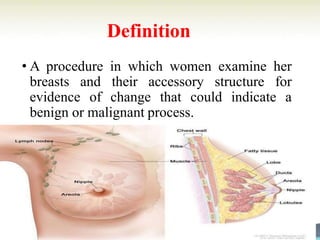
• A procedure in which women examine her
breasts and their accessory structure for
evidence of change that could indicate a
benign or malignant process.
Purposes
• To find any changes that may occur.
• To detect breast lumps.
• To improve quality of life.
• To cost benefit.
Timing of BSE
• Beginning at the age of 20years or after onset
of menarche.
• The BSE is usually performed within 7-10
days after the first day of the menstrual cycle,
when the breasts are smallest and cyclic
nodularity is least apparent.
Contd…
• If her periods arenot regular, a BSE should be
done on the same day every month.
• BSE should be regularly performed by every
woman such as pregnant, breast feeding and
menopausal woman, or have breast implants.
Contd…
Contd…
Contd…
Contd…
Contd..
Contd..
Guidelines for Breast self
Examination
• The national comprehensive cancer network
screening guidelines suggest that women
between 25 and 40 years old who are
asymptomatic and have no special risk
factors for breast cancer undergo a clinical
breast exam every 1 to 3 years.
Contd….
• Women older than age 50, women with
increased risk factors for breast cancer,
history of breast cancer, and/or symptomatic
patients are recommended to receive more
frequently clinical breast exams.
Step 1
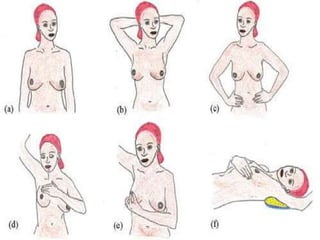
a. Begin by looking at breasts in the mirror with
shoulders straight and arms on the hips.
without visible
Look for:
- Breasts: size, shape and color
-Breasts : evenly shaped
distortion or swelling.
Contd…
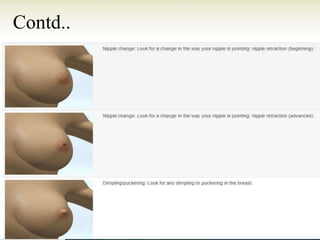
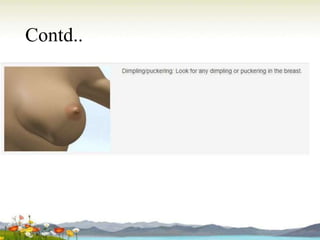
- Dimpling, puckering or bulging of the skin,
- A nipple that has changes position or become
inverted (pushed inward instead of sticking
out)
- Redness, soreness, rash or swelling
- If any changes, consult doctor.
Contd..
Step 2:
Place the hand at the back of the head.
• Look for any changes in size, shape, position or
any changes to the skin of the breasts.
• Check for any skin puckering, dimpling, sores or
discoloration.
Contd…
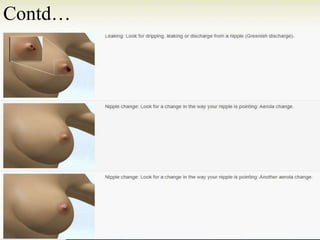
• Inspect nipples and look for any sores,
peeling or change in the direction of the
nipples and other unusual changes.
Contd…
Step 3:
• Next, place hands on hips and press down
firmly to tighten the chest muscles beneath
the breast.
• Turn from side to side so, inspection of outer
part of breast can be done.
Contd…
Step 4:
• Bend forward toward the mirror.
•Roll shoulders and elbows forward to tighten
the chest muscles.
• Breasts will fall forward.
Contd…
•Look for any changes in the shape or contour
of breast.
Step 1 to Step 4 involves inspection of
breast.
Contd..
Step 5: Palpation of the breast.
•Palpate the breasts with pads of the fingers to feel
for lumps or soreness.
•Several common patterns, which are designed to
ensure complete coverage.
•The vertical strip pattern involves moving the
fingers up and down over breast.
Contd…
•The pie-wedge pattern starts at the nipple and
moves outward.
•The circular pattern involves moving the
fingers in concentric circles from the nipple
outward.
Contd..
Step 6: Palpation of nipple
•Check nipples for discharge (fluid). Place
thumb and forefinger on the tissue surrounding
the nipple and put outward toward the end of
the nipple. Look for any discharge. Repeat on
other breasts.
Contd…
Step 7: Palpation of breast while lying down.
•Lie down and place a small pillow or folded
towel under right shoulder.
•Put right hand behind head.
•Place left hand on the upper portion of right
breast with finger together.
Contd..
•Do the circular motions.
•When the circle is complete, move in one inch
toward the nipple and complete another circle.
Continue in this pattern until felt the entire breast.
Make sure to feel the upper outer areas that extend
into armpits.
Contd…
After examination if find a lump
•See the health care provider if discover any
new changes.
Normal and abnormal results
• Many women find lumps or changes in their
breasts, since some of these are normal
changes that occur at various points in the
menstrual cycles.
• Finding a change or lump in breast is not a
reason to panic.
Contd…
• Breasts often feel different in different places.
• A firm ridge along the bottom of each breast
is normal, for instances.
• The look and feel of breasts will change as
age increases.
When to contact
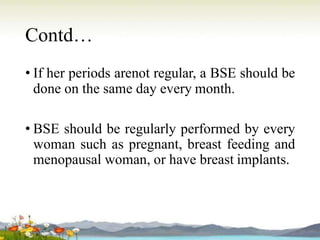
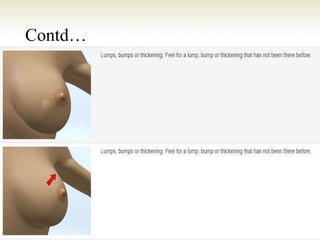
• A hard lump or knot near underarm.
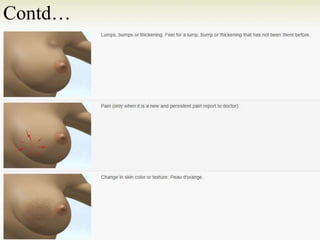
• Changes in the way breasts look or feel,
including thickening or prominent fullness that
is different from the surrounding tissue.
• Dimples, puckers, bulges or ridges on the skin
of breast.
Contd…
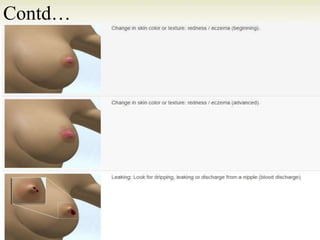
• A recent change in a nipple to become
ouched in (inverted) instead of sticking out.
• Redness, warmth, swelling or pain.
• Itching, scales, sores or rashes.
• Bloody nipple discharge.
Precautions for BSE
• When examining the breast, some general tips to
keep in mind include:
1. Use the pads offingers:
• Use of the pads, not the very tips of three middle
fingers for exam.
• If any difficulty feeling with finger pads, use
another part of hand that is more sensitive, such as
palm or the backs of the fingers.
2. Use different pressure levels:
• The goal is to feel different depths of breast
by using different levels of pressure to feel all
the breast tissue.
• Use light pressure to feel the tissue closet to
the skin, medium pressure to feel a little
deeper, and firm pressure to feel the tissue
closet to the chest and ribs.
Contd…
• Be sure to use each pressure level before
moving onto the next spot.
• If not sure how hard to press, talk with doctor
or nurse.
3. Take time:
• Donot rush.
• It may take several minutes to carefully
examine breasts.
4. Follow a pattern:
• Use a methodical technique to ensure the
examination of entire breast.
• For instance, imagine the face of a clock over the
breast.
• Begin near collarbone and examine that section,
moving finger toward nipple.
Merit
1. Women can use BSE to assess their breasts.
2. When they perform BSE properly and
regularly, they can notice any changes in
their breasts and seek further evaluation.
3. Reduces the risk of breast cancer by early
detection and treatment.
Contd…
1. Allows women to know the health of their
breasts.
2. Provides each woman knowledge of what
their own breast tissue feels like.
Contd…
1. Is a non invasive, simple procedure.
2.Can detect breast cancer at an earlier stage
than if a woman does not perform BSE.
3. Awareness of breast anatomy.
Barriers
1. Fear and anxiety about what may be found
during the exam.
2. False-positive (False alarm) finding, which
is a result that indicates that a condition is
present (i.e. breast lump or possible cancer)
when it is not (i.e. non-cancerous breast
tissue)
Role of Nurse in BSE
• Assessing a patient’s compliance of
performing self-breast examinations should
entail not only if she merely does the
examination, but when she is doing them and
how she is doing them.
Contd…
• As the primary nurse, if we are not educated
on proper techniques of a self-breast
examination, it is our responsibility to
provide a resource to the patient that can
properly demonstrate this.
Contd..
• Women should be educated on the proper
way to do a self-breast examination.
• Women should be told about the ideal time of
month to perform examination. This will
allow women to know what is normal breast
tissue and what is abnormal to aide in early
detection of breast cancer.
References
Book References
Prasai S. Durga. Gynaecology Nursing. 2nd
Edition. Jamal,kathmandu: Medhavi Publication;
2018:105-110
Brunner and Suddarth’s. Textbook of Medical-
Surgical Nursing. 13th edition. New Delhi: Wolters
Kluwer;2016:359-373
• Sharma Sarojini. Oncology Nursing Manual. 4th
Edition. Bharatpur, Chitwan:BP Koirala
Memorial Cancer Hospital, Dec 2014: 15-18
Net References
•Henderson JA, Ferquson T. Breast Examination
Techniques. Available from
(https://www.ncbi.nlm.nih.gov/books/NBK459179)
Accessed Date: 30th Edition, 2019
•Myoclinic. Breast Self examination for breast
awareness. Available from
(https://www.mayoclinic.org/tests.procedure/breastexa
minationabout/pac.20393237) Accessed Date: 30th Nov
2019
•Breast 360. Breast Self Examination. Available from
(https://Breast360.org/topics/2015/02/03/BreastSelfExa
mination_bsel) Accessed Date : 30th Nov2019
Thankyou

Breast Self Examination.pptx

  • 1.
  • 2.
    Overview: • Introduction • Purposes •Timing • Guidelines • Procedure
  • 3.
    Contd… • Results • Precautions •Merit • Disadvantages • Role of nurses • Research article
  • 4.
    Introduction • A breastself examination is a technique which allows an individual to examine his/her breast tissue for any physical or visual changes. • It is often used as an early detection method for breast cancer. • Both men and women should perform a BSE at least once each month beginning at age 20.
  • 5.
    Contd.. • A breastself-exam is a way anyone can check own breasts for any changes such as lumps or thickenings that could be symptomatic of breast cancer. • This process includes looking and feeling each breast, and reporting anything unusual to the doctor.
  • 6.
    Contd.. • When breastcancer is detected in its early stages, chances of surviving the disease are greatly improved. • In fact, women who perform regular breast self exam find 90% of all breast masses.
  • 7.
    Definition • A procedurein which women examine her breasts and their accessory structure for evidence of change that could indicate a benign or malignant process.
  • 8.
    Purposes • To findany changes that may occur. • To detect breast lumps. • To improve quality of life. • To cost benefit.
  • 9.
    Timing of BSE •Beginning at the age of 20years or after onset of menarche. • The BSE is usually performed within 7-10 days after the first day of the menstrual cycle, when the breasts are smallest and cyclic nodularity is least apparent.
  • 10.
    Contd… • If herperiods arenot regular, a BSE should be done on the same day every month. • BSE should be regularly performed by every woman such as pregnant, breast feeding and menopausal woman, or have breast implants.
  • 11.
  • 12.
  • 13.
  • 14.
  • 15.
  • 16.
  • 17.
    Guidelines for Breastself Examination • The national comprehensive cancer network screening guidelines suggest that women between 25 and 40 years old who are asymptomatic and have no special risk factors for breast cancer undergo a clinical breast exam every 1 to 3 years.
  • 18.
    Contd…. • Women olderthan age 50, women with increased risk factors for breast cancer, history of breast cancer, and/or symptomatic patients are recommended to receive more frequently clinical breast exams.
  • 19.
    Step 1 a. Beginby looking at breasts in the mirror with shoulders straight and arms on the hips. without visible Look for: - Breasts: size, shape and color -Breasts : evenly shaped distortion or swelling.
  • 20.
    Contd… - Dimpling, puckeringor bulging of the skin, - A nipple that has changes position or become inverted (pushed inward instead of sticking out) - Redness, soreness, rash or swelling - If any changes, consult doctor.
  • 21.
    Contd.. Step 2: Place thehand at the back of the head. • Look for any changes in size, shape, position or any changes to the skin of the breasts. • Check for any skin puckering, dimpling, sores or discoloration.
  • 22.
    Contd… • Inspect nipplesand look for any sores, peeling or change in the direction of the nipples and other unusual changes.
  • 23.
    Contd… Step 3: • Next,place hands on hips and press down firmly to tighten the chest muscles beneath the breast. • Turn from side to side so, inspection of outer part of breast can be done.
  • 24.
    Contd… Step 4: • Bendforward toward the mirror. •Roll shoulders and elbows forward to tighten the chest muscles. • Breasts will fall forward.
  • 25.
    Contd… •Look for anychanges in the shape or contour of breast. Step 1 to Step 4 involves inspection of breast.
  • 26.
    Contd.. Step 5: Palpationof the breast. •Palpate the breasts with pads of the fingers to feel for lumps or soreness. •Several common patterns, which are designed to ensure complete coverage. •The vertical strip pattern involves moving the fingers up and down over breast.
  • 27.
    Contd… •The pie-wedge patternstarts at the nipple and moves outward. •The circular pattern involves moving the fingers in concentric circles from the nipple outward.
  • 28.
    Contd.. Step 6: Palpationof nipple •Check nipples for discharge (fluid). Place thumb and forefinger on the tissue surrounding the nipple and put outward toward the end of the nipple. Look for any discharge. Repeat on other breasts.
  • 29.
    Contd… Step 7: Palpationof breast while lying down. •Lie down and place a small pillow or folded towel under right shoulder. •Put right hand behind head. •Place left hand on the upper portion of right breast with finger together.
  • 30.
    Contd.. •Do the circularmotions. •When the circle is complete, move in one inch toward the nipple and complete another circle. Continue in this pattern until felt the entire breast. Make sure to feel the upper outer areas that extend into armpits.
  • 31.
    Contd… After examination iffind a lump •See the health care provider if discover any new changes.
  • 33.
    Normal and abnormalresults • Many women find lumps or changes in their breasts, since some of these are normal changes that occur at various points in the menstrual cycles. • Finding a change or lump in breast is not a reason to panic.
  • 34.
    Contd… • Breasts oftenfeel different in different places. • A firm ridge along the bottom of each breast is normal, for instances. • The look and feel of breasts will change as age increases.
  • 35.
    When to contact •A hard lump or knot near underarm. • Changes in the way breasts look or feel, including thickening or prominent fullness that is different from the surrounding tissue. • Dimples, puckers, bulges or ridges on the skin of breast.
  • 36.
    Contd… • A recentchange in a nipple to become ouched in (inverted) instead of sticking out. • Redness, warmth, swelling or pain. • Itching, scales, sores or rashes. • Bloody nipple discharge.
  • 37.
    Precautions for BSE •When examining the breast, some general tips to keep in mind include: 1. Use the pads offingers: • Use of the pads, not the very tips of three middle fingers for exam. • If any difficulty feeling with finger pads, use another part of hand that is more sensitive, such as palm or the backs of the fingers.
  • 38.
    2. Use differentpressure levels: • The goal is to feel different depths of breast by using different levels of pressure to feel all the breast tissue. • Use light pressure to feel the tissue closet to the skin, medium pressure to feel a little deeper, and firm pressure to feel the tissue closet to the chest and ribs.
  • 39.
    Contd… • Be sureto use each pressure level before moving onto the next spot. • If not sure how hard to press, talk with doctor or nurse.
  • 40.
    3. Take time: •Donot rush. • It may take several minutes to carefully examine breasts.
  • 41.
    4. Follow apattern: • Use a methodical technique to ensure the examination of entire breast. • For instance, imagine the face of a clock over the breast. • Begin near collarbone and examine that section, moving finger toward nipple.
  • 42.
    Merit 1. Women canuse BSE to assess their breasts. 2. When they perform BSE properly and regularly, they can notice any changes in their breasts and seek further evaluation. 3. Reduces the risk of breast cancer by early detection and treatment.
  • 43.
    Contd… 1. Allows womento know the health of their breasts. 2. Provides each woman knowledge of what their own breast tissue feels like.
  • 44.
    Contd… 1. Is anon invasive, simple procedure. 2.Can detect breast cancer at an earlier stage than if a woman does not perform BSE. 3. Awareness of breast anatomy.
  • 45.
    Barriers 1. Fear andanxiety about what may be found during the exam. 2. False-positive (False alarm) finding, which is a result that indicates that a condition is present (i.e. breast lump or possible cancer) when it is not (i.e. non-cancerous breast tissue)
  • 46.
    Role of Nursein BSE • Assessing a patient’s compliance of performing self-breast examinations should entail not only if she merely does the examination, but when she is doing them and how she is doing them.
  • 47.
    Contd… • As theprimary nurse, if we are not educated on proper techniques of a self-breast examination, it is our responsibility to provide a resource to the patient that can properly demonstrate this.
  • 48.
    Contd.. • Women shouldbe educated on the proper way to do a self-breast examination. • Women should be told about the ideal time of month to perform examination. This will allow women to know what is normal breast tissue and what is abnormal to aide in early detection of breast cancer.
  • 49.
    References Book References Prasai S.Durga. Gynaecology Nursing. 2nd Edition. Jamal,kathmandu: Medhavi Publication; 2018:105-110 Brunner and Suddarth’s. Textbook of Medical- Surgical Nursing. 13th edition. New Delhi: Wolters Kluwer;2016:359-373 • Sharma Sarojini. Oncology Nursing Manual. 4th Edition. Bharatpur, Chitwan:BP Koirala Memorial Cancer Hospital, Dec 2014: 15-18
  • 50.
    Net References •Henderson JA,Ferquson T. Breast Examination Techniques. Available from (https://www.ncbi.nlm.nih.gov/books/NBK459179) Accessed Date: 30th Edition, 2019 •Myoclinic. Breast Self examination for breast awareness. Available from (https://www.mayoclinic.org/tests.procedure/breastexa minationabout/pac.20393237) Accessed Date: 30th Nov 2019 •Breast 360. Breast Self Examination. Available from (https://Breast360.org/topics/2015/02/03/BreastSelfExa mination_bsel) Accessed Date : 30th Nov2019
  • 51.