BIOPSYBIOPSYBreast BiopsyBreast Biopsy
compiled Bycompiled By
Dr.Dr. Sunil Vishwakarmaunil Vishwakarma
RSO SurgeryRSO Surgery
G. R. Medical College, GwaliorG. R. Medical College, Gwalior
WHAT IS BIOPSY?WHAT IS BIOPSY?
 Indicates removal of tissue from a living body forIndicates removal of tissue from a living body for
microscopic diagnostic examinationmicroscopic diagnostic examination
 Most precise and accurateMost precise and accurate
 Primary purpose: determine the diagnosisPrimary purpose: determine the diagnosis
precisely for proper treatmentprecisely for proper treatment
 Should always be used to verify presence andShould always be used to verify presence and
nature of neoplastic diseasenature of neoplastic disease
 More likely to rule out malignancy than toMore likely to rule out malignancy than to
diagnose cancerdiagnose cancer
TECHNIQUES OF BIOPSYTECHNIQUES OF BIOPSY
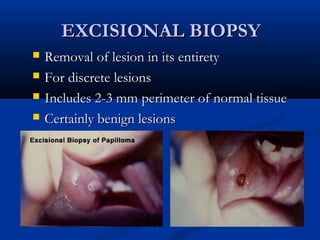
EXCISIONAL BIOPSYEXCISIONAL BIOPSY
 Removal of lesion in its entiretyRemoval of lesion in its entirety
 For discrete lesionsFor discrete lesions
 Includes 2-3 mm perimeter of normal tissueIncludes 2-3 mm perimeter of normal tissue
 Certainly benign lesionsCertainly benign lesions
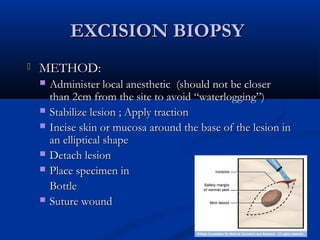
EXCISION BIOPSYEXCISION BIOPSY
 METHOD:METHOD:
 Administer local anesthetic (should not be closerAdminister local anesthetic (should not be closer
than 2cm from the site to avoid “waterlogging”)than 2cm from the site to avoid “waterlogging”)
 Stabilize lesion ; Apply tractionStabilize lesion ; Apply traction
 Incise skin or mucosa around the base of the lesion inIncise skin or mucosa around the base of the lesion in
an elliptical shapean elliptical shape
 Detach lesionDetach lesion
 Place specimen inPlace specimen in
BottleBottle
 Suture woundSuture wound
INCISIONAL BIOPSYINCISIONAL BIOPSY
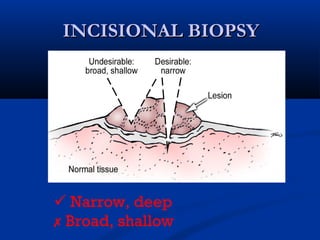
 Removes only a portion of the lesionRemoves only a portion of the lesion
 Removal of a wedge of tissue including normalRemoval of a wedge of tissue including normal
tissue, also known as WEDGE BIOPSYtissue, also known as WEDGE BIOPSY
 For lesions >1 cm diameterFor lesions >1 cm diameter
 Includes normal and abnormal tissuesIncludes normal and abnormal tissues
 May risk shedding malignant cellsMay risk shedding malignant cells
 Should not be done on pigmented or vascularShould not be done on pigmented or vascular
lesionslesions
 Record position, size, shape of lesionRecord position, size, shape of lesion
INCISIONAL BIOPSYINCISIONAL BIOPSY
 Narrow, deep
 Broad, shallow
INCISIONAL BIOPSYINCISIONAL BIOPSY
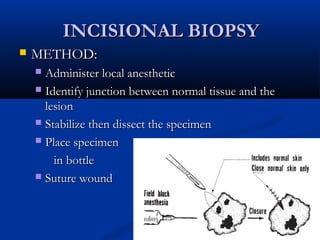
 METHOD:METHOD:
 Administer local anestheticAdminister local anesthetic
 Identify junction between normal tissue and theIdentify junction between normal tissue and the
lesionlesion
 Stabilize then dissect the specimenStabilize then dissect the specimen
 Place specimenPlace specimen
in bottlein bottle
 Suture woundSuture wound
ASPIRATION BIOPSYASPIRATION BIOPSY
 Performed with needle and syringe on any fluid-Performed with needle and syringe on any fluid-
filled lesion, except mucocelefilled lesion, except mucocele
 2 main types:2 main types:
 Explore whether a lesion contains fluidExplore whether a lesion contains fluid
 Used to actually aspirate cells for pathologicUsed to actually aspirate cells for pathologic
diagnosis (fine needle aspiration)diagnosis (fine needle aspiration)
 To avoid scar or when adjacent anatomic structures poseTo avoid scar or when adjacent anatomic structures pose
a risk. e.g. neck massesa risk. e.g. neck masses
ASPIRATION BIOPSYASPIRATION BIOPSY
 METHOD:METHOD:
 Clean the tissueClean the tissue
 Inject anesthetic OVER; not INTO the lesionInject anesthetic OVER; not INTO the lesion
 Select a wide bore needle and 10mL/20mL syringeSelect a wide bore needle and 10mL/20mL syringe
 Penetrate tissue and aspirate fluidPenetrate tissue and aspirate fluid
 Transfer to bottleTransfer to bottle
 Needle tip may have to be repositioned repeatedlyNeedle tip may have to be repositioned repeatedly
on an effort to locate a suitable fluid-containingon an effort to locate a suitable fluid-containing
cavitationcavitation
ASPIRATION BIOPSYASPIRATION BIOPSY
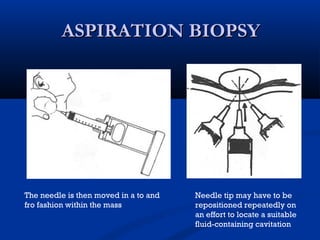
The needle is then moved in a to and
fro fashion within the mass
Needle tip may have to be
repositioned repeatedly on
an effort to locate a suitable
fluid-containing cavitation
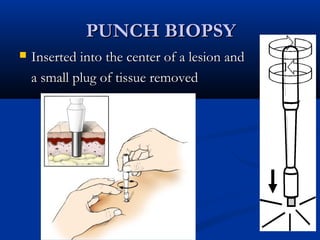
PUNCH BIOPSYPUNCH BIOPSY
 Inserted into the center of a lesion andInserted into the center of a lesion and
a small plug of tissue removeda small plug of tissue removed
BREAST BIOPSYBREAST BIOPSY
A breast biopsy is the removal of breast tissue to
examine it for signs of breast cancer or other
disorders. Several different types of biopsy may be
done.
INDICATIONSINDICATIONS
 Any suspicious lump/lesion in the breastAny suspicious lump/lesion in the breast
warrants for the biopsy.warrants for the biopsy.
 When a lump is found, a biopsy is the first stepWhen a lump is found, a biopsy is the first step
in diagnosis and treatment.in diagnosis and treatment.
 Although the primary purpose is to diagnoseAlthough the primary purpose is to diagnose
cancer, a biopsy can also be a surgical treatmentcancer, a biopsy can also be a surgical treatment
to remove cancer.to remove cancer.
MOST COMMON CAUSES OFMOST COMMON CAUSES OF
BREAST LUMPBREAST LUMP
 FibroadenomaFibroadenoma
 FibroadenosisFibroadenosis
 Breast abscessBreast abscess
 BreastcystBreastcyst
 Breast cancerBreast cancer
TYPES OF BREAST BIOPSIESTYPES OF BREAST BIOPSIES
There are two main types of biopsies:There are two main types of biopsies:
Needle BiopsyNeedle Biopsy
Open BiopsyOpen Biopsy
Your options for biopsy are determined byYour options for biopsy are determined by
whether the lump is palpable (can be felt) or non-whether the lump is palpable (can be felt) or non-
palpable (can not be felted), the location of thepalpable (can not be felted), the location of the
lump and the woman’s general health.lump and the woman’s general health.
NEEDLE BIOPSYNEEDLE BIOPSY
 A needle biopsy is a procedure that uses aA needle biopsy is a procedure that uses a
needle to remove tissue or cells from theneedle to remove tissue or cells from the
breast.breast.
There are two types of needle biopsies:There are two types of needle biopsies:
Fine Needle and Core Needle BiopsyFine Needle and Core Needle Biopsy
NEEDLE BIOPSIESNEEDLE BIOPSIES
 Fine NeedleFine Needle – A thin, hollow needle is used to– A thin, hollow needle is used to
remove a sample of tissue. The procedure isremove a sample of tissue. The procedure is
quick and can be done in a doctor’s office.quick and can be done in a doctor’s office.
 Core NeedleCore Needle – A larger needle is inserted– A larger needle is inserted
through a small incision in the skin, and a smallthrough a small incision in the skin, and a small
core of tissue is removed. This type of needlecore of tissue is removed. This type of needle
biopsy is done with the assistance ofbiopsy is done with the assistance of
mammography or ultrasound imaging in amammography or ultrasound imaging in a
doctor’s office or hospital outpatient clinic.doctor’s office or hospital outpatient clinic.
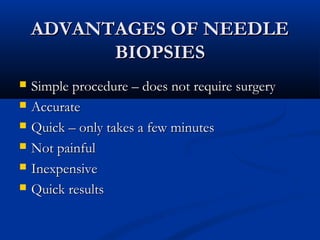
ADVANTAGES OF NEEDLEADVANTAGES OF NEEDLE
BIOPSIESBIOPSIES
 Simple procedure – does not require surgerySimple procedure – does not require surgery
 AccurateAccurate
 Quick – only takes a few minutesQuick – only takes a few minutes
 Not painfulNot painful
 InexpensiveInexpensive
 Quick resultsQuick results
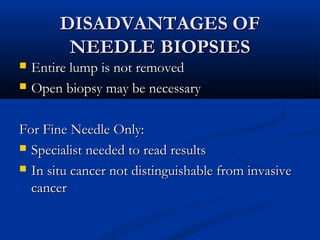
DISADVANTAGES OFDISADVANTAGES OF
NEEDLE BIOPSIESNEEDLE BIOPSIES
 Entire lump is not removedEntire lump is not removed
 Open biopsy may be necessaryOpen biopsy may be necessary
For Fine Needle Only:For Fine Needle Only:
 Specialist needed to read resultsSpecialist needed to read results
 In situ cancer not distinguishable from invasiveIn situ cancer not distinguishable from invasive
cancercancer
OPEN BIOPSIESOPEN BIOPSIES
 An open biopsy is a surgical procedure thatAn open biopsy is a surgical procedure that
opens the breast to remove tissue.opens the breast to remove tissue.
There are two types of open biopsies:There are two types of open biopsies:
Incisional and ExcisionalIncisional and Excisional
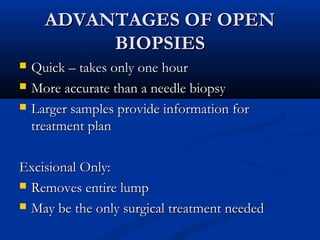
ADVANTAGES OF OPENADVANTAGES OF OPEN
BIOPSIESBIOPSIES
 Quick – takes only one hourQuick – takes only one hour
 More accurate than a needle biopsyMore accurate than a needle biopsy
 Larger samples provide information forLarger samples provide information for
treatment plantreatment plan
Excisional Only:Excisional Only:
 Removes entire lumpRemoves entire lump
 May be the only surgical treatment neededMay be the only surgical treatment needed
DISADVANTAGES OF OPENDISADVANTAGES OF OPEN
BIOPSIESBIOPSIES
 Surgical procedureSurgical procedure
 ExpensiveExpensive
 Side effects such as infection or blood collectionSide effects such as infection or blood collection
under the skinunder the skin
Excisional Only:Excisional Only:
 Removing tissue can change the look and feel ofRemoving tissue can change the look and feel of
the breastthe breast
IMAGING TECHNIQUESIMAGING TECHNIQUES
When a lump cannot be felt, the doctor mustWhen a lump cannot be felt, the doctor must
locate it with a special imaging technique.locate it with a special imaging technique.
 The doctor may use mammography (sometimesThe doctor may use mammography (sometimes
called stereotactic localization) or ultrasoundcalled stereotactic localization) or ultrasound
imagingimaging
 The lump is located by mammography orThe lump is located by mammography or
ultrasoundultrasound
 The doctor inserts a needle to collect a sampleThe doctor inserts a needle to collect a sample
of tissueof tissue
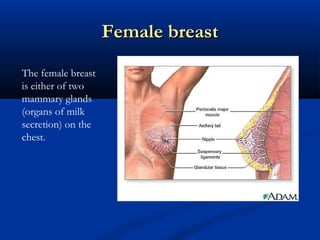
Female breastFemale breast
The female breast
is either of two
mammary glands
(organs of milk
secretion) on the
chest.
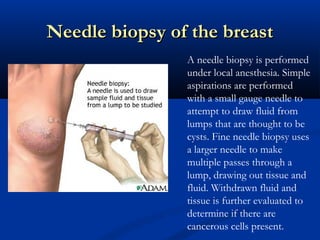
Needle biopsy of the breastNeedle biopsy of the breast
A needle biopsy is performed
under local anesthesia. Simple
aspirations are performed
with a small gauge needle to
attempt to draw fluid from
lumps that are thought to be
cysts. Fine needle biopsy uses
a larger needle to make
multiple passes through a
lump, drawing out tissue and
fluid. Withdrawn fluid and
tissue is further evaluated to
determine if there are
cancerous cells present.
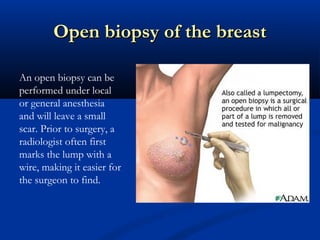
Open biopsy of the breastOpen biopsy of the breast
An open biopsy can be
performed under local
or general anesthesia
and will leave a small
scar. Prior to surgery, a
radiologist often first
marks the lump with a
wire, making it easier for
the surgeon to find.
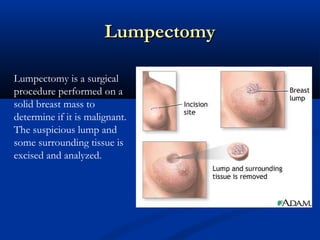
LumpectomyLumpectomy
Lumpectomy is a surgical
procedure performed on a
solid breast mass to
determine if it is malignant.
The suspicious lump and
some surrounding tissue is
excised and analyzed.
Advanced Breast Biopsy InstrumentationAdvanced Breast Biopsy Instrumentation
(ABBI)(ABBI)
The ABBI procedure is performed under local anesthesia and isThe ABBI procedure is performed under local anesthesia and is
a one-step biopsy procedure. This means that it combinesa one-step biopsy procedure. This means that it combines
needle localization with the removal of the lump.needle localization with the removal of the lump.
Using stereotactic techniques, a technician pinpoints the lumpUsing stereotactic techniques, a technician pinpoints the lump
with the aid of the computer, which calculates the precisewith the aid of the computer, which calculates the precise
location of the lump. The area is numbed with a local anestheticlocation of the lump. The area is numbed with a local anesthetic
and a marking needle is inserted to “tag” the precise location. Aand a marking needle is inserted to “tag” the precise location. A
narrow tube-like device is inserted into the breast to obtain anarrow tube-like device is inserted into the breast to obtain a
specimen. The small opening in the breast is closed with a fewspecimen. The small opening in the breast is closed with a few
stitches.stitches.
What are the advantages of the ABBIWhat are the advantages of the ABBI
procedure?procedure?
 The results are available in 24-48 hours.The results are available in 24-48 hours.
 The ABBI procedure takes less than one hour.The ABBI procedure takes less than one hour.
 The ABBI procedure is minimally invasive, therefore allowingThe ABBI procedure is minimally invasive, therefore allowing
the woman to experience less time in healing and recovery.the woman to experience less time in healing and recovery.
 The ABBI procedure may be an alternative to open biopsies forThe ABBI procedure may be an alternative to open biopsies for
non-palpable lesions.non-palpable lesions.
 The ABBI procedure is currently the only procedure other thanThe ABBI procedure is currently the only procedure other than
the traditional open surgery method which has the capability tothe traditional open surgery method which has the capability to
remove a lump or a cluster of microcalcifications in theirremove a lump or a cluster of microcalcifications in their
entirety.entirety.
What are the disadvantages of the ABBIWhat are the disadvantages of the ABBI
procedure?procedure?
A downside to the ABBI procedure is availability. It is aA downside to the ABBI procedure is availability. It is a
relatively new technique and many physicians may not be trainedrelatively new technique and many physicians may not be trained
in the procedure or have the available equipmentin the procedure or have the available equipment..
Mammotone & Minimally InvasiveMammotone & Minimally Invasive
Breast Biopsy (MIBB)Breast Biopsy (MIBB)
The Mammotone and MIBB are very similar and are often calledThe Mammotone and MIBB are very similar and are often called
Large Core Needle Biopsies.Large Core Needle Biopsies.
The Mammotone and MIBB are different from the core needleThe Mammotone and MIBB are different from the core needle
biopsy in that a needle is inserted once and multiple specimens arebiopsy in that a needle is inserted once and multiple specimens are
removed through contiguous sampling. Core needle biopsies requireremoved through contiguous sampling. Core needle biopsies require
the needle to be inserted multiple times.the needle to be inserted multiple times.
Both the Mammotone and MIBB biopsy utilize a vacuum system. ABoth the Mammotone and MIBB biopsy utilize a vacuum system. A
probe is inserted and samples of tissue are collected in a chamber.probe is inserted and samples of tissue are collected in a chamber.
Tissue samples are removed by action of a gentle vacuum. ByTissue samples are removed by action of a gentle vacuum. By
rotating a thumbwheel, the physician moves the sampling notch torotating a thumbwheel, the physician moves the sampling notch to
the next desired position.the next desired position.
Advantages of the Mammotone & MIBBAdvantages of the Mammotone & MIBB
The sample of the lump is larger (up to 8X larger), the needle isThe sample of the lump is larger (up to 8X larger), the needle is
inserted only once to obtain multiple samples, and the samplinginserted only once to obtain multiple samples, and the sampling
is contiguous and selectiveis contiguous and selective..
Thank YouThank You

Breast biopsy ppt

  • 1.
    BIOPSYBIOPSYBreast BiopsyBreast Biopsy compiledBycompiled By Dr.Dr. Sunil Vishwakarmaunil Vishwakarma RSO SurgeryRSO Surgery G. R. Medical College, GwaliorG. R. Medical College, Gwalior
  • 2.
    WHAT IS BIOPSY?WHATIS BIOPSY?  Indicates removal of tissue from a living body forIndicates removal of tissue from a living body for microscopic diagnostic examinationmicroscopic diagnostic examination  Most precise and accurateMost precise and accurate  Primary purpose: determine the diagnosisPrimary purpose: determine the diagnosis precisely for proper treatmentprecisely for proper treatment  Should always be used to verify presence andShould always be used to verify presence and nature of neoplastic diseasenature of neoplastic disease  More likely to rule out malignancy than toMore likely to rule out malignancy than to diagnose cancerdiagnose cancer
  • 3.
  • 4.
    EXCISIONAL BIOPSYEXCISIONAL BIOPSY Removal of lesion in its entiretyRemoval of lesion in its entirety  For discrete lesionsFor discrete lesions  Includes 2-3 mm perimeter of normal tissueIncludes 2-3 mm perimeter of normal tissue  Certainly benign lesionsCertainly benign lesions
  • 5.
    EXCISION BIOPSYEXCISION BIOPSY METHOD:METHOD:  Administer local anesthetic (should not be closerAdminister local anesthetic (should not be closer than 2cm from the site to avoid “waterlogging”)than 2cm from the site to avoid “waterlogging”)  Stabilize lesion ; Apply tractionStabilize lesion ; Apply traction  Incise skin or mucosa around the base of the lesion inIncise skin or mucosa around the base of the lesion in an elliptical shapean elliptical shape  Detach lesionDetach lesion  Place specimen inPlace specimen in BottleBottle  Suture woundSuture wound
  • 6.
    INCISIONAL BIOPSYINCISIONAL BIOPSY Removes only a portion of the lesionRemoves only a portion of the lesion  Removal of a wedge of tissue including normalRemoval of a wedge of tissue including normal tissue, also known as WEDGE BIOPSYtissue, also known as WEDGE BIOPSY  For lesions >1 cm diameterFor lesions >1 cm diameter  Includes normal and abnormal tissuesIncludes normal and abnormal tissues  May risk shedding malignant cellsMay risk shedding malignant cells  Should not be done on pigmented or vascularShould not be done on pigmented or vascular lesionslesions  Record position, size, shape of lesionRecord position, size, shape of lesion
  • 7.
    INCISIONAL BIOPSYINCISIONAL BIOPSY Narrow, deep  Broad, shallow
  • 8.
    INCISIONAL BIOPSYINCISIONAL BIOPSY METHOD:METHOD:  Administer local anestheticAdminister local anesthetic  Identify junction between normal tissue and theIdentify junction between normal tissue and the lesionlesion  Stabilize then dissect the specimenStabilize then dissect the specimen  Place specimenPlace specimen in bottlein bottle  Suture woundSuture wound
  • 9.
    ASPIRATION BIOPSYASPIRATION BIOPSY Performed with needle and syringe on any fluid-Performed with needle and syringe on any fluid- filled lesion, except mucocelefilled lesion, except mucocele  2 main types:2 main types:  Explore whether a lesion contains fluidExplore whether a lesion contains fluid  Used to actually aspirate cells for pathologicUsed to actually aspirate cells for pathologic diagnosis (fine needle aspiration)diagnosis (fine needle aspiration)  To avoid scar or when adjacent anatomic structures poseTo avoid scar or when adjacent anatomic structures pose a risk. e.g. neck massesa risk. e.g. neck masses
  • 10.
    ASPIRATION BIOPSYASPIRATION BIOPSY METHOD:METHOD:  Clean the tissueClean the tissue  Inject anesthetic OVER; not INTO the lesionInject anesthetic OVER; not INTO the lesion  Select a wide bore needle and 10mL/20mL syringeSelect a wide bore needle and 10mL/20mL syringe  Penetrate tissue and aspirate fluidPenetrate tissue and aspirate fluid  Transfer to bottleTransfer to bottle  Needle tip may have to be repositioned repeatedlyNeedle tip may have to be repositioned repeatedly on an effort to locate a suitable fluid-containingon an effort to locate a suitable fluid-containing cavitationcavitation
  • 11.
    ASPIRATION BIOPSYASPIRATION BIOPSY Theneedle is then moved in a to and fro fashion within the mass Needle tip may have to be repositioned repeatedly on an effort to locate a suitable fluid-containing cavitation
  • 12.
    PUNCH BIOPSYPUNCH BIOPSY Inserted into the center of a lesion andInserted into the center of a lesion and a small plug of tissue removeda small plug of tissue removed
  • 13.
    BREAST BIOPSYBREAST BIOPSY Abreast biopsy is the removal of breast tissue to examine it for signs of breast cancer or other disorders. Several different types of biopsy may be done.
  • 14.
    INDICATIONSINDICATIONS  Any suspiciouslump/lesion in the breastAny suspicious lump/lesion in the breast warrants for the biopsy.warrants for the biopsy.  When a lump is found, a biopsy is the first stepWhen a lump is found, a biopsy is the first step in diagnosis and treatment.in diagnosis and treatment.  Although the primary purpose is to diagnoseAlthough the primary purpose is to diagnose cancer, a biopsy can also be a surgical treatmentcancer, a biopsy can also be a surgical treatment to remove cancer.to remove cancer.
  • 15.
    MOST COMMON CAUSESOFMOST COMMON CAUSES OF BREAST LUMPBREAST LUMP  FibroadenomaFibroadenoma  FibroadenosisFibroadenosis  Breast abscessBreast abscess  BreastcystBreastcyst  Breast cancerBreast cancer
  • 16.
    TYPES OF BREASTBIOPSIESTYPES OF BREAST BIOPSIES There are two main types of biopsies:There are two main types of biopsies: Needle BiopsyNeedle Biopsy Open BiopsyOpen Biopsy Your options for biopsy are determined byYour options for biopsy are determined by whether the lump is palpable (can be felt) or non-whether the lump is palpable (can be felt) or non- palpable (can not be felted), the location of thepalpable (can not be felted), the location of the lump and the woman’s general health.lump and the woman’s general health.
  • 17.
    NEEDLE BIOPSYNEEDLE BIOPSY A needle biopsy is a procedure that uses aA needle biopsy is a procedure that uses a needle to remove tissue or cells from theneedle to remove tissue or cells from the breast.breast. There are two types of needle biopsies:There are two types of needle biopsies: Fine Needle and Core Needle BiopsyFine Needle and Core Needle Biopsy
  • 18.
    NEEDLE BIOPSIESNEEDLE BIOPSIES Fine NeedleFine Needle – A thin, hollow needle is used to– A thin, hollow needle is used to remove a sample of tissue. The procedure isremove a sample of tissue. The procedure is quick and can be done in a doctor’s office.quick and can be done in a doctor’s office.  Core NeedleCore Needle – A larger needle is inserted– A larger needle is inserted through a small incision in the skin, and a smallthrough a small incision in the skin, and a small core of tissue is removed. This type of needlecore of tissue is removed. This type of needle biopsy is done with the assistance ofbiopsy is done with the assistance of mammography or ultrasound imaging in amammography or ultrasound imaging in a doctor’s office or hospital outpatient clinic.doctor’s office or hospital outpatient clinic.
  • 19.
    ADVANTAGES OF NEEDLEADVANTAGESOF NEEDLE BIOPSIESBIOPSIES  Simple procedure – does not require surgerySimple procedure – does not require surgery  AccurateAccurate  Quick – only takes a few minutesQuick – only takes a few minutes  Not painfulNot painful  InexpensiveInexpensive  Quick resultsQuick results
  • 20.
    DISADVANTAGES OFDISADVANTAGES OF NEEDLEBIOPSIESNEEDLE BIOPSIES  Entire lump is not removedEntire lump is not removed  Open biopsy may be necessaryOpen biopsy may be necessary For Fine Needle Only:For Fine Needle Only:  Specialist needed to read resultsSpecialist needed to read results  In situ cancer not distinguishable from invasiveIn situ cancer not distinguishable from invasive cancercancer
  • 21.
    OPEN BIOPSIESOPEN BIOPSIES An open biopsy is a surgical procedure thatAn open biopsy is a surgical procedure that opens the breast to remove tissue.opens the breast to remove tissue. There are two types of open biopsies:There are two types of open biopsies: Incisional and ExcisionalIncisional and Excisional
  • 22.
    ADVANTAGES OF OPENADVANTAGESOF OPEN BIOPSIESBIOPSIES  Quick – takes only one hourQuick – takes only one hour  More accurate than a needle biopsyMore accurate than a needle biopsy  Larger samples provide information forLarger samples provide information for treatment plantreatment plan Excisional Only:Excisional Only:  Removes entire lumpRemoves entire lump  May be the only surgical treatment neededMay be the only surgical treatment needed
  • 23.
    DISADVANTAGES OF OPENDISADVANTAGESOF OPEN BIOPSIESBIOPSIES  Surgical procedureSurgical procedure  ExpensiveExpensive  Side effects such as infection or blood collectionSide effects such as infection or blood collection under the skinunder the skin Excisional Only:Excisional Only:  Removing tissue can change the look and feel ofRemoving tissue can change the look and feel of the breastthe breast
  • 24.
    IMAGING TECHNIQUESIMAGING TECHNIQUES Whena lump cannot be felt, the doctor mustWhen a lump cannot be felt, the doctor must locate it with a special imaging technique.locate it with a special imaging technique.  The doctor may use mammography (sometimesThe doctor may use mammography (sometimes called stereotactic localization) or ultrasoundcalled stereotactic localization) or ultrasound imagingimaging  The lump is located by mammography orThe lump is located by mammography or ultrasoundultrasound  The doctor inserts a needle to collect a sampleThe doctor inserts a needle to collect a sample of tissueof tissue
  • 25.
    Female breastFemale breast Thefemale breast is either of two mammary glands (organs of milk secretion) on the chest.
  • 26.
    Needle biopsy ofthe breastNeedle biopsy of the breast A needle biopsy is performed under local anesthesia. Simple aspirations are performed with a small gauge needle to attempt to draw fluid from lumps that are thought to be cysts. Fine needle biopsy uses a larger needle to make multiple passes through a lump, drawing out tissue and fluid. Withdrawn fluid and tissue is further evaluated to determine if there are cancerous cells present.
  • 27.
    Open biopsy ofthe breastOpen biopsy of the breast An open biopsy can be performed under local or general anesthesia and will leave a small scar. Prior to surgery, a radiologist often first marks the lump with a wire, making it easier for the surgeon to find.
  • 28.
    LumpectomyLumpectomy Lumpectomy is asurgical procedure performed on a solid breast mass to determine if it is malignant. The suspicious lump and some surrounding tissue is excised and analyzed.
  • 29.
    Advanced Breast BiopsyInstrumentationAdvanced Breast Biopsy Instrumentation (ABBI)(ABBI) The ABBI procedure is performed under local anesthesia and isThe ABBI procedure is performed under local anesthesia and is a one-step biopsy procedure. This means that it combinesa one-step biopsy procedure. This means that it combines needle localization with the removal of the lump.needle localization with the removal of the lump. Using stereotactic techniques, a technician pinpoints the lumpUsing stereotactic techniques, a technician pinpoints the lump with the aid of the computer, which calculates the precisewith the aid of the computer, which calculates the precise location of the lump. The area is numbed with a local anestheticlocation of the lump. The area is numbed with a local anesthetic and a marking needle is inserted to “tag” the precise location. Aand a marking needle is inserted to “tag” the precise location. A narrow tube-like device is inserted into the breast to obtain anarrow tube-like device is inserted into the breast to obtain a specimen. The small opening in the breast is closed with a fewspecimen. The small opening in the breast is closed with a few stitches.stitches.
  • 30.
    What are theadvantages of the ABBIWhat are the advantages of the ABBI procedure?procedure?  The results are available in 24-48 hours.The results are available in 24-48 hours.  The ABBI procedure takes less than one hour.The ABBI procedure takes less than one hour.  The ABBI procedure is minimally invasive, therefore allowingThe ABBI procedure is minimally invasive, therefore allowing the woman to experience less time in healing and recovery.the woman to experience less time in healing and recovery.  The ABBI procedure may be an alternative to open biopsies forThe ABBI procedure may be an alternative to open biopsies for non-palpable lesions.non-palpable lesions.  The ABBI procedure is currently the only procedure other thanThe ABBI procedure is currently the only procedure other than the traditional open surgery method which has the capability tothe traditional open surgery method which has the capability to remove a lump or a cluster of microcalcifications in theirremove a lump or a cluster of microcalcifications in their entirety.entirety.
  • 31.
    What are thedisadvantages of the ABBIWhat are the disadvantages of the ABBI procedure?procedure? A downside to the ABBI procedure is availability. It is aA downside to the ABBI procedure is availability. It is a relatively new technique and many physicians may not be trainedrelatively new technique and many physicians may not be trained in the procedure or have the available equipmentin the procedure or have the available equipment..
  • 32.
    Mammotone & MinimallyInvasiveMammotone & Minimally Invasive Breast Biopsy (MIBB)Breast Biopsy (MIBB) The Mammotone and MIBB are very similar and are often calledThe Mammotone and MIBB are very similar and are often called Large Core Needle Biopsies.Large Core Needle Biopsies. The Mammotone and MIBB are different from the core needleThe Mammotone and MIBB are different from the core needle biopsy in that a needle is inserted once and multiple specimens arebiopsy in that a needle is inserted once and multiple specimens are removed through contiguous sampling. Core needle biopsies requireremoved through contiguous sampling. Core needle biopsies require the needle to be inserted multiple times.the needle to be inserted multiple times. Both the Mammotone and MIBB biopsy utilize a vacuum system. ABoth the Mammotone and MIBB biopsy utilize a vacuum system. A probe is inserted and samples of tissue are collected in a chamber.probe is inserted and samples of tissue are collected in a chamber. Tissue samples are removed by action of a gentle vacuum. ByTissue samples are removed by action of a gentle vacuum. By rotating a thumbwheel, the physician moves the sampling notch torotating a thumbwheel, the physician moves the sampling notch to the next desired position.the next desired position.
  • 33.
    Advantages of theMammotone & MIBBAdvantages of the Mammotone & MIBB The sample of the lump is larger (up to 8X larger), the needle isThe sample of the lump is larger (up to 8X larger), the needle is inserted only once to obtain multiple samples, and the samplinginserted only once to obtain multiple samples, and the sampling is contiguous and selectiveis contiguous and selective..
  • 34.