Alka
srivastava
Breakeven
Analysis
Breakeven Analysis Defined
 Breakeven analysis examines the short run
relationship between changes in volume and
changes in total sales revenue, expenses and
net profit
 Also known as C-V-P analysis (Cost Volume
Profit Analysis)
Uses of Breakeven Analysis
 C-V-P analysis is an important tool in terms of
short-term planning and decision making
 It looks at the relationship between costs, revenue,
output levels and profit
 Short run decisions where C-V-P is used include
choice of sales mix, pricing policy etc.
Key Terminology: Breakeven
Analysis
 Break even point-the point at which a company
makes neither a profit or a loss.
 Contribution per unit-the sales price minus the
variable cost per unit. It measures the contribution
made by each item of output to the fixed costs and
profit of the organisation.
Key Terminology ctd.
 Margin of safety-a measure in which the budgeted
volume of sales is compared with the volume of
sales required to break even
 Marginal Cost – cost of producing one extra unit of
output
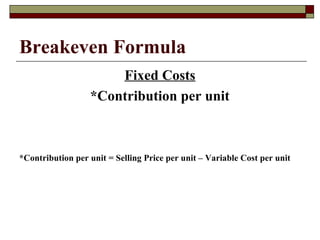
Breakeven Formula
Fixed Costs
*Contribution per unit
*Contribution per unit = Selling Price per unit – Variable Cost per unit
Breakeven Chart
USES OF BREAK EVEVN POINT
Helpful in deciding the minimum
quantity of sales
Helpful in the determination of tender
price
Helpful in examining effects upon
organization’s profitability
Helpful in deciding about the substitution
of new plants
Helpful in sales price and quantity
Helpful in determining marginal cost
Margin of Safety
 The difference between budgeted or actual
sales and the breakeven point
 The margin of safety may be expressed in
units or revenue terms
 Shows the amount by which sales can drop
before a loss will be incurred
Break even analysis should be distinguished from two other managerial
tools :-
Flexible budgets and standard cost the variable expense budget is built
on the same basic cost – output relationship, but it is confined to costs
and is primarily can concerned with the components of combined cost
since the purpose is to control cost by developing expenses standards
that are flexibly to achieving rate this purpose often leads to measures
of achieving that differ among costs and operation so that they cant be
readily added or translated in to an index of output for the enterprise as
a whole standard costs on the other hand on.
CONCLUSION
breakeven analikysis

breakeven analikysis

  • 1.
  • 2.
  • 3.
    Breakeven Analysis Defined Breakeven analysis examines the short run relationship between changes in volume and changes in total sales revenue, expenses and net profit  Also known as C-V-P analysis (Cost Volume Profit Analysis)
  • 4.
    Uses of BreakevenAnalysis  C-V-P analysis is an important tool in terms of short-term planning and decision making  It looks at the relationship between costs, revenue, output levels and profit  Short run decisions where C-V-P is used include choice of sales mix, pricing policy etc.
  • 5.
    Key Terminology: Breakeven Analysis Break even point-the point at which a company makes neither a profit or a loss.  Contribution per unit-the sales price minus the variable cost per unit. It measures the contribution made by each item of output to the fixed costs and profit of the organisation.
  • 6.
    Key Terminology ctd. Margin of safety-a measure in which the budgeted volume of sales is compared with the volume of sales required to break even  Marginal Cost – cost of producing one extra unit of output
  • 7.
    Breakeven Formula Fixed Costs *Contributionper unit *Contribution per unit = Selling Price per unit – Variable Cost per unit
  • 8.
  • 9.
    USES OF BREAKEVEVN POINT Helpful in deciding the minimum quantity of sales Helpful in the determination of tender price Helpful in examining effects upon organization’s profitability Helpful in deciding about the substitution of new plants Helpful in sales price and quantity Helpful in determining marginal cost
  • 10.
    Margin of Safety The difference between budgeted or actual sales and the breakeven point  The margin of safety may be expressed in units or revenue terms  Shows the amount by which sales can drop before a loss will be incurred
  • 11.
    Break even analysisshould be distinguished from two other managerial tools :- Flexible budgets and standard cost the variable expense budget is built on the same basic cost – output relationship, but it is confined to costs and is primarily can concerned with the components of combined cost since the purpose is to control cost by developing expenses standards that are flexibly to achieving rate this purpose often leads to measures of achieving that differ among costs and operation so that they cant be readily added or translated in to an index of output for the enterprise as a whole standard costs on the other hand on. CONCLUSION