BREAD AND PASTRY
PRODUCTION NC II
SHIELA R. PLAZA
BPP NC II - Trainer
COMPETENCY BASED
LEARNING MATERIALS
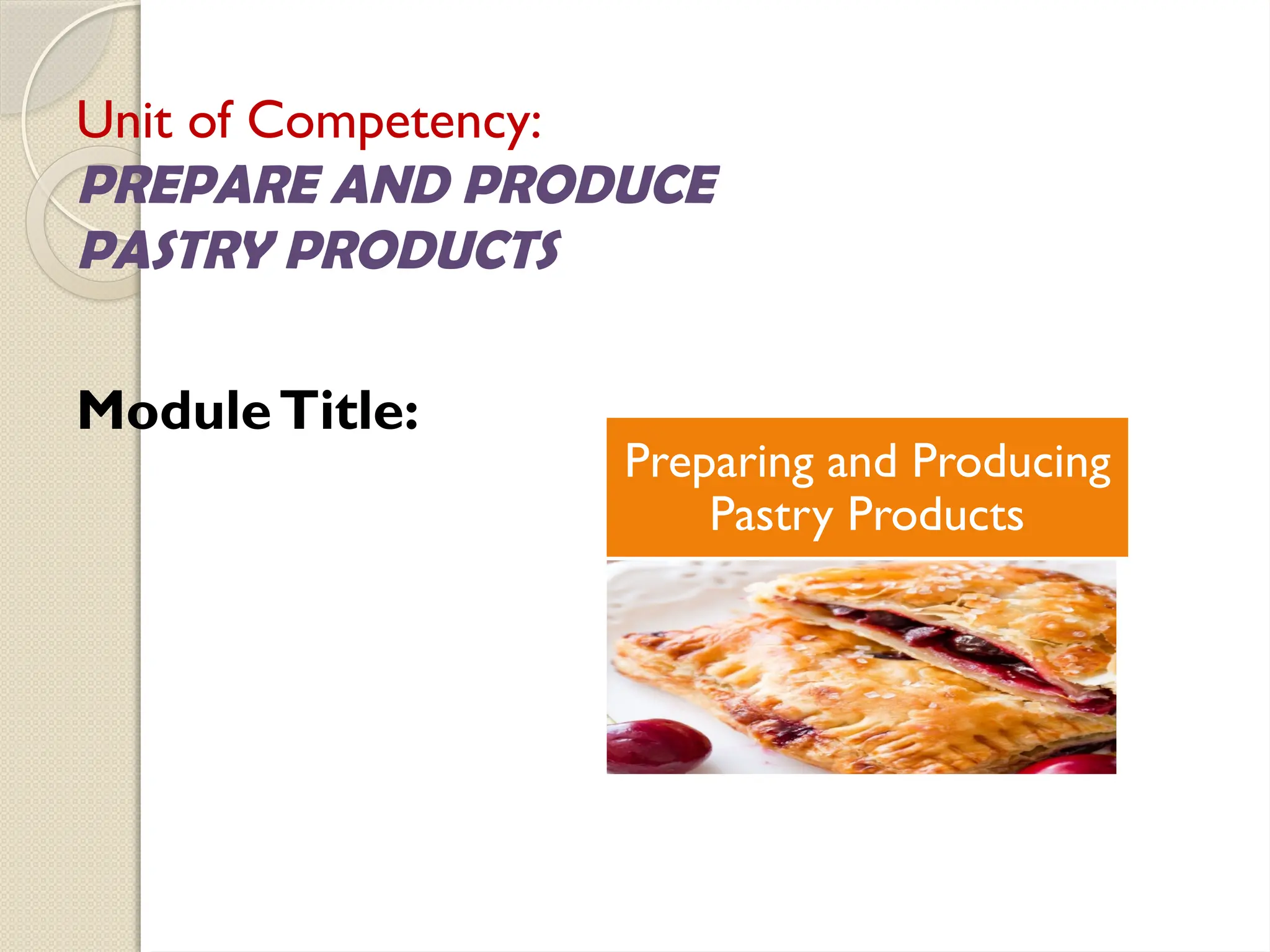
Unit of Competency:
PREPARE AND PRODUCE
PASTRY PRODUCTS
ModuleTitle:
Preparing and Producing
Pastry Products
HOW TO USE THIS COMPETENCY-BASED
LEARNING MATERIAL
The unit of competency, “PREPARE AND PRODUCE PASTRY PRODUCTS”, is one of the
competencies of BREAD AND PASTRY PRODUCTION NC II, a course which comprises the knowledge,
skills, and attitudes required for a TVET trainee to possess.
The module, PREPARING AND PRODUCING PASTRY PRODUCTS, contains materials related to,
Prepare pastry products, Decorate and present pastry products, Store pastry products.
In this module, you are required to go through a series of learning activities in order to complete each
learning outcome. In each learning outcome are Information Sheets, Self-Checks, Task Sheets and Job Sheets.
Follow and perform the activities on your own. If you have questions, do not hesitate to ask for assistance from
your facilitator.
Remember to:
Read information sheet and complete the self- checks.
Perform the Task Sheets, Operation Sheets, and Job Sheets until you are confident that your outputs conform to
the Performance Criteria Checklists that follow the said work sheets.
Submit outputs of theTask Sheets, Operation Sheets, and Job Sheets to your facilitator for evaluation and
recording in the Achievement Chart. Outputs shall serve as your portfolio during the Institutional Competency
Evaluation.When you feel confident that you have had sufficient practice, ask your trainer to evaluate you.The
results of your assessment will be recorded in your Achievement Chart and Progress Chart.
You must pass the Institutional Competency Evaluation for this competency before moving to another
competency.A Certificate of Achievement will be awarded to you after passing the evaluation.
LIST OF COMPETENCIES
No. Unit of Competency ModuleTitle Code
1 Prepare and produce bakery
products
Preparing and Producing Bakery
Products
TRS741379
2 Prepare and
produce pastry
products
Preparing and
Producing Pastry
Products
TRS741380
3 Prepare and present gateaux,
tortes and cakes
Preparing and Presenting
gateaux, tortes and cakes
TRS741342
4 Prepare and display petits fours Preparing and Displaying Petits
Fours
TRS741344
5 Present desserts Presenting Desserts TRS741343
MODULE DESCRIPTOR:
This unit deals with knowledge and
skills required by bakers and pastry cooks
(patisseries) to prepare and produce a
range of high-quality pastry products in
commercial food production environments
and hospitality establishments.
LEARNING OUTCOMES:
Upon completion of this module, you MUST
be able to:
 PREPARE PASTRY PRODUCTS
 DECORATE AND PRESENT PASTRY
PRODUCTS
 STORE PASTRY PRODUCTS
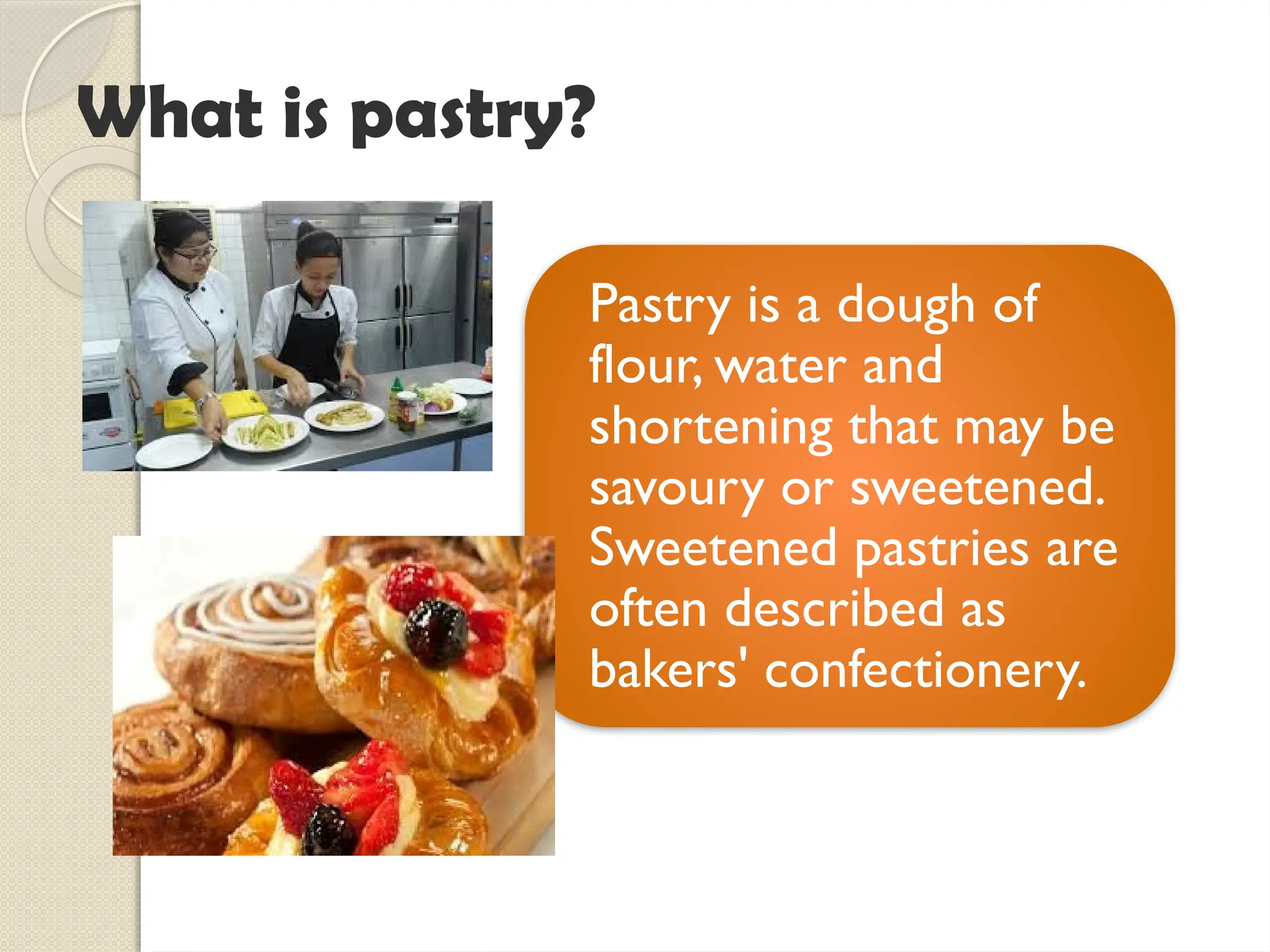
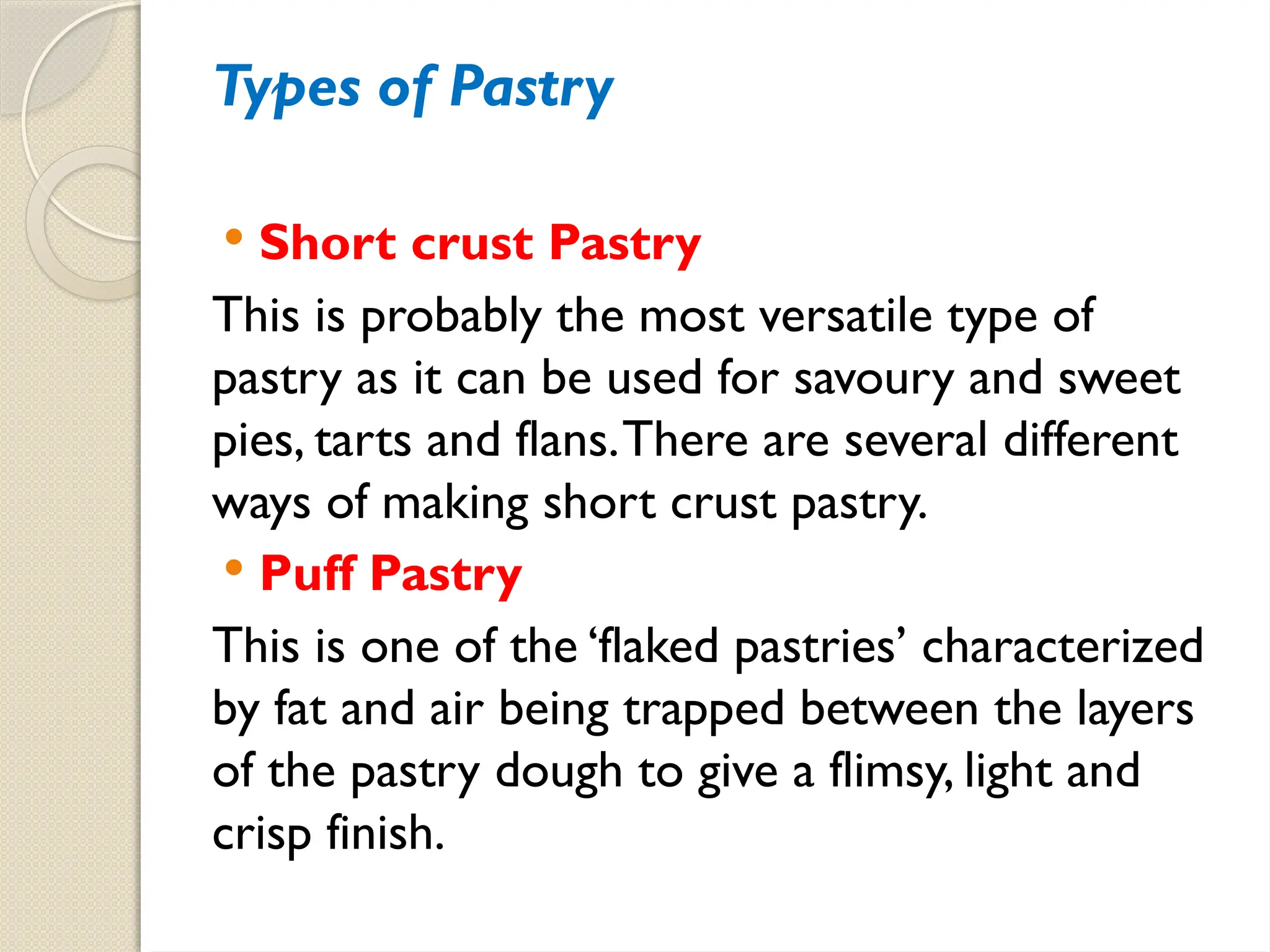
What is pastry?
Pastry is a dough of
flour, water and
shortening that may be
savoury or sweetened.
Sweetened pastries are
often described as
bakers' confectionery.
Types of Pastry
 Short crust Pastry
This is probably the most versatile type of
pastry as it can be used for savoury and sweet
pies, tarts and flans.There are several different
ways of making short crust pastry.
 Puff Pastry
This is one of the ‘flaked pastries’ characterized
by fat and air being trapped between the layers
of the pastry dough to give a flimsy, light and
crisp finish.
 Flaky Pastry
Used as a crust for savoury pies, sausage rolls, Eccles
cakes and jam puffs, flaky pastry is best made in cool
conditions and must be chilled during and after
making, to prevent the fat content from melting out
under cooking conditions.
 Rough Puff Pastry
This type is a cross between puff and flaky pastry. It is
also good for sausage rolls, savoury pie crusts and
tarts and has the advantage of being easier to make
than puff pastry, but is as light as flaky pastry.
 Choux Pastry
This incredibly light specialty pastry is used in
the making of éclairs, profiteroles and cream
buns.Air lifts the pastry during cooking to treble
in size all those cream-filled delights.
 Filo Pastry
This type of pastry (along with finely shredded
kadafi pastry, also from the Mediterranean) is
made in very thin sheets and used as a casing for
numerous delicate savoury and sweet dishes.
 Suet Crust Pastry
A traditional, British, pastry used for steamed or
boiled puddings, dumplings and roly-poly puddings.
Steak and kidney pudding is famously made with
suet crust pastry as is spotted dick and treacle
pudding.
 Hot Water Crust Pastry
Molded by hand while warm and used for raised
meat and game pies (like the famous Melton
Mowbray Pork Pies) hot water crust pastry is a rich
and crisp specialty.
 Pate Sucree Pastry
As the name suggests, this pastry is French.
It is a sweet pastry that incorporates sugar
and egg yolks for a rich, sweet result.
Usually baked blind, it gives a thin, crisp
pastry that melts in the mouth.
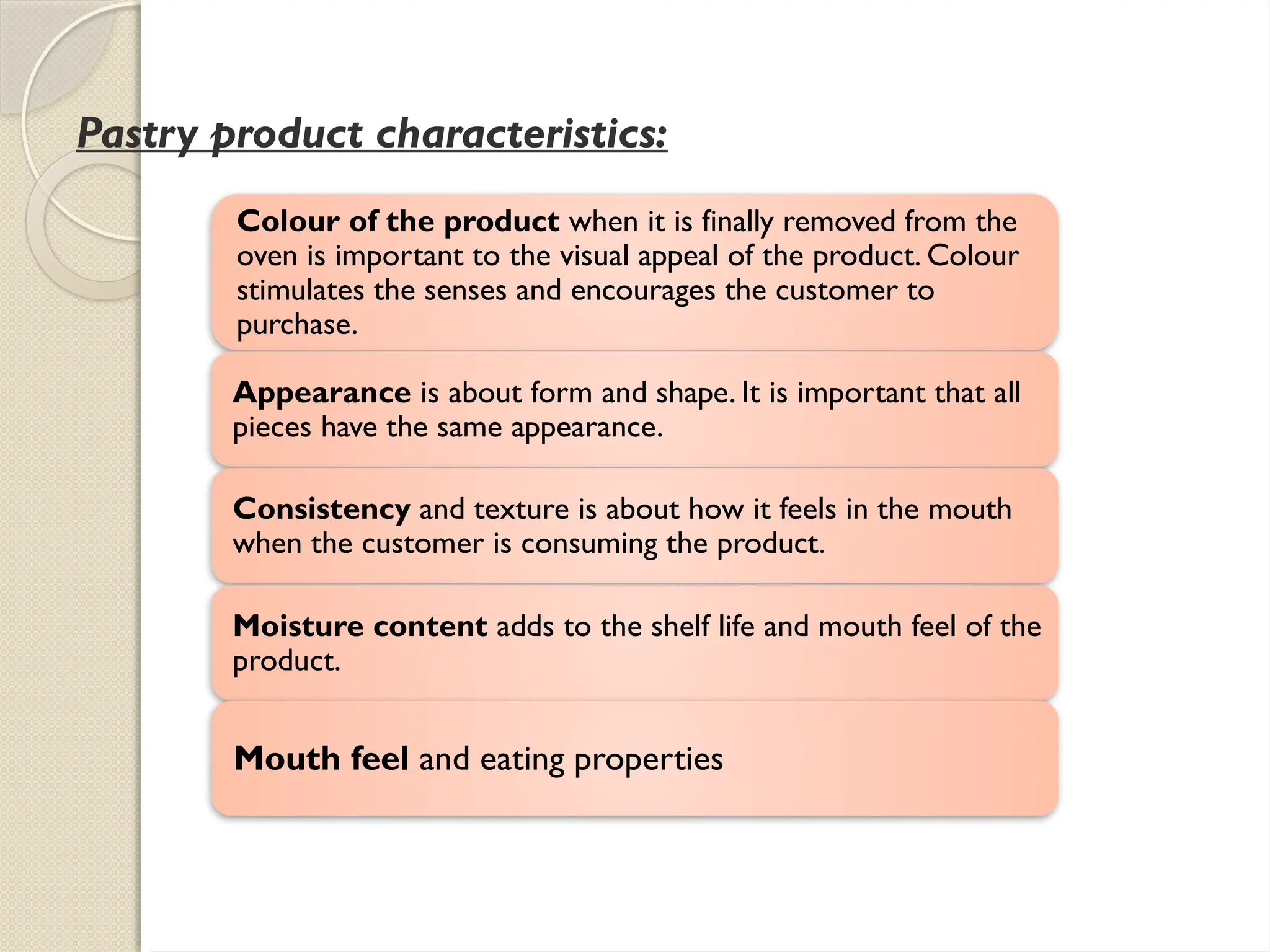
Pastry product characteristics:
Colour of the product when it is finally removed from the
oven is important to the visual appeal of the product. Colour
stimulates the senses and encourages the customer to
purchase.
Appearance is about form and shape. It is important that all
pieces have the same appearance.
Consistency and texture is about how it feels in the mouth
when the customer is consuming the product.
Moisture content adds to the shelf life and mouth feel of the
product.
Mouth feel and eating properties
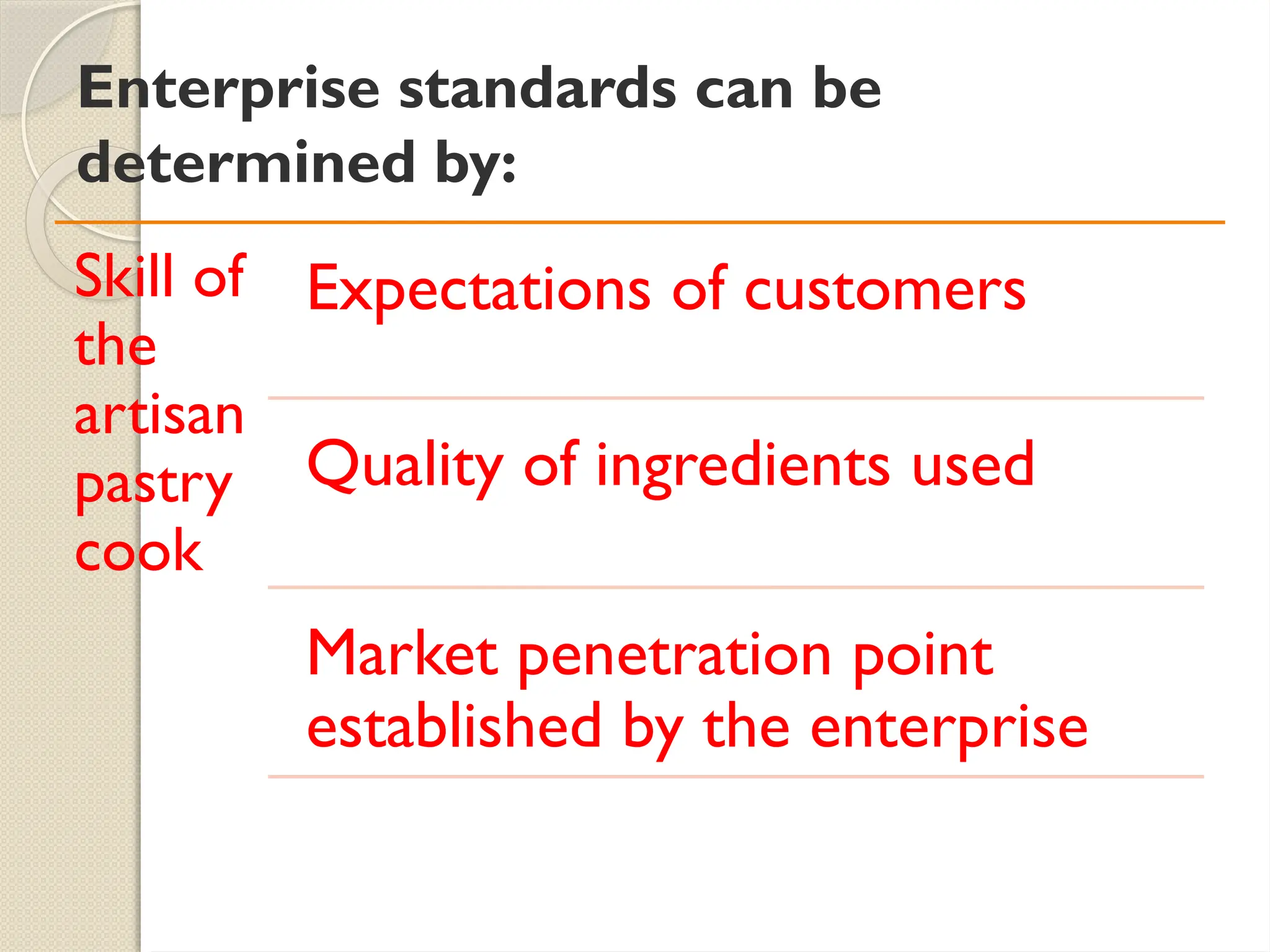
Enterprise standards can be
determined by:
Skill of
the
artisan
pastry
cook
Expectations of customers
Quality of ingredients used
Market penetration point
established by the enterprise
TOOLS, MATERIALS and EQUIPMENT
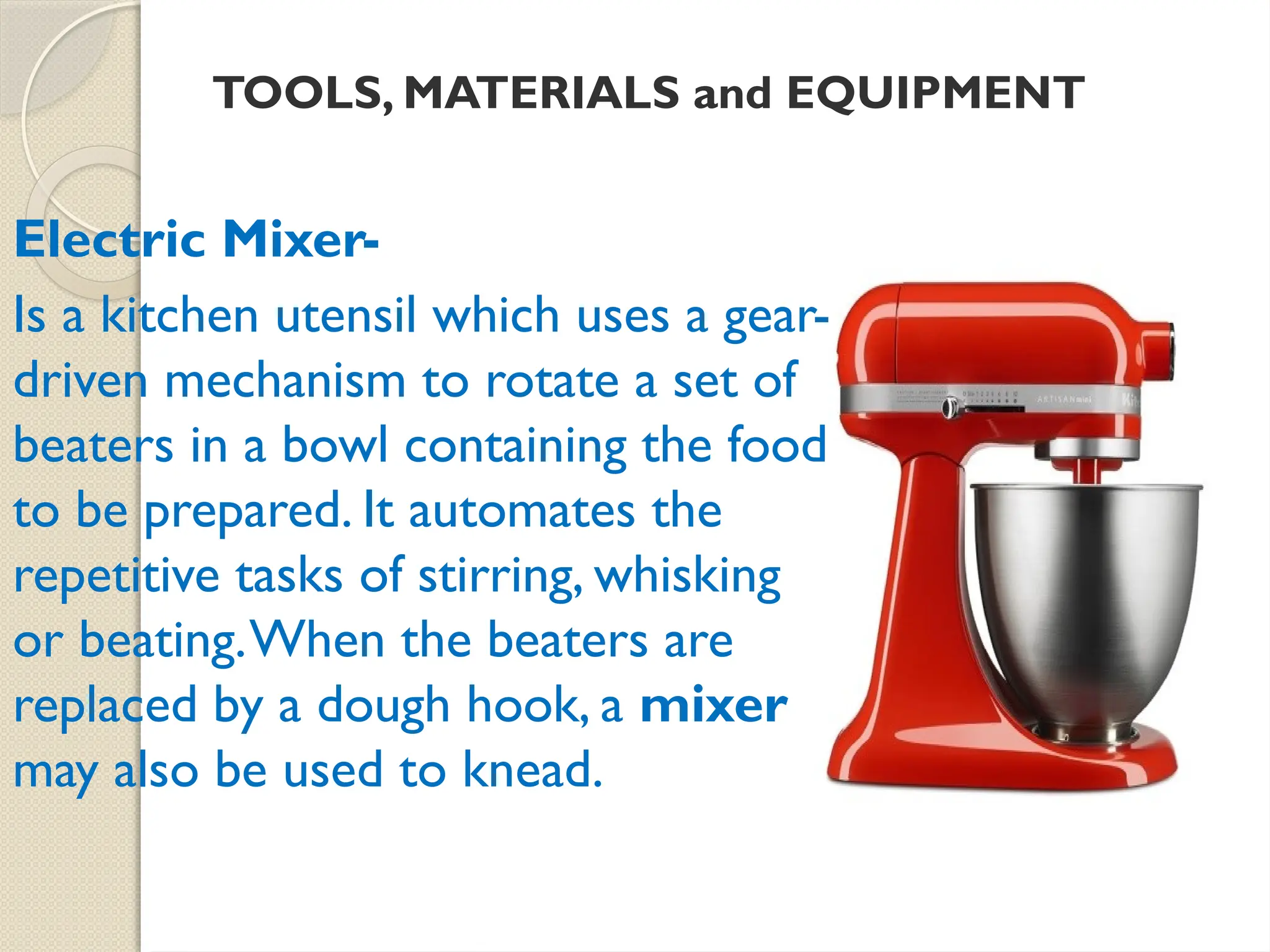
Electric Mixer-
Is a kitchen utensil which uses a gear-
driven mechanism to rotate a set of
beaters in a bowl containing the food
to be prepared. It automates the
repetitive tasks of stirring, whisking
or beating.When the beaters are
replaced by a dough hook, a mixer
may also be used to knead.
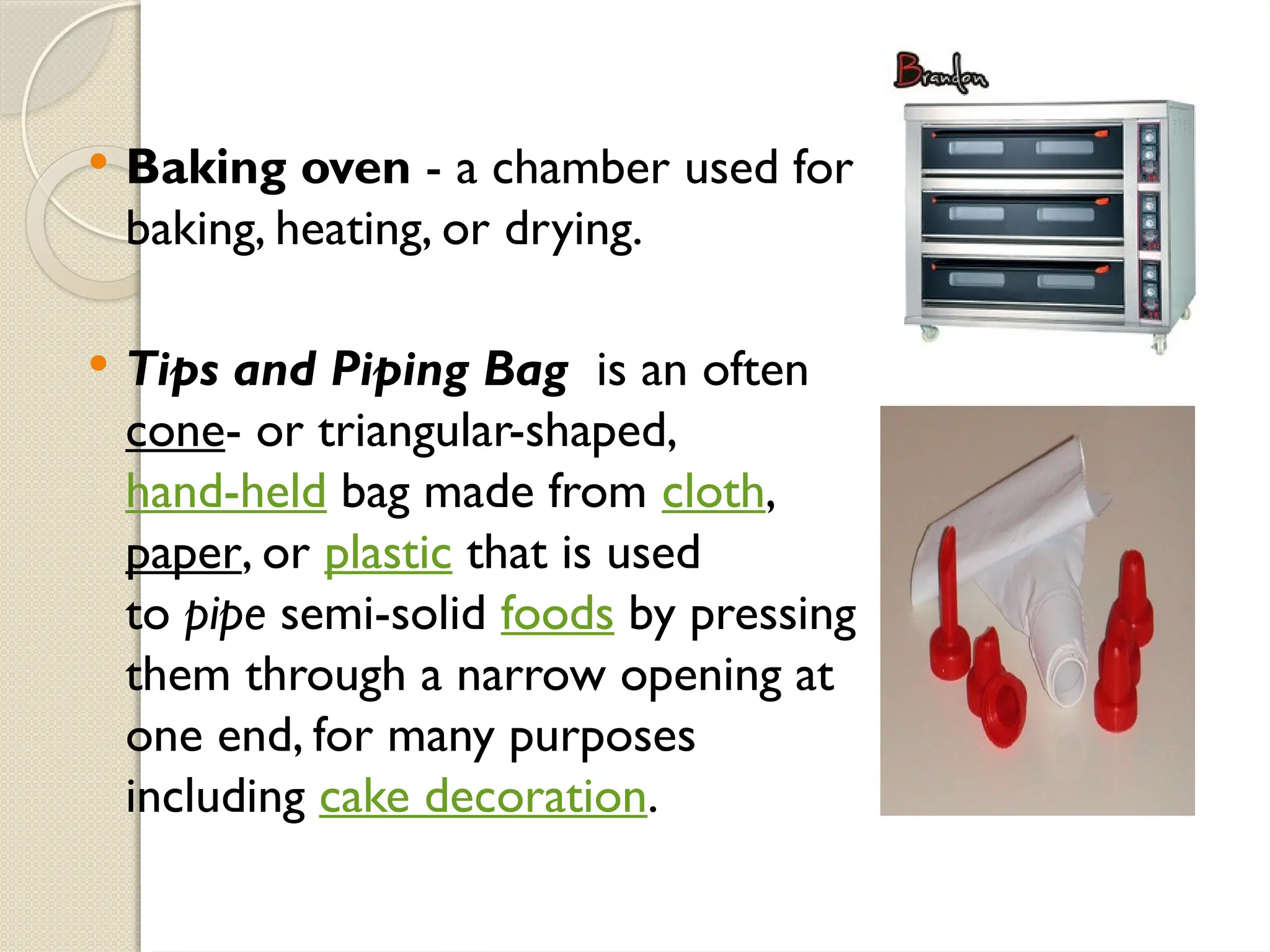
 Baking oven - a chamber used for
baking, heating, or drying.
 Tips and Piping Bag is an often
cone- or triangular-shaped,
hand-held bag made from cloth,
paper, or plastic that is used
to pipe semi-solid foods by pressing
them through a narrow opening at
one end, for many purposes
including cake decoration.
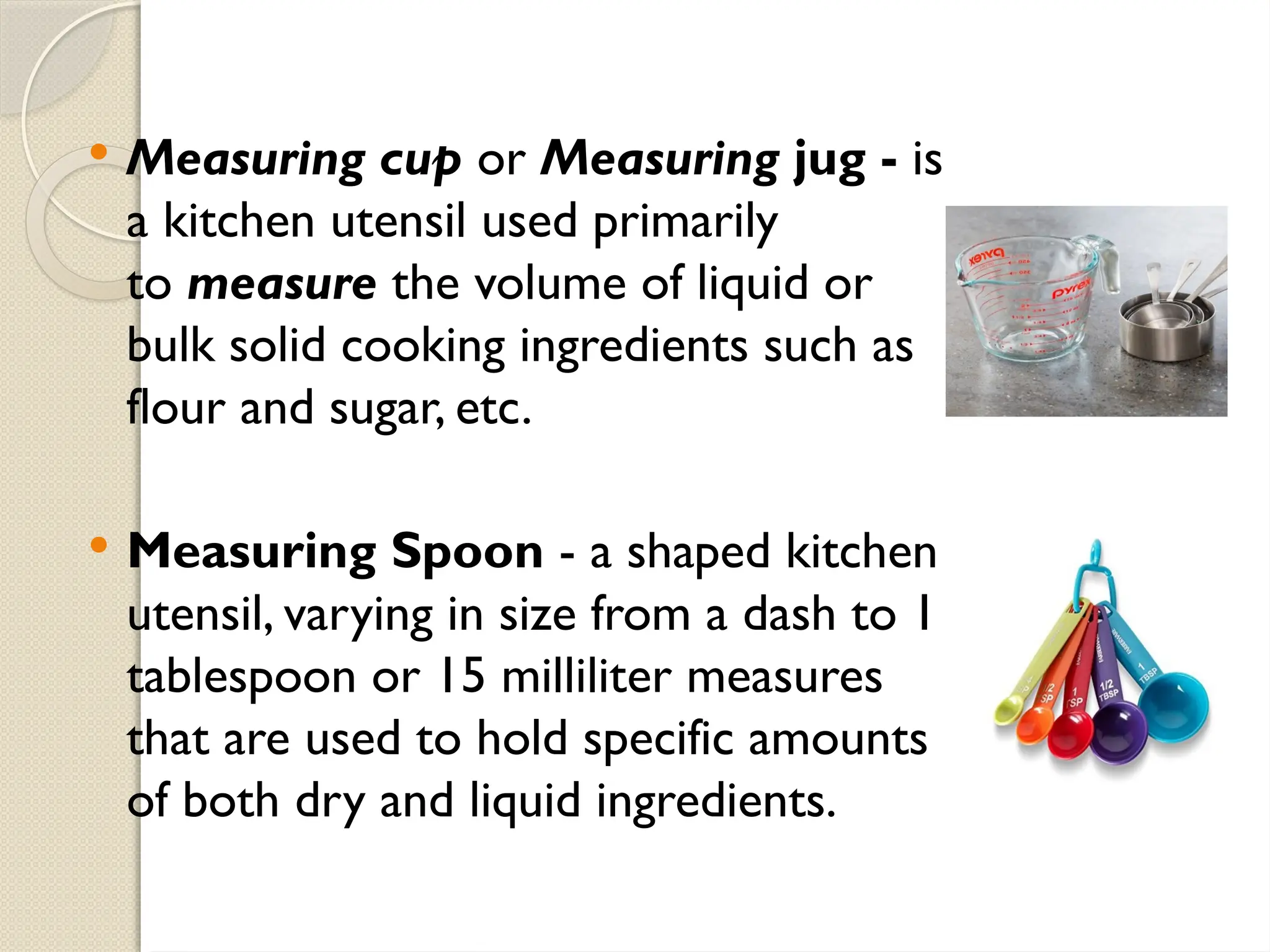
 Measuring cup or Measuring jug - is
a kitchen utensil used primarily
to measure the volume of liquid or
bulk solid cooking ingredients such as
flour and sugar, etc.
 Measuring Spoon - a shaped kitchen
utensil, varying in size from a dash to 1
tablespoon or 15 milliliter measures
that are used to hold specific amounts
of both dry and liquid ingredients.
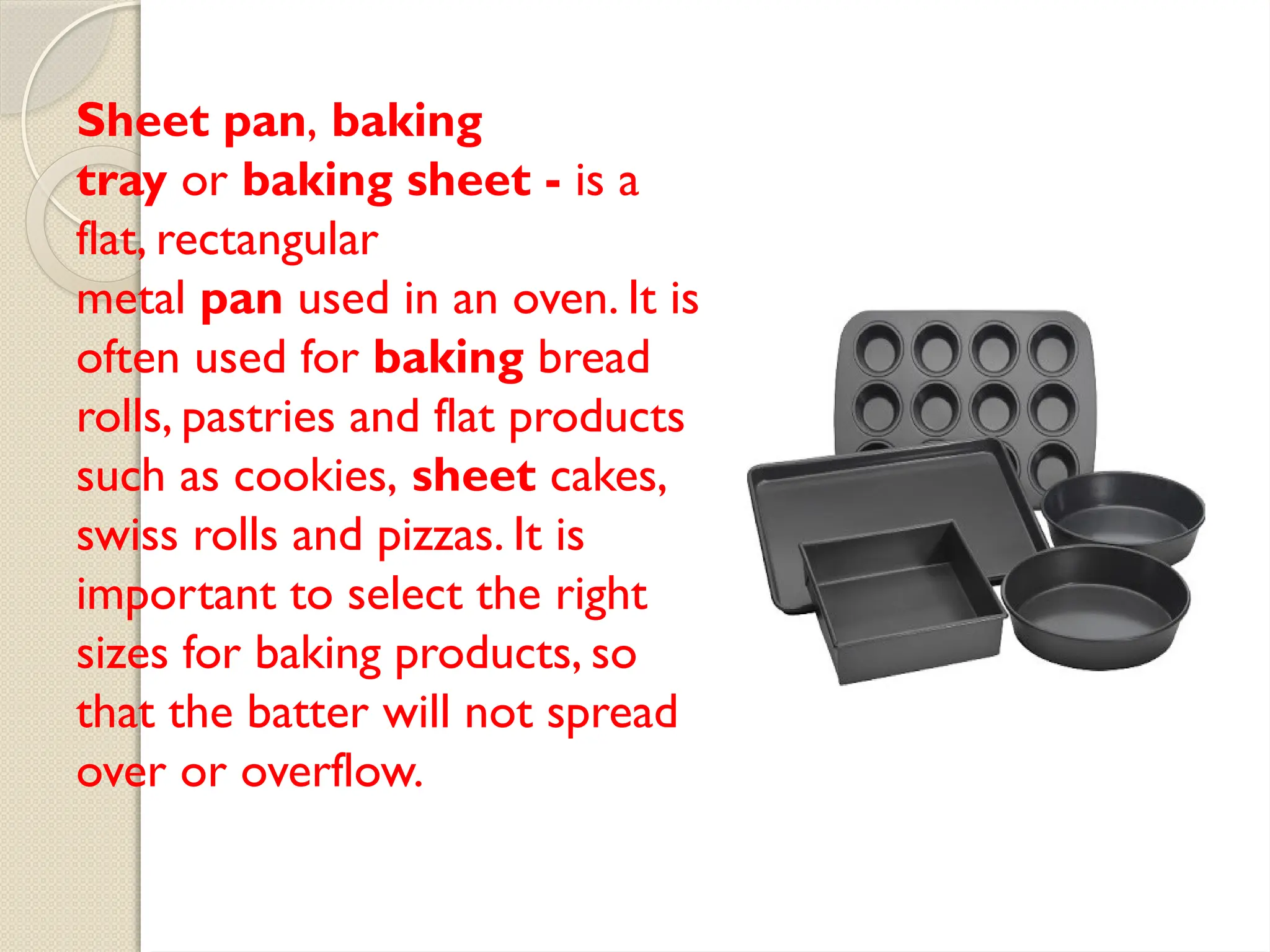
Sheet pan, baking
tray or baking sheet - is a
flat, rectangular
metal pan used in an oven. It is
often used for baking bread
rolls, pastries and flat products
such as cookies, sheet cakes,
swiss rolls and pizzas. It is
important to select the right
sizes for baking products, so
that the batter will not spread
over or overflow.
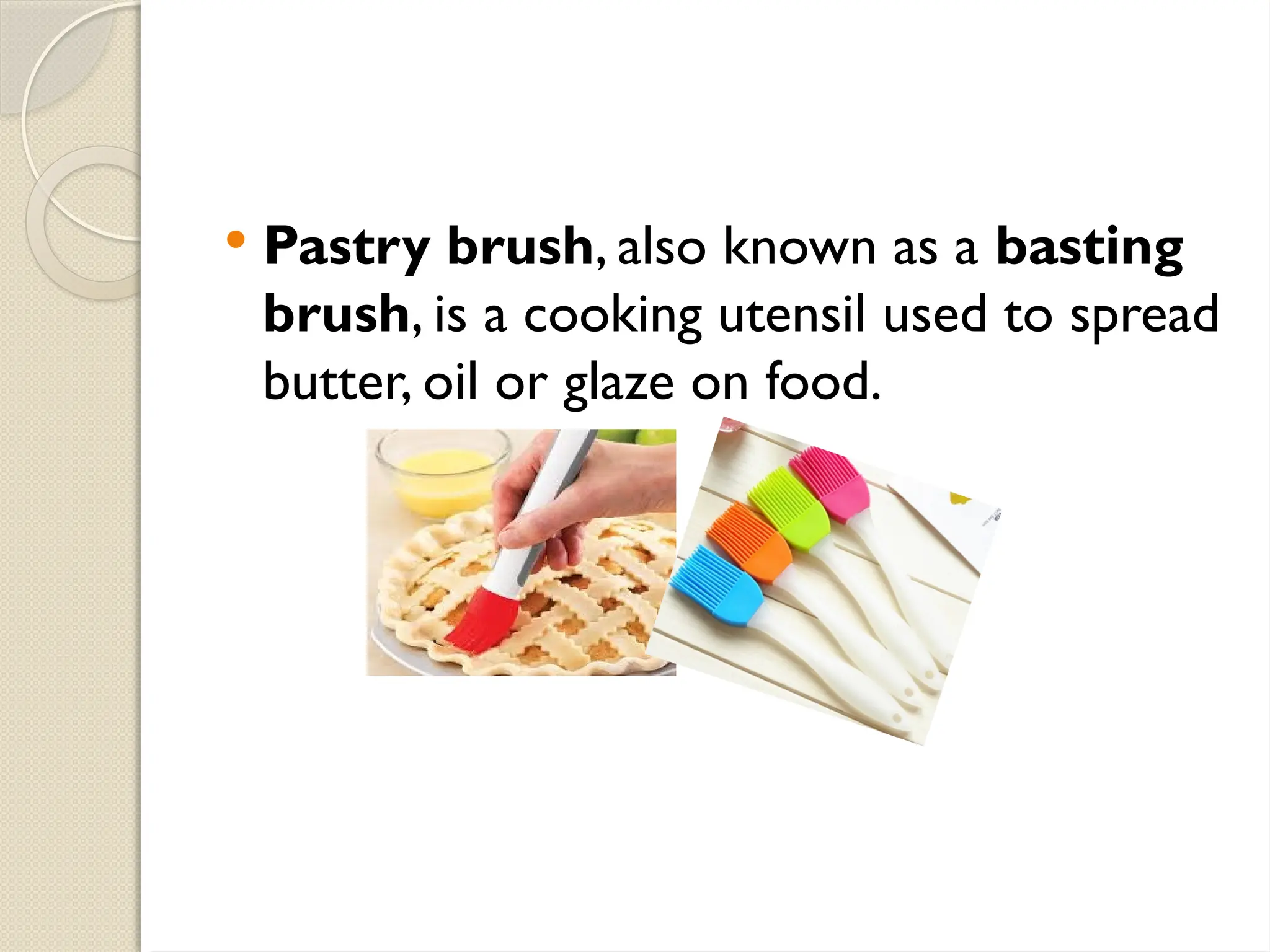
 Pastry brush, also known as a basting
brush, is a cooking utensil used to spread
butter, oil or glaze on food.
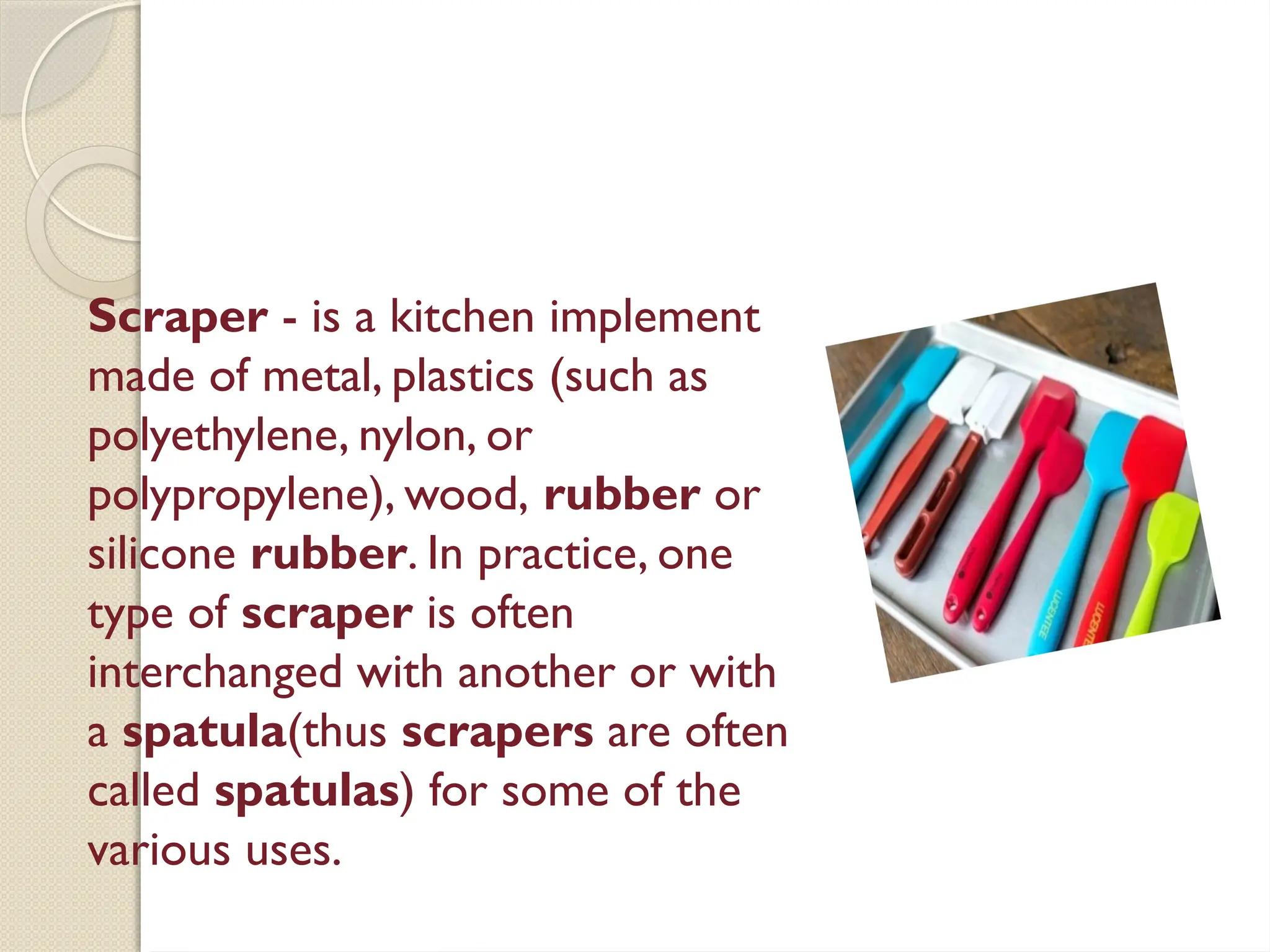
Scraper - is a kitchen implement
made of metal, plastics (such as
polyethylene, nylon, or
polypropylene), wood, rubber or
silicone rubber. In practice, one
type of scraper is often
interchanged with another or with
a spatula(thus scrapers are often
called spatulas) for some of the
various uses.
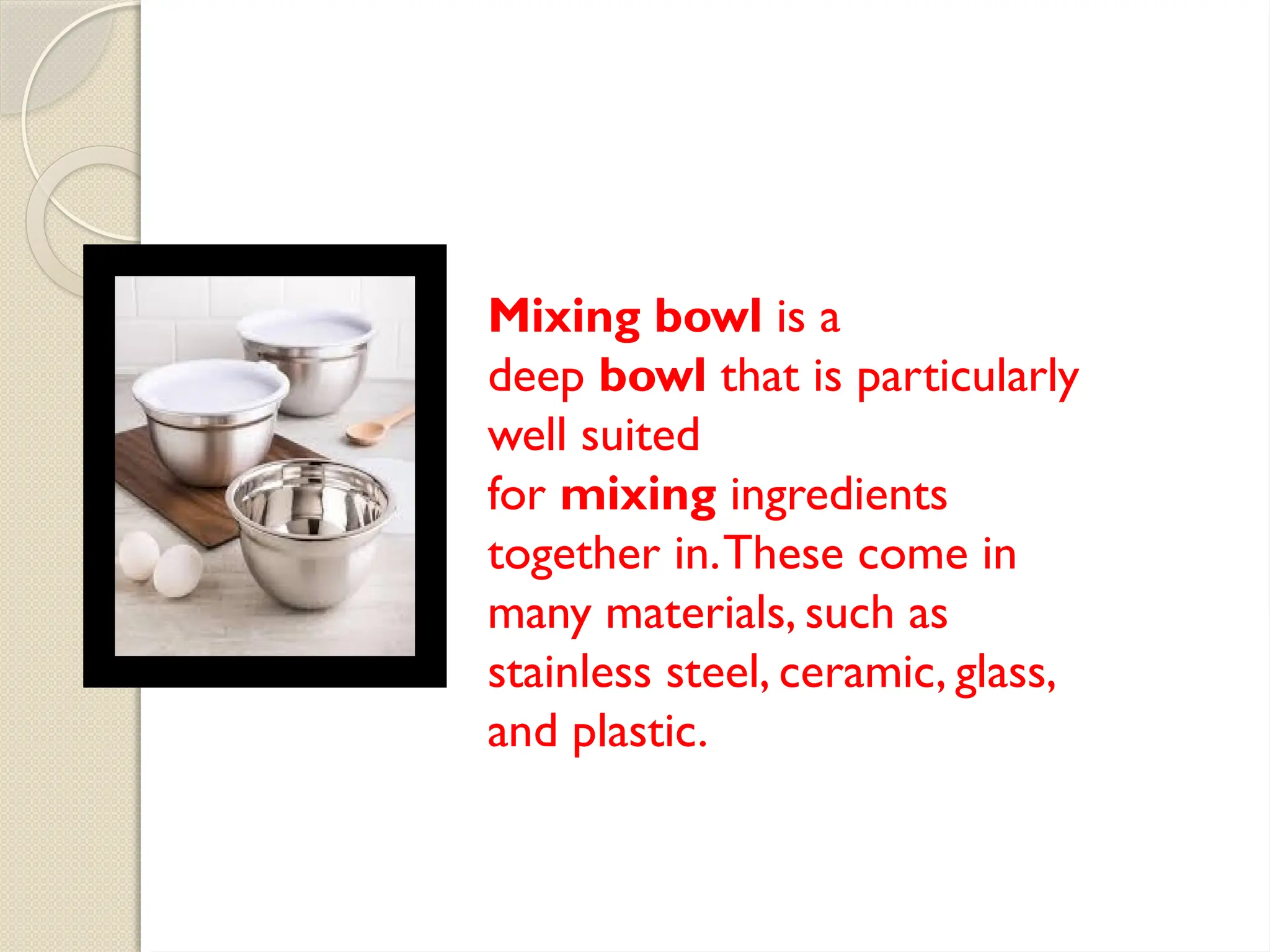
Mixing bowl is a
deep bowl that is particularly
well suited
for mixing ingredients
together in.These come in
many materials, such as
stainless steel, ceramic, glass,
and plastic.
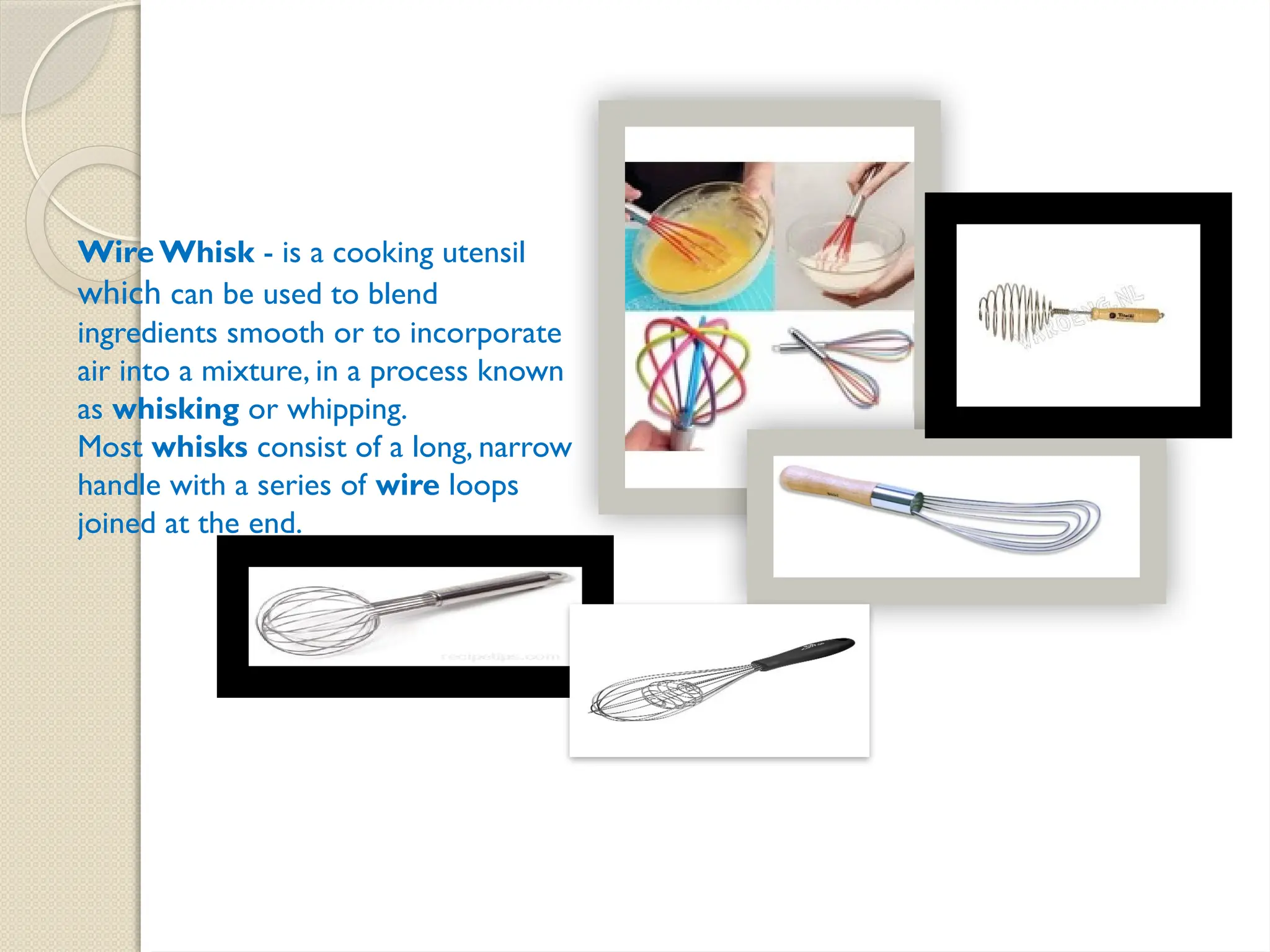
Wire Whisk - is a cooking utensil
which can be used to blend
ingredients smooth or to incorporate
air into a mixture, in a process known
as whisking or whipping.
Most whisks consist of a long, narrow
handle with a series of wire loops
joined at the end.
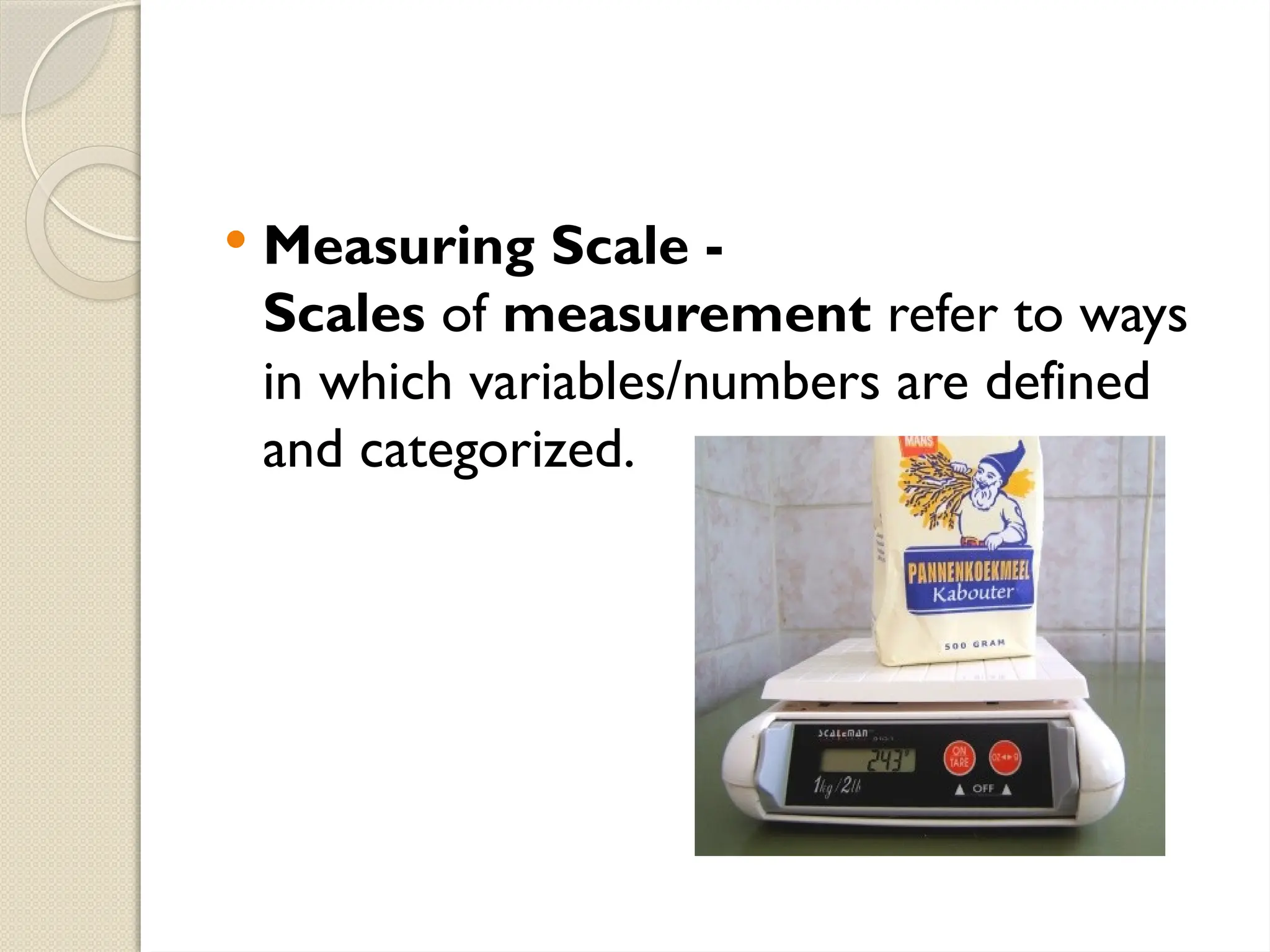
 Measuring Scale -
Scales of measurement refer to ways
in which variables/numbers are defined
and categorized.
FILLINGS and COATING/ICING, GLAZES and DECORATIONS
What is the difference of FROSTING and ICING?
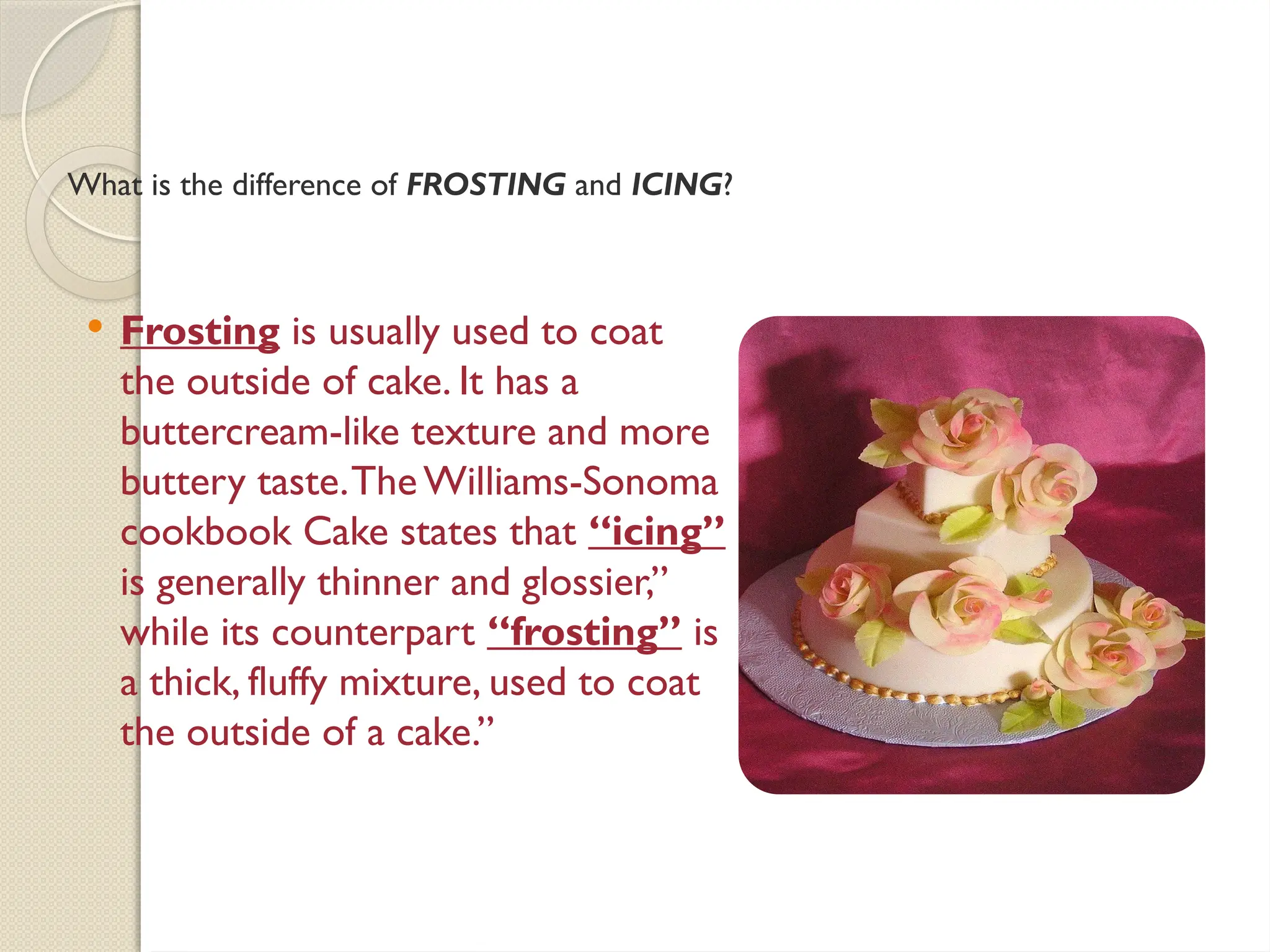
 Frosting is usually used to coat
the outside of cake. It has a
buttercream-like texture and more
buttery taste.TheWilliams-Sonoma
cookbook Cake states that “icing”
is generally thinner and glossier,”
while its counterpart “frosting” is
a thick, fluffy mixture, used to coat
the outside of a cake.”
Types of decorations
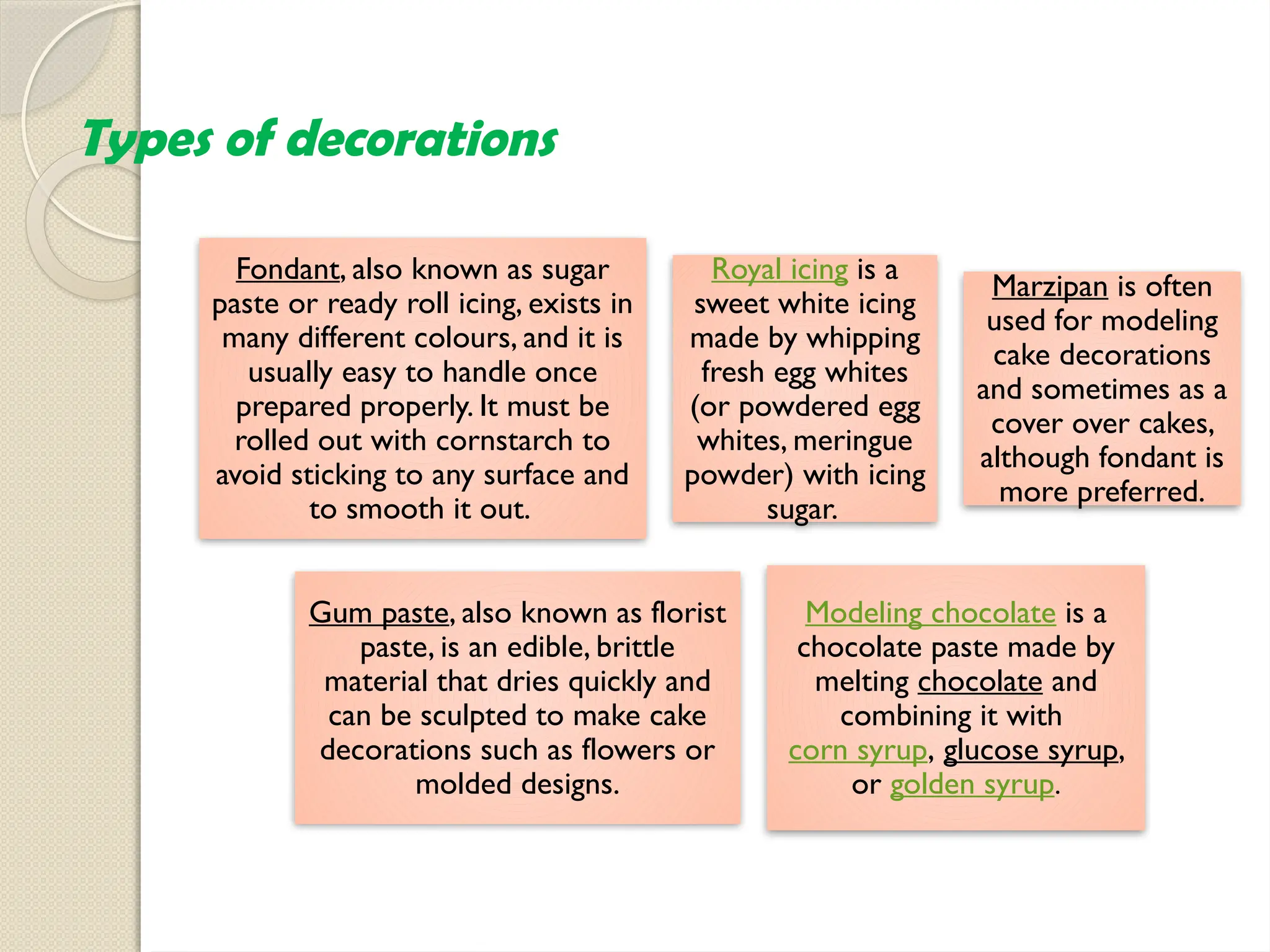
Fondant, also known as sugar
paste or ready roll icing, exists in
many different colours, and it is
usually easy to handle once
prepared properly. It must be
rolled out with cornstarch to
avoid sticking to any surface and
to smooth it out.
Royal icing is a
sweet white icing
made by whipping
fresh egg whites
(or powdered egg
whites, meringue
powder) with icing
sugar.
Marzipan is often
used for modeling
cake decorations
and sometimes as a
cover over cakes,
although fondant is
more preferred.
Gum paste, also known as florist
paste, is an edible, brittle
material that dries quickly and
can be sculpted to make cake
decorations such as flowers or
molded designs.
Modeling chocolate is a
chocolate paste made by
melting chocolate and
combining it with
corn syrup, glucose syrup,
or golden syrup.
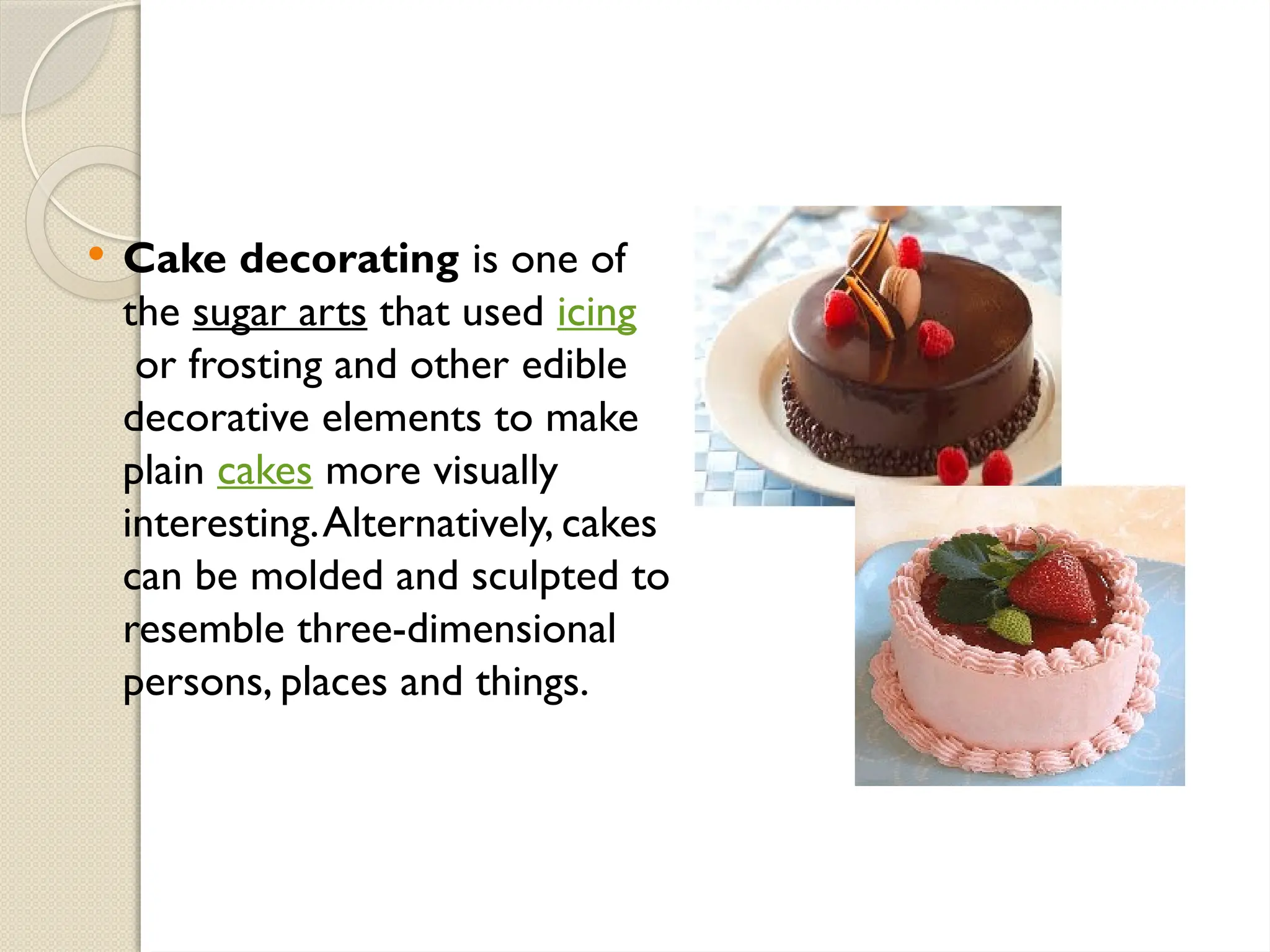
 Cake decorating is one of
the sugar arts that used icing
or frosting and other edible
decorative elements to make
plain cakes more visually
interesting.Alternatively, cakes
can be molded and sculpted to
resemble three-dimensional
persons, places and things.
Cakes are decorated to mark a special
celebration (such as birthday or wedding).They
can also mark national or religious holidays, or
be used to promote commercial enterprises.
However, cakes may be baked and decorated
for almost any social occasion.
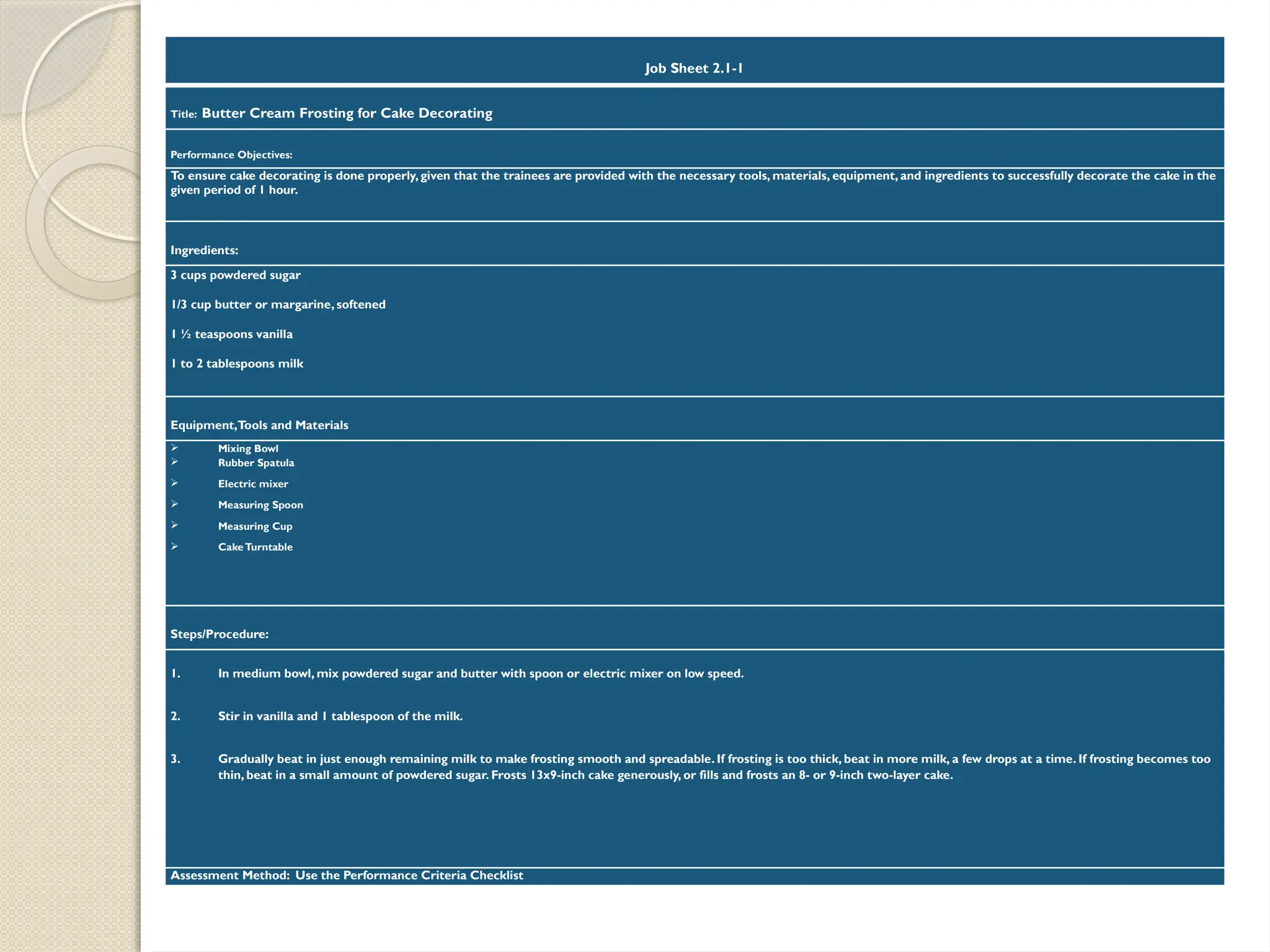
Job Sheet 2.1-1
Title: Butter Cream Frosting for Cake Decorating
Performance Objectives:
To ensure cake decorating is done properly, given that the trainees are provided with the necessary tools, materials, equipment, and ingredients to successfully decorate the cake in the
given period of 1 hour.
Ingredients:
3 cups powdered sugar
1/3 cup butter or margarine, softened
1 ½ teaspoons vanilla
1 to 2 tablespoons milk
Equipment,Tools and Materials
 Mixing Bowl
 Rubber Spatula
 Electric mixer
 Measuring Spoon
 Measuring Cup
 CakeTurntable
Steps/Procedure:
1. In medium bowl, mix powdered sugar and butter with spoon or electric mixer on low speed.
2. Stir in vanilla and 1 tablespoon of the milk.
3. Gradually beat in just enough remaining milk to make frosting smooth and spreadable. If frosting is too thick, beat in more milk, a few drops at a time. If frosting becomes too
thin, beat in a small amount of powdered sugar. Frosts 13x9-inch cake generously, or fills and frosts an 8- or 9-inch two-layer cake.
Assessment Method: Use the Performance Criteria Checklist
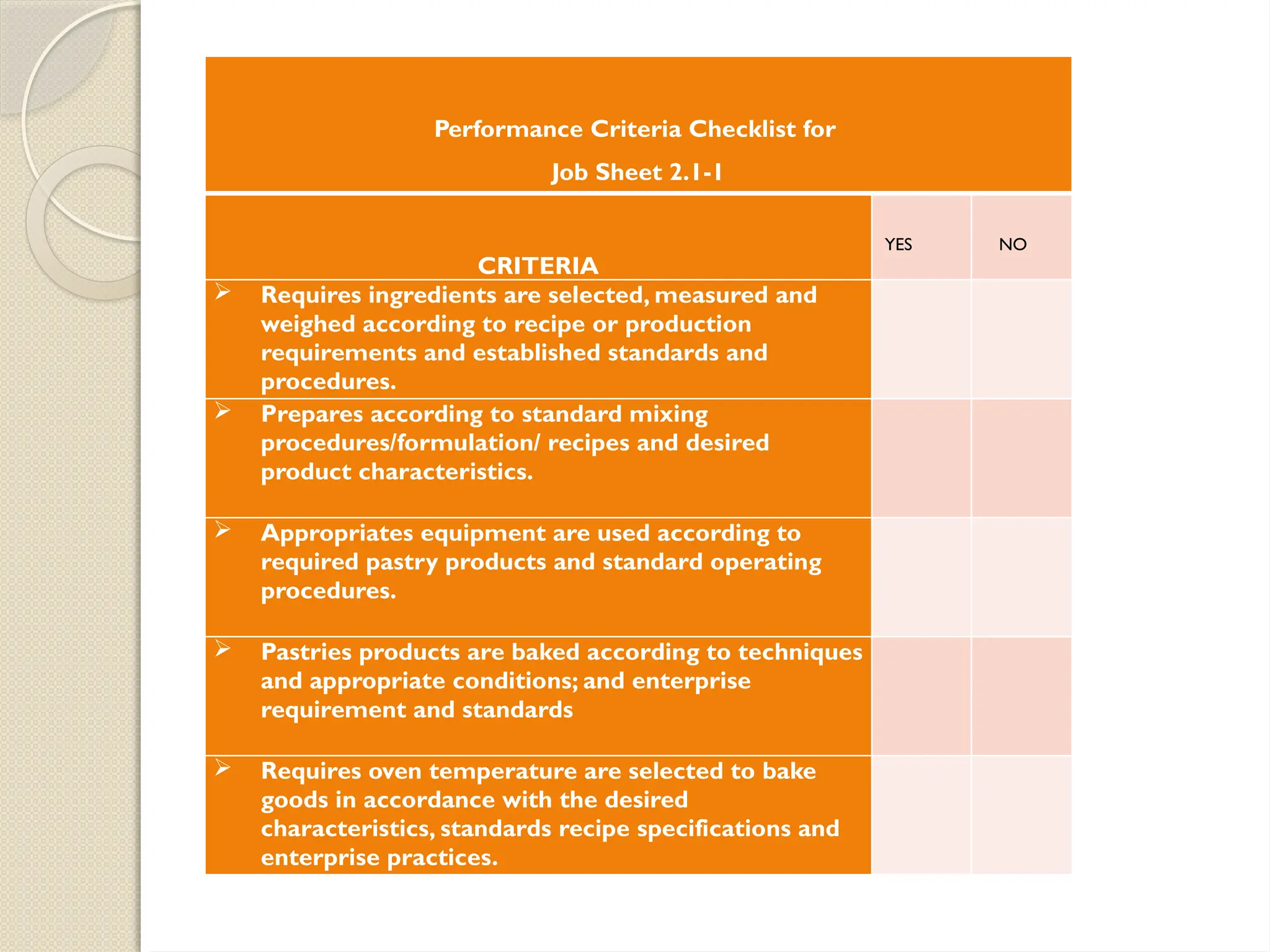
Performance Criteria Checklist for
Job Sheet 2.1-1
CRITERIA
YES NO
 Requires ingredients are selected, measured and
weighed according to recipe or production
requirements and established standards and
procedures.
 Prepares according to standard mixing
procedures/formulation/ recipes and desired
product characteristics.
 Appropriates equipment are used according to
required pastry products and standard operating
procedures.
 Pastries products are baked according to techniques
and appropriate conditions; and enterprise
requirement and standards
 Requires oven temperature are selected to bake
goods in accordance with the desired
characteristics, standards recipe specifications and
enterprise practices.

BREAD AND PASTRY PRODUCTION NC II GRADE 11

  • 1.
    BREAD AND PASTRY PRODUCTIONNC II SHIELA R. PLAZA BPP NC II - Trainer
  • 2.
  • 3.
    Unit of Competency: PREPAREAND PRODUCE PASTRY PRODUCTS ModuleTitle: Preparing and Producing Pastry Products
  • 4.
    HOW TO USETHIS COMPETENCY-BASED LEARNING MATERIAL The unit of competency, “PREPARE AND PRODUCE PASTRY PRODUCTS”, is one of the competencies of BREAD AND PASTRY PRODUCTION NC II, a course which comprises the knowledge, skills, and attitudes required for a TVET trainee to possess. The module, PREPARING AND PRODUCING PASTRY PRODUCTS, contains materials related to, Prepare pastry products, Decorate and present pastry products, Store pastry products. In this module, you are required to go through a series of learning activities in order to complete each learning outcome. In each learning outcome are Information Sheets, Self-Checks, Task Sheets and Job Sheets. Follow and perform the activities on your own. If you have questions, do not hesitate to ask for assistance from your facilitator. Remember to: Read information sheet and complete the self- checks. Perform the Task Sheets, Operation Sheets, and Job Sheets until you are confident that your outputs conform to the Performance Criteria Checklists that follow the said work sheets. Submit outputs of theTask Sheets, Operation Sheets, and Job Sheets to your facilitator for evaluation and recording in the Achievement Chart. Outputs shall serve as your portfolio during the Institutional Competency Evaluation.When you feel confident that you have had sufficient practice, ask your trainer to evaluate you.The results of your assessment will be recorded in your Achievement Chart and Progress Chart. You must pass the Institutional Competency Evaluation for this competency before moving to another competency.A Certificate of Achievement will be awarded to you after passing the evaluation.
  • 5.
    LIST OF COMPETENCIES No.Unit of Competency ModuleTitle Code 1 Prepare and produce bakery products Preparing and Producing Bakery Products TRS741379 2 Prepare and produce pastry products Preparing and Producing Pastry Products TRS741380 3 Prepare and present gateaux, tortes and cakes Preparing and Presenting gateaux, tortes and cakes TRS741342 4 Prepare and display petits fours Preparing and Displaying Petits Fours TRS741344 5 Present desserts Presenting Desserts TRS741343
  • 6.
    MODULE DESCRIPTOR: This unitdeals with knowledge and skills required by bakers and pastry cooks (patisseries) to prepare and produce a range of high-quality pastry products in commercial food production environments and hospitality establishments.
  • 7.
    LEARNING OUTCOMES: Upon completionof this module, you MUST be able to:  PREPARE PASTRY PRODUCTS  DECORATE AND PRESENT PASTRY PRODUCTS  STORE PASTRY PRODUCTS
  • 8.
    What is pastry? Pastryis a dough of flour, water and shortening that may be savoury or sweetened. Sweetened pastries are often described as bakers' confectionery.
  • 9.
    Types of Pastry Short crust Pastry This is probably the most versatile type of pastry as it can be used for savoury and sweet pies, tarts and flans.There are several different ways of making short crust pastry.  Puff Pastry This is one of the ‘flaked pastries’ characterized by fat and air being trapped between the layers of the pastry dough to give a flimsy, light and crisp finish.
  • 10.
     Flaky Pastry Usedas a crust for savoury pies, sausage rolls, Eccles cakes and jam puffs, flaky pastry is best made in cool conditions and must be chilled during and after making, to prevent the fat content from melting out under cooking conditions.  Rough Puff Pastry This type is a cross between puff and flaky pastry. It is also good for sausage rolls, savoury pie crusts and tarts and has the advantage of being easier to make than puff pastry, but is as light as flaky pastry.
  • 11.
     Choux Pastry Thisincredibly light specialty pastry is used in the making of éclairs, profiteroles and cream buns.Air lifts the pastry during cooking to treble in size all those cream-filled delights.  Filo Pastry This type of pastry (along with finely shredded kadafi pastry, also from the Mediterranean) is made in very thin sheets and used as a casing for numerous delicate savoury and sweet dishes.
  • 12.
     Suet CrustPastry A traditional, British, pastry used for steamed or boiled puddings, dumplings and roly-poly puddings. Steak and kidney pudding is famously made with suet crust pastry as is spotted dick and treacle pudding.  Hot Water Crust Pastry Molded by hand while warm and used for raised meat and game pies (like the famous Melton Mowbray Pork Pies) hot water crust pastry is a rich and crisp specialty.
  • 13.
     Pate SucreePastry As the name suggests, this pastry is French. It is a sweet pastry that incorporates sugar and egg yolks for a rich, sweet result. Usually baked blind, it gives a thin, crisp pastry that melts in the mouth.
  • 14.
    Pastry product characteristics: Colourof the product when it is finally removed from the oven is important to the visual appeal of the product. Colour stimulates the senses and encourages the customer to purchase. Appearance is about form and shape. It is important that all pieces have the same appearance. Consistency and texture is about how it feels in the mouth when the customer is consuming the product. Moisture content adds to the shelf life and mouth feel of the product. Mouth feel and eating properties
  • 15.
    Enterprise standards canbe determined by: Skill of the artisan pastry cook Expectations of customers Quality of ingredients used Market penetration point established by the enterprise
  • 16.
    TOOLS, MATERIALS andEQUIPMENT Electric Mixer- Is a kitchen utensil which uses a gear- driven mechanism to rotate a set of beaters in a bowl containing the food to be prepared. It automates the repetitive tasks of stirring, whisking or beating.When the beaters are replaced by a dough hook, a mixer may also be used to knead.
  • 17.
     Baking oven- a chamber used for baking, heating, or drying.  Tips and Piping Bag is an often cone- or triangular-shaped, hand-held bag made from cloth, paper, or plastic that is used to pipe semi-solid foods by pressing them through a narrow opening at one end, for many purposes including cake decoration.
  • 18.
     Measuring cupor Measuring jug - is a kitchen utensil used primarily to measure the volume of liquid or bulk solid cooking ingredients such as flour and sugar, etc.  Measuring Spoon - a shaped kitchen utensil, varying in size from a dash to 1 tablespoon or 15 milliliter measures that are used to hold specific amounts of both dry and liquid ingredients.
  • 19.
    Sheet pan, baking trayor baking sheet - is a flat, rectangular metal pan used in an oven. It is often used for baking bread rolls, pastries and flat products such as cookies, sheet cakes, swiss rolls and pizzas. It is important to select the right sizes for baking products, so that the batter will not spread over or overflow.
  • 20.
     Pastry brush,also known as a basting brush, is a cooking utensil used to spread butter, oil or glaze on food.
  • 21.
    Scraper - isa kitchen implement made of metal, plastics (such as polyethylene, nylon, or polypropylene), wood, rubber or silicone rubber. In practice, one type of scraper is often interchanged with another or with a spatula(thus scrapers are often called spatulas) for some of the various uses.
  • 22.
    Mixing bowl isa deep bowl that is particularly well suited for mixing ingredients together in.These come in many materials, such as stainless steel, ceramic, glass, and plastic.
  • 23.
    Wire Whisk -is a cooking utensil which can be used to blend ingredients smooth or to incorporate air into a mixture, in a process known as whisking or whipping. Most whisks consist of a long, narrow handle with a series of wire loops joined at the end.
  • 24.
     Measuring Scale- Scales of measurement refer to ways in which variables/numbers are defined and categorized.
  • 25.
    FILLINGS and COATING/ICING,GLAZES and DECORATIONS
  • 26.
    What is thedifference of FROSTING and ICING?  Frosting is usually used to coat the outside of cake. It has a buttercream-like texture and more buttery taste.TheWilliams-Sonoma cookbook Cake states that “icing” is generally thinner and glossier,” while its counterpart “frosting” is a thick, fluffy mixture, used to coat the outside of a cake.”
  • 27.
    Types of decorations Fondant,also known as sugar paste or ready roll icing, exists in many different colours, and it is usually easy to handle once prepared properly. It must be rolled out with cornstarch to avoid sticking to any surface and to smooth it out. Royal icing is a sweet white icing made by whipping fresh egg whites (or powdered egg whites, meringue powder) with icing sugar. Marzipan is often used for modeling cake decorations and sometimes as a cover over cakes, although fondant is more preferred. Gum paste, also known as florist paste, is an edible, brittle material that dries quickly and can be sculpted to make cake decorations such as flowers or molded designs. Modeling chocolate is a chocolate paste made by melting chocolate and combining it with corn syrup, glucose syrup, or golden syrup.
  • 28.
     Cake decoratingis one of the sugar arts that used icing or frosting and other edible decorative elements to make plain cakes more visually interesting.Alternatively, cakes can be molded and sculpted to resemble three-dimensional persons, places and things.
  • 29.
    Cakes are decoratedto mark a special celebration (such as birthday or wedding).They can also mark national or religious holidays, or be used to promote commercial enterprises. However, cakes may be baked and decorated for almost any social occasion.
  • 30.
    Job Sheet 2.1-1 Title:Butter Cream Frosting for Cake Decorating Performance Objectives: To ensure cake decorating is done properly, given that the trainees are provided with the necessary tools, materials, equipment, and ingredients to successfully decorate the cake in the given period of 1 hour. Ingredients: 3 cups powdered sugar 1/3 cup butter or margarine, softened 1 ½ teaspoons vanilla 1 to 2 tablespoons milk Equipment,Tools and Materials  Mixing Bowl  Rubber Spatula  Electric mixer  Measuring Spoon  Measuring Cup  CakeTurntable Steps/Procedure: 1. In medium bowl, mix powdered sugar and butter with spoon or electric mixer on low speed. 2. Stir in vanilla and 1 tablespoon of the milk. 3. Gradually beat in just enough remaining milk to make frosting smooth and spreadable. If frosting is too thick, beat in more milk, a few drops at a time. If frosting becomes too thin, beat in a small amount of powdered sugar. Frosts 13x9-inch cake generously, or fills and frosts an 8- or 9-inch two-layer cake. Assessment Method: Use the Performance Criteria Checklist
  • 31.
    Performance Criteria Checklistfor Job Sheet 2.1-1 CRITERIA YES NO  Requires ingredients are selected, measured and weighed according to recipe or production requirements and established standards and procedures.  Prepares according to standard mixing procedures/formulation/ recipes and desired product characteristics.  Appropriates equipment are used according to required pastry products and standard operating procedures.  Pastries products are baked according to techniques and appropriate conditions; and enterprise requirement and standards  Requires oven temperature are selected to bake goods in accordance with the desired characteristics, standards recipe specifications and enterprise practices.