National Certificate II
Bread, in all its various forms, is the most widely
consumed food in the world. Not only is it an important
source of carbohydrates, it’s also portable and compact,
which helps to explain why it has been an integral part
of our diet for thousands of years. In fact, recent
scholarship suggests humans started baking bread at
least 30,000 years ago.
Prehistoric man had already been making gruel
from water and grains, so it was a small jump to
starting cooking this mixture into a solid by frying it on
stones. A 2010 study by the National Academy of
Sciences discovered traces of starch (likely from the
roots of cattails and ferns) in prehistoric mortar and
pestle-like rocks. The roots would have been peeled and
dried before they were ground into flour and mixed
with water. Finally, the paste would be cooked on
heated rocks.
 The Baking-Pastry Production NC II program
(B/PPNCII) provides knowledge and skills in
baking and pastry production.
The B/PPNCII program includes preparing,
portioning and plating pastries, breads and
desserts according to the required industry
standard thus, maintaining cleanliness and
food safety.
The program aims to produce graduates who
are prepared to work as baking professionals
in hotels, restaurants, motels, canteens, resorts
and luxury cruises.
 >Prepare and Produce bakery products
 >Prepare and Produce pastry products
 >Prepare and Present gateaux, tortes
and cakes
 >Prepare and Display petits fours
 >Prepare Desserts
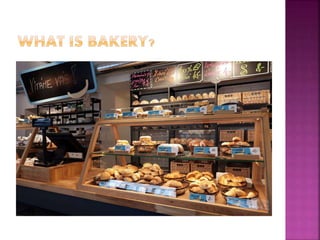
 A bakery is an establishment that produces
and sells flour-based food baked in
an oven such as bread, cakes, pastries,
and pies. Some retail bakeries are also cafés,
serving coffee and tea to customers who wish
to consume the baked goods on the premises.
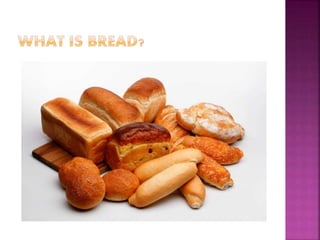
 Bread is a staple food prepared from a dough of ,
and water, usually by baking. Throughout recorded
history it has been popular around the world and is one
of the oldest artificial foods, having been of importance
since the dawn of agriculture.
 Proportions of types of flour and other ingredients vary
widely, as do modes of preparation. As a result, types,
shapes, sizes, and textures of breads differ around the
world. Bread may be leavened by processes such as
reliance on naturally occurring sourdough microbes,
chemicals, industrially produced yeast, or high-pressure
aeration. Some bread is cooked before it can leaven,
including for traditional or religious reasons. Non-cereal
ingredients such as fruits, nuts and fats may be included.
Commercial bread commonly contains additives to
improve flavor, texture, color, shelf life, and ease of
manufacturing
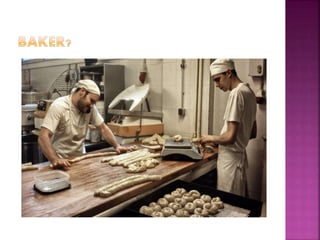
A baker is someone
who bakes and
sometimes sells breads and other
products made using an oven or other
concentrated heat source. The place
where a baker works is called
a bakery.
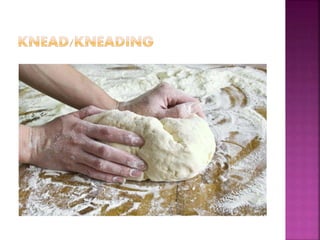
 Kneading is a process in the making of bread
or pasta dough, used to mix the ingredients and add
strength to the final product. Its importance lies in
the mixing of flour with water. When these two
ingredients are combined and kneaded,
the gliadin and glutenin proteins in the flour expand
and form strands of gluten, which gives bread
its texture. (To aid gluten production, many recipes
use bread flour, which is higher in protein than all-
purpose flour.) The kneading process warms and
stretches these gluten strands, eventually creating a
springy and elastic dough. If bread dough is not
kneaded enough, it will not be able to hold the tiny
pockets of gas (CO2) created by the leavenin
agent (such as yeast or baking powder), and will
collapse, leaving a heavy and dense loaf.
Prepare work surface
Scrape out dough
Knead dough
Turn dough
Thank You!!!

Bread and pastry production

  • 1.
  • 2.
    Bread, in allits various forms, is the most widely consumed food in the world. Not only is it an important source of carbohydrates, it’s also portable and compact, which helps to explain why it has been an integral part of our diet for thousands of years. In fact, recent scholarship suggests humans started baking bread at least 30,000 years ago. Prehistoric man had already been making gruel from water and grains, so it was a small jump to starting cooking this mixture into a solid by frying it on stones. A 2010 study by the National Academy of Sciences discovered traces of starch (likely from the roots of cattails and ferns) in prehistoric mortar and pestle-like rocks. The roots would have been peeled and dried before they were ground into flour and mixed with water. Finally, the paste would be cooked on heated rocks.
  • 3.
     The Baking-PastryProduction NC II program (B/PPNCII) provides knowledge and skills in baking and pastry production. The B/PPNCII program includes preparing, portioning and plating pastries, breads and desserts according to the required industry standard thus, maintaining cleanliness and food safety. The program aims to produce graduates who are prepared to work as baking professionals in hotels, restaurants, motels, canteens, resorts and luxury cruises.
  • 4.
     >Prepare andProduce bakery products  >Prepare and Produce pastry products  >Prepare and Present gateaux, tortes and cakes  >Prepare and Display petits fours  >Prepare Desserts
  • 6.
     A bakeryis an establishment that produces and sells flour-based food baked in an oven such as bread, cakes, pastries, and pies. Some retail bakeries are also cafés, serving coffee and tea to customers who wish to consume the baked goods on the premises.
  • 8.
     Bread isa staple food prepared from a dough of , and water, usually by baking. Throughout recorded history it has been popular around the world and is one of the oldest artificial foods, having been of importance since the dawn of agriculture.  Proportions of types of flour and other ingredients vary widely, as do modes of preparation. As a result, types, shapes, sizes, and textures of breads differ around the world. Bread may be leavened by processes such as reliance on naturally occurring sourdough microbes, chemicals, industrially produced yeast, or high-pressure aeration. Some bread is cooked before it can leaven, including for traditional or religious reasons. Non-cereal ingredients such as fruits, nuts and fats may be included. Commercial bread commonly contains additives to improve flavor, texture, color, shelf life, and ease of manufacturing
  • 10.
    A baker issomeone who bakes and sometimes sells breads and other products made using an oven or other concentrated heat source. The place where a baker works is called a bakery.
  • 12.
     Kneading isa process in the making of bread or pasta dough, used to mix the ingredients and add strength to the final product. Its importance lies in the mixing of flour with water. When these two ingredients are combined and kneaded, the gliadin and glutenin proteins in the flour expand and form strands of gluten, which gives bread its texture. (To aid gluten production, many recipes use bread flour, which is higher in protein than all- purpose flour.) The kneading process warms and stretches these gluten strands, eventually creating a springy and elastic dough. If bread dough is not kneaded enough, it will not be able to hold the tiny pockets of gas (CO2) created by the leavenin agent (such as yeast or baking powder), and will collapse, leaving a heavy and dense loaf.
  • 13.
    Prepare work surface Scrapeout dough Knead dough Turn dough
  • 14.