Branding Secrets for Non-Profits Ron Gossen, APR, PMP [email_address]
Is a brand… A logo? A jingle? A tagline? A product? A positioning? None of the above?
The answer is… 6.  None of the above. Logo, jingle, tagline, products and positioning are “how the brand is represented” NOT the brand.
A brand is… … all the promises and perceptions that the organization wants its constituents to feel about the organization and what it does. It’s identifying sustainable competitive advantage, and creating and managing a reputation to enable it.
Why brand?  Because you need people to do “something.” Volunteer Help manage Contribute Be served - outreach Support – talk about, write about.
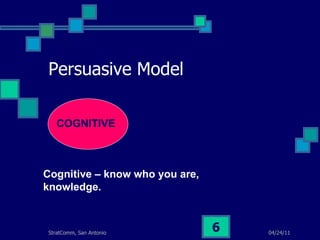
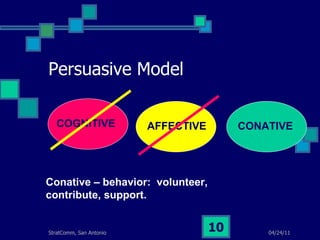
Persuasive Model COGNITIVE Cognitive – know who you are, knowledge.
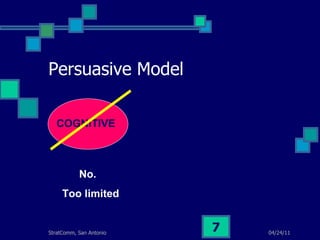
Persuasive Model COGNITIVE No.  Too limited
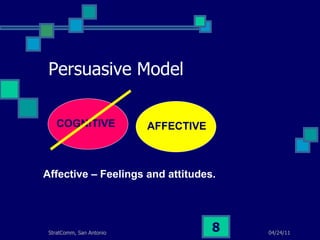
Persuasive Model COGNITIVE AFFECTIVE Affective – Feelings and attitudes.
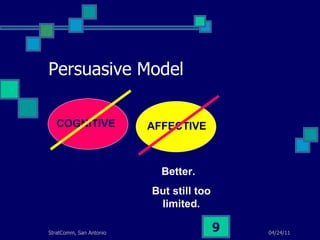
Persuasive Model COGNITIVE AFFECTIVE Better.  But still too limited.
Persuasive Model COGNITIVE AFFECTIVE CONATIVE Conative – behavior:  volunteer, contribute, support.
“The 4 Secrets of Branding” 1.  “You’re branded.” 2.  “Find the sweet spot.” 3.  “Make moonshine.” 4.  “The ‘anytime, anywhere, anyhow’ imperative.”
BRANDING – your competitive advantage! Brand identity – your culture. Brand meaning – drawn from your constituencies and the environment
BRANDING SECRET #1:  You’re branded.   Every organization is branded.  Like it or not! The question is not whether “to brand” or “not to brand.” If you don’t manage your brand, your competition or circumstances will manage it for you!
Strong Brand Criteria LEGITIMACY.  A promise that you can deliver. DISTINCTIVENESS.  Cut through the clutter. RELEVANCY.  Meaningful to your key audiences – don’t speak to yourself! CONSISTENCY.  Live up to your brand, anytime, anywhere and anyhow.
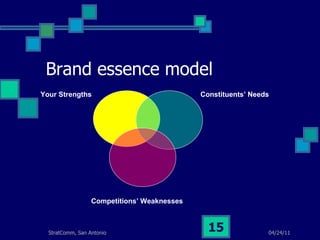
Brand essence model Your Strengths Constituents’ Needs Competitions’ Weaknesses
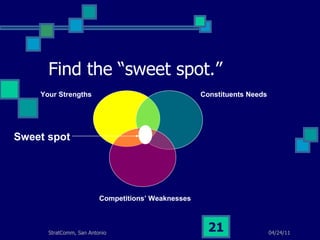
BRANDING SECRET #2:  Find the “sweet spot.” It’s a strength of your organization. It’s a want or need of your constituencies. It’s something that your competition can’t offer.
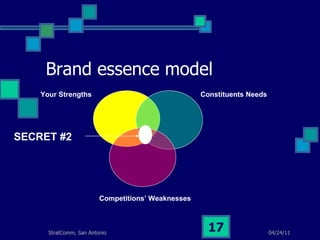
Brand essence model Your Strengths Constituents Needs Competitions’ Weaknesses SECRET #2
SWOT yourself, hard! Strengths & Weaknesses (internal) Opportunities & Threats (external)
Discover and uncover Study your “competition.”  SWOT them by reviewing secondary sources and interviewing their constituents with focus groups, executive interviews or objective research. Study your constituents with focus groups, executive interviews or objective research.
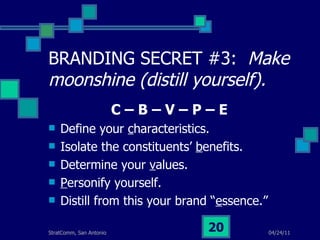
BRANDING SECRET #3:  Make moonshine (distill yourself). C – B – V – P – E Define your  c haracteristics. Isolate the constituents’  b enefits. Determine your  v alues. P ersonify yourself. Distill from this your brand “ e ssence.”
Find the “sweet spot.” Your Strengths Constituents Needs Competitions’ Weaknesses Sweet spot
Branding Secret #4:  The “anytime, anywhere, anyhow” imperative. Live the brand essence.  Act on it “anytime, anywhere, anyhow.”  Compare all strategic decisions to the brand essence, i.e.,”does this create well-being and productivity and contribute to meaningful lives?”  It’s a change-agent. Apply an advertising version (unique selling proposition) to everything.
Branding Process Deliverables Identification of sustainable organizational competitive advantage. Targeted constituents, publics and stakeholders WITH individualized message parameters. Strategic, objective-oriented, communications plan: internal communications, donor relations, program outreach, recipient communications, media relations, other stakeholder communications.
Branding Process Results Organizational focus, direction and renewed purpose. Board/trustee productivity and unity. Targeted messaging for development. Facilitated volunteer & staff recruitment. Employee satisfaction, longevity, reduced turn-over and reduced training costs. Efficient program delivery. And  others…
“ Questions to answers.  Answers to results.”   StratComm Strategic Communications Group   [email_address] Ron Gossen, M.B.A., A.P.R.

Branding Secrets for Non Profits 2011

  • 1.
    Branding Secrets forNon-Profits Ron Gossen, APR, PMP [email_address]
  • 2.
    Is a brand…A logo? A jingle? A tagline? A product? A positioning? None of the above?
  • 3.
    The answer is…6. None of the above. Logo, jingle, tagline, products and positioning are “how the brand is represented” NOT the brand.
  • 4.
    A brand is…… all the promises and perceptions that the organization wants its constituents to feel about the organization and what it does. It’s identifying sustainable competitive advantage, and creating and managing a reputation to enable it.
  • 5.
    Why brand? Because you need people to do “something.” Volunteer Help manage Contribute Be served - outreach Support – talk about, write about.
  • 6.
    Persuasive Model COGNITIVECognitive – know who you are, knowledge.
  • 7.
  • 8.
    Persuasive Model COGNITIVEAFFECTIVE Affective – Feelings and attitudes.
  • 9.
    Persuasive Model COGNITIVEAFFECTIVE Better. But still too limited.
  • 10.
    Persuasive Model COGNITIVEAFFECTIVE CONATIVE Conative – behavior: volunteer, contribute, support.
  • 11.
    “The 4 Secretsof Branding” 1. “You’re branded.” 2. “Find the sweet spot.” 3. “Make moonshine.” 4. “The ‘anytime, anywhere, anyhow’ imperative.”
  • 12.
    BRANDING – yourcompetitive advantage! Brand identity – your culture. Brand meaning – drawn from your constituencies and the environment
  • 13.
    BRANDING SECRET #1: You’re branded. Every organization is branded. Like it or not! The question is not whether “to brand” or “not to brand.” If you don’t manage your brand, your competition or circumstances will manage it for you!
  • 14.
    Strong Brand CriteriaLEGITIMACY. A promise that you can deliver. DISTINCTIVENESS. Cut through the clutter. RELEVANCY. Meaningful to your key audiences – don’t speak to yourself! CONSISTENCY. Live up to your brand, anytime, anywhere and anyhow.
  • 15.
    Brand essence modelYour Strengths Constituents’ Needs Competitions’ Weaknesses
  • 16.
    BRANDING SECRET #2: Find the “sweet spot.” It’s a strength of your organization. It’s a want or need of your constituencies. It’s something that your competition can’t offer.
  • 17.
    Brand essence modelYour Strengths Constituents Needs Competitions’ Weaknesses SECRET #2
  • 18.
    SWOT yourself, hard!Strengths & Weaknesses (internal) Opportunities & Threats (external)
  • 19.
    Discover and uncoverStudy your “competition.” SWOT them by reviewing secondary sources and interviewing their constituents with focus groups, executive interviews or objective research. Study your constituents with focus groups, executive interviews or objective research.
  • 20.
    BRANDING SECRET #3: Make moonshine (distill yourself). C – B – V – P – E Define your c haracteristics. Isolate the constituents’ b enefits. Determine your v alues. P ersonify yourself. Distill from this your brand “ e ssence.”
  • 21.
    Find the “sweetspot.” Your Strengths Constituents Needs Competitions’ Weaknesses Sweet spot
  • 22.
    Branding Secret #4: The “anytime, anywhere, anyhow” imperative. Live the brand essence. Act on it “anytime, anywhere, anyhow.” Compare all strategic decisions to the brand essence, i.e.,”does this create well-being and productivity and contribute to meaningful lives?” It’s a change-agent. Apply an advertising version (unique selling proposition) to everything.
  • 23.
    Branding Process DeliverablesIdentification of sustainable organizational competitive advantage. Targeted constituents, publics and stakeholders WITH individualized message parameters. Strategic, objective-oriented, communications plan: internal communications, donor relations, program outreach, recipient communications, media relations, other stakeholder communications.
  • 24.
    Branding Process ResultsOrganizational focus, direction and renewed purpose. Board/trustee productivity and unity. Targeted messaging for development. Facilitated volunteer & staff recruitment. Employee satisfaction, longevity, reduced turn-over and reduced training costs. Efficient program delivery. And others…
  • 25.
    “ Questions toanswers. Answers to results.” StratComm Strategic Communications Group [email_address] Ron Gossen, M.B.A., A.P.R.