Brand Management
Presentation
-By
Shagun Lidhoo
Roll No: 711
Specialization: Advertising
Batch: 2014
The DTH Sector in India
• DTH services were first proposed in India in 1996.
But they did not pass approval because there were
concerns over national security and a cultural
invasion.
• In 1997, the government even imposed a ban when
the Rupert Murdoch-owned Indian Sky Broadcasting
(ISkyB) was about to launch its DTH services in India.
• Finally in 2000, DTH was allowed in India.
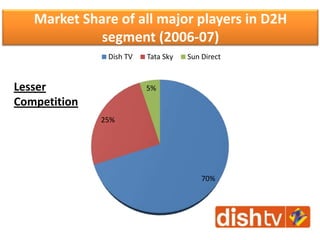
Market Share of all major players in D2H
segment (2006-07)
70%
25%
5%
Dish TV Tata Sky Sun Direct
Lesser
Competition
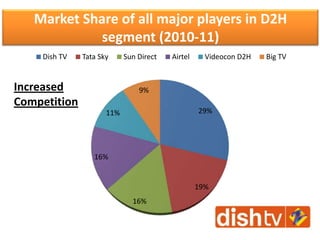
Market Share of all major players in D2H
segment (2010-11)
29%
19%
16%
16%
11%
9%
Dish TV Tata Sky Sun Direct Airtel Videocon D2H Big TV
Increased
Competition
DISH TV
• DISH TV is a division of Zee Network Enterprise (Essel
Group Venture).
• DISH TV is India’s first direct to home (DTH)
entertainment service.
• Dish TV is presently Asia's largest and going to be the
world's largest DTH company.
• Dish TV had about 13 million customers as of 31
October 2012.
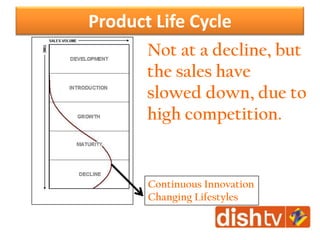
Product Life Cycle
Continuous Innovation
Changing Lifestyles
Not at a decline, but
the sales have
slowed down, due to
high competition.
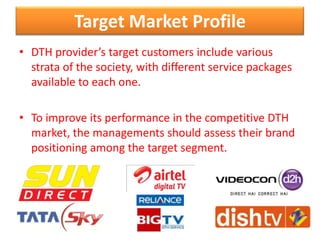
Target Market Profile
• DTH provider’s target customers include various
strata of the society, with different service packages
available to each one.
• To improve its performance in the competitive DTH
market, the managements should assess their brand
positioning among the target segment.
SWOT Analysis of DISH TV
• Strength:
– Vast distribution of dealers and customer service across
6600 towns
– High No. of channels – Maximum Content
– Considerable brand equity
– Good mix of regional packages
– Good branding and marketing by roping in celebrities for
TVCs and print ads
– Customized packages and services as per the customers
requirements
• Weaknesses:
– Provides only Mpeg-2 compression against MPEG-4 by
competitors
– Low revenue per user compared to global Industry
– High Customer Acquisition Cost
SWOT Analysis of DISH TV
• Opportunities:
– Strategic exclusive alliance with Bollywood and sports
events
– More roll out of CAS by Govt. of India
– Value added services and Gaming – Areas for revenue
gathering
SWOT Analysis of DISH TV
• Threats:
– Improved quality by digital players
– High Customer Retention Cost
– Stiff competition from cable operators
SWOT Analysis of DISH TV
Competitor- TATA SKY
• TATA SKY is a direct broadcast satellite television
provider in India.
• Incorporated in 2004, Tata Sky is a Joint
venture between the TATA Group (80%) and British
Sky Broadcasting Group (20%).
• Tata Sky was selected as a ”SUPER BRAND” for the
year 2009-2010 by an independent and voluntary
council of experts known as Superbrands Council. It
is the only Indian DTH to have won this distinction.
• Tata Sky had a subscriber base of 10 million
customers, as of 31st October 2012
SWOT Analysis of TATA SKY
• Strength:
– Leveraging on TATA brand
– Technological support from SKY
– Superior picture Quality
– Introduction of new and affordable packages
– Good Customer Service
– Interactive channels and Services
– One of the first to come up with record-rewind-pause
functions
– The first to break the Rs 100 price barrier in packaging; first
to introduce HD service at an unimaginable price point and
now, the first to provide a world-class quality DTH service
• Weaknesses:
– Second mover after DISH TV, who captured major market
share
– Cannot provide free service like DD
– Currently, does not offer free set-top box, like DISH TV
– Dependency on several broadcasters
– Poor signal quality during rains
SWOT Analysis of TATA SKY
• Opportunities
– Larger disposable incomes with India
– Tapping niche markets with better service and product
offering
– Expansion of distribution network through exclusive stores
– Interactive advertising
– Increase in number of TVs sold
– Global demand of DTH services
– More value added services
SWOT Analysis of TATA SKY
• Threats
– Increasing competition
– High dependence on ISRO
– Dependency on certain broadcasters for their channel
content, thus increase in price
– No exclusivity in content
SWOT Analysis of TATA SKY
Revenue (2011-2012)
• DISH TV, the leading DTH service in the Indian
Market, recorded a profit of Rs. 557.8 Crore, during
the fiscal year 2011-12.
• Whereas, it was not a good year for TATA SKY, as they
recorded a loss of Rs. 298 Crore, till the end of March
‘12. However, the present value is 36% decrease in
loss from Rs 470 crore loss in 2010-11 and 52.4%
decrease in loss from Rs 626 crore loss in 2009-10.
Consumer Wants
• Functional: Following are some of the features of
DISH TV:-
– Digital Picture Quality
– Stereophonic Sound
– Geographic Mobility
– Uninterrupted Viewing
– Capacity up to 400 DTH Channels
Consumer Wants
• Value:-
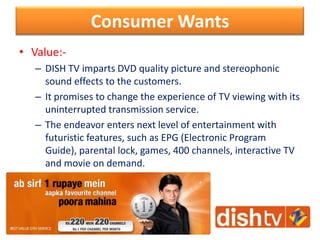
– DISH TV imparts DVD quality picture and stereophonic
sound effects to the customers.
– It promises to change the experience of TV viewing with its
uninterrupted transmission service.
– The endeavor enters next level of entertainment with
futuristic features, such as EPG (Electronic Program
Guide), parental lock, games, 400 channels, interactive TV
and movie on demand.

Brand management dish tv

  • 1.
    Brand Management Presentation -By Shagun Lidhoo RollNo: 711 Specialization: Advertising Batch: 2014
  • 2.
    The DTH Sectorin India • DTH services were first proposed in India in 1996. But they did not pass approval because there were concerns over national security and a cultural invasion. • In 1997, the government even imposed a ban when the Rupert Murdoch-owned Indian Sky Broadcasting (ISkyB) was about to launch its DTH services in India. • Finally in 2000, DTH was allowed in India.
  • 3.
    Market Share ofall major players in D2H segment (2006-07) 70% 25% 5% Dish TV Tata Sky Sun Direct Lesser Competition
  • 4.
    Market Share ofall major players in D2H segment (2010-11) 29% 19% 16% 16% 11% 9% Dish TV Tata Sky Sun Direct Airtel Videocon D2H Big TV Increased Competition
  • 5.
    DISH TV • DISHTV is a division of Zee Network Enterprise (Essel Group Venture). • DISH TV is India’s first direct to home (DTH) entertainment service. • Dish TV is presently Asia's largest and going to be the world's largest DTH company. • Dish TV had about 13 million customers as of 31 October 2012.
  • 6.
    Product Life Cycle ContinuousInnovation Changing Lifestyles Not at a decline, but the sales have slowed down, due to high competition.
  • 7.
    Target Market Profile •DTH provider’s target customers include various strata of the society, with different service packages available to each one. • To improve its performance in the competitive DTH market, the managements should assess their brand positioning among the target segment.
  • 8.
    SWOT Analysis ofDISH TV • Strength: – Vast distribution of dealers and customer service across 6600 towns – High No. of channels – Maximum Content – Considerable brand equity – Good mix of regional packages – Good branding and marketing by roping in celebrities for TVCs and print ads – Customized packages and services as per the customers requirements
  • 9.
    • Weaknesses: – Providesonly Mpeg-2 compression against MPEG-4 by competitors – Low revenue per user compared to global Industry – High Customer Acquisition Cost SWOT Analysis of DISH TV
  • 10.
    • Opportunities: – Strategicexclusive alliance with Bollywood and sports events – More roll out of CAS by Govt. of India – Value added services and Gaming – Areas for revenue gathering SWOT Analysis of DISH TV
  • 11.
    • Threats: – Improvedquality by digital players – High Customer Retention Cost – Stiff competition from cable operators SWOT Analysis of DISH TV
  • 12.
    Competitor- TATA SKY •TATA SKY is a direct broadcast satellite television provider in India. • Incorporated in 2004, Tata Sky is a Joint venture between the TATA Group (80%) and British Sky Broadcasting Group (20%). • Tata Sky was selected as a ”SUPER BRAND” for the year 2009-2010 by an independent and voluntary council of experts known as Superbrands Council. It is the only Indian DTH to have won this distinction. • Tata Sky had a subscriber base of 10 million customers, as of 31st October 2012
  • 13.
    SWOT Analysis ofTATA SKY • Strength: – Leveraging on TATA brand – Technological support from SKY – Superior picture Quality – Introduction of new and affordable packages – Good Customer Service – Interactive channels and Services – One of the first to come up with record-rewind-pause functions – The first to break the Rs 100 price barrier in packaging; first to introduce HD service at an unimaginable price point and now, the first to provide a world-class quality DTH service
  • 14.
    • Weaknesses: – Secondmover after DISH TV, who captured major market share – Cannot provide free service like DD – Currently, does not offer free set-top box, like DISH TV – Dependency on several broadcasters – Poor signal quality during rains SWOT Analysis of TATA SKY
  • 15.
    • Opportunities – Largerdisposable incomes with India – Tapping niche markets with better service and product offering – Expansion of distribution network through exclusive stores – Interactive advertising – Increase in number of TVs sold – Global demand of DTH services – More value added services SWOT Analysis of TATA SKY
  • 16.
    • Threats – Increasingcompetition – High dependence on ISRO – Dependency on certain broadcasters for their channel content, thus increase in price – No exclusivity in content SWOT Analysis of TATA SKY
  • 17.
    Revenue (2011-2012) • DISHTV, the leading DTH service in the Indian Market, recorded a profit of Rs. 557.8 Crore, during the fiscal year 2011-12. • Whereas, it was not a good year for TATA SKY, as they recorded a loss of Rs. 298 Crore, till the end of March ‘12. However, the present value is 36% decrease in loss from Rs 470 crore loss in 2010-11 and 52.4% decrease in loss from Rs 626 crore loss in 2009-10.
  • 18.
    Consumer Wants • Functional:Following are some of the features of DISH TV:- – Digital Picture Quality – Stereophonic Sound – Geographic Mobility – Uninterrupted Viewing – Capacity up to 400 DTH Channels
  • 19.
    Consumer Wants • Value:- –DISH TV imparts DVD quality picture and stereophonic sound effects to the customers. – It promises to change the experience of TV viewing with its uninterrupted transmission service. – The endeavor enters next level of entertainment with futuristic features, such as EPG (Electronic Program Guide), parental lock, games, 400 channels, interactive TV and movie on demand.