Module 4: Brand Identity
Brand Management

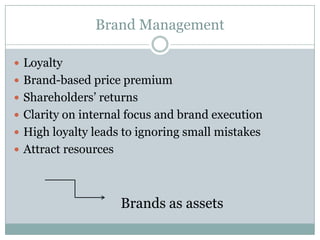
 Loyalty
 Brand-based price premium
 Shareholders’ returns
 Clarity on internal focus and brand execution
 High loyalty leads to ignoring small mistakes
 Attract resources


                      Brands as assets
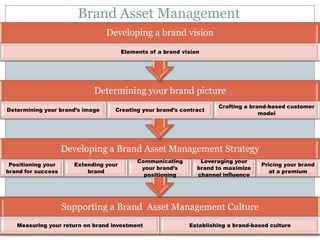
Brand Asset Management
                                 Developing a brand vision
                                       Elements of a brand vision


                            Determining your brand picture
                                                                      Crafting a brand-based customer
Determining your brand’s image     Creating your brand’s contract
                                                                                    model


                    Developing a Brand Asset Management Strategy
                                            Communicating        Leveraging your
 Positioning your     Extending your                                                 Pricing your brand
                                             your brand’s       brand to maximize
brand for success         brand                                                         at a premium
                                              positioning       channel influence


                    Supporting a Brand Asset Management Culture
   Measuring your return on brand investment                 Establishing a brand-based culture
Brand Vision

Clear direction for the brand in helping the
company achieve its long-term strategic and
financial growth goals.

Corporate vision-what the company is all about, its
customers and unique benefits
Brand Vision-how the company plans to leverage its
brands to reach the corporate vision and objectives
Purpose of establishing a brand vision

 Pull in senior management’s support and
  commitment
 Continuous research
 Stakeholders are aware
Brand’s vision components

 Statement of the overall goal of the brand
 Target market
 Point of differentiation
 Financial goals
Brand Vision Elements

 Trademarkable devices that serve to identify and
  differentiate the brand
-brand name, logos, character, spokespeople,
slogans, jingles, packages, URLs, and signage
Criteria for choosing brand elements
 Memorability
 Meaningfulness
 Likability
 Transferability
 Adaptability
 protectability
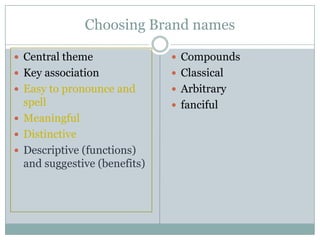
Choosing Brand names

 Central theme                Compounds
 Key association              Classical
 Easy to pronounce and        Arbitrary
  spell                        fanciful
 Meaningful
 Distinctive
 Descriptive (functions)
  and suggestive (benefits)
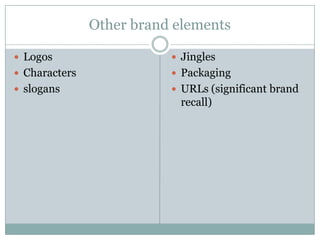
Other brand elements

 Logos                    Jingles
 Characters               Packaging
 slogans                  URLs (significant brand
                           recall)
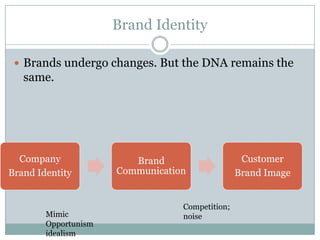
Brand Identity

  Brands undergo changes. But the DNA remains the
   same.


  Company                Brand                    Customer
Brand Identity        Communication              Brand Image


                                  Competition;
        Mimic                     noise
        Opportunism
        idealism
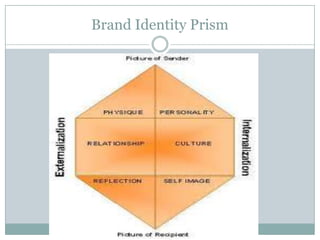
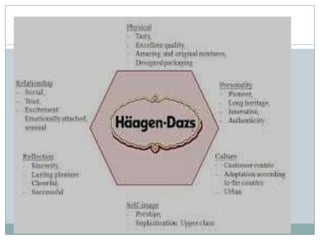
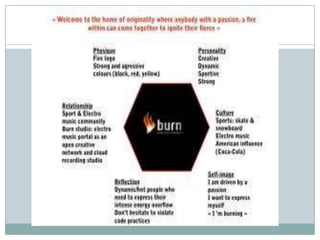
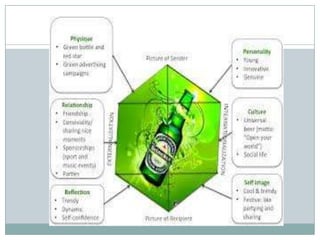
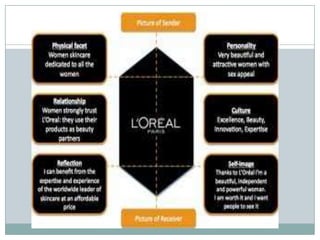
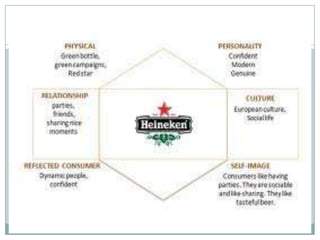
Brand Identity Prism
Brand Identity-name and brand characters

Brand identity is a unique set of brand
associations that the brand strategist aspires to
create or maintain. These associations represent
what the brand stands for and imply a promise
to customers from the organization members.
Brand Identity Perspective

 Brand as a product
 Brand as an organisation
 Brand as a person
 Brand as a symbol
Brand as Product-product related associations

 The product scope-associations with a product class
 Product-related attributes-specific attributes
 Quality/value- identity linked to core quality
 Associations with Use occasion
 Associations with users
 Link to a country or region-heritage & culture
 Brand as Organization
   Attributes of the organization to the brand

   More enduring & resistant to competitive claims

   Set of product classes

 Brand as a person-brand personality/human traits
 Brand as symbol-visual imagery, metaphors
  (Energiser bunny, LIC) & the brand heritage
  (KSRTC)
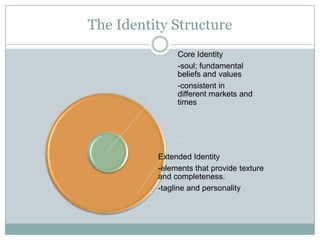
The Identity Structure
               Core Identity
               -soul; fundamental
               beliefs and values
               -consistent in
               different markets and
               times


          Extended Identity
          -elements that provide texture
          and completeness.
          -tagline and personality
Brand Identity Traps

 Brand Image trap
 Brand position trap
 The external perspective trap
 Product attribute fixation trap –
 users, country, organization, personality, emotional
 benefits, self-expressive benefits
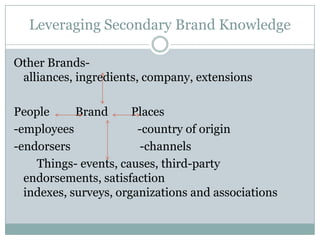
Leveraging Secondary Brand Knowledge

Other Brands-
 alliances, ingredients, company, extensions

People      Brand      Places
-employees              -country of origin
-endorsers              -channels
    Things- events, causes, third-party
  endorsements, satisfaction
  indexes, surveys, organizations and associations
Brand Image

Zaltman Metaphor Elicitation Technique (ZMET):
Brand Image development
a research tool that uses visual and sensory images to
help better understand the meaning of brands.
employs qualitative methods to elicit the
metaphors, constructs and mental models that drive
customers' thinking and behavior, as well as
quantitative analyses to provide data for marketing
mix decisions and segmentation strategies.
ZMET-Procedure

A total of 25 customers typically are recruited to participate in a
project. After qualifying for participation in a project (based on
screeners), customers are given a set of instructions and
guidelines about the research topic, eg., a brand name, a service
concept, product use, or product design. They are instructed to
take photographs and/or collect pictures from
magazines, books, newspapers or other sources that indicate
what the topic means to them. Customers are provided with a
camera, and a personal interview is scheduled approximately
seven to ten days hence. The personal interview involves a
guided conversation which we believe yields more valid, more
reliable and, importantly, more relevant insights than
traditional structured interview approaches (see McCracken
1988; Mishler 1986).
Using ZMET for image construct

 Alice, one of the customers was asked to take and/or collect pictures
  of what "Tide" meant to her.
 Alice, a young mother, collected 14 images. After completing Step 1
  (storytelling about each picture), the interviewer asked Alice if there
  were any pertinent images that she had not been able to collect
  (Step 2). Alice indicated that she would have liked to take a
  photograph of a pig sty, noting that she wondered if "Tide" would be
  able to "clean a dirty pig." In Step 3, Alice sorted her images into
  three groups: comfort, freshness, drudgery.
 In Step 4, the interviewer randomly selected three of Alice's
  pictures, and asked her, "How are any two of these three pictures
  similar to each other and different from the third." This surfaced
  two constructs: unpleasantness and freshness. The
  interviewer, using the laddering process, helped to elicit additional
  constructs and their relationships. After Alice's explanation, the
  interviewer continued to randomly select three pictures and
  question Alice until no new constructs were elicited.
The logo is for an editing studio
This logo was created for a puzzle game called Cluenatic. It involves
unraveling four clues. The logo has the letters C, L, U and E
arranged as a maze. From a distance, the logo looks like a key.
The below two are magazines from the Readers Digest. It attempts
          to communicate what it is about figuratively.
The arrow represents speed and precision which are the
         positioning elements of the company
This logo of a hairstylist brings the cheeky humour to the
                     dressing table.
Internal branding of IBM
while arranged adjacent to each other look a lot like the letter S in a
perpendicular direction.
limitless Imagination. The red background symbolizes
Action, while the yellow dots are the bubbles of Joy.
Brand identity

Brand identity

  • 1.
  • 2.
    Brand Management  Loyalty Brand-based price premium  Shareholders’ returns  Clarity on internal focus and brand execution  High loyalty leads to ignoring small mistakes  Attract resources Brands as assets
  • 3.
    Brand Asset Management Developing a brand vision Elements of a brand vision Determining your brand picture Crafting a brand-based customer Determining your brand’s image Creating your brand’s contract model Developing a Brand Asset Management Strategy Communicating Leveraging your Positioning your Extending your Pricing your brand your brand’s brand to maximize brand for success brand at a premium positioning channel influence Supporting a Brand Asset Management Culture Measuring your return on brand investment Establishing a brand-based culture
  • 4.
    Brand Vision Clear directionfor the brand in helping the company achieve its long-term strategic and financial growth goals. Corporate vision-what the company is all about, its customers and unique benefits Brand Vision-how the company plans to leverage its brands to reach the corporate vision and objectives
  • 5.
    Purpose of establishinga brand vision  Pull in senior management’s support and commitment  Continuous research  Stakeholders are aware
  • 6.
    Brand’s vision components Statement of the overall goal of the brand  Target market  Point of differentiation  Financial goals
  • 7.
    Brand Vision Elements Trademarkable devices that serve to identify and differentiate the brand -brand name, logos, character, spokespeople, slogans, jingles, packages, URLs, and signage Criteria for choosing brand elements  Memorability  Meaningfulness  Likability  Transferability  Adaptability  protectability
  • 8.
    Choosing Brand names Central theme  Compounds  Key association  Classical  Easy to pronounce and  Arbitrary spell  fanciful  Meaningful  Distinctive  Descriptive (functions) and suggestive (benefits)
  • 9.
    Other brand elements Logos  Jingles  Characters  Packaging  slogans  URLs (significant brand recall)
  • 10.
    Brand Identity Brands undergo changes. But the DNA remains the same. Company Brand Customer Brand Identity Communication Brand Image Competition; Mimic noise Opportunism idealism
  • 11.
  • 17.
    Brand Identity-name andbrand characters Brand identity is a unique set of brand associations that the brand strategist aspires to create or maintain. These associations represent what the brand stands for and imply a promise to customers from the organization members.
  • 18.
    Brand Identity Perspective Brand as a product  Brand as an organisation  Brand as a person  Brand as a symbol
  • 19.
    Brand as Product-productrelated associations  The product scope-associations with a product class  Product-related attributes-specific attributes  Quality/value- identity linked to core quality  Associations with Use occasion  Associations with users  Link to a country or region-heritage & culture
  • 20.
     Brand asOrganization  Attributes of the organization to the brand  More enduring & resistant to competitive claims  Set of product classes  Brand as a person-brand personality/human traits  Brand as symbol-visual imagery, metaphors (Energiser bunny, LIC) & the brand heritage (KSRTC)
  • 21.
    The Identity Structure Core Identity -soul; fundamental beliefs and values -consistent in different markets and times Extended Identity -elements that provide texture and completeness. -tagline and personality
  • 22.
    Brand Identity Traps Brand Image trap  Brand position trap  The external perspective trap  Product attribute fixation trap – users, country, organization, personality, emotional benefits, self-expressive benefits
  • 23.
    Leveraging Secondary BrandKnowledge Other Brands- alliances, ingredients, company, extensions People Brand Places -employees -country of origin -endorsers -channels Things- events, causes, third-party endorsements, satisfaction indexes, surveys, organizations and associations
  • 25.
    Brand Image Zaltman MetaphorElicitation Technique (ZMET): Brand Image development a research tool that uses visual and sensory images to help better understand the meaning of brands. employs qualitative methods to elicit the metaphors, constructs and mental models that drive customers' thinking and behavior, as well as quantitative analyses to provide data for marketing mix decisions and segmentation strategies.
  • 26.
    ZMET-Procedure A total of25 customers typically are recruited to participate in a project. After qualifying for participation in a project (based on screeners), customers are given a set of instructions and guidelines about the research topic, eg., a brand name, a service concept, product use, or product design. They are instructed to take photographs and/or collect pictures from magazines, books, newspapers or other sources that indicate what the topic means to them. Customers are provided with a camera, and a personal interview is scheduled approximately seven to ten days hence. The personal interview involves a guided conversation which we believe yields more valid, more reliable and, importantly, more relevant insights than traditional structured interview approaches (see McCracken 1988; Mishler 1986).
  • 27.
    Using ZMET forimage construct  Alice, one of the customers was asked to take and/or collect pictures of what "Tide" meant to her.  Alice, a young mother, collected 14 images. After completing Step 1 (storytelling about each picture), the interviewer asked Alice if there were any pertinent images that she had not been able to collect (Step 2). Alice indicated that she would have liked to take a photograph of a pig sty, noting that she wondered if "Tide" would be able to "clean a dirty pig." In Step 3, Alice sorted her images into three groups: comfort, freshness, drudgery.  In Step 4, the interviewer randomly selected three of Alice's pictures, and asked her, "How are any two of these three pictures similar to each other and different from the third." This surfaced two constructs: unpleasantness and freshness. The interviewer, using the laddering process, helped to elicit additional constructs and their relationships. After Alice's explanation, the interviewer continued to randomly select three pictures and question Alice until no new constructs were elicited.
  • 30.
    The logo isfor an editing studio
  • 31.
    This logo wascreated for a puzzle game called Cluenatic. It involves unraveling four clues. The logo has the letters C, L, U and E arranged as a maze. From a distance, the logo looks like a key.
  • 33.
    The below twoare magazines from the Readers Digest. It attempts to communicate what it is about figuratively.
  • 34.
    The arrow representsspeed and precision which are the positioning elements of the company
  • 35.
    This logo ofa hairstylist brings the cheeky humour to the dressing table.
  • 36.
  • 37.
    while arranged adjacentto each other look a lot like the letter S in a perpendicular direction.
  • 38.
    limitless Imagination. Thered background symbolizes Action, while the yellow dots are the bubbles of Joy.