BPMN Modeling
with Method and Style
Bruce Silver
bruce@brsilver.com
methodandstyle.com
Copyright Bruce Silver Associates 2018
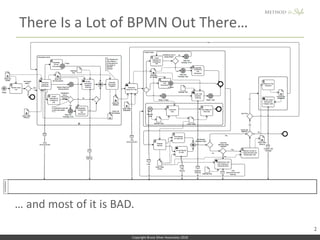
There Is a Lot of BPMN Out There…
2
… and most of it is BAD.
Copyright Bruce Silver Associates 2018
Isn’t it just a flowchart?
3
• BPMN looks like a traditional
flowchart, so outwardly familiar
• Same purpose: Communicate the
process logic visually through
diagrams
• But differences are significant
Copyright Bruce Silver Associates 2018
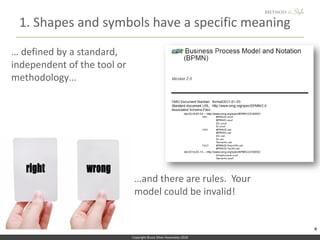
… defined by a standard,
independent of the tool or
methodology…
1. Shapes and symbols have a specific meaning
4
…and there are rules. Your
model could be invalid!
Copyright Bruce Silver Associates 2018
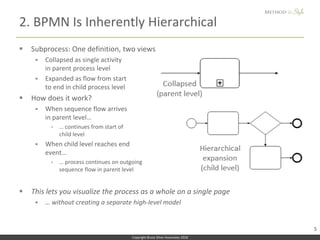
2. BPMN Is Inherently Hierarchical
 Subprocess: One definition, two views
 Collapsed as single activity
in parent process level
 Expanded as flow from start
to end in child process level
 How does it work?
 When sequence flow arrives
in parent level…
• … continues from start of
child level
 When child level reaches end
event…
• … process continues on outgoing
sequence flow in parent level
 This lets you visualize the process as a whole on a single page
 … without creating a separate high-level model
5
Copyright Bruce Silver Associates 2018
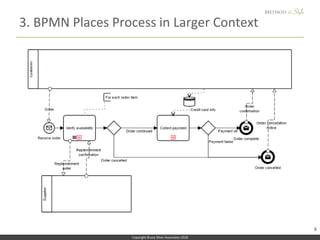
3. BPMN Places Process in Larger Context
6
Copyright Bruce Silver Associates 2018
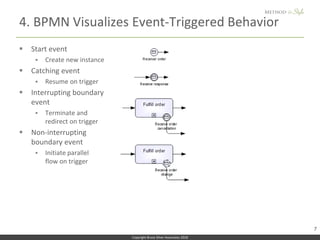
4. BPMN Visualizes Event-Triggered Behavior
 Start event
 Create new instance
 Catching event
 Resume on trigger
 Interrupting boundary
event
 Terminate and
redirect on trigger
 Non-interrupting
boundary event
 Initiate parallel
flow on trigger
7
Copyright Bruce Silver Associates 2018
Bad BPMN
1. … uses the shapes and symbols incorrectly
 The diagram does not reflect the modeler’s intent
2. … does not clearly communicate the process logic
 Only understood by those who already know how the process works
3. … is incomplete
 Does not reveal how the process starts, what the instance represents, its possible end
states, or its interactions with other entities and processes
4. … does not reflect a consistent methodology or structure
 Prevents shared understanding across all stakeholders
8
Copyright Bruce Silver Associates 2018
Good BPMN
9
1. … is correct
• Per rules of the spec. Shapes and symbols used correctly.
2. … is clear
• Process logic unambiguous from the printed diagram alone (even to those unfamiliar with
the process)
3. … is complete
• Tell at a glance how the process starts, what the instance represents, its possible end
states, its interactions with external entities
4. … is consistent
• Given same set of facts, all modelers should create (more or less) the same diagrams
• The BPMN spec deals only with #1… says nothing about #2, 3, or 4
• Those require additional conventions/constraints beyond the rules of the spec
Copyright Bruce Silver Associates 2018
Method and Style
 A way to create consistently “good BPMN”
 Need “style rules” to make the meaning clear from the diagrams
 Also need a methodology for creating the models
 … to ensure completeness, consistency, and structural correctness
 Method and Style is a learnable skill
 Requires NO technical expertise or deep experience in process modeling
 … just a disciplined approach to creating the models
10
Copyright Bruce Silver Associates 2018
What Does This Diagram Mean?
Copyright Bruce Silver Associates 2018
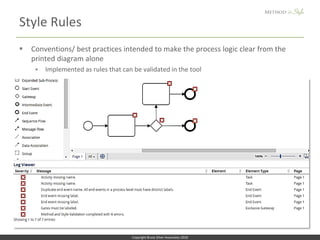
Style Rules
 Conventions/ best practices intended to make the process logic clear from the
printed diagram alone
 Implemented as rules that can be validated in the tool
Copyright Bruce Silver Associates 2018
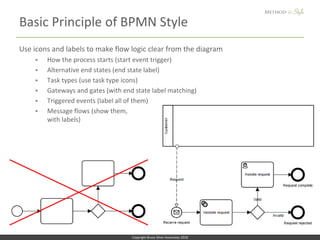
Basic Principle of BPMN Style
Use icons and labels to make flow logic clear from the diagram
 How the process starts (start event trigger)
 Alternative end states (end state label)
 Task types (use task type icons)
 Gateways and gates (with end state label matching)
 Triggered events (label all of them)
 Message flows (show them,
with labels)
Copyright Bruce Silver Associates 2018
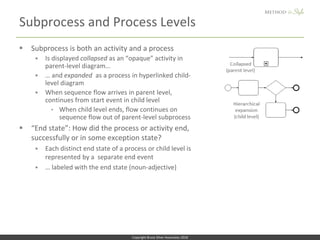
Subprocess and Process Levels
 Subprocess is both an activity and a process
 Is displayed collapsed as an “opaque” activity in
parent-level diagram…
 … and expanded as a process in hyperlinked child-
level diagram
 When sequence flow arrives in parent level,
continues from start event in child level
• When child level ends, flow continues on
sequence flow out of parent-level subprocess
 “End state”: How did the process or activity end,
successfully or in some exception state?
 Each distinct end state of a process or child level is
represented by a separate end event
 … labeled with the end state (noun-adjective)
Copyright Bruce Silver Associates 2018
Gateways and End States
 Gateway: When activity ends, where to go
next?
 Spec says gateway tests value of process data
• … but process data typically not defined in the
model
 Method and Style convention: Gateway tests the
end state of the preceding activity
 Each activity end state corresponds to a different
next step
 Gateway labeling
1. Each gate label is prior activity end state, or…
2. Gateway label is one end state + question mark,
with gates yes and no
15
Copyright Bruce Silver Associates 2018
Gateways and End States
 Process has 2 end
states
 Order complete
 Order failed
 Task Check Credit has
2 end states
 Credit ok
 Bad credit
 Subprocess Fulfill
order has 2 end
states
 Fulfilled ok
 Out of stock
 Each activity end
state corresponds to
a different next step
16
Copyright Bruce Silver Associates 2018
Gateways and End States
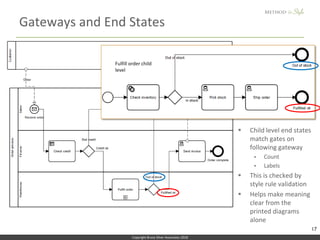
 Child level end states
match gates on
following gateway
 Count
 Labels
 This is checked by
style rule validation
 Helps make meaning
clear from the
printed diagrams
alone
17
Fulfill order child
level
Copyright Bruce Silver Associates 2018
Complete Information
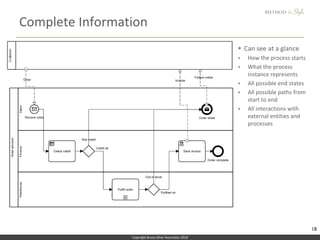
 Can see at a glance
 How the process starts
 What the process
instance represents
 All possible end states
 All possible paths from
start to end
 All interactions with
external entities and
processes
18
Copyright Bruce Silver Associates 2018
In Summary
 Method and Style is a disciplined approach to BPMN
 Imposes additional rules and a methodology…
 Designed to ensure your models reveal the process logic…
• Correctly
• Clearly
• Completely
• Consistently
 Preserving the value of all those stakeholder interviews and workshops
 Creating precise, consistent business requirements for IT
 Gets your whole team “on the same page”
 It requires no technical knowledge or experience
 Works best when supported by style rule validation in the tool
19
Copyright Bruce Silver Associates 2018
How Do You Learn BPMN Method and Style?
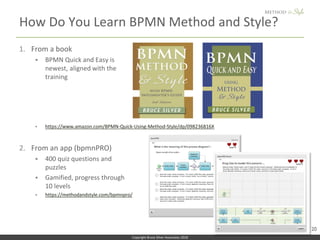
1. From a book
 BPMN Quick and Easy is
newest, aligned with the
training
 https://www.amazon.com/BPMN-Quick-Using-Method-Style/dp/098236816X
2. From an app (bpmnPRO)
 400 quiz questions and
puzzles
 Gamified, progress through
10 levels
 https://methodandstyle.com/bpmnpro/
20
Copyright Bruce Silver Associates 2018
How Do You Learn BPMN Method and Style?
3. From training
 Hands-on exercises with tools
 Live-onsite (private for teams),
public live-online, web/on-demand
anytime
 Post-class certification
21
Next live/online class May 22-24
• https://methodandstyle.com/product/bpmntraining/
• 10% off with discount code WEBINAR
Web/On-Demand anytime
• https://methodandstyle.com/product/bpmn-web-ondemand/
Copyright Bruce Silver Associates 2018
Certification
 Built into the training
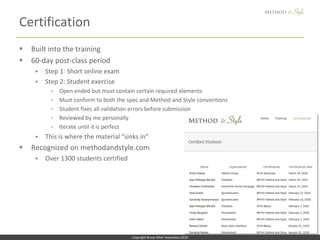
 60-day post-class period
 Step 1: Short online exam
 Step 2: Student exercise
• Open ended but must contain certain required elements
• Must conform to both the spec and Method and Style conventions
• Student fixes all validation errors before submission
• Reviewed by me personally
• Iterate until it is perfect
 This is where the material “sinks in”
 Recognized on methodandstyle.com
 Over 1300 students certified
22
Copyright Bruce Silver Associates 2018
23
Thank you
For any questions about Method and Style, training content,
certification, consulting/mentoring etc., contact
bruce@brsilver.com
More information on methodandstyle.com

BPMN Modeling with Method and Style

  • 1.
    BPMN Modeling with Methodand Style Bruce Silver bruce@brsilver.com methodandstyle.com
  • 2.
    Copyright Bruce SilverAssociates 2018 There Is a Lot of BPMN Out There… 2 … and most of it is BAD.
  • 3.
    Copyright Bruce SilverAssociates 2018 Isn’t it just a flowchart? 3 • BPMN looks like a traditional flowchart, so outwardly familiar • Same purpose: Communicate the process logic visually through diagrams • But differences are significant
  • 4.
    Copyright Bruce SilverAssociates 2018 … defined by a standard, independent of the tool or methodology… 1. Shapes and symbols have a specific meaning 4 …and there are rules. Your model could be invalid!
  • 5.
    Copyright Bruce SilverAssociates 2018 2. BPMN Is Inherently Hierarchical  Subprocess: One definition, two views  Collapsed as single activity in parent process level  Expanded as flow from start to end in child process level  How does it work?  When sequence flow arrives in parent level… • … continues from start of child level  When child level reaches end event… • … process continues on outgoing sequence flow in parent level  This lets you visualize the process as a whole on a single page  … without creating a separate high-level model 5
  • 6.
    Copyright Bruce SilverAssociates 2018 3. BPMN Places Process in Larger Context 6
  • 7.
    Copyright Bruce SilverAssociates 2018 4. BPMN Visualizes Event-Triggered Behavior  Start event  Create new instance  Catching event  Resume on trigger  Interrupting boundary event  Terminate and redirect on trigger  Non-interrupting boundary event  Initiate parallel flow on trigger 7
  • 8.
    Copyright Bruce SilverAssociates 2018 Bad BPMN 1. … uses the shapes and symbols incorrectly  The diagram does not reflect the modeler’s intent 2. … does not clearly communicate the process logic  Only understood by those who already know how the process works 3. … is incomplete  Does not reveal how the process starts, what the instance represents, its possible end states, or its interactions with other entities and processes 4. … does not reflect a consistent methodology or structure  Prevents shared understanding across all stakeholders 8
  • 9.
    Copyright Bruce SilverAssociates 2018 Good BPMN 9 1. … is correct • Per rules of the spec. Shapes and symbols used correctly. 2. … is clear • Process logic unambiguous from the printed diagram alone (even to those unfamiliar with the process) 3. … is complete • Tell at a glance how the process starts, what the instance represents, its possible end states, its interactions with external entities 4. … is consistent • Given same set of facts, all modelers should create (more or less) the same diagrams • The BPMN spec deals only with #1… says nothing about #2, 3, or 4 • Those require additional conventions/constraints beyond the rules of the spec
  • 10.
    Copyright Bruce SilverAssociates 2018 Method and Style  A way to create consistently “good BPMN”  Need “style rules” to make the meaning clear from the diagrams  Also need a methodology for creating the models  … to ensure completeness, consistency, and structural correctness  Method and Style is a learnable skill  Requires NO technical expertise or deep experience in process modeling  … just a disciplined approach to creating the models 10
  • 11.
    Copyright Bruce SilverAssociates 2018 What Does This Diagram Mean?
  • 12.
    Copyright Bruce SilverAssociates 2018 Style Rules  Conventions/ best practices intended to make the process logic clear from the printed diagram alone  Implemented as rules that can be validated in the tool
  • 13.
    Copyright Bruce SilverAssociates 2018 Basic Principle of BPMN Style Use icons and labels to make flow logic clear from the diagram  How the process starts (start event trigger)  Alternative end states (end state label)  Task types (use task type icons)  Gateways and gates (with end state label matching)  Triggered events (label all of them)  Message flows (show them, with labels)
  • 14.
    Copyright Bruce SilverAssociates 2018 Subprocess and Process Levels  Subprocess is both an activity and a process  Is displayed collapsed as an “opaque” activity in parent-level diagram…  … and expanded as a process in hyperlinked child- level diagram  When sequence flow arrives in parent level, continues from start event in child level • When child level ends, flow continues on sequence flow out of parent-level subprocess  “End state”: How did the process or activity end, successfully or in some exception state?  Each distinct end state of a process or child level is represented by a separate end event  … labeled with the end state (noun-adjective)
  • 15.
    Copyright Bruce SilverAssociates 2018 Gateways and End States  Gateway: When activity ends, where to go next?  Spec says gateway tests value of process data • … but process data typically not defined in the model  Method and Style convention: Gateway tests the end state of the preceding activity  Each activity end state corresponds to a different next step  Gateway labeling 1. Each gate label is prior activity end state, or… 2. Gateway label is one end state + question mark, with gates yes and no 15
  • 16.
    Copyright Bruce SilverAssociates 2018 Gateways and End States  Process has 2 end states  Order complete  Order failed  Task Check Credit has 2 end states  Credit ok  Bad credit  Subprocess Fulfill order has 2 end states  Fulfilled ok  Out of stock  Each activity end state corresponds to a different next step 16
  • 17.
    Copyright Bruce SilverAssociates 2018 Gateways and End States  Child level end states match gates on following gateway  Count  Labels  This is checked by style rule validation  Helps make meaning clear from the printed diagrams alone 17 Fulfill order child level
  • 18.
    Copyright Bruce SilverAssociates 2018 Complete Information  Can see at a glance  How the process starts  What the process instance represents  All possible end states  All possible paths from start to end  All interactions with external entities and processes 18
  • 19.
    Copyright Bruce SilverAssociates 2018 In Summary  Method and Style is a disciplined approach to BPMN  Imposes additional rules and a methodology…  Designed to ensure your models reveal the process logic… • Correctly • Clearly • Completely • Consistently  Preserving the value of all those stakeholder interviews and workshops  Creating precise, consistent business requirements for IT  Gets your whole team “on the same page”  It requires no technical knowledge or experience  Works best when supported by style rule validation in the tool 19
  • 20.
    Copyright Bruce SilverAssociates 2018 How Do You Learn BPMN Method and Style? 1. From a book  BPMN Quick and Easy is newest, aligned with the training  https://www.amazon.com/BPMN-Quick-Using-Method-Style/dp/098236816X 2. From an app (bpmnPRO)  400 quiz questions and puzzles  Gamified, progress through 10 levels  https://methodandstyle.com/bpmnpro/ 20
  • 21.
    Copyright Bruce SilverAssociates 2018 How Do You Learn BPMN Method and Style? 3. From training  Hands-on exercises with tools  Live-onsite (private for teams), public live-online, web/on-demand anytime  Post-class certification 21 Next live/online class May 22-24 • https://methodandstyle.com/product/bpmntraining/ • 10% off with discount code WEBINAR Web/On-Demand anytime • https://methodandstyle.com/product/bpmn-web-ondemand/
  • 22.
    Copyright Bruce SilverAssociates 2018 Certification  Built into the training  60-day post-class period  Step 1: Short online exam  Step 2: Student exercise • Open ended but must contain certain required elements • Must conform to both the spec and Method and Style conventions • Student fixes all validation errors before submission • Reviewed by me personally • Iterate until it is perfect  This is where the material “sinks in”  Recognized on methodandstyle.com  Over 1300 students certified 22
  • 23.
    Copyright Bruce SilverAssociates 2018 23 Thank you For any questions about Method and Style, training content, certification, consulting/mentoring etc., contact bruce@brsilver.com More information on methodandstyle.com