Book Review: Exposing Students to the AWL
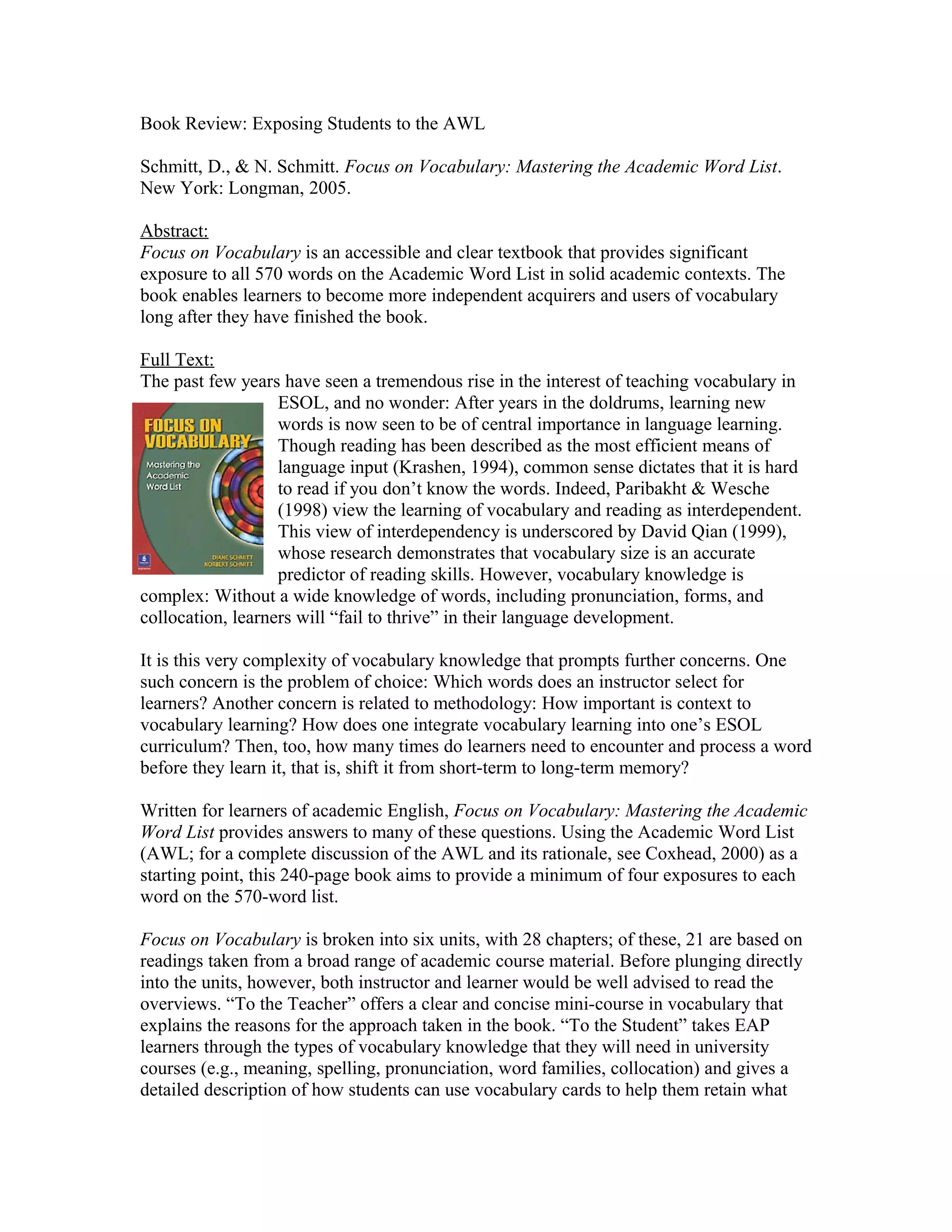
Schmitt, D., & N. Schmitt. Focus on Vocabulary: Mastering the Academic Word List.
New York: Longman, 2005.
Abstract:
Focus on Vocabulary is an accessible and clear textbook that provides significant
exposure to all 570 words on the Academic Word List in solid academic contexts. The
book enables learners to become more independent acquirers and users of vocabulary
long after they have finished the book.
Full Text:
The past few years have seen a tremendous rise in the interest of teaching vocabulary in
ESOL, and no wonder: After years in the doldrums, learning new
words is now seen to be of central importance in language learning.
Though reading has been described as the most efficient means of
language input (Krashen, 1994), common sense dictates that it is hard
to read if you don’t know the words. Indeed, Paribakht & Wesche
(1998) view the learning of vocabulary and reading as interdependent.
This view of interdependency is underscored by David Qian (1999),
whose research demonstrates that vocabulary size is an accurate
predictor of reading skills. However, vocabulary knowledge is
complex: Without a wide knowledge of words, including pronunciation, forms, and
collocation, learners will “fail to thrive” in their language development.
It is this very complexity of vocabulary knowledge that prompts further concerns. One
such concern is the problem of choice: Which words does an instructor select for
learners? Another concern is related to methodology: How important is context to
vocabulary learning? How does one integrate vocabulary learning into one’s ESOL
curriculum? Then, too, how many times do learners need to encounter and process a word
before they learn it, that is, shift it from short-term to long-term memory?
Written for learners of academic English, Focus on Vocabulary: Mastering the Academic
Word List provides answers to many of these questions. Using the Academic Word List
(AWL; for a complete discussion of the AWL and its rationale, see Coxhead, 2000) as a
starting point, this 240-page book aims to provide a minimum of four exposures to each
word on the 570-word list.
Focus on Vocabulary is broken into six units, with 28 chapters; of these, 21 are based on
readings taken from a broad range of academic course material. Before plunging directly
into the units, however, both instructor and learner would be well advised to read the
overviews. “To the Teacher” offers a clear and concise mini-course in vocabulary that
explains the reasons for the approach taken in the book. “To the Student” takes EAP
learners through the types of vocabulary knowledge that they will need in university
courses (e.g., meaning, spelling, pronunciation, word families, collocation) and gives a
detailed description of how students can use vocabulary cards to help them retain what
they learn. A separate teacher’s manual, with practice tests and an answer key to the
exercises, is also available.
Units are based on diverse topics, from sociology to business to biology to music. They
are structured in a roughly similar manner, beginning with brief prereading discussion in
“Getting Started,” moving to a knowledge-scale activity in which learners rate how well
they know the 24 target vocabulary items in the reading, and then the reading itself, with
the items highlighted in bold font. (Length varies, but they are usually around two pages
long, approximately 1,200-1,500 words.) The readings are followed by comprehension
questions and then sets of tasks that focus on meaning, form, and collocation. Concluding
each reading unit is an expansion task—discussion questions that usually lead into
writing. The fourth chapter in every unit is entitled “Strategy Practice” (there are three of
these in all). Dictionary use is featured in each of these, but other types of word
knowledge and learning tips are also covered.
The Strategy Practice chapters help learners to become more independent in their
vocabulary acquisition. Each chapter begins with work on dictionary use. My own
students are deeply attached to their expensive electronic dictionaries that frequently
provide incorrect information and few, if any, sentence examples about words, but
possess the advantage of portability. These chapters help students learn how to
systematically navigate their dictionaries by asking questions on topics such as the use of
abbreviations and the phonetic alphabet in entries to the use of abbreviations and ways of
learning from example sentences. The use of affixes is also threaded through these units.
Focus on Vocabulary has much to offer: It is well organized, with systematic recycling of
vocabulary and skills. Because the readings are taken from textbooks across the
disciplines, there will be a wide appeal and instant credibility for pre-entry students who
want to work with “real” course material. Expansion tasks called “Exploring the Topic”
provide opportunities for students to reflect on the topics they have read about. In short,
this book is written with both teachers and learners in mind. It would work well as the
core text in a stand-alone vocabulary course or, with supplementation, an academic
reading course. However, because the focus is on vocabulary, it would be helpful if the
Expansion tasks focused a bit more overtly on getting students to use the target items in a
less structured way, in their speaking and writing. Despite this quibble, teachers of
advanced learners, whether new to the profession or veterans, will find Focus on
Vocabulary accessible and clear. Providing significant exposure to all 570 words on the
Academic Word List, in solid academic contexts, it will enable learners to become more
independent acquirers and users of vocabulary long after they have finished the book.
References
Coxhead, A. (2000). A new Academic Word List. TESOL Quarterly 34(2), 213-238.
Krashen, S. (1994). The power of reading. Englewood, CO: Libraries Unlimited.
Paribakht, T. S., & Wesche, M. (1998). Reading and “incidental” vocabulary acquisition.
SSLA 21, 196-224.
Qian, D. (1999). Assessing the role of depth and breadth of vocabulary knowledge in
reading comprehension [Electronic version]. Canadian Modern Language Review
56 (2). Retrieved December 14, 2004, from Communication and Mass Media
Complete database.
Marti Sevier teaches Academic Skills in the English Bridge Program at Simon Fraser
University in British Columbia, Canada.

Bookreviewfocusonvocabularyl

  • 1.
    Book Review: ExposingStudents to the AWL Schmitt, D., & N. Schmitt. Focus on Vocabulary: Mastering the Academic Word List. New York: Longman, 2005. Abstract: Focus on Vocabulary is an accessible and clear textbook that provides significant exposure to all 570 words on the Academic Word List in solid academic contexts. The book enables learners to become more independent acquirers and users of vocabulary long after they have finished the book. Full Text: The past few years have seen a tremendous rise in the interest of teaching vocabulary in ESOL, and no wonder: After years in the doldrums, learning new words is now seen to be of central importance in language learning. Though reading has been described as the most efficient means of language input (Krashen, 1994), common sense dictates that it is hard to read if you don’t know the words. Indeed, Paribakht & Wesche (1998) view the learning of vocabulary and reading as interdependent. This view of interdependency is underscored by David Qian (1999), whose research demonstrates that vocabulary size is an accurate predictor of reading skills. However, vocabulary knowledge is complex: Without a wide knowledge of words, including pronunciation, forms, and collocation, learners will “fail to thrive” in their language development. It is this very complexity of vocabulary knowledge that prompts further concerns. One such concern is the problem of choice: Which words does an instructor select for learners? Another concern is related to methodology: How important is context to vocabulary learning? How does one integrate vocabulary learning into one’s ESOL curriculum? Then, too, how many times do learners need to encounter and process a word before they learn it, that is, shift it from short-term to long-term memory? Written for learners of academic English, Focus on Vocabulary: Mastering the Academic Word List provides answers to many of these questions. Using the Academic Word List (AWL; for a complete discussion of the AWL and its rationale, see Coxhead, 2000) as a starting point, this 240-page book aims to provide a minimum of four exposures to each word on the 570-word list. Focus on Vocabulary is broken into six units, with 28 chapters; of these, 21 are based on readings taken from a broad range of academic course material. Before plunging directly into the units, however, both instructor and learner would be well advised to read the overviews. “To the Teacher” offers a clear and concise mini-course in vocabulary that explains the reasons for the approach taken in the book. “To the Student” takes EAP learners through the types of vocabulary knowledge that they will need in university courses (e.g., meaning, spelling, pronunciation, word families, collocation) and gives a detailed description of how students can use vocabulary cards to help them retain what
  • 2.
    they learn. Aseparate teacher’s manual, with practice tests and an answer key to the exercises, is also available. Units are based on diverse topics, from sociology to business to biology to music. They are structured in a roughly similar manner, beginning with brief prereading discussion in “Getting Started,” moving to a knowledge-scale activity in which learners rate how well they know the 24 target vocabulary items in the reading, and then the reading itself, with the items highlighted in bold font. (Length varies, but they are usually around two pages long, approximately 1,200-1,500 words.) The readings are followed by comprehension questions and then sets of tasks that focus on meaning, form, and collocation. Concluding each reading unit is an expansion task—discussion questions that usually lead into writing. The fourth chapter in every unit is entitled “Strategy Practice” (there are three of these in all). Dictionary use is featured in each of these, but other types of word knowledge and learning tips are also covered. The Strategy Practice chapters help learners to become more independent in their vocabulary acquisition. Each chapter begins with work on dictionary use. My own students are deeply attached to their expensive electronic dictionaries that frequently provide incorrect information and few, if any, sentence examples about words, but possess the advantage of portability. These chapters help students learn how to systematically navigate their dictionaries by asking questions on topics such as the use of abbreviations and the phonetic alphabet in entries to the use of abbreviations and ways of learning from example sentences. The use of affixes is also threaded through these units. Focus on Vocabulary has much to offer: It is well organized, with systematic recycling of vocabulary and skills. Because the readings are taken from textbooks across the disciplines, there will be a wide appeal and instant credibility for pre-entry students who want to work with “real” course material. Expansion tasks called “Exploring the Topic” provide opportunities for students to reflect on the topics they have read about. In short, this book is written with both teachers and learners in mind. It would work well as the core text in a stand-alone vocabulary course or, with supplementation, an academic reading course. However, because the focus is on vocabulary, it would be helpful if the Expansion tasks focused a bit more overtly on getting students to use the target items in a less structured way, in their speaking and writing. Despite this quibble, teachers of advanced learners, whether new to the profession or veterans, will find Focus on Vocabulary accessible and clear. Providing significant exposure to all 570 words on the Academic Word List, in solid academic contexts, it will enable learners to become more independent acquirers and users of vocabulary long after they have finished the book.
  • 3.
    References Coxhead, A. (2000).A new Academic Word List. TESOL Quarterly 34(2), 213-238. Krashen, S. (1994). The power of reading. Englewood, CO: Libraries Unlimited. Paribakht, T. S., & Wesche, M. (1998). Reading and “incidental” vocabulary acquisition. SSLA 21, 196-224. Qian, D. (1999). Assessing the role of depth and breadth of vocabulary knowledge in reading comprehension [Electronic version]. Canadian Modern Language Review 56 (2). Retrieved December 14, 2004, from Communication and Mass Media Complete database. Marti Sevier teaches Academic Skills in the English Bridge Program at Simon Fraser University in British Columbia, Canada.