Monitoring Condition Factor
of the Dominant Fin Fishes
in the Estuaries of Lower Gangetic Delta
in the Backdrop of Climate Change
Ankita Mitra, Sufia Zaman, Prosenjit Pramanick and Shampa Mitra
Abstract The current global fisheries production is *160 million tonnes. The
quantum is gradually rising as a result of increases in aquaculture production.
A number of climate-related threats to capture both the fisheries and aquaculture are
identified, but we have high uncertainty in predictions of the future fisheries pro-
duction because of uncertainty over the future global aquatic net primary produc-
tion and the transfer of this production through the food chain to human
consumption. Recent changes in the distribution and productivity of a number of
fish species can be ascribed with high confidence to regional climate variability,
such as the El Niño–Southern Oscillation. The future production may increase in
some high-latitude regions because of warming and decreased ice cover, but the
dynamics in low-latitude regions are governed by different processes, and pro-
duction may decline as a result of reduced vertical mixing of the water column and,
hence, reduced recycling of nutrients. There are strong interactions between the
effects of fishing and the effects of climate because fishing reduces the age, size and
geographic diversity of populations and the biodiversity of marine ecosystems,
making both more sensitive to additional stresses such as climate change-induced
salinity oscillation. The estuaries in the lower Gangetic delta at the apex of Bay of
Bengal are noted for contrasting spatial variation of salinity. The Hooghly estuary
in the western sector is relatively low saline compared to the Matla estuary in the
central sector on account of receiving the fresh water discharge from the Farakka
barrage. The central sector is hyper saline due to siltation of the Bidyadhari River
since the late fifteenth century. The present study evaluates the condition factor of
fourteen commercially important fin fish species (that constitute *75 % of the
fishes in the catch basket) collected from the Hooghly and Matla estuaries in the
western and central sectors of the lower Gangetic delta, respectively. Relatively
A. Mitra (&)
Department of Ecology and Environmental Sciences,
School of Life Sciences, Puducherry, India
e-mail: mitrankita92@gmail.com
S. Zaman Á P. Pramanick Á S. Mitra
Department of Oceanography, Techno India University,
Salt Lake Campus, Kolkata 700091, India
© Springer International Publishing Switzerland 2016
S. Nautiyal et al. (eds.), Climate Change Challenge (3C)
and Social-Economic-Ecological Interface-Building, Environmental Science,
DOI 10.1007/978-3-319-31014-5_20
347
higher values of condition factor of all the species collected from the Hooghly
estuary (compared to those collected from the Matla estuary) confirm the adverse
effect of hyper salinity on the growth and condition factor of the species.
Keywords Salinity Á Condition index Á Fin fish Á Climate change
1 Introduction
The lower Gangetic delta at apex of Bay of Bengal sustains a wide spectrum of fin
fishes. The litter and detritus contributed by mangroves provide nutrition to the fish
community by triggering the growth of plankton. The fish fauna of the present
study area may be classified into residents and transients (migrants). The species
whose individuals of different sizes are present during all the months of the year in
any zone of the estuary are referred to as resident species. The important resident
finfish species are Mugil parsia, M. tade, Polynemus paradiseus, Polydactylus
indicus, Otolithoides biauritus, Lates calcarifer, Hilsa toli, Arius jella, Harpodon
nehereus, Setipinna taty, Ilisha elongata, Setipinna phasa, Coilia ramcarati, Pama
pama and Sillaginopsis panijus. The transient or migratory fishes enter and stay in
the Bay of Bengal associated estuaries for a short period. Depending on their
migratory pattern and direction, the migrants are divided into three categories
(Jhingran 1982; Mitra 2013): (1) Marine forms that migrate upstream and spawn in
freshwater areas of the estuary such as Tenualosa ilisha, P. paradiseus, S. panijus
and P. pama, (2) Freshwater species, which spawn in saline area of the estuary such
as Pangasius pangasius, and (3) Marine species, that spawn in less saline water of
the estuary such as A. jella, Osteogeneious militaris and Polydactylus indicus.
Two important estuaries in the lower Gangetic delta are the Hooghly and the
Matla estuaries. These two estuaries exhibit pronounced variation with respect to
salinity. The Hooghly estuary in the western sector is relatively low saline com-
pared to the Matla estuary in the central sector. This contrasting salinity may be
attributed to discharge of fresh water through Farakka barrage in the Hooghly
estuary and complete closure of fresh water discharge in the Matla estuary due to
siltation of the Bidyadhari River since the late fifteenth century. The difference in
salinity has profound influence on the condition factor of the fin fishes, which has
been attempted to study in the present programme.
Our main aim is to determine the impact of salinity variation on the condition
factor of the selected fin fish species as the price of the fish mostly depends on their
growth (in terms of length and weight).
348 A. Mitra et al.
2 Materials and Methods
The entire network of the present study consists of the collection of 100 individuals
of the selected species (T. ilisha, Pama pama, Pampus spp., Ilisha elongate, L.
calcarifer, P. pangasius, Liza parsia, Liza tade, Tenualosa toli, P. paradiseus, O.
biauritus, Tachysurus jella, Sciaena biauritus, Eleutheronema tetradactylum) from
the two major estuaries in the study area namely Hooghly (in the western sector)
and Matla (in the central sector). The sampling stations selected for the present
study are Diamond Harbour (in the Hooghly estuary) and Canning (in the Matla
estuary). Individual length and weight of the individuals of the selected species
were measured to evaluate the condition factor (Chow and Sandifer 1991) as per the
following expression:
K ¼
w
ðTLÞ3
 103
where K is the condition factor, w is the average weight (g) and TL is the average
total length (cm).
The secondary data of surface water salinity were obtained from the data bank
cited by Ray Choudhury et al. (2014), Chakraborty et al. (2013), Mitra (2013),
Sengupta et al. (2013), Mitra and Zaman (2014) and Mitra and Zaman (2015).
3 Results
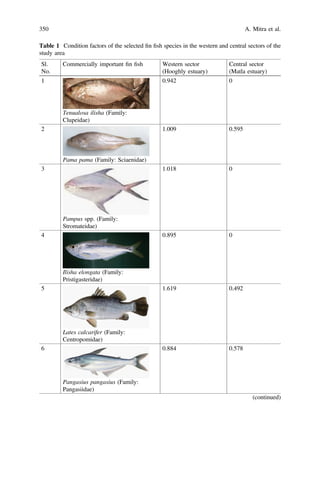
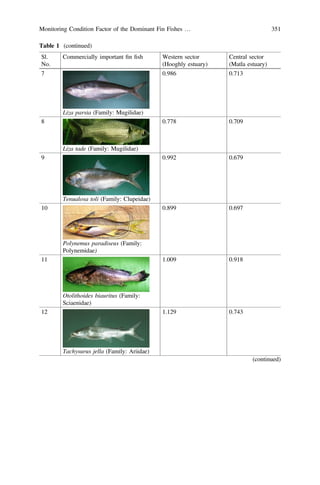
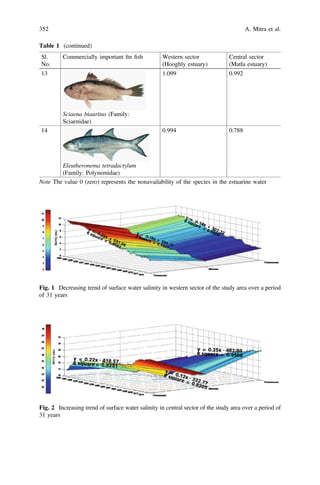
It is evident that condition factor is relatively higher for the fin fish species collected
from the Hooghly estuary compared to those collected from the Matla estuarine
water (Table 1). This may be attributed to variation in aquatic salinity as evidenced
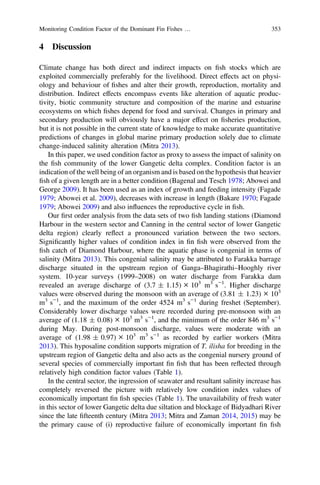
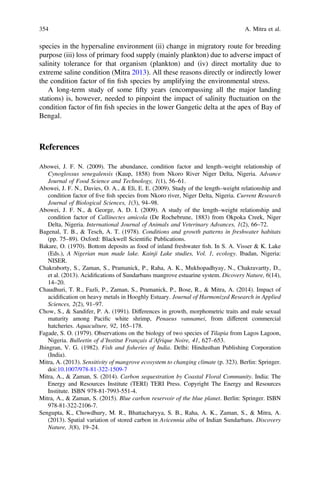
from the secondary data bank. The Hooghly estuarine water is relatively hyposaline
as compared to the water of Matla estuary in the central sector of the study area
(Figs. 1 and 2).
Monitoring Condition Factor of the Dominant Fin Fishes … 349
Table 1 Condition factors of the selected fin fish species in the western and central sectors of the
study area
Sl.
No.
Commercially important fin fish Western sector
(Hooghly estuary)
Central sector
(Matla estuary)
1
Tenualosa ilisha (Family:
Clupeidae)
0.942 0
2
Pama pama (Family: Sciaenidae)
1.009 0.595
3
Pampus spp. (Family:
Stromateidae)
1.018 0
4
Ilisha elongata (Family:
Pristigasteridae)
0.895 0
5
Lates calcarifer (Family:
Centropomidae)
1.619 0.492
6
Pangasius pangasius (Family:
Pangasiidae)
0.884 0.578
(continued)
350 A. Mitra et al.
Table 1 (continued)
Sl.
No.
Commercially important fin fish Western sector
(Hooghly estuary)
Central sector
(Matla estuary)
7
Liza parsia (Family: Mugilidae)
0.986 0.713
8
Liza tade (Family: Mugilidae)
0.778 0.709
9
Tenualosa toli (Family: Clupeidae)
0.992 0.679
10
Polynemus paradiseus (Family:
Polynemidae)
0.899 0.697
11
Otolithoides biauritus (Family:
Sciaenidae)
1.009 0.918
12
Tachysurus jella (Family: Ariidae)
1.129 0.743
(continued)
Monitoring Condition Factor of the Dominant Fin Fishes … 351
Table 1 (continued)
Sl.
No.
Commercially important fin fish Western sector
(Hooghly estuary)
Central sector
(Matla estuary)
13
Sciaena biauritus (Family:
Sciaenidae)
1.099 0.992
14
Eleutheronema tetradactylum
(Family: Polynemidae)
0.994 0.788
Note The value 0 (zero) represents the nonavailability of the species in the estuarine water
Fig. 1 Decreasing trend of surface water salinity in western sector of the study area over a period
of 31 years
Fig. 2 Increasing trend of surface water salinity in central sector of the study area over a period of
31 years
352 A. Mitra et al.
4 Discussion
Climate change has both direct and indirect impacts on fish stocks which are
exploited commercially preferably for the livelihood. Direct effects act on physi-
ology and behaviour of fishes and alter their growth, reproduction, mortality and
distribution. Indirect effects encompass events like alteration of aquatic produc-
tivity, biotic community structure and composition of the marine and estuarine
ecosystems on which fishes depend for food and survival. Changes in primary and
secondary production will obviously have a major effect on fisheries production,
but it is not possible in the current state of knowledge to make accurate quantitative
predictions of changes in global marine primary production solely due to climate
change-induced salinity alteration (Mitra 2013).
In this paper, we used condition factor as proxy to assess the impact of salinity on
the fish community of the lower Gangetic delta complex. Condition factor is an
indication of the well being of an organism and is based on the hypothesis that heavier
fish of a given length are in a better condition (Bagenal and Tesch 1978; Abowei and
George 2009). It has been used as an index of growth and feeding intensity (Fagade
1979; Abowei et al. 2009), decreases with increase in length (Bakare 1970; Fagade
1979; Abowei 2009) and also influences the reproductive cycle in fish.
Our first order analysis from the data sets of two fish landing stations (Diamond
Harbour in the western sector and Canning in the central sector of lower Gangetic
delta region) clearly reflect a pronounced variation between the two sectors.
Significantly higher values of condition index in fin fish were observed from the
fish catch of Diamond Harbour, where the aquatic phase is congenial in terms of
salinity (Mitra 2013). This congenial salinity may be attributed to Farakka barrage
discharge situated in the upstream region of Ganga–Bhagirathi–Hooghly river
system. 10-year surveys (1999–2008) on water discharge from Farakka dam
revealed an average discharge of (3.7 ± 1.15) × 103
m3
s−1
. Higher discharge
values were observed during the monsoon with an average of (3.81 ± 1.23) × 103
m3
s−1
, and the maximum of the order 4524 m3
s−1
during freshet (September).
Considerably lower discharge values were recorded during pre-monsoon with an
average of (1.18 ± 0.08) × 103
m3
s−1
, and the minimum of the order 846 m3
s−1
during May. During post-monsoon discharge, values were moderate with an
average of (1.98 ± 0.97) × 103
m3
s−1
as recorded by earlier workers (Mitra
2013). This hyposaline condition supports migration of T. ilisha for breeding in the
upstream region of Gangetic delta and also acts as the congenial nursery ground of
several species of commercially important fin fish that has been reflected through
relatively high condition factor values (Table 1).
In the central sector, the ingression of seawater and resultant salinity increase has
completely reversed the picture with relatively low condition index values of
economically important fin fish species (Table 1). The unavailability of fresh water
in this sector of lower Gangetic delta due siltation and blockage of Bidyadhari River
since the late fifteenth century (Mitra 2013; Mitra and Zaman 2014, 2015) may be
the primary cause of (i) reproductive failure of economically important fin fish
Monitoring Condition Factor of the Dominant Fin Fishes … 353
species in the hypersaline environment (ii) change in migratory route for breeding
purpose (iii) loss of primary food supply (mainly plankton) due to adverse impact of
salinity tolerance for that organism (plankton) and (iv) direct mortality due to
extreme saline condition (Mitra 2013). All these reasons directly or indirectly lower
the condition factor of fin fish species by amplifying the environmental stress.
A long-term study of some fifty years (encompassing all the major landing
stations) is, however, needed to pinpoint the impact of salinity fluctuation on the
condition factor of fin fish species in the lower Gangetic delta at the apex of Bay of
Bengal.
References
Abowei, J. F. N. (2009). The abundance, condition factor and length–weight relationship of
Cynoglossus senegalensis (Kaup, 1858) from Nkoro River Niger Delta, Nigeria. Advance
Journal of Food Science and Technology, 1(1), 56–61.
Abowei, J. F. N., Davies, O. A.,  Eli, E. E. (2009). Study of the length–weight relationship and
condition factor of five fish species from Nkoro river, Niger Delta, Nigeria. Current Research
Journal of Biological Sciences, 1(3), 94–98.
Abowei, J. F. N.,  George, A. D. I. (2009). A study of the length–weight relationship and
condition factor of Callinectes amicola (De Rochebrune, 1883) from Okpoka Creek, Niger
Delta, Nigeria. International Journal of Animals and Veterinary Advances, 1(2), 66–72.
Bagenal, T. B.,  Tesch, A. T. (1978). Conditions and growth patterns in freshwater habitats
(pp. 75–89). Oxford: Blackwell Scientific Publications.
Bakare, O. (1970). Bottom deposits as food of inland freshwater fish. In S. A. Visser  K. Lake
(Eds.), A Nigerian man made lake. Kainji Lake studies, Vol. 1, ecology. Ibadan, Nigeria:
NISER.
Chakraborty, S., Zaman, S., Pramanick, P., Raha, A. K., Mukhopadhyay, N., Chakravartty, D.,
et al. (2013). Acidifications of Sundarbans mangrove estuarine system. Dicovery Nature, 6(14),
14–20.
Chaudhuri, T. R., Fazli, P., Zaman, S., Pramanick, P., Bose, R.,  Mitra, A. (2014). Impact of
acidification on heavy metals in Hooghly Estuary. Journal of Harmonized Research in Applied
Sciences, 2(2), 91–97.
Chow, S.,  Sandifer, P. A. (1991). Differences in growth, morphometric traits and male sexual
maturity among Pacific white shrimp, Penaeus vannamei, from different commercial
hatcheries. Aquaculture, 92, 165–178.
Fagade, S. O. (1979). Observations on the biology of two species of Tilapia from Lagos Lagoon,
Nigeria. Bulleetin of d’Institut Français d’Afrique Noire, 41, 627–653.
Jhingran, V. G. (1982). Fish and fisheries of India. Delhi: Hindusthan Publishing Corporation
(India).
Mitra, A. (2013). Sensitivity of mangrove ecosystem to changing climate (p. 323). Berlin: Springer.
doi:10.1007/978-81-322-1509-7
Mitra, A.,  Zaman, S. (2014). Carbon sequestration by Coastal Floral Community. India: The
Energy and Resources Institute (TERI) TERI Press. Copyright The Energy and Resources
Institute. ISBN 978-81-7993-551-4.
Mitra, A.,  Zaman, S. (2015). Blue carbon reservoir of the blue planet. Berlin: Springer. ISBN
978-81-322-2106-7.
Sengupta, K., Chowdhury, M. R., Bhattacharyya, S. B., Raha, A. K., Zaman, S.,  Mitra, A.
(2013). Spatial variation of stored carbon in Avicennia alba of Indian Sundarbans. Discovery
Nature, 3(8), 19–24.
354 A. Mitra et al.

Book chapter on fish by Ankita (kinka) Mitra

  • 1.
    Monitoring Condition Factor ofthe Dominant Fin Fishes in the Estuaries of Lower Gangetic Delta in the Backdrop of Climate Change Ankita Mitra, Sufia Zaman, Prosenjit Pramanick and Shampa Mitra Abstract The current global fisheries production is *160 million tonnes. The quantum is gradually rising as a result of increases in aquaculture production. A number of climate-related threats to capture both the fisheries and aquaculture are identified, but we have high uncertainty in predictions of the future fisheries pro- duction because of uncertainty over the future global aquatic net primary produc- tion and the transfer of this production through the food chain to human consumption. Recent changes in the distribution and productivity of a number of fish species can be ascribed with high confidence to regional climate variability, such as the El Niño–Southern Oscillation. The future production may increase in some high-latitude regions because of warming and decreased ice cover, but the dynamics in low-latitude regions are governed by different processes, and pro- duction may decline as a result of reduced vertical mixing of the water column and, hence, reduced recycling of nutrients. There are strong interactions between the effects of fishing and the effects of climate because fishing reduces the age, size and geographic diversity of populations and the biodiversity of marine ecosystems, making both more sensitive to additional stresses such as climate change-induced salinity oscillation. The estuaries in the lower Gangetic delta at the apex of Bay of Bengal are noted for contrasting spatial variation of salinity. The Hooghly estuary in the western sector is relatively low saline compared to the Matla estuary in the central sector on account of receiving the fresh water discharge from the Farakka barrage. The central sector is hyper saline due to siltation of the Bidyadhari River since the late fifteenth century. The present study evaluates the condition factor of fourteen commercially important fin fish species (that constitute *75 % of the fishes in the catch basket) collected from the Hooghly and Matla estuaries in the western and central sectors of the lower Gangetic delta, respectively. Relatively A. Mitra (&) Department of Ecology and Environmental Sciences, School of Life Sciences, Puducherry, India e-mail: mitrankita92@gmail.com S. Zaman Á P. Pramanick Á S. Mitra Department of Oceanography, Techno India University, Salt Lake Campus, Kolkata 700091, India © Springer International Publishing Switzerland 2016 S. Nautiyal et al. (eds.), Climate Change Challenge (3C) and Social-Economic-Ecological Interface-Building, Environmental Science, DOI 10.1007/978-3-319-31014-5_20 347
  • 2.
    higher values ofcondition factor of all the species collected from the Hooghly estuary (compared to those collected from the Matla estuary) confirm the adverse effect of hyper salinity on the growth and condition factor of the species. Keywords Salinity Á Condition index Á Fin fish Á Climate change 1 Introduction The lower Gangetic delta at apex of Bay of Bengal sustains a wide spectrum of fin fishes. The litter and detritus contributed by mangroves provide nutrition to the fish community by triggering the growth of plankton. The fish fauna of the present study area may be classified into residents and transients (migrants). The species whose individuals of different sizes are present during all the months of the year in any zone of the estuary are referred to as resident species. The important resident finfish species are Mugil parsia, M. tade, Polynemus paradiseus, Polydactylus indicus, Otolithoides biauritus, Lates calcarifer, Hilsa toli, Arius jella, Harpodon nehereus, Setipinna taty, Ilisha elongata, Setipinna phasa, Coilia ramcarati, Pama pama and Sillaginopsis panijus. The transient or migratory fishes enter and stay in the Bay of Bengal associated estuaries for a short period. Depending on their migratory pattern and direction, the migrants are divided into three categories (Jhingran 1982; Mitra 2013): (1) Marine forms that migrate upstream and spawn in freshwater areas of the estuary such as Tenualosa ilisha, P. paradiseus, S. panijus and P. pama, (2) Freshwater species, which spawn in saline area of the estuary such as Pangasius pangasius, and (3) Marine species, that spawn in less saline water of the estuary such as A. jella, Osteogeneious militaris and Polydactylus indicus. Two important estuaries in the lower Gangetic delta are the Hooghly and the Matla estuaries. These two estuaries exhibit pronounced variation with respect to salinity. The Hooghly estuary in the western sector is relatively low saline com- pared to the Matla estuary in the central sector. This contrasting salinity may be attributed to discharge of fresh water through Farakka barrage in the Hooghly estuary and complete closure of fresh water discharge in the Matla estuary due to siltation of the Bidyadhari River since the late fifteenth century. The difference in salinity has profound influence on the condition factor of the fin fishes, which has been attempted to study in the present programme. Our main aim is to determine the impact of salinity variation on the condition factor of the selected fin fish species as the price of the fish mostly depends on their growth (in terms of length and weight). 348 A. Mitra et al.
  • 3.
    2 Materials andMethods The entire network of the present study consists of the collection of 100 individuals of the selected species (T. ilisha, Pama pama, Pampus spp., Ilisha elongate, L. calcarifer, P. pangasius, Liza parsia, Liza tade, Tenualosa toli, P. paradiseus, O. biauritus, Tachysurus jella, Sciaena biauritus, Eleutheronema tetradactylum) from the two major estuaries in the study area namely Hooghly (in the western sector) and Matla (in the central sector). The sampling stations selected for the present study are Diamond Harbour (in the Hooghly estuary) and Canning (in the Matla estuary). Individual length and weight of the individuals of the selected species were measured to evaluate the condition factor (Chow and Sandifer 1991) as per the following expression: K ¼ w ðTLÞ3 Â 103 where K is the condition factor, w is the average weight (g) and TL is the average total length (cm). The secondary data of surface water salinity were obtained from the data bank cited by Ray Choudhury et al. (2014), Chakraborty et al. (2013), Mitra (2013), Sengupta et al. (2013), Mitra and Zaman (2014) and Mitra and Zaman (2015). 3 Results It is evident that condition factor is relatively higher for the fin fish species collected from the Hooghly estuary compared to those collected from the Matla estuarine water (Table 1). This may be attributed to variation in aquatic salinity as evidenced from the secondary data bank. The Hooghly estuarine water is relatively hyposaline as compared to the water of Matla estuary in the central sector of the study area (Figs. 1 and 2). Monitoring Condition Factor of the Dominant Fin Fishes … 349
  • 4.
    Table 1 Conditionfactors of the selected fin fish species in the western and central sectors of the study area Sl. No. Commercially important fin fish Western sector (Hooghly estuary) Central sector (Matla estuary) 1 Tenualosa ilisha (Family: Clupeidae) 0.942 0 2 Pama pama (Family: Sciaenidae) 1.009 0.595 3 Pampus spp. (Family: Stromateidae) 1.018 0 4 Ilisha elongata (Family: Pristigasteridae) 0.895 0 5 Lates calcarifer (Family: Centropomidae) 1.619 0.492 6 Pangasius pangasius (Family: Pangasiidae) 0.884 0.578 (continued) 350 A. Mitra et al.
  • 5.
    Table 1 (continued) Sl. No. Commerciallyimportant fin fish Western sector (Hooghly estuary) Central sector (Matla estuary) 7 Liza parsia (Family: Mugilidae) 0.986 0.713 8 Liza tade (Family: Mugilidae) 0.778 0.709 9 Tenualosa toli (Family: Clupeidae) 0.992 0.679 10 Polynemus paradiseus (Family: Polynemidae) 0.899 0.697 11 Otolithoides biauritus (Family: Sciaenidae) 1.009 0.918 12 Tachysurus jella (Family: Ariidae) 1.129 0.743 (continued) Monitoring Condition Factor of the Dominant Fin Fishes … 351
  • 6.
    Table 1 (continued) Sl. No. Commerciallyimportant fin fish Western sector (Hooghly estuary) Central sector (Matla estuary) 13 Sciaena biauritus (Family: Sciaenidae) 1.099 0.992 14 Eleutheronema tetradactylum (Family: Polynemidae) 0.994 0.788 Note The value 0 (zero) represents the nonavailability of the species in the estuarine water Fig. 1 Decreasing trend of surface water salinity in western sector of the study area over a period of 31 years Fig. 2 Increasing trend of surface water salinity in central sector of the study area over a period of 31 years 352 A. Mitra et al.
  • 7.
    4 Discussion Climate changehas both direct and indirect impacts on fish stocks which are exploited commercially preferably for the livelihood. Direct effects act on physi- ology and behaviour of fishes and alter their growth, reproduction, mortality and distribution. Indirect effects encompass events like alteration of aquatic produc- tivity, biotic community structure and composition of the marine and estuarine ecosystems on which fishes depend for food and survival. Changes in primary and secondary production will obviously have a major effect on fisheries production, but it is not possible in the current state of knowledge to make accurate quantitative predictions of changes in global marine primary production solely due to climate change-induced salinity alteration (Mitra 2013). In this paper, we used condition factor as proxy to assess the impact of salinity on the fish community of the lower Gangetic delta complex. Condition factor is an indication of the well being of an organism and is based on the hypothesis that heavier fish of a given length are in a better condition (Bagenal and Tesch 1978; Abowei and George 2009). It has been used as an index of growth and feeding intensity (Fagade 1979; Abowei et al. 2009), decreases with increase in length (Bakare 1970; Fagade 1979; Abowei 2009) and also influences the reproductive cycle in fish. Our first order analysis from the data sets of two fish landing stations (Diamond Harbour in the western sector and Canning in the central sector of lower Gangetic delta region) clearly reflect a pronounced variation between the two sectors. Significantly higher values of condition index in fin fish were observed from the fish catch of Diamond Harbour, where the aquatic phase is congenial in terms of salinity (Mitra 2013). This congenial salinity may be attributed to Farakka barrage discharge situated in the upstream region of Ganga–Bhagirathi–Hooghly river system. 10-year surveys (1999–2008) on water discharge from Farakka dam revealed an average discharge of (3.7 ± 1.15) × 103 m3 s−1 . Higher discharge values were observed during the monsoon with an average of (3.81 ± 1.23) × 103 m3 s−1 , and the maximum of the order 4524 m3 s−1 during freshet (September). Considerably lower discharge values were recorded during pre-monsoon with an average of (1.18 ± 0.08) × 103 m3 s−1 , and the minimum of the order 846 m3 s−1 during May. During post-monsoon discharge, values were moderate with an average of (1.98 ± 0.97) × 103 m3 s−1 as recorded by earlier workers (Mitra 2013). This hyposaline condition supports migration of T. ilisha for breeding in the upstream region of Gangetic delta and also acts as the congenial nursery ground of several species of commercially important fin fish that has been reflected through relatively high condition factor values (Table 1). In the central sector, the ingression of seawater and resultant salinity increase has completely reversed the picture with relatively low condition index values of economically important fin fish species (Table 1). The unavailability of fresh water in this sector of lower Gangetic delta due siltation and blockage of Bidyadhari River since the late fifteenth century (Mitra 2013; Mitra and Zaman 2014, 2015) may be the primary cause of (i) reproductive failure of economically important fin fish Monitoring Condition Factor of the Dominant Fin Fishes … 353
  • 8.
    species in thehypersaline environment (ii) change in migratory route for breeding purpose (iii) loss of primary food supply (mainly plankton) due to adverse impact of salinity tolerance for that organism (plankton) and (iv) direct mortality due to extreme saline condition (Mitra 2013). All these reasons directly or indirectly lower the condition factor of fin fish species by amplifying the environmental stress. A long-term study of some fifty years (encompassing all the major landing stations) is, however, needed to pinpoint the impact of salinity fluctuation on the condition factor of fin fish species in the lower Gangetic delta at the apex of Bay of Bengal. References Abowei, J. F. N. (2009). The abundance, condition factor and length–weight relationship of Cynoglossus senegalensis (Kaup, 1858) from Nkoro River Niger Delta, Nigeria. Advance Journal of Food Science and Technology, 1(1), 56–61. Abowei, J. F. N., Davies, O. A., Eli, E. E. (2009). Study of the length–weight relationship and condition factor of five fish species from Nkoro river, Niger Delta, Nigeria. Current Research Journal of Biological Sciences, 1(3), 94–98. Abowei, J. F. N., George, A. D. I. (2009). A study of the length–weight relationship and condition factor of Callinectes amicola (De Rochebrune, 1883) from Okpoka Creek, Niger Delta, Nigeria. International Journal of Animals and Veterinary Advances, 1(2), 66–72. Bagenal, T. B., Tesch, A. T. (1978). Conditions and growth patterns in freshwater habitats (pp. 75–89). Oxford: Blackwell Scientific Publications. Bakare, O. (1970). Bottom deposits as food of inland freshwater fish. In S. A. Visser K. Lake (Eds.), A Nigerian man made lake. Kainji Lake studies, Vol. 1, ecology. Ibadan, Nigeria: NISER. Chakraborty, S., Zaman, S., Pramanick, P., Raha, A. K., Mukhopadhyay, N., Chakravartty, D., et al. (2013). Acidifications of Sundarbans mangrove estuarine system. Dicovery Nature, 6(14), 14–20. Chaudhuri, T. R., Fazli, P., Zaman, S., Pramanick, P., Bose, R., Mitra, A. (2014). Impact of acidification on heavy metals in Hooghly Estuary. Journal of Harmonized Research in Applied Sciences, 2(2), 91–97. Chow, S., Sandifer, P. A. (1991). Differences in growth, morphometric traits and male sexual maturity among Pacific white shrimp, Penaeus vannamei, from different commercial hatcheries. Aquaculture, 92, 165–178. Fagade, S. O. (1979). Observations on the biology of two species of Tilapia from Lagos Lagoon, Nigeria. Bulleetin of d’Institut Français d’Afrique Noire, 41, 627–653. Jhingran, V. G. (1982). Fish and fisheries of India. Delhi: Hindusthan Publishing Corporation (India). Mitra, A. (2013). Sensitivity of mangrove ecosystem to changing climate (p. 323). Berlin: Springer. doi:10.1007/978-81-322-1509-7 Mitra, A., Zaman, S. (2014). Carbon sequestration by Coastal Floral Community. India: The Energy and Resources Institute (TERI) TERI Press. Copyright The Energy and Resources Institute. ISBN 978-81-7993-551-4. Mitra, A., Zaman, S. (2015). Blue carbon reservoir of the blue planet. Berlin: Springer. ISBN 978-81-322-2106-7. Sengupta, K., Chowdhury, M. R., Bhattacharyya, S. B., Raha, A. K., Zaman, S., Mitra, A. (2013). Spatial variation of stored carbon in Avicennia alba of Indian Sundarbans. Discovery Nature, 3(8), 19–24. 354 A. Mitra et al.