CHAPTER 1: SUMMARY
A Project Based Approach to Translation Technology
Terminology and Definitions:
CAT-tools: this stands for computer-aided translation tools. These are the software such as SDL Trados and
MemoQ which offer many tools to help translators.
Translation Memory (TM): this is the most important tool of CAT tools. This is why when some translators talk
about CAT tools, they actually mean TM; CAT tools and TM are sometimes interchangeable.
Translation Environment Tools (TEnT): this is a more general term. It includes all the technologies,
applications and tools used by translators in the process. Examples are Microsoft Word and Office, dictionaries,
web browsers, conversion tools from .docx to .pdf etc.
Compatibility
-Most CAT tools are only compatible with Windows operating system.
- However, some new programs were developed recently to work with
other operating systems. An example of this is OmegaT, which is a free
software that works with multiple operating systems such as Apple's
iOS. The biggest CAT tools still only work with Microsoft Windows.
Translation Memory (TM)
• Translation Memory is a text archive of matching source and target units.
• The main benefit of using TM is saving time. This will increase
productivity and profits because translators can translate more.
Benefits of CAT Tools in General (for example: SDL Trados and MemoQ)
• They present ST and TT side by side for translators, so it is easy for the translator
to compare them.
• They also have a search function for large texts.
• CAT tools also allow text-sharing, so many translators can work together or revise
for each other across different computers.
• CAT tools also integrate many helpful tools in one program, such as dictionaries
and glossaries.
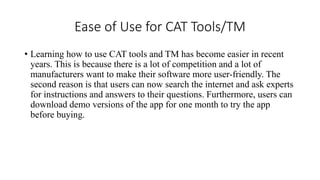
Ease of Use for CAT Tools/TM
• Learning how to use CAT tools and TM has become easier in recent
years. This is because there is a lot of competition and a lot of
manufacturers want to make their software more user-friendly. The
second reason is that users can now search the internet and ask experts
for instructions and answers to their questions. Furthermore, users can
download demo versions of the app for one month to try the app
before buying.
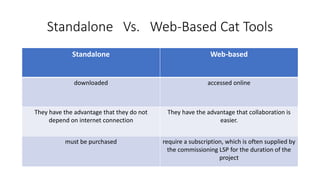
Standalone Vs. Web-Based Cat Tools
Web-based
Standalone
accessed online
downloaded
They have the advantage that collaboration is
easier.
They have the advantage that they do not
depend on internet connection
require a subscription, which is often supplied by
the commissioning LSP for the duration of the
project
must be purchased
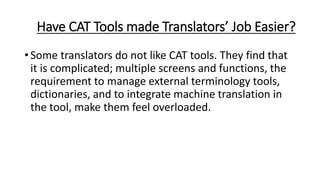
Have CAT Tools made Translators’ Job Easier?
• Some translators do not like CAT tools. They find that
it is complicated; multiple screens and functions, the
requirement to manage external terminology tools,
dictionaries, and to integrate machine translation in
the tool, make them feel overloaded.

Book_ A Project based approach CHAPTER 1 summary.pptx

  • 1.
    CHAPTER 1: SUMMARY AProject Based Approach to Translation Technology
  • 2.
    Terminology and Definitions: CAT-tools:this stands for computer-aided translation tools. These are the software such as SDL Trados and MemoQ which offer many tools to help translators. Translation Memory (TM): this is the most important tool of CAT tools. This is why when some translators talk about CAT tools, they actually mean TM; CAT tools and TM are sometimes interchangeable. Translation Environment Tools (TEnT): this is a more general term. It includes all the technologies, applications and tools used by translators in the process. Examples are Microsoft Word and Office, dictionaries, web browsers, conversion tools from .docx to .pdf etc.
  • 3.
    Compatibility -Most CAT toolsare only compatible with Windows operating system. - However, some new programs were developed recently to work with other operating systems. An example of this is OmegaT, which is a free software that works with multiple operating systems such as Apple's iOS. The biggest CAT tools still only work with Microsoft Windows.
  • 4.
    Translation Memory (TM) •Translation Memory is a text archive of matching source and target units. • The main benefit of using TM is saving time. This will increase productivity and profits because translators can translate more.
  • 5.
    Benefits of CATTools in General (for example: SDL Trados and MemoQ) • They present ST and TT side by side for translators, so it is easy for the translator to compare them. • They also have a search function for large texts. • CAT tools also allow text-sharing, so many translators can work together or revise for each other across different computers. • CAT tools also integrate many helpful tools in one program, such as dictionaries and glossaries.
  • 6.
    Ease of Usefor CAT Tools/TM • Learning how to use CAT tools and TM has become easier in recent years. This is because there is a lot of competition and a lot of manufacturers want to make their software more user-friendly. The second reason is that users can now search the internet and ask experts for instructions and answers to their questions. Furthermore, users can download demo versions of the app for one month to try the app before buying.
  • 7.
    Standalone Vs. Web-BasedCat Tools Web-based Standalone accessed online downloaded They have the advantage that collaboration is easier. They have the advantage that they do not depend on internet connection require a subscription, which is often supplied by the commissioning LSP for the duration of the project must be purchased
  • 8.
    Have CAT Toolsmade Translators’ Job Easier? • Some translators do not like CAT tools. They find that it is complicated; multiple screens and functions, the requirement to manage external terminology tools, dictionaries, and to integrate machine translation in the tool, make them feel overloaded.