ASSISTED TRANSLATION
BASED IN A VOCABULARY
BANK IN MEXICO
Made by Claudia Lucina Venado Venado
Introduction
Some authors consider that translation
is not in condition of being named as
an exact science, due to subjectivity of
each translator.
 Therefore to provide higher levels in
quality and efficiency in modern
translations, it is necessary to
generate or locate the proper tools.
 This thesis proposes the use of an
online software (CAT) for technical
translation.

What is translation?

Translate means give a voice to the
silenced speech, is communicate to the
separate people through the language.
History of translation


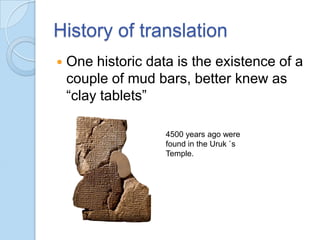
One historic data is the existence of a
couple of mud bars, better knew as
“clay tablets”
4500 years ago were
found in the Uruk `s
Temple.


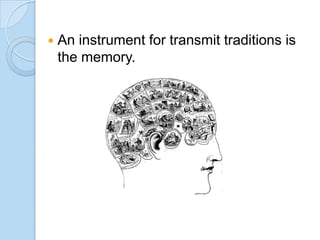
An instrument for transmit traditions is
the memory.


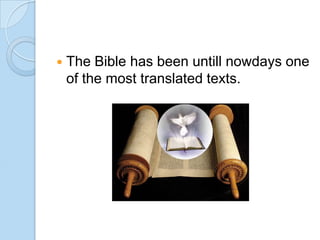
The Bible has been untill nowdays one
of the most translated texts.
In the middle age, monasteries were
sites for translation proyects and let
new languages born.
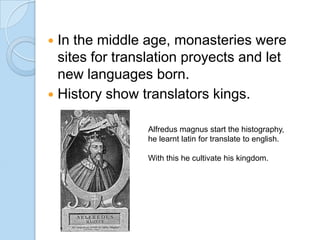
 History show translators kings.


Alfredus magnus start the histography,
he learnt latin for translate to english.
With this he cultivate his kingdom.
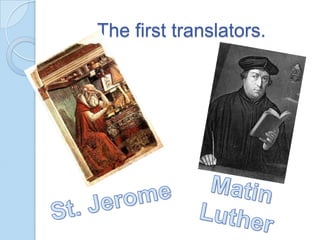
The first translators.
Types of translation
Literal translation.- means word by
word.
 Communicative translation.- it is
related by informative texts and
instructions texts.
 Creative translation .- this is based in
create a new text without been stretch
with the origin text.

Computer Assisted
Translation
is sometimes called machine-assisted,
or machine-aided, translation.
 Computer-assisted translation (CAT)
incorporates that manual editing stage
into the software, making translation
an interactive process between human
and computer

Problematic Plan

Do students focus in the dictionary at
the moment of translation?
 Do web translators confused the
students?

Justify
Tests made on 1999 report that only
15% of translators use CAT.
 In this thesis we noticed technology
help the translation exercise.
 The students agreed that web help a
lot the translation.

Hypothesis



Assisted translation by a vocabulary
bank in Mexico can help translation.
General Objective



Introduce useful tools for students
close to concluding their translation
degree.
Specific Objectives


- Describe how to create a blog



- Investigate which universities in
Mexico City have translation degree.



-Investigate if there are enough
dictionaries for help translation
Look for if these universities have a
vocabulary bank
 Make a list of the most popular
vocabulary.
 Create a vocabulary bank on internet.

Method



Analytic, cross section, observational
and Prospective
Instruments


Surveys that noticed that a
vocabulary bank help to the students
in translation process.
Character


Students from the last grades in
translation degree into the Instituto
Angloamericano Churubusco.
Study`s Limitation
Survey to the last grade students in
translation degree,
 On September in 2011.

RESULTS


The results of the survey made to 100
of students from the Instituto Superior
Angloamericano Churubusco are
shown in the next graphics
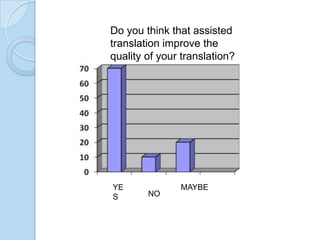
Do you think that assisted
translation improve the
quality of your translation?

YE
S

NO

MAYBE
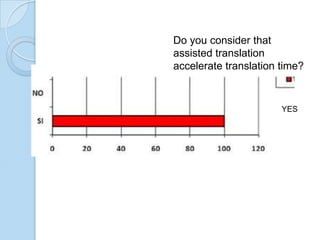
Do you consider that
assisted translation
accelerate translation time?

YES
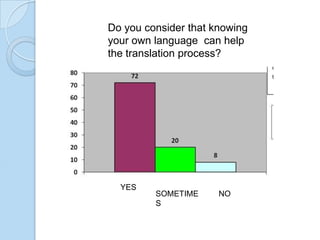
Do you consider that knowing
your own language can help
the translation process?

YES

SOMETIME
S

NO
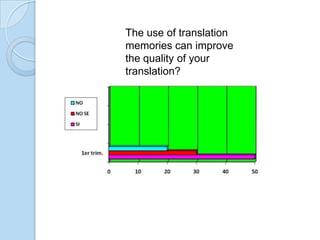
The use of translation
memories can improve
the quality of your
translation?
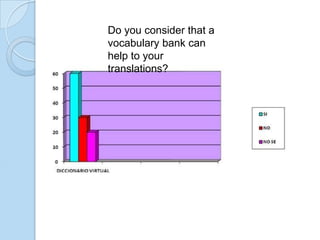
Do you consider that a
vocabulary bank can
help to your
translations?
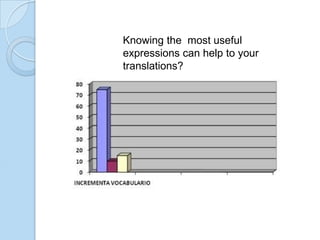
Knowing the most useful
expressions can help to your
translations?
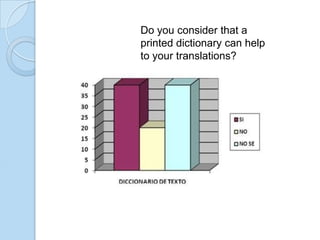
Do you consider that a
printed dictionary can help
to your translations?
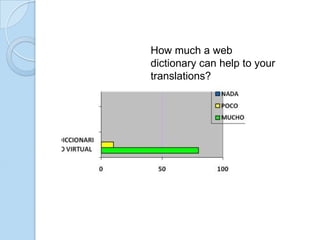
How much a web
dictionary can help to your
translations?
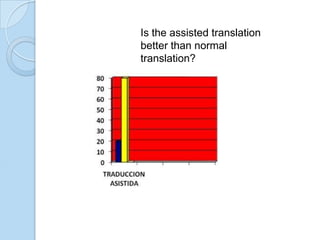
Is the assisted translation
better than normal
translation?
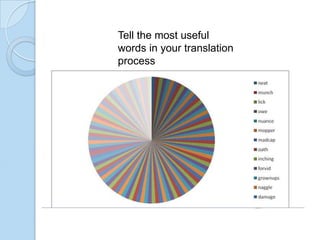
Tell the most useful
words in your translation
process
DEVELOPED PROJECT

www.languishtraduxion.com
CONTENT
WHO WE ARE?
 VISION
 MISION
 TECHNICAL DICTIONARIES
 SERVICES
 COMMENTS

THANKS FOR YOUR
ATENTTION

Presentacion tesi sfinal

  • 1.
    ASSISTED TRANSLATION BASED INA VOCABULARY BANK IN MEXICO Made by Claudia Lucina Venado Venado
  • 2.
    Introduction Some authors considerthat translation is not in condition of being named as an exact science, due to subjectivity of each translator.  Therefore to provide higher levels in quality and efficiency in modern translations, it is necessary to generate or locate the proper tools.  This thesis proposes the use of an online software (CAT) for technical translation. 
  • 3.
    What is translation? Translatemeans give a voice to the silenced speech, is communicate to the separate people through the language.
  • 4.
    History of translation  Onehistoric data is the existence of a couple of mud bars, better knew as “clay tablets” 4500 years ago were found in the Uruk `s Temple.
  • 5.
     An instrument fortransmit traditions is the memory.
  • 6.
     The Bible hasbeen untill nowdays one of the most translated texts.
  • 7.
    In the middleage, monasteries were sites for translation proyects and let new languages born.  History show translators kings.  Alfredus magnus start the histography, he learnt latin for translate to english. With this he cultivate his kingdom.
  • 8.
  • 9.
    Types of translation Literaltranslation.- means word by word.  Communicative translation.- it is related by informative texts and instructions texts.  Creative translation .- this is based in create a new text without been stretch with the origin text. 
  • 10.
    Computer Assisted Translation is sometimescalled machine-assisted, or machine-aided, translation.  Computer-assisted translation (CAT) incorporates that manual editing stage into the software, making translation an interactive process between human and computer 
  • 11.
    Problematic Plan Do studentsfocus in the dictionary at the moment of translation?  Do web translators confused the students? 
  • 12.
    Justify Tests made on1999 report that only 15% of translators use CAT.  In this thesis we noticed technology help the translation exercise.  The students agreed that web help a lot the translation. 
  • 13.
    Hypothesis  Assisted translation bya vocabulary bank in Mexico can help translation.
  • 14.
    General Objective  Introduce usefultools for students close to concluding their translation degree.
  • 15.
    Specific Objectives  - Describehow to create a blog  - Investigate which universities in Mexico City have translation degree.  -Investigate if there are enough dictionaries for help translation
  • 16.
    Look for ifthese universities have a vocabulary bank  Make a list of the most popular vocabulary.  Create a vocabulary bank on internet. 
  • 17.
    Method  Analytic, cross section,observational and Prospective
  • 18.
    Instruments  Surveys that noticedthat a vocabulary bank help to the students in translation process.
  • 19.
    Character  Students from thelast grades in translation degree into the Instituto Angloamericano Churubusco.
  • 20.
    Study`s Limitation Survey tothe last grade students in translation degree,  On September in 2011. 
  • 21.
    RESULTS  The results ofthe survey made to 100 of students from the Instituto Superior Angloamericano Churubusco are shown in the next graphics
  • 22.
    Do you thinkthat assisted translation improve the quality of your translation? YE S NO MAYBE
  • 23.
    Do you considerthat assisted translation accelerate translation time? YES
  • 24.
    Do you considerthat knowing your own language can help the translation process? YES SOMETIME S NO
  • 25.
    The use oftranslation memories can improve the quality of your translation?
  • 26.
    Do you considerthat a vocabulary bank can help to your translations?
  • 27.
    Knowing the mostuseful expressions can help to your translations?
  • 28.
    Do you considerthat a printed dictionary can help to your translations?
  • 29.
    How much aweb dictionary can help to your translations?
  • 30.
    Is the assistedtranslation better than normal translation?
  • 31.
    Tell the mostuseful words in your translation process
  • 32.
  • 33.
    CONTENT WHO WE ARE? VISION  MISION  TECHNICAL DICTIONARIES  SERVICES  COMMENTS 
  • 34.