Electronic tools forTranslators
Level III, 2nd Semester
2024/2025
Compiled by:
Dr. Mohammed Alkamel
Assistant Professor of English Language
alkamel2030@gmail.com
3.
Computer-Assisted Translation
Computer-Assisted Translationis a term used to describe computer
techniques to facilitate the process of translation.
There are three basic types of CAT (Computer Assisted Translation)
tools to assist human translation work;
Terminology Management
It refersto databases that hold preferred terms specific to an enterprise.
Essentially, a terminology database is an intel-ligent glossary of a
company’s preferred translations of specified terms in multiple
languages.
6.
Translation Memory
• TranslationMemory (TM) is a database of previously carried out
translations. TM contains only high-quality translations which can be
reused in future. The reuse of translations by means of Translation
Memory is the most widely recognized and appreciated feature of
CAT.
7.
Potential Benefits ofCAT
1. Repetitive or similar texts need be translated only once.
2. Once glossaries have been entered in the system, future translations will always be
consistent.
3. Greater speed of draft translation, thereby allowing more time for quality control.
4. A computer can work on draft translation at any time of the day, thus a 10,000
word translation that would take a human translator a week to produce could be
done overnight ready for editing the next morning. (Speeds of up to 10,000 words
per hour have been claimed).
5. Better quality control since text already entered in the software will not need to be
re- checked.
8.
Machine Translation
• Machinetranslation (MT) is automated translation or “translation
carried out by a computer”, as defined in the Oxford English
dictionary. It is a process, sometimes referred to as Natural Language
Processing which uses a bilingual data set and other language assets to
build language and phrase models used to translate text.
9.
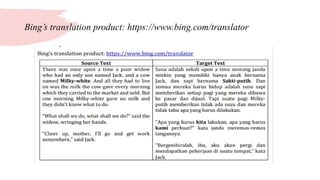
Bing
• Bing hadno problems at all with the compound words test. As with all
the tools we tested it translated the idiom ‘once in a blue moon’
literally. Bing did the best of all of the four tools with it’s translation of
the missing word ‘fundraising’ offering the most clear alternative. It’s
translation of the multiple meaning word ‘rose’ was correct, though
the sentence itself was wrong. Despite the error in the last sentence,
Bing’s translation was by a narrow margin the most understandable of
the four tools tested.
10.
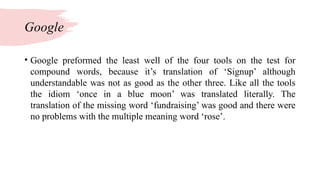
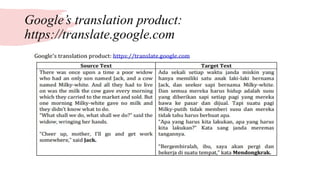
Google
• Google preformedthe least well of the four tools on the test for
compound words, because it’s translation of ‘Signup’ although
understandable was not as good as the other three. Like all the tools
the idiom ‘once in a blue moon’ was translated literally. The
translation of the missing word ‘fundraising’ was good and there were
no problems with the multiple meaning word ‘rose’.
11.
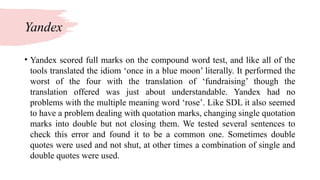
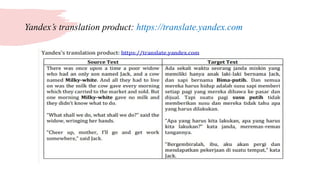
Yandex
• Yandex scoredfull marks on the compound word test, and like all of the
tools translated the idiom ‘once in a blue moon’ literally. It performed the
worst of the four with the translation of ‘fundraising’ though the
translation offered was just about understandable. Yandex had no
problems with the multiple meaning word ‘rose’. Like SDL it also seemed
to have a problem dealing with quotation marks, changing single quotation
marks into double but not closing them. We tested several sentences to
check this error and found it to be a common one. Sometimes double
quotes were used and not shut, at other times a combination of single and
double quotes were used.
12.
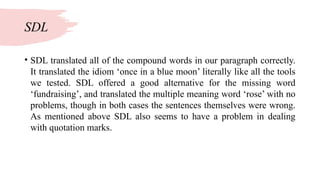
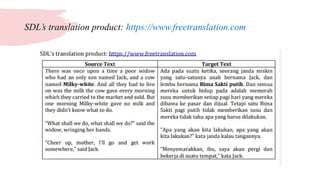
SDL
• SDL translatedall of the compound words in our paragraph correctly.
It translated the idiom ‘once in a blue moon’ literally like all the tools
we tested. SDL offered a good alternative for the missing word
‘fundraising’, and translated the multiple meaning word ‘rose’ with no
problems, though in both cases the sentences themselves were wrong.
As mentioned above SDL also seems to have a problem in dealing
with quotation marks.
13.
Google, Bing Yandex,and SDL
Google, Bing Yandex, and SDL have different translation products.
Following are the samples of translation product by, Google, Bing
Yandex, and SDL. Can you tell the differences?



![Savings of 83% thanks to CAT tools... [case study]](https://cdn.slidesharecdn.com/ss_thumbnails/saving-big-with-cat-tools-140312083505-phpapp01-thumbnail.jpg?width=640&height=640&fit=bounds)


![lean_presntation[1].pptxlean_presntation[1].pptx](https://cdn.slidesharecdn.com/ss_thumbnails/leanpresntation1-250123161234-74cf1c73-thumbnail.jpg?width=640&height=640&fit=bounds)

![lean_presntation[1].pptxlean_presntation[1].pptx](https://cdn.slidesharecdn.com/ss_thumbnails/leanpresntation1-250122175706-facecad5-thumbnail.jpg?width=640&height=640&fit=bounds)


