Dr Wazzan AL Juhani MD FRCSC
Dr. Majed Aalasbali
First Task
1- What is the age of the pt ?
 above 40 yr
 skeletal mature ( 20-40)
 Skeletal immature
2- Then Look at the X-ray Feature ?
 Benign looking Vs more aggressive feature
 Matrix
3- Location of the lesion .
• intra-articular
• epiphysis
• metaphysis
• diaphysis
 Then put in the spectrum .
 Benign Lesion
 Metz , vs primary bone tumor ( osteo sarcoma vs chondro, ewing )
 Metabolic Bone disease , e.g brown tumor, paget
 osteomyelitis ( local Tumor )
Benign Vs Malignant
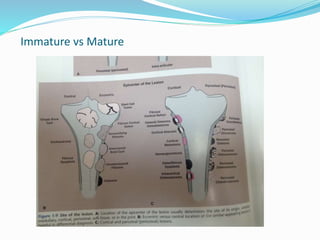
Immature vs Mature
What to read in X-Ray
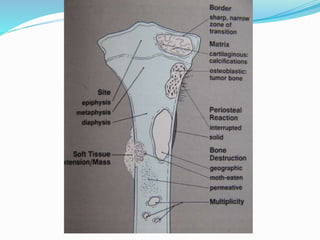
1. Site
2. Size
3. Matrix
4. Pattern/margins incl. zone of transition
5. Effect of the lesion on bone
6. Reaction of bone to the lesion
7. Soft tissue mass
site
• Which bone is affected (femur, radius,…)
• Where in the bone
 Diaphysis, metaphysis, epiphysis, or combination
 Central, eccentric, intracortical, surface
matrix
• Fibrous
• Cartilagenous
- stippled, arcs and rings
• Osseous
- cloud-like, dense
LESION EFFECT ON BONE
• Cortical thinning
 Lower grade, less aggressive
• Cortical expansion
 Low or high grade, tumor mimickers
• Cortical destruction
 High grade, aggressive
EFFECT BONE ON LESION
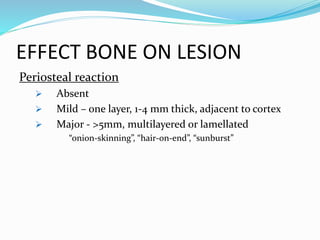
Periosteal reaction
 Absent
 Mild – one layer, 1-4 mm thick, adjacent to cortex
 Major - >5mm, multilayered or lamellated
“onion-skinning”, “hair-on-end”, “sunburst”
SOFT TISSUE MASS
Soft Tissue Mass
• Absent
• Present
Biopsy
 Fine Needle Aspiration (FNA)
 not typically used for sarcoma
 Core biopsy (Tru-cut)
 allow for tumor structural examination
 cytologic and stromal elements of the tumor
 frequently used for sarcoma
 Incisional biopsy
 small surgical incision carefully placed to access tumor without
contamination of critical structures
 Excisional biopsy
 small, superficial soft tissue masses
NOT FOR BIOPSY
 An asymptomatic (latent) or symptomatic bone lesion
(active) that appears entirely benign on imaging does
not need a biopsy
 A soft tissue lesion that appears entirely benign on
MRI (lipoma, hemangioma) does not need a biopsy
 When in doubt, it is safer to do a biopsy.
INDICATIONS FOR BIOPSY
1) Aggressive or malignant appearing bone or soft tissue
lesions
2) For soft tissue lesions - >5cm, deep to fascia or
overlying bone or neurovascular structures
3) Unclear diagnosis in symptomatic patient
4) Special situation - solitary bone lesion in a patient
with a history of carcinoma
BEFORE BIOPSY
 CBC, platelets, coagulation screen
 Cross-sectional imaging – depicts local anatomy, solid
areas of tumour
 Experienced musculoskeletal pathologist available
PRINCIPLES OF BIOPSY
SKIN
Avoid tenuous skin , Avoid transverse incision
DEEP
Through muscle , meticulous hemostasis , Avoid NV
SAMPLE
Ensure adequate diagnostic tissue , FROZEN –SECTION
CLOSURE
Tight muscle closure , drain at corner , compression dressing
Send for C/S
 For tumours without soft
tissue mass, plan biopsy
through area of maximal
cortical weakening based on
CT or MRI .
 For tumours or with soft
tissue mass, biopsy soft
tissue rather than creating
hole in bone .
A- bone forming Tumor
 Benign lesion
 Osteoma
 Enostosis
 osteod osteoma
 Osteoblastoma
 Malignant Tumor
 Osteosarcoma
 Soft tissue ( Extraskeletal ) osteosarcoma .
B- Cartilage ( chondrogenic Lesion)
 Benign lesion
 Enchondroma
 perisoteal chondroma
 osteochndroma
 chondroblastoma
 chondromyxoid fibroma
 Malignant Lesion
 chondrosarcoma

Fibrous lesion
 Benign Lesion
 Fibrous cortical defect
 fibrous dysplasia
 osteofibrous Dysplasia
 Malignant Tumor
 MFH
Tumor like lesion
 Benign lesion
 GCT
 Simple bone cyst
 ABC
 Interosseous lipoma
 Malignant Tumor
 Adamantinoma
 chordoma
Intra-articular Tumor
 PVNS
 Synovial chondromatosis
 lipoma Arborescnes
 Synovial Hmeangioma
Above 40 yr
 DDX ( think of Metz)
 Metz
 MM
 lymphoma
 May be some thing else
( Sarcoma)
 Infection vs Brown
Tumor
Big Five osteophilic
 Breast
 prostate
 Lung
 Kidney
 Thyroid
 Then think of GI , Melanoma
Metz
 some clue to DDX
 Most common is Breast + prostate
 Most common with Acral mets
 Lung
 Kidney
 cortical Mets : Lung , Kidney
 Most common to Bone + soft tissue
 Lung ,Kidney
Mets
 Most common site
 thoracolumbar spine
 sacrum
 PF
 pelvis
 ribs ,sternum
 PH
Approach
 Known Hx of cancer ?
 No Metastatic Work Up + Biopsy
 f/u MSK biopsy Principle .
 Yes solitary Lesion
 Metastatic Work up + Biopsy .
 Yes Multi focal Bone or Visceral Metz .
 Biopsy if not Proven before
 proven Metz treat accordingly .
Metz workup
 HX + E
 Breast , prostate & thyroid exam
 abdomen for organomegaly
 Lab ( Blood work) ,urine anaylsis
 Cbc anemia ,thrombo - Ca ,Ph ,ALP
 ESR CRP infection ,MM - serum /urine EP
 INR , ptt coagulopathy - PSA
 Liver enzyme , - TSH
 systemic work up
 Bone scan
 skeletal survey
 CT chest ,abdomen ,pelvis
 Bone marrow aspirate . Eg MM ,Lymphoma ,Ewing
sarcoma ( by the medical oncolgist)
 Local
 full length x-ray
 CT VS MRI
Goal of treatment
 Pain relief .
 Immediate mobilization .
 Immediate Rigid fixation
 durable fixation
 protect the entire Bone when feasible
 Radio therapy
 Reduce need for subsequent surgery .
 improve post-op Function
 Bisphosphonate
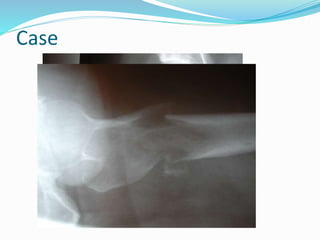
Case
Case 2
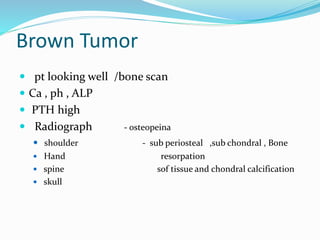
Brown Tumor
 pt looking well /bone scan
 Ca , ph , ALP
 PTH high
 Radiograph - osteopeina
 shoulder - sub periosteal ,sub chondral , Bone
 Hand resorpation
 spine sof tissue and chondral calcification
 skull
 Multiple lesion
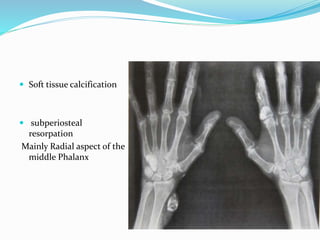
 subperiosteal resorpation
Mainly Radial aspect of the middle
Phalanx
 Soft tissue calcification
 subperiosteal
resorpation
Mainly Radial aspect of the
middle Phalanx
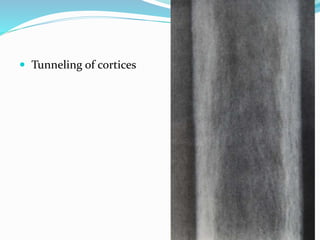
 Tunneling of cortices
Rugger jersey spine
Salt and Pepper Skull
Resorpation of the clavicle
Less than 40
 more Of Benign Lesion
 Skeletal Immature ( Location )
 UBC osteoid osteoma / osteoblastoma
 ABC
 non ossifying fibroma
 EG
 Osteomyelitis
 Fibrous dysplasia
 Skeletal Mature
 GCT
 Enchndroma
 infection
 ABC
Classification of Benign Bone
Tumours
 Benign latent
(enchondroma)
 Benign active (Fibrous
dysplasia)
 Benign aggressive
(GCT)
Presentation
 Incidental finding
 Mass- Painless or Painful
 Pain without mass
 Pathological Fracture
Surface
Surface
Surface
Surface
Epiphyseal
Epiphyseal
Apophyseal
Epiphyseal lesions
 Chondroblastoma
 Clear cell chondrosarcoma
 Osteomyelitis (occasionally)
Epiphyseal-Metaphyseal
 Benign aggressive lesions
 GCT
 ABC
 osteoblastoma
Metaphyseal
Metaphyseal
Metaphyseal
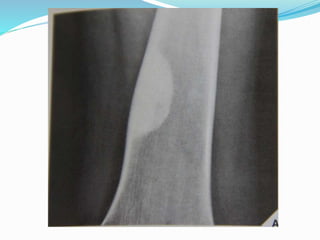
Metaphyseal lesions
 Enchondroma
 UBC
 NOF/fibrous cortical defect
 Chondromyxoid fibroma
 Osteosarcoma
 Chondrosarcoma
Diaphyseal
Diaphyseal
Diaphyseal
Diaphyseal
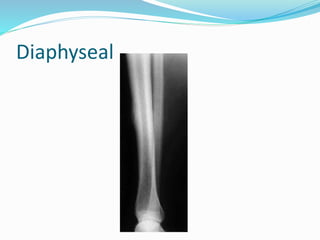
Diaphyseal lesions
 Osteoid osteoma
 Fibrous dysplasia
 Osteofibrous dysplasia
 Adamantinoma
 Ewing’s sarcoma
Treatment
 Observe /asymptomatic
 Radio frequency ablation
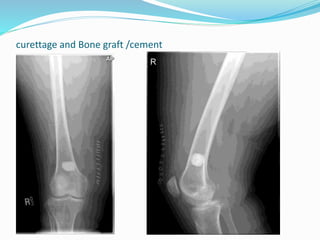
 curettage and Bone graft /cement
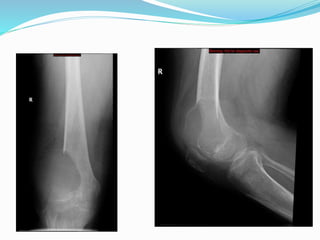
 extensive Curettage
 Resection and replace
Case
Case

curettage and Bone graft /cement
extensive Curettage
Resection and replace
 And always remember
infection
Sarcoma treatment
 Bone sarcoma
 Chemo + wide margin + chemo
 Except : low grade sarcoma
 E.g paraosteal OS
 Chondrosarcoma
 Soft tissue sarcoma
Radiotherapy + wide margin

Bone Lesion Approach.pptx

  • 1.
    Dr Wazzan ALJuhani MD FRCSC Dr. Majed Aalasbali
  • 2.
    First Task 1- Whatis the age of the pt ?  above 40 yr  skeletal mature ( 20-40)  Skeletal immature 2- Then Look at the X-ray Feature ?  Benign looking Vs more aggressive feature  Matrix 3- Location of the lesion . • intra-articular • epiphysis • metaphysis • diaphysis  Then put in the spectrum .  Benign Lesion  Metz , vs primary bone tumor ( osteo sarcoma vs chondro, ewing )  Metabolic Bone disease , e.g brown tumor, paget  osteomyelitis ( local Tumor )
  • 3.
  • 5.
  • 7.
    What to readin X-Ray 1. Site 2. Size 3. Matrix 4. Pattern/margins incl. zone of transition 5. Effect of the lesion on bone 6. Reaction of bone to the lesion 7. Soft tissue mass
  • 8.
    site • Which boneis affected (femur, radius,…) • Where in the bone  Diaphysis, metaphysis, epiphysis, or combination  Central, eccentric, intracortical, surface
  • 9.
    matrix • Fibrous • Cartilagenous -stippled, arcs and rings • Osseous - cloud-like, dense
  • 11.
    LESION EFFECT ONBONE • Cortical thinning  Lower grade, less aggressive • Cortical expansion  Low or high grade, tumor mimickers • Cortical destruction  High grade, aggressive
  • 12.
    EFFECT BONE ONLESION Periosteal reaction  Absent  Mild – one layer, 1-4 mm thick, adjacent to cortex  Major - >5mm, multilayered or lamellated “onion-skinning”, “hair-on-end”, “sunburst”
  • 14.
    SOFT TISSUE MASS SoftTissue Mass • Absent • Present
  • 15.
    Biopsy  Fine NeedleAspiration (FNA)  not typically used for sarcoma  Core biopsy (Tru-cut)  allow for tumor structural examination  cytologic and stromal elements of the tumor  frequently used for sarcoma  Incisional biopsy  small surgical incision carefully placed to access tumor without contamination of critical structures  Excisional biopsy  small, superficial soft tissue masses
  • 16.
    NOT FOR BIOPSY An asymptomatic (latent) or symptomatic bone lesion (active) that appears entirely benign on imaging does not need a biopsy  A soft tissue lesion that appears entirely benign on MRI (lipoma, hemangioma) does not need a biopsy  When in doubt, it is safer to do a biopsy.
  • 17.
    INDICATIONS FOR BIOPSY 1)Aggressive or malignant appearing bone or soft tissue lesions 2) For soft tissue lesions - >5cm, deep to fascia or overlying bone or neurovascular structures 3) Unclear diagnosis in symptomatic patient 4) Special situation - solitary bone lesion in a patient with a history of carcinoma
  • 18.
    BEFORE BIOPSY  CBC,platelets, coagulation screen  Cross-sectional imaging – depicts local anatomy, solid areas of tumour  Experienced musculoskeletal pathologist available
  • 19.
    PRINCIPLES OF BIOPSY SKIN Avoidtenuous skin , Avoid transverse incision DEEP Through muscle , meticulous hemostasis , Avoid NV SAMPLE Ensure adequate diagnostic tissue , FROZEN –SECTION CLOSURE Tight muscle closure , drain at corner , compression dressing Send for C/S
  • 20.
     For tumourswithout soft tissue mass, plan biopsy through area of maximal cortical weakening based on CT or MRI .  For tumours or with soft tissue mass, biopsy soft tissue rather than creating hole in bone .
  • 21.
    A- bone formingTumor  Benign lesion  Osteoma  Enostosis  osteod osteoma  Osteoblastoma  Malignant Tumor  Osteosarcoma  Soft tissue ( Extraskeletal ) osteosarcoma .
  • 22.
    B- Cartilage (chondrogenic Lesion)  Benign lesion  Enchondroma  perisoteal chondroma  osteochndroma  chondroblastoma  chondromyxoid fibroma  Malignant Lesion  chondrosarcoma 
  • 23.
    Fibrous lesion  BenignLesion  Fibrous cortical defect  fibrous dysplasia  osteofibrous Dysplasia  Malignant Tumor  MFH
  • 24.
    Tumor like lesion Benign lesion  GCT  Simple bone cyst  ABC  Interosseous lipoma  Malignant Tumor  Adamantinoma  chordoma
  • 25.
    Intra-articular Tumor  PVNS Synovial chondromatosis  lipoma Arborescnes  Synovial Hmeangioma
  • 26.
    Above 40 yr DDX ( think of Metz)  Metz  MM  lymphoma  May be some thing else ( Sarcoma)  Infection vs Brown Tumor
  • 27.
    Big Five osteophilic Breast  prostate  Lung  Kidney  Thyroid  Then think of GI , Melanoma
  • 28.
    Metz  some clueto DDX  Most common is Breast + prostate  Most common with Acral mets  Lung  Kidney  cortical Mets : Lung , Kidney  Most common to Bone + soft tissue  Lung ,Kidney
  • 29.
    Mets  Most commonsite  thoracolumbar spine  sacrum  PF  pelvis  ribs ,sternum  PH
  • 30.
    Approach  Known Hxof cancer ?  No Metastatic Work Up + Biopsy  f/u MSK biopsy Principle .  Yes solitary Lesion  Metastatic Work up + Biopsy .  Yes Multi focal Bone or Visceral Metz .  Biopsy if not Proven before  proven Metz treat accordingly .
  • 31.
    Metz workup  HX+ E  Breast , prostate & thyroid exam  abdomen for organomegaly  Lab ( Blood work) ,urine anaylsis  Cbc anemia ,thrombo - Ca ,Ph ,ALP  ESR CRP infection ,MM - serum /urine EP  INR , ptt coagulopathy - PSA  Liver enzyme , - TSH
  • 32.
     systemic workup  Bone scan  skeletal survey  CT chest ,abdomen ,pelvis  Bone marrow aspirate . Eg MM ,Lymphoma ,Ewing sarcoma ( by the medical oncolgist)  Local  full length x-ray  CT VS MRI
  • 33.
    Goal of treatment Pain relief .  Immediate mobilization .  Immediate Rigid fixation  durable fixation  protect the entire Bone when feasible  Radio therapy  Reduce need for subsequent surgery .  improve post-op Function  Bisphosphonate
  • 34.
  • 36.
  • 38.
    Brown Tumor  ptlooking well /bone scan  Ca , ph , ALP  PTH high  Radiograph - osteopeina  shoulder - sub periosteal ,sub chondral , Bone  Hand resorpation  spine sof tissue and chondral calcification  skull
  • 39.
  • 40.
     subperiosteal resorpation MainlyRadial aspect of the middle Phalanx
  • 41.
     Soft tissuecalcification  subperiosteal resorpation Mainly Radial aspect of the middle Phalanx
  • 42.
  • 43.
  • 44.
  • 45.
  • 46.
    Less than 40 more Of Benign Lesion  Skeletal Immature ( Location )  UBC osteoid osteoma / osteoblastoma  ABC  non ossifying fibroma  EG  Osteomyelitis  Fibrous dysplasia  Skeletal Mature  GCT  Enchndroma  infection  ABC
  • 47.
    Classification of BenignBone Tumours  Benign latent (enchondroma)  Benign active (Fibrous dysplasia)  Benign aggressive (GCT)
  • 48.
    Presentation  Incidental finding Mass- Painless or Painful  Pain without mass  Pathological Fracture
  • 51.
  • 52.
  • 53.
  • 54.
  • 56.
  • 57.
  • 58.
  • 59.
    Epiphyseal lesions  Chondroblastoma Clear cell chondrosarcoma  Osteomyelitis (occasionally)
  • 60.
  • 61.
  • 63.
    Epiphyseal-Metaphyseal  Benign aggressivelesions  GCT  ABC  osteoblastoma
  • 64.
  • 65.
  • 66.
  • 73.
    Metaphyseal lesions  Enchondroma UBC  NOF/fibrous cortical defect  Chondromyxoid fibroma  Osteosarcoma  Chondrosarcoma
  • 74.
  • 75.
  • 76.
  • 77.
  • 78.
    Diaphyseal lesions  Osteoidosteoma  Fibrous dysplasia  Osteofibrous dysplasia  Adamantinoma  Ewing’s sarcoma
  • 79.
    Treatment  Observe /asymptomatic Radio frequency ablation  curettage and Bone graft /cement  extensive Curettage  Resection and replace
  • 80.
  • 81.
  • 82.
    curettage and Bonegraft /cement
  • 84.
  • 87.
  • 88.
     And alwaysremember infection
  • 89.
    Sarcoma treatment  Bonesarcoma  Chemo + wide margin + chemo  Except : low grade sarcoma  E.g paraosteal OS  Chondrosarcoma  Soft tissue sarcoma Radiotherapy + wide margin