Introduction
• The physiopathology of reflex sympathetic dystrophy syndrome (CRPS I) remains
unclear.
• The syndrome combines joint pain, trophic disturbance, bone demineralisation and a
theoretical regressive evolution without sequelae.
• Clinically, it comprises two phases: a ‘‘hot’’ phase of circulatory disturbance, associated
with pain and functional impairment; and a ‘‘cold’’ phase of trophic alteration, stiffness
and tendon retraction.
Introduction
• In 1999, Zollinger, in a prospective randomized study, showed vitamin C to be effective
in preventing CRPS I following distal radius fracture.
• Results of a prospective study to assess the potential role of vitamin C in preventing
CRPS I in scheduled foot and ankle surgery
Materials and Methods
• Study Design:
• Prospective and with blinded statistical analysis
• Inclusion Criteria
• July 2002 to July 2004
• From July 2002 to June 2003 (Group I) the patients had surgery without vitamin C, and from
July 2003 to June 2004 (Group II) received preventive vitamin C treatment: 1 g on the first
postoperative day, and then each morning for 45 days.
• Compliance was checked at 3 weeks and 3 months. In case of non-compliance, patients were
excluded from analysis.
Materials and Methods
• Exclusion Criteria
• Diabetic patients were excluded. These patients’ pain status is hard to estimate.
• Methodology
• Age, sex, history of CRPS I, psychological context of anxio-depression, type of presenting
pathology, type of anesthesia, surgical procedure, tourniquet time, post-operative cast, and
non-weight bearing time.
• Xray 10th, 21st and 45th day post-operatively, and then every 3 months
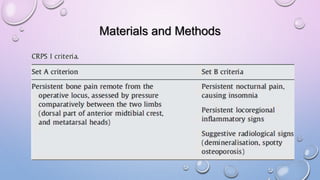
• The diagnosis of CRPS I was made from clinical data as proposed by the IASP criteria: in the
presence of the set A criterion or at least two set B criteria
Materials and Methods
• Student’s t-tests were applied to quantitative variables
• Quantitative variables were compared by analysis of variance (ANOVA).
• Individual data were processed using SPSS version 11.0 software for Windows
Results
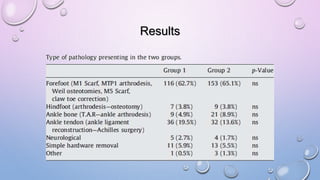
• Patients included
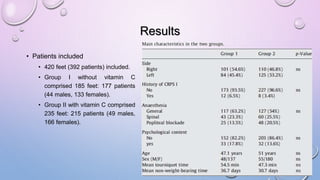
• 420 feet (392 patients) included.
• Group I without vitamin C
comprised 185 feet: 177 patients
(44 males, 133 females).
• Group II with vitamin C comprised
235 feet: 215 patients (49 males,
166 females).
Results
• Effect of vitamin C
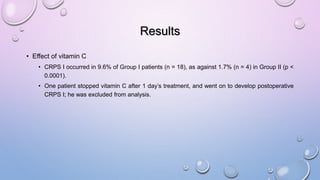
• CRPS I occurred in 9.6% of Group I patients (n = 18), as against 1.7% (n = 4) in Group II (p <
0.0001).
• One patient stopped vitamin C after 1 day’s treatment, and went on to develop postoperative
CRPS I; he was excluded from analysis.
Results
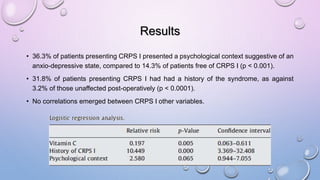
• 36.3% of patients presenting CRPS I presented a psychological context suggestive of an
anxio-depressive state, compared to 14.3% of patients free of CRPS I (p < 0.001).
• 31.8% of patients presenting CRPS I had had a history of the syndrome, as against
3.2% of those unaffected post-operatively (p < 0.0001).
• No correlations emerged between CRPS I other variables.
Results
Conclusion
• Vitamin C appears effective in preventing post-operative CRPS I. Although generally
post-traumatic, CRPS I also occurs in scheduled surgery.
• Vitamin C seems to us to offer a simple and cost-effective means of limiting this
complication.
• Our results need confirming in a prospective study involving both upper and lower-limb
affections.
Vitamine C, Foot & ankle.pptx

Vitamine C, Foot & ankle.pptx

  • 2.
    Introduction • The physiopathologyof reflex sympathetic dystrophy syndrome (CRPS I) remains unclear. • The syndrome combines joint pain, trophic disturbance, bone demineralisation and a theoretical regressive evolution without sequelae. • Clinically, it comprises two phases: a ‘‘hot’’ phase of circulatory disturbance, associated with pain and functional impairment; and a ‘‘cold’’ phase of trophic alteration, stiffness and tendon retraction.
  • 3.
    Introduction • In 1999,Zollinger, in a prospective randomized study, showed vitamin C to be effective in preventing CRPS I following distal radius fracture. • Results of a prospective study to assess the potential role of vitamin C in preventing CRPS I in scheduled foot and ankle surgery
  • 4.
    Materials and Methods •Study Design: • Prospective and with blinded statistical analysis • Inclusion Criteria • July 2002 to July 2004 • From July 2002 to June 2003 (Group I) the patients had surgery without vitamin C, and from July 2003 to June 2004 (Group II) received preventive vitamin C treatment: 1 g on the first postoperative day, and then each morning for 45 days. • Compliance was checked at 3 weeks and 3 months. In case of non-compliance, patients were excluded from analysis.
  • 5.
    Materials and Methods •Exclusion Criteria • Diabetic patients were excluded. These patients’ pain status is hard to estimate. • Methodology • Age, sex, history of CRPS I, psychological context of anxio-depression, type of presenting pathology, type of anesthesia, surgical procedure, tourniquet time, post-operative cast, and non-weight bearing time. • Xray 10th, 21st and 45th day post-operatively, and then every 3 months • The diagnosis of CRPS I was made from clinical data as proposed by the IASP criteria: in the presence of the set A criterion or at least two set B criteria
  • 6.
  • 7.
    Materials and Methods •Student’s t-tests were applied to quantitative variables • Quantitative variables were compared by analysis of variance (ANOVA). • Individual data were processed using SPSS version 11.0 software for Windows
  • 8.
    Results • Patients included •420 feet (392 patients) included. • Group I without vitamin C comprised 185 feet: 177 patients (44 males, 133 females). • Group II with vitamin C comprised 235 feet: 215 patients (49 males, 166 females).
  • 9.
    Results • Effect ofvitamin C • CRPS I occurred in 9.6% of Group I patients (n = 18), as against 1.7% (n = 4) in Group II (p < 0.0001). • One patient stopped vitamin C after 1 day’s treatment, and went on to develop postoperative CRPS I; he was excluded from analysis.
  • 10.
    Results • 36.3% ofpatients presenting CRPS I presented a psychological context suggestive of an anxio-depressive state, compared to 14.3% of patients free of CRPS I (p < 0.001). • 31.8% of patients presenting CRPS I had had a history of the syndrome, as against 3.2% of those unaffected post-operatively (p < 0.0001). • No correlations emerged between CRPS I other variables.
  • 11.
  • 12.
    Conclusion • Vitamin Cappears effective in preventing post-operative CRPS I. Although generally post-traumatic, CRPS I also occurs in scheduled surgery. • Vitamin C seems to us to offer a simple and cost-effective means of limiting this complication. • Our results need confirming in a prospective study involving both upper and lower-limb affections.