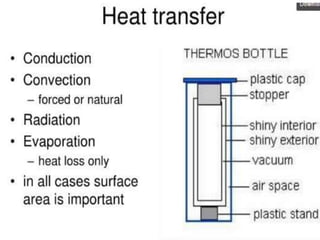
Heat transfer, heat production and
temperature regulation in animals
Why does temperature matter?
• chemical reactions of metabolism are slower at
low temperatures rate approximately doubles
per 10o C rise
• proteins (enzymes, structural proteins), DNA
and RNA denature at high temperatures
• lipids in membrane require temperature to
maintain fluidity for function
• fatty acid profile can differ depending on species
habitat temperature
All animals produce heat
• First law of thermodynamics, about the
conservation of energy:
• Second law of thermodynamics, about entropy
so they all must lose heat to environment or
will cook themselves to death
• if they lose heat faster than they generate it,
body temperature falls and vice-versa.
Conduction
•Heat transfer between non-moving matter
• within on matter or between two touching matters
• solid to solid, solid to unmoving fluid, unmoving
fluid to unmoving fluid
• fluid is liquid (like water) or gas (like air)
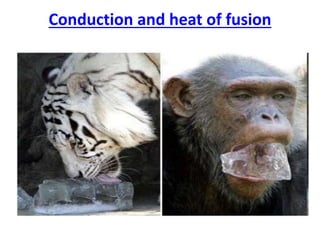
Conduction and heat of fusion
• Convection
• movement between a body and a moving fluid
• fluid movement can be generated by heat natural
or passive convection fluid movement can be
forced water pump forcefully moves engine
coolant through engine convecting heat from
cylinders to coolant and carrying it to radiator
where it convects out of coolant to solid radiator
and convects off of radiator to air cooling fan and
car movement forcefully convect air through
radiator heart forces blood from body core to
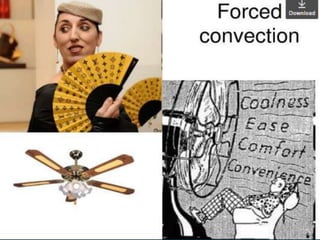
surface fans cool (or heat) body by forced
convection
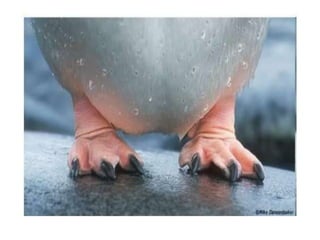
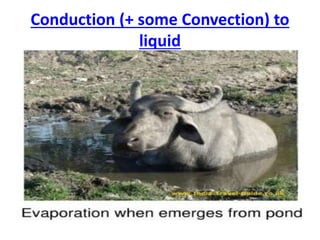
Conduction (+ some Convection) to
liquid
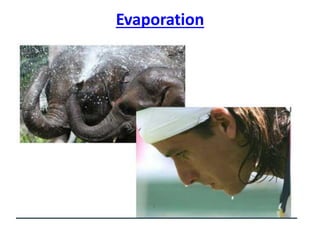
Evaporation
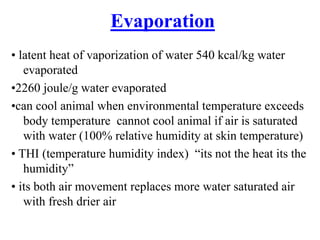
• latent heat of vaporization of water 540 kcal/kg water
evaporated
•2260 joule/g water evaporated
•can cool animal when environmental temperature exceeds
body temperature cannot cool animal if air is saturated
with water (100% relative humidity at skin temperature)
• THI (temperature humidity index) “its not the heat its the
humidity”
• its both air movement replaces more water saturated air
with fresh drier air
Evaporation
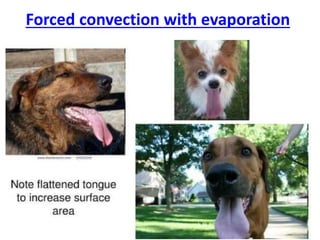
Forced convection with evaporation
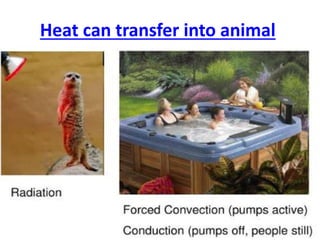
Heat can transfer into animal
Conduction
• heat loss between unmoving matter (solids or still fluids)
• Q/time = conductance (k)/depth (L) * area * temperature
difference
• heat loss/area at fixed temp difference = k / L
• L is ‘depth’ of solid
• k (conductance) is proportional to density
• Insulating materials (styrofoam, fiberglass blankets,
down jackets) are all low density to resist heat
• One reason why loosing heat to air requires convection
Conduction
• heat loss between unmoving matter (solids or still fluids)
• Q/time = heat loss
• heat loss/area = k / L * temperature difference
• l is ‘depth’ of solid
• k is proportional to density
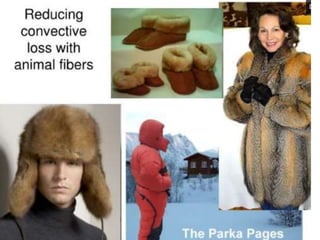
• creating an unmoving layer of low density air = smaller
k
• increasing L reduces rate of heat transfer
• fluffy hair, fur or feathers do both!
• Offsets increased delta T in winter
Convection
• • Rate of heat transfer by convection =
h*A*(Ts - Tb) Ts=surface temperature (at
interface of solid and fluid) Tb = temperature
somewhere far enough from the surface so its
the average temperature of the mass of fluid
(think air temperature) A is the contact area
Heat transfer depends on
• temperature difference determines direction
and rate
• area
• how does area relate to animal mass?

Body Temperature And Its Regulation.pptx

  • 1.
    Heat transfer, heatproduction and temperature regulation in animals
  • 2.
    Why does temperaturematter? • chemical reactions of metabolism are slower at low temperatures rate approximately doubles per 10o C rise • proteins (enzymes, structural proteins), DNA and RNA denature at high temperatures • lipids in membrane require temperature to maintain fluidity for function • fatty acid profile can differ depending on species habitat temperature
  • 3.
    All animals produceheat • First law of thermodynamics, about the conservation of energy: • Second law of thermodynamics, about entropy so they all must lose heat to environment or will cook themselves to death • if they lose heat faster than they generate it, body temperature falls and vice-versa.
  • 5.
    Conduction •Heat transfer betweennon-moving matter • within on matter or between two touching matters • solid to solid, solid to unmoving fluid, unmoving fluid to unmoving fluid • fluid is liquid (like water) or gas (like air)
  • 7.
  • 8.
    • Convection • movementbetween a body and a moving fluid • fluid movement can be generated by heat natural or passive convection fluid movement can be forced water pump forcefully moves engine coolant through engine convecting heat from cylinders to coolant and carrying it to radiator where it convects out of coolant to solid radiator and convects off of radiator to air cooling fan and car movement forcefully convect air through radiator heart forces blood from body core to surface fans cool (or heat) body by forced convection
  • 9.
    Conduction (+ someConvection) to liquid
  • 14.
    Evaporation • latent heatof vaporization of water 540 kcal/kg water evaporated •2260 joule/g water evaporated •can cool animal when environmental temperature exceeds body temperature cannot cool animal if air is saturated with water (100% relative humidity at skin temperature) • THI (temperature humidity index) “its not the heat its the humidity” • its both air movement replaces more water saturated air with fresh drier air
  • 15.
  • 16.
  • 17.
    Heat can transferinto animal
  • 18.
    Conduction • heat lossbetween unmoving matter (solids or still fluids) • Q/time = conductance (k)/depth (L) * area * temperature difference • heat loss/area at fixed temp difference = k / L • L is ‘depth’ of solid • k (conductance) is proportional to density • Insulating materials (styrofoam, fiberglass blankets, down jackets) are all low density to resist heat • One reason why loosing heat to air requires convection
  • 19.
    Conduction • heat lossbetween unmoving matter (solids or still fluids) • Q/time = heat loss • heat loss/area = k / L * temperature difference • l is ‘depth’ of solid • k is proportional to density • creating an unmoving layer of low density air = smaller k • increasing L reduces rate of heat transfer • fluffy hair, fur or feathers do both! • Offsets increased delta T in winter
  • 20.
    Convection • • Rateof heat transfer by convection = h*A*(Ts - Tb) Ts=surface temperature (at interface of solid and fluid) Tb = temperature somewhere far enough from the surface so its the average temperature of the mass of fluid (think air temperature) A is the contact area
  • 22.
    Heat transfer dependson • temperature difference determines direction and rate • area • how does area relate to animal mass?