Thermoregulation is thebody’s way of
maintaining internal temperature by activating
heat loss or heat production when the body
exceeds or falls from the set point or reference
level.
3.
Thermoregulation in Organisms
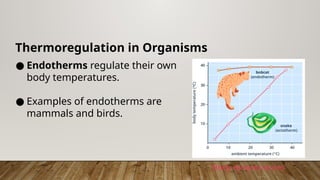
●Endotherms regulate their own
body temperatures.
● Examples of endotherms are
mammals and birds.
Body temperatures
4.
Thermoregulation in Organisms
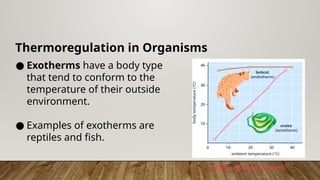
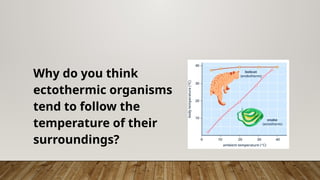
●Exotherms have a body type
that tend to conform to the
temperature of their outside
environment.
● Examples of exotherms are
reptiles and fish.
Body temperatures
5.
Thermoregulation Strategies: Shivering
●Thermogenesis is the ability of
organisms to generate its own
body heat.
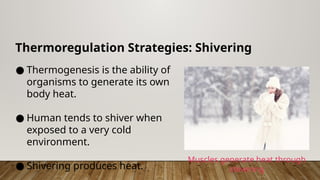
● Human tends to shiver when
exposed to a very cold
environment.
● Shivering produces heat.
Muscles generate heat through
shivering
6.
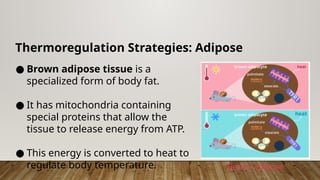
Thermoregulation Strategies: Adipose
●Brown adipose tissue is a
specialized form of body fat.
● It has mitochondria containing
special proteins that allow the
tissue to release energy from ATP.
● This energy is converted to heat to
regulate body temperature. Brown adipose
7.
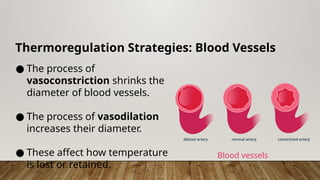
Thermoregulation Strategies: BloodVessels
● The process of
vasoconstriction shrinks the
diameter of blood vessels.
● The process of vasodilation
increases their diameter.
● These affect how temperature
is lost or retained.
Blood vessels
8.
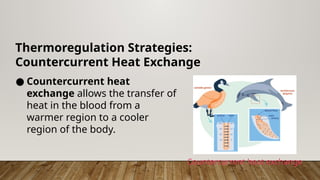
Thermoregulation Strategies:
Countercurrent HeatExchange
● Countercurrent heat
exchange allows the transfer of
heat in the blood from a
warmer region to a cooler
region of the body.
Countercurrent heat exchange
9.
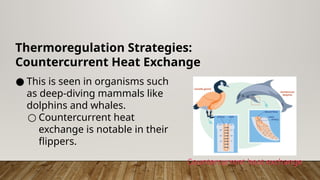
Thermoregulation Strategies:
Countercurrent HeatExchange
● This is seen in organisms such
as deep-diving mammals like
dolphins and whales.
○ Countercurrent heat
exchange is notable in their
flippers.
Countercurrent heat exchange
10.
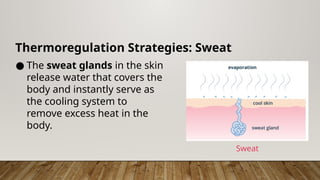
Thermoregulation Strategies: Sweat
●The sweat glands in the skin
release water that covers the
body and instantly serve as
the cooling system to
remove excess heat in the
body.
Sweat
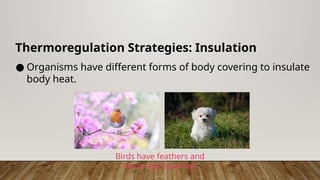
Thermoregulation Strategies: Insulation
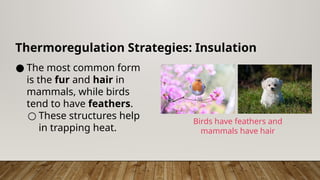
●The most common form
is the fur and hair in
mammals, while birds
tend to have feathers.
○ These structures help
in trapping heat.
Birds have feathers and
mammals have hair
13.
Endothermic organisms haveacquired physiological
adaptations to regulate their own body
temperatures.
1
Thermoregulation is the body’s way of maintaining
internal temperature by activating heat loss or heat
production.
2
Exothermic organisms lack the physiological capacity
to create internal heat.
3
14.
Write the wordtrue if the given statement is
correct, otherwise, write false.
1. Thermogenesis is the process of generating own body heat.
2. Muscle contraction is the most common means of generating body
heat.
3. Insulating appendages in animals do not aid in thermoregulation.
4. Sweating is an involuntary process and cannot be controlled by the
brain.
5. Smooth muscles in the blood vessel are responsible for the dilation
and constriction.
15.
Why do youthink
ectothermic organisms
tend to follow the
temperature of their
surroundings?