Introduction to .NET Framework
BN1001 – Demo PPT
Demo Advance Dot Net
http://www.conlinetraining.com/courses/advance-dot-net-online-training/
Introduction to .NET Framework
.NET – What Is It?
 Software platform
 Language neutral
 In other words:
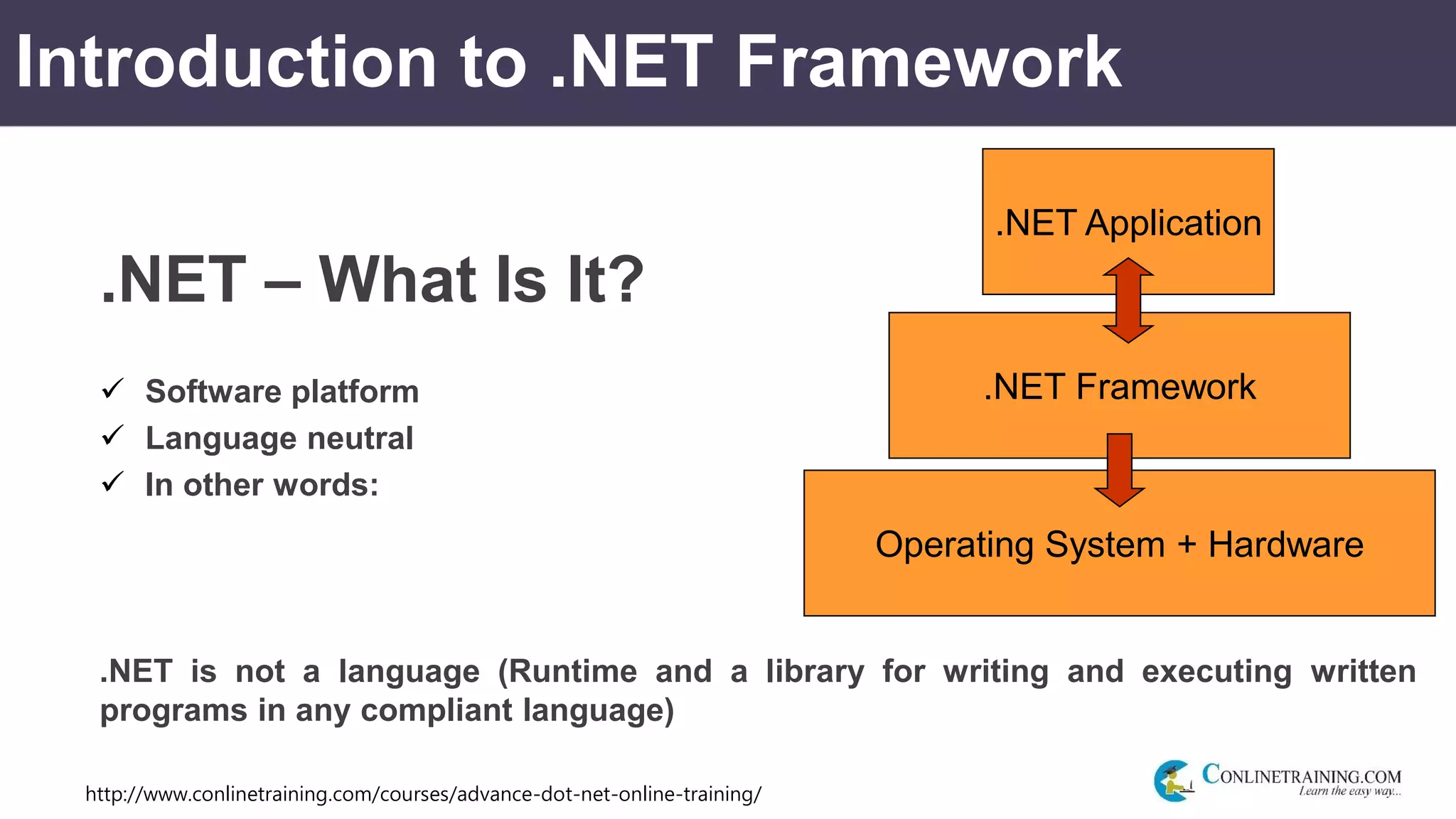
.NET is not a language (Runtime and a library for writing and executing written
programs in any compliant language)
Operating System + Hardware
.NET Framework
.NET Application
http://www.conlinetraining.com/courses/advance-dot-net-online-training/
What Is .NET
 .Net is a new framework for developing web-based and windows-based
applications within the Microsoft environment.
 The framework offers a fundamental shift in Microsoft strategy: it moves
application development from client-centric to server-centric.
 The .NET framework exposes numerous classes to the developer. These classes
allow the development of rich client applications and Web based applications alike.
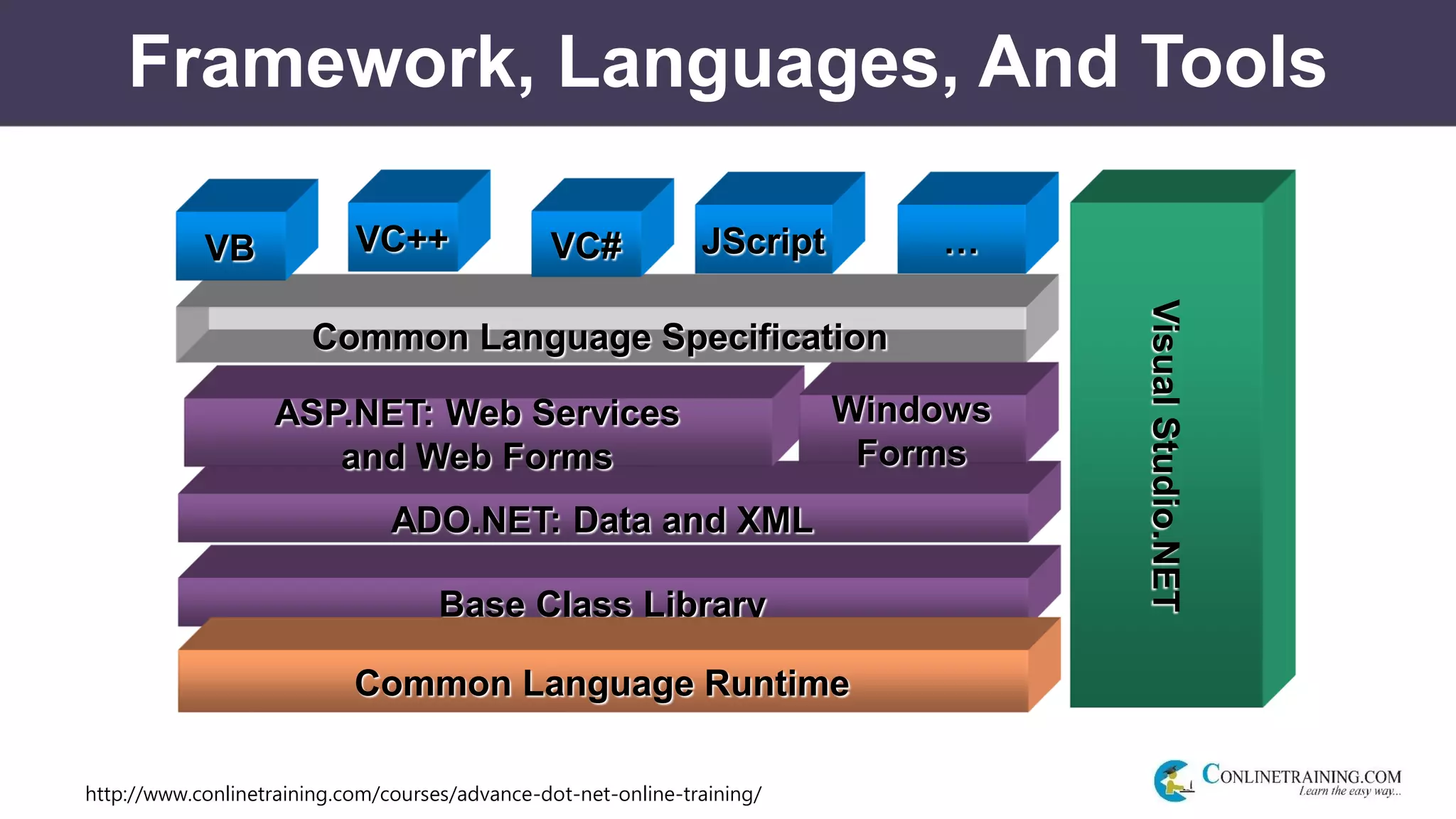
In the above slide these classes have been divided into 4 areas.
 ASP.NET provides the core Web infrastructure such as Web Forms for UI based
development and Web Services for programmatic interface development,
 User interface development on the Windows platform can be done using Windows
Forms
 ADO.NET and XML provide the functionality for data access.
 Finally, the core base classes provide infrastructure services such as security,
transaction management etc.
http://www.conlinetraining.com/courses/advance-dot-net-online-training/
Framework, Languages, And Tools
Base Class Library
Common Language Specification
Common Language Runtime
ADO.NET: Data and XML
VB VC++ VC#
VisualStudio.NET
ASP.NET: Web Services
and Web Forms
JScript …
Windows
Forms
http://www.conlinetraining.com/courses/advance-dot-net-online-training/
The .NET Framework
NET Framework Services
 Common Language Runtime
 Windows® Forms
 ASP.NET
 Web Forms
 Web Services
 ADO.NET, evolution of ADO
 Visual Studio.NET
http://www.conlinetraining.com/courses/advance-dot-net-online-training/
Common Language Runtime
 Common, secure execution environment.
 We’ll drill into this in some detail in the first parts of the presentation.
Windows® forms- Framework for building rich clients
 A demonstration will highlight some of these features, such as the delegate-based
event model.
ASP.NET- Web forms
 Manageable code (non spaghetti)
 Logical evolution of ASP (compiled)
 Again, we’ll drill into a hint at the power of Web Forms with a demonstration
ASP.NET- Web Services
 Programming the Internet to leverage the "power at the edge of the cloud".
 We will cover this in detail, as this – along with the CLR – is one of the more
powerful aspects of .NET Framework.
http://www.conlinetraining.com/courses/advance-dot-net-online-training/
Cont..
ADO.NET, evolution of ADO
 New objects (e.g., DataSets, Datareader)
Visual Studio.NET
 Most productive development environment gets better and fully supports the .NET
Framework
http://www.conlinetraining.com/courses/advance-dot-net-online-training/
Common Language Runtime (CLR)
 CLR works like a virtual machine in executing all languages.
 All .NET languages must obey the rules and standards imposed by CLR.
Examples:
 Object declaration, creation and use
 Data types, language libraries
 Error and exception handling
 Interactive Development Environment (IDE)
http://www.conlinetraining.com/courses/advance-dot-net-online-training/
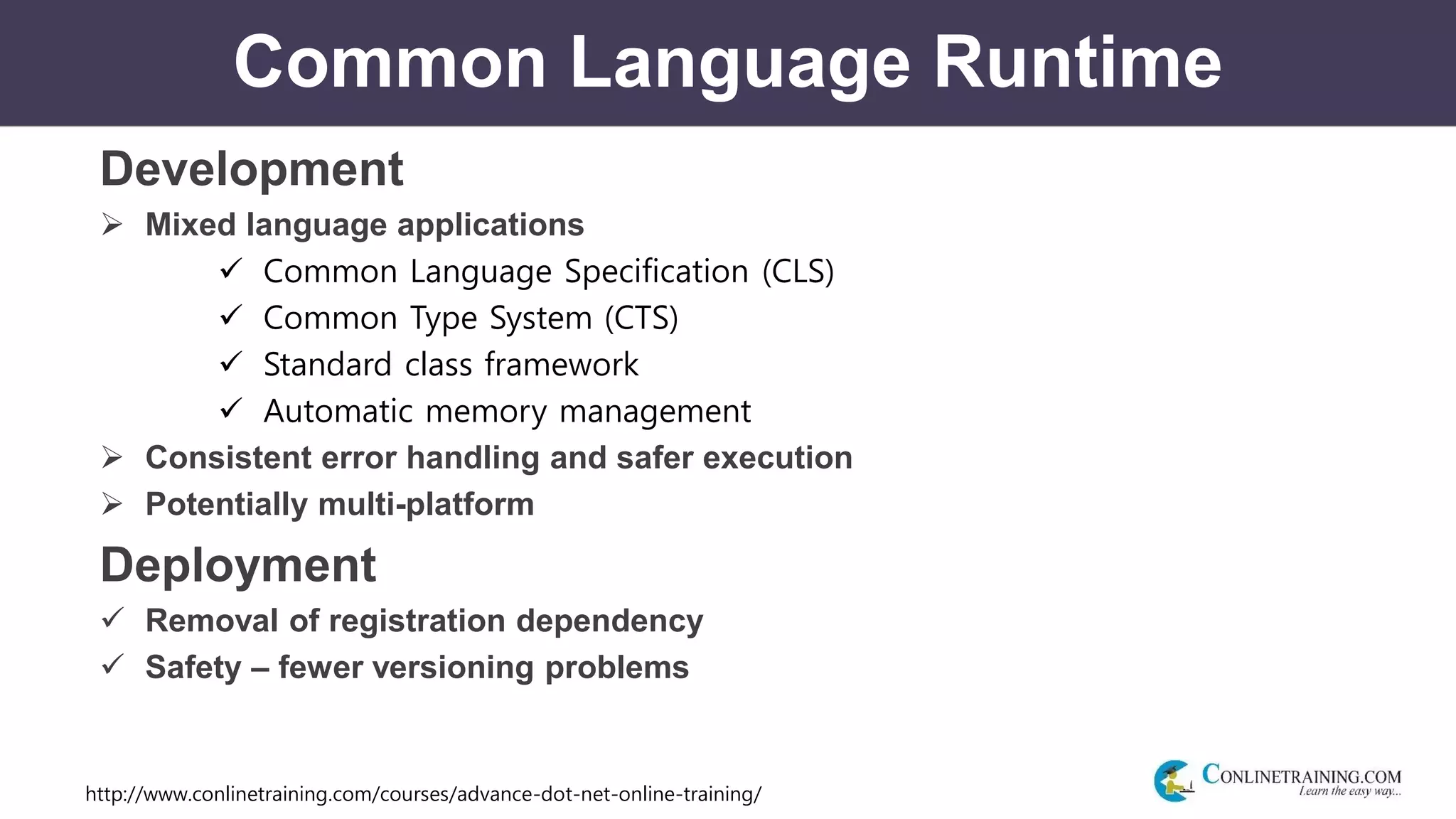
Common Language Runtime
Development
 Mixed language applications
 Common Language Specification (CLS)
 Common Type System (CTS)
 Standard class framework
 Automatic memory management
 Consistent error handling and safer execution
 Potentially multi-platform
Deployment
 Removal of registration dependency
 Safety – fewer versioning problems
http://www.conlinetraining.com/courses/advance-dot-net-online-training/
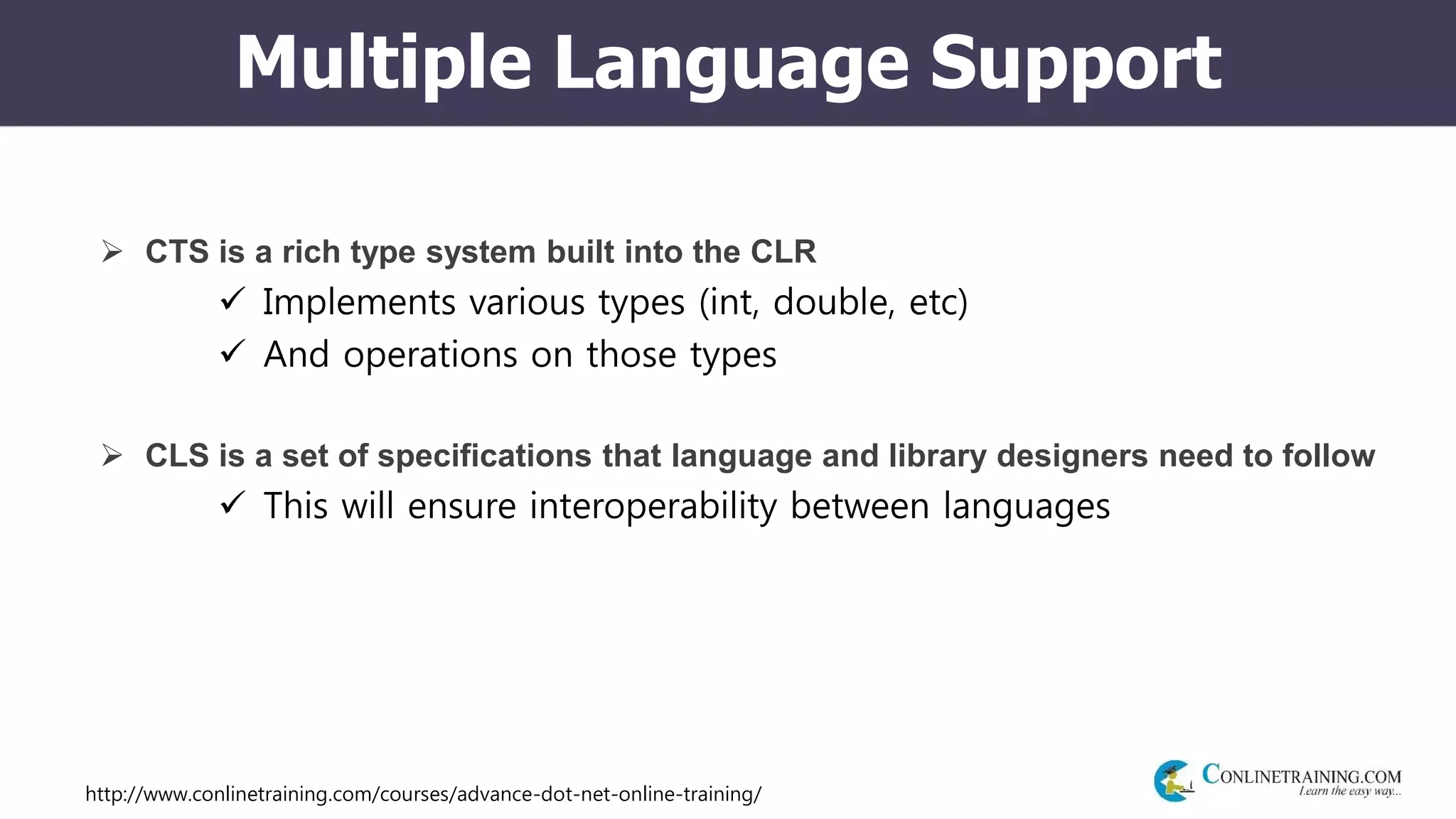
Multiple Language Support
 CTS is a rich type system built into the CLR
 Implements various types (int, double, etc)
 And operations on those types
 CLS is a set of specifications that language and library designers need to follow
 This will ensure interoperability between languages
http://www.conlinetraining.com/courses/advance-dot-net-online-training/
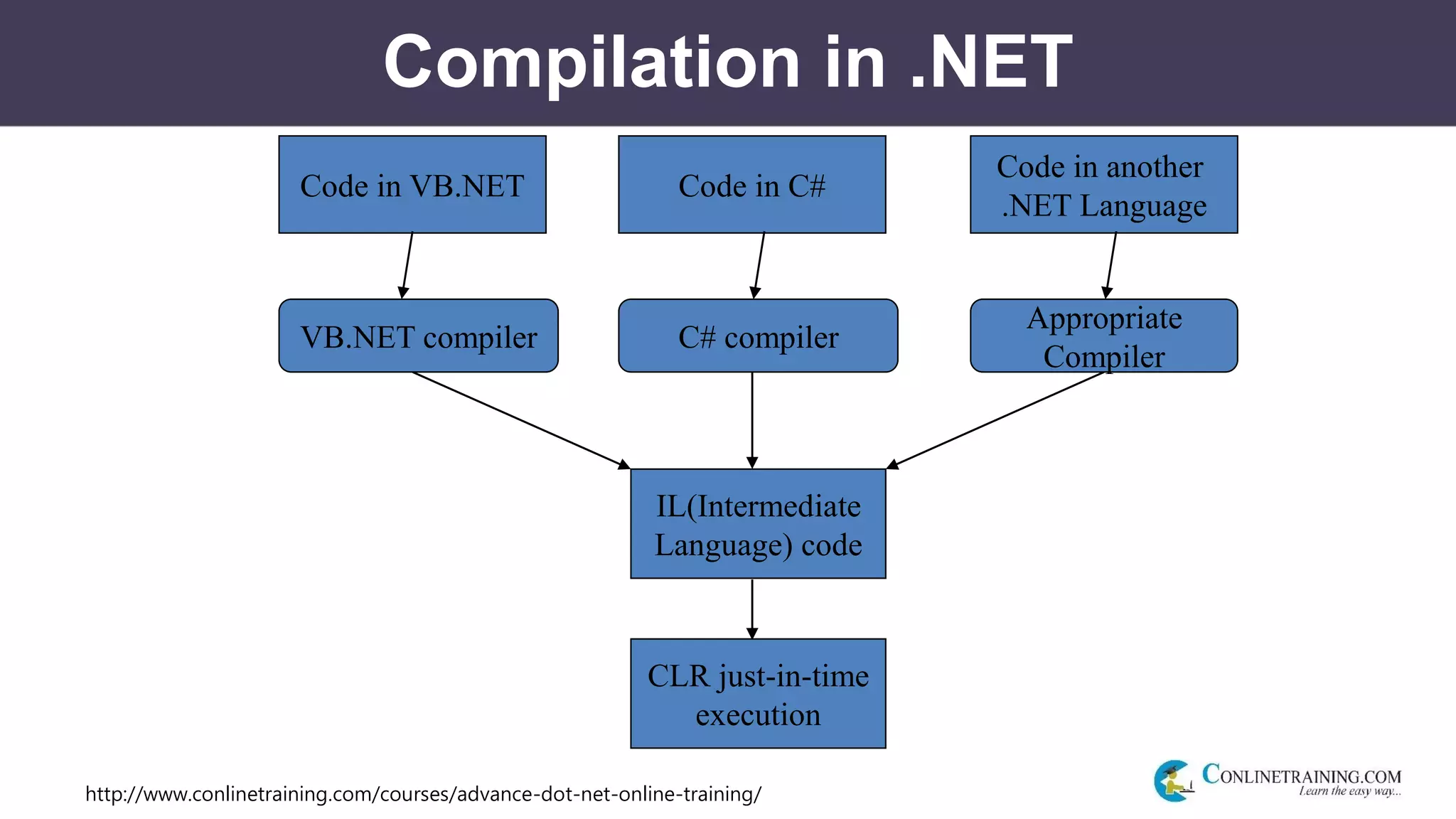
Compilation in .NET
Code in VB.NET Code in C#
Code in another
.NET Language
VB.NET compiler C# compiler
Appropriate
Compiler
IL(Intermediate
Language) code
CLR just-in-time
execution
http://www.conlinetraining.com/courses/advance-dot-net-online-training/
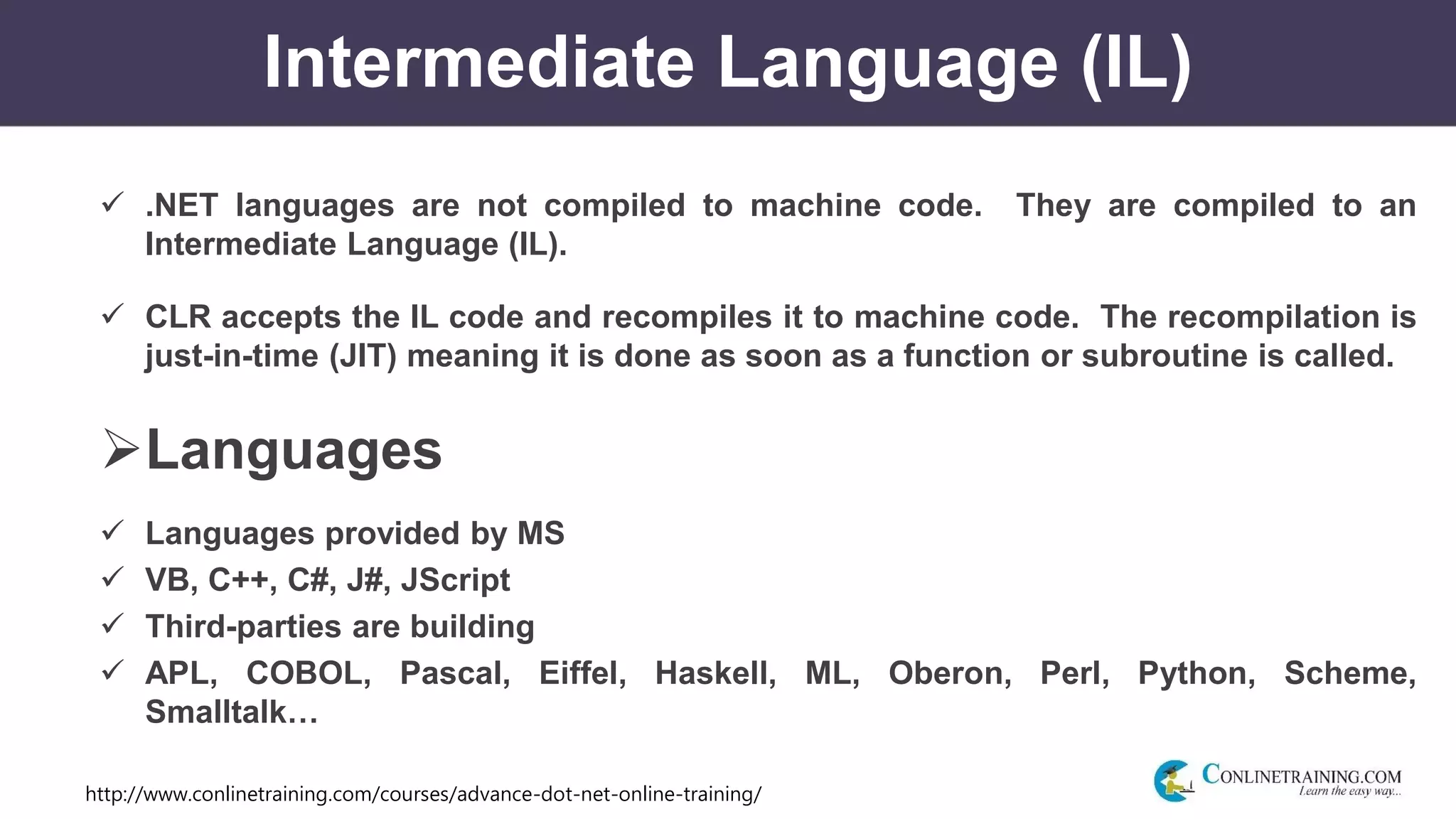
Intermediate Language (IL)
 .NET languages are not compiled to machine code. They are compiled to an
Intermediate Language (IL).
 CLR accepts the IL code and recompiles it to machine code. The recompilation is
just-in-time (JIT) meaning it is done as soon as a function or subroutine is called.
Languages
 Languages provided by MS
 VB, C++, C#, J#, JScript
 Third-parties are building
 APL, COBOL, Pascal, Eiffel, Haskell, ML, Oberon, Perl, Python, Scheme,
Smalltalk…
http://www.conlinetraining.com/courses/advance-dot-net-online-training/
Windows Forms
• Framework for Building Rich Clients
– RAD (Rapid Application Development)
– Rich set of controls
– Data aware
– ActiveX® Support
– Licensing
– Accessibility
– Printing support
– Unicode support
– UI inheritance
http://www.conlinetraining.com/courses/advance-dot-net-online-training/
ASP.NET
 ASP.NET,the platform services that allow to program Web Applications an
d Web Services in any .NET language
 ASP.NET Uses .NET languages to generate HTML pages. HTML page is ta
rgeted to the capabilities of the requesting Browser
 ASP.NET “Program” is compiled into a .NET class and cached the first ti
me it is called. All subsequent calls use the cached version.
Logical Evolution of ASP
– Supports multiple languages
– Improved performance
– Control-based, event-driven execution model
– More productive
– Cleanly encapsulated functionality
http://www.conlinetraining.com/courses/advance-dot-net-online-training/
Cont.…
 The first incarnation of ASP proved very successful. As part of the .NET Framework,
Microsoft support ASP.NET. ASP.NET is a logical evolution of ASP, but addresses many of
the issues associated with ASP.
 ASP.NET is now compiled and not interpreted.
 A great deal of work has also been done to make sure that ASP.NET development becomes
cleaner and more productive.
http://www.conlinetraining.com/courses/advance-dot-net-online-training/
ASP.NET Web Forms
 Allows clean cut code
 Code-behind Web Forms
 Easier for tools to generate
 Code within is compiled then executed
 Improved handling of state information
 Support for ASP.NET server controls
 Data validation
 Data bound grids
http://www.conlinetraining.com/courses/advance-dot-net-online-training/
ASP.NET
 The Web Form is basically an ASP.NET file (.ASPX) that makes use of the new features of
ASP.NET. ASP.NET in conjunction with Web Forms eliminate a number of the traditional
problems associated with ASP.
 ASP.NET provides the developer with the option of separating the code from the UI elements
using ‘code-behind’ forms. Using such a mechanism will also make Form tools much easier to
develop.
 ASP.NET also conquers one of the annoying side effects of using ASP – state. Imagine that a
user has filled in an ASP generated form and then hits the submit button. At this stage IIS
(server side) will regenerate the form and as a side effect all the information that the user
entered into the form will be erased. In many situations this is unacceptable, and many an
ASP developer has struggled to find work arounds (most of which may not be considered
elegant). Fortunately, ASP.NET allows controls to maintain state.
 ASP.NET supports a number of new rich server controls. These controls can be used to
improve data connectivity (data bound controls) and data validation.
http://www.conlinetraining.com/courses/advance-dot-net-online-training/
ASP.NET Web Services
A technical definition
 “A programmable application component accessible via standard Web protocols”
Technically a Web Service is “A programmable application component accessible via standard
Web protocols”. In other words, it’s a component that can be called remotely, over the internet,
from a client application.
Take our previous example of a Web application that required ‘stock information’. This Web
application possibly would not have that information readily at hand. However, what if another
Web application (possibly on another machine, on the other side of the planet) did? Further more
what if this remote machine exposed a component with a method such as ‘GetStockPrice (string
strCompanyName)’. Surely this would make life much easier, making separate Web sites act like
‘one big application’.
Web service consumers can send and receive messages using XML, and therefore the audience
of clients is unlimited.
http://www.conlinetraining.com/courses/advance-dot-net-online-training/
Web Services
• It is just an application…
• …that exposes its features and capabilities over the network…
• …using XML…
• …to allow for the creation of powerful new applications that are more than the sum
of their parts…
http://www.conlinetraining.com/courses/advance-dot-net-online-training/
ADO.NET(Data and XML)
• New objects (e.g., DataSets)
• Separates connected / disconnected issues
• Language neutral data access
• Uses same types as CLR
• Great support for XML
http://www.conlinetraining.com/courses/advance-dot-net-online-training/
Visual Studio.NET
Development tool that contains a rich set of productivity and debugging features
http://www.conlinetraining.com/courses/advance-dot-net-online-training/
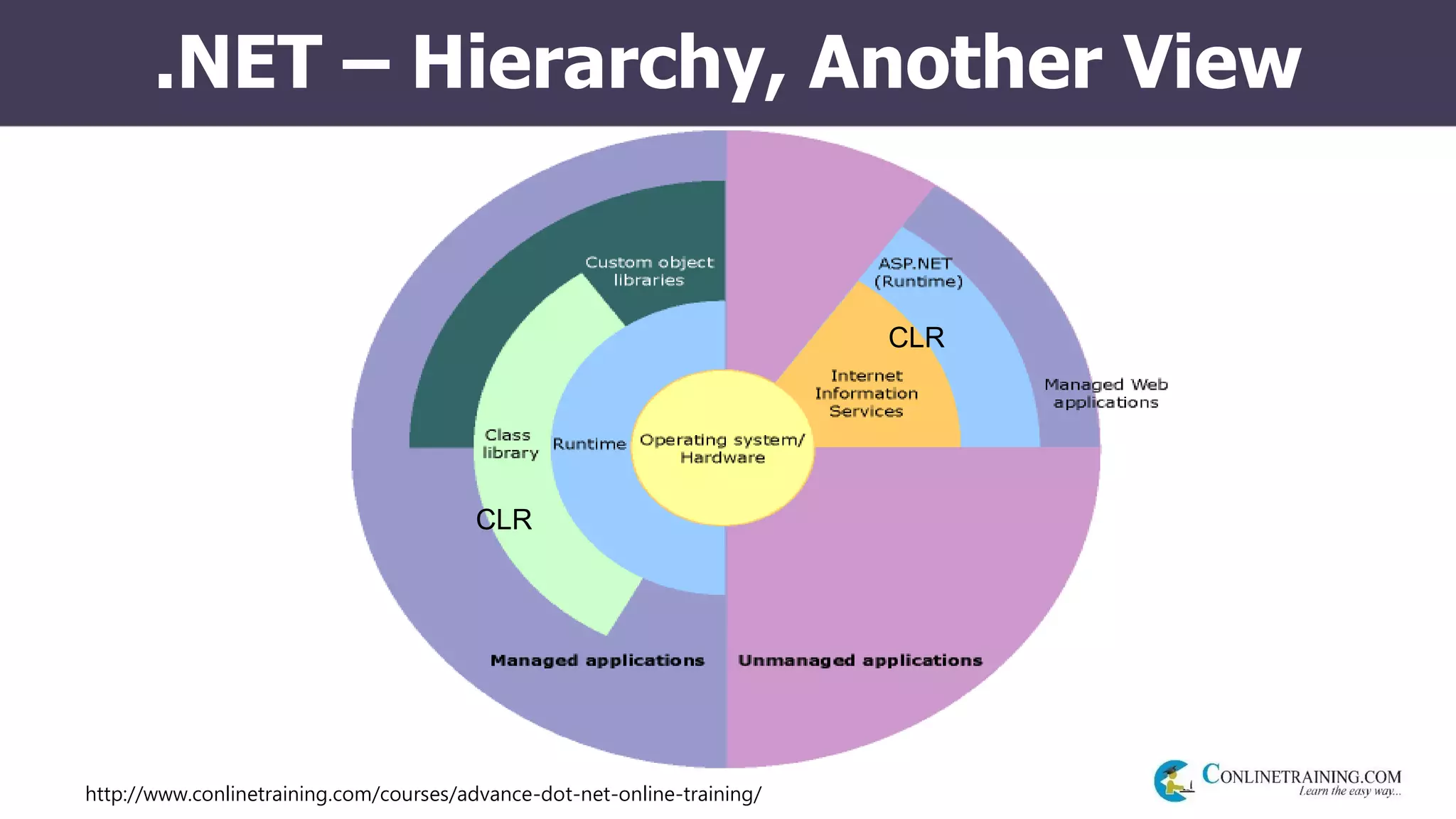
.NET – Hierarchy, Another View
CLR
CLR
http://www.conlinetraining.com/courses/advance-dot-net-online-training/
Summary
The .NET Framework
– Dramatically simplifies development and deployment
– Provides robust and secure execution environment
– Supports multiple programming languages
http://www.conlinetraining.com/courses/advance-dot-net-online-training/
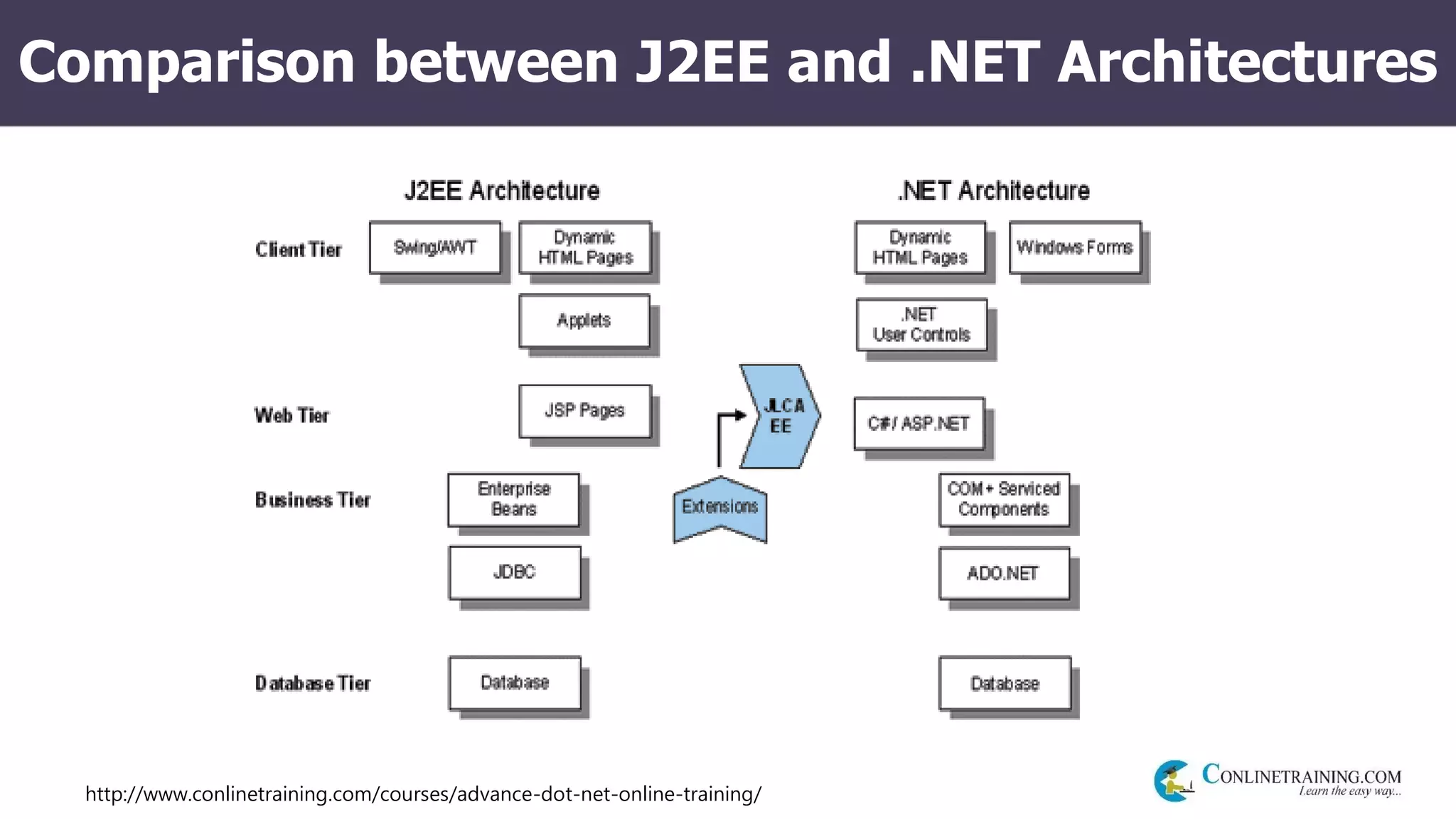
Comparison between J2EE and .NET Architectures
http://www.conlinetraining.com/courses/advance-dot-net-online-training/
J2EE and .NET
Execution Engine
J2EE
Java source code compiles into machine-independent byte code
Runtime Environment : JVM
.NET
Any compliant language compiles into MSIL
Runtime environment : CLR
 Both JVM and CLR ,support services, such as code verification, memory management via garbage collection,
and code security
http://www.conlinetraining.com/courses/advance-dot-net-online-training/
J2EE and .NET
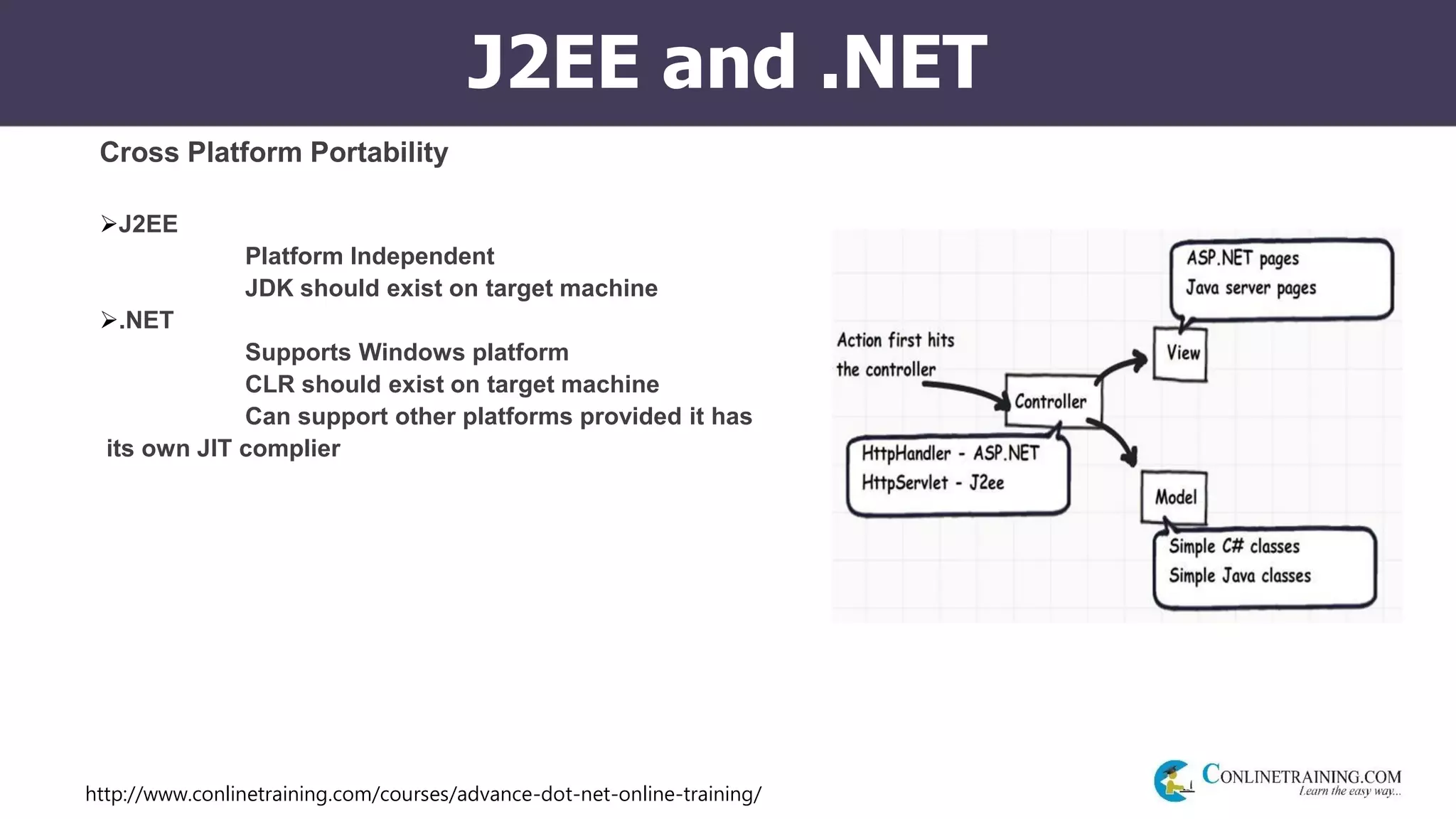
Cross Platform Portability
J2EE
Platform Independent
JDK should exist on target machine
.NET
Supports Windows platform
CLR should exist on target machine
Can support other platforms provided it has
its own JIT complier
http://www.conlinetraining.com/courses/advance-dot-net-online-training/
J2EE and .NET
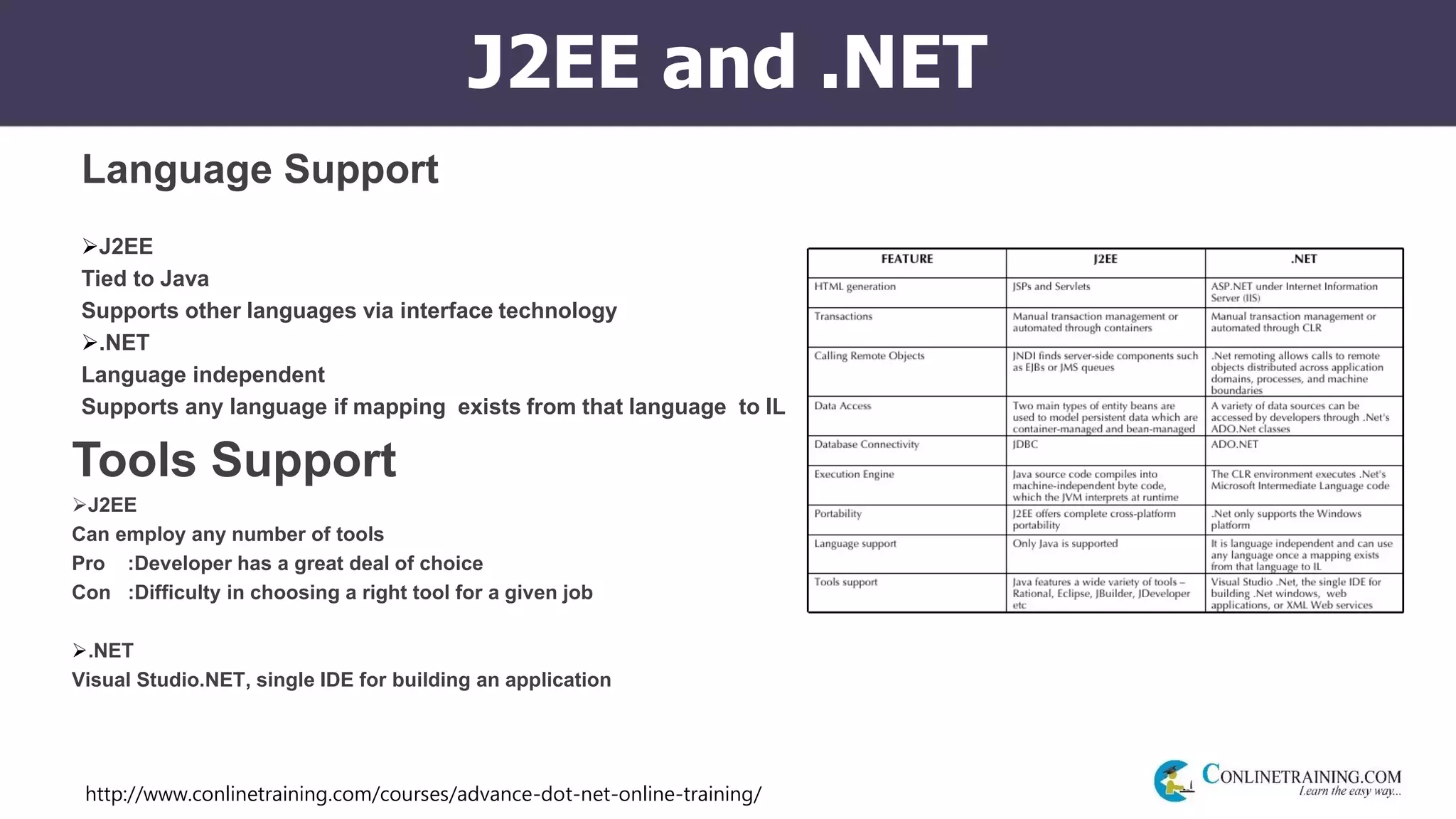
Language Support
J2EE
Tied to Java
Supports other languages via interface technology
.NET
Language independent
Supports any language if mapping exists from that language to IL
Tools Support
J2EE
Can employ any number of tools
Pro :Developer has a great deal of choice
Con :Difficulty in choosing a right tool for a given job
.NET
Visual Studio.NET, single IDE for building an application
http://www.conlinetraining.com/courses/advance-dot-net-online-training/
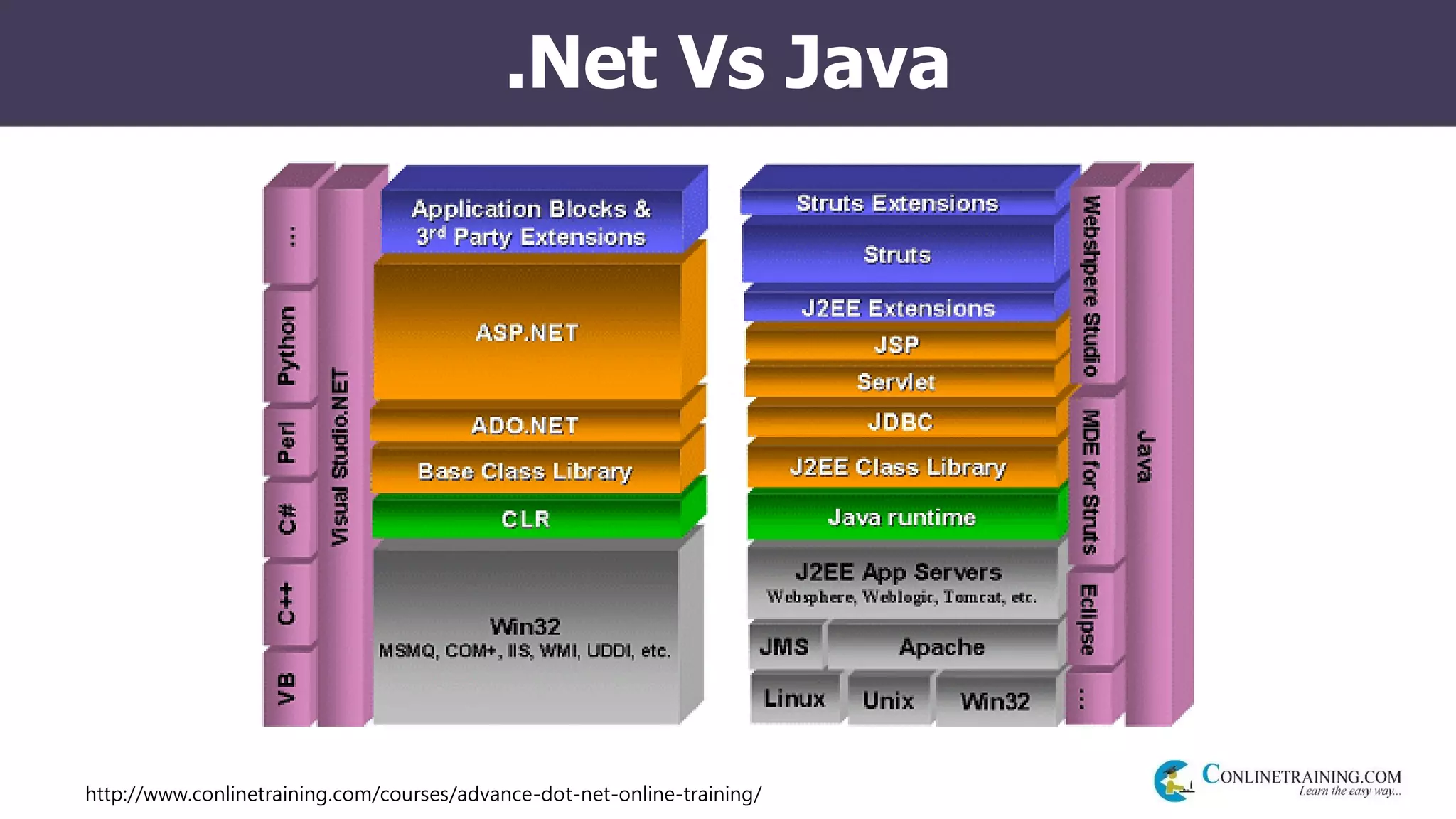
.Net Vs Java
http://www.conlinetraining.com/courses/advance-dot-net-online-training/
Email us : info@conlineTraining.com
Visit : www.conlinetraining.com

Bn1001 demo ppt advance dot net