BMW
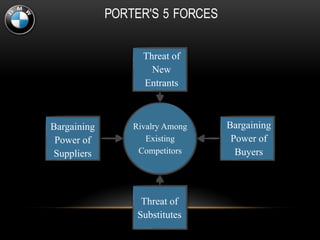
Rivalry Among
Existing
Competitors
Threat of
New
Entrants
Bargaining
Power of
Suppliers
Bargaining
Power of
Buyers
Threat of
Substitutes
PORTER'S 5 FORCES
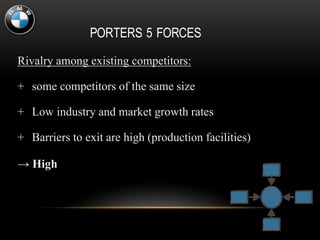
Rivalry among existing competitors:
+ some competitors of the same size
+ Low industry and market growth rates
+ Barriers to exit are high (production facilities)
→ High
PORTERS 5 FORCES
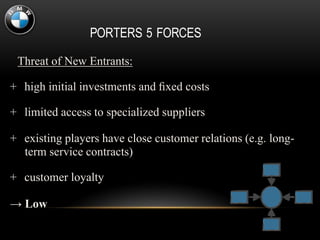
Threat of New Entrants:
+ high initial investments and fixed costs
+ limited access to specialized suppliers
+ existing players have close customer relations (e.g. long-
term service contracts)
+ customer loyalty
→ Low
PORTERS 5 FORCES
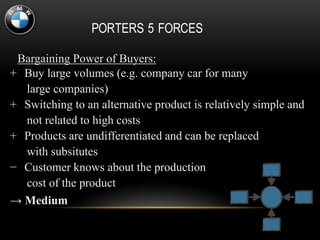
Bargaining Power of Buyers:
+ Buy large volumes (e.g. company car for many
large companies)
+ Switching to an alternative product is relatively simple and
not related to high costs
+ Products are undifferentiated and can be replaced
with subsitutes
− Customer knows about the production
cost of the product
→ Medium
PORTERS 5 FORCES
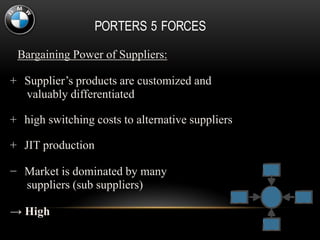
Bargaining Power of Suppliers:
+ Supplier’s products are customized and
valuably differentiated
+ high switching costs to alternative suppliers
+ JIT production
− Market is dominated by many
suppliers (sub suppliers)
→ High
PORTERS 5 FORCES
PORTERS 5 FORCES
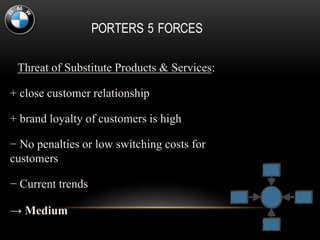
Threat of Substitute Products & Services:
+ close customer relationship
+ brand loyalty of customers is high
− No penalties or low switching costs for
customers
− Current trends
→ Medium
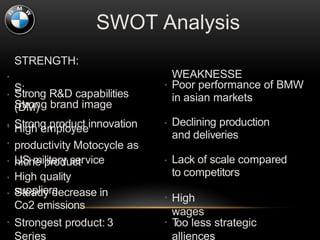
STRENGTH:
WEAKNESSE
S:
Strong brand image
•
• Strong R&D capabilities
(DM)
• Strong product innovation• High employee
productivity Motocycle as
niche product
•
• US military service
• High quality
suppliers• Steady decrease in
Co2 emissions
• Strongest product: 3
Series
SWOT Analysis
• Poor performance of BMW
in asian markets
• Declining production
and deliveries
• Lack of scale compared
to competitors
• High
wages
• Too less strategic
alliences
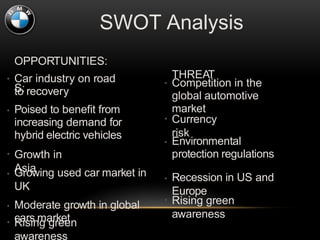
OPPORTUNITIES:
THREAT
S:
• Car industry on road
to recovery
• Poised to benefit from
increasing demand for
hybrid electric vehicles
• Growth in
Asia• Growing used car market in
UK
• Moderate growth in global
cars market• Rising green
awareness
SWOT Analysis
• Competition in the
global automotive
market
• Currency
risk
• Environmental
protection regulations
• Recession in US and
Europe
• Rising green
awareness
PORSCHE
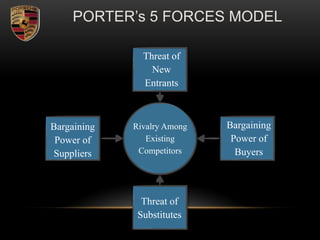
Rivalry Among
Existing
Competitors
Threat of
New
Entrants
Bargaining
Power of
Suppliers
Bargaining
Power of
Buyers
Threat of
Substitutes
PORTER’s 5 FORCES MODEL
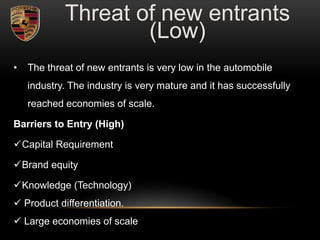
• The threat of new entrants is very low in the automobile
industry. The industry is very mature and it has successfully
reached economies of scale.
Barriers to Entry (High)
Capital Requirement
Brand equity
Knowledge (Technology)
 Product differentiation.
 Large economies of scale
Threat of new entrants
(Low)
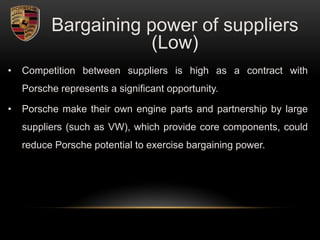
• Competition between suppliers is high as a contract with
Porsche represents a significant opportunity.
• Porsche make their own engine parts and partnership by large
suppliers (such as VW), which provide core components, could
reduce Porsche potential to exercise bargaining power.
Bargaining power of suppliers
(Low)
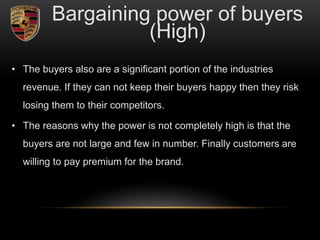
• The buyers also are a significant portion of the industries
revenue. If they can not keep their buyers happy then they risk
losing them to their competitors.
• The reasons why the power is not completely high is that the
buyers are not large and few in number. Finally customers are
willing to pay premium for the brand.
Bargaining power of buyers
(High)
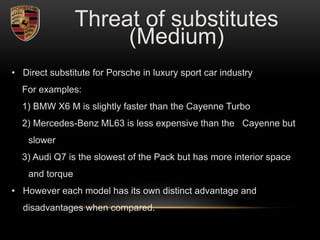
• Direct substitute for Porsche in luxury sport car industry
For examples:
1) BMW X6 M is slightly faster than the Cayenne Turbo
2) Mercedes-Benz ML63 is less expensive than the Cayenne but
slower
3) Audi Q7 is the slowest of the Pack but has more interior space
and torque
• However each model has its own distinct advantage and
disadvantages when compared.
Threat of substitutes
(Medium)
OPPORTUNITIES:
THREAT
S:
SWOT Analysis
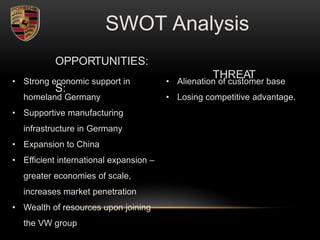
• Strong economic support in
homeland Germany
• Supportive manufacturing
infrastructure in Germany
• Expansion to China
• Efficient international expansion –
greater economies of scale,
increases market penetration
• Wealth of resources upon joining
the VW group
• Alienation of customer base
• Losing competitive advantage.
STRENGTH:
WEAKNESSE
S:
SWOT Analysis
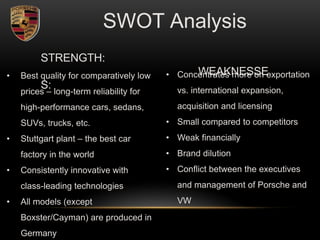
• Best quality for comparatively low
prices – long-term reliability for
high-performance cars, sedans,
SUVs, trucks, etc.
• Stuttgart plant – the best car
factory in the world
• Consistently innovative with
class-leading technologies
• All models (except
Boxster/Cayman) are produced in
Germany
• Concentrates more on exportation
vs. international expansion,
acquisition and licensing
• Small compared to competitors
• Weak financially
• Brand dilution
• Conflict between the executives
and management of Porsche and
VW
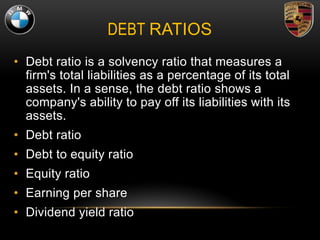
DEBT RATIOS
• Debt ratio is a solvency ratio that measures a
firm's total liabilities as a percentage of its total
assets. In a sense, the debt ratio shows a
company's ability to pay off its liabilities with its
assets.
• Debt ratio
• Debt to equity ratio
• Equity ratio
• Earning per share
• Dividend yield ratio
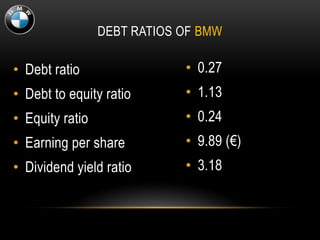
DEBT RATIOS OF BMW
• Debt ratio
• Debt to equity ratio
• Equity ratio
• Earning per share
• Dividend yield ratio
• 0.27
• 1.13
• 0.24
• 9.89 (€)
• 3.18
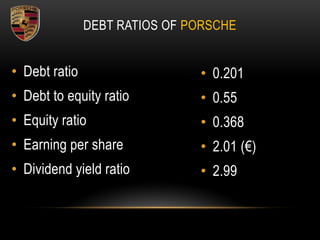
DEBT RATIOS OF PORSCHE
• Debt ratio
• Debt to equity ratio
• Equity ratio
• Earning per share
• Dividend yield ratio
• 0.201
• 0.55
• 0.368
• 2.01 (€)
• 2.99
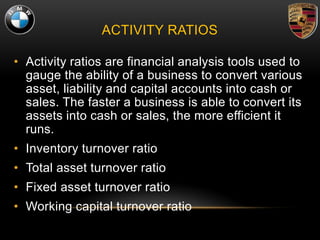
ACTIVITY RATIOS
• Activity ratios are financial analysis tools used to
gauge the ability of a business to convert various
asset, liability and capital accounts into cash or
sales. The faster a business is able to convert its
assets into cash or sales, the more efficient it
runs.
• Inventory turnover ratio
• Total asset turnover ratio
• Fixed asset turnover ratio
• Working capital turnover ratio
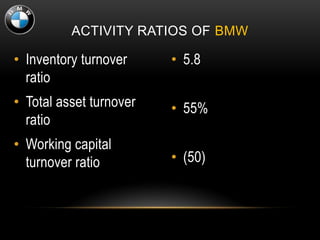
ACTIVITY RATIOS OF BMW
• Inventory turnover
ratio
• Total asset turnover
ratio
• Working capital
turnover ratio
• 5.8
• 55%
• (50)
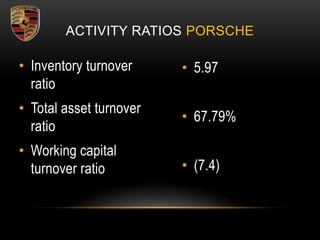
ACTIVITY RATIOS PORSCHE
• Inventory turnover
ratio
• Total asset turnover
ratio
• Working capital
turnover ratio
• 5.97
• 67.79%
• (7.4)
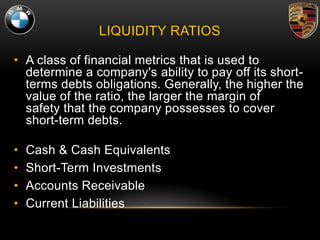
LIQUIDITY RATIOS
• A class of financial metrics that is used to
determine a company's ability to pay off its short-
terms debts obligations. Generally, the higher the
value of the ratio, the larger the margin of
safety that the company possesses to cover
short-term debts.
• Cash & Cash Equivalents
• Short-Term Investments
• Accounts Receivable
• Current Liabilities
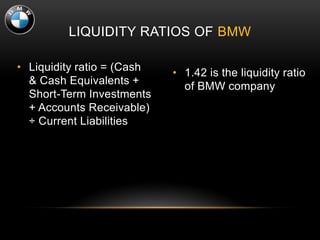
LIQUIDITY RATIOS OF BMW
• Liquidity ratio = (Cash
& Cash Equivalents +
Short-Term Investments
+ Accounts Receivable)
÷ Current Liabilities
• 1.42 is the liquidity ratio
of BMW company
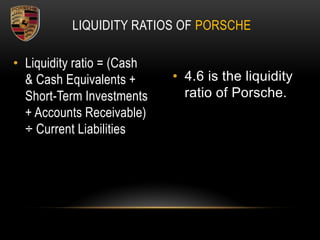
LIQUIDITY RATIOS OF PORSCHE
• Liquidity ratio = (Cash
& Cash Equivalents +
Short-Term Investments
+ Accounts Receivable)
÷ Current Liabilities
• 4.6 is the liquidity
ratio of Porsche.
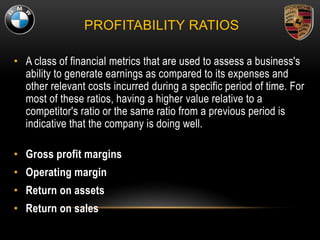
PROFITABILITY RATIOS
• A class of financial metrics that are used to assess a business's
ability to generate earnings as compared to its expenses and
other relevant costs incurred during a specific period of time. For
most of these ratios, having a higher value relative to a
competitor's ratio or the same ratio from a previous period is
indicative that the company is doing well.
• Gross profit margins
• Operating margin
• Return on assets
• Return on sales
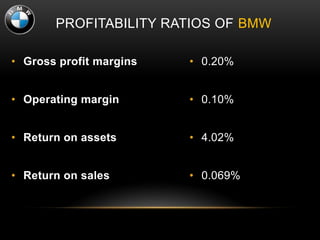
PROFITABILITY RATIOS OF BMW
• Gross profit margins
• Operating margin
• Return on assets
• Return on sales
• 0.20%
• 0.10%
• 4.02%
• 0.069%
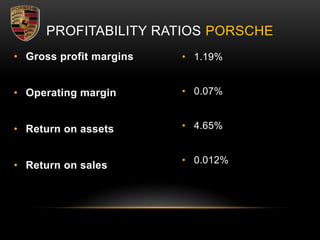
PROFITABILITY RATIOS PORSCHE
• Gross profit margins
• Operating margin
• Return on assets
• Return on sales
• 1.19%
• 0.07%
• 4.65%
• 0.012%
Bmw Vs Porsche

Bmw Vs Porsche

  • 2.
  • 3.
    Rivalry Among Existing Competitors Threat of New Entrants Bargaining Powerof Suppliers Bargaining Power of Buyers Threat of Substitutes PORTER'S 5 FORCES
  • 4.
    Rivalry among existingcompetitors: + some competitors of the same size + Low industry and market growth rates + Barriers to exit are high (production facilities) → High PORTERS 5 FORCES
  • 5.
    Threat of NewEntrants: + high initial investments and fixed costs + limited access to specialized suppliers + existing players have close customer relations (e.g. long- term service contracts) + customer loyalty → Low PORTERS 5 FORCES
  • 6.
    Bargaining Power ofBuyers: + Buy large volumes (e.g. company car for many large companies) + Switching to an alternative product is relatively simple and not related to high costs + Products are undifferentiated and can be replaced with subsitutes − Customer knows about the production cost of the product → Medium PORTERS 5 FORCES
  • 7.
    Bargaining Power ofSuppliers: + Supplier’s products are customized and valuably differentiated + high switching costs to alternative suppliers + JIT production − Market is dominated by many suppliers (sub suppliers) → High PORTERS 5 FORCES
  • 8.
    PORTERS 5 FORCES Threatof Substitute Products & Services: + close customer relationship + brand loyalty of customers is high − No penalties or low switching costs for customers − Current trends → Medium
  • 9.
    STRENGTH: WEAKNESSE S: Strong brand image • •Strong R&D capabilities (DM) • Strong product innovation• High employee productivity Motocycle as niche product • • US military service • High quality suppliers• Steady decrease in Co2 emissions • Strongest product: 3 Series SWOT Analysis • Poor performance of BMW in asian markets • Declining production and deliveries • Lack of scale compared to competitors • High wages • Too less strategic alliences
  • 10.
    OPPORTUNITIES: THREAT S: • Car industryon road to recovery • Poised to benefit from increasing demand for hybrid electric vehicles • Growth in Asia• Growing used car market in UK • Moderate growth in global cars market• Rising green awareness SWOT Analysis • Competition in the global automotive market • Currency risk • Environmental protection regulations • Recession in US and Europe • Rising green awareness
  • 11.
  • 12.
    Rivalry Among Existing Competitors Threat of New Entrants Bargaining Powerof Suppliers Bargaining Power of Buyers Threat of Substitutes PORTER’s 5 FORCES MODEL
  • 13.
    • The threatof new entrants is very low in the automobile industry. The industry is very mature and it has successfully reached economies of scale. Barriers to Entry (High) Capital Requirement Brand equity Knowledge (Technology)  Product differentiation.  Large economies of scale Threat of new entrants (Low)
  • 14.
    • Competition betweensuppliers is high as a contract with Porsche represents a significant opportunity. • Porsche make their own engine parts and partnership by large suppliers (such as VW), which provide core components, could reduce Porsche potential to exercise bargaining power. Bargaining power of suppliers (Low)
  • 15.
    • The buyersalso are a significant portion of the industries revenue. If they can not keep their buyers happy then they risk losing them to their competitors. • The reasons why the power is not completely high is that the buyers are not large and few in number. Finally customers are willing to pay premium for the brand. Bargaining power of buyers (High)
  • 16.
    • Direct substitutefor Porsche in luxury sport car industry For examples: 1) BMW X6 M is slightly faster than the Cayenne Turbo 2) Mercedes-Benz ML63 is less expensive than the Cayenne but slower 3) Audi Q7 is the slowest of the Pack but has more interior space and torque • However each model has its own distinct advantage and disadvantages when compared. Threat of substitutes (Medium)
  • 17.
    OPPORTUNITIES: THREAT S: SWOT Analysis • Strongeconomic support in homeland Germany • Supportive manufacturing infrastructure in Germany • Expansion to China • Efficient international expansion – greater economies of scale, increases market penetration • Wealth of resources upon joining the VW group • Alienation of customer base • Losing competitive advantage.
  • 18.
    STRENGTH: WEAKNESSE S: SWOT Analysis • Bestquality for comparatively low prices – long-term reliability for high-performance cars, sedans, SUVs, trucks, etc. • Stuttgart plant – the best car factory in the world • Consistently innovative with class-leading technologies • All models (except Boxster/Cayman) are produced in Germany • Concentrates more on exportation vs. international expansion, acquisition and licensing • Small compared to competitors • Weak financially • Brand dilution • Conflict between the executives and management of Porsche and VW
  • 19.
    DEBT RATIOS • Debtratio is a solvency ratio that measures a firm's total liabilities as a percentage of its total assets. In a sense, the debt ratio shows a company's ability to pay off its liabilities with its assets. • Debt ratio • Debt to equity ratio • Equity ratio • Earning per share • Dividend yield ratio
  • 20.
    DEBT RATIOS OFBMW • Debt ratio • Debt to equity ratio • Equity ratio • Earning per share • Dividend yield ratio • 0.27 • 1.13 • 0.24 • 9.89 (€) • 3.18
  • 21.
    DEBT RATIOS OFPORSCHE • Debt ratio • Debt to equity ratio • Equity ratio • Earning per share • Dividend yield ratio • 0.201 • 0.55 • 0.368 • 2.01 (€) • 2.99
  • 22.
    ACTIVITY RATIOS • Activityratios are financial analysis tools used to gauge the ability of a business to convert various asset, liability and capital accounts into cash or sales. The faster a business is able to convert its assets into cash or sales, the more efficient it runs. • Inventory turnover ratio • Total asset turnover ratio • Fixed asset turnover ratio • Working capital turnover ratio
  • 23.
    ACTIVITY RATIOS OFBMW • Inventory turnover ratio • Total asset turnover ratio • Working capital turnover ratio • 5.8 • 55% • (50)
  • 24.
    ACTIVITY RATIOS PORSCHE •Inventory turnover ratio • Total asset turnover ratio • Working capital turnover ratio • 5.97 • 67.79% • (7.4)
  • 25.
    LIQUIDITY RATIOS • Aclass of financial metrics that is used to determine a company's ability to pay off its short- terms debts obligations. Generally, the higher the value of the ratio, the larger the margin of safety that the company possesses to cover short-term debts. • Cash & Cash Equivalents • Short-Term Investments • Accounts Receivable • Current Liabilities
  • 26.
    LIQUIDITY RATIOS OFBMW • Liquidity ratio = (Cash & Cash Equivalents + Short-Term Investments + Accounts Receivable) ÷ Current Liabilities • 1.42 is the liquidity ratio of BMW company
  • 27.
    LIQUIDITY RATIOS OFPORSCHE • Liquidity ratio = (Cash & Cash Equivalents + Short-Term Investments + Accounts Receivable) ÷ Current Liabilities • 4.6 is the liquidity ratio of Porsche.
  • 28.
    PROFITABILITY RATIOS • Aclass of financial metrics that are used to assess a business's ability to generate earnings as compared to its expenses and other relevant costs incurred during a specific period of time. For most of these ratios, having a higher value relative to a competitor's ratio or the same ratio from a previous period is indicative that the company is doing well. • Gross profit margins • Operating margin • Return on assets • Return on sales
  • 29.
    PROFITABILITY RATIOS OFBMW • Gross profit margins • Operating margin • Return on assets • Return on sales • 0.20% • 0.10% • 4.02% • 0.069%
  • 30.
    PROFITABILITY RATIOS PORSCHE •Gross profit margins • Operating margin • Return on assets • Return on sales • 1.19% • 0.07% • 4.65% • 0.012%