PREPARE A TESTIMONY OF ORGANISATIONAL
IMPLEMENTATION EVALUATION
Department of Management Studies
Indian Institute of Technology Roorkee
B M N 6 0 5 – S T R AT E G I C M A N A G E M E N T
PRESENTED BY
GROUP - 12
ANKITA SHUKLA | ANOOP TS | BABY CHANDRA | BHAVYA SIHMAR | MANVI GOEL | MOHD. SUFIYAN | RAKESH G NAIR | SUCHI AERON
BCG MATRIX
Growth Share Matrix
3
BCG Matrix - Overview
• It is also known as growth–share matrix, product portfolio matrix, Boston Box, Boston matrix, Boston
Consulting Group analysis and portfolio diagram.
• It was created by Bruce D. Henderson for the Boston Consulting Group in 1970 to help corporations
to analyse their business units, that is, their product lines.
• This helps the company allocate resources and is used as an analytical tool in brand marketing,
product management, strategic management, and portfolio analysis.
• To use the chart, analysts plot a scatter graph to rank the business units (or products) on the basis of
their relative market shares and growth rates.
• Need to analyse TATA Motors’ relative market share and growth rate to draw the BCG Matrix.
Sources: Pearce, John A. (2000). Strategic management : formulation, implementation, and control. Robinson, Richard B. (Richard Braden)
BCG Matrix - Analysis
4
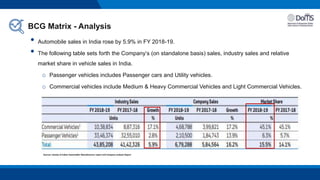
• Automobile sales in India rose by 5.9% in FY 2018-19.
• The following table sets forth the Company‘s (on standalone basis) sales, industry sales and relative
market share in vehicle sales in India.
o Passenger vehicles includes Passenger cars and Utility vehicles.
o Commercial vehicles include Medium & Heavy Commercial Vehicles and Light Commercial Vehicles.
Sources: Society of Indian Automobile Manufacturers report and Company analysis Report
5
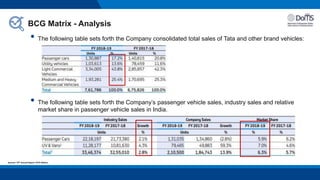
• The following table sets forth the Company consolidated total sales of Tata and other brand vehicles:
Sources: 74th Annual Report TATA Motors
• The following table sets forth the Company’s passenger vehicle sales, industry sales and relative
market share in passenger vehicle sales in India.
BCG Matrix - Analysis
6
Sources: 74th Annual Report TATA Motors
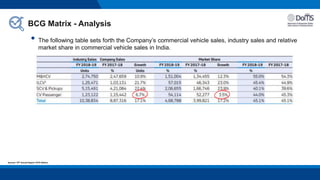
• The following table sets forth the Company’s commercial vehicle sales, industry sales and relative
market share in commercial vehicle sales in India.
BCG Matrix - Analysis
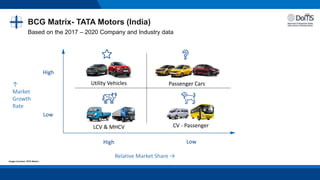
Based on the 2017 – 2020 Company and Industry data
7
Relative Market Share →
High
Low
Low
BCG Matrix- TATA Motors (India)
High
↑
Market
Growth
Rate
Utility Vehicles Passenger Cars
CV - Passenger
LCV & MHCV
Images Courtesy: TATA Motors
GAP ANALYSIS
9
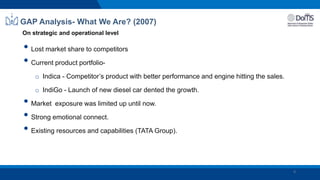
GAP Analysis- What We Are? (2007)
On strategic and operational level
• Lost market share to competitors
• Current product portfolio-
o Indica - Competitor’s product with better performance and engine hitting the sales.
o IndiGo - Launch of new diesel car dented the growth.
• Market exposure was limited up until now.
• Strong emotional connect.
• Existing resources and capabilities (TATA Group).
10
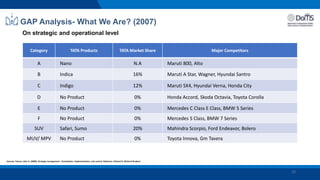
GAP Analysis- What We Are? (2007)
On strategic and operational level
Sources: Pearce, John A. (2000). Strategic management : formulation, implementation, and control. Robinson, Richard B. (Richard Braden)
Category TATA Products TATA Market Share Major Competitors
A Nano N.A Maruti 800, Alto
B Indica 16% Maruti A Star, Wagner, Hyundai Santro
C Indigo 12% Maruti SX4, Hyundai Verna, Honda City
D No Product 0% Honda Accord, Skoda Octavia, Toyota Corolla
E No Product 0% Mercedes C Class E Class, BMW 5 Series
F No Product 0% Mercedes S Class, BMW 7 Series
SUV Safari, Sumo 20% Mahindra Scorpio, Ford Endeavor, Bolero
MUV/ MPV No Product 0% Toyota Innova, Gm Tavera
11
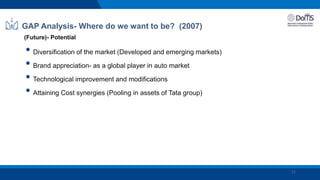
GAP Analysis- Where do we want to be? (2007)
(Future)- Potential
• Diversification of the market (Developed and emerging markets)
• Brand appreciation- as a global player in auto market
• Technological improvement and modifications
• Attaining Cost synergies (Pooling in assets of Tata group)
12
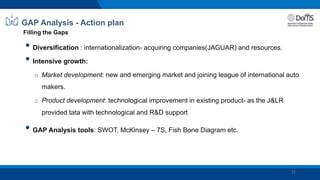
GAP Analysis - Action plan
Filling the Gaps
• Diversification : internationalization- acquiring companies(JAGUAR) and resources.
• Intensive growth:
o Market development: new and emerging market and joining league of international auto
makers.
o Product development: technological improvement in existing product- as the J&LR
provided tata with technological and R&D support
• GAP Analysis tools: SWOT, McKinsey – 7S, Fish Bone Diagram etc.
SWOT ANALYSIS
Strength, Weakness, Opportunity and Threat
14
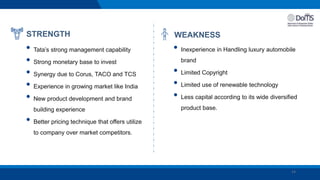
STRENGTH
• Tata’s strong management capability
• Strong monetary base to invest
• Synergy due to Corus, TACO and TCS
• Experience in growing market like India
• New product development and brand
building experience
• Better pricing technique that offers utilize
to company over market competitors.
WEAKNESS
• Inexperience in Handling luxury automobile
brand
• Limited Copyright
• Limited use of renewable technology
• Less capital according to its wide diversified
product base.
15
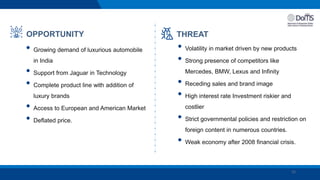
OPPORTUNITY
• Growing demand of luxurious automobile
in India
• Support from Jaguar in Technology
• Complete product line with addition of
luxury brands
• Access to European and American Market
• Deflated price.
THREAT
• Volatility in market driven by new products
• Strong presence of competitors like
Mercedes, BMW, Lexus and Infinity
• Receding sales and brand image
• High interest rate Investment riskier and
costlier
• Strict governmental policies and restriction on
foreign content in numerous countries.
• Weak economy after 2008 financial crisis.
PESTEL ANALYSIS
Political, Economic, Social, Technological, Environmental and Legal
17
POLITICAL
• Govt. allowed automatic approval for foreign equity investment up to 100% in the automobile sector and
does not lay down any minimum condition. This was favourable for Tata Motors.
• Political confrontation with opposition party in West Bengal, Where plant was to set up.
• The political desire to maintain and develop UK based employment opportunities and to protect UK trusted
brands gives JLR significant leverage. This leverage is even stronger when previous Government support
of non UK brand competitors such as Toyota was not as abundant as JLRs.
Sources: Pearce, John A. (2000). Strategic management : formulation, implementation, and control. Robinson, Richard B. (Richard Braden)
ECONOMIC
• Britain’s ever present Brexit bias (which came true on 31st January 2020) on JLR.
• Ford was doing their turnaround. They had to sell JLR as it was performing weak.
• The issues that could trouble Tata Motors were economic slowdown in European and American markets,
funding risks, currency risks etc.
18
SOCIAL
• As standard of living continuously improved, it led to increase in purchase of automobiles, and especially
there is increase in demand of upper segment cars.
• Effective marketing and an established UK production history have helped the brand to become
incorporated within both the UK and globally as a reflection of quality, luxury and reliability.
• This helped to maintain a pricing premium that also extends to affiliated products (such as branded
clothing) and ensured that higher prices are also sustained for products in the ‘used car’ market.
• Due to easy policies of car finance, 85% of cars are financed in India.
Sources: Pearce, John A. (2000). Strategic management : formulation, implementation, and control. Robinson, Richard B. (Richard Braden)
19
TECHNOLOGY
• Invested in Research and Development to enhance technological capabilities.
• Latest engine and four-wheel drive technology, manufacturing expertise, high quality design capabilities,
extremely loyal global dealership network and prestigious clientele.
• Setting up manufacturing assembly units in India and China for low-cost production.
• Secured patent rights across a large range of engineering solutions (Lightweight aluminium technologies)
Sources: Pearce, John A. (2000). Strategic management : formulation, implementation, and control. Robinson, Richard B. (Richard Braden)
ENVIRONMENTAL
• The company is seeking to become carbon neutral by 2020.
• Promotion of hybrid engines.
• Best in production of Eco-friendly, CO2 Emission rate and fuel-efficient vehicles compared to is
competitors. (BMW X5 and Audi Q7 have 47.6mp and 45.2 mpg and Range Rover TDV6 model’s fuel economy is 44.1mpg).
• Expanding the availability of recyclable materials.
20
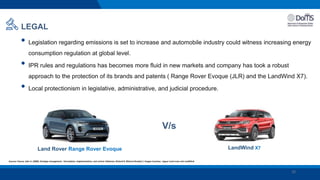
LEGAL
• Legislation regarding emissions is set to increase and automobile industry could witness increasing energy
consumption regulation at global level.
• IPR rules and regulations has becomes more fluid in new markets and company has took a robust
approach to the protection of its brands and patents ( Range Rover Evoque (JLR) and the LandWind X7).
• Local protectionism in legislative, administrative, and judicial procedure.
Sources: Pearce, John A. (2000). Strategic management : formulation, implementation, and control. Robinson, Richard B. (Richard Braden) | Images Courtesy : Jaguar Land rover and LandWind
V/s
Land Rover Range Rover Evoque LandWind X7
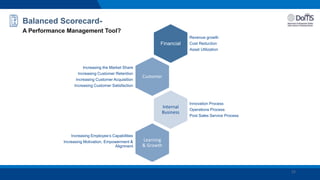
Balanced Scorecard (BSC)
Financial
Revenue growth
Cost Reduction
Asset Utilization
Customer
Increasing the Market Share
Increasing Customer Retention
Increasing Customer Acquisition
Increasing Customer Satisfaction
Internal
Business
Innovation Process
Operations Process
Post Sales Service Process
Learning
& Growth
Increasing Employee’s Capabilities
Increasing Motivation, Empowerment &
Alignment
Balanced Scorecard-
A Performance Management Tool?
22
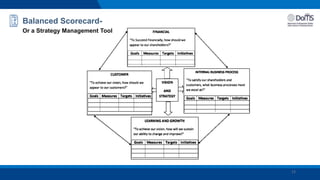
Balanced Scorecard-
Or a Strategy Management Tool
23
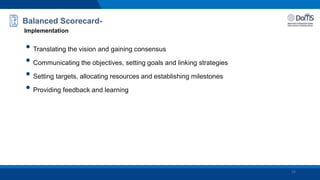
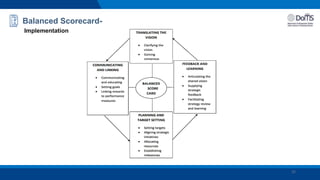
Balanced Scorecard-
Implementation
• Translating the vision and gaining consensus
• Communicating the objectives, setting goals and linking strategies
• Setting targets, allocating resources and establishing milestones
• Providing feedback and learning
24
Balanced Scorecard-
Implementation
25
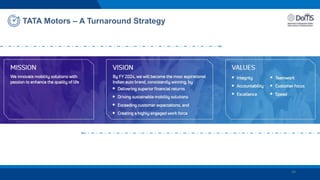
TATA Motors – A Turnaround Strategy
26
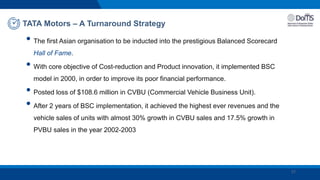
• The first Asian organisation to be inducted into the prestigious Balanced Scorecard
Hall of Fame.
• With core objective of Cost-reduction and Product innovation, it implemented BSC
model in 2000, in order to improve its poor financial performance.
• Posted loss of $108.6 million in CVBU (Commercial Vehicle Business Unit).
• After 2 years of BSC implementation, it achieved the highest ever revenues and the
vehicle sales of units with almost 30% growth in CVBU sales and 17.5% growth in
PVBU sales in the year 2002-2003
TATA Motors – A Turnaround Strategy
27
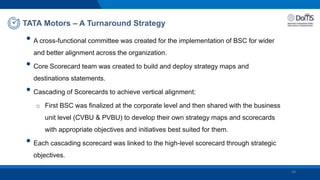
• A cross-functional committee was created for the implementation of BSC for wider
and better alignment across the organization.
• Core Scorecard team was created to build and deploy strategy maps and
destinations statements.
• Cascading of Scorecards to achieve vertical alignment:
o First BSC was finalized at the corporate level and then shared with the business
unit level (CVBU & PVBU) to develop their own strategy maps and scorecards
with appropriate objectives and initiatives best suited for them.
• Each cascading scorecard was linked to the high-level scorecard through strategic
objectives.
TATA Motors – A Turnaround Strategy
28
• This resulted in better alignment of various levels of the organizations to the
company’s overall direction and strategy.
• The lower-level managers were now allowed to participate in determining how to
achieve results rather than just following orders from the top. It developed a sense of
ownership and accountability among them.
• Example, CVBU’s internal process objective “Enhance product and service quality
levels” gets translated to Jamshedpur Manufacturing plants’ strategy map in two
process objectives, “Quality and consistency” and “Ensuring new products adhere to
cost, time and quality targets”.
TATA Motors – A Turnaround Strategy
29
• CVBU also used various surveys and feedback systems to assess strategic
understanding of its employees.
• Based on the objectives, targets and information from surveys, feedback and
reviews, Major Performing Areas (MPAs) for each manager and employee were
defined which were directly linked with the department’s scorecard. Further
compensation was tied to performance on MPAs.
TATA Motors – A Turnaround Strategy
30
THANK YOU

Organisational Evaluation

  • 1.
    PREPARE A TESTIMONYOF ORGANISATIONAL IMPLEMENTATION EVALUATION Department of Management Studies Indian Institute of Technology Roorkee B M N 6 0 5 – S T R AT E G I C M A N A G E M E N T PRESENTED BY GROUP - 12 ANKITA SHUKLA | ANOOP TS | BABY CHANDRA | BHAVYA SIHMAR | MANVI GOEL | MOHD. SUFIYAN | RAKESH G NAIR | SUCHI AERON
  • 2.
  • 3.
    3 BCG Matrix -Overview • It is also known as growth–share matrix, product portfolio matrix, Boston Box, Boston matrix, Boston Consulting Group analysis and portfolio diagram. • It was created by Bruce D. Henderson for the Boston Consulting Group in 1970 to help corporations to analyse their business units, that is, their product lines. • This helps the company allocate resources and is used as an analytical tool in brand marketing, product management, strategic management, and portfolio analysis. • To use the chart, analysts plot a scatter graph to rank the business units (or products) on the basis of their relative market shares and growth rates. • Need to analyse TATA Motors’ relative market share and growth rate to draw the BCG Matrix. Sources: Pearce, John A. (2000). Strategic management : formulation, implementation, and control. Robinson, Richard B. (Richard Braden)
  • 4.
    BCG Matrix -Analysis 4 • Automobile sales in India rose by 5.9% in FY 2018-19. • The following table sets forth the Company‘s (on standalone basis) sales, industry sales and relative market share in vehicle sales in India. o Passenger vehicles includes Passenger cars and Utility vehicles. o Commercial vehicles include Medium & Heavy Commercial Vehicles and Light Commercial Vehicles. Sources: Society of Indian Automobile Manufacturers report and Company analysis Report
  • 5.
    5 • The followingtable sets forth the Company consolidated total sales of Tata and other brand vehicles: Sources: 74th Annual Report TATA Motors • The following table sets forth the Company’s passenger vehicle sales, industry sales and relative market share in passenger vehicle sales in India. BCG Matrix - Analysis
  • 6.
    6 Sources: 74th AnnualReport TATA Motors • The following table sets forth the Company’s commercial vehicle sales, industry sales and relative market share in commercial vehicle sales in India. BCG Matrix - Analysis
  • 7.
    Based on the2017 – 2020 Company and Industry data 7 Relative Market Share → High Low Low BCG Matrix- TATA Motors (India) High ↑ Market Growth Rate Utility Vehicles Passenger Cars CV - Passenger LCV & MHCV Images Courtesy: TATA Motors
  • 8.
  • 9.
    9 GAP Analysis- WhatWe Are? (2007) On strategic and operational level • Lost market share to competitors • Current product portfolio- o Indica - Competitor’s product with better performance and engine hitting the sales. o IndiGo - Launch of new diesel car dented the growth. • Market exposure was limited up until now. • Strong emotional connect. • Existing resources and capabilities (TATA Group).
  • 10.
    10 GAP Analysis- WhatWe Are? (2007) On strategic and operational level Sources: Pearce, John A. (2000). Strategic management : formulation, implementation, and control. Robinson, Richard B. (Richard Braden) Category TATA Products TATA Market Share Major Competitors A Nano N.A Maruti 800, Alto B Indica 16% Maruti A Star, Wagner, Hyundai Santro C Indigo 12% Maruti SX4, Hyundai Verna, Honda City D No Product 0% Honda Accord, Skoda Octavia, Toyota Corolla E No Product 0% Mercedes C Class E Class, BMW 5 Series F No Product 0% Mercedes S Class, BMW 7 Series SUV Safari, Sumo 20% Mahindra Scorpio, Ford Endeavor, Bolero MUV/ MPV No Product 0% Toyota Innova, Gm Tavera
  • 11.
    11 GAP Analysis- Wheredo we want to be? (2007) (Future)- Potential • Diversification of the market (Developed and emerging markets) • Brand appreciation- as a global player in auto market • Technological improvement and modifications • Attaining Cost synergies (Pooling in assets of Tata group)
  • 12.
    12 GAP Analysis -Action plan Filling the Gaps • Diversification : internationalization- acquiring companies(JAGUAR) and resources. • Intensive growth: o Market development: new and emerging market and joining league of international auto makers. o Product development: technological improvement in existing product- as the J&LR provided tata with technological and R&D support • GAP Analysis tools: SWOT, McKinsey – 7S, Fish Bone Diagram etc.
  • 13.
    SWOT ANALYSIS Strength, Weakness,Opportunity and Threat
  • 14.
    14 STRENGTH • Tata’s strongmanagement capability • Strong monetary base to invest • Synergy due to Corus, TACO and TCS • Experience in growing market like India • New product development and brand building experience • Better pricing technique that offers utilize to company over market competitors. WEAKNESS • Inexperience in Handling luxury automobile brand • Limited Copyright • Limited use of renewable technology • Less capital according to its wide diversified product base.
  • 15.
    15 OPPORTUNITY • Growing demandof luxurious automobile in India • Support from Jaguar in Technology • Complete product line with addition of luxury brands • Access to European and American Market • Deflated price. THREAT • Volatility in market driven by new products • Strong presence of competitors like Mercedes, BMW, Lexus and Infinity • Receding sales and brand image • High interest rate Investment riskier and costlier • Strict governmental policies and restriction on foreign content in numerous countries. • Weak economy after 2008 financial crisis.
  • 16.
    PESTEL ANALYSIS Political, Economic,Social, Technological, Environmental and Legal
  • 17.
    17 POLITICAL • Govt. allowedautomatic approval for foreign equity investment up to 100% in the automobile sector and does not lay down any minimum condition. This was favourable for Tata Motors. • Political confrontation with opposition party in West Bengal, Where plant was to set up. • The political desire to maintain and develop UK based employment opportunities and to protect UK trusted brands gives JLR significant leverage. This leverage is even stronger when previous Government support of non UK brand competitors such as Toyota was not as abundant as JLRs. Sources: Pearce, John A. (2000). Strategic management : formulation, implementation, and control. Robinson, Richard B. (Richard Braden) ECONOMIC • Britain’s ever present Brexit bias (which came true on 31st January 2020) on JLR. • Ford was doing their turnaround. They had to sell JLR as it was performing weak. • The issues that could trouble Tata Motors were economic slowdown in European and American markets, funding risks, currency risks etc.
  • 18.
    18 SOCIAL • As standardof living continuously improved, it led to increase in purchase of automobiles, and especially there is increase in demand of upper segment cars. • Effective marketing and an established UK production history have helped the brand to become incorporated within both the UK and globally as a reflection of quality, luxury and reliability. • This helped to maintain a pricing premium that also extends to affiliated products (such as branded clothing) and ensured that higher prices are also sustained for products in the ‘used car’ market. • Due to easy policies of car finance, 85% of cars are financed in India. Sources: Pearce, John A. (2000). Strategic management : formulation, implementation, and control. Robinson, Richard B. (Richard Braden)
  • 19.
    19 TECHNOLOGY • Invested inResearch and Development to enhance technological capabilities. • Latest engine and four-wheel drive technology, manufacturing expertise, high quality design capabilities, extremely loyal global dealership network and prestigious clientele. • Setting up manufacturing assembly units in India and China for low-cost production. • Secured patent rights across a large range of engineering solutions (Lightweight aluminium technologies) Sources: Pearce, John A. (2000). Strategic management : formulation, implementation, and control. Robinson, Richard B. (Richard Braden) ENVIRONMENTAL • The company is seeking to become carbon neutral by 2020. • Promotion of hybrid engines. • Best in production of Eco-friendly, CO2 Emission rate and fuel-efficient vehicles compared to is competitors. (BMW X5 and Audi Q7 have 47.6mp and 45.2 mpg and Range Rover TDV6 model’s fuel economy is 44.1mpg). • Expanding the availability of recyclable materials.
  • 20.
    20 LEGAL • Legislation regardingemissions is set to increase and automobile industry could witness increasing energy consumption regulation at global level. • IPR rules and regulations has becomes more fluid in new markets and company has took a robust approach to the protection of its brands and patents ( Range Rover Evoque (JLR) and the LandWind X7). • Local protectionism in legislative, administrative, and judicial procedure. Sources: Pearce, John A. (2000). Strategic management : formulation, implementation, and control. Robinson, Richard B. (Richard Braden) | Images Courtesy : Jaguar Land rover and LandWind V/s Land Rover Range Rover Evoque LandWind X7
  • 21.
  • 22.
    Financial Revenue growth Cost Reduction AssetUtilization Customer Increasing the Market Share Increasing Customer Retention Increasing Customer Acquisition Increasing Customer Satisfaction Internal Business Innovation Process Operations Process Post Sales Service Process Learning & Growth Increasing Employee’s Capabilities Increasing Motivation, Empowerment & Alignment Balanced Scorecard- A Performance Management Tool? 22
  • 23.
    Balanced Scorecard- Or aStrategy Management Tool 23
  • 24.
    Balanced Scorecard- Implementation • Translatingthe vision and gaining consensus • Communicating the objectives, setting goals and linking strategies • Setting targets, allocating resources and establishing milestones • Providing feedback and learning 24
  • 25.
  • 26.
    TATA Motors –A Turnaround Strategy 26
  • 27.
    • The firstAsian organisation to be inducted into the prestigious Balanced Scorecard Hall of Fame. • With core objective of Cost-reduction and Product innovation, it implemented BSC model in 2000, in order to improve its poor financial performance. • Posted loss of $108.6 million in CVBU (Commercial Vehicle Business Unit). • After 2 years of BSC implementation, it achieved the highest ever revenues and the vehicle sales of units with almost 30% growth in CVBU sales and 17.5% growth in PVBU sales in the year 2002-2003 TATA Motors – A Turnaround Strategy 27
  • 28.
    • A cross-functionalcommittee was created for the implementation of BSC for wider and better alignment across the organization. • Core Scorecard team was created to build and deploy strategy maps and destinations statements. • Cascading of Scorecards to achieve vertical alignment: o First BSC was finalized at the corporate level and then shared with the business unit level (CVBU & PVBU) to develop their own strategy maps and scorecards with appropriate objectives and initiatives best suited for them. • Each cascading scorecard was linked to the high-level scorecard through strategic objectives. TATA Motors – A Turnaround Strategy 28
  • 29.
    • This resultedin better alignment of various levels of the organizations to the company’s overall direction and strategy. • The lower-level managers were now allowed to participate in determining how to achieve results rather than just following orders from the top. It developed a sense of ownership and accountability among them. • Example, CVBU’s internal process objective “Enhance product and service quality levels” gets translated to Jamshedpur Manufacturing plants’ strategy map in two process objectives, “Quality and consistency” and “Ensuring new products adhere to cost, time and quality targets”. TATA Motors – A Turnaround Strategy 29
  • 30.
    • CVBU alsoused various surveys and feedback systems to assess strategic understanding of its employees. • Based on the objectives, targets and information from surveys, feedback and reviews, Major Performing Areas (MPAs) for each manager and employee were defined which were directly linked with the department’s scorecard. Further compensation was tied to performance on MPAs. TATA Motors – A Turnaround Strategy 30
  • 31.