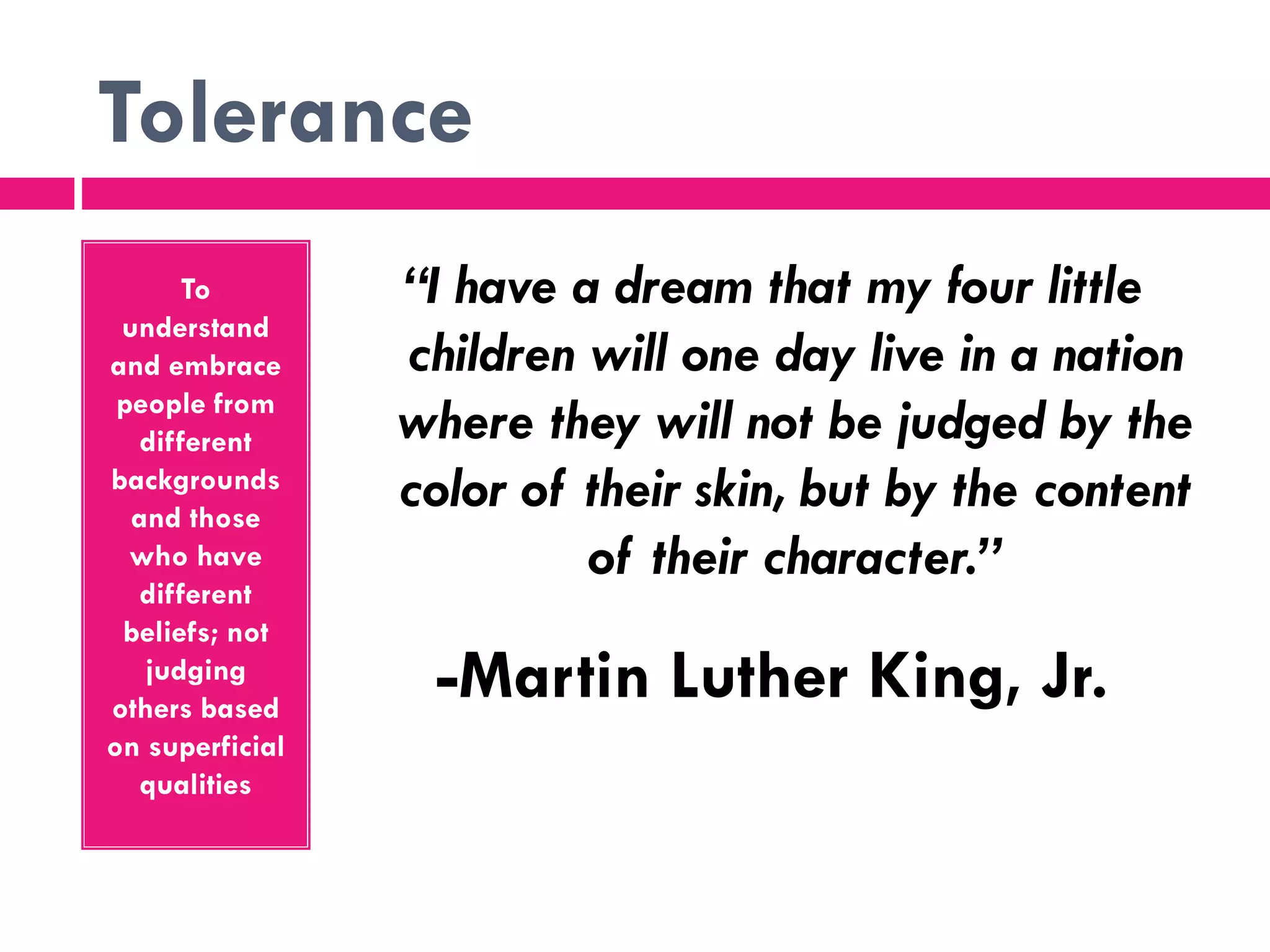
Tolerance
To
understand
and embrace
people from
different
backgrounds
and those
who have
different
beliefs; not
judging
others based
on superficial
qualities
“I have a dream that my four little
children will one day live in a nation
where they will not be judged by the
color of their skin, but by the content
of their character.”
-Martin Luther King, Jr.
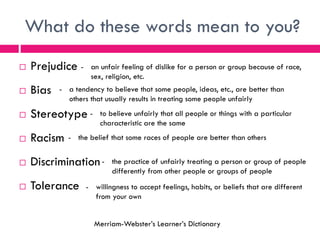
What do these words mean to you?
 Prejudice
 Bias
 Stereotype
 Racism
 Discrimination
 Tolerance
- an unfair feeling of dislike for a person or group because of race,
sex, religion, etc.
- a tendency to believe that some people, ideas, etc., are better than
others that usually results in treating some people unfairly
- to believe unfairly that all people or things with a particular
characteristic are the same
- the belief that some races of people are better than others
- the practice of unfairly treating a person or group of people
differently from other people or groups of people
- willingness to accept feelings, habits, or beliefs that are different
from your own
Merriam-Webster’s Learner’s Dictionary
Bullying
 Tolerant? Or prejudiced?
 Why do people bully?
Bullying: The Epidemic
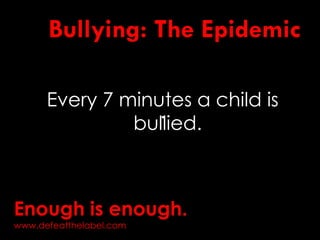
Every 7 minutes a child is
bullied.
.
Enough is enough.
www.defeatthelabel.com
Bullying: The Epidemic
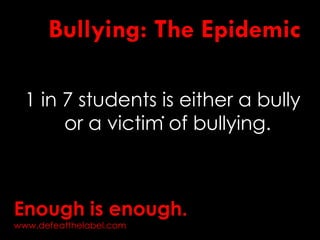
1 in 7 students is either a bully
or a victim of bullying.
.
Enough is enough.
www.defeatthelabel.com
Bullying: The Epidemic
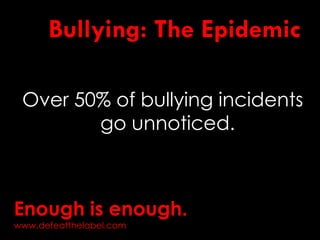
Over 50% of bullying incidents
go unnoticed.
Enough is enough.
www.defeatthelabel.com
Bullying: The Epidemic
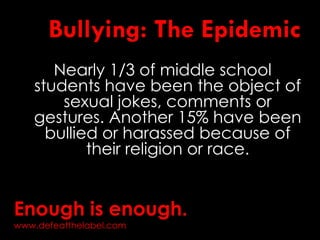
Nearly 1/3 of middle school
students have been the object of
sexual jokes, comments or
gestures. Another 15% have been
bullied or harassed because of
their religion or race.
Enough is enough.
www.defeatthelabel.com
Defeat the Label
Defeat the Label
 Why were all the students wearing white t-shirts?
 What caused them to see themselves differently?
We’re all just plain white tees!
 Select any two children from the group and ask the
others, “What is different about these two
students?” Then ask “What is the same?”
 There will almost always be more same references,
especially if the teacher’s class and school are
mentioned, i.e. they’re both students at Baker
Middle School.
Take Action!
Take the
ANTI-BULLYING
PLEDGE!
“The Sneetches.”
In Dr. Suess story, “The Sneetches”, Sneetches come in
two varieties; some have stars on their bellies and
some do not. The star-bellied Sneetches think that they
are superior to the plain-bellied Sneetches.
As you watch video…
 Look for ways the Sneetches show bias and
prejudice towards each other.
 What ultimately causes the Sneetches to be more
tolerant?
After Viewing
Class Discussion:
 Were the star-bellies right to treat the plain-bellies
the way they did?
 What do you think the Sneetches learned from their
day on the beach with Sylvester McMonkey
McBean?
 Was Sylvester right when he said, “You can’t teach
a Sneetch?”
Wear pink tomorrow
for TOLERANCE!

BMS Character Education - Tolerance

  • 1.
    Tolerance To understand and embrace people from different backgrounds andthose who have different beliefs; not judging others based on superficial qualities “I have a dream that my four little children will one day live in a nation where they will not be judged by the color of their skin, but by the content of their character.” -Martin Luther King, Jr.
  • 2.
    What do thesewords mean to you?  Prejudice  Bias  Stereotype  Racism  Discrimination  Tolerance - an unfair feeling of dislike for a person or group because of race, sex, religion, etc. - a tendency to believe that some people, ideas, etc., are better than others that usually results in treating some people unfairly - to believe unfairly that all people or things with a particular characteristic are the same - the belief that some races of people are better than others - the practice of unfairly treating a person or group of people differently from other people or groups of people - willingness to accept feelings, habits, or beliefs that are different from your own Merriam-Webster’s Learner’s Dictionary
  • 3.
    Bullying  Tolerant? Orprejudiced?  Why do people bully?
  • 4.
    Bullying: The Epidemic Every7 minutes a child is bullied. . Enough is enough. www.defeatthelabel.com
  • 5.
    Bullying: The Epidemic 1in 7 students is either a bully or a victim of bullying. . Enough is enough. www.defeatthelabel.com
  • 6.
    Bullying: The Epidemic Over50% of bullying incidents go unnoticed. Enough is enough. www.defeatthelabel.com
  • 7.
    Bullying: The Epidemic Nearly1/3 of middle school students have been the object of sexual jokes, comments or gestures. Another 15% have been bullied or harassed because of their religion or race. Enough is enough. www.defeatthelabel.com
  • 8.
  • 9.
    Defeat the Label Why were all the students wearing white t-shirts?  What caused them to see themselves differently?
  • 10.
    We’re all justplain white tees!  Select any two children from the group and ask the others, “What is different about these two students?” Then ask “What is the same?”  There will almost always be more same references, especially if the teacher’s class and school are mentioned, i.e. they’re both students at Baker Middle School.
  • 11.
  • 12.
    “The Sneetches.” In Dr.Suess story, “The Sneetches”, Sneetches come in two varieties; some have stars on their bellies and some do not. The star-bellied Sneetches think that they are superior to the plain-bellied Sneetches. As you watch video…  Look for ways the Sneetches show bias and prejudice towards each other.  What ultimately causes the Sneetches to be more tolerant?
  • 13.
    After Viewing Class Discussion: Were the star-bellies right to treat the plain-bellies the way they did?  What do you think the Sneetches learned from their day on the beach with Sylvester McMonkey McBean?  Was Sylvester right when he said, “You can’t teach a Sneetch?”
  • 14.